

 Free Consultation
 PCI-DSS Compliant
 GDPR Ready
 ISO 27001
 NDA Protected
 AI Services
 AI App Development
 Generative AI Development
 AI Chatbot Development
 AI Integration Services
 AI Consulting Services
 AI For Fintech
 AI Financial Assistant Solution
 AI Insurance Agent Development
 Tech Stack
 OpenAI / GPT-4
 Claude / Anthropic
 Gemini / Google AI
 Llama / Open Source
 LangChain / LlamaIndex
 Pinecone / Pgvector
 AWS / Azure AI


 Fintech Solution
 Core Fintech
 App Development
 Neobank Solutions
 eWallet Solutions
 Lending Software
 Banking Solutions
 BNPL Solutions
 BNPL Solutions
 Insurance App
 Wealth Management
 Crypto & DeFi
 Blockchain Development
  Payroll Software
 DeFi Solutions
 Crypto Wallet
 Crypto On/Off Ramp
 Crypto Exchange
 Trading Platform
 Payments
 Compliance
 Regulations & Compliance
 Fraud Detection
 Lending Ecosystem
 P2P Lending Platform
 Mortgage Software
 Engagement
 Fintech Outsourcing

 Mobile Development
 Mobile App Dev
 iOS App Development
 Android App Development
 React Native
 Flutter Development
 Web Solution
 Node.js Development
 React.js Development
 Angular Development
 App Services
 UI/UX Design
 App Maintenance
 By Stage
 MVP Development
 Industry Solutions
 Healthcare App Dev
 Education App Dev
 Travel App Dev
 Real Estate App Dev
 Logistics Software
 Social Media App

 Hire Mobile Developers
 Hire iPhone Developers
 Hire Android Developers
 Hire React Native Devs
 Hire Flutter Developers
 Hire Web Developers
 Hire Node.js Developers
 Hire Angular Developers
 Hire PHP Developers
 Hire Laravel Developers
 How It Works
 Pre-Vetted Developers
 Ready In 48 Hours
 NDA From Day One
 Replace Guarantee
 Company
 About Us
 Our Work Process
 Portfolio
 Case Studies
 Blog / Insights
 Careers
 Contact Us
 Awards
 Recognition


 Offices



TL;DR
- eWallet security uses tokenization, encryption, biometric authentication, and fraud monitoring to protect a digital wallet’s transactions and stored data from theft or compromise.
- Global cybercrime damages are predicted to reach $10.5 trillion in 2025, up from $3 trillion in 2015. Cybersecurity Ventures now anticipates this will reach $12.2 trillion by 2031. (Source: Cybersecurity Ventures.)
- Phishing is the most common breach vector, resulting in 16% of incidents (IBM 2025).
- The 10 most common eWallet threats include social engineering, phishing, API failures, malware, MITM attacks, weak authentication, account takeover, unpatched vulnerabilities, QR code scams, and third-party risk.
- Nimble AppGenie builds PCI-DSS-compliant, ISO 27001-certified wallet security into every eWallet project from day one. See our work with SatPay and Pay By Check below.
E-wallet applications have become a common part of our daily routine. Used by a considerable portion of the global population, eWallet applications handle trillions of dollars in transactions every year.
While they are widely accepted for their convenience and ease of use, this raises the question of whether e-wallets are safe. eWallet security is a major concern, especially for service providers, and accurate data is more important than repeating alarming statistics.
Below, Nimble AppGenie covers everything you need to know about eWallet security: an audit process, verified threat data, best practices, and must-have features.
The Ever-Growing Threat of Cyber Fraud: A Global Security Crisis
Fintech statistics uncover an ever-expanding market, with trillions in market value and billions of users globally.
But they also show the growing threat of cyber fraud:
- Global cybercrime damages are predicted to reach $10.5 trillion in 2025, up from $3 trillion in 2015. Cybersecurity Ventures now anticipates this will reach $12.2 trillion by 2031. (Source: Cybersecurity Ventures.)
- Phishing is the most common initial attack vector at 16% of breaches, averaging $4.8 million in cost per incident, not even the 80%+ figure usually repeated without a source. (Source: IBM Cost of a Data Breach Report 2025.)
- The Verizon 2025 Data Breach Investigations Report analyzed 22,000+ incidents across 139 countries and found ransomware in 44% of confirmed breaches.
- The global average cost of data breaches rose 12% to a record $4.99 million in 2026, driven by higher escalation, detection, and lost-business costs. Organizations working with AI and automation extensively for security saved an average of $1.93 million compared with those not using it. (Source: IBM, 2026.)
- The FBI’s Internet Crime Complaint Center logged 1,008,597 complaints in 2025, with documented losses exceeding $20.88 billion, a 26% increase from 2024. (Source: FBI IC3, 2025.)
The losses from these cyberattacks are huge, but they are not the only reason why digital wallet security matters; here are more below.
Why is Digital Wallet Security Important?
eWallet security is not just a compliance checkbox; it is the foundation of customer trust and sustainable revenue in fintech. Nimble AppGenie builds PCI-DSS and ISO 27001 security controls into every eWallet project from day one, precisely because retrofitting security after launch costs 3–10× more than getting it right upfront.
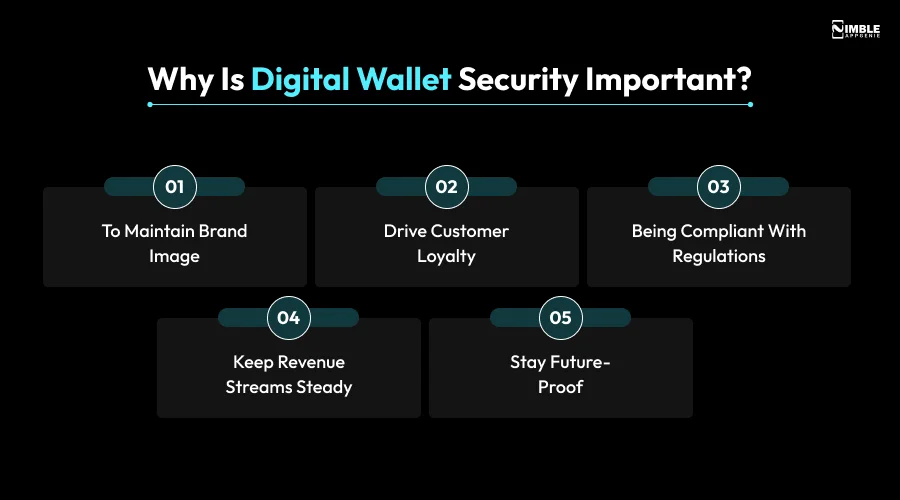
1. To Maintain Brand Image
If a company wants to market an eWallet app and build a sustainable brand image, eWallet app security is important. Customers don’t want to get associated with companies losing customers’ money to cyber threats and fraud.
2. Drive Customer Loyalty
When users know their high-value information and money are safe, they can use the app worry-free. Ask yourself: have you ever worried about fraud when using apps like PayPal? Exactly.
3. Being Compliant With Regulations
Fintech requires an endless number of regulations, and most share one theme in common: delivering security to end users. If an eWallet app wants to compete in the market, it should meet user and data privacy standards.
4. Keep Revenue Streams Steady
eWallet monetization strategies can generate millions if done right. But a secure app attracts more investors and customers while deflecting fraud attempts that can take millions at a time.
5. Stay Future-Proof
If you have been exploring fintech app development, you have likely heard the word “future-proof” a lot. Attaining that level starts with securing your eWallet.
What Are the Common eWallet Security Threats & Weak Points?
One should know the threats to create a secure eWallet application. Below are the most common ones:
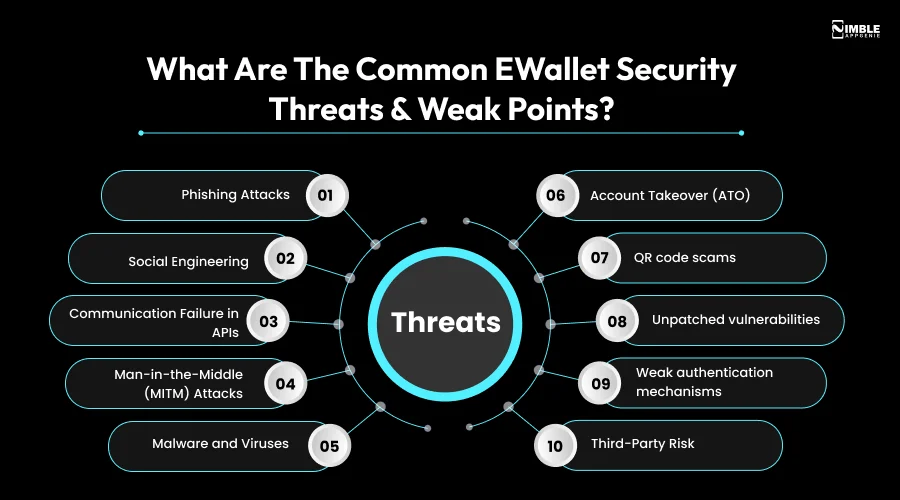
Threat 1: Phishing Attacks
One of the most common types of security threats is phishing attacks.
For those who don’t know about phishing, the attackers try to obtain sensitive information by pretending to be a trustworthy entity.
Here’s how it works in the eWallet security world: deceptive messages, emails, or calls are sent to the customer, directing them to a fake counterfeit website that may look like their bank’s.
Here, once they enter their login credentials or personal information, attackers will use it to their advantage.
Due to the general lack of awareness and financial literacy among generations, it is one of the most harmful cyberattacks. Companies across the world have launched their own financial literacy apps to tackle this problem.
Threat 2: Social Engineering
This is a rather “non-technical” cyber threat.
Social engineering is when an attacker manipulates the user to gain their confidential information. This involves psychological games and tricks, and they are quite effective.
There have been instances where people have impersonated someone and exploited the information of the eWallet company’s employees.
Threat 3: Communication Failure in APIs
To make an application work, a lot of Fintech APIs are used.
APIs, or application programming interfaces, establish communication between different components, and they also involve the transfer of financial information.
More often than not, different components come from different companies, which makes them less compatible with each other and leads to communication failure. This can lead to data leaks and other unwanted parties sucking in the data.
This is why making API security is the most important e-wallet security measure.
Threat 4: Man-in-the-Middle (MITM) Attacks
Man-in-the-middle or MitM attacks are yet another common form of cyberattacks that pose a big threat to eWallet app security.
Here’s how it takes place: the hacker will intercept communication between the devices and eWallet platforms. During these attack sessions, they will steal any important data they can get their hands on, including login credentials and payment information.
Threat 5: Malware and Viruses
If you have been using a PC or any kind of computer, there is a high chance that you have already heard of malware and viruses.
These are malicious software and programs that can damage even the most secure eWallets. Malware and viruses are often disguised under the name of popular apps that users may want to download from third-party sites. For instance, app store or Play Store alternatives.
But when they are installed, they attach themselves to smartphones, and they are hard to uninstall. Here, they will capture the user’s financial data as well as the user’s keystrokes.
Mitigate mobile malware risks around eWallet usage by equipping endpoints with Bitdefender Free Antivirus – start with a free antivirus download to enable real-time threat blocking, phishing protection, and safe browsing.
Threat 6: Account Takeover (ATO)
The name says it all. Account takeover, more popularly known as ATO, is when an attacker gains access to a user’s account and locks them out of it.
Various methods can be used to gain unauthorized access, including social engineering. Speaking of which, once the user is inside the account, they will exploit the funds and transfer them to their account. They also steal their personal information.
Threat 7: QR Code Scams
In all popular eWallet applications like Google Play, Apple Pay, and Samsung Pay, we have something called QR code-triggered payments.
This has become a common way to trigger payments in recent years. This has become one of the biggest threats to digital wallet security.
The reason is that hackers can create fake QR codes that, when scanned, can redirect users to phishing websites or download malware onto their devices.
Threat 8: Unpatched Vulnerabilities
Creating an eWallet app is no easy task. More often than not, many bugs and errors are overlooked, leaving vulnerabilities.
These vulnerabilities are often targeted by hackers and used to damage the platform while trying to gain access to user accounts.
With the rise of eWallet applications, protecting sensitive information from cyber threats is crucial. One of the major security risks to be mindful of is malware, which can secretly occupy your system. Incorporating solutions offering real-time malware detection makes it easier to keep such threats at bay.
This is a big issue that can be solved with regular app maintenance and support services.
Threat 9: Weak Authentication Mechanisms
E-Wallet apps should use strong authentication mechanisms, such as multi-factor authentication (MFA), to protect user accounts.
However, it should also be understood that weak authentication methods, like single passwords, are easily compromised by hackers. And that’s what happens when there is a compromise in the secure digital wallet.
Threat 10: Third-Party Risk
In every app development process, third-party components are involved.
Similarly, eWallet apps often rely on third-party services, such as payment processors and data storage providers.
If these third-party providers are not secure, user data could be compromised.
Now that we’re done with the common threats to eWallet security, it’s time to see how you can identify them. Take a look at the audit process in the section below.
Key Terms to Know:
- MITM (Man-in-the-Middle): An attacker secretly intercepts communication between two parties, such as a payment server and a device.
- ATO (Account Takeover): An attacker gains unauthorized access to a user’s account and locks the real owner out.
- MFA (Multi-Factor Authentication): Requiring two or more independent proofs of identity – such as a password plus a fingerprint – before granting access.
- PCI-DSS: The Payment Card Industry Data Security Standard, a set of requirements any platform handling card data must meet.
- Tokenization: Replacing a real card or account number with a disposable substitute, so the original is never revealed during the transaction.
How to Audit Digital Wallet Security?
The first step to making your digital wallet secure is to identify the vulnerabilities.
To do this, we need to conduct an audit to check eWallet security. In this section of the blog, we shall be discussing exactly that.
So let’s get right into it:
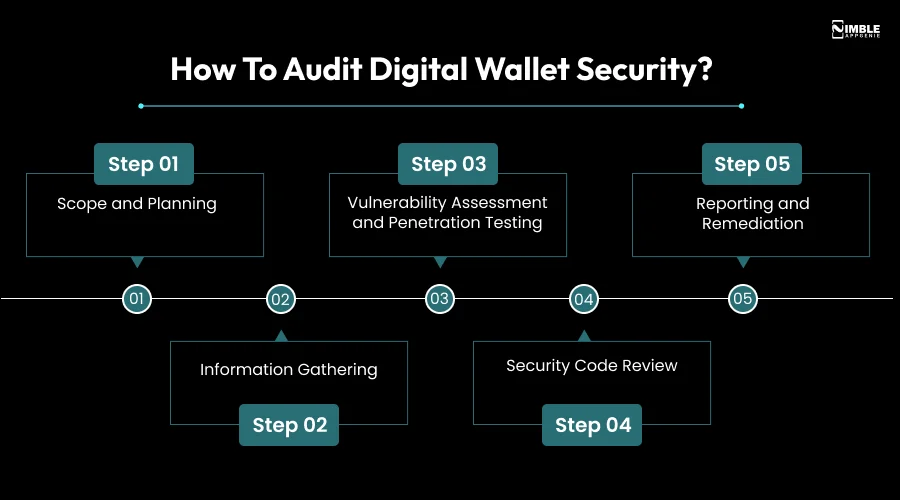
Step 1: Scope and Planning
The first step in conducting an app security audit is defining the scope. What do you want to audit? Is it the data storage or authentication process?
Once you have a scope, it’s time to select an audit method. For instance, it can be penetration or beta testing, vulnerability scanning, and so on.
Also, for this, the team needs to set up a timeline and budget.
Step 2: Information Gathering
With the scope set and a plan ahead, it’s time to start gathering information.
The team will gain access to information about the eWallet app, including architecture diagrams, source code (if applicable), system documentation, and security policies.
Plus, they shall also analyze the eWallet app design and implementation to identify potential vulnerabilities.
Step 3: Vulnerability Assessment and Penetration Testing
It’s time to start using automated testing tools for vulnerability assessment.
One of the most important things that happens in this step is manual penetration testing. This is done to identify zero-day vulnerabilities and exploit potential attack vectors.
After testing, the impact as well as the severity of the identified vulnerabilities are assessed.
Step 4: Security Code Review
Following the testing, it is time to review the eWallet app’s source code to identify coding errors and security weaknesses.
Following this, the team will check the use of secure coding practices and cryptographic algorithms. This is done to ensure compliance with industry best practices for secure coding.
Step 5: Reporting and Remediation
With all that said and done, it’s time to create a report.
The audit team will prepare a comprehensive audit report documenting identified vulnerabilities, their severity, impact, and remediation recommendations.
Following this, it’s time to make the necessary changes to ensure the vulnerabilities are fixed. Here, banking app developers must focus on vulnerabilities based on their risk level and develop a remediation plan.
Finally, it’s time to carry out remediation measures to address identified vulnerabilities.
This is how you identify gaps in digital wallet security measures. Based on the audit report, it’s time to introduce eWallet app security features. Let’s just look at that in the next section of the blog.
What Are the Top Security Features of a Digital Wallet?
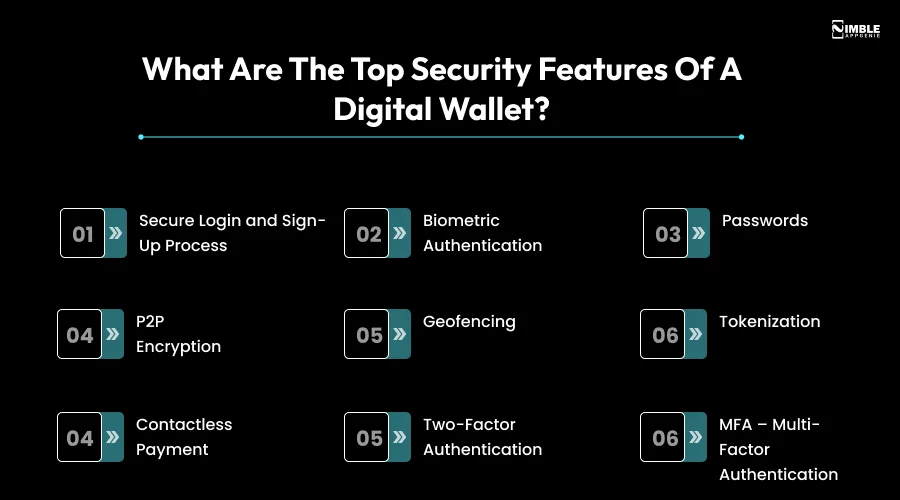
One of the top tips to improve eWallet security is to introduce features that complement app security at all levels.
eWallet app features play an important role in ensuring impregnable security. Take a look at some of the top wallet app features that help ensure total security.
These are, as mentioned below:
Feature 1: Secure Login and Sign-Up Process
If you want to know how to protect your digital wallet app, the first thing that you need to learn is secure onboarding.
The client side is the most vulnerable part of an eWallet platform. If the user is not verified, they can be a huge security threat.
This is why, to secure your digital wallet app, the platform must have a secure login and signup process.
Feature 2: Biometric Authentication
Throughout this blog, we have read how important authentication is in mobile wallet security. Well, one of the best authentication features is biometric authentication.
This functionality has been in mobile phones for years now. For instance, a fingerprint scanner on Android devices for unlocking, and the popular FaceID for facial scans on recent iPhone models.
Biometrics are unique to every human and pretty difficult to bypass… that’s what makes it a top eWallet app security feature.
Feature 3: Passwords
A password is the most basic mode of protection, which must be used by every personalized website or app.
Adding a rejection feature that activates when the password is too short or easy to guess will make your app more secure and safe.
Biometric security can be added if the smartphone has a fingerprint sensor. This is a key part of a secure wallet app.
Feature 4: P2P Encryption
P2P Encryption is a robust security tool that helps in protecting the debit or credit card transaction process.
As soon as you swipe a card on the PoI (Point of Interaction) terminal, it will start encrypting your debit or credit card data until the final transaction is completed.
This is a useful fraud prevention tool to carry out if you are trying to ensure eWallet security with robustness.
Feature 5: Geofencing
Geofencing integration in the eWallet application ensures that the app knows the location of the user.
Here’s how it helps you secure your digital wallet: whenever there is an unauthorized transaction, it will not be approved as it won’t match the user’s current location.
This is often used in eWallet apps like Google Pay. If you are planning to level up the eWallet app, make sure to improve this feature.
Feature 6: Tokenization
With the help of this technology, seamless eWallet security has become a reality.
Tokenization disconnects the buyer’s sensitive data from the end receiver through the use of mapped tokens, which the receiver uses to process the buyer’s credit card payment.
As soon as the user enters the card details to make payments, the card details are encrypted and turned into tokens that look similar to a random number. Here is a complete explanation of what payment tokenization is and how it protects users.
Feature 7: Contactless Payment
Contactless payment is one of the eWallet app trends that has been changing the market. This is seen in the top NFC payment apps and how they have become so popular.
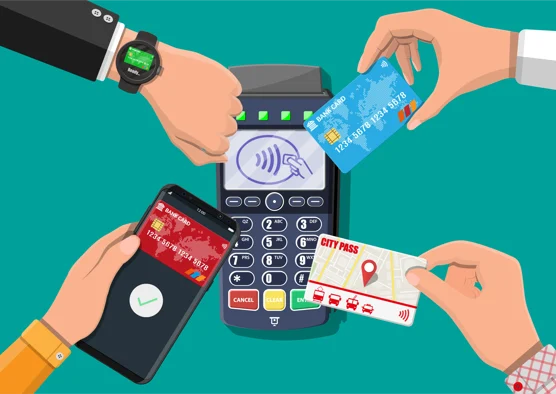
Well, apart from the convenience value and its aesthetic appeal, contactless payment technology is also great for promoting digital wallet security. Communication via NFC technology is much faster and more secure since all the data is encrypted.
Furthermore, when being used via a phone, it is next to impossible to commit physical fraud, which is often the case with credit cards and debit cards.
Feature 8: Two-Factor Authentication
What better than one layer of app security? That’s right, two layers.
This brings us to one of the top tips for improving digital wallet security, i.e., introducing a two-factor authentication feature.
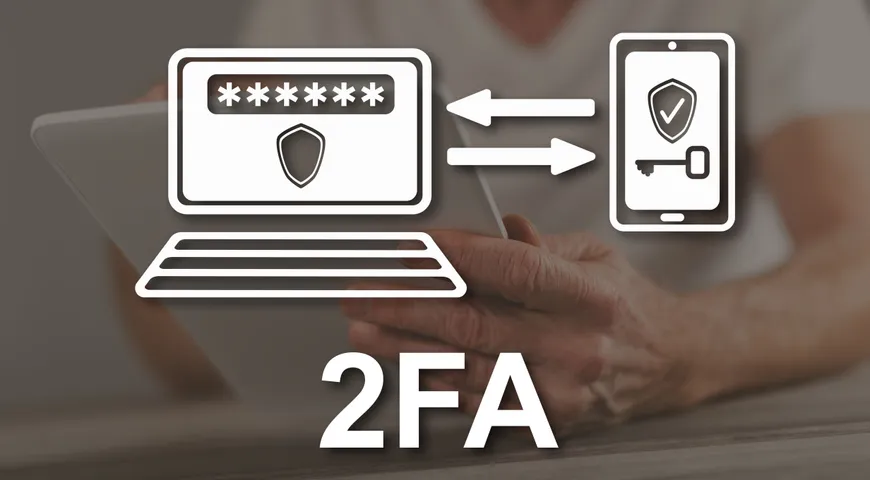
What this does is, in addition to the usual authentication layer, another one is adde,d which can be activated via OTP or biometric.
Since it is already hard enough to bypass one layer, getting through two is next to impossible physically.
Feature 9: MFA – Multi-Factor Authentication
Well, if you want to take the authentication process to the next level when enhancing your digital wallet security, consider MFA.
It stands for multi-factor authentication. Here, the user is required to pass two or more layers of authentication to verify their identity and make a transaction possible.
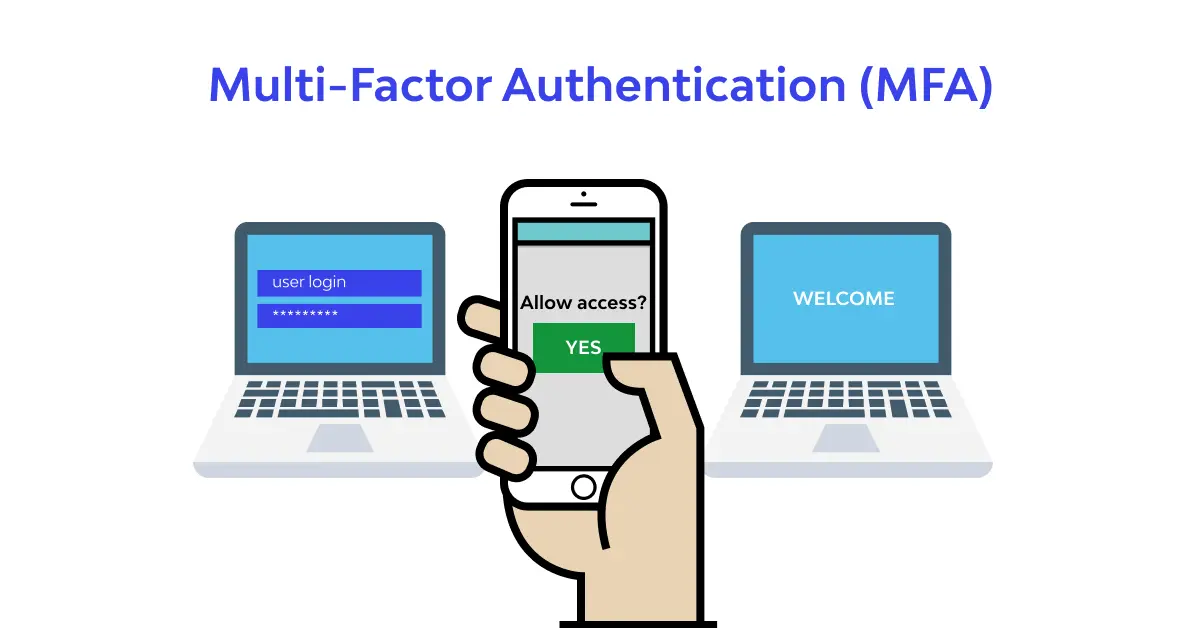
Whether you want to create an app like Cash or the usual eWallet, this is a top feature that you should consider.
With that out of the way, let’s look at some of the top technologies used to secure an eWallet application.
What Are the Top Technologies for eWallet Security?
If you have an idea for the eWallet app that you want to bring to reality or want to update the current legacy system to improve the eWallet app security, here’s a tip to follow.
The app tech stack plays an important role in the functioning and working of the app. Take a look at some top technologies to add to your tech stack to make sure there are no vulnerabilities.
So, with that being said, let’s get started:
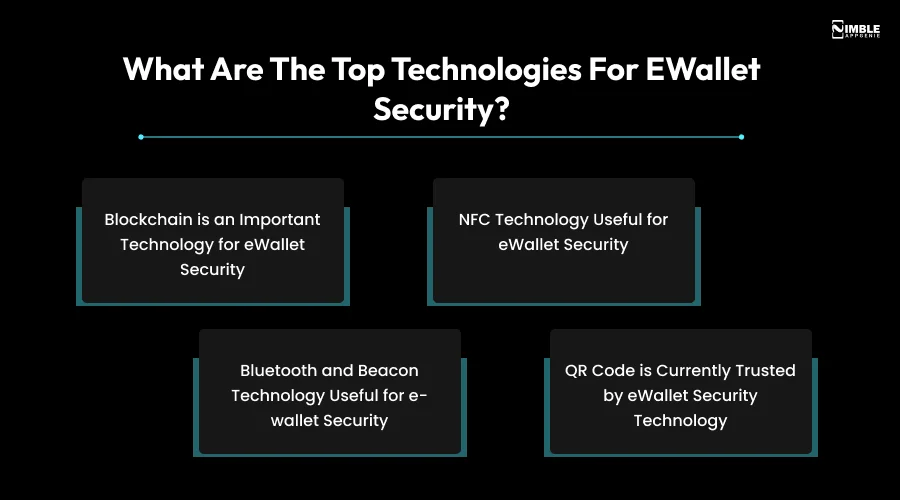
1. Blockchain is an Important Technology for eWallet Security
The use of blockchain development expands far beyond cryptocurrencies. Digital wallets integrated with blockchain technology are extremely safe, secure, and immutable when compared to other solutions.
This technology is preferred mostly by financial organizations and government agencies due to the high level of security associated with blockchain.
Blockchain is also very enticing to these large organizations due to the extra features that blockchain technology offers, such as decentralization and the ability to offer tokens
2. NFC Technology Useful for eWallet Security
NFC, or Near Field Communications, allows users to transfer funds without sharing their contact details. This technology deals with easy data exchange between closely located devices.
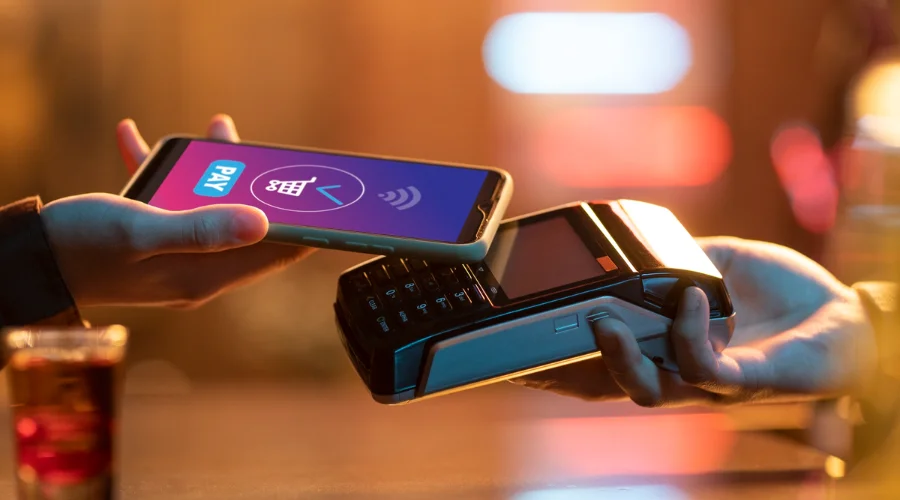
NFC mobile payment allows users to make payments directly with their smartphone – instead of payment cards. Some of the successful examples of NFC are Samsung Pay and Apple Pay.
In addition to this, NFC also allows the transfer of funds by simply touching one smartphone to another smartphone. It is one of the most trusted e-wallet tech.
3. Bluetooth and Beacon Technology Useful for e-wallet Security
Are eWallets safe?
Well, when filled with mobile payment applications and security like Bluetooth, yes, they are.
This allows you to identify nearby devices where you can make a payment. This is a very fast and secure technology to use for transferring funds digitally.
You can transfer funds to other users who are close to you or who are in the prescribed transfer range. The best part is that this technology doesn’t even ramp up the cost to develop an e-wallet app too much.
4. QR Code is Currently Trusted by eWallet Security Technology
QR Codes are generally used for making payments or transferring funds to other members of the public.
It is also used to make payments with contacts that are not already saved in the user’s phone. To make a payment, users just have to scan the QR code of the receiver.

This technology is one of the smoothest and most simplified ways of making payments.
With all that said and done, let’s look at some of the best practices to secure your digital wallet in the next section of the blog.
What Are the Best Practices to Secure Your Digital Wallet?
Now that you know how to protect your mobile wallet, it’s time to look at some best practices to follow.
Inspired by what top digital wallet apps are doing, here are some things to do when securing your application.
These are, as mentioned below:
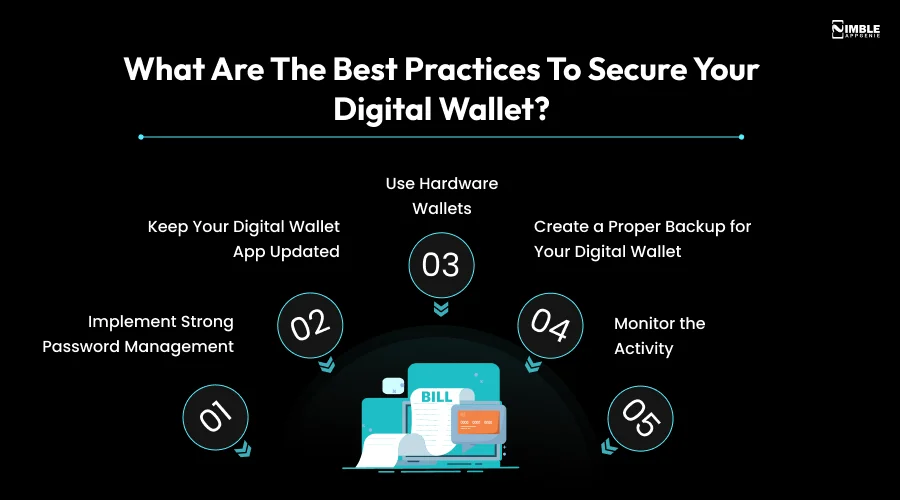
1. Implement Strong Password Management
One of the most important parts of eWallet app security as a whole is the authentication process.
To keep it secure and take it to the next level, what you can do as a service provider is implement strong password management.
2. Keep Your Digital Wallet App Updated
Developing a mobile app isn’t enough; it’s also important to invest in maintenance and updates.
To do this, you can partner with a mobile app development company or assemble your own in-house team of developers.
However, the former is highly recommended over the latter due to the cost involved. In any case, this is one of the Best Practices to Secure Your Digital Wallet to follow.
3. Use Hardware Wallets
Implementing hardware wallets as a security best practice for eWallet apps involves utilizing specialized physical devices to store and manage cryptographic keys securely.
These keys are crucial for authorizing transactions and accessing digital assets within the eWallet.
Moreover, the hardware wallet is a separate, dedicated device that is specifically designed to provide a highly secure environment for key management. This can take app security to the next level.
4. Create a Proper Backup for Your Digital Wallet
One of the best practices to follow is to create a proper backup for a digital wallet.
Now, depending on your platform, it can be a native backup or cloud-based. However, it is highly advised that you keep a backup on the cloud or avoid wallet app security threats.
After all, the user’s device is more vulnerable to threats.
5. Monitor the Activity
A considerable number of security threats to eWallet applications are internal. Based on this trend, one of the things that people finally started doing is using constant monitoring.
The monitoring team and software will securely identify discrepancies and avoid some of the big threats way before they happen.
It is also a good way to identify common security threats.
What Are the Factors to Consider for eWallet Security?
Now that we’re done with digital wallet security features and best practices, it’s time to look at some of the top factors to consider when implementing these things.
These are, as mentioned below:
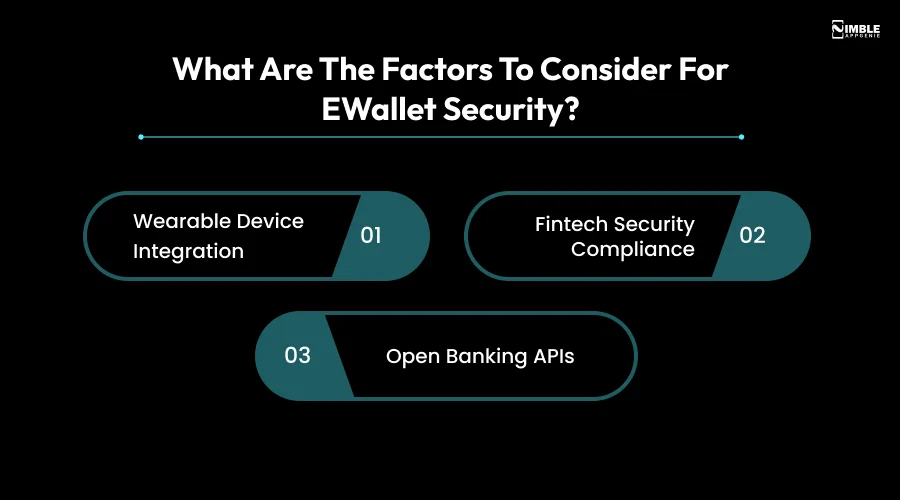
Factor 1: Wearable Device Integration
The popularity of wearable app development has been growing among eWallet app companies as they want to offer their end-users supreme convenience.
Based on IoT technology, wearable device integration does offer benefits as well as lucrative features. But on the flip side, it can also leave an open door for fraudsters.
So, it’s one of the things that you have to keep in mind when enhancing your eWallet security.
Factor 2: Fintech Security Compliance
In the fintech world, there are regulations like PCI compliance and GDPR compliance, which have to be followed.
The consequences of not following fintech regulations and compliance can be dire for a company. And since most of them have to do with eWallet app security, it is something to look out for.
Factor 3: Open Banking APIs
Open banking APIs are the golden grail of the eWallet world. It is next to impossible to build an online digital wallet without these components.
But, as good as they are, they are often the weak point in app security, making them a point of interest for companies.
Moving on, let’s look at some of the top eWallet app security future trends.
What Are the Future Trends for Digital Wallet Security?
If you want to create an eWallet app that’s successful among people and offers unmatched security, it’s important to consider future trends and adapt accordingly.
Therefore, the future trends that will help enhance eWallet security are, as mentioned below:
| Trends | Description | Potential benefits |
| Quantum Computing | When these computers are here, eWallet companies will be able to leverage quantum algorithms to enhance data encryption, potentially revolutionizing security. | Unbreakable data encryption and stronger fraud detection. |
| New Regulations | As time progressed, new regulations were introduced, standardized security protocols, and stronger consumer protection. | Increased trust and adoption of e-wallets. |
| AI-Driven Security Tools | Trending machine learning and AI technologies help create algorithms that will identify anomalies and prevent fraud in real-time. | Faster threat identification and proactive risk mitigation. |
| Decentralized Wallets | An application of blockchain, Defi can enhance user control and security against hacking and data breaches. | Greater autonomy and transparency in financial management. |
| User Education | It will become a common idea to empower users with knowledge about secure e-wallet practices and to recognize scams. | Reduced risk of human error and phishing attacks, increased trust in technology. |
Why Partner with Nimble AppGenie to Enhance Digital Wallet Security?
Nimble AppGenie is a widely chosen eWallet app development company with hands-on experience delivering 350+ projects, including top digital wallets like SatPay and Pay By Check. Check out our recognition for building custom fintech solutions on platforms like Clutch, GoodFirms, and DesignRush.
FAQs
Use strong, unique passwords, enable multi-factor authentication, keep your device and app updated, and stay cautious of phishing attempts.
Digital wallets typically use encryption, secure login credentials, multi-factor authentication, and transaction monitoring to protect user data and funds.
Account takeover (ATO) is the most damaging single threat; an attacker who gains access to a user’s wallet account can drain funds and lock the real owner out before the platform detects anything unusual. Preventing ATO requires a combination of phishing-resistant MFA, behavioral anomaly detection, and real-time transaction monitoring, all of which NimbleAppGenie builds into every eWallet project from the architecture stage.
When used with proper security measures, digital wallets are generally safe. Users should still stay vigilant against phishing and other threats, and choose reputable providers.
Phishing remains the most common initial attack vector, involved in 16% of data breaches according to IBM’s 2025 report, followed by stolen credentials and API vulnerabilities.
In 2026, the global average cost of a data breach reaches $4.99 million, marking 12% growth from the previous year, according to the 21st annual IBM Cost of a Data Breach Report.

Niketan Sharma, CTO, Nimble AppGenie, is a tech enthusiast with more than a decade of experience in delivering high-value solutions that allow a brand to penetrate the market easily. With a strong hold on mobile app development, he is actively working to help businesses identify the potential of digital transformation by sharing insightful statistics, guides & blogs.
Table of Contents




No Comments
Comments are closed.