Free Consultation
 PCI-DSS Compliant
 GDPR Ready
 ISO 27001
 NDA Protected
 AI Services
 AI App Development
 Generative AI Development
 AI Chatbot Development
 AI Integration Services
 AI For Fintech
 AI Financial Assistant Solution
 AI Insurance Agent Development
 Tech Stack
 OpenAI / GPT-4
 Claude / Anthropic
 Gemini / Google AI
 Llama / Open Source
 LangChain / LlamaIndex
 Pinecone / Pgvector
 AWS / Azure AI


 Fintech Solution
 Core Fintech
 Fintech App Development
 Neobank App Development
 eWallet App Development
 Payment Integration
 Lending Software
 BNPL Solution
 BNPL App Development
 Insurance App
 Investment App Dev
 Wealth Management App
 Crypto & DeFi
 DeFi App Development
 Crypto Wallet Dev
 Crypto Exchange Dev
 Trading Platform Dev
 Payments
 Compliance
 RegTech App Dev
 Fraud Detection
 Lending Ecosystem
 P2P Lending Platform
 Mortgage Lending
 Engagement
 Outsourcing Dev


 Mobile Development
 Mobile App Dev
 iOS App Development
 Android App Development
 React Native
 Flutter Development
 Web Development
 Node.js Development
 React.js Development
 Angular Development
 PHP / Laravel
 App Services
 UI/UX Design
 App Maintenance
 By Stage
 MVP Development
 Industry Solutions
 Healthcare App Dev
 Education App Dev
 Travel App Dev
 Real Estate App Dev
 Logistics Software
 Social Media App


 Hire Mobile Developers
 Hire iPhone Developers
 Hire Android Developers
 Hire React Native Devs
 Hire Flutter Developers
 Hire Web Developers
 Hire Node.js Developers
 Hire Angular Developers
 Hire PHP Developers
 Hire Laravel Developers
 How It Works
 Pre-Vetted Developers
 Ready In 48 Hours
 NDA From Day One
 Replace Guarantee

 Company
 About Us
 Portfolio
 Case Studies
 Blog / Insights
 Careers
 Contact Us
 Recognition


 Offices


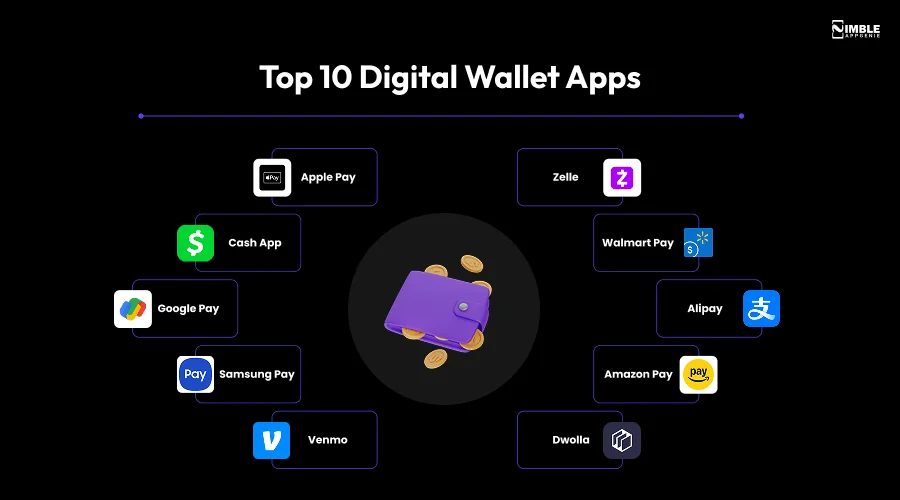
| Quick Answers: The best digital wallet apps in 2026 are Cash App, Apple Pay, Google Pay, Samsung Wallet, PayPal, Zelle, Venmo, Amazon Pay, Dwolla, and Walmart Pay – each suited to a distinct use case, from everyday tap-to-pay to free US bank transfers. |
TL;DR
- No single “best” wallet exists – the right choice depends on your country, device, and whether you need retail, P2P, or banking features.
- Google Pay and Apple Pay stay strong general-purpose options; Samsung Wallet covers similar ground, particularly for Samsung device owners.
- Cash App, Venmo, and Zelle are the top US picks for peer-to-peer transfers, each with distinct feature and fee trade-offs.
- Walmart Pay and Amazon Pay are retailer-embedded or closed-loop wallets effective for loyal customers of those specific stores.
- Nimble AppGenie builds custom digital wallet apps for businesses that don’t find the right fit among these ten.
Digital wallets have become popular fast. From daily payments to online transactions, digital wallet apps make it all possible without the need for a user to carry a physical wallet.
Cash transactions have witnessed a massive decline, thanks to increased use of cards, mobile wallets, and e-wallets. But more apps on the market also means more confusion over which one to use.
This list covers the top 10 digital wallet apps, their exceptional features, and the pros and cons of each.
1. Apple Pay
One of the most popular names when it comes to tech, smartphones, and apps is the tech giant Apple.
With its continuous innovation that covers a spectrum of industries, it has taken over the digital wallet space as well with Apple Pay.
The e-wallet built by Apple has all the necessary features and has the potential to replace a physical wallet, as you can not only use digital cash, but can also save all your card information in the wallet to pay for it through tap & pay.
Standout Features:
- Exclusive Apple Card
- Add Credit/Debit Cards
- Apple Pay Later Integration
Pros:
- Convenient to use, tap the smartphone on the POS to pay.
- Reliable Security Measures (encryption, tokenization, face ID/touch ID)
- Integrated wallet management to keep track of booked tickets, cards & more.
Cons:
- Only works for Apple devices, cannot be used on any other operating system.
- Offline payments require Tap & Pay, which is not always available at every store.
- Acceptance of Apple Pay is still an issue in tier 2,3 cities, which could pose an issue.
2. Cash App
Another popular name when it comes to digital wallets, Cash App, has made its way to the top players in the market in no time!
With the idea of peer-to-peer payments executed properly, it has become an unavoidable payment method.
It takes the entire concept of digital payments to another level as it not only offers a wallet, but also has integrated ways to interact with your bank accounts.
Not only that, the application offers a Cash Card that allows you to use the money both offline and online.
Standout Features:
- Multi-Layer Authentication.
- Cryptocurrency Sending & Receiving.
- Customer Accounts
Pros:
- Ease of money transfer makes peer-to-peer transactions easy.
- Stocks & cryptocurrency options are available for direct investments.
- Dedicated Cash Card so you can use your Cash App balance offline.
Cons:
- Added processing fees are implied on instant money transfers.
- Limited service areas: Cash App is not available outside the USA & UK.
- Debit card details required to add funds cannot be used through banking details.
3. Google Pay
Google Pay is a responsive digital wallet that simplifies making payments for all types of users.
While Apple Pay is limited to Apple Devices, Google Pay offers its services to both ends of the spectrum.
Both iOS and Android users can use the application to make payments, save cards, and use them for both in-store and online transactions.
Google Pay is a widely used payment method as Android devices are affordable and easily accessible even in the most remote locations.
Standout Features:
- Compliance with GDPR
- Mobile Recharge
- Bill Payment Options
Pros:
- Ease of integration with Google services on your device for integrated payments.
- No additional transaction processing fees for regular transactions. (cards excluded).
- User-friendly and easy to set up, while offering insights on financial literacy for users.
Cons:
- Google Pay is highly prone to digital fraud as new users are not cautious enough.
- Lacks international transfers and limits transactions to a certain amount in supported regions.
- Participating banks that enable direct transactions is limited.
4. PayPal
One of the most renowned digital payment methods, PayPal offers an accepted digital wallet that is used for international transactions.
With the help of PayPal, people can manage their financial information using their email and passwords.
This also enables different use cases for the app, as it can be used for financial transactions, shopping, e-commerce, sending and receiving funds, and more.
The application offers an easy way to manage online transactions.
Standout Features:
- Enhanced Direct Deposit
- Subscription Management
- Buy Now, Pay Later Ability
Pros:
- It is widely accepted by online retailers, merchants, and users.
- No separate merchant account is needed for business transactions.
- Offers buyer protection, helping users get their money back in case of a failed transaction.
Cons:
- Implied charges on credit and debit card transactions.
- Unreliable resolutions, as there’s no third-party arbitration.
- High chargeback fees for business transactions.
5. Samsung Wallet
Samsung’s wallet (rebranded from Samsung Pay to Samsung Wallet in most markets) is best for day-to-day use for Samsung device owners, consolidating payments and other digital wallet functions into an app on the phone.
Standout Features:
Biometric authentication, UWB technology, Virtual credit/debit cards
Pros:
Combines payment and digital wallet functions in one app; transaction tracking plus Samsung-specific rewards; a dedicated vault for cards and payment information.
Cons:
Limited to Samsung devices; some transactions require extra confirmation steps, adding friction; doesn’t support certain online purchase flows.
6. Venmo
Venmo allows users to send/receive money and adds a social aspect to the app. For instance, users can split the bill at dinner or split necessities with their partner or roommate, or even send a gift to a friend.
While doing all of this, users can earn cash back and many amazing deals. Another great offering is cash advances.
Venmo is one of the best cash advance apps on the market, with high limits and easy repayment. Much like other apps like Revolut & Cash, this platform enables crypto trading.
Standout Features:
- Debit/Credit Card Processing.
- Online – eCommerce payment.
- Split the bill
Pros:
- Social features to share payment descriptions and check transactions with contacts.
- Offers a detailed transaction history to make each expense traceable.
- Sophisticated, user-friendly features that allow easy onboarding of users.
Cons:
- Risk to user privacy, as social features often make it difficult to maintain discretion.
- Venmo transactions done for any services or goods are counted as taxable income for businesses.
- Credit Card transactions are charged a processing fee.
7. Zelle
Zelle is known for its simple interface and strong eWallet app security, and is one of the best mobile banking tools for anyone in the US. Its network now spans more than 2,400 financial institutions nationwide. (Source: Zelle, 2026.)
Important change: As of April 1, 2025, Zelle discontinued its standalone app completely. It’s no longer a separate app to download – senders and recipients must now access Zelle through their bank’s or credit union’s app instead.
Standout Features:
Mobile banking functionality, strong security, fast bank-to-bank payments
Pros:
No fees for instant bank-to-bank transfers; settles in minutes; no third-party intermediary involved.
Cons:
Occasional technical glitches can create fraud exposure; no longer usable without a participating bank account, since the standalone app is gone; restricted to US-based banks.
8. Walmart Pay
Another interesting approach towards building a digital wallet is Walmart Pay. Not only does it allow simplified online payments, but it also expedites the checkout process at any of the Walmart stores.
A user can simply link their preferred card to the wallet and use it for easy payments.
However, it is also a perfect example of a closed-loop payment system, as all the Walmart Pay wallets are limited to functioning at Walmart.
This often comes across as an issue; however, it is highly helpful for regular Walmart users.
Standout Features:
- Unified experience
- Available on both iOS & Android
- Scan & Go for Walmart+ Users
Pros:
- Allows users to make payments in the Walmart app, in-person transactions, and more.
- The closed-loop nature of the wallet reduces the risk of fraud.
- Maintains a digital record of receipts for future reference.
Cons:
- Limited acceptance since it is a closed-loop wallet, which restricts its use at other retailers.
- Walmart Pay does not support NFC, reducing the convenience of tap and pay/
- Comparatively smaller user base and troubleshooting forums.
9. Amazon Pay
Amazon Pay is one of the best digital wallet apps on the market today. This is not a stand-alone solution like other apps, such as PayPal.
Rather, it is an integrated solution that you can find within Amazon’s eCommerce app.
Amazon Pay solves some of the largest eWallet app challenges by offering seamless integration with P2P Payments, as well as high-level security.
Its availability on all platforms is what makes it one of the best digital wallet apps for iOS and Android.
Standout Features:
- Diverse payment options
- Rewards and cashback
- Send and receive money
Pros:
- Allows easy checkout for Amazon users.
- The app uses Amazon’s secure infrastructure to offer secure transactions.
- Offers easy money transfers between accounts.
Cons:
- Not all merchants accept Amazon Pay, especially for offline payments.
- High transaction fees are another issue in using Amazon Pay, especially for cross-border transactions.
- Amazon has a reserved policy that often ends up delaying transaction settlement for merchants and users.
10. Dwolla
Dwolla offers a digital wallet that supports ACH transactions. People from around the US use it regularly.
The application allows users to manage their funds while maintaining an e-wallet that can be used to make payments.
With ACH payments, it opens a new realm of transactions that do not require you to use cash, a credit card, a debit card, or a check.
It offers instant settlement with low transaction fees, making it more convenient for businesses and individuals.
The app is popular among startups looking for an affordable payment solution.
Standout Features:
- Allows ACH transfers with a digital wallet.
- Offers account-to-account transfers.
- Integrated tools for payment workflow management.
Pros:
- Low transaction fees make transactions convenient for users.
- Instant settlements for payments, skipping the long processing of transactions.
- Easy to integrate with other platforms, enabling businesses to make the most of it.
Cons:
- Limited availability of the app restricts it to the USA only.
- While it can be integrated with other apps, it cannot process credit card payments.
- International users cannot use the application due to availability restrictions.
Each of these wallets has its pros and cons and can be helpful for a dedicated set of audiences with a dedicated set of features. Needless to say, the pros and cons of each make it clearer to make the choice. Simply opt for a digital wallet app as per your use case and transactional requirements.
All the wallets are tried and tested, so you need not worry about that! Simply go to the app store and start using the app today!
Quick Comparison: Which Wallet Fits Your Use Case?
| Wallet | Best For | Platform |
| Apple Pay | Everyday tap-to-pay, Apple ecosystem users | iOS only |
| Cash App | P2P plus investing/crypto | US & UK |
| Google Pay | Cross-platform everyday use | iOS & Android |
| PayPal | International e-commerce and business | Global |
| Samsung Wallet | Samsung device owners | Samsung only |
| Venmo | Social P2P payments | US only |
| Zelle | Free, instant US bank transfers | US only |
| Walmart Pay | Regular Walmart shoppers | iOS & Android |
| Amazon Pay | Amazon ecosystem shoppers | iOS & Android |
| Dwolla | US-based ACH transfers for startups | Web/API |
Each of these wallets suits a different use case and audience – the right choice comes down to matching the wallet to your country, device, and transaction type.

Build Your Own Digital Wallet With Nimble AppGenie
All ten wallets above have real strengths, but also have real limitations – a geography restriction, a missing feature a specific business needs, or a platform restriction.
Digital wallet adoption has grown rapidly alongside smartphone penetration, making this a robust market for custom wallet development, not an established one. Nimble AppGenie designs and develops digital wallet apps for businesses that demand something none of the 10 above cover.

FAQs
When choosing the best wallet app to use, here are some factors to consider:
- Security
- Compatibility
- Ease of Use
- Fees
- Available Features
Look for apps with a good reputation, positive user reviews, and robust customer support.
While almost every pick on this list of digital wallet apps has millions of users, the most popular eWallets in the US include Apple Pay, Google Pay, and PayPal.
Verify if the app uses encryption, offers two-factor authentication, and complies with industry standards as well as regulatory compliance like GDPR compliance.
Mobile wallets are likely to evolve with enhanced features like biometric authentication, integration with emerging technologies, and increased acceptance, making them a central part of daily transactions.
While minimal, the risks include unauthorized access, data breaches, and potential fraud. For that reason, you should safeguard personal information, enable security features, and stay informed about the app’s security protocols to minimize these risks.

Niketan Sharma, CTO, Nimble AppGenie, is a tech enthusiast with more than a decade of experience in delivering high-value solutions that allow a brand to penetrate the market easily. With a strong hold on mobile app development, he is actively working to help businesses identify the potential of digital transformation by sharing insightful statistics, guides & blogs.