Free Consultation
 PCI-DSS Compliant
 GDPR Ready
 ISO 27001
 NDA Protected
 AI Services
 AI App Development
 Generative AI Development
 AI Chatbot Development
 AI Integration Services
 AI For Fintech
 AI Financial Assistant Solution
 AI Insurance Agent Development
 Tech Stack
 OpenAI / GPT-4
 Claude / Anthropic
 Gemini / Google AI
 Llama / Open Source
 LangChain / LlamaIndex
 Pinecone / Pgvector
 AWS / Azure AI


 Fintech Solution
 Core Fintech
 Fintech App Development
 Neobank App Development
 eWallet App Development
 Payment Integration
 Lending Software
 BNPL Solution
 BNPL App Development
 Insurance App
 Investment App Dev
 Wealth Management App
 Crypto & DeFi
 DeFi App Development
 Crypto Wallet Dev
 Crypto Exchange Dev
 Trading Platform Dev
 Payments
 Compliance
 RegTech App Dev
 Fraud Detection
 Lending Ecosystem
 P2P Lending Platform
 Mortgage Lending
 Engagement
 Outsourcing Dev


 Mobile Development
 Mobile App Dev
 iOS App Development
 Android App Development
 React Native
 Flutter Development
 Web Development
 Node.js Development
 React.js Development
 Angular Development
 PHP / Laravel
 App Services
 UI/UX Design
 App Maintenance
 By Stage
 MVP Development
 Industry Solutions
 Healthcare App Dev
 Education App Dev
 Travel App Dev
 Real Estate App Dev
 Logistics Software
 Social Media App


 Hire Mobile Developers
 Hire iPhone Developers
 Hire Android Developers
 Hire React Native Devs
 Hire Flutter Developers
 Hire Web Developers
 Hire Node.js Developers
 Hire Angular Developers
 Hire PHP Developers
 Hire Laravel Developers
 How It Works
 Pre-Vetted Developers
 Ready In 48 Hours
 NDA From Day One
 Replace Guarantee

 Company
 About Us
 Portfolio
 Case Studies
 Blog / Insights
 Careers
 Contact Us
 Recognition


 Offices


TL;DR
- Cost to build an app like Wise starts at $25,000 for a single-corridor MVP and can reach $250,000+ for a multi-market platform, driven mainly by the number of currencies, countries, and payment integrations.
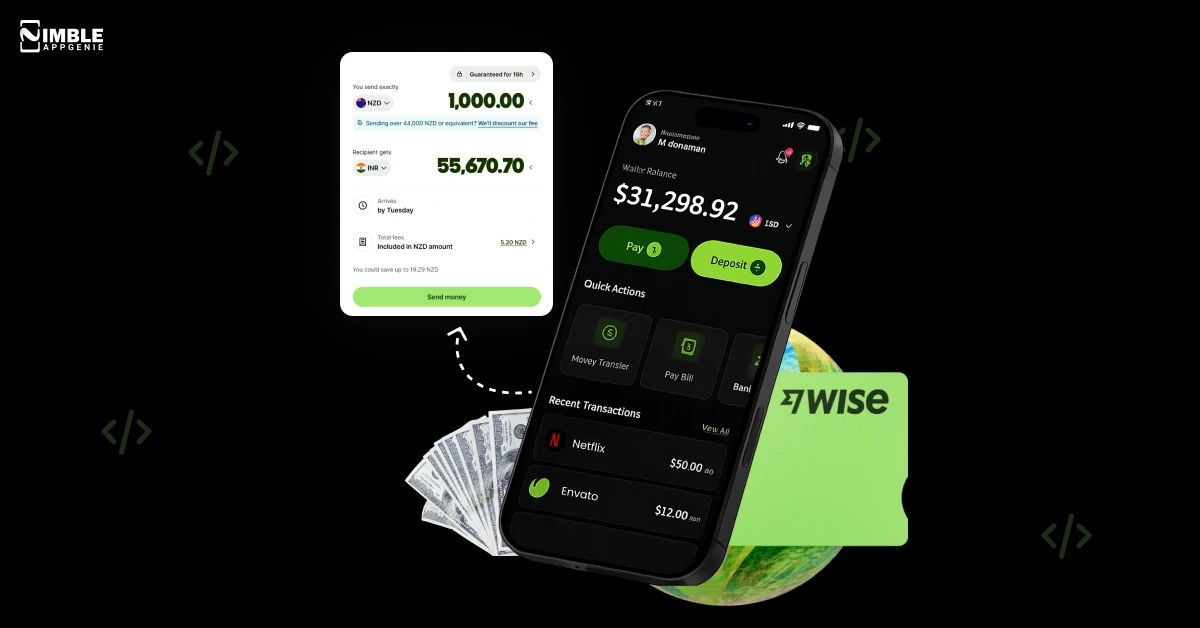
- Building an app like Wise means building a multi-currency money-movement product: accounts, currency conversion, cross-border transfers, and the compliance layer that makes it legal to operate.
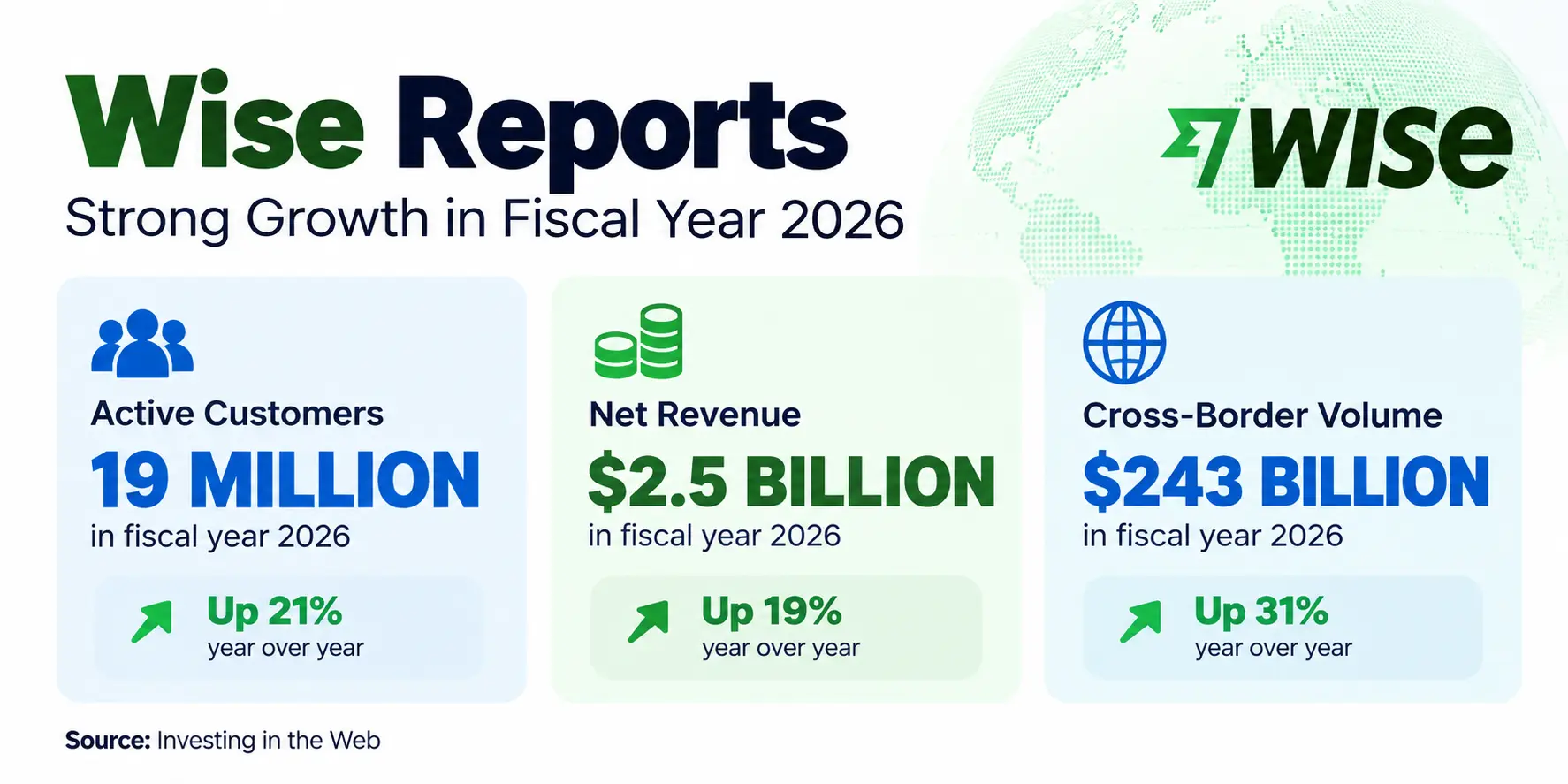
- Wise just hit a major milestone: in May 2026, it completed a dual listing on NASDAQ (ticker WSE) alongside its existing London listing, on the back of $243 billion in FY26 cross-border volume and 19 million active customers.
- Architecture depends on the ledger, FX, payment orchestration, and compliance layers; this is where most underestimation happens, not the UI.
- Regulatory costs are real line items (EMI license, PCI-DSS, MSB/state registration, AML setup) and are often the most underestimated part of the budget.
- Nimble AppGenie has direct fintech build experience relevant here: multi-currency wallets (Swap Africa, Pay by Wallet) and currency-exchange e-wallets (Pay By Check).
When you build an app like Wise, you build a multi-currency money-movement product: accounts that hold balances in several currencies, a currency-conversion engine, cross-border transfers, and the compliance layer that makes it legal to operate.
Cost to build an app like Wise starts at $25,000 for a single-corridor MVP and can reach $250,000+ for a full-featured, multi-market platform. The gap between those numbers depends on how many currencies, countries, and payment integrations you support on day one.
Wise in 2026: Why the Bar Keeps Rising
Most “cost to build a Wise-like app” guides usually skip what Wise is doing right now. But it’s worth knowing, as it’s the benchmark you are implicitly building against.
- In May 2026, Wise accomplished a dual listing on NASDAQ (WSE) while retaining its London Stock Exchange listing, focusing specifically on deepening its US cross-border payments footprint.
- Wise reported 19 million active customers for fiscal year 2026 (up 21% year over year), $2.5 billion in net revenue (up 19%), and $243 billion in cross-border volume (up 31%).
- Wise Business, its SME-focused product, has grown its business customers to 572,000+, increasing cross-border volume 35% annually, faster than its customer segment.
- 75% of transfers now complete faster, highlighting continued infrastructure investment – a bar that has surged considerably since Wise’s early “few days to settle” days.
A new entrant doesn’t need Wise’s scale to thrive. The “narrower problem” approach still works, but expectations for multi-currency features and instant settlements are now higher than they were a year or two ago.
What Is a Wise-Like App?

A Wise-like app is a multi-currency money-movement product that allows users to hold balances in different currencies, convert between them at near-real exchange rates, and send money across borders rapidly and more cheaply than a traditional bank.
It’s not a fixed product – it’s a category. At minimum, it usually includes:
- Multi-currency accounts or balances
- International money transfers between bank accounts
- Currency conversion at (or close to) live market rates
- Transaction tracking and history
- Beneficiary/recipient management
Some businesses stop there. Others add business accounts, debit cards, recurring transfers, or bill pay. The point is that your version can be broader or narrower than Wise – a payroll tool for a remote-first company doesn’t need the same scope as a consumer app targeting 40 currencies.
Why Build an App Like Wise?
Most businesses building in this category aren’t trying to beat Wise at its own game. They aim to solve a narrower problem:
- A payroll platform paying distributed teams in local currencies
- A tuition or living-expense payment app for international students
- A freelancer/marketplace payout tool for agencies
- A B2B transfer tool for SMEs paying overseas suppliers
- A niche corridor (e.g., a specific remittance route) that’s underserved
Traditional banks still charge 3-5% on FX and take days to settle. That gap is what makes a focused, well-scoped Wise-like product commercially viable – not an attempt to compete with Wise head-on across every market.
Key Features of an App Like Wise
| Feature | What It Does |
| Registration & onboarding | Account creation, identity capture |
| KYC/KYB | Identity and business verification before funds move |
| Multi-currency accounts | Hold balances in more than one currency |
| Currency conversion & FX display | Show live rates and convert on transfer |
| Money transfers | Move funds between accounts/banks, domestic or cross-border |
| Beneficiary management | Save and verify recipient bank details |
| Transaction tracking | Real-time status from initiation to settlement |
| Funding methods | Bank transfer, card, or local payment method top-up |
| Notifications | Transfer status, rate alerts, security events |
| Business accounts (if applicable) | Multi-user access, invoicing, payroll batches |
| Admin dashboard | User management, transaction monitoring, support tools |
| Fraud/risk controls | Transaction monitoring, velocity limits, sanctions checks |
Don’t build all twelve on day one. An MVP usually ships with KYC, onboarding, one or two currency pairs, transaction history, and basic transfers – everything else gets prioritized against the cost of building it.
How Does an App Like Wise Work?
A typical transfer flow looks like this:
User onboarding → identity verification (KYC) → funding → currency/FX selection → transfer setup → payment routing → recipient-side processing → settlement → status update
The exact architecture depends on your currencies, countries, payment corridors, and which banking or payment partners you route through. For a deeper look at how international settlement and multi-jurisdiction payment rails work, see our cross-border payment app development guide – this page focuses on how those pieces apply particularly to a Wise-like product.
Technology & Architecture for a Wise-Like App
A Wise-like product needs more than a standard app backend. The components that actually matter:
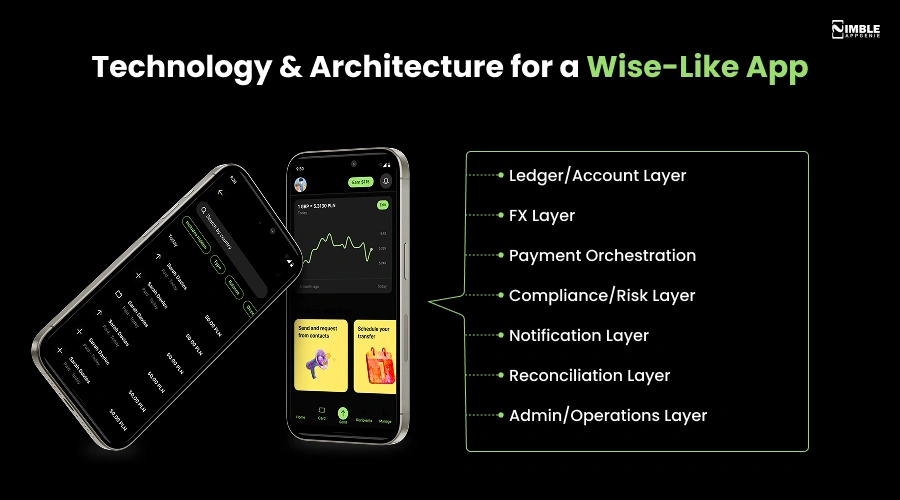
- Ledger/Account Layer: Tracks balances, credits, debits, and multi-currency holdings with transaction-level accuracy.
- FX Layer: Sources rates, applies your margin, and handles conversion logic.
- Payment Orchestration: Routes each transfer to the right banking or payment provider based on currency, corridor, and cost.
- Compliance/Risk Layer: KYC/KYB, AML screening, ongoing transaction monitoring, and sanctions checks.
- Notification Layer: Transfer status and account alerts.
- Reconciliation Layer: Matches your internal ledger against what providers and banks actually settled
- Admin/Operations Layer: Support tools, manual intervention capability, and transaction review
The ledger and reconciliation layers are where most underestimation happens – a Wise-like product is not moving money once; it is proving where every unit of money is at every stage, which is what regulators and banking partners require.
APIs & Third-Party Integrations Required
A Wise-like app depends on external providers for the pieces you won’t build yourself:
- Banking partners and payment processors
- FX rate providers
- Payment rails (ACH, SWIFT, local rails depending on corridor)
- Sanctions/AML screening services
- KYC/KYB and identity verification vendors
- Notification services
- Fraud and risk-scoring providers
Each integration adds development time, a dependency you don’t fully control, and ongoing cost – provider downtime or approval delays affect your product directly. More countries and payment methods mean more integrations, which is one of the highest cost and timeline levers.
How to Build an App Like Wise?
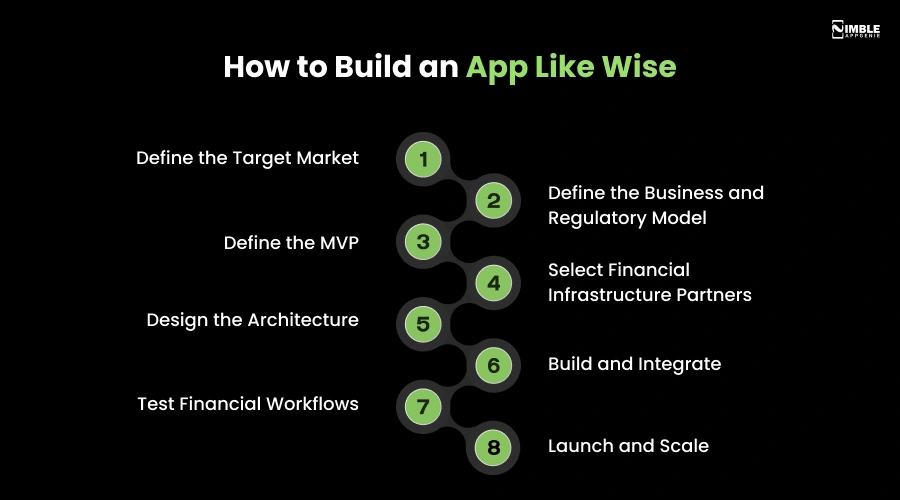
- Define the Target Market: which countries, currencies, and corridors you are serving first.
- Define the Business and Regulatory Model: How you make money and whether you will hold a license, partner with a licensed provider, or operate as an agent.
- Define the MVP: The smallest set of currencies, integrations, and features that allows you to validate demand.
- Select Financial Infrastructure Partners: Evaluate banking/payment providers on API quality, coverage, onboarding requirements, and settlement speed.
- Design the Architecture: Payments, ledger, compliance, FX, and reconciliation, planned together rather than bolted on later.
- Build and Integrate: Development plus connecting the financial infrastructure chosen in step 4.
- Test Financial Workflows: Successful and failed payments, FX calculation edge cases, reversals, webhooks, provider errors, reconciliation, duplicate-request handling.
- Launch and Scale: Start with the corridor or segment that proves the model, then expand.
How Much Does It Cost to Develop an App Like Wise?
A Wise-like app generally costs $25,000 to $250,000+ to build, depending on scope.
| Product Scope | Estimated Cost | What’s Typically Included |
| Basic MVP | $25,000 – $70,000 | Onboarding, KYC, 1–2 currency pairs, basic transfers, transaction history |
| Standard Wise-like platform | $70,000 – $150,000 | Multi-currency accounts, real-time FX, business accounts, notifications |
| Advanced multi-market platform | $150,000 – $250,000+ | Full compliance stack, multiple corridors, recurring transfers, analytics, deep integrations |
These are estimates, not quotes – actual cost depends on your specific scope. The main cost drivers:
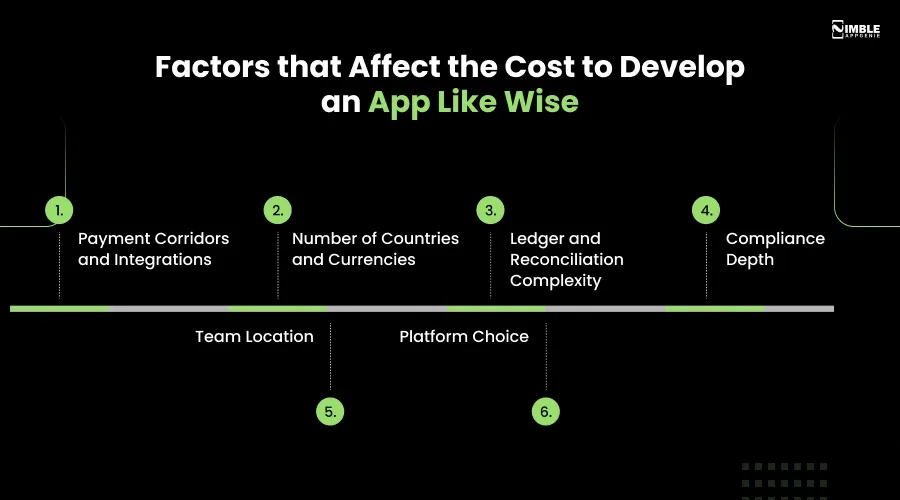
- Payment Corridors and Integrations: More providers mean more integration and testing time.
- Number of Countries and Currencies: Each additional market generally means new banking relationships, localization work, and compliance requirements.
- Ledger and Reconciliation Complexity: More currencies and providers mean more edge cases to reconcile
- Compliance Depth: KYC/KYB, AML, and sanctions screening scale with jurisdiction count.
- Team Location: North America/Western European rates run $150–$250/hr; offshore teams typically run $30–$80/hr for comparable output
- Platform Choice: Native iOS/Android costs more than cross-platform frameworks like React Native or Flutter
A narrower MVP costs less and validates faster. A broader scope raises cost but reduces the number of iterations needed later. If your product leans closer to a single-currency digital wallet than a multi-currency conversion platform, our cost to build an eWallet app breakdown may be a closer fit for your scope.
Wise-Like App Development Timeline
| Stage | Estimated Time |
| Discovery & planning | 2–4 weeks |
| UI/UX design | 2–4 weeks |
| Frontend development | 4–8 weeks |
| Backend development & integrations | 6–12 weeks |
| Testing & QA | 2–4 weeks |
| Deployment & app store review | 1–2 weeks |
| Total (software build) | 17–34 weeks |
This covers software development only. It doesn’t include external dependencies that run on their own timelines: payment-provider approval, licensing, banking-partner onboarding, and compliance review – some of which can take longer than the build itself. Plan for these in parallel, not after development finishes.
How Does a Wise-Like App Make Money?
Most Wise-like apps combine a small FX margin with account and transaction fees rather than depending on a single revenue stream:
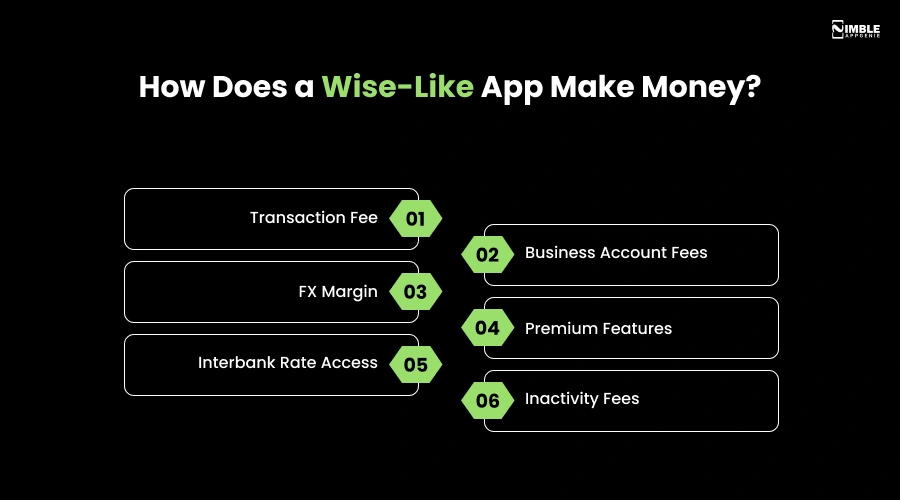
- Transaction Fee: Flat, percentage-based, or tiered by transfer size.
- Business Account Fees: Per-seat or subscription pricing for business users.
- FX Margin: A small markup over the mid-market/wholesale rate, usually disclosed upfront.
- Premium Features: Faster processing, higher limits, and dedicated support.
- Interbank Rate Access: Better wholesale rates as transaction volume grows.
- Inactivity Fees: For dormant accounts, where regulation allows.
The right mix depends on your customer segments, corridors, and partner costs – a B2B payout tool and a customer remittance app will lean on distinct combinations of these.
Regulatory and Licensing Costs
Operating a Wise-like product legally requires financial licensing, and this is often underestimated in cost planning.
| License/Requirement | Market | Cost Range | Notes |
| EMI License | UK/EU | $40,000 – $100,000 | Includes application fee plus legal setup; 3–6 months to obtain |
| MSB Registration (FinCEN) | USA | Free federally + $500–$5,000/state | Each US state requires a separate money transmitter license |
| PCI DSS Compliance | Global | $5,000 – $50,000/year | Required if you store or process card data |
| AML Program Setup | Global | $10,000 – $30,000 | Policy, monitoring rules, compliance officer role |
| GDPR/Data Privacy | UK/EU | $5,000 – $20,000 | Privacy policy, DPAs, consent management |
| PSD2/Open Banking | EU/UK | $10,000 – $30,000 | Strong Customer Authentication implementation |
If a full license is not realistic yet, partnering with an already-licensed provider and building on top of their regulated infrastructure is the faster path to market for early-stage products. This is general information, not legal advice – confirm requirements with a licensing attorney for your specific jurisdictions.
Compliance & Security Considerations
Beyond licensing, a Wise-like product needs:
- Transaction monitoring and fraud detection
- KYC/KYB and ongoing sanctions screening (OFAC and equivalent lists)
- Secure API design and audit logging
- Encryption, role-based access control, and MFA
Requirements scale with your payment flows, jurisdictions, and partners – a domestic-only product has a much lighter compliance load than one operating across multiple countries. Integrating a compliance vendor reduces risk but doesn’t automatically make a product compliant; underlying policies and monitoring still need to be built and maintained.
Challenges of Building an App Like Wise
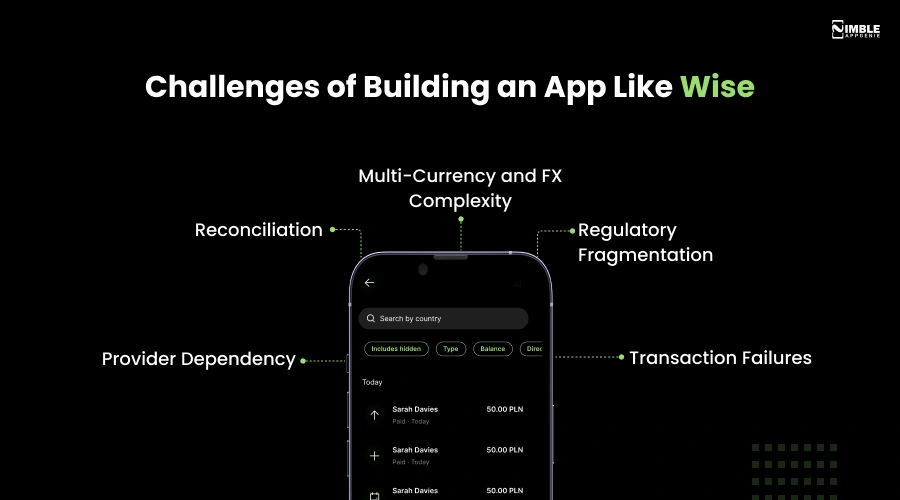
1. Provider Dependency: Your product’s reliability partly depends on banking/payment partners you don’t control.
Solution: Build provider abstraction into the payment layer early, so routing is not hardcoded to one provider. If a partner has an outage or changes terms, you can shift volume despite rebuilding.
2. Reconciliation: Matching internal records against multiple external providers.
Solution: Build automated reconciliation from day one, even at low volume. Manual reconciliation feels fine at 50 transactions a day and becomes unmanageable at 5,000 – retrofitting it later means auditing history you can’t completely trust.
3. Multi-Currency and FX Complexity: Margin logic, rate sourcing, and ledger accuracy across currencies.
Solution: Launch with fewer currency pairs than you eventually want. Get the FX and ledger logic right for two or three currencies before scaling to twenty – the edge cases multiply faster than the currency count.
4. Regulatory Fragmentation: Different rules per country/state add compliance overhead as you expand.
Solution: Pick your first 1-2 corridors based on regulatory simplicity, not just market size. A well-regulated, well-documented market is usually faster to launch in than a bigger one with unclear requirements.
5. Transaction Failures: Handling partial failures, retries, and reversals smoothly.
Solution: Design transaction states (failed, pending, reversed) and idempotent request handling before writing the main transfer logic, not after a duplicate-charge incident forces the rework.
How to Make Your Wise-Like App Different?
Cloning Wise’s feature list is not a strategy – it’s a way to compete on someone else’s terms. Stronger positioning usually comes from:
- Focusing on one corridor or region deeply instead of many shallowly
- Faster or simpler onboarding for that segment
- Serving a specific segment (freelancers, SMEs, students, remote payroll)
- A pricing model that’s genuinely simpler or cheaper for your niche
- Specialized business-payment workflows (batch payroll, invoicing)
How to Choose a Wise-Like App Development Company?
Evaluate a partner on:
- Ledger and multi-currency account system design
- Direct experience with payment/banking API integrations
- Fraud/risk control implementation
- Compliance-aware development (not just “we can add KYC”)
- Track record testing financial workflows, not just standard app QA
Questions worth asking:
- Have they built ledger systems before?
- Which banking/payment partners have they integrated?
- How do they handle reconciliation and failed-transaction edge cases?
Why Choose Nimble AppGenie?
Nimble AppGenie has been building fintech applications since 2017, with 350+ delivered projects and direct experience in payment integrations, multi-currency functionality, banking APIs, and compliance-aware engineering. The team is ISO 27001 certified and PCI-DSS compliant, with offices in London, Houston, Dubai, and Toronto. Relevant delivered work includes:
Swap Africa: A multi-currency wallet allowing users and businesses to send, receive, and manage funds across multiple African markets, in French and English.
Pay By Check: A US e-wallet supporting ACH/EFT-based transfers and currency exchange.
Pay by Wallet: An e-wallet built to convert funds to a desired currency and complete the transaction in real time, with transaction history and related features.
FAQs
Yes. Wise reported 19 million active customers and $243 billion in cross-border volume for fiscal year 2026, and completed a dual listing on NASDAQ (WSE) in May 2026 alongside its existing London listing.
Costs typically range from $25,000 for a basic MVP to $250,000+ for a full-featured, multi-market platform, depending on countries, currencies, integrations, and compliance scope.
Software development typically takes 17–34 weeks. External dependencies like banking-partner onboarding and licensing run separately and can extend the overall timeline.
At minimum: onboarding, KYC, multi-currency accounts, currency conversion, transfers, beneficiary management, and transaction tracking. Scope beyond that depends on your target market.
Banking/payment partners, FX rate providers, KYC/KYB and sanctions-screening vendors, and fraud-risk services, at minimum.
Yes, many successful products in this category start with a single corridor or segment rather than global coverage, which significantly reduces initial cost and compliance scope.
Common models include transaction fees, FX margin, business account fees, premium features, and inactivity fees, often combined.
Look for direct experience with ledger systems, banking/payment API integrations, and compliance-aware development, not just general app development experience.

Niketan Sharma, CTO, Nimble AppGenie, is a tech enthusiast with more than a decade of experience in delivering high-value solutions that allow a brand to penetrate the market easily. With a strong hold on mobile app development, he is actively working to help businesses identify the potential of digital transformation by sharing insightful statistics, guides & blogs.