

 Free Consultation
 PCI-DSS Compliant
 GDPR Ready
 ISO 27001
 NDA Protected
 AI Services
 AI App Development
 Generative AI Development
 AI Chatbot Development
 AI Integration Services
 AI Consulting Services
 AI For Fintech
 AI Financial Assistant Solution
 AI Insurance Agent Development
 Tech Stack
 OpenAI / GPT-4
 Claude / Anthropic
 Gemini / Google AI
 Llama / Open Source
 LangChain / LlamaIndex
 Pinecone / Pgvector
 AWS / Azure AI


 Fintech Solution
 Core Fintech
 App Development
 Neobank Solutions
 eWallet Solutions
 Lending Software
 Banking Solutions
 BNPL Solutions
 BNPL Solutions
 Insurance App
 Wealth Management
 Crypto & DeFi
 Blockchain Development
  Payroll Software
 DeFi Solutions
 Crypto Wallet
 Crypto On/Off Ramp
 Crypto Exchange
 Trading Platform
 Payments
 Compliance
 Regulations & Compliance
 Fraud Detection
 Lending Ecosystem
 P2P Lending Platform
 Mortgage Software
 Engagement
 Fintech Outsourcing

 Mobile Development
 Mobile App Dev
 iOS App Development
 Android App Development
 React Native
 Flutter Development
 Web Solution
 Node.js Development
 React.js Development
 Angular Development
 App Services
 UI/UX Design
 App Maintenance
 By Stage
 MVP Development
 Industry Solutions
 Healthcare App Dev
 Education App Dev
 Travel App Dev
 Real Estate App Dev
 Logistics Software
 Social Media App

 Hire Mobile Developers
 Hire iPhone Developers
 Hire Android Developers
 Hire React Native Devs
 Hire Flutter Developers
 Hire Web Developers
 Hire Node.js Developers
 Hire Angular Developers
 Hire PHP Developers
 Hire Laravel Developers
 How It Works
 Pre-Vetted Developers
 Ready In 48 Hours
 NDA From Day One
 Replace Guarantee
 Company
 About Us
 Our Work Process
 Portfolio
 Case Studies
 Blog / Insights
 Careers
 Contact Us
 Awards
 Recognition


 Offices



In a Nutshell:
- Mobile app development cost in 2026 ranges from $15K for simple apps to $500K+ for complex platforms. The biggest driver is feature complexity, not platform.
- Android vs iOS development cost differs by 10-20%; choosing cross-platform development with Flutter or React Native can cut your budget by 30-45% without sacrificing quality.
- App development cost by region varies massively – US developers bill $130-$200/hr while offshore app development in India runs $25-$55/hr; Eastern Europe offers the best quality-to-cost ratio at $40-$80/hr.
- Hidden app development costs, including cloud hosting, App Store fees, OS update compatibility, and post-launch bug fixes, typically add 50-60% on top of your initial build budget over 3 years.
- AI tools like GitHub Copilot are reducing routine development time by 30-40%, but rising user expectations mean AI-powered app features now add $15,000-$50,000 to stay competitive in 2026.
- Nimble AppGenie opts for the smartest way to reduce app development cost by launching a focused MVP app first, using third-party APIs, writing a detailed spec, and partnering with a hybrid development team for US-quality output at offshore rates.
Planning to build a mobile app? The first question on your mind is definitely – how much is it going to cost me? Well, a fair question.
Mobile app development costs in 2026 can range from $15,000 for a simple app to $500,000 for a complex platform. Where does your’s lie in this range?
| “Most founders come to us with a number in their head. Our first job is to replace that number with a strategy.” – Niketan Sharma, Nimble AppGenie CTO. |
Custom app development cost is primarily driven by complexity, platform, features, and the development team’s location and experience. The biggest factor that determines the figures is the type of app you are building.
This guide breaks down the app development cost with no vague estimates. Let’s know the real number and a thorough analysis.
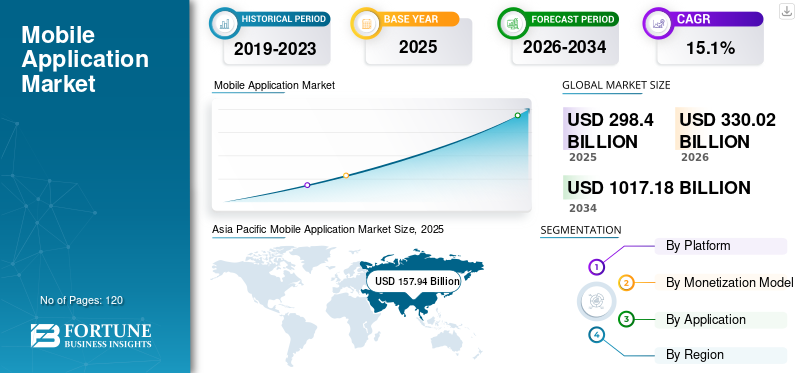
| The global mobile app market is anticipated to reach $330.02 billion in 2026. Companies that invest in mobile app development now will grab tomorrow’s market share. |
Let’s get started!
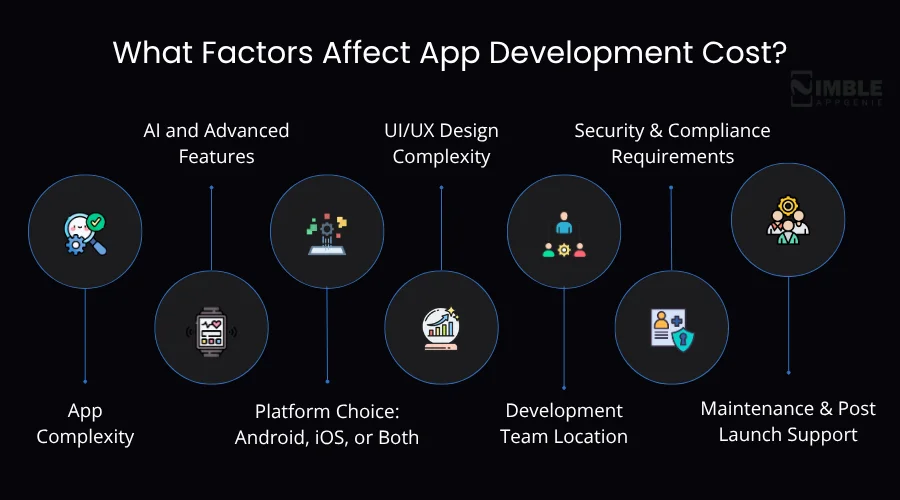
What Factors Affect App Development Cost?
No two apps cost the same – it’s because the mobile app development company determined the cost by a combination of the factors that your project needs specifically.
Let’s talk about the major factors affecting the cost of app development that a business owner and project manager should know.
♦ App Complexity
This is one of the biggest cost factors. A simple utility application with 3-5 screens costs only a fraction of what a social platform or a marketplace needs.
♦ AI and Advanced Features
Every feature, like payment gateways, authentication, GPS, AI recommendations, and AI recommendations – adds development hours that contribute to the mobile app creation cost.
♦ Platform Choice: Android, iOS, or Both
Developing natively for Android and iOS means two different codebases that double your development investment.
Cross-platform frameworks like React Native and Flutter offer the best option – one codebase deployed to both platforms at around 60-75% of the cost of full native development.
♦ UI/UX Design Complexity
Most mobile app development companies underestimate the app design. A custom, brand-centric UI with micro-interactions, animations, and accessibility compliance takes 3-5x longer compared to a template-based design.
In 2026, users expect intuitive, polished interfaces. Here, cutting corners directly affects retention and reviews.
| “The most expensive app is the one you build twice. Skipping discovery to save time costs more than the discovery ever would have.” – Nimble AppGenie CTO |
♦ Development Team Location
Hourly rates for developers differ enormously by geography. In San Francisco, a senior developer bills at $150 – 200/hr. The same skill level in India costs around $25 – $50/hr.
We will cover this in complete detail in the regional breakdown section later in this post.
♦ Security and Compliance Requirements
Mobile apps handling sensitive data, like financial transactions, health details, and children’s data, should comply with HIPAA, GDPR, PCI-DSS, or COPPA, depending on your market.
From day one, building compliance adds 15 to 30% to development cost but saves significantly more in possible fines and breaches.
♦ Maintenance and Post-Launch Support
Most budgets aim at building the app, overlooking what comes after. Bug fixes, OS updates, feature iterations, and server costs generally run 15-20% of the actual development budget annually. We will learn more about this in the hidden cost section.
Considering all the factors impacting the total cost to estimate the expenses with each requirement, you can use an app development cost estimation tool to calculate the potential cost for your app development.
| The cost to build an app is directly proportional to how much value it delivers. The question is not ‘how do we spend less?’ – it is ‘how do we get maximum ROI from each dollar invested?’ |
Cost by App Complexity
Now, let’s talk about real numbers. Below is the latest 2026 market breakdown of app development cost based on complexity tier.
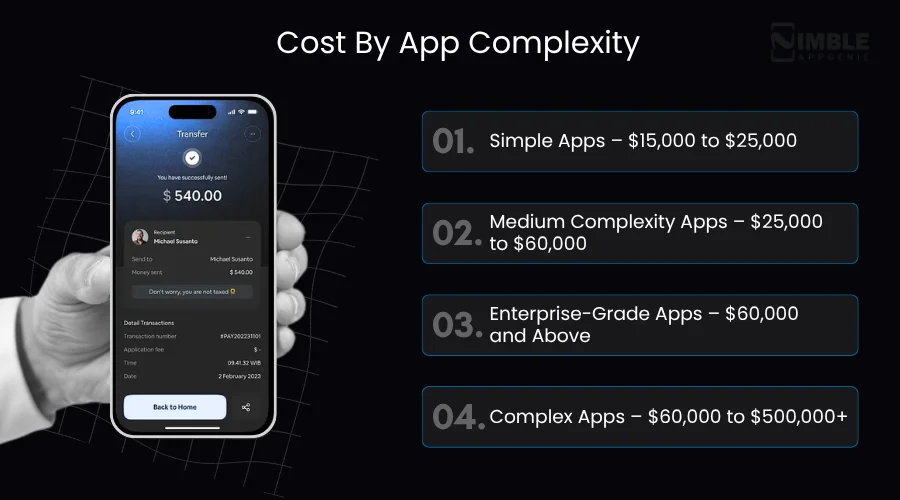
1. Simple Apps – $15,000 to $25,000
Simple applications serve as a single-purpose use case with minimal backend needs. Think unit converters, calculators, static informational apps, or basic to-do apps for small businesses.
Best for: MVPs to concept validation, internal business tools, first-time app owners testing the market, and community apps with small user bases.
What’s Included: Basic UI components, 3-8 screens, minimal third-party integrations, simple data storage, and standard authentication.
Timeline: 4-8 weeks from starting to App Store launch.
Example: A local restaurant chain’s app with a reservation form, menu viewer, and loyalty points tracker would fall in the $12,000-20,000 range.
2. Medium Complexity Apps – $25,000 to $60,000
The most common tier, medium complexity apps, is for funded startups and well-established SMBs launching their first real digital product. Such apps have real backend infrastructure, rich feature sets, and real users with actual expectations.
Best for: On-demand service platforms (think DoorDash-styled apps or Uber-like platforms), eCommerce apps, B2B SaaS mobile clients, marketplace apps in specialized niches, and fitness and wellness apps.
What’s Included: Custom UI/UX design, 10-30 screens, API integrations (maps, payment gateways, and social login), user authentication and profiles, admin dashboards, push notifications, and basic analytics.
Timeline: 2-4 months
Example: A fitness app with nutrition logging, a subscription paywall, workout tracking, and social sharing would typically cost about $55,000-90,000 to create properly.
| “Make something people want. You can always add features later – but you can’t un-spend a budget on things users don’t need.” – Paul Graham, Y Combinator |
3. Enterprise-Grade Apps – $60,000 and Above
Entirely a different category, enterprise app development leads to mission-critical systems that need the top security standards, integrate with existing enterprise infrastructure, involve custom hardware or IoT components, and support millions of concurrent users.
Best For: Healthcare networks, banks and financial institutions, logistics conglomerates, retail chains with complex POS integration, and government applications.
What’s Included: Advanced security architecture and penetration testing, custom enterprise integrations (SAP, Salesforce, Oracle, etc.), dedicated QA and penetration testing, CI/CD pipelines and DevOps infrastructure, SSLA-backend support contracts, and multiple regional deployments.
Timeline: 4 – 9+ months, usually in phased releases
4. Complex Apps – $60,000 to $500,000+
Full-scale platforms are the complex apps that power the whole business model. These demands multiple user roles, sophisticated architecture, and deep third-party integrations.
Best For: Telemedicine platforms, multi-vendor marketplaces, logistics and fleet management apps, edtech apps with live sessions, social platforms, and fintech applications with complicated financial workflows.
What’s Included: Multiple user roles and permission levels, 30+ screens, advanced backend with scalable cloud infrastructure, real-time functionality (live tracking, chat, video streaming), comprehensive analytics, multiple payment flows, and complex business logic.
Timeline: 12+ months
Example: A telemedicine platform with EHR integration, video consultations, HIPAA compliance, and insurance verification would run $180,000-$280,000.
♦ A Quick Snapshot of Cost By App Complexity
| Complexity | Cost Range (2026) | Timeline | Team Size |
| Simple App | $15K – $25K | 4-8 Weeks | 2-4 Developers |
| Medium Complexity | $25K – $60K | 2-4 Months | 4-8 Developers |
| Enterprise-Grade | $60K+ | 4-9 Months | 8-15 Developers |
| Complex App | $60K to $500K+ | 12+ Months | 15-30+ Developers |
Cost by Platform: Android vs iOS vs Cross-Platform
Platform choice is one of the most financially impactful and first decisions a project manager and business owner will make.
In 2026, the cost for mobile app development stacks up the numbers as follows:
1. Android App Development Cost
The average Android app development cost ranges between $35,000 – $280,000, running around 10-20% higher than iOS apps due to device fragmentation testing.
Open ecosystem, the biggest strength of Android is the development challenge. Android apps with thousands of device manufacturers, hardware specs, fragmented OS versions, and screen sizes thoroughly need notably more QA work, generally adding 15-25% to the development timeline.
Android covers a huge market share, which makes it essential for mass-market consumer applications, specifically in evolving markets across Africa, Asia, and Latin America.
2. iOS App Development Cost
The average iOS app development cost ranges between $30,000 – $250,000 depending on complexity.
iOS apps are typically faster to create because Apple’s ecosystem is more standardized with fewer device variations, consistent hardware specs, and rigid OS update adoption.
iOS users also exhibit higher average spend in apps, making it the most-chosen first-launch platform for subscription-based and premium business models.
| “Cross-platform is no longer a compromise — for 80% of apps, Flutter gives you native performance at a fraction of the native price.” – Nimble AppGenie Lead Developer |
3. Cross-Platform App Development Cost
The average cross-platform development cost ranges between $25,000 – $200,000.
With frameworks like Flutter (Google) and React Native (Meta), developers can write one codebase that runs on Android and iOS. In 2026, Flutter has surged as the dominant cross-platform framework that the industry leaders use, like eBay Motors, Google Pay, and BMW.
Cross-platform is not always cheaper for complex apps; it needs deep native features. However, native development may be more cost-effective in the long run. But, cross-platform offers a 30-45% cost advantage for most MVPs and medium-complexity apps.
♦ Average App Development Cost by Platform At a Glance
| Platform | Cost Range | Time to Market | Best For |
| Android Only | $35K – $280K | Moderate | Mass market, emerging markets |
| iOS Only | $30K – $250K | Shorter | Premium, subscription apps |
| Both (Native) | $65K – $500K+ | Longer | Full market coverage, complex apps |
| Cross-Platform | $25K – $200K | Fastest | MVPs, budget-conscious launches |
Cost by Region: A Global Developer Rate Breakdown
The location of your development team enormously impacts the cost and is more complex. Communication overhead, quality, IP security, and time zone alignment all contribute to the real cost of a regional development partner.
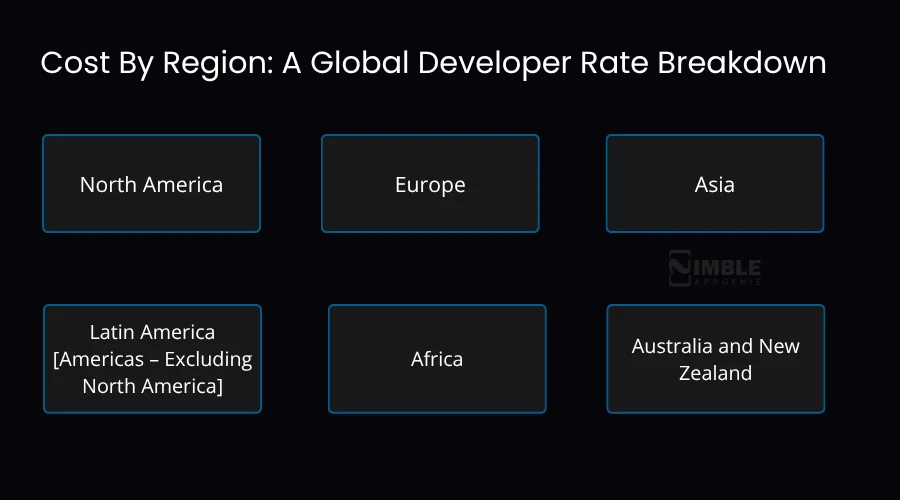
1. North America
Best For: Fintech, enterprise, healthcare, and regulated industries where compliance expertise and data security justify the premium.
The United States and Canada lead some of the globe’s most senior app development skills with established agencies, native English communication, and robust IP protection frameworks.
- US Senior Developer Rate: $130 – $200/hour
- US Mid-Level Developer: $100 – $150/hour
- Canada Senior Developer: $100 – $150/hour
- Typical project cost (medium app): $120,000 – $250,000
2. Europe
Best For: Startups and scale-ups that demand premium quality with a 40-60% cost advantage over North American rates.
Europe brings an exclusive middle ground with strong English proficiency (specifically in Northern and Western Europe), highly talented developers, more favorable time zones, and EU data protection compliance for US-based companies than Asia.
► Western Europe (UK, Germany, France, Netherlands)
- Senior Developer Rate: $80 – $150/hour
- Typical project cost (medium app): $80,000 – $180,000
► Eastern Europe (Poland, Ukraine, Romania, and the Czech Republic)
Eastern Europe showcases one of the top value-quality ratios in the worldwide market. Countries like Ukraine and Poland produce extraordinary engineering talent from robust STEM university systems.
- Senior Developer Rate: $40 – $80/hour
- Typical project cost (medium app): $40,000 – $100,000
3. Asia
Asia holds the largest volume of mobile app developers worldwide, with a massive change in quality and expertise across distinct countries.
► India
The world’s biggest mobile app development outsourcing market, India, brings an experienced ecosystem of agencies, a huge talent pool, and powerful English communication. Quality widely varies, so vet your partner deeply for sure.
- Senior Developer Rate: $25 – $55/hour
- Typical project cost (medium app): $20,000 – $60,000
► Southeast Asia (Thailand, Indonesia, the Philippines, and Vietnam)
Vietnam has emerged specifically as a high-growth tech hub, with a younger, swiftly upskilling developer workforce, and government-backed STEM education initiatives.
- Developer Rate: $20 – $45/hour
- Typical project cost (medium app): $18,000 – $55,000
| “The important thing about outsourcing or global sourcing is that it becomes a very powerful tool to leverage talent, improve productivity, and reduce work cycles.” – Azim Premji, Chairman of Wipro Limited. |
4. Latin America [Americas – Excluding North America]
Best For: US companies requiring offshore pricing with near-shore communication advantages.
Latin America, particularly Argentina, Brazil, Mexico, and Colombia, has seen a surge in tech talent over the last five years.
The key benefit: near-shore time zone alignment with the US, making real-time collaboration far more seamless than with Asian teams.
- Senior Developer Rate: $35 – $75/hour
- Typical project cost (medium app): $30,000 – $80,000
5. Africa
In the global tech talent market, Africa is the most thrilling market. Countries like Kenya, Nigeria, Egypt, Ghana, and South Africa are producing powerful engineering graduates, with expanding startup ecosystems and elevating global visibility.
- Senior Developer Rate: $20 – $45/hour
- Typical project cost (medium app): $15,000 – $50,000
The African tech ecosystem is still growing, and finding proficient teams for complex projects needs thorough vetting. However, for well-scoped MVP projects, Africa provides unique value and growing quality.
6. Australia and New Zealand
Australian developers are premium-priced, akin to those in the US and UK, with strong English-language communication, robust IP protection, and specific expertise in the agriculture, mining, and government technology sectors.
- Senior Developer Rate: $100 – $170/hour
- Typical project cost (medium app): $90,000 – $200,000
♦ A Swift Review of App Development Cost By Region
| Region | Sr. Dev Rate/Hr | Medium App Cost | Key Strength |
| North America | $130 – $200 | $120K – $250K | Compliance, enterprise |
| Western Europe | $80 – $150 | $80K – $180K | Quality, GDPR expertise |
| Eastern Europe | $40 – $80 | $40K – $100K | Best value-quality ratio |
| India | $25 – $55 | $20K – $60K | Scale, English, ecosystem |
| SE Asia | $20 – $45 | $18K – $55K | Cost, growing quality |
| Latin America | $35 – $75 | $30K – $80K | Near-shore, time zones |
| Africa | $20 – $45 | $15K – $50K | Emerging, fast growth |
| Australia | $100 – $170 | $90K – $200K | Compliance, govt sector |
Cost by Industry
Your industry shapes the requirements of your app more than almost any other factor.
User expectations, regulatory needs, mobile app security standards, and required integrations all vary notably by vertical.
Let’s check below what app development actually costs across the top industries in 2026:
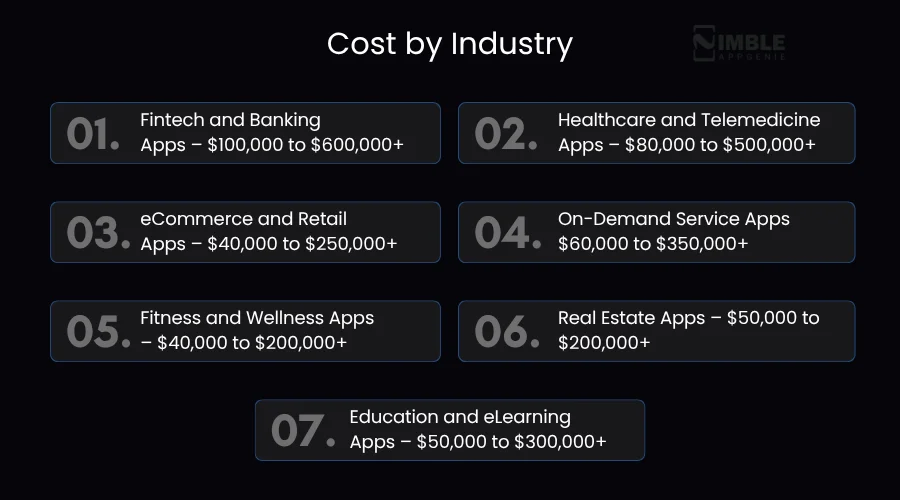
1. Fintech and Banking Apps – $100,000 to $600,000+
A complete guide on the average cost to develop a fintech app: $150,000 – $400,000 (mid-tier)
Financial apps demand bank-level security, regulatory compliance, and complex transaction logic across jurisdictions with real-time data processing. Whether you are developing a neobank, lending app, payment solution, or investment platform, the technical needs are most demanding in software.
Core features: End-to-end encryption, biometric authentication, real-time transaction processing, PCI-DSS compliance, and KYC/AML workflows.
2. Healthcare and Telemedicine Apps – $80,000 to $500,000+
Average cost of telemedicine platforms – $120,000 – $350,000 (fully-featured)
Healthcare applications face an extremely high compliance bar in any industry.
HIPAA compliance (US), GDPR (EU), and local health data regulations are mandatory; they are basic requirements. Features like insurance verification, e-prescriptions, and medical device connectivity add substantial complexity.
Core features: HL7/FHIR API integration, encrypted data storage, appointment scheduling, video consultation, and patient portal.
Key Compliance Overhead: FDA guidance for medical devices, HIPAA, and state licensing requirements.
3. eCommerce and Retail Apps – $40,000 to $250,000+
Average eCommerce app development cost: $60,000 – $150,000 (fully featured)
eCommerce mobile apps should be appealing, reliable, and fast during peak traffic. Core needs include search and filtering, product catalog management, multiple payment methods, AR-powered try-on, and returns management features.
Core features: Checkout, product catalog, payment gateway, cart, loyalty programs, order tracking, and push notifications.
4. On-Demand Service Apps – $60,000 to $350,000+
The ‘Uber for X’ model remains at the top among the most popular app categories, being one of the most complex technically. Dynamic pricing algorithms, surge management, and driver/provider matching all drive significant development investment.
Average cost of on-demand service apps: $80,000 – $200,000 (basic)
Core features: Provider-consumer matching, real-time tracking, ratings and reviews, geofencing, and in-app payments.
5. Fitness and Wellness Apps – $40,000 to $200,000+
Average cost of fitness and wellness apps: $55,000 – $140,000 (mid-tier)
The fitness app market is severely competitive. To outshine the competitors, you need AI-personalized plans, sophisticated workout tracking, nutrition databases, wearable device integration (Apple Watch, Fitbit, and Garmin), compelling subscription management, and social databases.
6. Real Estate Apps – $50,000 to $200,000+
Average cost to create a real estate app: $60,000 – $160,000 (mid-tier)
Modern real estate apps feature MLS/IDX integration, mortgage calculators, virtual tours, neighborhood analytics, and agent communication tools.
7. Education and eLearning Apps – $50,000 to $300,000
Average cost to build an EdTech app: $70,000 – $180,000 (a complete learning platform)
EdTech apps range from basic course viewers to advanced adaptive learning platforms with AI-driven personalization, live tutoring, certification management, and gamification. COPPA compliance is needed for apps targeting users under 13.
Core Features: Video streaming, certificates, course management, progress tracking, live sessions, and assessments.
♦ Mobile App Development Cost By Industry – A Quick Snapshot
| Industry | Cost Range (2026) | Complexity | Key Cost Driver |
| Fintech / Banking | $100K – $600K+ | High | PCI-DSS, KYC/AML |
| Healthcare / Telemedicine | $80K – $500K+ | High | HIPAA, EHR integration |
| On-Demand Services | $60K – $350K | High | Real-time GPS, matching |
| eCommerce / Retail | $40K – $250K | Medium | Catalog, payments, returns |
| Education / eLearning | $50K – $300K | Medium | Live sessions, LMS logic |
| Real Estate | $50K – $200K | Medium | MLS/IDX, AR tours |
| Fitness & Wellness | $40K – $200K | Medium | Wearables, subscriptions |
Hidden Costs Nobody Tells You About
Most cost estimates you will find on the web focus on initial development. The real cost of mobile app ownership includes ongoing expenditures designed to keep the app secure, operational, and competitive in a fast-evolving market.
Below are the hidden costs that usually shock first-time app owners:
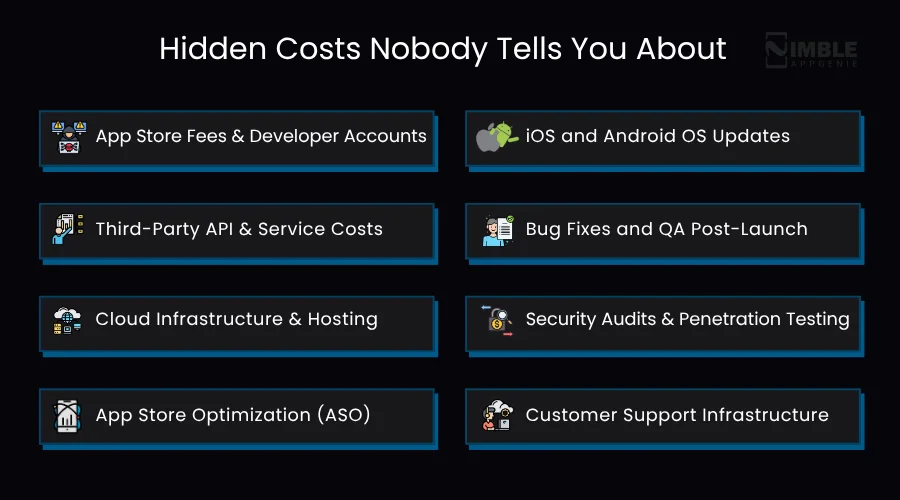
1. App Store Fees and Developer Accounts
- Google’s Play Store: $25 Registration Fee (One-time)
- Apple for iOS Developer Account: $99/year
Both platforms charge a 15-30% commission on subscriptions and purchases, a substantial factor for subscription-based business models.
Apple’s App Store review process usually takes 1-3 days, but can take 2+ weeks for complex apps, affecting your launch timeline and demanding a buffer in your planning.
2. Third-Party API and Service Costs
Every API integration brings its pricing model.
Consider the cumulative cost of payment processing (Stripe charges 2.9% + $0.30 per transaction), Twilio for SMS and voice, Google Maps API (charged every map load), and Firebase for real-time features. SendGrid for email, and analytics platforms like Amplitude or Mixpanel.
These costs are hidden in most development quotes but can increase $500-5000/month in operational overhead depending on usage volume.
3. Cloud Infrastructure and Hosting
Your mobile app needs databases, servers, content delivery networks, and storage. Google Cloud, Azure, and AWS all provide scalable infrastructure.
A platform managing 100,000+ active users could run $3,000-15,000/month or more.
Various development quotes don’t mention infrastructure setup, which can contribute $5000-20,000 to the initial build and ongoing monthly operational costs.
4. App Store Optimization (ASO)
Developing the app is just the start. If no one could find it on Google Play or the App Store, your investment generates zero return.
Professional ASO – screenshot optimization, keyword research, A/B testing your store listing, and rating management typically costs $2,000-8,000 initially and $500-2,000 per month ongoing.
| “Building the app is 40% of the investment. The other 60% is everything that happens after you ship.” – Nimble AppGenie Project Manager |
5. iOS and Android OS Updates
Apple and Google release significant OS updates annually, mostly introducing breaking changes to UI components, APIs, and app behaviors.
Every major update generally requires 20-80 hours of developer time to ensure your app stays compatible.
At $50-150/hr, that’s $1,000-12,000 every major OS update cycle.
6. Bug Fixes and QA Post-Launch
It doesn’t matter how deep your pre-launch testing is; real users will definitely find bugs that your QA team overlooked or missed.
Budget for at least 2 to 3 sprint cycles of post-launch bug fixing, generally adding 10-15% to your development cost.
7. Security Audits and Penetration Testing
Annual security audits and sensitive user data handling are essential for apps, and in some apps, it’s legally required.
Professional penetration testing usually costs $5,000-25,000 for every engagement.
8. Customer Support Infrastructure
How will users contact you when they have issues? Developing in-app support chat, staffing customer support, and integrating with help desk software are ongoing costs, and initial budgets are often ignored.
♦ A Quick Analysis of the Hidden Cost of App Development
| Hidden cost | Typical amount | Frequency | What to watch for |
| App Store fees & commissions | $25–$99/yr + 15–30% cut | Annual | Apple takes 15–30% of all in-app purchases and subscriptions |
| Cloud infrastructure & hosting | $50–$15,000/mo | Monthly | Scales with active users; often excluded from dev quotes |
| Third-party API costs | $500–$5,000/mo | Monthly | Stripe, Google Maps, Twilio, and Firebase each has its pricing |
| App Store Optimization (ASO) | $2K–$8K setup + $500–$2K/mo | Ongoing | Without ASO, discoverability and downloads suffer significantly |
| Post-launch bug fixes | 10–15% of dev cost | One-time | Real users always find issues QA missed, budget 2–3 sprint cycles |
| OS update compatibility | $1,000–$12,000/cycle | Annual | Apple & Google’s major releases often break existing API behavior |
| Security audits & pen testing | $5,000–$25,000 | Annual | Legally required in healthcare and fintech; highly recommended elsewhere |
| Customer support infrastructure | Varies by scale | Ongoing | In-app support chat, help desk software, and support staffing |
How AI is Changing App Development Cost in 2026?
Artificial Intelligence influences mobile app development in two different ways:
- As a feature to build, and
- A tool transforming how development takes place
Understanding both concepts is important for the one budgeting an app project in 2026.
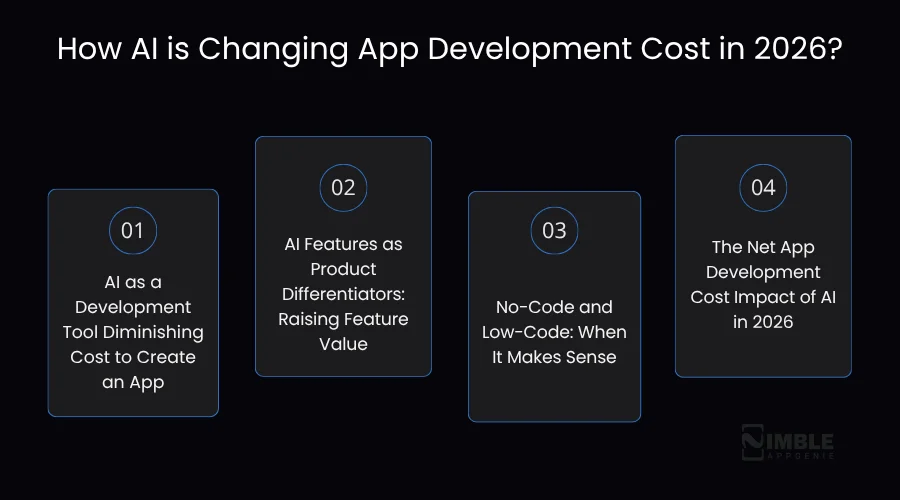
► AI as a Development Tool – Diminishing Cost to Create an App
The most immediate impact of AI on app development cost is taking place inside development teams.
AI-powered coding tools – GitHub Copilot, Cursor, Claude, and specialized tools like Tabnine – have noticeably boosted developer productivity.
At Nimble AppGenie, our internal data across 50+ projects reveals that AI coding assistance reduces daily development tasks – unit test writing, boilerplate code, basic CRUD operations, and documentation by 30-40%.
Although complex architecture decisions, novel integrations, and creative problem-solving still need senior human proficiency.
AI paces the work, doesn’t replace development judgment.
► AI Features as Product Differentiators: Raising Feature Value
On the product edge, AI-powered features are becoming an entry cost in competitive app categories.
Now, users expect:
- AI-powered search with natural language queries
- Personalized content recommendations (Netflix-style)
- Predictive analytics and behavioral insights
- Computer vision for AR try-on, document scanning, or image recognition
- Intelligent chatbots and virtual assistants
- Voice interfaces and multimodal interaction
Integrating a pre-built AI API (like Google Gemini, OpenAI, or Anthropic’s Claude) into your application adds $15,000-50,000 to development cost.
Building custom ML models is considerably more expensive – $80,000-300,000+, and generally only justified for brands with proprietary data advantages.
| “AI won’t replace developers — but developers who use AI will replace those who don’t.” – Attributed to Jeff Atwood, Co-founder of Stack Overflow |
► No-Code and Low-Code: When It Makes Sense
Platforms like Adalo, Bubble, FlutterFlow, and Webflow allow non-developers to create functional apps at a fraction of traditional app development cost.
For very simple apps, MVP validation, or internal tools, no-code can cut costs by 60-80%.
The compromises are real: vendor lock-in, performance limitations, scalability constraints, and limited customization make no-code unsuitable for consumer applications demanding significant growth or needing complex backend logic.
► The Net App Development Cost Impact of AI in 2026
AI is diminishing the cost of developing standard features while simultaneously increasing user expectations for what a competitive app demands to include.
The complete effect for most app projects is approximately cost-neutral to moderately positive, with the huge savings on simpler, well-scoped projects.
How to Reduce Your App Development Cost?
Budget optimization doesn’t mean compromising quality – it means making smarter decisions about investments.
Here are the proven strategies Nimble AppGenie recommends to worldwide clients looking to boost ROI:
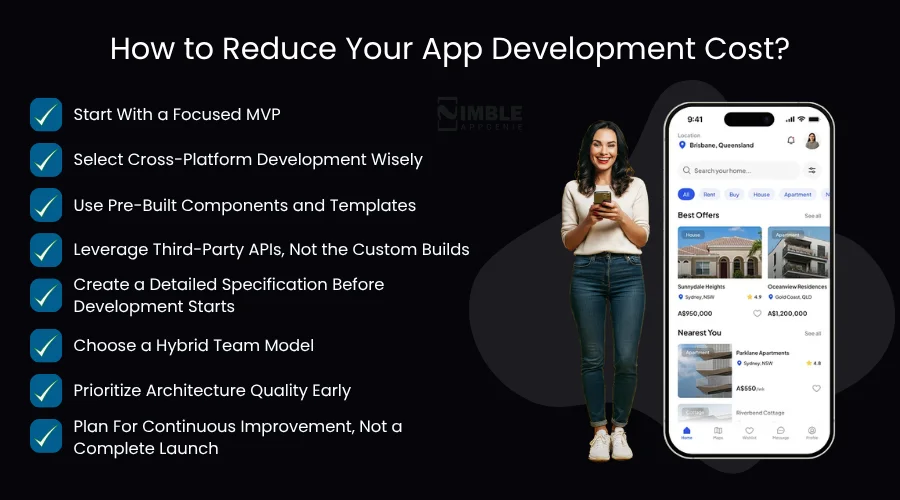
- Start With a Focused MVP
- Select Cross-Platform Development Wisely
- Using Pre-Built Components and Templates
- Leverage Third-Party APIs, Not Custom Builds
- Create a Detailed Specification Before Development Starts
- Choose a Hybrid Team Model
- Prioritize Architecture Quality Early
- Plan for Continuous Improvement, Not a Complete Launch
Want to optimize your app budget without compromising performance or user experience? Read our guide on how to reduce mobile app development cost without cutting quality for practical strategies that help startups and businesses save smarter.
How Can Nimble AppGenie Help You Build Apps Within Your Budget?
At Nimble AppGenie, a trusted mobile app development company, we have helped 500+ startups, enterprises, and SMBs across 30+ countries turn their app ideas into market-leading products.
We comprehend that app development budget is not only a limitation, but it’s also a strategic asset that demands to be deployed smartly.
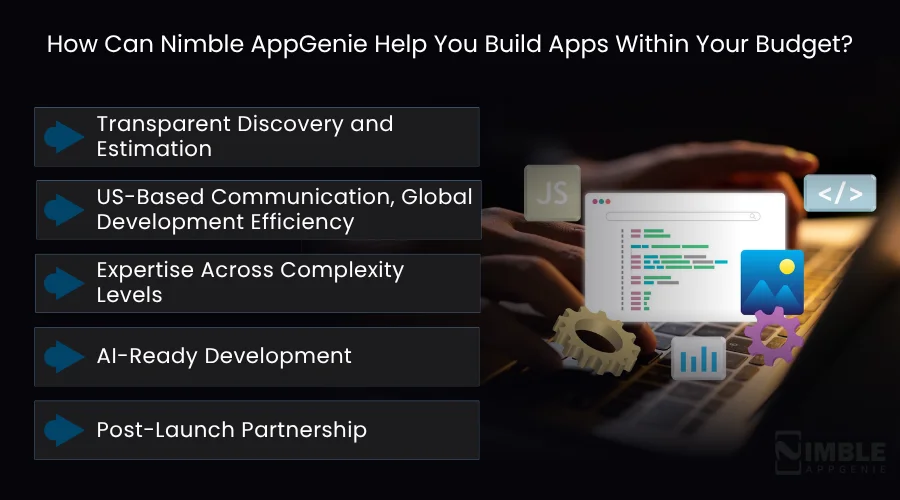
➤ Transparent Discovery and Estimation
We don’t give unclear quotes. Every engagement begins with a structured Discover phase where we analyze your objectives, user requirements, competitive landscape, and technical requirements to deliver a detailed timeline, scope, and fixed-price or milestone-based cost estimate you can plan around.
➤ US-Based Communication, Global Development Efficiency
Our clientele works directly with US-based project managers and solution architects who fluently speak your business language. Our development teams are thoroughly vetted for technical excellence, delivering North American-quality work at notably more competitive costs.
| “We don’t just build apps. We help you decide what to build, why to build it, and how to make it pay for itself.” – Nimble AppGenie Founder. |
➤ Expertise Across Complexity Levels
Whether you want an MVP to validate your idea or a full-fledged enterprise platform, we have a mobile app development team to deliver. Our portfolio spans fintech, healthcare, on-demand services, enterprise SaaS, eCommerce, and Edtech across Android, iOS, and cross-platform.
➤ AI-Ready Development
We don’t just build apps that perform today, we develop applications that are set for what’s next. Every project includes performance optimization, an AI integration strategy, and a scalable architecture crafted to evolve with your business.
➤ Post-Launch Partnership
We don’t end the partnership after launch; we stay connected with our maintenance and growth packages to keep your app up-to-date, continuously improving, and secure based on dynamic market demands and real user data.
Ready to get a real number for your specific app? Contact Nimble AppGenie for a free, no-obligation consultation and project estimate. We will tell you exactly what your app will cost and why.
Conclusion
Mobile app development in 2026 is defined by the choices you make. From app complexity and platform selection to development team location and post-launch planning, every decision directly affects your final budget.
While mobile app development costs can range widely, the intelligent approach is not about spending less; it’s about spending strategically.
Successful businesses prioritize a focused MVP, utilize cross-platform technologies, and plan early for hidden costs and future growth. Simultaneously, popular AI tools are accelerating mobile app development, but they raise the bar for user expectations, making thoughtful feature planning more critical than ever.
Ultimately, building an app in 2026 that can thrive comes down to balancing cost, long-term value, and quality. With the right strategy, choosing the right app development company, and the right mobile app tech stack, you can turn your vision into a high-performing product without excessive overspending.
Come to us with your app idea, and our specialists will help you with app development costs based on platforms, features, and complexity. Get your exact cost estimate.
FAQs
iOS apps are commonly 10-20% less expensive to develop than equivalent Android apps due to Apple’s more standardized device ecosystem, which decreases mobile app testing overhead. However, reaching Android’s larger global market often justifies the additional investment. Cross-platform frameworks like Flutter bring both to near-parity at a lower total cost.
The most cost-effective approaches are:
- No-code platforms for simple, internal, or MVP tools.
- Cross-platform development using Flutter or React Native.
- Offshore or near-shore development teams with strong vetting.
- MVP-first scoping that defers non-critical features.
Combining these strategies can reduce costs by 40-60% than traditional full-scope, domestic app development.
Red flags include quotes without the discovery phase, fixed-price bids on poorly scoped projects, rates dramatically below regional averages (often indicating inexperienced teams or hidden costs), no clear communication about technology stack and mobile app architecture decisions, and a lack of references to relevant prior work. A reasonable quote includes a clear scope of work, a milestone-based payment structure, and transparent hourly rates or project costs with justification.

Niketan Sharma, CTO, Nimble AppGenie, is a tech enthusiast with more than a decade of experience in delivering high-value solutions that allow a brand to penetrate the market easily. With a strong hold on mobile app development, he is actively working to help businesses identify the potential of digital transformation by sharing insightful statistics, guides & blogs.
Table of Contents




No Comments
Comments are closed.