


TL;DR:
- The global crypto exchange market is heading toward $213 billion by 2034, and if you are planning to build a cryptocurrency exchange app like Coinbase, the business case is already proven.
- You are not building a blockchain or a coin. You are building an application layer – trading engine, wallet, and fiat on-ramp on top of existing networks like Ethereum, Solana, and BNB Chain.
- There are 5 types of crypto apps you can build: CEX, DEX, Wallet App, Trading App, and Payment App. Pick one before anything else.
- Minimum viable features: KYC/AML, multi-currency wallet, buy/sell/trade, real-time charts, fiat on-ramp, 2FA, portfolio tracker, and an admin dashboard.
- Tech stack in short: React Native or Flutter (frontend), Node.js + Go (backend), Web3.js or Ethers.js (blockchain), PostgreSQL + MongoDB (database).
- Development has 10 steps – not 8. Most guides skip liquidity setup and fiat gateway integration. Both will kill your launch if missed.
- Compliance is not optional. US needs FinCEN + state MTLs. The UK needs FCA authorization. The EU needs MiCA. Start legal in parallel with design.
- Security non-negotiables: 95% cold storage, withdrawal whitelisting, proof of reserves, real-time transaction monitoring, and a third-party audit before launch.
- Cost ranges from $20,000 (basic wallet) to $500,000+ (enterprise exchange). Compliance and security typically eat 25–35% of your total budget.
- Biggest mistakes first-time builders make: skipping liquidity setup, underbudgeting compliance, hiring generalist developers for blockchain work, and launching without a security audit.
- Crypto exchange development is complex; your development partner needs fintech and compliance experience, not just coding ability.
- Nimble AppGenie specializes in end-to-end cryptocurrency exchange app development for the UK and US markets.
The global crypto exchange market is projected to reach $213 billion by 2034, creating significant opportunities for new entrants. Coinbase proved that a well-developed crypto app can drive 56 million verified users and process millions of monthly transactions.
This guide is for founders, product owners, and fintech companies who want to build a cryptocurrency exchange app like Coinbase, not only to understand what one is. Whether you are planning to develop a crypto wallet app, a multi-asset trading platform, or a niche regional exchange for a specific audience, here you will find everything you need.
By the time you finish reading, you will know the steps to build a crypto app like Coinbase, what features to build, which tech stack to use, how compliance works in 2026, and how to get your MVP to market without wasting budget.
What Is a Cryptocurrency Exchange App Like Coinbase?
Coinbase is a centralized exchange (CEX) that combines three products in one: a trading platform where users buy and sell crypto, a fiat on-ramp that lets people convert dollars or pounds into crypto instantly, and a self-custody wallet for holding digital assets.
It’s one of the most recognized names in the fintech industry – listed on NASDAQ, regulated in the US and UK, and trusted by institutional and retail users alike.
When a fintech startup says they want to build a cryptocurrency exchange app like Coinbase, they mean creating an application layer – the trading engine, user interface, and wallet infrastructure. You are not creating a new coin or a new blockchain. You are building a platform on top of existing blockchain networks.
In 2024, Coinbase rolled out Base, its Ethereum Layer 2 network, and is now expanding into a super app model that integrates payments, DeFi access, staking, and an AI-powered wallet assistant into a single product. That direction indicates where the industry is heading: integrated, multi-function crypto platforms with a consumer-first design.
Your opportunity is to create something similar but smarter for your target audience.
Why Build a Crypto Exchange App in 2026?
The regulatory uncertainty that held back crypto investment for years is clearing. Two major frameworks now provide businesses with real clarity:
- The GENIUS Act (US): Passed in 2025, this legislation establishes clear rules for payment stablecoins, creating a legal framework for US-based crypto apps to operate with confidence.
- MiCA (EU): The Markets in Crypto Assets regulation took complete effect in 2024, offering a unified licensing pathway across 27 EU member states. For any European launch, this is your compliance base.
Those regulatory developments have unlocked fresh institutional capital. Venture investment in crypto infrastructure is growing again, and enterprise adoption of blockchain-based payments is speeding up.
| As of Q1 2026, Coinbase has 1 million+ paid subscribers, which has led to around 12% of the user base transacting monthly. It’s validation that a well-designed, compliant crypto exchange is a scalable business. |
The gap in the crypto exchange market is not another generic global exchange. It’s regional and niche platforms; an exchange created for one country’s compliance requirements, a crypto payment gateway development for a specific industry, or a trading app focused on a single asset class.
Coinbase can’t serve every audience with the same depth, and that’s your opening.
Must-Have Features of a Coinbase-Like App
Features are where most apps win or lose. If you build too little, users will leave, and if you build the wrong things, you waste the chance.
Here is what a production-ready crypto exchange app demands – split into what users see and what your team manages on the back-end.
User-Facing Features
- KYC/AML Verification: Identity verification is non-negotiable in any regulated market. Integrate automated Know Your Customer (KYC) tools, such as Onfido or Jumio, to verify IDs, confirm liveness, and screen against sanction lists. Anti-Money Laundering (AML) monitoring should run constantly, not just at signup.
- Multi-Currency Wallet: Users need a single wallet to hold Bitcoin, Ethereum, stablecoins, and other assets. Support hot wallets for active trading and allow users to move funds to cold storage.
- Buy / Sell / Trade: The core transaction engine that permits users to buy crypto with fiat, sell crypto back to fiat, and trade one asset for another. Include market orders, limit orders, and clear fee disclosures before confirmation.
- Real-Time Price Charts: Integrate charting tools (TradingView is the industry standard) so users can view candlestick charts, analyze price movements, and set their own timeframes.
- Portfolio Tracker: Show users their total holdings, asset allocation, percentage gains and losses, and transaction history. This is a retention feature through which users track performance and come back more often.
- Fiat On/Off Ramp: Fiat on-ramp and off-ramp integration is what connects your exchange to real-world money. The on-ramp lets users deposit funds via bank transfer, debit card, or third-party providers like MoonPay or Transak. The off-ramp lets them withdraw back to their bank account. Without this, your platform is isolated from real-world money, and most users will never fund their accounts.
- Two-Factor Authentication (2FA): Mandatory for account security. It supports authenticator apps (Google Authenticator, Authy) as well as SMS-based verification.
- Push Notifications: Alert users when prices reach their targets, when a transaction completes, or when there is a security event on their account. Notifications drive engagement without needing the user to stay in the app.
- In-App Customer Support: A live chat or ticketing system fosters trust. Users encountering issues with their money need fast, reliable help; a missing support channel is one of the top reasons users abandon crypto apps.
Admin & Operations Features
- Admin Dashboard: A control panel for your team to manage users, update fee structures, review flagged transactions, list new tokens, and monitor platform health in real time.
- Transaction Monitoring: Automated tools that flag suspicious activity – large transfers, unusual patterns, or accounts attempting to avoid KYC. It’s required for AML compliance in most jurisdictions.
- Fee & Liquidity Management: Configure trading fees (flat or percentage-based), manage maker/taker spreads, and monitor liquidity depth across trading pairs. This is your primary revenue control panel.
Advanced Features to Differentiate Your Cryptocurrency Exchange App
Once you make your core product live, these crypto exchange app features make users stay on your platform and pay more.
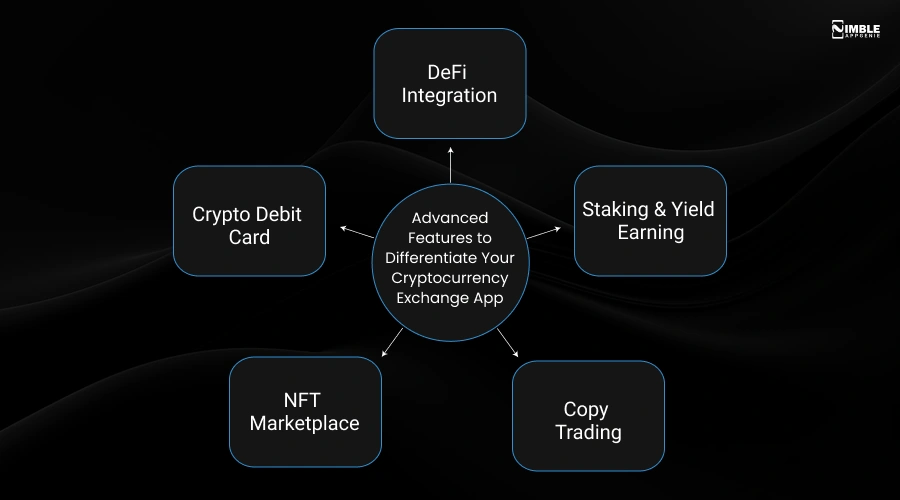
- DeFi Integration: Connect your app to decentralized finance protocols, like lending, borrowing, and liquidity pools, without users needing to handle their wallets manually. You capture the value of DeFi while diminishing the complexity.
- Staking & Yield Earning: Allows users to earn rewards by staking supported cryptocurrencies. Coinbase gets a percentage of all staking rewards as commission. This is a low-friction, reliable revenue stream that needs minimal trading volume to generate income.
- Copy Trading: Permits less experienced users to mirror the trades of verified top performers on your platform. Revenue model: a percentage of subscription fees or follower profits for access to premium traders.
- NFT Marketplace: Add a section where users can find, buy, and sell NFTs. Even a basic NFT storefront builds a new category of transaction fees and expands your platform’s appeal beyond pure trading.
- Crypto Debit Card: Partner with a card issuer (like Margeta or Baanx) to offer users a card that lets users spend their crypto anywhere that accepts Mastercard or Visa. Interchange fees from each swipe become recurring revenue.
Tech Stack For Cryptocurrency Exchange App Development
Fintech firms usually ask, “What tech stack does Coinbase use?” The answer to this is that your technology choices impact cost, security, scalability, and how swiftly you can ship. Below is the stack used across production-grade crypto platforms.
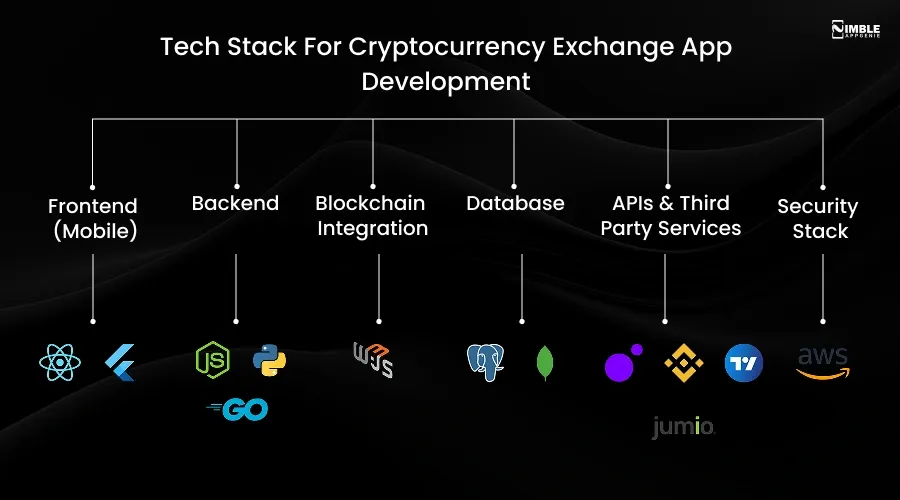
Frontend (Mobile)
- React Native: Build Android and iOS from a single codebase. Faster to ship and seamless to maintain for most startup budgets.
- Flutter: Google’s UI framework delivers near-native performance with perfect charting and animation support, useful for data-heavy trading screens.
Understand the differences between Flutter and React Native.
Backend
- Node.js: Event-driven, fast, and well-suited to high-frequency, real-time API requests.
- Python: Used for algorithmic trading logic, data analytics, and machine learning-based risk scoring.
- Go (Golang): Chosen for the trading engine and order matching system, where microsecond-level performance matters.
Blockchain Integration
- Web3.js / Ethers.js: The two leading JavaScript libraries for connecting your app to Ethereum-compatible blockchains.
- Supported Networks: Ethereum, Solana, BNB Chain, and Polygon cover the majority of user demand and DeFi activity in 2026.
Database
- PostgreSQL: For transactional data that requires strict consistency: user accounts, trade records, balances.
- MongoDB: For flexible, high-volume data such as market data feeds, notification logs, and analytics events.
APIs & Third-Party Services
If you want to know – “What APIs does Coinbase use for trading?” Here you go:
- MoonPay / Transak: Fiat on/off ramp processing.
- Binance API / Coinbase Pro API: For price feeds and liquidity aggregation.
- TradingView: Charting widgets.
- Onfido / Jumio: KYC verification.
Security Stack
- SSL/TLS encryption across all communication layers
- HSM (Hardware Security Module) for private key management
- AWS CloudFront or Cloudflare for DDoS mitigation
- Regular third-party penetration testing and smart contract audits
Step-by-Step Development Process to Build A Cryptocurrency Exchange App Like Coinbase
How to develop a cryptocurrency app like Coinbase? Cryptocurrency exchange app development is not a single sprint; it’s a structured process that moves from research to revenue.
Now you will ask: “What are the steps to build a crypto trading app?” Below are the 10 stages every build goes through.
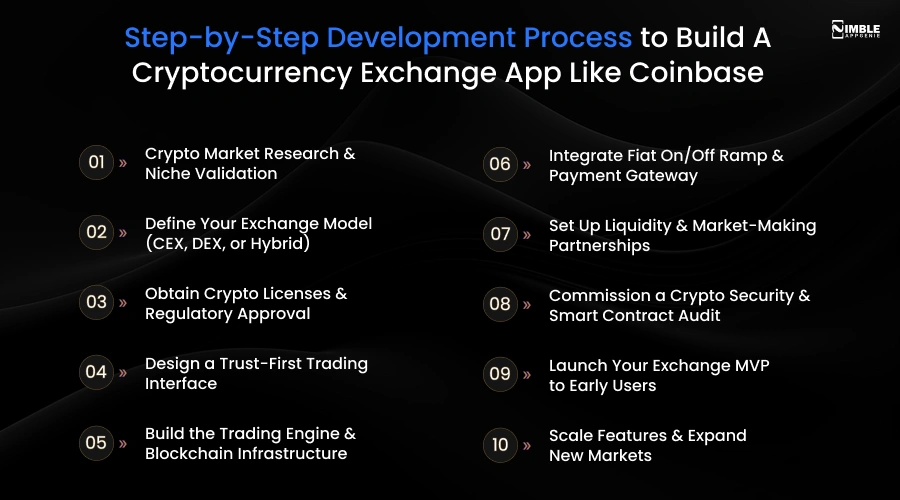
Step 1: Crypto Market Research & Niche Validation
Define your target user, identify your competitive gap, and validate that your exchange concept has a paying audience. Are you building for institutional users, retail traders, or a specific region? Know exactly who you are developing for before starting with the code.
Know more about: How to Do Mobile App Market Research?
Step 2: Define Your Exchange Model (CEX, DEX, or Hybrid)
Define whether you are creating a centralized exchange, a decentralized exchange, or a hybrid model. This single decision transforms every subsequent choice, from your licensing needs and tech architecture to how you handle user funds and liquidity.
Step 3: Obtain Crypto Licenses & Regulatory Approval
Engage a crypto-specialist before you start. In the US, you need FinCEN registration and state money transmitter licenses, in the UK, FCA authorization, and in the EU, MiCA registration. Start this process along with design, as regulatory approval takes time and can’t be rushed.
Step 4: Design a Trust-First Trading Interface
Build wireframes and an interactive prototype before you begin your crypto exchange app development. Users are moving real money, so ensure every screen, confirmation dialog, and error message reduces anxiety, not creates it.
Test with real users beforehand. A confusing UI is one of the major reasons crypto apps fail at launch.
Step 5: Build the Trading Engine & Blockchain Infrastructure
This is the core of the platform. Create your order matching engine, API integrations, wallet infrastructure, and database architecture.
Smart contract development and blockchain integration require specialists if you are building a DEX. This is not the phase to cut costs by choosing a general team of app developers.
Step 6: Integrate Fiat On/Off Ramp & Payment Gateway
Connect your exchange to real-world money. Integrate a fiat on-ramp provider, like Transak, MoonPay, or a direct banking partner, to let users deposit and withdraw in pounds, dollars, or euros.
This is a different technical and compliance step, not an afterthought in backend development.
Step 7: Set Up Liquidity & Market-Making Partnerships
An exchange without liquidity is dead on commencement. Before launch, connect to market makers or liquidity providers to ensure your order books have sufficient depth for users to trade without excessive slippage. Most first-time builders miss this step and pay for it after launch.
Step 8: Commission a Crypto Security & Smart Contract Audit
Before your product reaches users, bring in a third-party security firm. This includes penetration testing on your mobile and web layers, smart contract auditing for any DeFi or DEX features, and a complete review of your key management practices.
Skipping this step has bankrupted exchanges; don’t take it as optional.
Step 9: Launch Your Exchange MVP to Early Users
Release your app to a limited, regulated audience. Focus on the core loop – register, fund, verify, and withdraw, collect real user data, and fix friction. This is a controlled technical validation, not a marketing stunt.
Step 10: Scale Features & Expand New Markets
Once your main exchange is stable, add advanced features – staking, DeFi integrations, copy trading, and an NFT marketplace.
Grow into new jurisdictions with the compliance base already in place. The most successful exchanges treat their platforms as consistently evolving products, not finished projects.

Best Security Practices for Your Cryptocurrency Exchange App
For Coinbase clone app development, security is the most critical non-functional requirement, which determines users’ trust in you with their money and whether your business will survive.
The Bybit hack in February 2025 stands as one of the largest cryptocurrency exchange breaches in history, with attackers stealing about $1.4 billion in Ethereum (ETH). Mt. Gox lost 850,000 Bitcoin. The Ronin Network breach cost $625 million. These are not rare cautionary tales, but the baseline risk if you don’t build security in from day one.
Fintech companies usually come with a query: How do I prevent my crypto app from getting hacked? Below are the best practices to follow.
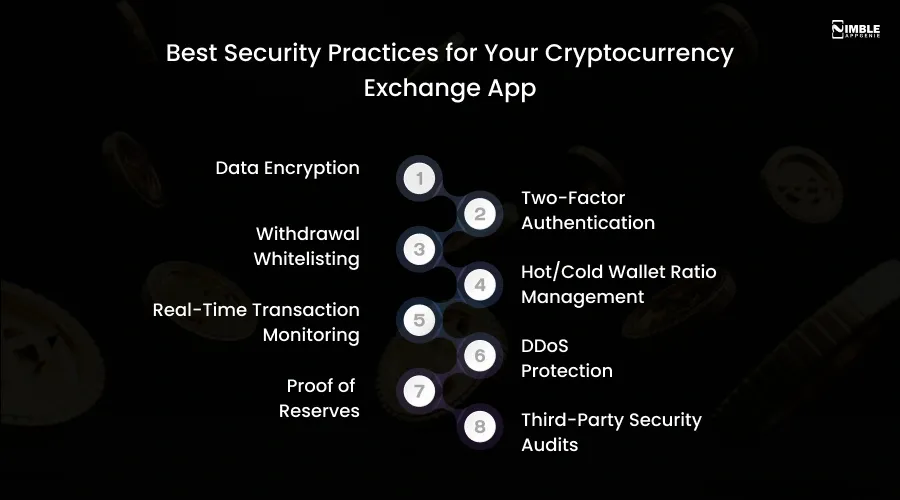
1. Data Encryption
All user data should be encrypted at rest, using AES-256, and in transit using TLS 1.3. Never store private keys or seed phrases on your servers in plain text. If your database is breached, encryption is the last line of defence between your users’ funds and an attacker.
2. Two-Factor Authentication (2FA)
It is mandatory for all user accounts. For operational accounts and admin accounts, you need hardware security keys (FIDO2/WebAuthn), not SMS-based 2FA. SMS can be intercepted via SIM-swapping attacks. Hardware keys can’t.
3. Withdrawal Whitelisting
Allow users to pre-approve a list of withdrawal addresses before any funds leave their account. Even if an attacker gets full login access, they can’t withdraw to an unapproved address. Coinbase leverages this, which is an exchange-specific control that generic fintech apps don’t need.
4. Hot/Cold Wallet Ratio Management
Store at least 95% of platform funds in cold storage – hardware wallets are physically disconnected from the internet. Only maintain a small operational float in hot wallets to cover active withdrawals.
This is the only effective defense against exchange hacks. Coinbase, Kraken, and Binance all publish their cold storage ratios publicly; you should do the same. It is a direct trust signal to your users.
5. Real-Time Transaction Monitoring
Deploy automated monitoring that flags suspicious withdrawals, unusual trading patterns, abnormal login locations, and bot activity in real time.
This is not general fintech compliance; this is exchange-specific operational security. Set thresholds, build escalation workflows, and ensure your operations team can freeze accounts within minutes of a flag.
6. DDoS Protection
Deploy a CDN layer with AWS Shield or Cloudflare. Exchanges are high-value DDoS targets; attackers will try to take your platform offline during peak trading periods to force panic withdrawals or cause financial damage. A successful attack during high-volume trading permanently ruins user trust.
7. Proof of Reserves
After the FTX collapse in 2022, proof of reserves became the trust standard for exchanges. Publish cryptographic, on-chain proof that your exchange holds the funds it claims to hold – verified independently, not self-reported. Users now expect this. Exchanges that can’t prove reserves are losing users to those that can.
8. Third-Party Security Audits
Commission audits from established security firms – Trail of Bits, CertiK, or Quantstamp for smart contracts, before every major release. Make audit reports publicly available. Sophisticated users read them before depositing significant funds. Treat your audit report as a marketing asset, not only an internal compliance document.
Build security into your cryptocurrency trading app development process from the first sprint. Retrofitting security after launch costs three times more. By the time you discover the gap, it may already have been exploited.
How Much Does It Cost to Build a Crypto App Like Coinbase?
Cost is always the primary concern for founders, where they usually ask:
- How much does it cost to build a crypto exchange like Coinbase?
- Is $50,000 enough to build a crypto trading app?
- How much does it cost to build a crypto exchange with good security?
- How much does it cost to start a cryptocurrency exchange in the United States?
- What is the cheapest way to build a cryptocurrency exchange?
- How much does a crypto wallet app development cost?
- How much does it cost to start a cryptocurrency exchange in the United States?
The short answer: it depends on what you’re building. Here’s the full breakdown.
Well, it depends on four variables: development team location, feature scope, the blockchains, and compliance complexity you need to support.
Below is a clear framework:
Cost Breakdown by App Type
| App Type | Estimated Cost | Timeline |
| Basic Crypto Wallet App | $20,000 – $40,000 | 2 – 3 months |
| Simple Trading App (MVP) | $40,000 – $80,000 | 3 – 4 months |
| Full Crypto Exchange (CEX) | $100,000 – $300,000 | 6 – 9 months |
| Enterprise-Grade Exchange | $300,000 – $500,000+ | 9 – 12 months |
| Cost Insight:
The biggest cost driver is not the features you build – it is the compliance and security infrastructure you cannot cut. KYC integration, security audits, and legal counsel typically account for 25–35% of total build cost on a CEX. Ensure a budget for this from day one, not as an afterthought. |
Key Cost Factors
- Feature Scope: Each advanced feature, like staking, copy trading, and the NFT marketplace, adds QA complexity and development time. Clearly define your MVP features and keep your MVP lean.
- Compliance Complexity: A single-market wallet app has minimal compliance overhead. A multi-jurisdiction CEX with fiat on-ramps needs legal counsel, automated KYC/AML tooling, and ongoing regulatory monitoring, all of which cost money.
- Team Location: A UK/US-based agency charges $100–$180 per hour. An Eastern European team runs $50–$90. South and Southeast Asian teams are $25–$60. Each tier comes with different communication and quality tradeoffs.
- Blockchain Choice: Ethereum integration is well-documented and relatively fast. Custom smart contract development for a DEX or integrating a less common blockchain adds significant development time.
The right cryptocurrency exchange development company for your budget is not always the cheapest. A mid-range app development team with fintech experience delivers better ROI than a low-cost team that has never created a regulated financial product.
Crypto apps deal with real money – the cost of getting it wrong far exceeds the cost of doing it right.

Compliance & Legal Requirements for Developing A Cryptocurrency Exchange App Like Coinbase
Most founders underestimate compliance, but regulators look at compliance first. Founders often ask: Do I need a license to run a cryptocurrency exchange? And what licenses do I need to build a crypto app in the US?
Below is what you need across the three largest markets.
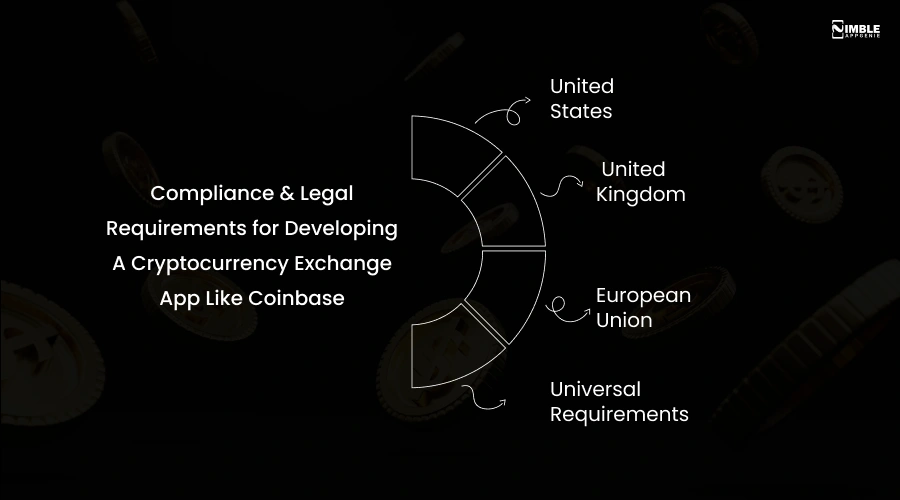
1. United States
- FinCEN Registration: Any business transmitting cryptocurrency in the US must register as a Money Services Business (MSB) with FinCEN. This is your federal baseline. This also answered your question – “What is FinCEN registration for crypto?”
- State Money Transmitter Licenses (MTLs): Most US states require a separate license to operate. New York’s BitLicense is the most rigorous. Obtaining licenses in all 50 states takes 12–18 months and significant legal spend.
2. United Kingdom
- FCA Registration: Crypto asset businesses in the UK should be registered with the Financial Conduct Authority (FCA) under the MLR 2017 anti-money laundering regime. FCA approval has a high rejection rate. So, build your compliance program before applying.
3. European Union
Many clients come to us asking, “What is MiCA and does it apply to my crypto startup?” Here you go:
- MiCA Authorization: The Markets in Crypto Assets regulation requires Crypto Asset Service Providers (CASPs) to obtain authorization from their home country regulator. A MiCA license provides EU-wide passporting rights.
4. Universal Requirements
Is KYC mandatory for all crypto apps? Well absolutely.
- KYC/AML: Regardless of jurisdiction, you should verify the identity of your users, monitor transactions, and report suspicious activity. This is not optional; it is the minimum operating standard in every regulated market.
Start your compliance process when you start your UI/UX design process. The two must run in parallel.
How Nimble AppGenie Builds Crypto Exchange Apps?
Nimble AppGenie, a leading blockchain development company, serves clients worldwide, especially the US and the UK, following its dedicated fintech practice. Our portfolio spans payment platforms, eWallet apps, DeFi tools, and complete crypto exchange builds across various jurisdictions.
We bring three things that generic development companies can’t: deep experience with regulated financial product development, a compliance-aware delivery process, and a security-first engineering culture that keeps you building on the right side of FinCEN, MiCA, and FCA requirements from day one.
What You Get Working With Us
- End-to-end development: discovery, design, backend, blockchain, security audit, and launch
- Transparent fixed-scope pricing with no hidden costs
- UK/US compliance experience built into your product architecture, not added later
- Post-launch support, monitoring, and iterative feature development
- Proven fintech portfolio – see our eWallet development work and fintech app development projects
Whether you are planning a basic crypto wallet development or a full-fledged CEX, the next step is a non-obligation consultation.
Get a free quote for your crypto app – our team will review your requirements and give you a clear scope, timeline, and cost estimate within 48 hours.
Start your crypto exchange development project today. Reach out to the Nimble AppGenie team.
Conclusion
Is Cryptocurrency Exchange App Development Like Coinbase Worth It in 2026? The short answer is yes, if you build it right.
The crypto trading market is growing. Regulation is clearer than it has ever been. Coinbase’s numbers prove the revenue model works. And the gap for niche, regional, and specialized exchanges is real.
But there are just as many failed crypto platforms. Most did not fail because the idea was wrong. They failed because the security was overlooked, the build was rushed, or compliance was treated as an afterthought.
The exchanges that win in 2026 are the ones that treat their platform as a financial product first and a technology product second. That means getting licensing right before launch, building security in from sprint one, and choosing a cryptocurrency exchange development partner with experience building regulated fintech products, not just apps.
If you are serious about developing a cryptocurrency exchange app like Coinbase, the next step is to have a conversation with an experienced team.
FAQs
Cost ranges from $20,000 for a basic wallet app to $500,000+ for an enterprise-grade exchange. The specific number depends on your feature list, the compliance requirements in your target market, and your development partner’s location and expertise.
A simple trading app MVP typically takes 3–4 months. A full centralized exchange with KYC, fiat on-ramp, and admin tools takes 6–9 months. Enterprise-grade platforms with multi-jurisdiction compliance and advanced features require 9–12 months.
Yes, in virtually every major market. In the US, you need FinCEN registration and state-level money transmitter licenses. FCA authorization is required in the UK. In the EU, MiCA authorization covers all 27 member states. Start your legal process before development begins.
You can obtain a cryptocurrency exchange license in the US in 6 to 24 months. The timeframe depends on whether you want to operate only in specific states or nationwide, and the type of service you offer.
A centralized exchange (CEX) is operated by a company that acts as the intermediary; it holds user funds and executes trades on their behalf. A decentralized exchange (DEX) runs on smart contracts with no central operator; users trade directly wallet-to-wallet. CEXs are more regulated but easier to use. DEXs are more complex to build and audit.
Yes. Nimble AppGenie builds end-to-end crypto exchange apps for founders and businesses in the UK, US, and globally. We handle design, development, blockchain integration, security auditing, and compliance-aware architecture. Contact us for a free project quote.

Niketan Sharma, CTO, Nimble AppGenie, is a tech enthusiast with more than a decade of experience in delivering high-value solutions that allow a brand to penetrate the market easily. With a strong hold on mobile app development, he is actively working to help businesses identify the potential of digital transformation by sharing insightful statistics, guides & blogs.
Table of Contents
No Comments
Comments are closed.