

 Free Consultation
 PCI-DSS Compliant
 GDPR Ready
 ISO 27001
 NDA Protected
 AI Services
 AI App Development
 Generative AI Development
 AI Chatbot Development
 AI Integration Services
 AI Consulting Services
 AI For Fintech
 AI Financial Assistant Solution
 AI Insurance Agent Development
 Tech Stack
 OpenAI / GPT-4
 Claude / Anthropic
 Gemini / Google AI
 Llama / Open Source
 LangChain / LlamaIndex
 Pinecone / Pgvector
 AWS / Azure AI


 Fintech Solution
 Core Fintech
 App Development
 Neobank Solutions
 eWallet Solutions
 Lending Software
 Banking Solutions
 BNPL Solutions
 BNPL Solutions
 Insurance App
 Wealth Management
 Crypto & DeFi
 Blockchain Development
  Payroll Software
 DeFi Solutions
 Crypto Wallet
 Crypto On/Off Ramp
 Crypto Exchange
 Trading Platform
 Payments
 Compliance
 Regulations & Compliance
 Fraud Detection
 Lending Ecosystem
 P2P Lending Platform
 Mortgage Software
 Engagement
 Fintech Outsourcing

 Mobile Development
 Mobile App Dev
 iOS App Development
 Android App Development
 React Native
 Flutter Development
 Web Solution
 Node.js Development
 React.js Development
 Angular Development
 App Services
 UI/UX Design
 App Maintenance
 By Stage
 MVP Development
 Industry Solutions
 Healthcare App Dev
 Education App Dev
 Travel App Dev
 Real Estate App Dev
 Logistics Software
 Social Media App

 Hire Mobile Developers
 Hire iPhone Developers
 Hire Android Developers
 Hire React Native Devs
 Hire Flutter Developers
 Hire Web Developers
 Hire Node.js Developers
 Hire Angular Developers
 Hire PHP Developers
 Hire Laravel Developers
 How It Works
 Pre-Vetted Developers
 Ready In 48 Hours
 NDA From Day One
 Replace Guarantee
 Company
 About Us
 Our Work Process
 Portfolio
 Case Studies
 Blog / Insights
 Careers
 Contact Us
 Awards
 Recognition


 Offices


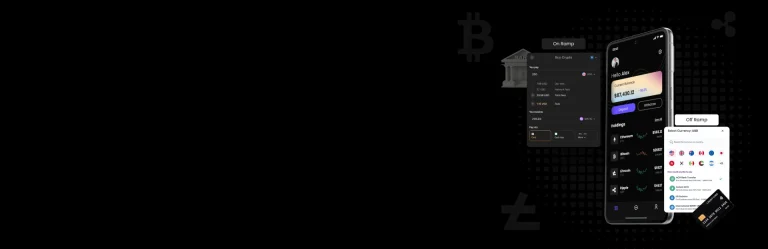
Key Takeaways:
- The cryptocurrency market is expected to grow to USD 18.2 billion by 2033.
- Crypto on-ramp does facilitate the exchange of fiat to cryptocurrencies, while the crypto-off ramp converts the cryptocurrencies to fiat.
- Your platform requires both to build trust, allowing users to realize profits and withdrawals, support regulatory compliance, increase liquidity, and improve overall user experience.
- The integration process begins with evaluating the need, searching for available integration models, choosing the provider, handling webhooks, testing in Sandbox, and launching and monitoring.
- The challenges in integration include compliance challenges, KYC challenges, fragmented regulations, market volatility, and authentication and token expiration.
- Partner with NimbleAppGenie and integrate the on-ramp and off-ramp effectively.
The global cryptocurrency market is projected to grow from USD 7.1 billion in 2026 to USD 18.2 billion by 2033, growing at a CAGR of 14.5% from 2026 to 2033.

This growing market is creating an opportunity for fintech startups and entrepreneurs to invest and earn profits.
Yet, one fundamental challenge remains that most people still hold their wealth in traditional fiat currencies. Bridging this gap between conventional money and the digital asset world is where crypto on-ramps and off-ramps become essential.
Simply put, a crypto on-ramp lets users convert fiat currency into cryptocurrency, while an off-ramp does the reverse. Without these two mechanisms, even the most sophisticated crypto platform remains inaccessible to the majority of its potential users.
For builders, founders, and fintech companies, understanding how on-ramps and off-ramps work, and how to integrate them, is no longer optional. It is the foundation of any crypto product built for real-world adoption.
Hence, in this guide, we’ll walk you through the concepts of crypto on-ramp, off-ramp, types, integration process, and challenges.
What is Crypto On-Ramp?
A crypto on-ramp is a service that facilitates the exchange of regular government-issued money (fiat) for cryptocurrencies. It acts like a digital highway entrance, allowing users to use the everyday payment methods such as bank transfer, credit card, or digital wallet.
Basically, it is the process that converts traditional cash into cryptocurrencies.
In practical terms, users pay with a debit card, and with any UPIs or bank transfers, in exchange for the same, they receive Bitcoin, ETH, or USDC in their wallet, in minutes.
How Does Crypto On-Ramp Work?
Step 1: Identity checks: The user proves their identity by submitting a government ID.
Step 2: Payment: You select a payment method, such as a debit card or bank account.
Step 3: Conversion: The service does calculate money, the exchange rate, and then converts it into fiat currencies.
Step 4: Delivery: Later, the purchased cryptocurrency is instantly deposited into your crypto wallet.
Types of On-Ramps
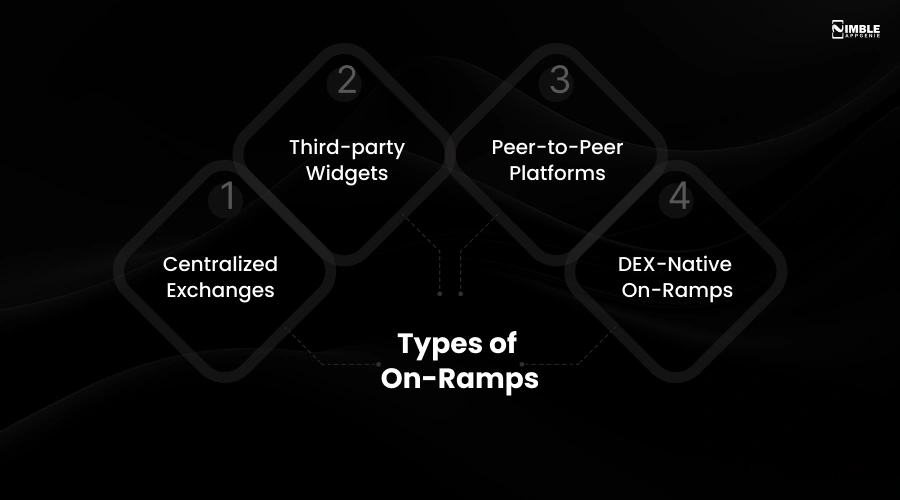
► Centralized Exchanges
This type of on-ramp helps to convert the traditional government-issued money (fiat), such as EUR, INR, and USD, into cryptocurrencies.
► Third-party Widgets
A third-party widget in a crypto on-ramp is a pre-built, embedded checkout screen where users can buy cryptocurrencies with traditional money within a website or within an app.
► Peer-to-Peer Platforms
It is a platform that connects buyers and sellers directly, allowing them to exchange traditional money (fiat) for cryptocurrency. It doesn’t include any middlemen who set the prices for exchanges.
► DEX-Native On-Ramps
It is a built-in feature on a decentralized exchange that lets you buy cryptocurrency directly without regular money.
Now, let’s understand and examine “what is a crypto off-ramp?” in the following section.
What is Crypto Off-Ramp?
The crypto off- ramp is just the opposite of the crypto on-ramp. Here, the users convert digital assets back to fiat currencies. Here, the users can receive funds directly from a crypto to a bank transfer.
This typically comprises exchanging crypto assets from a wallet or an exchange with a sell transaction in order to pay fiat funds to a bank account or a local payment rail.
Basically, it is a process to convert digital cryptocurrencies into cash.
How Does Crypto Off-Ramp Work?
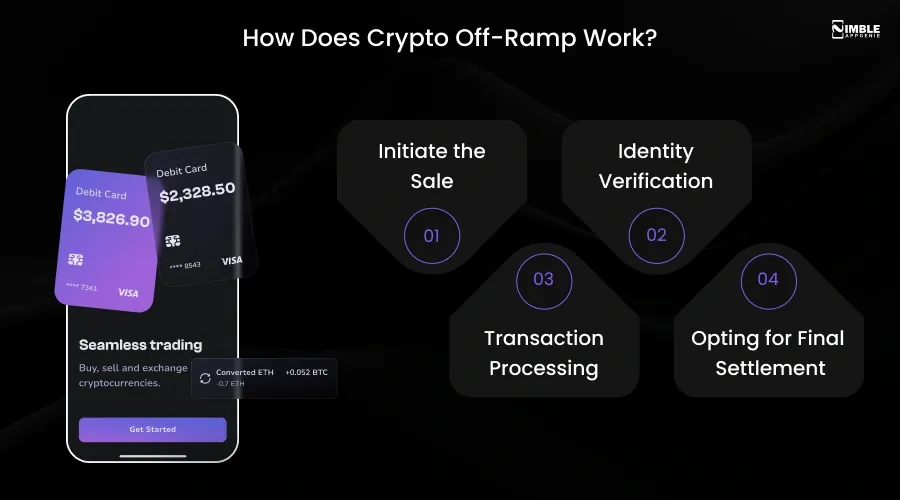
♦ Initiate the Sale
In this step, you initiate a transaction by selecting the number of cryptocurrencies and the amount that you want to sell in exchange for fiat.
♦ Identity Verification
The platform performs a complete identity verification, which is an important step to avoid money laundering and any kind of fraud.
♦ Transaction Processing
Under this step, the cryptocurrencies are processed and converted into fiat.
♦ Opting For Final Settlement
A complete settlement for the transactions takes place under this step. Here, the users receive the confirmation message related to the conversion of cryptocurrencies.
The types of crypto on-ramp are similar to off-ramp crypto; the difference is that in off-ramp, the crypto is converted into fiat.
A leading fintech software development company knows how to integrate both and when, but before that, you should know the key differences. Let’s evaluate them all in the next section.
On-Ramp vs. Off-Ramp: Key Differences
The major difference that you will notice here is that the on-ramp converts fiat into cryptocurrencies, while the off-ramp converts cryptocurrencies to fiat.
Let’s evaluate the key differences in the mentioned table:
| Factor | On-Ramp | Off-Ramp |
| Direction | Fiat → Crypto | Crypto → Fiat |
| User action | Deposit/buy crypto | Withdraw/sell crypto |
| KYC requirement | Usually required | Always required |
| Settlement speed | Instant–15 min (card) | Minutes–2 days (bank) |
| Typical fees | 1–3.5% | 0.5–2% |
| Regulatory complexity | Moderate | Higher (AML monitoring)Al |
| Primary use case | Onboard new users | Enable real-world utility |
| Stablecoin use | USDC/USDT purchase | USDC/USDT → bank |
But does your platform require both?
Well, let’s evaluate the same in the next section.
Why Your Crypto Platform Needs Both?
Your crypto platform needs both the on-ramp and off-ramp crypto because they act as a direct bridge between the traditional fiat currency and the digital asset economy. Adding both is part of fintech software development.
Here’s why you need a crypto platform:
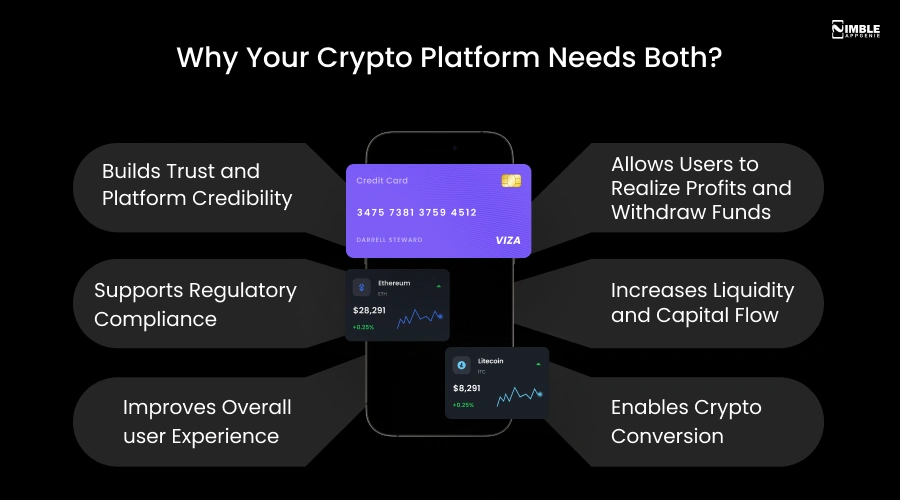
► Builds Trust and Platform Credibility
The crypto on-ramp and Off-ramp component builds trust and platform credibility through combining blockchain technologies with strict security safeguards. These components seamlessly combine the bank-level security, regulatory compliance, and user experience.
► Allows Users to Realize Profits and Withdraw Funds
Adding both the crypto platforms will help you to exchange digital tokens for the traditional government currency, and then transfer it to a bank account. Opting for this feature in crypto further helps to improve the user experience by allowing them to convert cryptocurrency.
► Supports Regulatory Compliance
The crypto platform does support regulatory compliance by using tools that verify user identities, track blockchain transactions, and block illegal activity. On-ramp and off-ramp crypto acts as a bridge for blockchain and traditional finance.
► Increases Liquidity and Capital Flow
Crypto on-ramps and off-ramps increase the liquidity and capital flow by helping users to easily buy crypto using regular money, while off-ramps help to convert the cryptocurrency into fiat. This results automatically in increasing liquidity and capital flow.
► Improves Overall user Experience
The crypto on-ramps and off-ramps do allows users to instantly buy crypto with the familiar methods. This creates no additional search baggage and no need to connect with any other platform to convert their currencies. Therefore, it improves overall user experience.
► Enables Crypto Conversion
This is one prime reason to use both on-ramp and off-ramp cryptocurrencies in the platforms. These components enable users to convert cash into crypto and then crypto to cash at the time of withdrawal.
But most of the fintech startups often ask, “How can I integrate fiat into my crypto platform?”
Well, there is a complete process for the same, initiated from market research, selecting the right fiat partner, mapping the user journey, handling compliance, and opting for the technical integration.
In the following section, you will learn the details.
How to Integrate Fiat Into Your Crypto Platform?
You can integrate fiat into your crypto platform via blockchain app development and selecting the right fiat partner.
Here are certain steps to follow for a complete integration process:
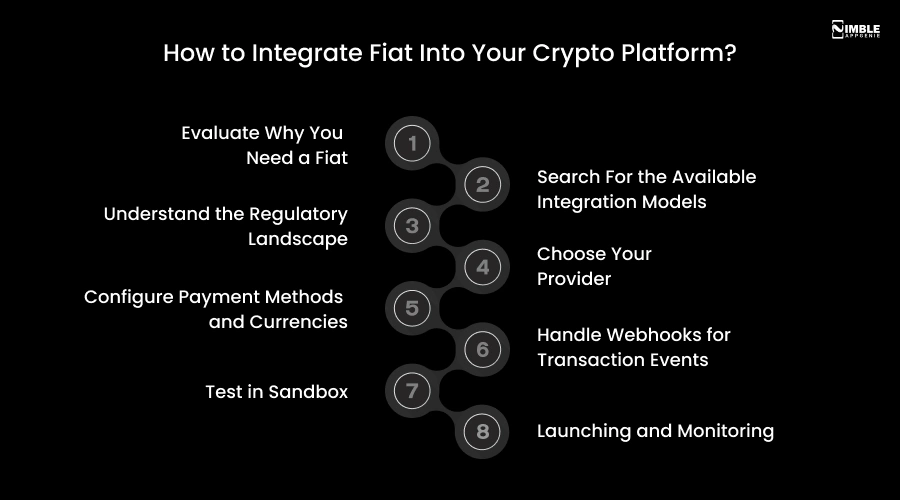
➤ Evaluate Why You Need a Fiat
Before asking how to integrate fiat into your crypto platform, you should understand why you need to integrate fiat into your crypto platform.
Your platform is different from that of your competitors, hence you need to know how you can make a change with this integration.
You need to perform:
- Market research for your crypto platform based on the current environment.
- Evaluate the prospective need and gap in your crypto platform due to fiat.
- Identify the needs of your potential users.
➤ Search For the Available Integration Models
What are the integration models available in the market for performing fiat integration in a crypto platform?
Learning about the fiat integration models will assist you in evaluating the diversified scope of integration to fulfill your purpose.
Well, here are fiat integration models that you can use:
- Embedded Components: This is the fastest way to integrate, where you embed a pre-built widget right into your app. However, the provider handles payments, liquidity, and identity verification.
- Hosted flows: It is an integration model where a third-party payment provider hosts the payment and identifies the verification screens entirely on their own servers.
- API integrations: Here, you do not need to build a complicated fiat for your crypto platform from scratch. With the API integrations, you allow the crypto platform to communicate with the traditional banking network. It does offer complete control over the user interface.
➤ Understand the Regulatory Landscape
Learning about region-specific regulations and crypto industry standards will help you determine the factors related to feature types and user demands.
These are crucial parameters to check before opting for integration:
- Register as a Money Services Business (MSB) with FinCEN (USA) or an equivalent body in your country.
- Obtain a Money Transmitter License (MTL), required in most US states and many countries.
- KYC/AML compliance, which requires you to verify user identity and monitor transactions.
- GDPR / data privacy laws if operating in Europe.
➤ Choose Your Provider
Those who are experts in crypto platform development can help you in building secure, AI-powered cryptocurrency wallets and trading platforms. Building custom hot and cold wallets for secure asset storage or creating a complete platform.
Here is the list of providers:
- Coinbase: It serves as a primary gateway for individuals and businesses to enter the crypto market.
- Uniswap: This is a platform that operates entirely on open-source code and smart contracts.
- Kraken: It serves as a digital marketplace where you can buy, sell, and trade cryptocurrencies.
- Binance: This platform acts as a provider in the crypto market by offering global infrastructure and a wide range of trading services.
- MoonPay: This is a foundational financial technology provider that bridges traditional fiat currencies and assets.
- Simplex: This platform uses AI to assess risk and prevent fraud, and guarantees merchants will not lose money to credit card fraud.
- Banxa: It operates as a globally licensed infrastructure that enables businesses to embed crypto and fiat services into their platforms.
➤ Configure Payment Methods and Currencies
Under this step, you need to ensure a smooth checkout experience so that the buyers can use their preferred payment options.
Here’s what you need to do:
- Payment Gateways: Here, you can connect tools to process credit cards and online transactions.
- Payment Processor: A third-party company handles the complete technicalities of the payment methods.
- Select the Wallet Payment option: Now, you need to select the right wallet payment option or need to build a crypto wallet app.
- Identify the Types of Currencies: Selecting the different types of currencies can help your users to successfully exchange currencies to prevent errors and even reduce the transaction fees.
➤ Handle Webhooks for Transaction Events
This step includes capturing the automated, real-time HTTP callbacks sent by payment gateways and banks whenever a transaction status changes.
Here, you add this feature where you can provide the users updates related to any type of transaction took place.
How this feature works for crypto on-ramp and off-ramp:
- Endpoint Creation: Expose a secure, public HTTPS URL to receive the HTTP post request.
- Opt for Request Verification: You need to opt for a request verification before deducting funds from the user’s account, that increase overall user experience.
- Real-time Updates: It instantly locks digital goods and updates within the user interface.
- Database Updates: Perform the regular database updates to scale your crypto app.
➤ Test in Sandbox
Every provider offers a sandbox/testnet mode. Under this step, you can test the actual crypto scenarios within your wallet, without hampering the live functionalities of the app.
Here’s what you need to follow:
- Mimicking Real-World Environment: You test any new feature and updates in the software application without impacting the production environment.
- Software & Operating Systems: This type of testing works on both the software and operating systems. Thus, in the case of your crypto platform, you can perform testing in the Sandbox.
- Opting for Overall Testing: After implementing and integrating any new APIs and techniques, you can opt for security testing and complete performance testing.
➤ Launching and Monitoring
Before connecting the sandbox to your actual app’s functionalities, you need to test. And after testing and reducing bugs, it’s time to launch it.
Here’s what you need to do:
- Deploy the crypto with real-time transaction monitoring.
- Set up alerts and provider downtime alerts.
- Effectively launch and monitor every transaction that takes place.
Well, you can further face the challenges in implementing and integrating the crypto on-ramp and off-ramp.
What are the Common Integration Failures in Crypto On-Ramp and Off-Ramp?
The key integration challenges are compliance and KYC, fragmented regulations, and even market volatility.
Here is the list of common integration challenges:
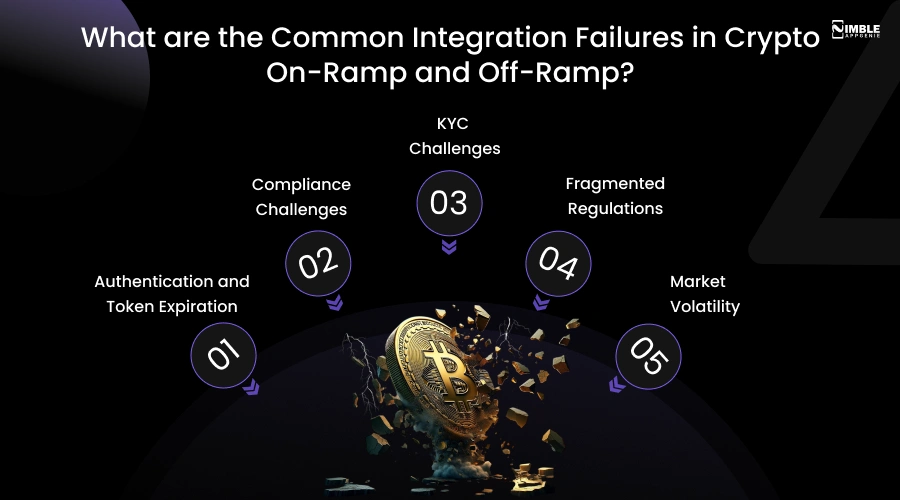
➤ Authentication and Token Expiration
You might face a challenge related to the authentication key expiration, where the systems might stop talking. Here, users might face the challenge related to sudden API failures and disrupted workflows.
➤ Compliance Challenges
Your crypto platform can face issues related to compliance, by creating complicated technological hurdles, data security risks, and even operational bottlenecks. Additionally, the overly aggressive AML rules can block legitimate large withdrawals.
➤ KYC Challenges
Users often abandon on-ramp flows at the KYC step, that restrict the users from performing transactions. This challenge is observed often on mobile devices. This even creates user friction, delaying transaction speeds, compromising privacy, and excluding unbanked populations.
➤ Fragmented Regulations
This challenge creates a major barrier in crypto on-ramps by forcing companies to navigate a complicated and overlapping web of local laws and regulations. It even leads to geographic restrictions and inconsistent asset classification.
➤ Market Volatility
Integrating a card-only on-ramp for market bank transfer or local payment methods dominates, and results in a zero conversion rate. High market volatility can result in an increase in the overall cost to integrate a crypto on-ramp and off-ramp.
Well, opting for the right strategies and connecting with the right partner can be helpful at this stage.
Why Connect With Nimble AppGenie to Build a Crypto Wallet?
You should connect with Nimble AppGenie, because we are the leading crypto wallet development company offering diversified solutions related to crypto on-ramp and off-ramp, along with creating a complete wallet.
Here’s why choose us:
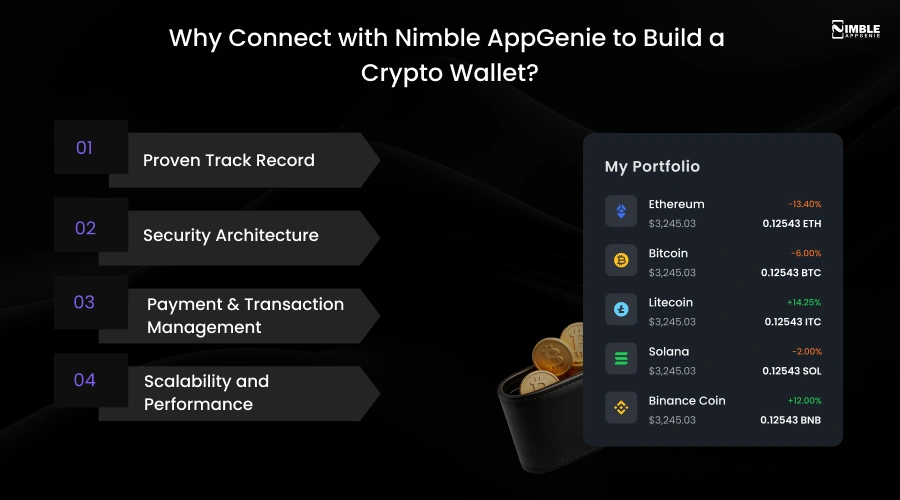
♦ Proven Track Record
Nimble AppGenie has a proven track record of offering crypto-related solutions, as we have already done before. We have delivered 20+ crypto apps that represent our expertise in fintech app development.
♦ Security Architecture
We consider security not as an option but as a foundation of your crypto app. This helps us to rely on isolating private keys, applying strict encryption, and verifying transactions to prevent hacks.
♦ Payment & Transaction Management
Our team opts for the significant APIs that are crucial for adopting payment and transaction protocols into your crypto apps. This helps us to successfully integrate customized and prominent APIs effectively for your app.
♦ Scalability and Performance
Our experts know how to scale your app and overall performance through implementing an elastic cloud architecture. We ensure that your crypto wallet is able to adopt the latest upgrades in technology.
Conclusion
Crypto On-ramp is an essential component for converting fiat into cryptocurrencies, while the crypto off-ramp is for converting cryptocurrencies to fiat. Including both these components is important for your crypto platform as it provides a gateway to the users to enter and exit from the cryptoworld.
To integrate it, one should evaluate their needs, search for the integration models, understand the regulatory requirements, select the right provider, configure payment methods, opt for testing, and then launch it to the market. Connecting with the right provider will help you here to connect with the target market.
FAQs

Niketan Sharma, CTO, Nimble AppGenie, is a tech enthusiast with more than a decade of experience in delivering high-value solutions that allow a brand to penetrate the market easily. With a strong hold on mobile app development, he is actively working to help businesses identify the potential of digital transformation by sharing insightful statistics, guides & blogs.
Table of Contents




No Comments
Comments are closed.