

 Free Consultation
 PCI-DSS Compliant
 GDPR Ready
 ISO 27001
 NDA Protected
 AI Services
 AI App Development
 Generative AI Development
 AI Chatbot Development
 AI Integration Services
 AI Consulting Services
 AI For Fintech
 AI Financial Assistant Solution
 AI Insurance Agent Development
 Tech Stack
 OpenAI / GPT-4
 Claude / Anthropic
 Gemini / Google AI
 Llama / Open Source
 LangChain / LlamaIndex
 Pinecone / Pgvector
 AWS / Azure AI


 Fintech Solution
 Core Fintech
 App Development
 Neobank Solutions
 eWallet Solutions
 Lending Software
 Banking Solutions
 BNPL Solutions
 BNPL Solutions
 Insurance App
 Wealth Management
 Crypto & DeFi
 Blockchain Development
  Payroll Software
 DeFi Solutions
 Crypto Wallet
 Crypto On/Off Ramp
 Crypto Exchange
 Trading Platform
 Payments
 Compliance
 Regulations & Compliance
 Fraud Detection
 Lending Ecosystem
 P2P Lending Platform
 Mortgage Software
 Engagement
 Fintech Outsourcing

 Mobile Development
 Mobile App Dev
 iOS App Development
 Android App Development
 React Native
 Flutter Development
 Web Solution
 Node.js Development
 React.js Development
 Angular Development
 App Services
 UI/UX Design
 App Maintenance
 By Stage
 MVP Development
 Industry Solutions
 Healthcare App Dev
 Education App Dev
 Travel App Dev
 Real Estate App Dev
 Logistics Software
 Social Media App

 Hire Mobile Developers
 Hire iPhone Developers
 Hire Android Developers
 Hire React Native Devs
 Hire Flutter Developers
 Hire Web Developers
 Hire Node.js Developers
 Hire Angular Developers
 Hire PHP Developers
 Hire Laravel Developers
 How It Works
 Pre-Vetted Developers
 Ready In 48 Hours
 NDA From Day One
 Replace Guarantee
 Company
 About Us
 Our Work Process
 Portfolio
 Case Studies
 Blog / Insights
 Careers
 Contact Us
 Awards
 Recognition


 Offices


In a Nutshell:
- Outsourcing mobile app development helps you save time, reduce costs, and get access to skilled developers without building a full in-house team. It makes the whole process faster and easier to manage.
- A big part of mobile app development outsourcing is choosing the right working model. Fixed price is good when everything is clear, time and material works when things may change, and a dedicated team is better for long-term apps.
- When you outsource app development, one mistake to avoid is waiting too long. Delays can slow your project, increase costs, and make you miss the right time to launch.
- Choosing a freelancer or an agency is a crucial stage in outsourcing projects. Freelancers are fine for small tasks, but agencies are more reliable for bigger and more serious projects.
- Many people worry about challenges in outsourcing mobile app development, like communication issues or delays. The good part is that these problems can be handled by staying in touch, giving feedback, and keeping everything clear.
- In the end, app development outsourcing successfully depends on your involvement. When you stay connected, track progress, and guide the team, your app idea becomes much easier to turn into a real product.
You have a great app idea, but getting it developed can feel impossible. Finding the right developers, sticking to a budget, and meeting deadlines is a constant struggle. It is not just you.
Statista reports that nearly one in four small businesses in 2025 could not launch their mobile apps because they did not have the right team. Even bigger companies often get stuck when internal teams are overloaded with other projects.
This is why you should outsource mobile app development to make a real difference. When you work with an experienced external team, you can get expert assistance, save time, and control costs without overloading your own staff.
Clutch shows that more than half of companies now depend on outsourced app developers to get projects done faster and better. So, if you are a startup founder planning to build a mobile app, outsourcing can give you the support you need to turn your idea into reality.
In this blog, we will walk you through how to outsource the right team and manage communication that can take your idea from a stressful, uncertain process to a smooth, successful app launch.
So, let’s begin!
Market Overview of Mobile App Development Outsourcing
Mobile app development outsourcing is a highly preferred way of getting an app developed without going through the hassle of hiring an in-house team or scouring through piles of resumes to find the right fit for your needs.
Not to mention, the cost of mobile outsourcing is much more efficient than that of an in-house development team.
One of the key issues that entrepreneurs face when planning to outsource mobile app development is verifying the authenticity of the market.
If you are wondering if outsourcing as a market is legitimate or not, let us give you a few mobile app market statistics that will help you understand the stature of the current mobile app outsourcing market.
- According to recent data, the global market size for outsourcing mobile app development services is expected to reach $1,536 million by 2033, with a yearly growth rate (CAGR) of 8.1%.
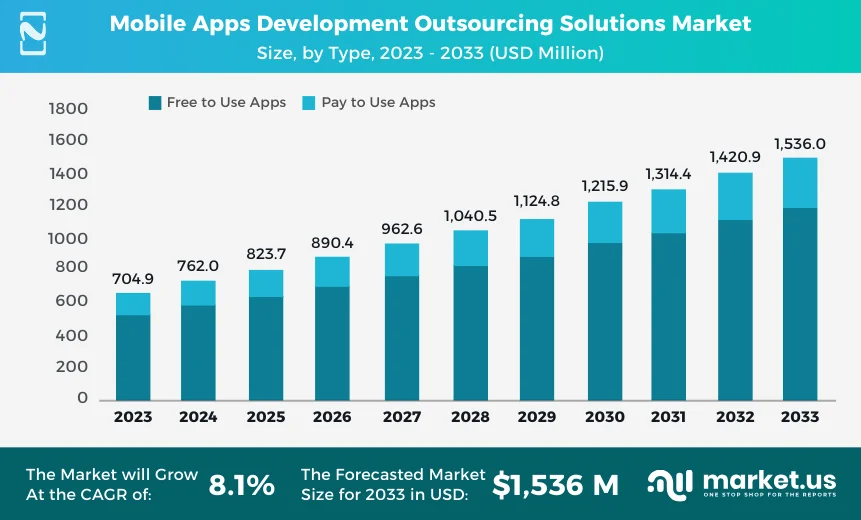
- North America is leading this market, holding 35% of the total share, which shows a strong demand for mobile app development in that region.
- In 2025, the global revenue from this market is expected to hit $120.05 billion. The market will continue to grow steadily, with an annual growth rate of 0.68%, reaching a total value of $124.20 billion by 2030.
These numbers clearly show that outsourcing mobile app development is not just a trend. It’s a growing market trusted by thousands of businesses worldwide.
While a lot of you might have gained clarity on mobile app development outsourcing solutions and how popular they are, some of you may be wondering how exactly outsourcing helps or why it is a good decision to utilize outsourcing services.
Check out the next section for a more detailed answer to your question!
Types of Engagement Models in App Development Outsourcing
When you outsource app development, the way you choose to work with the team can highly affect your cost, speed, and overall experience. Each model fits different types of projects, so it is vital to understand them a bit deeper before deciding.
Take a look at the types of engagement models.
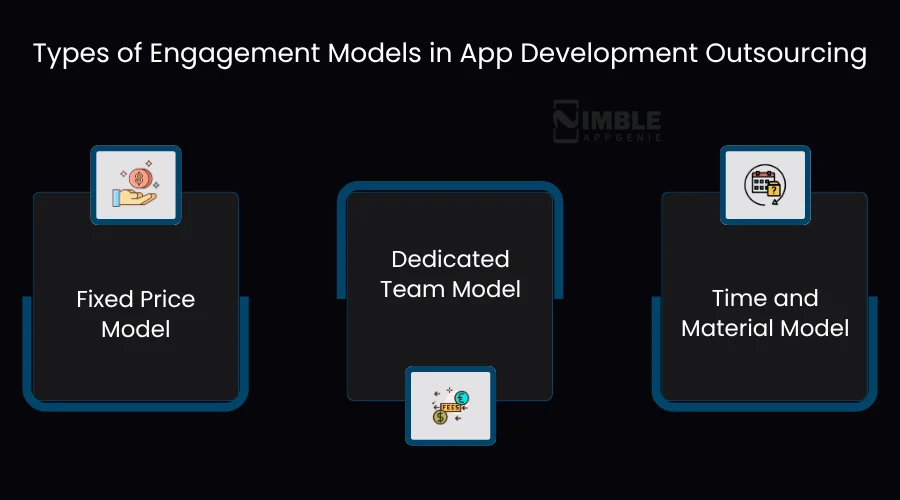
1. Fixed Price Model
This fixed price model works best when you already know what you want to build. You share the complete requirements, and the company provides you with a final cost and timeline. Everything is planned, which makes it really easier to manage your budget.
However, this model is not flexible. If you want to integrate new features or make changes later, it usually leads to extra costs and delays. That’s why it works well for small to mid-size projects with clear objectives like an MVP app with fixed features.
2. Dedicated Team Model
This model gives you a full team that works only on your project. The team can include developers, designers, testers, and a project manager. They act like your own remote team, focused only on your app.
A dedicated development team model is a great choice for long-term projects or apps that need continuous updates and improvements. You get better control, direct communication, and faster decision-making.
But this also means you need to stay involved, manage priorities, and guide the team regularly. It usually comes with a monthly cost based on the team size.
3. Time and Material Model
You can pay for the actual time and effort spent on your project. It means you are billed hourly, daily, or weekly, depending on the work done. It is the ideal option when your idea is still changing or when you are not fully sure about all the features.
However, the biggest benefit here is the flexibility. You can make changes anytime, add new features, or adjust the scope as you go. But since the work is not fixed from the beginning, the total cost can rise if the project takes longer than expected.
This model works well for startups or complex applications where planning everything in advance is quite difficult.
So, if your project is clear and short-term, a fixed price works well. If you need flexibility, go with time and material. And if you are building something long-term and serious, a dedicated team is often the better option.
Why Should You Outsource Mobile App Development?
Mobile app development outsourcing allows you to partner with an experienced team of professionals who have enough experience to finish the project much faster, without costing you a lot.
Choosing to outsource can be a smarter move for your business. Not only does it delegate your work to an experienced team, but it also simplifies the further process for launching your app, as your team now has more time to focus on the market.
Let’s check out the benefits of outsourcing app development.
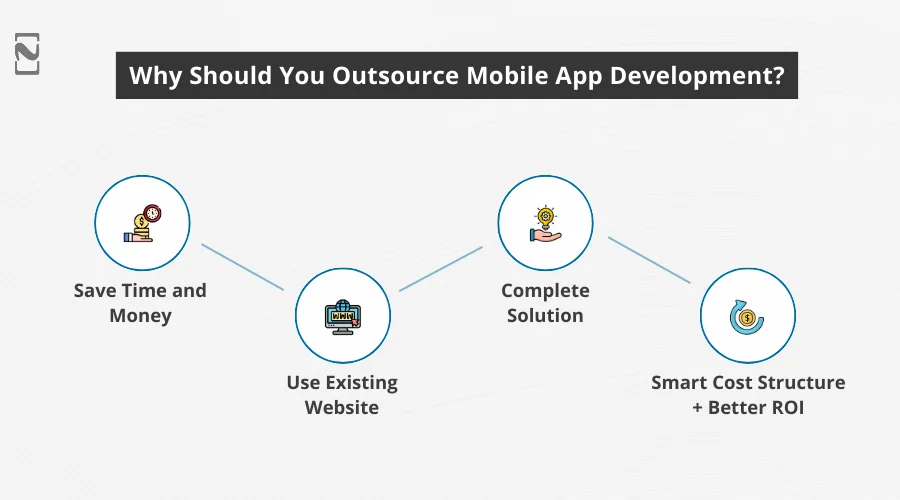
► Save Time and Money
Developing a custom mobile application from scratch takes months. The mobile app development cost is also very high.
If you outsource that work, you can get your application up and running in just a few weeks. And it does so without hiring an in-house team or investing heavily in development resources.
► Use Existing Website
If you already have a website, mobile application outsourcing allows you to turn it into an app without rebuilding everything from the start.
Your website and app stay in sync, so there is no need to manage two separate platforms.
► Complete Solution
A good IT outsourcing partner manages everything. For example, project management, app store submission, maintenance, and issue fixes.
You get an offshore mobile app development partner, not just a tool to support your project development journey.
► Smart Cost Structure + Better ROI
Outsourcing app development costs far less over time. You pay for real value: fewer delays, less maintenance, and more efficient updates.
This makes for a smarter investment and gives you a better ROI.
The best part about outsourcing mobile app development services is that the company you align with is also working on various projects, which means they must adhere to the timeline. It’s like completing your project on time; it awards them with more time to take on new projects.
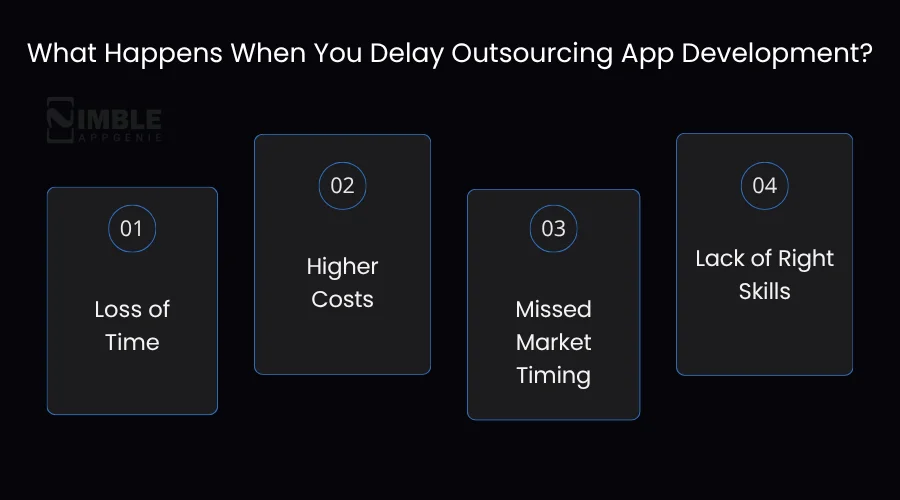
What Happens When You Delay Outsourcing App Development?
When you delay mobile app development outsourcing, your project simply slows down, costs rise, and you risk missing the right time to launch. Also, it becomes quite difficult to find the best skills when you need a team. As a result, your mobile app may take longer to build, perform poorly, or struggle to compete in the market.
Let’s check them out.
♦ Loss of Time
When you delay outsourcing, your app takes enough time to move forward. You may spend weeks or months trying to hire the right people or manage everything on your own.
In that time, competitors can launch similar apps and start gaining users. Once you fall behind, it becomes very hard to catch up.
♦ Higher Costs
If you delay too long, it can lead to higher costs. Hiring an in-house team, training them, and managing slow progress can stretch your budget more than expected.
Small delays turn into longer timelines, and longer timelines mean more spending. So, it is advisable to outsource mobile app development earlier to control time and cost better.
♦ Missed Market Timing
Entering the market at the right time is just as important as the idea itself. Every mobile app idea has a certain timeframe. If you wait too long, users’ demands may shift, or someone else may already solve the same problem.
Even a good idea can lose its value if it comes too late. So, it is good to enter the market at the right time and not miss the opportunity to become the next industry leader.
♦ Lack of Right Skills
Developing a mobile app requires different skills, such as design, development, testing, and scaling. If you delay outsourcing, you may not have all these skills available when needed.
This can lead to poor quality, more errors, and slow progress. With the right development team in place early, you can avoid these issues and build a stronger product.

Freelance or Agency: Which Mobile App Development Outsourcing Mode Should You Select?
When you decide to outsource mobile app development, one of the first questions you might face is whether to hire a freelancer or work with an agency. It might seem simple, but this choice can affect cost, quality, timelines, and even the success of your mobile application.
Many startups and small businesses get confused because both options have clear advantages and drawbacks, and the decision depends heavily on your project’s size, complexity, and goals.
Let’s deeply understand which one is best for your project.
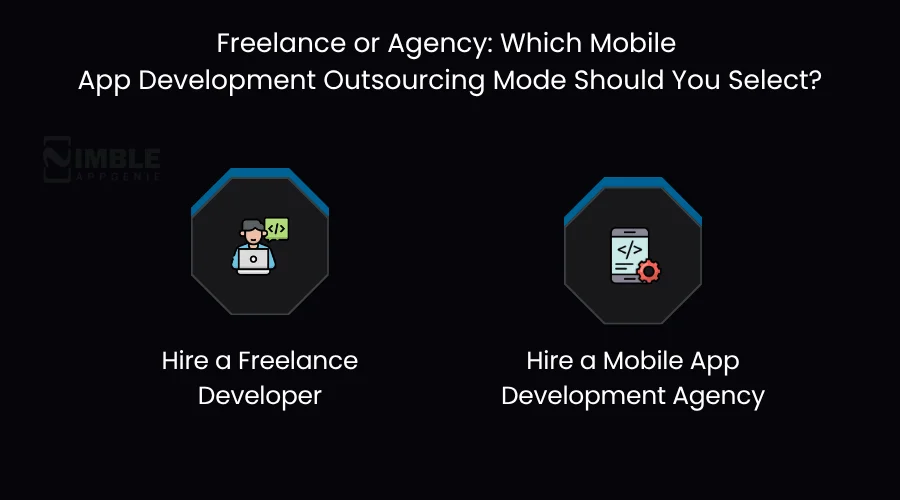
➤ Hire a Freelance Developer
Freelancers are independent developers or small teams who take on projects individually. They are usually more affordable than agencies, making them attractive for startups or smaller projects. Freelancers often provide flexibility, which can be useful if your project scope changes.
But the downside is that freelancers may have limited availability, and handling multiple specialists for design, development, and testing can fall entirely on you. Deadlines and coordination can become challenging if the project grows beyond their capacity.
➤ Hire a Mobile App Development Agency
Agencies are structured teams with multiple experts in design, development, testing, and project management. They can handle your project end-to-end, ensuring smoother communication and consistent quality.
Mobile app development agencies are best for complex projects or when you need someone to manage the workflow entirely. The trade-off is a higher cost compared to freelancers, and sometimes a less flexible approach if your requirements change mid-project.
The table below showcases the difference between hiring a freelancer and an agency.
| Aspect / Factor | Freelancer | Agency |
| Team Size | Individual or small team | Structured team with multiple experts |
| Cost | Generally lower, budget-friendly | Higher due to full-service and multiple specialists |
| Flexibility | Can adjust quickly, and it is easy to change the scope | Less flexible, follows structured processes |
| Expertise & Skills | Limited to the freelancer’s skills | Full range: design, frontend, backend, testing, project management |
| Project Management | You handle coordination, deadlines, and tools | The agency provides dedicated project managers |
| Availability | May be limited, can only work on one or two projects | Consistent availability from team members |
| Quality & Accountability | Depends on the freelancer’s experience and discipline | Agencies have established QA and review processes |
| Communication | Direct with a freelancer, simpler but may be irregular | Structured communication channels and regular updates |
| Project Complexity | Best for small, simple apps | Best for medium to large, complex apps |
| Timeline / Speed | Can be fast for small projects | Can handle large projects efficiently |
| Scalability | Harder to scale if the project grows | Easy to scale with additional team members |
| Post-launch Support | May be limited or need separate hiring | Often included in a package or maintenance plan |
| Best For | Startups, small projects, prototypes | Complex apps, startups with funding, long-term projects |
| Risks / Challenges | Missed deadlines, lack of specialized skills, and more coordination | Higher cost, less adaptability to sudden changes |
So, how should you decide? If your app is small, simple, and your budget is tight, a freelancer may be enough. But if you need full support, strict timelines, multiple experts, and professional project management, an agency is usually the safer choice.
Knowing your project goal, timeline, and long-term scope will assist you in making the right decision and avoiding costly mistakes.
3 Step Process to Outsource Mobile App Development
The way outsourcing works is quite simple! You already have an idea and execution plan ready for your application. All you need is a team of professionals to execute it and refine it during the process.
Here are the 3 steps that can help you execute mobile app development outsourcing efficiently.
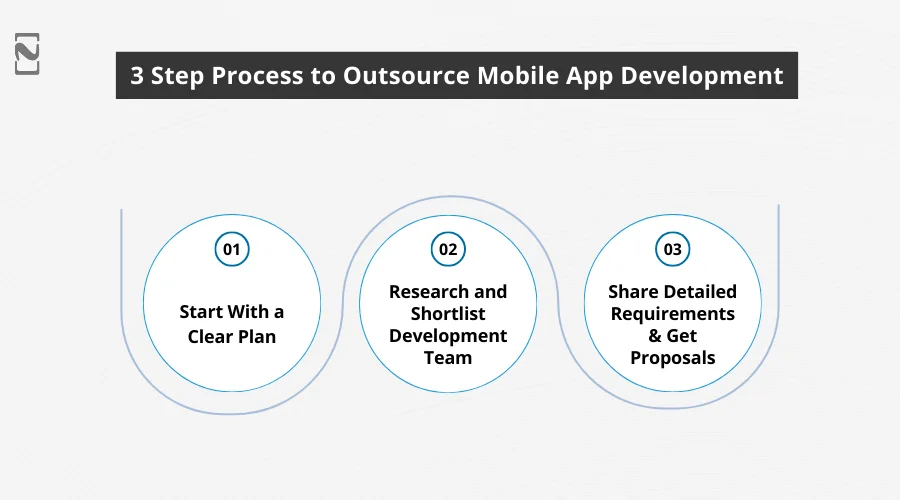
Step 1: Start With a Clear Plan
Before you find out how to hire app developers, take time to define your project idea. What kind of app are you developing? Who will use it? What features are essential? Do you want a native or cross-platform app?
Write down your goals, must-have features, timeline, and budget range. The clearer your requirements are from the beginning, the smoother the outsourcing process will be.
Step 2: Research and Shortlist Development Team
Once you know what you need, you can start looking for the right outsourced mobile app development team. You should browse the marketplace, agency websites, or referrals.
Additionally, check their past work to see if they have worked on similar apps.
Reading reviews from past clients can help you know how well this company works, or whether they deliver on time or not.
Case studies and testimonials can help you find out their performance in past projects. A great app idea requires a reliable and experienced team to bring it to life.
Step 3: Share Detailed Requirements and Get Proposals
Now that you are in conversation with potential teams, share your full project brief. You can include mockups if you have them, or just a rough user flow.
Additionally, you can ask them to submit a proposal outlining their understanding of the project, timelines, budget estimate, and mobile app development frameworks.
Now you can compare the proposals not just by cost, but also by quality, clarity, and communication.
These three steps help you choose a solution. Is it that easy?
With the help of the proposals you receive, you get an idea of how a company might approach your project.
Mobile App Development Outsourcing: Best Practices to Follow
While the process of outsourcing seems to be a simple one, it often leaves you with more pressing questions, i.e., how to choose the right mobile app development outsourcing or what are the best practices to follow?
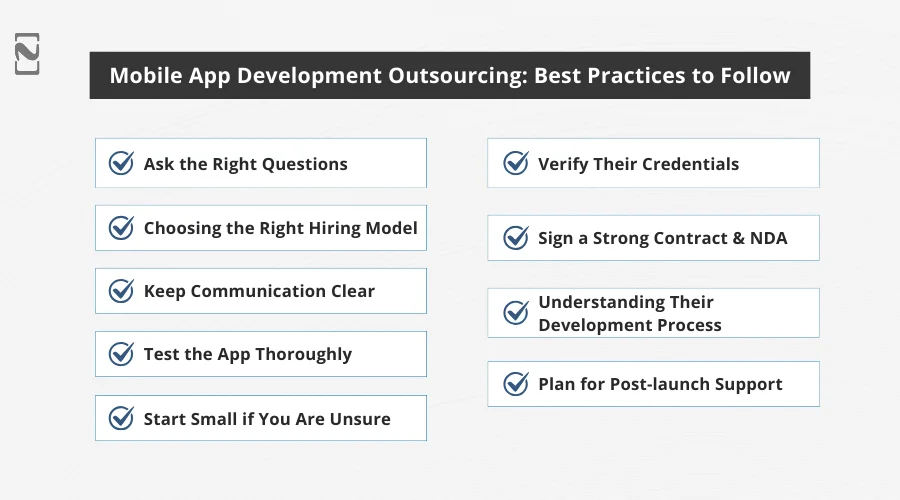
1. Ask the Right Questions
When you have shortlisted potential outsource mobile app development companies, do not just jump in right away. Talk to them as it helps you know them better.
Besides, you should ask about their mobile app development process, the tools they use, and how they handle communication.
Just try to understand their working style and whether it aligns with yours. A good outsourced application development partner will be transparent, professional, and willing to answer all your questions.
2. Verify Their Credentials
Do not just rely on what the offshore mobile app development company says; do a little homework. You should verify the apps they claim to have developed.
Go to the Play Store to check whether that app really exists, and if it exists, does it really work and have good reviews?
You can even check out the reviews and ratings. Also, check the live products, download them, and test their performance.
You can even ask for client references. A reliable and trusted outsourced mobile app development team will have no problem backing up their claims.
3. Choosing the Right Hiring Model
Outsourcing mobile app development companies often provide different engagement models. So, when you outsource, choose a model that aligns with your project.
The fixed price model is great if your app requirements are clear and will not change. It offers a set of outsourced app development costs.
Time and materials work well for flexible projects where the scope might evolve, and you pay based on hours of work.
The dedicated team model is ideal for long-term or complex apps; you get a remote team working just for you.
Each model has its pros and cons, so choose based on your budget, timeline, and how involved you want to be during outsourcing mobile application development.
4. Sign a Strong Contract and NDA
Once you have chosen your offshore mobile application development partner, it is time to make it official.
You can sign a detailed contract that mentions the timelines, deliverables, payment schedules, costs, intellectual property rights, and a process for handling changes.
It’s also a good idea to include a clause covering the mobile app architecture, especially if your app has a complex or unique technical structure.
You can also sign an NDA or non-disclosure agreement to protect your app idea. It is a special case if the NDA involves proprietary concepts or sensitive data.
5. Keep Communication Clear
Clear communication is one of the essential parts of a successful outsourced app development project.
From the start, decide how you will stay in touch, from weekly Zoom calls and Slack messages to email updates.
Just make sure everyone knows their role and what they are responsible for. So that there is no confusion later on.
6. Understanding Their Development Process
Before development begins, ask the team how they manage the development process. A good mobile app outsourcing company usually follows an agile method.
It is a method in which they develop an app in small sprints. After each sprint, they show you what has been done so you can give feedback, suggest changes, or move things in a new direction if required.
This step-by-step approach keeps you involved and helps avoid unexpected issues. It also allows for smoother handling of technical tasks like API development.
This often requires regular input and testing to make sure everything works well on all platforms.
7. Test the App Thoroughly
Once the app is developed, mobile app testing is crucial. This includes checking for bugs, performance issues, user experience problems, and compatibility across devices.
You should be actively involved at this stage, working with the QA team to ensure the final product meets your expectations.
Do not rush the launch; mobile app security and quality control are non-negotiable.
8. Plan For Post-Launch Support
Launching the app does not mean the job is done. Mobile applications often need updates, bug fixes, app performance optimization, or new features based on user feedback.
That’s why it’s important to ask about post-launch support before a project begins.
Make sure your outsourced mobile app development partner provides assistance after the app goes live.
You can ask the team about how updates will be handled, how quickly bugs will be fixed, and whether they will help you scale the app if it grows.
9. Start Small if You Are Unsure
If you are working with a new offshore app development team and are not 100% sure yet, consider starting with a small pilot project. Ask them to build a basic version of a feature or a simple prototype.
It is a low-risk way to test their communication, development quality, and delivery before committing to a full-featured app development.
With the help of these practices, you not only stay on the safer side but also make the most of your invested money. Mobile app development outsourcing is all about making the most of the available resources while being cost-effective.
Hence, we recommend that Nimble AppGenie be your outsourcing partner. With years of experience and hundreds of timely delivered apps, we are your best bet when it comes to mobile app development.

Top Countries to Choose For Mobile App Development Outsourcing
When deciding on ways to choose your outsourcing partner for mobile app development, many businesses have concerns related to which region they should choose for mobile app development outsourcing.
In case you are worried about choosing the right solution, or you need to have a team that is not only best at what it does but is also highly compatible with your vision and ensures impeccable coordination, then you must pay attention to the country in which you are going to outsource your work.
With IT and development becoming a top career choice for students across the globe, there are several countries that can be suitable for your app development requirements.
Let’s take a look at some of the top countries to outsource your app development projects for the best value.
These countries are –
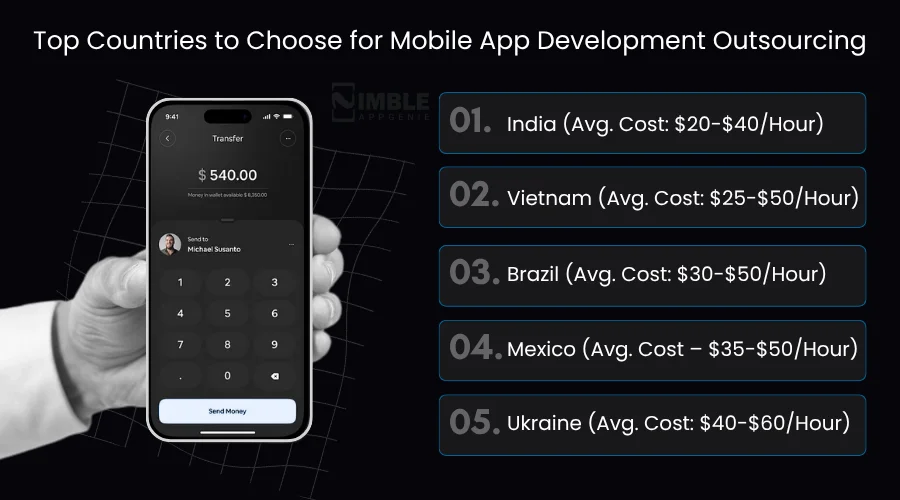
1. India (Avg. Cost: $20-$40/Hour)
With the largest pool of developers, quality assurance experts, and all types of analysts, India is one of the best countries to outsource mobile app development.
Not only do they offer comprehensive support, but they also do it at a much lower cost. The country has multiple cities like Bangalore, Hyderabad, Pune, etc., that offer high-quality mobile app development outsourcing services.
The only issue, however, with outsourcing to India is that the time zone is certainly not aligned with North America and Europe. This means you will have to ensure coordination.
Not to mention, with so many development companies emerging in the Indian market, choosing the right one may seem like looking for a needle in a haystack.
2. Vietnam (Avg. Cost: $25-$50/Hour)
Another country from Asia that can take care of your mobile app development outsourcing requirements is Vietnam.
The country offers a significantly well-established IT and development infrastructure, which is shown in the growing number of developers and IT professionals in the country.
Cities like Hanoi, Ho Chi Minh City, and Da Nang are some of the top cities where you can find reliable developers.
While the country does have high exposure to Western culture and offers services at a competitive price, it also lacks timezone compatibility.
Also, the pool of resources is significantly smaller when compared to other Asian countries like India. Another issue that several businesses have faced when planning to outsource mobile app development to Vietnam is that the industry experience of developers is relatively lower than what one expects when building a large enterprise-scale solution.
3. Brazil (Avg. Cost: $30-$50/Hour)
In the past few years, Brazil has emerged as one of the most preferred mobile app development outsourcing partners for many North American companies.
This is due to the fact that the cultural proximity and time zones are aligned with North America, which eliminates the barrier to smooth coordination.
Brazil is definitely up there when it comes to delivering quality app development services, as the developers from cities like São Paulo and Rio de Janeiro are highly skilled and qualified.
The pool of resources may definitely be smaller than that from Asian countries; however, the quality of service is definitely at par, if not better.
However, one thing that often becomes a deal breaker for many companies is the insufficient English proficiency, as it is a key player in establishing coherent communication.
Don’t forget, the prices are definitely on the higher side of the mobile app development outsourcing spectrum.
4. Mexico (Avg. Cost – $35-$50/Hour)
Mexico is a popular nearshore outsourcing option for the United States and Canada. Developers from the country are known to have strong native app development solutions.
The country offers significant cost savings along with favorable time zones and cultural alignment. The prices associated with the solution are definitely a bargain when compared to what one might pay in Europe or North America.
However, the prices are definitely on the higher side with respect to Asian countries like India or Vietnam. Popular Mexican cities like Guadalajara, Monterrey, and Mexico City offer some of the biggest mobile app development companies in the country. But these companies, due to their recent establishment, often lack the exposure you might expect from them.
5. Ukraine (Avg. Cost: $40-$60/Hour)
A hub for some of the most diverse software development companies in the central and eastern European countries, Ukraine offers some of the finest app developers who can deliver high-quality solutions for your projects.
Not only are the professionals here skilled, but they also have quite vast experience, considering the average developer is either a senior developer or has associate-level experience.
Kyiv, Lviv, and Kharkiv are some of the popular tech cities known for their vast mobile app development infrastructure. The cost is definitely higher, but so is the quality. Not to mention the timezone difference comes in when the project is from a different part of the world.
With all these countries providing the best pool of resources for mobile app development, it purely depends on your compatibility, your requirements, and your budget for outsourcing.
The choice of region and country becomes extremely crucial in long-term projects. This is because not only do you outsource a project and get it completed, but you may also be required to stay in touch with the team forever for future requirements.
Establishing a sustainable connection with a development team can prove to be highly beneficial in the long run, and for that, your cultural and timezone differences should be appropriate or not become a problem.
Challenges of Outsourcing Mobile App Development and Ways to Manage Them
Outsourcing your project can be a smart move, but it is not always seamless.
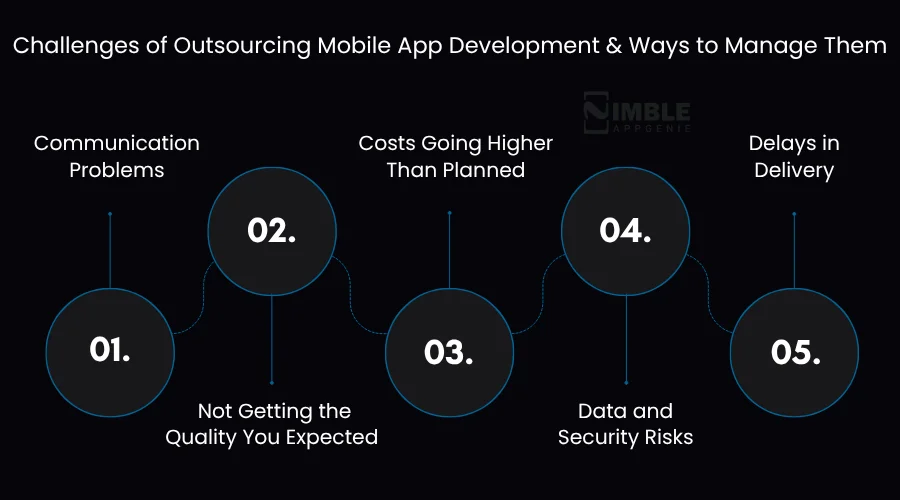
You might face many challenges with:
- Communication problem
- Quality project issues
- Costly app development
- Data and security risks
- Delays in project delivery
But the good part is, most of these challenges can be easily solved if you know what to expect and how to manage them. Here are the common challenges of mobile app development outsourcing and their possible solutions.
♦ Communication Problems
When you hire a team from a different country or region, there is a high chance of misunderstanding. Time differences and language can slow things down.
Solution :
You can just keep things really simple and clear. Project management tools like Slack or Zoom can work best to keep in touch with the team and have regular check-ins. Besides, you can even write down things so nothing gets missed.
♦ Not Getting the Quality You Expected
There are high chances that the final product does not match the idea or image you already had in mind, or it comes with bugs.
Solution :
It is suggested not to wait till the end. You should ask for small updates, test features in advance, and give feedback quickly. You can even follow the agile methodology. This way, the problems do not pile up.
♦ Costs Going Higher Than Planned
Outsourcing can look affordable at the start, but extra changes, modifications, and fixes can increase the development cost later.
Solution :
You should be clear about what you want from the start. Also, agree on pricing, and ask what will cost extra. Always keep a little extra budget aside because changes can come up during the development process.
♦ Data and Security Risks
Outsourcing mobile app development also comes with lots of data and security risks. You may need to share some essential data or information with the external development team. This can be quite risky.
Solution :
The best thing you can do is use agreements or contracts like an NDA and only share what is necessary. This way, your data will also be protected. Additionally, you can use security tools for file sharing.
♦ Delays in Delivery
It is obvious that projects sometimes take longer than expected, if there are changes or any modifications. Adding features or functionalities can take more time, so it can delay project delivery.
Solution :
You can simply break the work into small parts with deadlines. Also, track your project’s progress on time so delays do not go unnoticed. This will not delay project delivery.
Why Outsource Your Mobile App Development to Nimble AppGenie?
If you are planning to make a mobile app, Nimble AppGenie is here to help. We, a leading mobile app development company, have worked on powerful apps across different industries.
Over the years, we have developed more than 350+ mobile apps, websites, and so on.
One of the large parts of our business comes from repeat clients and referrals, which says a lot about the trust we have built. We provide full end-to-end IT services and have had the opportunity to work with multiple companies globally.
The best part? You can hire dedicated mobile app developers within 48 hours and get your project moving fast. If you are ready to bring your app idea to life, book a free consultation with us today. We would love to hear about your vision.

Final Thoughts
Choosing someone to develop your mobile application is a big step if you are not familiar with technology. There are many mobile app development outsourcing companies out there, but do not let them overwhelm you.
The above mobile app development outsourcing guide is a good place to start and can help you find the right outsourcing app development team to develop mobile apps for your business.
If you already have a website and want to turn it into an app, you do not need to look far. Nimble AppGenie can quickly turn your website into a mobile app that looks great and works well, and that too as per the timeline decided by you!
Building a mobile application is never easy. However, with mobile app development outsourcing and the right company to do the job, you can achieve the best results without having to go through all the hassle of hiring an in-house team that may be costlier.
Hopefully, this mobile app development outsourcing guide helps you understand the role of outsourcing and makes it easier for you to choose the right partner. That will be all for this one.
FAQs

Niketan Sharma, CTO, Nimble AppGenie, is a tech enthusiast with more than a decade of experience in delivering high-value solutions that allow a brand to penetrate the market easily. With a strong hold on mobile app development, he is actively working to help businesses identify the potential of digital transformation by sharing insightful statistics, guides & blogs.
Table of Contents




No Comments
Comments are closed.