

 Free Consultation
 PCI-DSS Compliant
 GDPR Ready
 ISO 27001
 NDA Protected
 AI Services
 AI App Development
 Generative AI Development
 AI Chatbot Development
 AI Integration Services
 AI Consulting Services
 AI For Fintech
 AI Financial Assistant Solution
 AI Insurance Agent Development
 Tech Stack
 OpenAI / GPT-4
 Claude / Anthropic
 Gemini / Google AI
 Llama / Open Source
 LangChain / LlamaIndex
 Pinecone / Pgvector
 AWS / Azure AI


 Fintech Solution
 Core Fintech
 App Development
 Neobank Solutions
 eWallet Solutions
 Lending Software
 Banking Solutions
 BNPL Solutions
 BNPL Solutions
 Insurance App
 Wealth Management
 Crypto & DeFi
 Blockchain Development
  Payroll Software
 DeFi Solutions
 Crypto Wallet
 Crypto On/Off Ramp
 Crypto Exchange
 Trading Platform
 Payments
 Compliance
 Regulations & Compliance
 Fraud Detection
 Lending Ecosystem
 P2P Lending Platform
 Mortgage Software
 Engagement
 Fintech Outsourcing

 Mobile Development
 Mobile App Dev
 iOS App Development
 Android App Development
 React Native
 Flutter Development
 Web Solution
 Node.js Development
 React.js Development
 Angular Development
 App Services
 UI/UX Design
 App Maintenance
 By Stage
 MVP Development
 Industry Solutions
 Healthcare App Dev
 Education App Dev
 Travel App Dev
 Real Estate App Dev
 Logistics Software
 Social Media App

 Hire Mobile Developers
 Hire iPhone Developers
 Hire Android Developers
 Hire React Native Devs
 Hire Flutter Developers
 Hire Web Developers
 Hire Node.js Developers
 Hire Angular Developers
 Hire PHP Developers
 Hire Laravel Developers
 How It Works
 Pre-Vetted Developers
 Ready In 48 Hours
 NDA From Day One
 Replace Guarantee
 Company
 About Us
 Our Work Process
 Portfolio
 Case Studies
 Blog / Insights
 Careers
 Contact Us
 Awards
 Recognition


 Offices



API (Application Programming Interface) development is the complete procedure of developing, testing, and managing APIs that allow different software programs to communicate and share data seamlessly.
The overall API market size was valued at USD 6.89 billion in 2025 and is projected to reach USD 37.43 billion by 2034, growing at a CAGR of 20% from 2023 to 2028.

Startups and entrepreneurs who are looking to enter the app development industry or simply want to have a complete API development, this is the right time.
In this guide, you will get a detailed overview of what is API development, its types, tools used to develop an API, steps to develop an API, features, pain points, and best practices.
Now, let’s get started.
What is an API?
An API (Application Programming Interface) is a set of rules and protocols that enable software to communicate with one another and share data as required. It is a connective tissue that allows the different software programs, the front-end interfaces, as well as the third-party services to communicate with each other.
You see, when you want to check the weather from the convenience of your home screen, you open the weather app or widget. However, that app is not the direct source of the current temperature stats. It is connected to a central website that shares its data with your app.
This sharing of data requires a certain level of communication between the two using specific methods and data formats. These methods and data formats are defined by APIs, which allow a website to access data from a server or an app to fetch data from a database.
► What is API Development?
API development is an end-to-end process for creating, publishing, and maintaining APIs. These APIs serve as software intermediaries and allow different applications to securely communicate with each other.
It is the complete process from evaluating the need to develop an API to identifying effective features, technologies to use here, design, testing, and then connecting it to the app.
Types of APIs & Their Classification
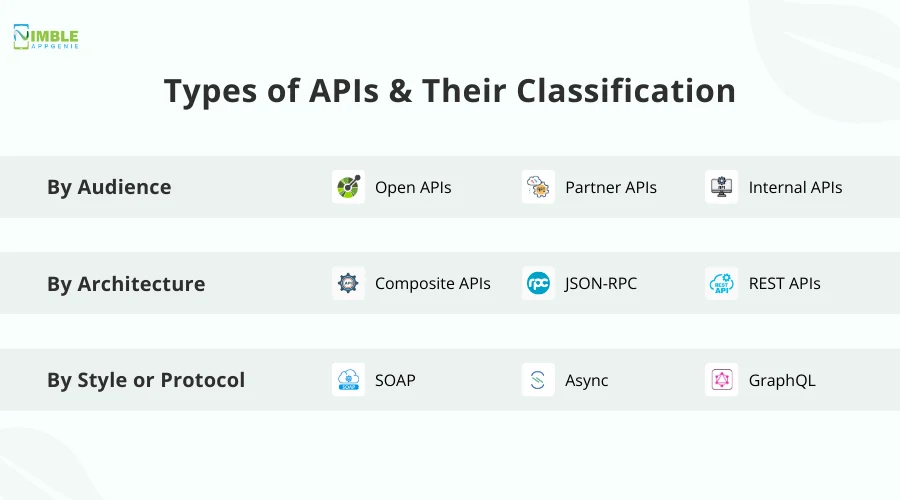
Different types of APIs are being used. These types are also defined based on different factors. There are 3 classifications commonly referred to when looking for APIs.
They are:
➤ By Audience
This classification is based on the availability of the APIs. These include:
- Open APIs
- Partner APIs
- Internal APIs
➤ By Architecture
This defines differences in APIs based on the architecture they use.
- Composite APIs
- JSON-RPC
- REST APIs
➤ By Style or Protocol
Since there are different protocols used by APIs, this becomes a great classification factor for APIs.
- SOAP
- Async
- GraphQL
Other than these, you can also classify APIs based on where they are used, what type of technologies it is being used for, and what type of vertical it is being used in.
Understanding APIs Used in App/Web Development
If you are wondering how to develop an API, it is important to evaluate what it means in terms of app and web development.
APIs used in app and web development allow different software applications to communicate with each other; however, in app development, these APIs act as a bridge to fetch data, handle security, and access device hardware.
APIs used in app and web development act as intermediaries that allow different software programs to communicate and share data. Here, instead of using every single feature from scratch, developers use APIs to plug directly into pre-existing functionalities, data sources, or device hardware.
Different types of APIs are used to exchange data in different ways. Out of all the types shared in the previous section, the most commonly used APIs are Representational State Transfer APIs, commonly known as RESTful APIs or REST APIs.
REST defines the architecture used to design APIs that work over a network to enable the transfer of data. Mobile applications use REST APIs because it is extremely easy to integrate and enables instant data fetching.
REST APIs use a client-server architecture. Resources that are to be shared are identified with the help of Unique Resource Identifiers or URIs. The interaction between the client and server is stateless.
There are several operations that RESTful APIs can apply to the data that is being fetched and shown to the user. These operations include:
- GET: Used to retrieve data from a server.
- PUT: Used to replace/update existing data.
- POST: Used to create new resources.
- DELETE: Used to remove existing resources.
Other than these, RESTful APIs also offer basic Create, Read, Update, and Delete operations, often referred to as CRUD.
How Does an API Work?
APIs work as a software intermediary that allows two different apps to communicate, share data, and interact with each other.
When an API is put to task, there is a series of steps that it follows. Otherwise, it may seem like a simple transfer of data from server to client.
Before you learn the complete process of API development, here are the steps stating how an API works:
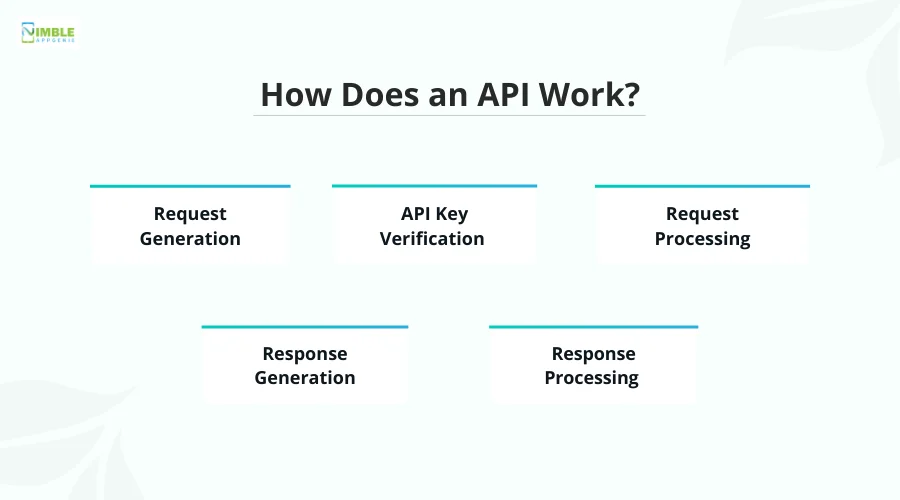
Step 1: Request Generation
The very first step is the generation of data requests. The client application interface is used to initiate a request to fetch specific data from the server and send it over.
Step 2: API Key Verification
When the request is received by the server, it first tries to verify the API key that was used to invoke the information. This verification is to ensure that the API uses the correct protocols to handle the data.
Step 3: Request Processing
Once the API key is authenticated and authorized by the server, the request is processed, and the required data is shared. The processing involves querying the database for required data, calculating the results, etc.
Step 4: Response Generation
After the request is processed, all the data is ready with the server to be sent. This response has all the information that was demanded by the API in the request to be processed.
Step 5: Response Processing
The response after being generated is processed, and the data is shared as requested. Once these steps are completed, the user interface of the app/website is updated, and the required data is shown.
While the process seems lengthy, all of it happens in a matter of seconds, making it feel seamless.
Tools to Develop an API
The different tools used to create an API are Restlet, Swagger, RAML, Apiary, and GitHub.
You see, for every type of development process, there are dedicated tools, programming languages, and other resources that are used. Similarly, when it comes to API development, there are dedicated tools.
Before learning about API development, let’s evaluate the right tools to create an API.
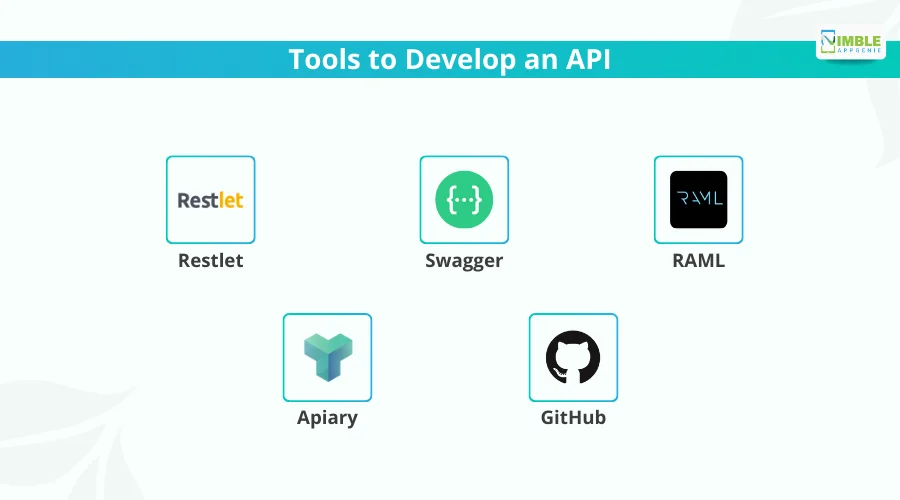
1. Restlet
An Integrated Development Environment (IDE) for API development, where Java developers can develop their REST architecture-based web APIs (REST APIs).
RESTlet API development framework is compatible with HTTP, HTTPS, JSON, and XML. It can be downloaded for free under an Apache license.
2. Swagger
An open-source API development framework that allows developers to create RESTful APIs. Swagger is a series of tools for API development. It starts with Swagger Editor, used to edit API specifications in YAML.
Swagger UI allows developers to dynamically generate documentation and a sandbox for the API. Lastly, Swagger Core is used for the implementation of Swagger in Java.
3. RAML
RESTful API Modeling Language (RAML) facilitates API lifecycle management, from design and development to third-party accessibility, including testing and documentation.
RAML allows developers to build APIs in various syntaxes, including Node.js (JavaScript), Java, Python, and .NET.
4. Apiary
It sounds more like a gimmick, but Apiary promises tools that allow developers to build their APIs in 30 minutes. Apiary provides developers with mock servers that allow them to run tests and mock-ups before encoding an API (like wireframing for user interfaces).
5. GitHub
An open-source git repository hosting service that allows developers to easily manage code files, control versions, pull requests, and comments, all of which will be distributed across the groups. Developers can also save their code in private repositories.
Other than these, API Science and AuthO are also helpful in API development. These tools enable developers to curate their APIs as they see fit. Different developers prefer different tools, as per their convenience.
In this AI era, it is essential to consider the important AI tools and techniques used to build an API. Here is the table defining the AI for the same;
| Tool | Description |
| OpenAI | Generates API specifications, OpenAPI schemas, backend code, test cases, and documentation from natural language requirements, accelerating API design and development. |
| Cursor | Helps developers create API endpoints, generate backend services, refactor code, and troubleshoot API implementations using AI-assisted coding. |
| Anthropic Claude | Assists with API architecture design, schema generation, backend implementation, testing strategies, and technical documentation. |
| Google Gemini | Supports API contract creation, code generation, integration workflows, and documentation development for modern API projects. |
| Amazon Q Developer | Generates API code, cloud integrations, infrastructure configurations, and serverless API implementations within AWS environments. |
| Tabnine | Provides intelligent code completion and assists in generating API endpoints, models, and integration logic across multiple programming languages. |
What is the Process For API Development?
Before we begin with the API development process, let us quickly take a look at all the components that you have to deal with. The API development components include –
| Component | What It Is | What It Includes |
| API Specification | The blueprint that defines how an API behaves and how clients should interact with it, before or alongside development. | Endpoints/URIs, request & response formats, data models, supported HTTP methods, parameters, standards like OpenAPI (Swagger) or RAML. |
| Authentication & Authorization | The mechanism that verifies who is calling the API (authentication) and what they’re allowed to do (authorization). | API keys, OAuth 2.0, JWT tokens, role-based access control (RBAC), and session/token expiry rules. |
| API Documentation | The reference material helps developers understand and integrate with the API correctly. | Endpoint descriptions, request/response examples, error codes, code samples (Python, JS, etc.), interactive sandboxes (Swagger UI, Postman docs). |
| API Security | The set of practices that protect the API and its data from unauthorized access, abuse, or attack. | SSL/TLS encryption, rate limiting & throttling, input validation, API gateways, and regular vulnerability testing. |
To create an API, you need to follow the right series of steps that begin with planning, API design, API testing, and then end with the deployment of the API.
Here is a complete series of steps to follow for building an API:
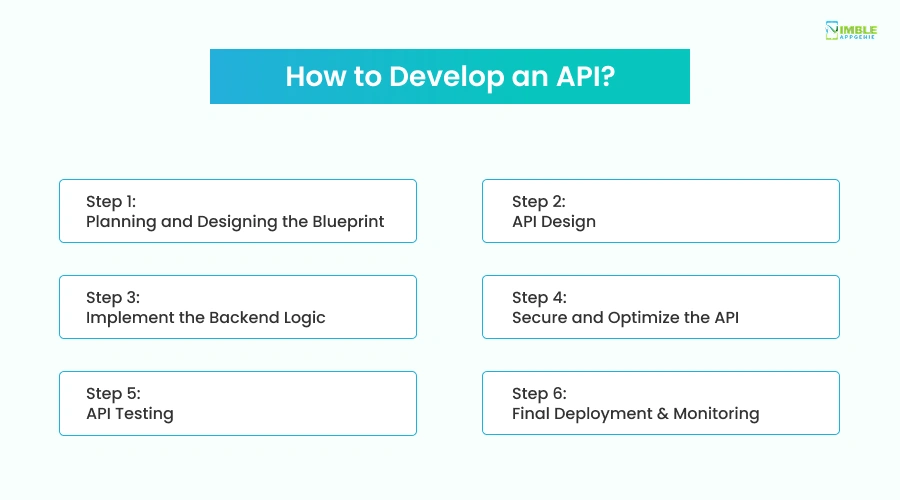
Step 1: Planning and Designing the Blueprint
The first step is to plan what your API will look like. It addresses the specifications you want in the API. What functionality do you want it to have? Who is the intended user, and which apps will leverage its use?
You need to define the complete use case and the exact problem that your API will solve. Along with this, you need to choose the architectural style, such as selecting REST, GraphQL, or gRPC.
Along with this, you need to use the OpenAPI specification for drafting your endpoints, payload schemas, and response codes before coding.
Step 2: API Design
This is the intentional process of planning, structuring, and establishing the exact rules for how the API exposes the data and system capabilities to the developers.
To ensure that the API you are building is reliable, secure, and scalable, you need to create an architecture that suits your concept.
The design of an API includes a choice of architecture along with the API’s endpoints, methods, data formats, and other parameters.
Step 3: Implement the Backend Logic
Adopting and implementing the backend logic is all about creating an API that comprises creating a server that receives requests, processes data, interacts with databases, and returns formatted responses.
This step is all about matching the client’s URL and HTTP method to the correct function. Here, you run pre-processing tasks such as rate limiting for preventing DDoS attacks, or CORS to allow browser access.
A proper backend architecture relies on a structured sequence including routing, middleware, authentication, input validation, and even error handling.
Step 4: Secure and Optimize the API
You can secure and optimize an API through a multi-layered approach. For securing an API, the key elements comprise authentication, rate limiting, caching, and payload validation.
Here, you can ensure all API communication uses HTTPS and transport layer security for highly sensitive machine-to-machine communications to ensure server identity.
Create a layered strategy that balances robust identity verification, strict traffic controls, efficient data management, and continuous performance monitoring.
Step 5: API Testing
For performing API testing, you should send structured requests to the specific API endpoints and validate that the server returns the correct response, status code, and data format.
After you complete the development process, you should now test all the essential functionalities for ensuing that the API is working effectively.
This testing and analysis comprises ensuring that all the endpoints are working fine and the data requirements are being fulfilled as expected.
Step 6: Final Deployment & Monitoring
Now, at this point, you should opt for the final deployment and monitoring of the API. This is the step where the API moves from an isolated testing environment into a live, production-ready ecosystem that is accessible to consumers.
All the metrics, such as uptime, requests per month, monthly unique users, response time, resource usage, etc. Monitoring these will help you identify the core gaps that you can address and refine the API.
Once all these steps are complete, you have a well-developed API. These steps to create an API can be easily used by any professional to build an API.
However, the majority of users are not familiar with code. Hence, they often look for API developers who can assist in finishing the process.
Features of a Well-Built API
A well-built API offers a plethora of features to its users. Some of those features are just for convenience, while some features are considered a must-have for an API as they allow it to be user-friendly, secure, and fully optimized for usage.
These features include:
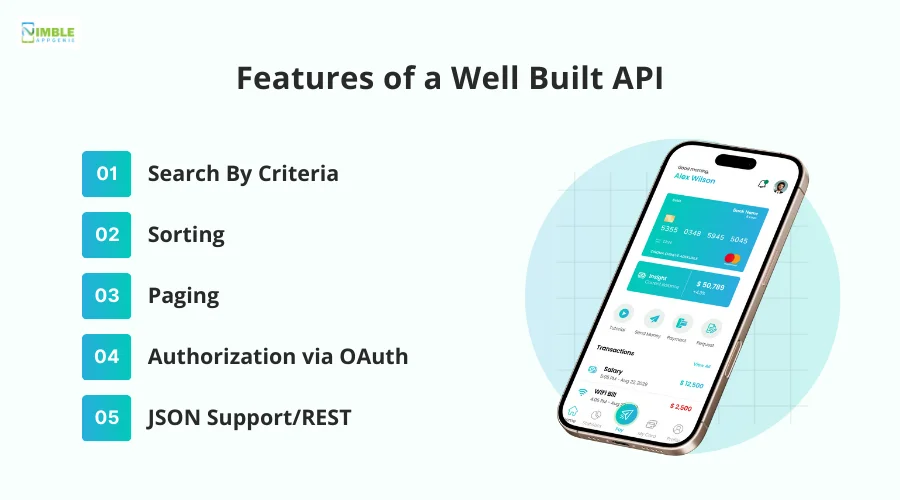
♦ Search By Criteria
A feature that allows a user to search for required data based on particular criteria. The most common one is the date.
♦ Sorting
When data is fetched through an API in bulk, the API should offer a custom sorting mechanism so that when it sends the data, it is received by the user in the desired format.
♦ Paging
Your API should be smart enough to create pages of the data to be displayed as required. For instance, if a user has requested limited data, your API should share only that and show other pages with a similar number of results.
♦ Authorization via OAuth
If you are familiar with the development norms, OAuth is the fastest way to securely authorize access to the data. Implement this feature to improve the speed with which your program interface fetches data.
♦ JSON Support/REST
While it is not necessary to create an API that follows REST or JSON, it improves the user experience and enhances the use cases of your API.
The majority of API users are mobile app developers or web developers. If you offer a RESTful API, a developer is more likely to use your API.
If you can develop an API that has all these features, you can deploy an API that gets the job done easily for the developer.
There are many other features that you can incorporate; however, they depend on what type of API you are developing. Now, what understanding what is API development, let’s get ahead with what you need to choose to build in-house vs hire an API development company in the next section.
Build In-House Vs. Hire an API Development Company
There is always an option to either hire an API development company or you can create an API by yourself, that too in-house, so what’s the better option?
Well, to deal with this, here is a table that can help you to make a decision:
| Factor | Build In-House | Hire an API Development Company | Impact on the Project |
| Development Speed | Depends on internal team availability and expertise. | Dedicated specialists can often accelerate development. | Faster delivery can reduce time-to-market. |
| Cost | Lower external spending but requires investment in hiring, training, and infrastructure. | Higher upfront vendor cost but fewer internal resource requirements. | Total cost varies based on project complexity and duration. |
| Expertise | Limited to the skills of the existing team. | Access to experienced API architects, developers, and integration specialists. | Better expertise can improve API quality and scalability. |
| Control | Full control over development, priorities, and intellectual property. | Development is shared with an external partner. | Greater control may simplify alignment with business goals. |
| Scalability | Scaling requires hiring or reallocating internal resources. | Vendors can typically scale teams up or down as needed. | Easier resource scaling helps manage changing project demands. |
| Maintenance & Support | Ongoing support remains the organization’s responsibility. | Many vendors offer post-deployment support and maintenance services. | Can reduce the long-term operational burden on internal teams. |
| Risk | Knowledge stays within the organization, but project success depends on internal capabilities. | Reduced execution risk through specialized expertise, but it introduces vendor dependency. | Impacts project continuity, quality, and long-term flexibility. |
| Time to Build Team | Requires recruiting and onboarding if skills are unavailable internally. | The team is usually available immediately. | Faster project initiation and execution. |
Based on the points of difference, you can make a decision on whether you need to opt for an in-house developer or hire an API developer.
One of the key points is that while outsourcing, you can focus completely on your business, and other important strategies are valuable to deal with.
If you are dealing with API development, there are certain pain points that you might come across. Let’s have a look at them in the following section.
Pain Points Related to API Development (Startups & Entrepreneurs)
Startups and entrepreneurs often face challenges related to implementing APIs. Here’s what they often face, and how you can avoid them:
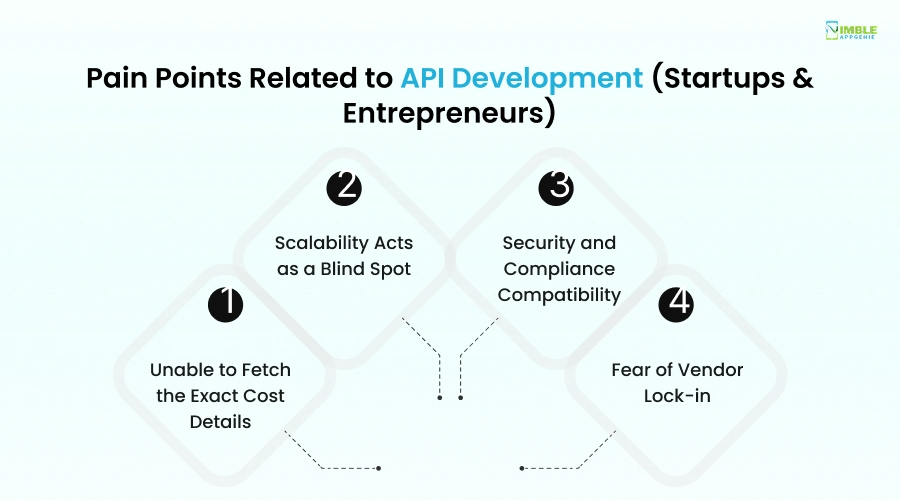
► Unable to Fetch the Exact Cost Details
This is a common issue among startups. Asking and estimating the right cost and API for the project without expert guidance brings challenges and requires careful answering.
With an experienced set of developers at Nimble AppGenie, you will be able to get the complete estimated cost details to build an API and learn how to add it to your project.
► Scalability Acts as a Blind Spot
Knowing whether the selected API will be scalable as the traffic rises, or can have seamless integration issues when a new technology is introduced, is a challenge.
Nimble AppGenie has specialized product engineers in AI and the latest technologies, which makes us the best option to choose for resolving the scalability issues.
► Security and Compliance Compatibility
Every region has its own compliance and even APIs to use. There might be a compulsive API or network to be integrated into the app to make it smoothly functioning in a particular city or region.
With the product engineers of Nimble AppGenie, you can be assured of selecting the right compliance and security networks. Our experts comply with the latest technological requirements.
► Fear of Vendor Lock-in
Most of the startups and entrepreneurs are often worried about what if a single developer or agency builds the API, and you get completely dependent on that vendor for maintaining it or making changes.
Well, the experts are available for you all the time. However, when it comes to a locked-in scenario, we transfer to you the complete control of your app, so that you can make decisions independently for the API and its related maintenance.
We have even selected the prompt steps and practices you can opt for building an API, lets have a look in the next section.
Best Practices to Help You Develop APIs
Now, how do you get a well-developed API? Well, there are a few practices that can help you create an API that is secure, efficient, scalable, and user-friendly. The idea is to create an API that can easily meet the requirements of modern-day applications/websites.
- Ensure clarity in naming conventions to reduce confusion between endpoints. This makes your API more user-friendly for the developers.
- Make sure you have used the proper HTTP methods to establish crystal-clear communication.
- Incorporate authentication mechanisms such as SSL/TLS and other data encryption methods that keep your API secure from unauthorized access and ensure that the data on your API is intact.
- Design APIs that have limited but necessary functionalities, as they are more accurate in getting the job done and simplifying the complications for a developer.
- Pay attention to the documentation as a well-documented API simplifies the integration process for a developer, enhancing the overall experience.
If you can incorporate these practices into your API development, the outcome will be nothing short of a well-designed API.
Keep in mind that all of these best practices will only come in handy when you have justified all the key components of an API development.

How Nimble AppGenie Simplifies API Development?
With the entire process of API development unfolding right in front of you, you may be wondering if there is a simpler way to build an API. Well, there is! We at Nimble AppGenie, a leading mobile app development company can help you create an API in no time.
Thanks to our expert developers, you can simply state what you want the API to do, and they will simply implement it for you.
Our developers have years of experience in delivering quality API development services. Reach out to the experts today and give your business the convenience of an API.
A well-built API can simplify the functionality of your application by a huge margin. Not to mention it boosts your service visibility as if you own a website that has a lot of data that others might need. You can develop an API of your own, offering access to your database for monetization.
Conclusion
Knowing how things work when it comes to API development, you should have gotten clarity on whether you want to make an API of your own or want to delegate the task to someone else. Either way, APIs will always be a crucial part of any application to manage and fetch data.
Implementation of APIs brings a completely new outlook to the way things are done in an app. It saves a lot of time for developers and hence, is of high importance.
Hopefully, this post helps you understand the process behind developing an API and the best practices to incorporate into it.
That will be all for this blog. Thanks for reading. Good luck!
FAQs

Niketan Sharma, CTO, Nimble AppGenie, is a tech enthusiast with more than a decade of experience in delivering high-value solutions that allow a brand to penetrate the market easily. With a strong hold on mobile app development, he is actively working to help businesses identify the potential of digital transformation by sharing insightful statistics, guides & blogs.
Table of Contents




No Comments
Comments are closed.