

 Free Consultation
 PCI-DSS Compliant
 GDPR Ready
 ISO 27001
 NDA Protected
 AI Services
 AI App Development
 Generative AI Development
 AI Chatbot Development
 AI Integration Services
 AI Consulting Services
 AI For Fintech
 AI Financial Assistant Solution
 AI Insurance Agent Development
 Tech Stack
 OpenAI / GPT-4
 Claude / Anthropic
 Gemini / Google AI
 Llama / Open Source
 LangChain / LlamaIndex
 Pinecone / Pgvector
 AWS / Azure AI


 Fintech Solution
 Core Fintech
 App Development
 Neobank Solutions
 eWallet Solutions
 Lending Software
 Banking Solutions
 BNPL Solutions
 BNPL Solutions
 Insurance App
 Wealth Management
 Crypto & DeFi
 Blockchain Development
  Payroll Software
 DeFi Solutions
 Crypto Wallet
 Crypto On/Off Ramp
 Crypto Exchange
 Trading Platform
 Payments
 Compliance
 Regulations & Compliance
 Fraud Detection
 Lending Ecosystem
 P2P Lending Platform
 Mortgage Software
 Engagement
 Fintech Outsourcing

 Mobile Development
 Mobile App Dev
 iOS App Development
 Android App Development
 React Native
 Flutter Development
 Web Solution
 Node.js Development
 React.js Development
 Angular Development
 App Services
 UI/UX Design
 App Maintenance
 By Stage
 MVP Development
 Industry Solutions
 Healthcare App Dev
 Education App Dev
 Travel App Dev
 Real Estate App Dev
 Logistics Software
 Social Media App

 Hire Mobile Developers
 Hire iPhone Developers
 Hire Android Developers
 Hire React Native Devs
 Hire Flutter Developers
 Hire Web Developers
 Hire Node.js Developers
 Hire Angular Developers
 Hire PHP Developers
 Hire Laravel Developers
 How It Works
 Pre-Vetted Developers
 Ready In 48 Hours
 NDA From Day One
 Replace Guarantee
 Company
 About Us
 Our Work Process
 Portfolio
 Case Studies
 Blog / Insights
 Careers
 Contact Us
 Awards
 Recognition


 Offices



Key Takeaways:
- A crypto wallet app stores, sends, and receives cryptocurrencies using private and public keys.
- Hot, cold, custodial, non-custodial, multi-chain, and DeFi are the six main types of crypto wallets.
- Essential features include multi-currency support, biometric authentication, 2FA, and real-time price tracking.
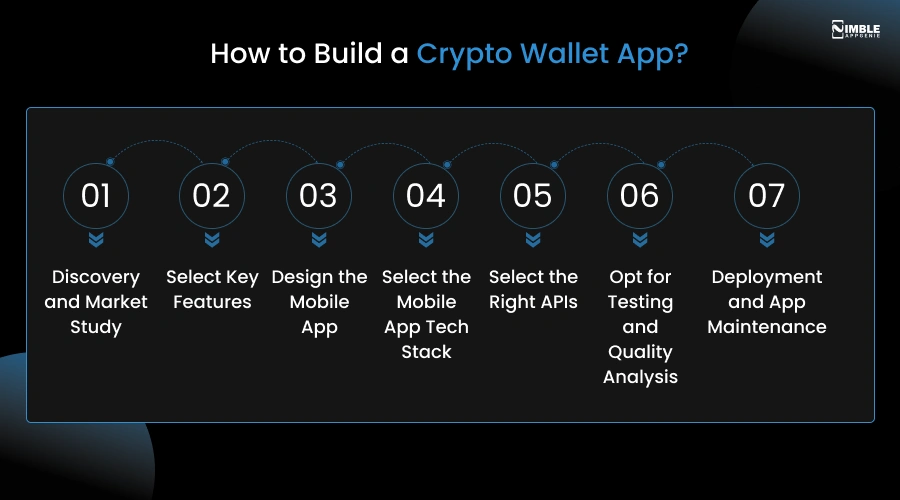
- To build a crypto wallet app, follow seven steps, from market research to deployment and maintenance.
- The total development cost ranges from $30,000 to $200,000, depending on complexity and tech stack.
- Compliance with regulations like KYC, AML, GDPR, and MiCA is non-negotiable for a legally operating crypto wallet.
- Connect with Nimble AppGenie for successful fintech software solutions.
You can build a crypto wallet app starting with an MVP, searching for the market, selecting features, designing, choosing a tech stack, deployment, maintenance, and improving.
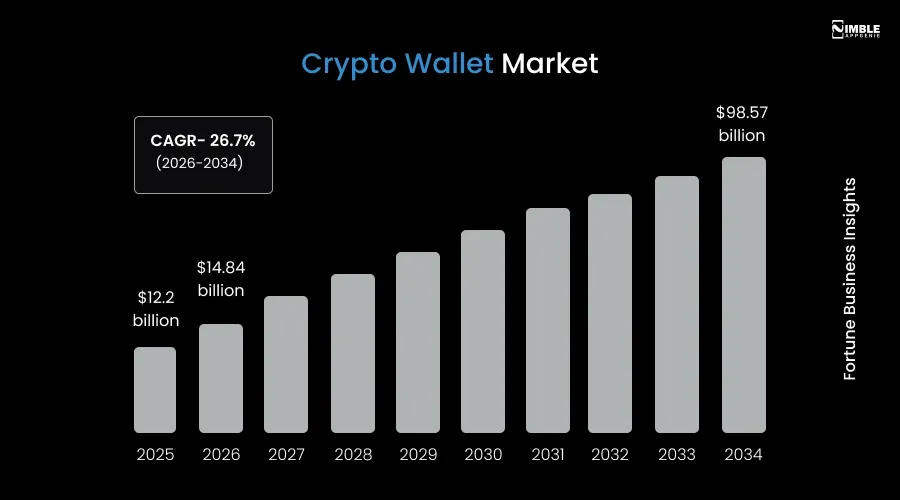
Do you know that the current crypto wallet app market is projected to reach USD 98.57 billion by 2034?
Yes!
This represents a golden window of opportunities for you as an entrepreneur and an investor to create a crypto wallet app.
Well, if you are the one searching for how to create a crypto wallet app, you are at the right place.
In this guide, we will walk you through the concept of a crypto wallet, market stats, types of crypto wallets, features, steps, costs, and much more.
Hence, let’s get it all started.
What is a Crypto Wallet App?
A crypto wallet app is a digital application that helps users store, send, receive, and even manage their cryptocurrencies, including Ethereum, Bitcoin, and other digital assets.
These are the digital and physical tools built to store the private keys required to access, manage, and even transfer cryptocurrencies and NFTs. These wallets are secure interfaces ranging from apps to physical hardware that help you sign transactions and prove.
The core points of crypto wallets are:
- Security & Ownership
- Asset Management & trading
- Wide Compatibility
Here is a list of certain market stats to consider:
- The global crypto wallet market size was valued at USD 12.20 billion in 2025.
- This market is expected to grow from USD 14.84 billion in 2026 to USD 98.57 billion by 2034, exhibiting a CAGR of 26.7% during the forecast period.
- This market is dominated with a market share of 32.13% in 2025.
- The cryptocurrency users hit 560 million, which already covers 7% of the global population.
Well, in case you want to build a cryptocurrency platform, it is essential to understand and learn about the different types of cryptocurrency wallets present before you select one.
Other than this, AI in cryptowallet apps is quickly changing the way these wallets work. It acts as more than a mere storage device and helps to convert a cryptowallet into a smart financial instrument.
Going with the integration of the latest technologies is significant for smart security, delivering personalized user experience, and optimizing transactions, with intelligent automation.
Let’s get started with the different types in the following section.
Which Type of Crypto Wallet Should You Build?
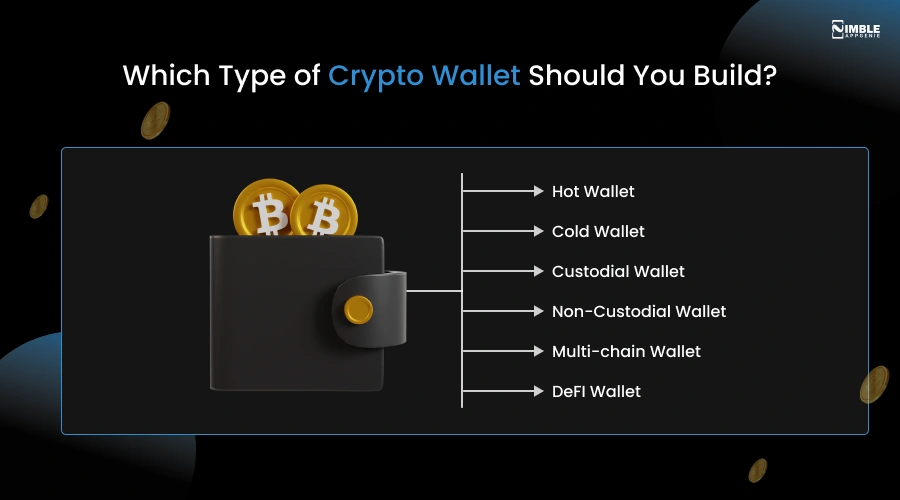
The different types of cryptocurrency wallets available are hot wallets, cold wallets, custodial wallets, non-custodial wallets, multi-chain wallets, and even DeFi wallets.
Here are different types of cryptocurrency wallets:
1. Hot Wallet
This is a type of cryptocurrency wallet that is always connected to the internet, and do offers maximum convenience for daily trading and transactions.
It is primarily designed for convenience and speed. It does allow users to effectively send, receive, and trade digital assets. You can build a hot crypto wallet by understanding the complete requirements of your app.
2. Cold Wallet
The cold wallet is a type of cryptocurrency wallet that is ideal for long-term holding and even for larger sums.
It is a type of wallet that signs transactions offline and has no direct internet link. The common use case is long-term storage and even safer holding.
3. Custodial Wallet
The custodial wallet is a type of cryptocurrency wallet where a third party centralizes the exchange and the financial service.
Additionally, the key aspects of the custodial wallets are management, user access, usage, and even recovery.
4. Non-Custodial Wallet
A non-custodial wallet is a type of cryptocurrency wallet where users have exclusive control over the private keys and the seed phrase.
The key features related to the non-custodial wallets are it opts for total control, privacy & autonomy, as well as key responsibilities.
5. Multi-chain Wallet
A multi-chain wallet is a cryptocurrency wallet that enables users to store, manage, and even transact data across multiple wallets and even across different blockchain networks.
This is a kind of wallet that allows you to store assets and even interact with the different blockchain networks.
6. DeFi Wallet
The DeFi wallet connects with the distinct smart contracts and even with the DeFi apps. Furthermore, most of the financial experts categorize the DeFi app based on its technical architecture, and even how they store the private keys.
Here, key components of a DeFi wallet include self-custody, wallet integration, and even smart contracts.
Which Wallet Type is Right for You?
| Your Goal | Best Wallet Type |
| Daily crypto trading | Hot Wallet |
| Long-term investment | Cold Wallet |
| Building for beginners | Custodial Wallet |
| Maximum user control | Non-Custodial Wallet |
| DeFi & Web3 integration | Multi-Sig Wallet |
Now, as you are clear with the different types of crypto wallets, let’s get ahead with the key features to include in a crypto wallet app in the given section.
How Many Features Can You Include in a Crypto Wallet App?
The key features to include in a crypto wallet are top-tier security, push notifications, and user authentication. Private keys management, address generation, transaction history, two-factor authentication, and many others.
Here is the list of the key features to include in a crypto wallet app:
| # | Features | Description |
| 1 | Multi-Currency Support | Allows users to store, send, and receive multiple cryptocurrencies within a single wallet |
| 2 | Two-Factor Authentication (2FA) | Adds an extra layer of security by requiring a second verification step during login |
| 3 | QR Code Scanner | Enables users to send and receive crypto instantly by scanning a wallet address QR code |
| 4 | Real-Time Price Tracking | Displays live cryptocurrency prices and market trends directly within the app |
| 5 | Push Notifications | Alerts users instantly about transactions, price changes, and security activities |
| 6 | Crypto Exchange & Swap | Allows users to exchange one cryptocurrency for another seamlessly within the app |
| 7 | Biometric Authentication | Secures wallet access through fingerprint or face ID recognition |
| 8 | Transaction History | Provides a detailed log of all past sent, received, and exchanged transactions |
| 9 | Backup & Recovery | Enables users to recover their wallet safely using a seed phrase or private key |
| 10 | Portfolio Management | Gives users a complete overview of their crypto holdings, gains, and losses |
| 11 | DeFi Integration | Connects users to decentralized finance platforms for staking, lending, and earning |
| 12 | Cross-Platform Compatibility | Ensures seamless wallet access across iOS, Android, and web platforms |
Well, these are not sufficient for disrupting the crypto industry; here, you will be required to change the features based on the requirements of your app.
With Nimble AppGenie, we can help you to add and implement the brainstorming features that might make a change.
Such as:
- AI-based intent transaction
- Autonomous safety and scam protection
- Universal cross-app crypto identity
But how do we build a crypto wallet app?
How to Create a Crypto Wallet App?
You can build a crypto wallet by following a significant series of steps beginning with market research, selecting features, till app launch and maintenance.
Here is the series of steps to follow:
Step 1: Discovery and Market Study
This is the first and foremost step to opt for while creating a crypto wallet app. Here, you should define the complete aim for your project related to what you want to deliver and how it can help your target users to solve their issues.
Here’s what you need to do:
- Study the market derivatives, such as demand and connectivity with users.
- Evaluate how your competitors are doing and why.
- Explore the market gaps
Step 2: Select Key Features
Build your app’s strong presence by including the key features that are essential and even those that are effective to make your business stand out.
Here, the feature selection should be based on:
- What do you want to serve the users?
- Are each feature is optimized to provide valuable insights?
- How can you make a difference with your feature?
Step 3: Design the Mobile App
You can design the complete mobile app through understanding the user behavior, identifying what kind of features and designs, understanding the guidelines of mobile app design, and navigation parameters, effective for creating a crypto wallet app.
Here’s how you need to design the complete mobile app:
- Consider user experience and functionality
- Opt for Security and privacy
- Create mobile app wireframes and prototypes
Step 4: Select the Mobile App Tech Stack
Now, in this step, you need to select the right mobile app tech stack for your app. You need to select the right tech stack by balancing the complete requirements of your app. The tech stack should support the design and functionality of the features.
Here is the table to consider for selecting a tech stack for a fintech app:
| Category | Technology / Tools |
| Frontend (Mobile) | React Native, Flutter, Swift (iOS), Kotlin (Android) |
| Backend | Node.js, Python, Ruby on Rails, Go |
| Blockchain Network | Ethereum, Bitcoin, Solana, Binance Smart Chain |
| Smart Contracts | Solidity, Rust, Vyper |
| Database | PostgreSQL, MongoDB, Firebase, MySQL |
| Cloud & Storage | AWS, Google Cloud, Microsoft Azure |
| Security & Encryption | SSL/TLS, AES-256, Two-Factor Authentication (2FA) |
| Crypto APIs | CoinGecko API, CoinMarketCap API, Moralis API |
| Wallet Integration | Web3.js, Ethers.js, WalletConnect |
| Payment Gateway | BitPay, CoinPayments, Stripe Crypto |
| Push Notifications | Firebase Cloud Messaging, OneSignal |
| Testing Tools | Appium, Jest, Truffle, Hardhat |
| DevOps & Deployment | Docker, Kubernetes, CI/CD Pipeline |
Step 5: Select the Right APIs
In this step, you should select the right type of integrations for your crypto wallet app. An application programming interface (API) acts as a protocol that allows different software applications to communicate and even exchange data with each other.
Here’s what you need to do for selecting the right APIs:
- Consider the data accuracy
- Evaluate the core requirements of the app
- Check for the reliability and latency
Step 6: Opt for Testing and Quality Analysis
Now, under this step, you should conduct a complete mobile app testing. It involves a mix of functional, non-functional, and even environment-specific testing. This step helps detect the software bugs and mitigate them.
Here’s what comes under the software testing:
- Check the functionality of your app
- Check the security of your crypto app
- Check for the payment integrations
Step 7: Deployment and App Maintenance
Now, it’s time to deploy your crypto app and focus on transitioning the application into reality. After deployment, another step comes in: mobile app maintenance. With a top-rated mobile app development company, you can expect to handle your maintenance and support.
Here’s what you need to do under this step:
- Identify the platforms to deploy your crypto wallet app.
- Select the right mobile app maintenance and support provider.
- Select the right features that you can bring to the app updates.
When you make a crypto wallet app, one of the important considerations here is “cost”. Let’s get ahead with the cost parameter in the following section.
How Much Does it Cost to Build a Crypto Wallet App?
The overall cost to create a crypto wallet app varies from $30,000 to $200,000, depending on different factors such as the complexity of your crypto app, the skills of the developers, design, selection of the tech stack, and even the API selection.
Now, let’s get ahead with the given table stating the cost breakdown of a crypto wallet app:
| # | Development Phase | Details | Estimated Cost |
| 1 | UI/UX Design | Wireframing, prototyping, and visual design | $3,000 — $8,000 |
| 2 | Frontend Development | Mobile app screens, navigation, and user interface | $5,000 — $15,000 |
| 3 | Backend Development | Server, APIs, and database architecture | $8,000 — $20,000 |
| 4 | Blockchain Integration | Connecting to Ethereum, Bitcoin, or Solana networks | $10,000 — $25,000 |
| 5 | Smart Contract Development | Writing and deploying secure smart contracts | $8,000 — $20,000 |
| 6 | Security & Encryption | SSL, AES-256, two-factor authentication, and audits | $5,000 — $15,000 |
| 7 | Wallet Features | Send, receive, swap, and portfolio management | $8,000 — $25,000 |
| 8 | Third-Party API Integration | Crypto price feeds, payment gateways, and KYC tools | $5,000 — $15,000 |
| 9 | Testing & QA | Functional, security, and performance testing | $3,000 — $10,000 |
| 10 | Deployment & Launch | App store submission and server deployment | $2,000 — $7,000 |
| 11 | Post-Launch Maintenance | Bug fixes, updates, and feature additions | $5,000 — $20,000 |
| Total Estimated Cost | $30,000 — $200,000 |
You can also check out the complete cost breakdown of a fintech app if you choose to develop it.
Now, after considering the cost, let’s get ahead with the list of key challenges in building a crypto wallet app in the following section.
What are the Biggest Challenges in Building a Crypto Wallet App?
The key challenges that you might face to make a crypto wallet app are adopting complexity in technical jargon, opting for clarification of the navigation structures, security, and even establishing trust of the users in the app.
Let’s understand and consider the key challenges along with their solutions to build a crypto wallet app:

1. Security and Key Management
Opting for the right security methods is one of the most significant challenges to make a crypto wallet app. Security is a challenge because these apps operate in a hostile environment where a single break can result in the irreversible loss of assets.
Under the encryption layer, keys must be encrypted at Rest, and decrypted temporarily to minimize the time a readable key exists. It will be helpful in securing the app and its data successfully.
2. Complexity in Technical Jargon
The complexity of jargon while a user uses a crypto app is a design challenge to avoid. In reality, the crypto transactions introduce diversified concepts that are not present in the traditional banking and even in the stock trading̣. It creates confusion for the users.
Hence, the design of the app should be simple and easy to understand. Here, you should use simple language rather than technical jargon for enhancing user experience.
3. Difficulty in the Navigational Structures
The complexity in the navigational structures is what you need to avoid to build a crypto wallet app. It is also a crucial design challenge that should be avoided through strategically planning your cryptocurrency wallet app design during development.
Here, you should opt for the attractive and even simple buttons that are easily understandable to the actual users for operating the complete mobile app.
4. Establishing Trust Among the Users
If your app fails to provide clear and transparent feedback on the transaction process, then this is a critical challenge to avoid while building a crypto wallet app. Decentralization is the hallmark of Web 3.0. This means there can be a delay during crypto wallet transactions.
However, a user might expect to complete the transaction seamlessly with one click of a button. Here, you need time to verify and record each transaction.
Well, along with understanding the challenges faced to create a crypto wallet app, another significant element to consider is compliance and security.
Let’s get ahead to learn about the compliance and security in the following section.
What are the Crypto Regulations and Compliance to Follow in 2026?
If you are wondering how to develop a crypto wallet app, one of the crucial paradigms to not ignore is its compliance and security.
Here’s all about the crypto regulations and compliance to follow in 2026:
| # | Regulation / Compliance | Full Form | Simple Meaning |
| 1 | KYC | Know Your Customer | Verify who your users are before they use your app |
| 2 | AML | Anti-Money Laundering | Ensure your app is not used for illegal money transfers |
| 3 | GDPR | General Data Protection Regulation | Protect the personal data of users in the European Union |
| 4 | CCPA | California Consumer Privacy Act | Give US-based users control over their personal data |
| 5 | CTF | Counter Terrorism Financing | Prevent your app from being used to fund illegal activities |
| 6 | FATF | Financial Action Task Force | Follow global standards for crypto transaction monitoring |
| 7 | MiCA | Markets in Crypto Assets | Follow the EU’s official crypto licensing and operating rules |
| 8 | BSA | Bank Secrecy Act | Report suspicious financial activities to the US authorities |
| 9 | SEC Compliance | Securities and Exchange Commission | Ensure your crypto token is not classified as an illegal security |
| 10 | PCI DSS | Payment Card Industry Data Security Standard | Keep all payment and transaction data fully secure |
| 11 | VASP | Virtual Asset Service Provider | Register your crypto app as a legal financial service provider |
| 12 | Travel Rule | FATF Travel Rule | Share sender and receiver information for crypto transactions above a threshold |
Why Partner With Nimble AppGenie in Building a Crypto Wallet App?
Connect with Nimble AppGenie for crypto wallet development service. We understand the crypto industry well, and are the top-rated fintech mobile app development company focused on delivering apps as per client requirements.
Our team has experience of 8+ years in delivering the best fintech solutions. We have already worked on 350+ solutions in this duration.
Here are some of our best case studies to consider:
1. Pay By Wallet
Pay By Wallet app’s main purpose was to serve and build currency exchange and international transactions. We have already delivered an e-wallet that converts the funds to the desired currencies, and that too in real time.
2. MaxPay
MaxPay was created as a secure payment gateway for the fantasy and betting-related apps. The main purpose of this app is to keep the transactions safe.
3. Pay By Check
The Pay By Check app was built to simplify online payments with EFT and ACH, enabling a smooth and secure transaction and currency flow.
Conclusion
Building a crypto wallet app in 2026 is one of the most rewarding yet complex ventures in the fintech space. From selecting the right wallet type and features to choosing the perfect tech stack and staying compliant with global regulations.
Whether you are an entrepreneur entering the crypto space or a business looking to expand digitally, the opportunity is massive and the time is now.
You can create a crypto wallet app by following a complete process from market study, selecting the features, designing the app, and building a complete tech stack for your crypto wallet app.
FAQs

Niketan Sharma, CTO, Nimble AppGenie, is a tech enthusiast with more than a decade of experience in delivering high-value solutions that allow a brand to penetrate the market easily. With a strong hold on mobile app development, he is actively working to help businesses identify the potential of digital transformation by sharing insightful statistics, guides & blogs.
Table of Contents




No Comments
Comments are closed.