

 Free Consultation
 PCI-DSS Compliant
 GDPR Ready
 ISO 27001
 NDA Protected
 AI Services
 AI App Development
 Generative AI Development
 AI Chatbot Development
 AI Integration Services
 AI Consulting Services
 AI For Fintech
 AI Financial Assistant Solution
 AI Insurance Agent Development
 Tech Stack
 OpenAI / GPT-4
 Claude / Anthropic
 Gemini / Google AI
 Llama / Open Source
 LangChain / LlamaIndex
 Pinecone / Pgvector
 AWS / Azure AI


 Fintech Solution
 Core Fintech
 App Development
 Neobank Solutions
 eWallet Solutions
 Lending Software
 Banking Solutions
 BNPL Solutions
 BNPL Solutions
 Insurance App
 Wealth Management
 Crypto & DeFi
 Blockchain Development
  Payroll Software
 DeFi Solutions
 Crypto Wallet
 Crypto On/Off Ramp
 Crypto Exchange
 Trading Platform
 Payments
 Compliance
 Regulations & Compliance
 Fraud Detection
 Lending Ecosystem
 P2P Lending Platform
 Mortgage Software
 Engagement
 Fintech Outsourcing

 Mobile Development
 Mobile App Dev
 iOS App Development
 Android App Development
 React Native
 Flutter Development
 Web Solution
 Node.js Development
 React.js Development
 Angular Development
 App Services
 UI/UX Design
 App Maintenance
 By Stage
 MVP Development
 Industry Solutions
 Healthcare App Dev
 Education App Dev
 Travel App Dev
 Real Estate App Dev
 Logistics Software
 Social Media App

 Hire Mobile Developers
 Hire iPhone Developers
 Hire Android Developers
 Hire React Native Devs
 Hire Flutter Developers
 Hire Web Developers
 Hire Node.js Developers
 Hire Angular Developers
 Hire PHP Developers
 Hire Laravel Developers
 How It Works
 Pre-Vetted Developers
 Ready In 48 Hours
 NDA From Day One
 Replace Guarantee
 Company
 About Us
 Our Work Process
 Portfolio
 Case Studies
 Blog / Insights
 Careers
 Contact Us
 Awards
 Recognition


 Offices



In a Nutshell:
- The digital lending market is growing thanks to the exponential penetration of smartphones in emerging markets.
- With the implementation of AI, financial institutions can enhance background checks through real-time credit scoring.
- Creating specialized solutions like P2P lending, student loan apps, etc., can put you ahead of the competition. Simply decide what kind of loan lending app development you want to go for and start working on the solution.
- Loan lending app development is highly preferred as it offers dedicated monetization solutions for increased revenue streams.
- Nimble AppGenie can help you build a loan lending app that capitalizes on all the rising market trends while ensuring better performance.
Building a loan lending app presents a tremendous opportunity in the rapidly growing fintech industry.
These apps offer borrowers and lenders a convenient and accessible platform, leveraging advanced technologies like AI-powered credit scoring and blockchain security to revolutionize the lending process.
Businesses, especially traditional financial institutions, can leverage the latest technologies and build a money-lending ecosystem that can be automated.
With the right features and a user-centric design, a loan lending app can streamline loan approvals, enhance the user experience, and ensure secure transactions.
Staying ahead of market trends and adopting innovative solutions can help your app stand out and meet the dynamic needs of today’s digital-savvy users.
If you are planning to build a loan lending app of your own but do not know how to get started, worry no more!
Understanding the Loan Lending Market: Growth, Revenue, & More
The loan lending market has seen remarkable growth. Especially with the rise of technology and the use of loan lending apps.
The core reason behind the same is the ease of internet access and how swiftly the reach of smartphones has increased in tier-2 and tier-3 cities of the world.
As per fintech statistics, the loan lending market is poised for significant expansion in the coming years.
Here are some key statistics that highlight the current state and prospects of the loan lending market:
- The global peer-to-peer (P2P) lending market size was valued at USD 246.6 billion in 2024 and is expected to grow at a compound annual growth rate (CAGR) of 29.5% from 2025 to 2033.
- In the United States, the online lending market reached approximately USD 190.4 billion in 2025, with continued expansion expected as more consumers and businesses turn to digital lending solutions.
- Mobile lending is on the rise, with the number of mobile loan app users projected to exceed 250 million by 2027, underscoring the importance of mobile wallets, offline payments, and digital transactions in the lending industry.
- Advanced technologies like AI and machine learning are being increasingly integrated into loan lending apps to streamline the lending process and improve risk assessment, enhancing both efficiency and security.
- Regulatory developments are shaping the loan lending market, with new fintech regulations being introduced to ensure compliance and build user trust.
These statistics underscore the dynamic growth of the loan lending market and the vast opportunities available for innovation.
The numbers clearly indicate that the market is open to accepting loan lending solutions. However, while these statistics show you the bigger picture, it is also important to be aware of the different types of loan lending apps that cater to different niches and audiences.
Check out the next section, where we have discussed all the types of lending solutions you can plan to build and enter the market.
What are the Different Types of Loan Lending Apps?
Loan lending apps come in various types, and each is designed to cater to different types of borrowers and lending needs.
Understanding these variations can help you determine the best approach when you decide to build a loan app.
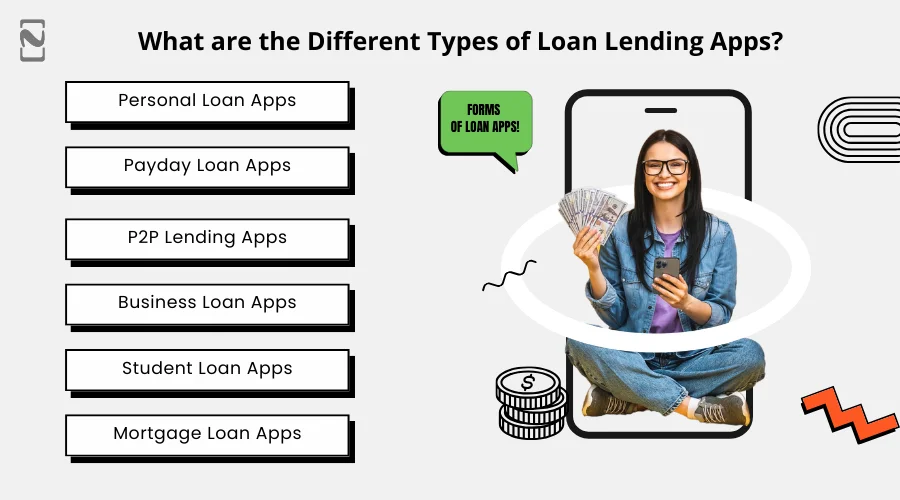
Here are the main types of loan lending apps that dominate the market:
► Personal Loan Apps
Personal loan apps provide unsecured loans to individuals for personal use.
These loans can be used for various purposes, such as consolidating debt, covering medical expenses, or funding home improvements.
The application process is typically straightforward, requiring users to fill out a form, submit necessary documents, and wait for approval.
Features:
- Easy Application Process
- Flexible Repayment Options
- Credit Score Monitoring
- Personalized Loan Offers.
► Payday Loan Apps
Payday loan apps offer short-term loans that are usually due on the borrower’s next payday.
These apps cater to users who need immediate cash for emergencies or unexpected expenses.
While convenient, these loans often come with high interest rates and fees.
They are also known as cash advance apps.
Features:
- Quick Access To Funds
- No Credit Check Required
- Direct Deposit to Bank Accounts
- Financial Management Tools.
► P2P Lending Apps
Peer-to-peer (P2P) lending apps connect borrowers directly with individual lenders, bypassing traditional financial institutions.
These platforms allow lenders to earn interest on their funds while providing borrowers with competitive loan terms.
The app typically facilitates the entire process, from loan application to disbursement and repayment.
Features:
- Direct Borrower-Lender Connection
- Competitive Interest Rates
- Automated Investment Options For Lenders
- Comprehensive Loan Management Tools.
Also Read: How To Create A Successful P2P Lending App?
► Business Loan Apps
Business loan apps are designed to provide financing to small and medium-sized enterprises (SMEs).
These loans can be used for various business needs, such as expanding operations, purchasing inventory, or managing cash flow.
The app may offer different types of business loans, including term loans, lines of credit, and invoice financing.
Features:
- Flexible Credit Lines
- Quick Application Process
- Integration with Business Accounts
- Real-Time Access To Funds.
► Student Loan Apps
Student loan apps help students secure funding for their education.
These apps may offer both private and federal student loans, along with refinancing options. These have been rather popular lately.
They often provide tools and resources to help students understand their borrowing options and manage their loans effectively.
Features:
- Customizable Loan Terms
- In-School Repayment Options
- Loan Calculators
- Educational Resources for Financial Literacy.
► Mortgage Loan Apps
Mortgage loan apps streamline the process of applying for and managing home loans.
Over the years, mortgage software development has seen massive demand as it offers a lucrative investment opportunity. These apps provide users with the ability to apply for a mortgage, upload necessary documents, and track the progress of their application.
They may also offer tools to calculate mortgage payments and compare loan options.
Features:
- Digital Application Process
- Document Upload and Tracking
- Mortgage Calculators
- Real-Time Application Updates.
Each type of loan lending app serves a specific market segment, addressing unique financial needs and preferences.
By understanding these different forms, you can better tailor your app development efforts to target the right audience and provide the most relevant features and services.
This understanding is crucial as you move forward with plans to develop a loan lending app.
First Recorded Loan: The oldest recorded loan dates back over 4,000 years in ancient Mesopotamia, where clay tablets were used to record loan agreements.
What Features Should an AI-Powered Loan Lending App Have?
If you are planning to build a loan lending app, you must know the important features.
Well, this section is all about that.
Here, we highlight the key features you should consider when planning to create a loan lending app, helping you build a robust and competitive product.
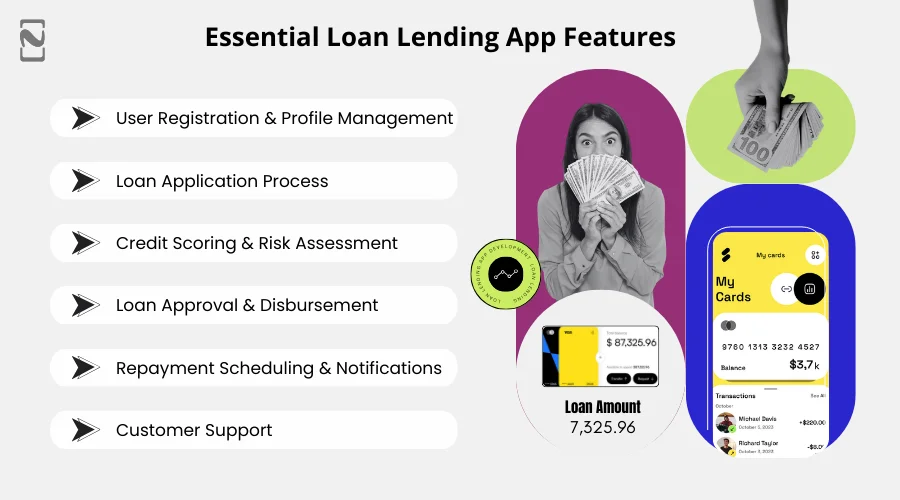
For a detailed overview, here are some must-have loan lending app features:
1. User Registration and Profile Management
Users should be able to register, create, and manage their profiles easily.
The process involves capturing personal information, verifying identity through documents like ID proofs, and allowing users to set up their account preferences.
2. Loan Application Process
A streamlined application process where users can apply for different types of loans by providing relevant details such as the loan amount, purpose, and repayment period.
This feature should guide users through each step, from filling out forms to submitting required documents.
3. Credit Scoring and Risk Assessment
Integration of AI and machine learning to evaluate user creditworthiness based on various financial parameters.
This involves analyzing credit history, income, employment status, and other relevant data points to assess the risk associated with lending to the user.
The system should provide a transparent credit score and insights into factors affecting it.
For microfinance-specific lending where borrowers often have no credit bureau history at all, our AI microfinance software guide covers the alternative-data scoring models built for thin-file applicants.
4. Loan Approval and Disbursement
Automated processes for loan approval and fund disbursement to the user’s bank account.
The system should facilitate quick decision-making and secure transfer of funds, providing users with timely access to their loans.
5. Repayment Scheduling and Notifications
Tools for setting up repayment schedules and sending reminders/notifications to users.
This feature should allow users to choose their repayment plan, set up automatic payments, and receive timely reminders to ensure they stay on track with their payments.
6. Customer Support
In-app customer support options such as live chat, email, or phone support.
The support system should be accessible and responsive, providing users with assistance whenever they encounter issues.
What are the Advanced Features of a Loan Lending App?
Advanced loan lending apps leverage cutting-edge technologies to deliver faster, smarter, and more secure lending experiences.
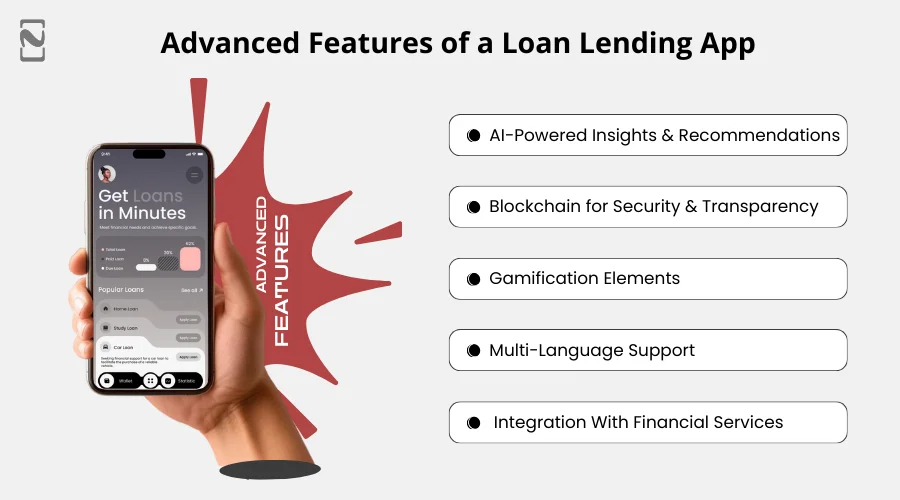
1. AI-Powered Insights and Recommendations
AI-driven insights to provide users with personalized loan recommendations and financial advice. The feature analyzes user data and behavior to offer tailored financial solutions and tips.
2. Blockchain for Security and Transparency
Utilizing blockchain technology to ensure secure, transparent, and immutable transaction records.
This feature leverages the decentralized nature of blockchain to provide secure and transparent financial transactions.
3. Gamification Elements
Integrating Gamification in loan lending apps, you can include elements such as rewards, badges, and leaderboards to engage the users.
This feature uses game-like elements to make the loan application and repayment process more interactive and enjoyable.
4. Multi-Language Support
Offering the app in multiple languages to cater to a diverse user base. This feature ensures that non-English speaking users can access and use the app comfortably.
Provide users with an advanced analytics dashboard to track their financial health, loan performance, and repayment status.
This feature offers detailed insights into financial activities, helping users manage their loans more effectively.
5. Integration With Financial Services
Integration with other financial services like insurance, investment platforms, and credit bureaus.
This feature provides a holistic financial solution, making the app a one-stop platform for users’ financial needs.
By incorporating these essential and advanced features, you can create a loan lending app that not only meets the basic requirements but also offers enhanced functionalities that differentiate it from competitors.
How To Build A Loan Lending App: Development Process
After completing the pre-development steps, it’s time to dive into the actual development process of your loan lending app.
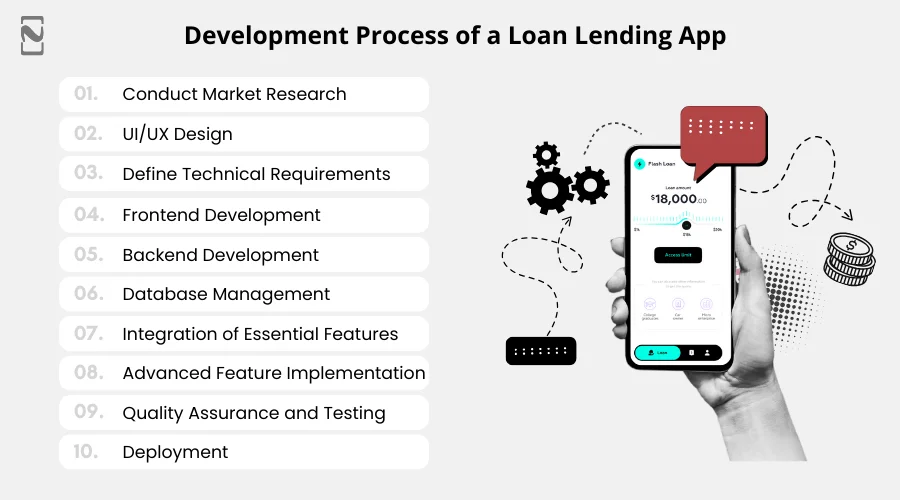
This comprehensive guide will walk you through the detailed steps involved in developing a successful loan lending app.
Step 1: Conduct Market Research
Begin by conducting comprehensive market research to understand current loan lending trends, user demands, and the competitive landscape.
Analyze your target audience, their preferences, and any gaps in the market that your app can fill.
This insight will help you identify unique selling points and features that can set your app apart from competitors.
Step 2: UI/UX Design
Design an intuitive and engaging user interface (UI) that offers a seamless user experience (UX).
Create wireframes to outline the app’s structure and flow, followed by interactive prototypes to visualize the user journey.
Focus on ease of navigation, accessibility, and visual appeal to ensure a positive user experience.
Step 3: Define Technical Requirements
A fintech app’s tech stack is super important.
So what you need to do is outline the technical requirements for your app. This includes the mobile tech stack, platform compatibility, and scalability considerations.
Decide whether your app will be developed for iOS, Android, or both. You can select the loan lending app tech stack wisely via the following table.
| Components | Technology Options | Description |
| Frontend | React, Angular, Vue.js | Choose a modern front-end framework for building responsive and dynamic user interfaces. |
| Backend | Node.js, Express.js, Django, Ruby on Rails | Select a robust backend framework to handle server-side logic, database interactions, and API creation. |
| Database | MongoDB, PostgreSQL, MySQL | Opt for a scalable and reliable database solution to store user data, loan information, and transaction records. |
| Mobile Development | Swift (iOS), Kotlin (Android), React Native, Flutter | Use native languages for platform-specific apps or cross-platform frameworks for broader reach. |
| Hosting/Cloud | AWS, Google Cloud Platform, Microsoft Azure | Utilize cloud services for scalable infrastructure, storage, and computing power. |
| Authentication & Security | OAuth, JWT, SSL/TLS, Firebase Authentication | Implement secure authentication mechanisms and protocols to protect user data and ensure secure transactions. |
| Payment Gateway | Stripe, PayPal, Braintree, Square | Integrate with reliable payment gateways for handling financial transactions and loan disbursements. |
| Notifications | Firebase Cloud Messaging (FCM), Twilio | Implement push notifications and SMS alerts to keep users informed about their loan status and updates. |
| Analytics | Google Analytics, Mixpanel, Firebase Analytics | Use analytics tools to track user behavior, app performance, and other critical metrics. |
| DevOps | Docker, Kubernetes, Jenkins, GitHub Actions | Implement CI/CD pipelines and container orchestration for efficient development and deployment. |
| Blockchain | Ethereum, Hyperledger | Consider blockchain for enhanced security and transparency in loan transactions and agreements. |
| AI/ML | TensorFlow, PyTorch, Scikit-learn | Utilize AI/ML frameworks for credit scoring, risk assessment, and personalized recommendations. |
Step 4: Frontend Development
Develop the user-facing part of the app using modern front-end technologies.
Ensure that the interface is responsive and functioning smoothly across various devices and screen sizes.
Implement UI designs and integrate user interaction elements, ensuring they align with the overall fintech app design and functionality.
Step 5: Backend Development
Develop server-side logic, database interactions, and API integrations.
The backend should handle data processing, user authentication, loan transactions, and other core functionalities.
Focus on creating a scalable, secure, and efficient backend that can handle high loads and provide fast response times.
Step 6: Database Management
Choose and configure a reliable database to store user data, loan information, and transaction records.
Implement data models and schemas that ensure efficient data storage and retrieval. Ensure that the database is secure, scalable, and capable of handling large volumes of data.
Step 7: Integration of Essential Features
Integrate core features such as user registration, loan application, credit scoring, loan approval, disbursement, and repayment schedule.
These features form the backbone of the app, providing users with the essential functionalities needed for loan management software.
Step 8: Advanced Feature Implementation
Add advanced features such as AI-powered insights, blockchain security, gamification elements, multi-language support, and advanced analytics.
These features enhance the app’s competitiveness and user engagement, providing users with added value and innovative functionalities.
Step 9: Quality Assurance and Testing
Conduct thorough testing to identify and fix bugs, ensure security, and validate that the app meets all requirements.
Perform various testing methods such as unit testing, integration testing, and user acceptance testing to ensure the app is reliable and performs well under different conditions.
Step 10: Deployment
Deploy the app to production servers and make it available to users. Ensure a smooth transition from development to the live environment by setting up production configurations and monitoring the deployment process closely to address any issues that arise.
This detailed development process ensures that all aspects of building a loan lending app are covered, from initial planning to post-deployment support, leading to a successful and competitive product in the fintech market.
How Much Does It Cost To Build A Loan Lending App?
On average, the cost to develop a loan lending app can range from $25,000 to $250,000 and more.
The exact cost depends on various factors such as the complexity of features, the development team’s location, and the time required for development.
Here’s a detailed breakdown of the key cost components:
| Component | Description | Estimated Cost Range |
| UI/UX Design | Designing an intuitive and engaging user interface and experience. This includes wireframes, prototypes, and final design. | $5,000 – $15,000 |
| Frontend Development | Developing the user-facing part of the app using modern front-end technologies. | $10,000 – $30,000 |
| Backend Development | Develop server-side logic, database interactions, and API integrations. | $15,000 – $40,000 |
| Database Management | Setting up and configuring a reliable database to store user data and transaction records. | $5,000 – $10,000 |
| Integration of Essential Features | Implement core features such as user registration, loan application, credit scoring, loan approval, disbursement, and repayment schedule. | $10,000 – $30,000 |
| Advanced Feature Implementation | Add advanced features like AI-powered insights, blockchain security, gamification elements, multi-language support, and advanced analytics. | $15,000 – $40,000 |
| Quality Assurance and Testing | Conduct thorough testing to identify and fix bugs, ensure security, and validate that the app meets all requirements. | $5,000 – $15,000 |
| Deployment | Deploying the app to production servers and making it available to users. | $3,000 – $8,000 |
| Post-Deployment Support and Maintenance | Provide ongoing support and maintenance to fix bugs, improve features, and ensure the app remains secure and up-to-date. | $5,000 – $12,000 Per Year |
The total cost can vary based on specific requirements, the complexity of the app, and additional features that might be required.
It’s important to budget for potential changes and ongoing maintenance to keep the app updated and secure.
How Do Money Lending Apps Make Money?
One might often wonder, Are loan apps profitable?
Well, they can be. Loan lending apps employ several monetization strategies to generate revenue.
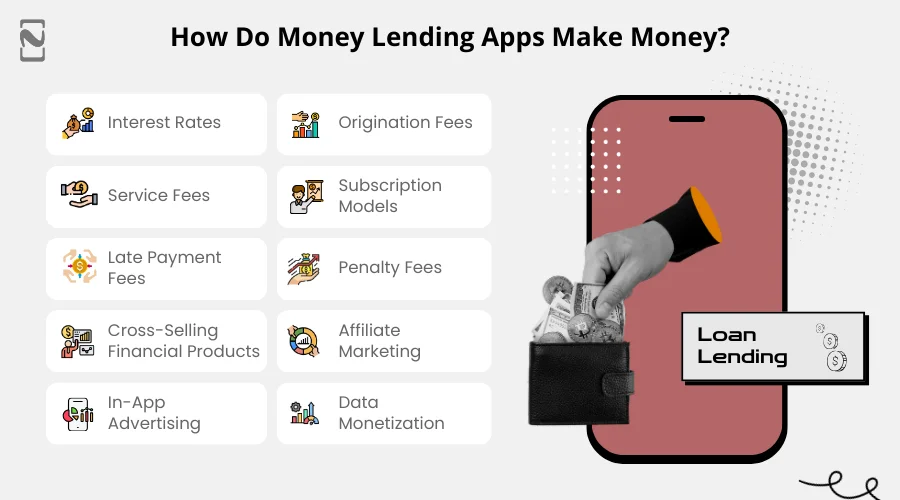
1. Interest Rates
Charging interest on the loan amount is the primary revenue source for loan lending apps.
For example, LendingClub offers loans with interest rates tailored to the borrower’s credit profile and loan type.
If an app serves 10,000 users with an average loan amount of $5,000 at a 10% annual interest rate, the potential revenue from interest alone can be substantial, potentially reaching millions annually.
2. Origination Fees
This is a one-time fee charged for processing the loan application, typically deducted from the loan amount before disbursement.
SoFi, for instance, charges origination fees ranging from 1% to 6% of the loan amount.
For a platform disbursing $50 million in loans annually, even a 2% origination fee can generate $1 million.
3. Service Fees
Some loan apps charge service fees for managing the loan, providing customer support, and maintaining the platform.
Earnin, for example, encourages users to tip voluntarily for the service instead of charging mandatory fees.
If each user tips $5 per transaction and the app processes 100,000 transactions a year, this can lead to $500,000 in revenue.
4. Subscription Models
Loan lending platforms can offer premium features and services through subscription models.
Credit Karma, for instance, offers premium subscriptions with enhanced features and financial insights.
With 10,000 subscribers paying $10 per month, the app can generate $1.2 million annually from subscriptions.
5. Late Payment Fees
Loan apps often charge fees for late payments to incentivize timely repayments and compensate for the risk of delayed payments.
Many loan services, including traditional banks, charge a fixed fee or a percentage of the missed payment amount.
For an app with 5,000 late payments a month at $25 per late fee, this could result in $1.5 million annually.
6. Penalty Fees
In addition to late fees, some apps impose penalty fees for other violations of the loan agreement, such as prepayment penalties or fees for insufficient funds.
If an app charges $50 for each prepayment and 1,000 users prepay annually, it can generate $50,000 in penalty fees.
7. Cross-Selling Financial Products
Loan apps can partner with other financial service providers to offer additional products such as insurance, credit cards, or investment services.
For example, Kabbage offers business loans and promotes business insurance and payment processing services.
By earning commissions of $100 per sale and making 500 sales monthly, the app could generate $600,000 annually.
8. Affiliate Marketing
By promoting third-party products and services, loan apps can earn affiliate commissions.
Credit Karma earns affiliate commissions by recommending credit cards and personal loans to users.
With commissions averaging $50 per referral and 2,000 referrals monthly, the app could make $1.2 million annually.
9. In-App Advertising
Some loan lending apps generate revenue through in-app advertising.
By displaying targeted ads to users, these apps can earn revenue from ad impressions, clicks, or conversions.
Freemium loan apps may use in-app advertising as their primary revenue source.
With a CPM (cost per thousand impressions) of $10 and 1 million monthly impressions, the app could earn $120,000 annually.
10. Data Monetization
Loan apps can monetize anonymized user data by selling insights to financial institutions, market researchers, or advertisers.
This data can provide valuable insights into consumer behavior and market trends.
If the app sells data insights at $50,000 per report and sells 10 reports annually, it can generate $500,000.
By leveraging these various monetization strategies, loan lending apps can build a sustainable business model that generates consistent revenue while providing valuable financial services to users.
AI’s Impact: AI and machine learning in loan lending can not only reduce default rates but also predict borrower behavior with up to 95% accuracy.
Why Should You Develop a Loan Lending App?
The demand for digital financial solutions continues to rise in 2026, making it an opportune time to develop a loan lending app.
There are several compelling reasons why businesses should invest in creating these apps.
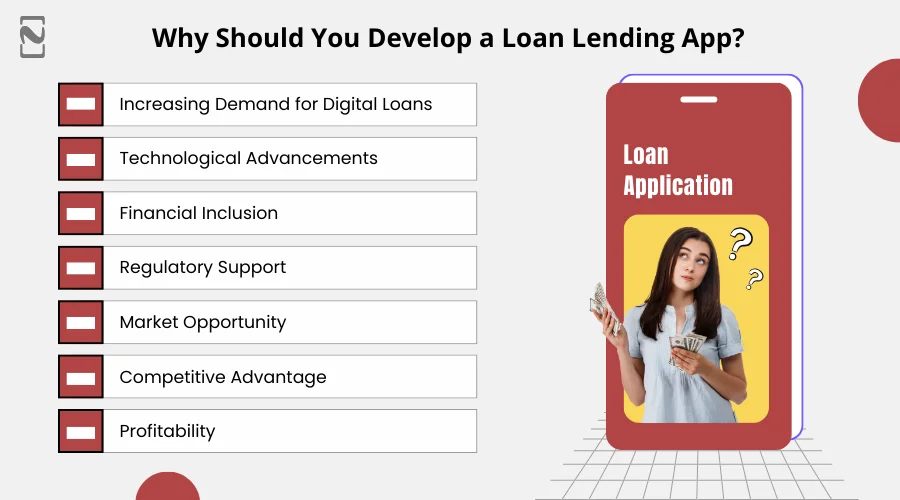
So, let’s look at some of the top driving reasons to start a fintech business through loan lending app development.
Reason 1: Increasing Demand for Digital Loans
The global shift towards digital finance has accelerated the adoption of loan lending apps.
Consumers and businesses alike are seeking faster, more convenient ways to access credit without the bureaucratic hurdles of traditional banking.
According to recent fintech statistics, the digital lending market is expected to grow significantly, providing ample opportunities for new entrants.
Reason 2: Technological Advancements
Advancements in technology, particularly AI, machine learning, and blockchain, have transformed the loan lending landscape.
AI and machine learning enable more accurate risk assessment and personalized loan offerings, while blockchain ensures secure and transparent transactions.
Integrating these technologies into your loan lending app can provide a competitive edge and enhance user trust and satisfaction.
Reason 3: Financial Inclusion
Developing a loan app can significantly contribute to financial inclusion, especially in underserved and unbanked regions.
By providing easy access to credit, these apps can help individuals and small businesses overcome financial barriers, promoting economic growth and stability.
Reason 4: Regulatory Support
Governments and regulatory bodies are increasingly recognizing the importance of digital financial solutions and are creating frameworks to support their growth.
Staying updated with fintech regulations ensures compliance and builds consumer confidence, making your app more attractive to potential users.
Reason 5: Market Opportunity
With a growing number of smartphone users globally, the potential market for loan lending apps is vast.
The convenience of applying for loans through mobile apps appeals to tech-savvy consumers, driving higher adoption rates.
By offering unique features and a seamless user experience, your app can capture a significant share of this expanding market.
Reason 6: Competitive Advantage
Entering the loan lending app market now can position your business as a pioneer in digital finance.
By offering innovative features such as gamification, real-time loan processing, and personalized financial advice, you can differentiate your app from competitors and build a loyal user base.
Reason 7: Profitability
Loan lending apps can be highly profitable through various monetization strategies, including interest rates, service fees, and premium features.
With the assistance of implementing as well as developing a robust business model and understanding the overall cost statement, you can ensure the importance of sustainable revenue streams that will help make effective profits.
In conclusion, building a loan lending app in 2026 presents a lucrative opportunity to tap into a growing market, leverage advanced technologies, and promote financial inclusion.
What Are the Challenges In Implementing Loan Lending Apps?
Implementing loan lending apps comes with various challenges that developers and businesses need to address to ensure success.
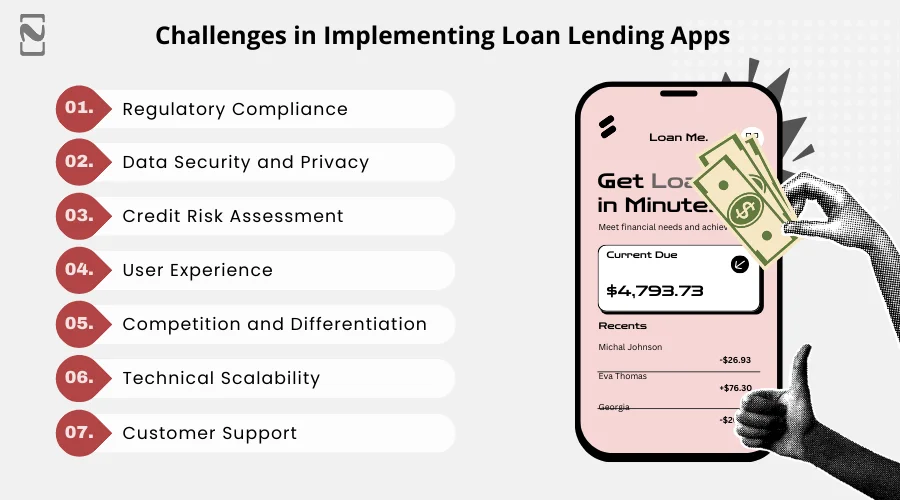
Here are some of the common mistakes to avoid while developing a money-lending app:
1. Regulatory Compliance
Navigating the complex regulatory landscape is one of the biggest challenges. Different regions have varying regulations regarding data protection, lending practices, and consumer rights, making compliance a daunting task.
Implementing a robust compliance framework from the beginning can help mitigate risks and avoid legal issues.
2. Data Security and Privacy
Ensuring data security and privacy is crucial, especially given the sensitive nature of financial data handled by loan lending apps.
Any breach can lead to severe consequences, including loss of trust and legal penalties.
Adhering to data protection standards like GDPR and CCPA is also essential.
3. Credit Risk Assessment
Accurately assessing the credit risk of borrowers is critical to minimizing defaults and ensuring the financial stability of the lending platform.
Traditional credit scoring models may not be sufficient for all types of borrowers, especially those with limited credit history.
4. User Experience
Providing a seamless and intuitive user experience is vital to attract and retain users. Complex or confusing interfaces can deter potential borrowers and lead to high dropout rates during the application process.
Ensure that the application process is streamlined and easy to navigate.
5. Competition and Differentiation
The loan lending market is highly competitive, with many players offering similar services. Differentiating your app from competitors and capturing market share can be challenging.
6. Technical Scalability
As the user base grows, ensuring that the app can handle increased load and transactions without compromising performance becomes challenging.
7. Customer Support
Providing efficient customer support to address user queries and issues is essential for maintaining a positive user experience. Poor support can lead to user dissatisfaction and attrition.
Regularly train support staff to handle complex issues and provide timely resolutions.
By addressing these challenges with the right strategies and solutions, you can ensure the successful implementation and operation of your loan lending app, providing a valuable service to users
while maintaining compliance and security for digital lending platforms.
How Does Nimble AppGenie Empower Great Ideas With Powerful Technology?
As a leading loan lending app development company, Nimble AppGenie specializes in creating robust, scalable, and user-friendly loan lending apps tailored to your business needs.
Our expertise in fintech allows us to integrate advanced features like AI-powered credit scoring, blockchain security, and a seamless user experience, ensuring your app stands out in a competitive market.
Partner with us to leverage cutting-edge technology and industry best practices and transform your ideas into a successful loan lending platform that meets the needs of modern users.
Our comprehensive approach ensures that your app is not only functional but also secure, scalable, and ready for the future.
Conclusion
Loan lending app development opens a new realm of growth and opportunities for financial institutions. Not only do these loan lending apps digitize the process for users, but they also expand the reach of a financial institution exponentially.
The market is definitely ripe for building a loan lending ecosystem, and with different types of loan lending solutions available, the options to enter the market become even more convenient.
It is only a matter of how you plan, how you identify the opportunities, and what type of loan lending app development services you opt for.
The blog clearly discusses every minute step involved in building a loan lending app. We hope this guide helps you achieve your objectives without having to compromise on the quality of your loan lending solution.
For further requirements, feel free to contact our experts, as they can do it all for you! Thanks for reading, good luck!
FAQs
Essential features include user registration and profile management, loan application processes, credit scoring, loan approval and disbursement, repayment scheduling, and robust customer support.
Loan lending apps use a combination of traditional credit scores and alternative data sources, such as social media activity and transaction history, often powered by AI and machine learning models.
Regulatory requirements vary by region but typically include data protection laws, lending regulations, and consumer protection standards. Compliance with GDPR, CCPA, and other local regulations is crucial.
Apps ensure data security through advanced encryption, two-factor authentication, regular security audits, and compliance with data protection standards.
They generate revenue through interest rates, origination fees, service fees, subscription models, late payment fees, penalty fees, cross-selling financial products, affiliate marketing, in-app advertising, and data monetization.
Key trends include AI and machine learning, blockchain technology, the integration of alternative data, embedded finance, RegTech, gamification, and biometric authentication.

Niketan Sharma, CTO, Nimble AppGenie, is a tech enthusiast with more than a decade of experience in delivering high-value solutions that allow a brand to penetrate the market easily. With a strong hold on mobile app development, he is actively working to help businesses identify the potential of digital transformation by sharing insightful statistics, guides & blogs.
Table of Contents




No Comments
Comments are closed.