

 Free Consultation
 PCI-DSS Compliant
 GDPR Ready
 ISO 27001
 NDA Protected
 AI Services
 AI App Development
 Generative AI Development
 AI Chatbot Development
 AI Integration Services
 AI Consulting Services
 AI For Fintech
 AI Financial Assistant Solution
 AI Insurance Agent Development
 Tech Stack
 OpenAI / GPT-4
 Claude / Anthropic
 Gemini / Google AI
 Llama / Open Source
 LangChain / LlamaIndex
 Pinecone / Pgvector
 AWS / Azure AI


 Fintech Solution
 Core Fintech
 App Development
 Neobank Solutions
 eWallet Solutions
 Lending Software
 Banking Solutions
 BNPL Solutions
 BNPL Solutions
 Insurance App
 Wealth Management
 Crypto & DeFi
 Blockchain Development
  Payroll Software
 DeFi Solutions
 Crypto Wallet
 Crypto On/Off Ramp
 Crypto Exchange
 Trading Platform
 Payments
 Compliance
 Regulations & Compliance
 Fraud Detection
 Lending Ecosystem
 P2P Lending Platform
 Mortgage Software
 Engagement
 Fintech Outsourcing

 Mobile Development
 Mobile App Dev
 iOS App Development
 Android App Development
 React Native
 Flutter Development
 Web Solution
 Node.js Development
 React.js Development
 Angular Development
 App Services
 UI/UX Design
 App Maintenance
 By Stage
 MVP Development
 Industry Solutions
 Healthcare App Dev
 Education App Dev
 Travel App Dev
 Real Estate App Dev
 Logistics Software
 Social Media App

 Hire Mobile Developers
 Hire iPhone Developers
 Hire Android Developers
 Hire React Native Devs
 Hire Flutter Developers
 Hire Web Developers
 Hire Node.js Developers
 Hire Angular Developers
 Hire PHP Developers
 Hire Laravel Developers
 How It Works
 Pre-Vetted Developers
 Ready In 48 Hours
 NDA From Day One
 Replace Guarantee
 Company
 About Us
 Our Work Process
 Portfolio
 Case Studies
 Blog / Insights
 Careers
 Contact Us
 Awards
 Recognition


 Offices



Key Takeaways:
- Fintech APIs are developed to bridge the gap between financial systems and apps to communicate data securely.
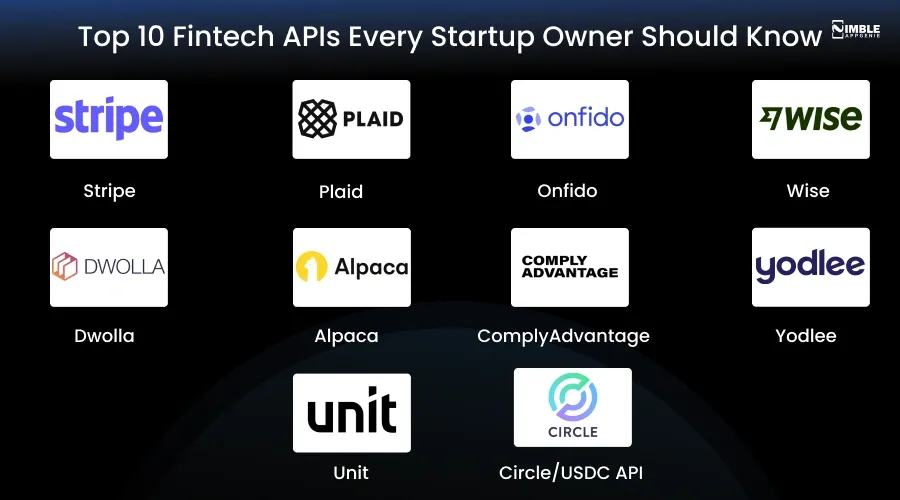
- The top 10 fintech APIs for startups are Stripe, Plaid, Onfido, Wise, Dwolla, Alpaca, ComplyAdvantage, Yodlee, Unit, and Circle/USDC API.
- Businesses and fintech startups can select the right fintech APIs by identifying the target market, core functionality, integration complexity, and by knowing compliance needs.
- Most of the businesses and startups often commit API integration mistakes, such as selecting the popular API instead of the right API, and building an API without any sandbox strategy.
- You can connect with the right team of developers, such as Nimble AppGenie, who can help you to identify, integrate, and even offer post-integration support.
The global fintech API market is projected to account for $1.20 billion in 2026 and reach $19.50 billion by 2034, growing at a CAGR of 8.4% during the forecast period.
With this growing market, you have a brilliant fintech idea, but building every financial rail from scratch will require payments, identity verification, bank connections, and fraud detection. Additionally, it would take 18+ months and millions of dollars.
So, what’s the solution?
Well, fintech APIs are the shortcuts that help you launch your fintech app in weeks, not in years. With the best fintech APIs, every startup can enter the market in less than 5 months.
However, fintech startups usually ask, “What APIs do I need to build a fintech app from scratch?”
There are top fintech APIs such as Plaid, Stripe, Wise, and many others. In this guide to the top 10 fintech APIs, we’ll walk you through how to choose the right APIs, the core list, and the challenges that you might encounter.
Let’s begin it all from the basics.
What is a Fintech API and why is it important?
A fintech API (Application Programming Interface) is a software bridge that allows different financial systems and apps to communicate and share data securely.
The implementation of fintech APIs is important because:
- It enhances efficiency
- Offers support for modular development
- Eliminates the need for building functionalities from scratch
- Enables access to rich data
- Fosters partnerships
- Provides pre-built functionality
- Simplifies cross-border financial transactions
In fintech, all sectors make use of APIs, whether they are digital payment & transfers, digital banking, alternative lending, insurtech, or blockchain & cryptocurrencies.
Fintech startups often ask, “Do I need a banking license to use fintech APIs for my startup?”
Most fintech APIs, especially BaaS and payment APIs, are designed to operate under the provider’s regulatory umbrella, meaning your startup can offer financial services without holding a full banking license.
However, specific use cases (e.g., lending, insurance) may still require regional licensing.
Also Read: A Complete Guide to Fintech APIs
Well, as you know why need a fintech API, let’s evaluate how to choose one for your app or software.
How to Choose the Right Fintech API for your Startup?
You can select the right fintech API for your startup by identifying the requirements of your project.
If your fintech startup idea includes a neobank, the must-have APIs are Plaid, Stripe Treasury, Onfido, and Unit. However, for a personal finance app, you require APIs such as Plaid, MX, and Yodlee.
Here are the steps to select the right fintech API for your startup:

Step 1: Evaluate the Core Function of Your App
Know what your platform or app is all about. Is it a neobank app, a lending/credit app, or an eWallet app?
The diversification of your fintech app will help you define the type of fintech API required.
Step 2: Identify the Target Markets
Are you targeting the US market, the UK, MENA, or the EU? The target audience will help you examine your system’s required security, data depth, and transaction speed.
If your market is UK-focused, you will need an open banking API to facilitate seamless, instant checkouts and avoid traditional card fees.
Step 3: Examine the Compliance Standards
Now, you should examine the complete compliance standards that include a systematic review of the organization’s procedures and policies, along with the industry frameworks.
Along with this, you should execute the compliance testing via documented evolution and through assessing IT security controls.
Step 4: Know the Complexity of Integration
In this step, you should know the complexity of integration, evaluate specific technical indicators across the overall API’s architecture, and the infrastructure overhead.
The level of integration difficulty is rarely determined by a single factor, but rather by how these hidden technical constraints compound.
Step 5: Clarify the Free Tiers vs. Per-Transaction Pricing
Now, you should be very clear about the free tiers, it represents a revenue or access model. Here, basic usage is free and is designed to convert users to paid users.
However, the per-transaction pricing is all about the payment gateways and the per-transaction model.
How to Automate Payment APIs in Fintech Startups?
Most early-stage fintech teams integrate a payment API once and then manually patch around its edge cases for the next two years. Automating the payment layer properly means designing for retries, reconciliation, and failure states from the start; not just wiring up a “charge card” endpoint.
A practical automation sequence:
► Webhook-First Design
Build your system to react to payment events (success, failure, dispute, refund) via webhooks rather than polling, so state updates happen in real time without manual checks.
► Idempotency Keys on Every Eequest
Prevents duplicate charges when a network retry fires after a timeout, which is one of the most common production bugs in payment integrations.
► Automated Reconciliation
Match provider settlement reports against your internal ledger on a schedule (daily, minimum) instead of manually auditing transactions.
► Retry Logic With Backoff
For failed payments due to insufficient funds or transient errors, automate retry attempts on a schedule rather than requiring manual re-submission.
► Sandbox-To-Production Parity Testing
Automate a test suite that runs the same transaction scenarios in sandbox and production to catch environment-specific breakage before it hits users.
Startups that skip steps 2 and 3 end up doing manual reconciliation in a spreadsheet six months post-launch; it’s worth the extra sprint upfront.
Need this built for you rather than in-house? See our integration services.
Top 10 Fintech APIs Every Startup Owner Should Know in 2026
Let’s discover the complete list here:
1. Stripe
Stripe API is a suite of RESTful APIs that allows developers to securely integrate billing, payment processing, and financial services into the websites and applications.
This API has predictable resource-oriented URLs, accepts form-encoded request bodies, and uses standard HTTP response codes and verbs.
Best For: Neobanks, eWallets, Marketplaces, and Subscription Fintechs
Benefits of Using Stripe:
- Developer-friendly and customizable API
- Offers tax automation
- Enables fintechs and financial platforms to instantly verify APIs
- Eliminate complex banking integrations and streamline operations
Demerits of Using Stripe:
- Risk and Account Stability
- Offers limited customer support
- Strict Rate limits
- Technical complexity
Fintech startups often ask, “Is Stripe good for fintech startups or just e-commerce?”
Yes, Stripe is good for fintech startups, not just for e-commerce. It provides the core infrastructure that powers neobanks, lending platforms, and crypto startups.
Other than this, Stripe does offer several specialized products for creating fintech apps, such as Stripe Connect, Stripe Capital, and Stripe Identity.
2. Plaid
Plaid is built for every financial need, and is a network that makes your products better. It is a financial translator, and does allow the software applications to connect directly with the banks.
It is a developer-friendly interface that bridges the gap between financial institutions and fintechs, enabling actions like verifying account balances and initiating payments.
Best for: Personal finance apps, lending platforms, budgeting tools, neobanks
Benefits of Using Plaid:
- Effortless Onboarding
- Bank-Level Security
- Total Data Control
- Provides End-to-end data encryption
Demerits of Using Plaid:
- Connection and reliability issues
- Cost and pricing structure
- Privacy and security concerns
- Fragile webhook pipeline
3. Onfido
Onfido API is a leading digital identity and biometric verification platform used in fintech and biometric sectors. This is an API and a cloud-based platform that allows businesses to automate digital identity verification.
This API allows businesses to safely onboard users at scale through validating official government documentation and verifying user identity via AI.
Best for: Any fintech app requiring a digital onboarding API in fintech, lending, neobanking, or remittances.
Benefits of Using Onfido:
- Orchestrate award-winning document and biometric verification
- Provides vital fraud detection signals
- Offers highly customizable, user-friendly mobile SDKs
- Balances high-security risk management with excellent user experience
Demerits of Using Onfido:
- Cumbersome user experience
- Biometrics and privacy concerns
- Technical & OCR flaws
- Customer support bottlenecks
4. Wise
WIse is among the top 10 fintech APIs that every startup owner should be aware of. This API bypasses the traditional SWIFT networks and allows for cheaper and faster international transactions.
Over this platform, the users consistently gain access to transparent mid-market exchange rates and significantly reduce back-office processing costs.
Best for: Remittance apps, global payroll fintechs, cross-border marketplaces
Benefits of Using Wise:
- Accelerate customer onboarding with automated checks
- Prevents sophisticated fraud like deepfakes and synthetic IDs
- Ensure compliance with KYC and AML regulations
- Offers no-code integration
Demerits of Using Wise:
- High costs & locked-in pricing
- Complicated onboarding
- Limited document coverage
- Lacks full-backed transaction monitoring
5. Dwolla
Dwolla is a fintech API that allows businesses to embed account-to-account transfers, open-banking features, and digital wallets into their applications.
This API connects your business to the U.S. banking infrastructure via an established relationship with one of Dwolla’s financial institution partners. A top fintech app development company uses this tool to embed account-to-account (A2A) payments.
Best For: Lending platforms, payroll apps, P2P payments, marketplace payouts
Benefits of Using Dwolla:
- Cost efficiency & automation
- Provides seamless integration
- Have features such as same-day, real-time payments, and white-label UI
- Offers tiered pricing, which means you pay as you go
Demerits of Using Dwolla:
- No-credit or debit card support
- Have slower processing times
- Developed strictly only for domestic U.S transfer
- Requires consumer accounts
6. Alpaca
Alpaca is a brokerage and trading infrastructure API, whose main features are commission-free stock trading, real-time market data, fractional shares, and crypto support.
This API works on the free-for-trading API, commission-free API-first structure for the standard individual cash accounts. It is used by fintech startups building Robinhood-like experiences.
Best for: Investment apps, robo-advisors, wealth management tools, crypto-fiat hybrid apps
Benefits of Using Alpaca:
- Allows commission-free trading on U.S. stocks and options
- Offers real-time and historical data
- Provides risk-free paper trading
- Highly sustainable resource
Demerits of Using Alpaca:
- Data feed limitations & cost
- Provides limited customer support
- Have incomplete order types
- Strict rate limiting
7. ComplyAdvantage
ComplyAdvantage is a developer tool that allows financial, fintech, and crypto platforms for an AI-powered Anti-Money Laundering (AML) screening, sanctions checks, and transaction monitoring.
The key features that this API offers are real-time sanctions, PEP screening, adverse media monitoring, and transaction risk scoring. With the pricing models as subscription-based, and contact for enterprise.
Best for: Any fintech handling money movement, such as payments, lending, and crypto.
Benefits of Using ComplyAdvantage:
- Avoids high-risk migrations with a granular REST API to operate as a compliance stack
- Every endpoint is documented and well-explained for developers
- Supports business continuity with high availability
- Real-time, low-latency integration pathways
Demerits of Using ComplyAdvantage:
- Data inaccuracy flags false positives and suggests unrelated entities
- Users experience poor customer support due to the slow response times
- People find the user interface cluttered and complicated to use
- The platform lacks detailed logging for case processing
Also Read: How AI is revolutionizing fraud detection in fintech?
8. Yodlee
The Yodlee is a RESTful API that allows developers to access personal financial data from the Yodlee platform. It is used by fintechs and financial institutions to aggregate and analyze consumer-permissioned financial data from over 19,000 global sources.
API is a realistic data set of attributes that transforms the raw transaction data into categorized insights for cash flow streams.
Best For: PFM (personal finance management) apps, credit underwriting, global fintech products
Benefits of Using Yodlee:
- Offers transaction data enrichment
- Provides real-time account verification
- Provides accelerated time-to-market
- Yodlee offers open finance connectivity utilizing consumer-permissioned data to power secure financial experiences.
Demerits of Using Yodlee:
- No transaction execution
- Outdated architecture
- Have a complicated infrastructure
- The platform has an ambiguous pricing model
9. Unit
Unit is an enterprise-grade financial infrastructure platform that helps you to offer financial services to your customers. The platform is a full banking-as-a-service stack that includes accounts, cards, payments, and compliance.
The key features used in the top fintech apps include FDIC-insured accounts, debit/credit card issuing (via Visa/Mastercard), ACH + wire + RTP, and KYC built in.
Best For: Neobank startups, embedded finance products, vertical SaaS adding banking features
Benefits of Using Unit:
- This fintech API is used for automatic data enrichment
- It does offer AI-powered insights and peer benchmarking to guide savings
- Offers streamlined security that employs strict user-permissioned access
- Uses transaction and income history for predicting future balances
Demerits of Using Unit:
- Poorly configured JSON that can pass unit tests can crash the API
- Have resistance to refactoring
- High fragility and false security issues
- People often find the user interface cluttered
10. Circle/USDC API
Circle/USDC is among the best 10 fintech APIs that offer a stablecoin infrastructure (USDC) for programmable money. The key features of this API are USDC issuance/redemption, multi-chain support, programmable payments, and treasury management.
In this API, developers programmatically issue, send, receive, and redeem USDC. This API essentially programmable dollars that move on the blockchain rails instead of traditional banking rails, like SWIFT or ACH.
Best for: Crypto-fiat apps, global payroll (stablecoin), DeFi-adjacent fintechs, cross-border settlement
Benefits of Using Circle:
- Send and receive funds internationally in seconds
- Offers automated & autonomous payments
- Have institutional-grade compliance
- Builds automations with admin APIs
Demerits of Using Circle:
- Integration and error handling
- Authentication and rate limits
- Complicated pricing models
- Offers usage caps and overage fees
Now, let’s proceed with the biggest mistakes startup founders often make.
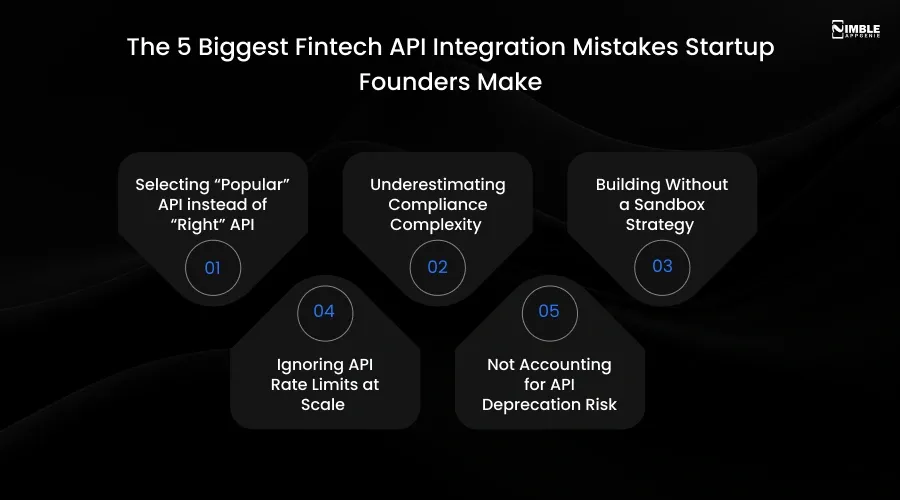
The 5 Biggest Integration Mistakes Startup Founders Make
The biggest mistakes and pain points of the founders are choosing the popular API instead of the right API, understanding the complexity of complaints, and many more.
Let’s consider the list below for pain points of the startup founders:
1. Selecting “Popular” API instead of “Right” API
Instead of going for the popular API, you should select the right API for your platform. When your end user uses the platform, they don’t see the API; they see the functionality of your app.
For example, Stripe is great, but it’s not always the right fit. For MENA-focused remittance, these startups might be better served by Wise and local payment rails.
2. Underestimating Compliance Complexity
Integrating KYC and AML compliance for fintech doesn’t mean you are compliant; you still need to define the compliance workflows, data retention policies, and audit trails.
Thus, you need to go beyond the KYC integration, offering regulatory proliferation, and providing global operations.
3. Building Without a Sandbox Strategy
Without an isolated environment, you can end up in a scenario where you might introduce risks and inefficiencies that directly affect the stakeholders, developers, and end-users.
This is a type of issue that can result in costly troubleshooting and security risks for your fintech app.
4. Ignoring API Rate Limits at Scale
An API that is working great for 100 users may become a bottleneck at 100,000. Hence, testing the APIs’ limits is important for startup owners.
This can even result from abrupt service outages and broken integrations to unexpected bill spikes and data loss.
5. Not Accounting for API Deprecation Risk
API can change. Building your entire stack on one vendor will create extreme dependency, which is dangerous. As it acts as a bridge between different systems and end-user apps, a breakage in an API can result in losing your app.
Here, you should construct a modular fintech app architecture that can protect you from having a dependency on only one vendor.
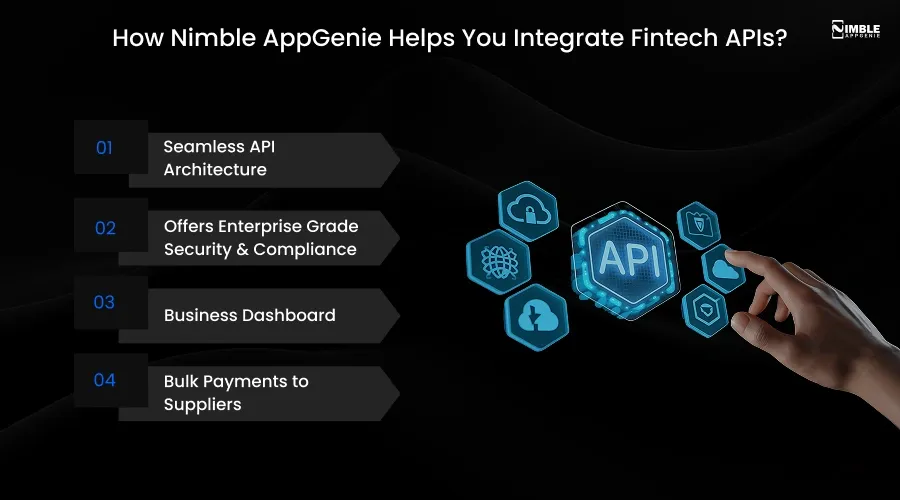
How Nimble AppGenie Helps You Integrate Fintech APIs?
To integrate the top fintech APIs in your project, you need a team of experienced developers.
Well, you don’t need to go far. Nimble AppGenie is the best fintech software development company, specializing in fintech API integration services that connect your platform with the APIs it needs to run.
Here’s what we offer:
1. Seamless API Architecture
Nimble AppGenie does offer an integrated and user-friendly API structure, which not only benefits your platform but also helps users to seamlessly navigate through the app. We opt for a cloud-native architecture to integrate APIs.
2. Offers Enterprise Grade Security & Compliance
We comply with the latest regulations and security standards by integrating the security practices directly into the software development lifecycle. Additionally, we do comply with the KYC in fintech apps and AML requirements alongside the data compliance frameworks.
3. Scalability & Performance
Our team integrates the APIs that not only work for a specific set of users, we integrate the APIs that scales up with your app and platforms. That’s what makes us different from others.
4. Have Proven Track Record
Nimble AppGenie has a proven track record, which means we have already helped 100+ businesses and companies to find and add their APIs to their platforms.
Conclusion
Selecting the right API can help you to enhance the overall performance and productivity of your app. It will further help you to examine the compliance standards, and even help to clarify the free tiers vs per transaction pricing.
The top 10 fintech APIs are Stripe, Plaid, Onfido, Wise, Dwolla, Alpaca, Comply/Advantage, Yodlee, Unit, and Circle/USDC API. Along with this, you should consider the different types of pain points, including seamless API architecture, scalability & performance, proven track record, and enterprise-grade security.
FAQs
A fintech API (Application Programming Interface) is a software bridge that allows a financial application to securely communicate with external financial systems, such as banks, payment gateways, KYC providers, or credit bureaus. They enable startups to offer features like payments, lending, or identity verification without building this infrastructure from scratch.
There’s no single “best” API; the right choice depends on your product type. For payments, Stripe is the default for most startups. For bank data connectivity, Plaid leads in the US. And for KYC/identity, Onfido or Persona are top choices. For neobank infrastructure, Unit or Synapse provides the most complete BaaS stack. Most fintech startups need 3–5 APIs working together.
Yes, and most fintech apps do. A typical neobank might use Plaid (bank data), Stripe (payments), Onfido (KYC), ComplyAdvantage (AML), and Unit (banking infrastructure) simultaneously. The key is designing a clean, modular architecture that prevents vendor lock-in and handles API failures gracefully.
It will totally depend on the identity verification APIs. These providers do offer plug-and-play SDKs for handling document scanning, as well as database screening. The top providers that you can use are SumSub, Jumio, Onfido, and Persona.
The best cross-border payment API for fintech startups depends on your particular business model. You can use Stripe and Wise, which are ideal for the consumer and merchant-facing apps.
The best options for adding stock trading to your fintech app are Alpaca. These APIs do offer licensed brokerage and clearing infrastructure for executing trades legally.

Niketan Sharma, CTO, Nimble AppGenie, is a tech enthusiast with more than a decade of experience in delivering high-value solutions that allow a brand to penetrate the market easily. With a strong hold on mobile app development, he is actively working to help businesses identify the potential of digital transformation by sharing insightful statistics, guides & blogs.
Table of Contents




No Comments
Comments are closed.