

 Free Consultation
 PCI-DSS Compliant
 GDPR Ready
 ISO 27001
 NDA Protected
 AI Services
 AI App Development
 Generative AI Development
 AI Chatbot Development
 AI Integration Services
 AI Consulting Services
 AI For Fintech
 AI Financial Assistant Solution
 AI Insurance Agent Development
 Tech Stack
 OpenAI / GPT-4
 Claude / Anthropic
 Gemini / Google AI
 Llama / Open Source
 LangChain / LlamaIndex
 Pinecone / Pgvector
 AWS / Azure AI


 Fintech Solution
 Core Fintech
 App Development
 Neobank Solutions
 eWallet Solutions
 Lending Software
 Banking Solutions
 BNPL Solutions
 BNPL Solutions
 Insurance App
 Wealth Management
 Crypto & DeFi
 Blockchain Development
  Payroll Software
 DeFi Solutions
 Crypto Wallet
 Crypto On/Off Ramp
 Crypto Exchange
 Trading Platform
 Payments
 Compliance
 Regulations & Compliance
 Fraud Detection
 Lending Ecosystem
 P2P Lending Platform
 Mortgage Software
 Engagement
 Fintech Outsourcing

 Mobile Development
 Mobile App Dev
 iOS App Development
 Android App Development
 React Native
 Flutter Development
 Web Solution
 Node.js Development
 React.js Development
 Angular Development
 App Services
 UI/UX Design
 App Maintenance
 By Stage
 MVP Development
 Industry Solutions
 Healthcare App Dev
 Education App Dev
 Travel App Dev
 Real Estate App Dev
 Logistics Software
 Social Media App

 Hire Mobile Developers
 Hire iPhone Developers
 Hire Android Developers
 Hire React Native Devs
 Hire Flutter Developers
 Hire Web Developers
 Hire Node.js Developers
 Hire Angular Developers
 Hire PHP Developers
 Hire Laravel Developers
 How It Works
 Pre-Vetted Developers
 Ready In 48 Hours
 NDA From Day One
 Replace Guarantee
 Company
 About Us
 Our Work Process
 Portfolio
 Case Studies
 Blog / Insights
 Careers
 Contact Us
 Awards
 Recognition


 Offices


Key Takeaways:
- MetaMask app is a self-custodial cryptocurrency wallet and Web3 gateway that allows users to securely store digital assets, swap tokens, and interact directly with dApps.
- Features of the MetaMask app include multi-network support, built-in swaps and bridges, a built-in Web3 browser, and many other features.
- To build an app like MetaMask, you should evaluate the requirements, identify the scope of the app, select the right features, include the tech stack, test, and then launch the app.
- The overall cost to build an app like MetaMask can vary from $20,000 to $100,000+. This cost varies depending on factors such as features, selection of developers, and scope of your app.
- Fintech startups might face challenges such as security-related issues, multichain synchronisation, integration, architecture, and technical challenges.
- Connect with Nimble AppGenie and build an app like MetaMask with the help of top developers.
You can build an app like MetaMask by following the right process: conducting market research, selecting the right set of features, creating an effective architecture, testing, and then launching it on targeted platforms.
“The future of cryptocurrency belongs to those who can win the trust of the users in every transaction”.
The adoption of cryptocurrency continues to reshape the financial landscape and has become the foundation of the Web3 ecosystem.
When it comes to cryptocurrency, MetaMask has emerged as one of the most well-recognized and used crypto wallets among users. Currently, the platform has over 1 crore+ downloads.
This represents that MetaMask has the highest demand in the market, and creating a clone of MetaMask is a huge opportunity to grasp attention of people.
For the fintech startups and entrepreneurs who are looking to enter this industry, building an app like MetaMask can open doors of opportunity to deliver a secure, scalable, and feature-rich app.
But the question is “how to build an app like MetaMask?”
Well, this is a complete guide to creating a cryptocurrency wallet app like MetaMask, from the concept of the app, working process, development steps, to monetization and challenges; it covers it all.
What is the MetaMask App?
The MetaMask app is a popular, self-custodial cryptocurrency wallet that allows users to store and manage their digital assets. It is the world’s most secure and flexible crypto wallet that is trusted by 100 million users.
Under this app, users can trade, buy, sell, spend, and explore across every major blockchain network.
This is the app that puts you in complete control of your assets as well as your trades with complete self-custody. With the MetaMask app, users can send crypto in the real world with the MetaMask Card.
MetaMask app allows users to securely store and manage digital assets, swap tokens, and interact with the Web3 ecosystem directly.
Also Read: “How to Develop a Crypto Platform?”
Here’s how the MetaMask App Works!
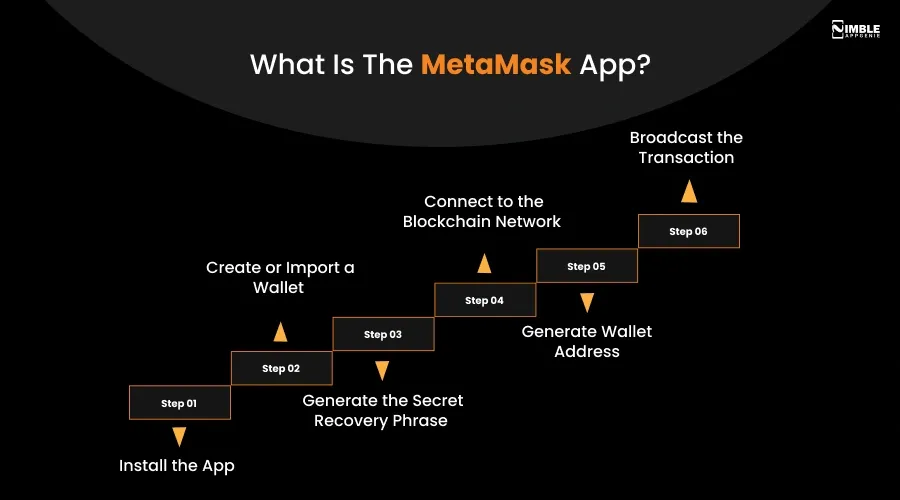
Step 1: Install the App
This is the first step, where the users install the mobile app via their official app store, such as the Apple Store and the Google Play Store.
Step 2: Create or Import a Wallet
In this step, the users can create their own wallet or can effectively import the complete wallet. This is a straightforward process, whether you are using a desktop browser or the mobile app; it is a simple process.
Step 3: Generate the Secret Recovery Phrase
It is a human-readable master key that mathematically drives where the user’s generated key is backed up. Under this step, your app will generate a 12- to 24-word sequence from a standardized dictionary.
Step 4: Connect to the Blockchain Network
Under this step, you can connect your app to a blockchain network such as MetaMask. You need to use a Remote Procedure Call (RPC) node.
Step 5: Generate Wallet Address
In this step, MetaMask generates a wallet address with the help of cryptographic derivation. This app generates a deterministic process rather than randomly assigning one.
Step 6: Broadcast the Transaction
This app broadcasts the transactions locally by securely signing the transaction payload with a simple private key.
This is how the complete MetaMask app works. Now, if you are not clear about what type of app to build, whether a custodial or non-custodial wallet, the following section will state it all.
Custodial vs Non-Custodial Wallets: The First Decision You Make
A custodial wallet is a wallet in which a third party is fully responsible for completely managing the private keys. Instead of having custodial access to your funds, a service provider gets complete control.
However, the non-custodial wallet is a cryptocurrency wallet where you and only you control the private keys to your funds.
Here is the complete table defining the differences:
| Factor | Custodial Wallet | Non-Custodial Wallet |
| Control of Private Keys | A third party (e.g., an exchange or wallet provider) holds and manages the private keys. | The user has full control and ownership of the private keys. |
| Ownership of Funds | Funds are managed on the user’s behalf by the service provider. | The user has complete ownership and control over their funds. |
| Security Responsibility | The provider is responsible for securing the wallet and recovering access if needed. | The user is responsible for securing the wallet and backing up the recovery phrase. |
| Account Recovery | Access can usually be recovered through the provider’s account recovery process. | Recovery is only possible using the Secret Recovery Phrase or private keys; if lost, access cannot be restored. |
| Ease of Use | Generally more beginner-friendly with simplified account management. | Requires users to manage keys and recovery phrases, making it slightly more technical. |
| Transaction Approval | Some transactions or withdrawals may require provider authorization or compliance checks. | Users can initiate and sign transactions directly without relying on a third party. |
| Privacy | Often requires user identity verification (KYC) and stores account information. | Typically offers greater privacy, as users control their wallet without mandatory identity verification. |
| Examples | Coinbase Exchange Wallet, Binance Exchange Wallet | MetaMask, Trust Wallet, Ledger, Trezor |
Well, MetaMask is a non-custodial wallet, which means you have sole control over the private keys and funds.
Hence, many fintech startups and financial institutions often ask, “How to create an app like MetaMask?”
Well, here, you need to follow the complete process from understanding the market, selecting the right set of features, designing the app, selecting the tech stack, testing, and launching.
Let’s get started with features, then evaluate the overall process to create an app like MetaMask.
Features to Include in a MetaMask App
To develop an app like MetaMask, you need to include features such as customizable gas fees, two-factor authentication, a high conversion rate, a multiple-signature vault, and multi-language support.
Let’s evaluate the complete set of features in the table below:
| Feature | Description |
| Wallet Creation & Import | Create a new wallet or import an existing wallet using a Secret Recovery Phrase. |
| Secure Key Management | Securely stores private keys on the user’s device, ensuring full control of digital assets. |
| Multi-Network Support | Supports Ethereum and multiple EVM-compatible blockchain networks. |
| Crypto Asset Management | Send, receive, and store cryptocurrencies and tokens. |
| NFT Support | Store, view, send, and receive NFTs within the wallet. |
| Built-in Token Swaps | Swap supports cryptocurrencies directly within the app. |
| dApp Browser & Wallet Connection | Connect and interact securely with decentralized applications (dApps). |
| Transaction Signing | Review and digitally sign blockchain transactions securely. |
| Gas Fee Management | View and customize network transaction (gas) fees before confirmation. |
| Buy Crypto | Purchase cryptocurrencies through integrated third-party payment providers. |
| Portfolio Dashboard | View wallet balances, token holdings, and transaction history in one place. |
| Security Features | Protect the wallet with password authentication, biometrics, and a Secret Recovery Phrase backup. |
But the question remains, “How to make an app like MetaMask?”
Well, you can develop an app like MetaMask by identifying the requirements of the audience, selecting the right set of features, designing the app, selecting the right tech stack, testing the app, and then finally launching the app.
Let’s get into the details in the following section.
How to Build an App Like MetaMask?
Create a self-custody cryptocurrency wallet like MetaMask that consists of building a secure interface and Web3 gateway for the users.
When you make an app like MetaMask, you develop a strong, secure bridge that allows users to store the private keys and manage digital assets by directly interacting with dApps.
Now, let’s evaluate the complete set of steps to develop an app like MetaMask:
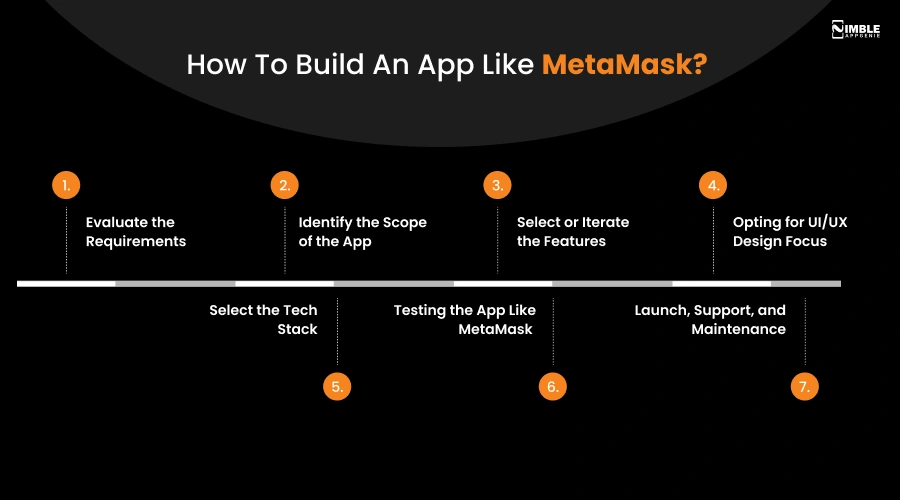
1. Evaluate the Requirements
You need to analyze the requirements of the MetaMask app, for Web3, and all other needs of the current market. Here, as a fintech startup, you must prioritize security, blockchain compatibility, and DApp integration.
Let’s evaluate the complete requirements:
- Perform a complete market study.
- Prioritize security and DApp integration.
- Identify regulatory compliance requirements for the app.
- Conduct a competitive analysis.
2. Identify the Scope of the App
Now, under this step, you should analyse the objectives of the MetaMask app. Creating a clone like MetaMask is not just about copying the well-recognized app; it’s about defining what you can provide better to the customers.
Here’s how you can identify the scope of the app:
- Set up the Architecture of the app you want to build.
- Securely implement cryptography and key management.
- Define exactly what you will build and how you will create it.
- Document limitations on budget, timeline, and even technology stack.
3. Select or Iterate the Features
This is the step to create an app like MetaMask, where you need to select the right features such as multichain support, secure key management, multi-network support, and many others.
You should decide on:
- Changing the complete set of features.
- Iterating the features of an app like MetaMask.
- Interact with the user interface via the dashboard to access wallet capabilities.
- Evaluate the variables for relevance and to optimize the model’s relevance.
4. Opting for UI/UX Design Focus
Under this step, you should opt for balancing the complicated blockchain initiatives with the intuitive and Web3-friendly design. You should be very particular about mastering the foundational design principles and learning the core user research techniques.
Here’s what you need to understand about the design of MetaMask:
- Ensure the digital interface has clearly visible interactive indicators.
- Committing to a structured path of user research and visual interface design.
- Craft digital products that are both highly functional and visually appealing.
- To build an app like MetaMask, opt for a UI/UX for managing the visual aesthetics.
5. Select the Tech Stack
Selecting the right tech stack closely depends on whether you are creating a standard dApp or extending the wallet itself with a MetaMask snap. Under this step, blockchain development takes place.
Here’s what you need to do for selecting the right tech stack:
- Assess the Project Requirements & Goals.
- Evaluate Your Team’s Expertise and fintech app architecture.
- Analyze the cost of each technology you include here.
- Focused on frontend excellence and seamless blockchain connectivity.
6. Testing the App Like MetaMask
Under this step to build an app like MetaMask, you need to validate both the standard app functionality and the unique Web3 interactions as a fintech app testing procedure.
Here’s what you need to opt for when testing the app like MetaMask:
- Verify the 12/24-word secret recovery phrase.
- Opt for the transaction and signing testing of apps like MetaMask.
- Validate blockchain interactions and cross-platform syncing.
- Verify the dApp connections, transaction flows, and network switching.
7. Launch, Support, and Maintenance
This step is all about launching the app on the decided platforms. Here, this strategy must cover phases such as knowing the audience, focusing on the goal of the app, and bridging the gap between demand and supply.
Here’s what you need to do:
- Evaluate the target audience for your app.
- Opt for the complete support for your MetaMask app.
- Maintain the overall dApp through ongoing security audits and via frequent updates for compatibility.
- Opt for the automation in maintenance, which comprises continuous security auditing, RPC node scaling, and dApp integration updates.
Here is the complete set of steps to create an app like MetaMask. Let’s get into the details of the complete tech stack to include while creating an app like MetaMask.
Tech Stack to Build an App Like MetaMask
The overall technology stack for creating a Web3 wallet like MetaMask depends on how your technology stack must prioritize cross-platform usability and seamless blockchain connectivity.
Here’s what you need to know about the fintech app tech stack required to create an app like MetaMask:
| Technology Layer | Recommended Tech Stack |
| Frontend (Mobile App) | React Native (Android & iOS) |
| Backend | Node.js with Express.js |
| Blockchain Integration | Ethereum, EVM-compatible blockchains, Web3.js or Ethers.js |
| Wallet & Key Management | BIP-39, BIP-32, BIP-44, Secure Enclave (iOS), Android Keystore |
| Database | PostgreSQL or MongoDB (for optional backend services) |
| Cloud & Infrastructure | AWS, Google Cloud, or Microsoft Azure |
| Blockchain Node / RPC Provider | Infura, Alchemy, or QuickNode |
| Authentication & Security | Biometric Authentication (Face ID/Fingerprint), AES-256 Encryption, JWT (if backend authentication is required) |
| Notifications | Firebase Cloud Messaging (FCM) and Apple Push Notification Service (APNs) |
| Payment Integration | MoonPay, Transak, or Ramp Network (for crypto purchases) |
| DevOps & CI/CD | Docker, GitHub Actions, Fastlane |
Tech stack selection is not optional; it is a mandatory component; hence, you need to balance the right real-time avatar interactions, as well as scalable backend infrastructure.
Now, let’s get ahead with the required cost to build an app like MetaMask in the given section.
What’s the Cost to Create an App Like MetaMask?
The average cost to make an app like MetaMask can vary between $20,000 and $100,000+, depending on the number of supported blockchains, the type of MVP you want to build, and the multi-chain platforms.
Fintech app development cost can vary due to complexity, compliance requirements, and various other factors.
From MVP to enterprise-grade MetaMask-like app, here is the complete cost breakdown of how to build an app like MetaMask:
| Development Scope | Estimated Cost (USD) | Key Cost Determinants |
| Basic MVP Wallet | $20,000–$35,000 | Wallet creation, crypto send/receive, multi-network support, basic security, and portfolio view. |
| Standard Wallet App | $35,000–$60,000 | Includes token swaps, dApp browser, NFT support, push notifications, and enhanced UI/UX. |
| Advanced Wallet App | $60,000–$80,000 | Adds WalletConnect, fiat on-ramp integration, custom RPC support, advanced security, and performance optimization. |
| Enterprise-Grade MetaMask-like App | $80,000–$100,000+ | Includes cross-platform optimization, extensive blockchain integrations, advanced security audits, compliance, scalability, and ongoing maintenance. |
After understanding the cost, let’s get ahead with the key challenges and pain points that you might face as a fintech startup or enterprise building an app like MetaMask.
What are the Key Challenges and Pain Points to Make an App Like MetaMask?
The key challenges and pain points for building an app like MetaMask are security and key management, multi-chain and node infrastructure, third-party integrations, and interface complexity.
When you begin to develop an app like MetaMask, you might come across the pain points that can make your journey challenging.
Let’s discuss all these challenges and pain points below:
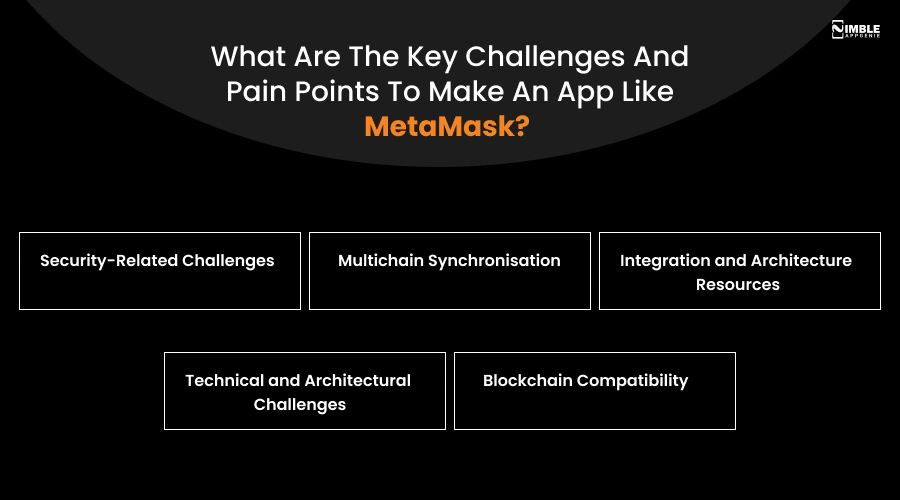
► Security-Related Challenges
Building an app like MetaMask can help you to resolve intense security challenges because it is a non-custodial wallet. Managing the complicated keys offline prevents browser-based exploits with dApps.
► Multichain Synchronisation
Multichain synchronization is an architectural challenge because there is no central database. This is a pain point for the majority of people because blockchains act as isolated “islands”, while synchronization prevents conflicts such as duplicate spending.
► Integration and Architecture Resources
Integration and architectural resources, whether via APIs or microservices, securely manage the private keys. Unable to communicate and share data seamlessly is the critical challenge to making an app like MetaMask.
► Technical and Architectural Challenges
The technical and architectural challenges are when fintech startups face difficulty in balancing client-side cryptography security with real-time, multi-chain blockchain synchronization. This challenge can lead to vulnerabilities and a seed phrase bottleneck.
► Blockchain Compatibility
Lack of blockchain compatibility is a pain point for the majority of fintech entrepreneurs because blockchain is an isolated network with different languages and transaction structures.
With the challenges, now let’s get ahead with the monetization strategies to include while building an app like MetaMask.
How Does the MetaMask App Earn Money?
To create an app like MetaMask, you need to include effective fintech money-making strategies such as in-app token swaps, on ramp/off ramp commissions.
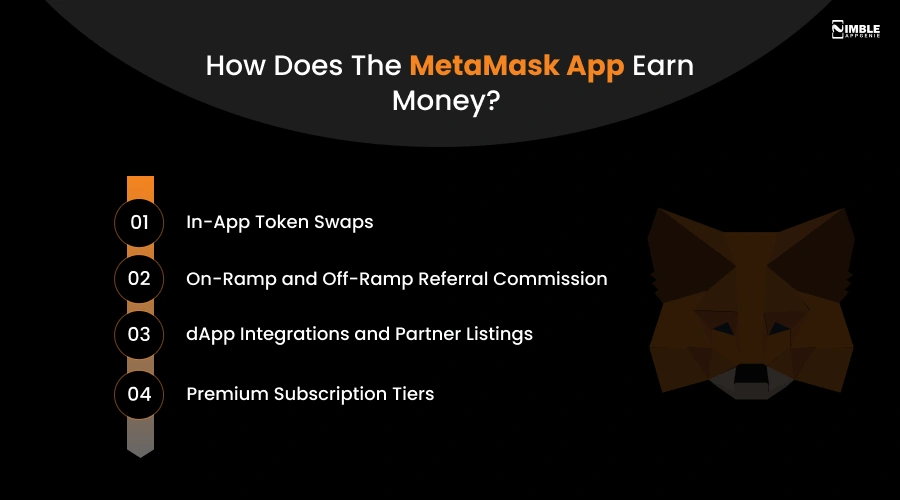
♦ In-App Token Swaps
The in-app token swaps generate revenue through integrating a DEX aggregator within your wallet app. This is a primary revenue driver for the Web3 software wallets.
Here, the in-app token swaps do generate revenue through charging a small fee on every and each transaction processed.
♦ On-Ramp and Off-Ramp Referral Commission
One of the earning mediums for the app, like MetaMask, is on-ramp and off-ramp referral commissions that range from 0.5% to 1.5% per transaction.
It is a percentage of the total transaction volume when users buy and sell via third-party providers integrated into the app. This is a recurring revenue stream to earn money while building an app like MetaMask.
♦ dApp Integrations and Partner Listings
Under this strategy, you earn money through charging listing fees and earning a percentage of the user transactions. However, partner listings refer to getting your app officially registered.
The core earnings and benefits for your MetaMask-like app are web3 protocols that pay the listing fees or provide the affiliate commissions on the trading volume generated via the wallet.
♦ Premium Subscription Tiers
A premium subscription tier in a Web3 wallet transition to build an app like MetaMask transitions the app from a single-revenue model to a predictable, recurring revenue engine.
MetaMask offers the premium subscription via dedicated paid tiers that bundle physical hardware and further enhance security.
Well, to build a clone like MetaMask, you need to connect with a well-recognized company.
Partner With Nimble AppGenie and Create Your App Like MetaMask
Connect with Nimble AppGenie and build your app like MetaMask by offering end-to-end blockchain integration, smart contract development, as well as web extension support. The company offers end-to-end services for creating a crypto wallet app.
Nimble AppGenie is the best crypto wallet development company, building secure, scalable, and custom blockchain wallets with features such as smart contract integration, multi-currency support, and biometric authentication.
Connect with our team because:
➤ Cost-Efficiency and Fast Prototyping
Nimble AppGenie offers budget-friendly options for building an app like MetaMask. Here, our team provides fast prototyping by leveraging AI-assisted code generation for building an MVP. We always prioritise using interactive design tools for instant solutions.
➤ Security at its Core
In every crypto wallet app, we build security parameters at its core, not just a polishing effect after building the complete app. We understand that for building a secure foundation, all you need is to adopt the defense-in-depth approach. Hence, we opt for robust security measures for each of our apps from the beginning.
➤ Frictionless User Experience
Offering the users a fabulous and frictionless experience is all what we require; here, our developers use account abstraction, embedded wallets, and chain abstraction. These tools eliminate the complicated onboarding barriers to make interactions feel seamless.
Conclusion
MetaMask is a self-custodial cryptocurrency wallet that allows users to securely store digital assets, swap tokens, and interact with blockchain networks directly from mobile and desktop browsers.
To create an app like MetaMask, you need to identify the market gap, understand the requirements of the users, select the right features, design the app, choose technologies and architecture, and then test the app before launching.
The overall cost to build an app like MetaMask depends on different factors, including the complexity of the features, technology requirements, design of the app, and skills of the developers. Here, key challenges comprises security related issues, multichain synchronisation, blockchain compatibility, and technical issues.
Connecting with the right and efficient team of developers can be helpful here for converting your app into a success.
FAQs

Niketan Sharma, CTO, Nimble AppGenie, is a tech enthusiast with more than a decade of experience in delivering high-value solutions that allow a brand to penetrate the market easily. With a strong hold on mobile app development, he is actively working to help businesses identify the potential of digital transformation by sharing insightful statistics, guides & blogs.
Table of Contents




No Comments
Comments are closed.