

 Free Consultation
 PCI-DSS Compliant
 GDPR Ready
 ISO 27001
 NDA Protected
 AI Services
 AI App Development
 Generative AI Development
 AI Chatbot Development
 AI Integration Services
 AI Consulting Services
 AI For Fintech
 AI Financial Assistant Solution
 AI Insurance Agent Development
 Tech Stack
 OpenAI / GPT-4
 Claude / Anthropic
 Gemini / Google AI
 Llama / Open Source
 LangChain / LlamaIndex
 Pinecone / Pgvector
 AWS / Azure AI


 Fintech Solution
 Core Fintech
 App Development
 Neobank Solutions
 eWallet Solutions
 Lending Software
 Banking Solutions
 BNPL Solutions
 BNPL Solutions
 Insurance App
 Wealth Management
 Crypto & DeFi
 Blockchain Development
  Payroll Software
 DeFi Solutions
 Crypto Wallet
 Crypto On/Off Ramp
 Crypto Exchange
 Trading Platform
 Payments
 Compliance
 Regulations & Compliance
 Fraud Detection
 Lending Ecosystem
 P2P Lending Platform
 Mortgage Software
 Engagement
 Fintech Outsourcing

 Mobile Development
 Mobile App Dev
 iOS App Development
 Android App Development
 React Native
 Flutter Development
 Web Solution
 Node.js Development
 React.js Development
 Angular Development
 App Services
 UI/UX Design
 App Maintenance
 By Stage
 MVP Development
 Industry Solutions
 Healthcare App Dev
 Education App Dev
 Travel App Dev
 Real Estate App Dev
 Logistics Software
 Social Media App

 Hire Mobile Developers
 Hire iPhone Developers
 Hire Android Developers
 Hire React Native Devs
 Hire Flutter Developers
 Hire Web Developers
 Hire Node.js Developers
 Hire Angular Developers
 Hire PHP Developers
 Hire Laravel Developers
 How It Works
 Pre-Vetted Developers
 Ready In 48 Hours
 NDA From Day One
 Replace Guarantee
 Company
 About Us
 Our Work Process
 Portfolio
 Case Studies
 Blog / Insights
 Careers
 Contact Us
 Awards
 Recognition


 Offices



Key Takeaways:
- The fintech solutions for healthcare do combine financial technology with medical services to reduce administrative costs and make healthcare more affordable for patients.
- The core pain points are slow revenue cycles, inaccurate invoicing, delayed payments, high administrative costs, and restricted care access.
- Features to include are point-of-care financing, automated claims management, electronic health record, and AI-driven insurance verification.
- The cost to integrate fintech solutions for healthcare varies from $20,000 to $80,000.
- The key fintech solutions for healthcare are patient financing and BNPL solutions, technology in insurance, autonomous revenue cycle management, and sustainable management systems.
- Partner with Nimble AppGenie to integrate fintech solutions for healthcare in your software.
Do you know that the global fintech market has reached USD 320.81 billion in 2025 and is further forecasted to reach USD 652.80 billion by 2030?
Yes, and it can increase further.
However, the healthcare industry market size is estimated at USD 11.70 trillion in 2025, which can increase to USD 20.85 trillion by 2035.
Investing in healthcare + fintech today is not just about technology integration; it is about managing everything from the patient’s entrance to medical care to discharge, and sometimes a lifelong journey.
In this scenario, expenses are incurred from taking care of the patient till medication and more. Recording it all required a complete fintech solution for managing patients’ history for their medication and care.
Hence, fintech solutions for healthcare come into play.
But what is it, and what does it include?
In this guide to fintech solutions for healthcare, we have stated the fintech solutions for healthcare, core pain points, and core features, fintech solutions for healthcare, along with compliance architecture.
Let’s begin it all together.
A Brief on Fintech Solutions for Healthcare
Fintech solutions for healthcare bridge the gap between medical services and financial technology for reducing administrative costs, automating complicated insurance claims, to help the healthcare providers streamline their billing.
It provides digital tools, payment systems, and credit options to help healthcare providers streamline their billing, reducing administrative costs and later making medical care more affordable and even accessible for patients.
These fintech solutions for healthcare can minimize the transaction friction between patients, healthcare providers, and insurers.
The fintech solutions for healthcare comprise the following components:
- Patient payment and billing portals
- Digital lending
- Medical crowdfunding
- Health savings integrations
- Automated revenue cycle management
By reducing the administrative overhead, digital innovations can improve the cash flow for providers and later lower the financial barriers for patients accessing care.
If you create a healthcare app, you should be very well aware of the fintech solutions; well, you do not need to wander; let’s begin with the core pain points.
The Core Pain Points Fintech Solves in Healthcare
Providers lose revenue due to slow reimbursement cycles, and patients face confusing, delayed bills, access, and administration.
Apart from this, the fintech firms often face issues related to a lack of trust and transparency, cybersecurity, competition, price transparency, big data, and payment processing.
Fintech resolves the core healthcare pain points by automating the administrative tasks and even bridging the financial gaps.
Let’s discuss the core pain points of the healthcare industry in detail as follows:
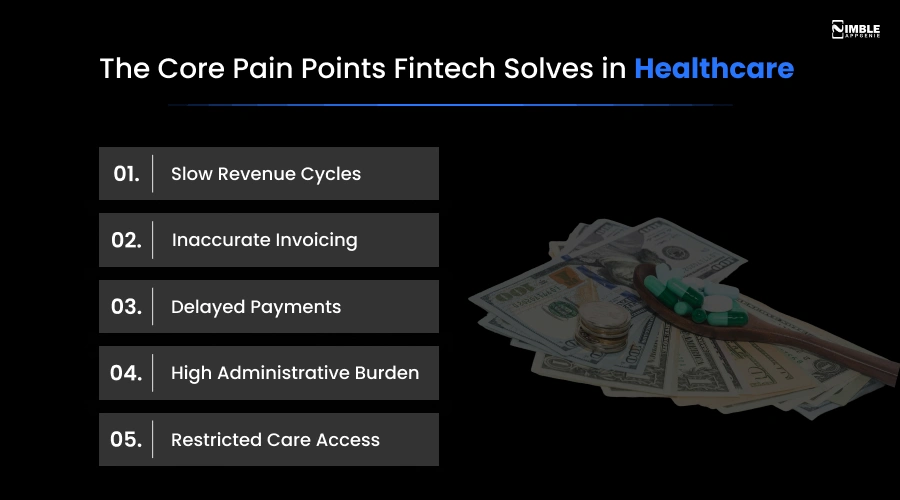
1. Slow Revenue Cycles
A slow revenue cycle limits the complete cash flow and working capital by automating invoicing and by offering real-time financial tracking. The slow revenue cycle creates a timing gap between expenses paid and revenue collected.
2. Inaccurate Invoicing
An inaccurate invoice is one of the core issues of the healthcare industry that causes severe cash flow disruptions, damages client relationships, and creates costly administrative bottlenecks. It results in compliance and legal penalties.
3. Delayed Payments
The delayed payments in the healthcare industry disrupt the cash flow for providers and delay critical treatments for patients. This further causes cash flow disruption and even strain on the working capital for the healthcare providers.
4. High Administrative Burden
Manual billing, paper-based insurance verification, and disjointed claim processing are resolved by automating claims and billing, offering patients transparent payment plans, and directly accelerating the cash flow at the point of care.
5. Restricted Care Access
The restricted care access does impact the industry by straining infrastructure, driving up long-term financial burdens, and overburdening hospital staff. This creates an immense barrier to care that the fintech industry can resolve by making medical services more affordable.
Now, let’s get ahead with the core features of a healthcare fintech solution in the following section.
Core Features of a Healthcare Fintech Solution
When you opt for healthcare fintech solutions, you combine administration with financial technology to improve affordability, streamline billing, and even automate the billing cycles.
Here is the list of Features to include in the healthcare fintech solution:
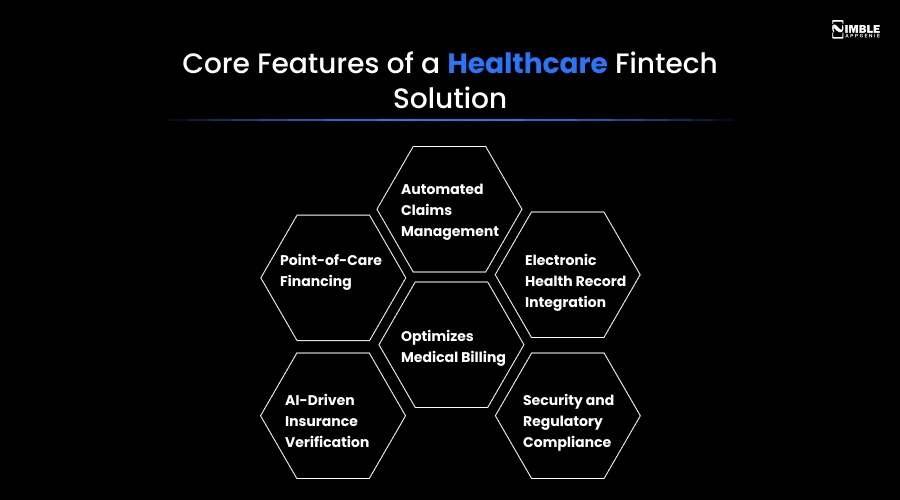
1] Point-of-Care-Financing
Point-of-care financing is a core healthcare fintech feature that converts expensive medical procedures into manageable payment plans directly at the clinic or hospital. It prevents the patients from abandoning vital treatment due to immediate financial constraints.
2] Automated Claims Management
The automated claims management in a healthcare fintech solution is a technology-driven solution that digitizes and speeds up the medical billing and insurance lifecycle.
3] Electronic Health Record (EHR) Integration
An electronic health record is the complete process for connecting a centralized patient database with other healthcare software. It uses APIs and standards such as HL7 and FHIR to enable real-time data sharing and reduce medical errors.
4] Security and Regulatory Compliance
Within the healthcare sector, security and regulatory compliance can be defined as the embedded technological features that ensure that the financial transactions and patient health care are securely processed, stored, and reported.
5] AI-Driven Insurance Verification
The AI-driven insurance verification feature is a technology that uses machine learning and artificial intelligence to automatically check and confirm the status of insurance verification for the patient.
6] Optimizes Medical Billing
With the help of AI in healthcare, you can optimize fintech solutions for medical billing by automating the complex financial workflows, enabling seamless insurance verifications, and offering patients flexible payment options.
Now, many healthcare firms often ask, “What are the fintech solutions for healthcare?”
In the given section, let’s evaluate the same.
What are the Fintech Solutions for Healthcare?
The fintech solutions for healthcare do streamline medical payments, ease the administrative burdens, provide supply chain financing, and further enhance patient affordability.
The fintech solutions in healthcare do streamline the business side of medicine, improve cash flow for providers, and further make medical care more affordable and even accessible for patients.
Here is the list of fintech solutions for healthcare:
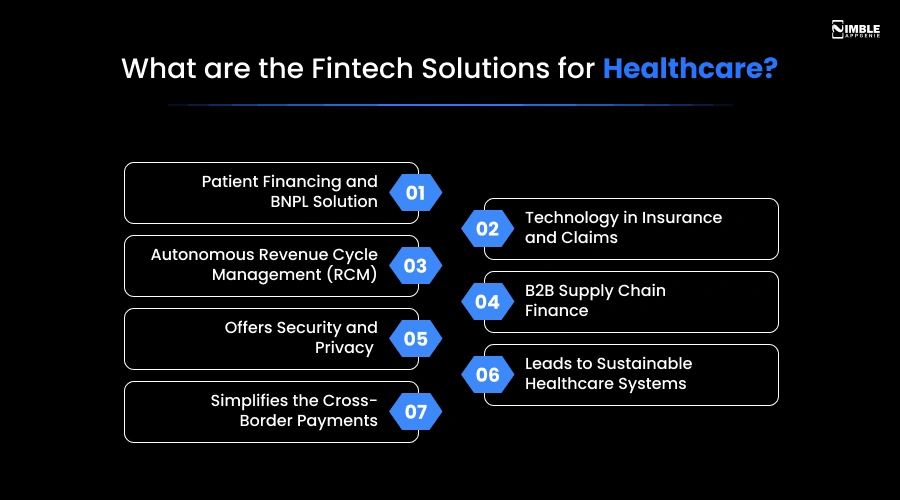
1. Patient Financing and BNPL Solution
The patient financing and BNPL solutions break down the large medical and elective healthcare bills into smaller, manageable, and interest-free installments.
This solution helps in:
- Making necessary medical treatments more affordable and accessible.
- These solutions split the large out-of-pocket medical bills into smaller, and even interest-free installments.
- It improves operating margins and works with existing practice management systems.
2. Technology in Insurance and Claims
Healthcare-based insurtech eases policy administration, eligibility, and claims. The online fintech healthcare platforms minimize mistakes in manuals, reduce the time of approval, and further enhance the solutions between insurers and even care providers.
This solution helps in:
- Use of AI helps in reducing the processing time, improving accuracy, and offers fraud detection efficiency.
- Similarly, the use of AI helps in enhancing scalability without compromising accuracy and efficiency.
- Technology does offer transparency in fintech operations by simplifying the claims process via AI, automation, and IoT.
Also Read: How Much Does It Cost to Develop an Insurance App?
3. Autonomous Revenue Cycle Management (RCM)
RCM in healthcare refers to the use of AI, machine learning, and intelligent automation to independently handle and optimize financial operations.
Unlike traditional automation, autonomous RCM continuously learns from data, makes informed decisions, and further enhances reimbursement throughout the revenue cycle.
This solution helps in:
- Enables healthcare fintech solutions by automating the complicated medical billing, verifying insurance eligibility, and further streamlining payment collections.
- Fintech dashboards do provide real-time reporting on key financial metrics that integrate clinical data with financial systems, offering transparent payment experiences for patients.
- Through RCM, you can have real-time reporting on key financial metrics such as denial rates, underpayments, and payer trends.
4. B2B Supply Chain Finance
Through fintech solutions, you can opt for instant funding and working capital to medical equipment suppliers, easing the cash flow issues caused by delayed insurance payouts.
This fintech solution helps in:
- Streamlining billing and reducing administrative overhead lets providers focus on patient care.
- The fintech transforms patient financing by offering seamless digital solutions like zero-cost EMIs, BNPL, and customizable installment plans.
- Fintech solutions for healthcare do offer embedding financial services that are directly into the corporate workflows.
5. Offers Security and Privacy
Fintech solutions for healthcare do offer security and privacy solutions through applying the banking-grade encryption, immutable ledgers, as well as tokenized data to transactions, and electronic health records:
This fintech solution helps in:
- By utilizing end-to-end encryption, blockchain, and biometric authentication, when considering mobile app security.
- Through recording transaction trails on an immutable and decentralized ledger.
- The fintech solutions in healthcare substitute the sensitive financial and medical ID numbers with the unique and non-sensitive strings of characters.
6. Leads to Sustainable Healthcare Systems
Fintech solutions in healthcare do lead to a sustainable mechanism in the healthcare industry through solving critical bottlenecks in funding, billing, and accessibility.
These fintech solutions in healthcare help in:
- Streamlining the administrative workflows offers flexible patient financing and even drives financial inclusion.
- Bridges the affordability gaps by enabling the uninsured or low-income populations to access treatments without any financial burdens.
- Combines fintech with wearable tech that enables usage-based “InsurTech” and even preventive health incentives.
7. Simplifies the Cross-Border Payments
The fintech solutions in healthcare simplify cross-border payments by removing traditional banking barriers, providing multi-currency options, and even automating the compliance landscape.
Fintech solutions in healthcare help in:
- The fintech solutions make the healthcare industry more affordable and accessible by streamlining the medical billing and minimizing administrative costs.
- Eliminates high fees, slow clearing times, and currency conversion hurdles.
- Through the collaboration of fintech in healthcare, you can simplify the international payment procedure and promote transparency.
These are the fintech solutions for the healthcare industry that streamline operations and expand access by merging financial technology with medical care.
Now, let’s get ahead with the compliance layer that you might skip while opting for the fintech solutions for healthcare.
The Compliance Layer Most Guides Skip
Most of the guides skip the overlapping architecture, where the financial and medical frameworks strictly collide.
One of the major aims of fintech in healthcare is to increase people’s alternatives for how they access and pay for healthcare, especially in times of high out-of-pocket costs.
Here is the list of compliance layers that one should follow:
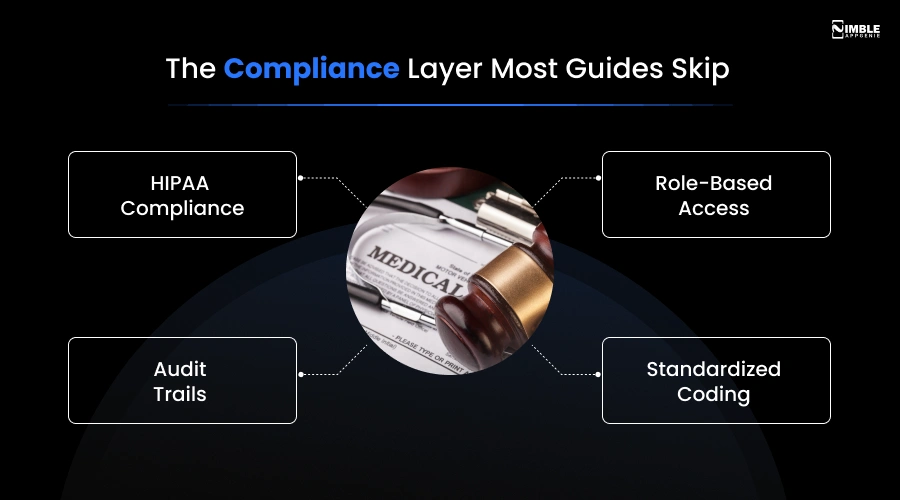
► HIPAA Compliance
The AI workflows must protect the workings of fintech to safeguard patients’ protected health information (PHI).
Fintech solutions achieve this through rules that protect medical privacy, prevent healthcare fraud, and ensure that individuals can transform their health insurance when changing jobs.
► Audit Trails
The automated systems should log every decision and transaction for transparency, along with regulatory reporting.
These are trails are those that track every action performed on the healthcare app, as sensitive data, such as electronic health records (EHRs).
► Role-Based Access
Access given to the AI tools and claims data should be limited to authorized personnel for maintaining compliance.
The role-based access is a methodology that restricts the network and even the system from accessing authorized users based solely on their job functions.
► Standardized Coding
This compliance is all about aligning with the ICD (International Classification of Diseases) and CPT (Current Procedural Terminology) and other coding standards, such as HCPCS, for representing diagnoses and even procedures in the financial transactions.
Under this practice, you can combine secure software development with medical data semantics.
While navigating the compliance landscape for healthcare fintech solutions, most fintech companies and startups often ask about the architecture used for these applications.
Let’s get ahead on the diverse types of tech stacks to include in healthcare fintech applications.
Tech Stack for Healthcare Fintech Applications
The mobile tech stack for healthcare fintech applications requires a dual-focus tech stack, robust financial transactions processing, combined with strictly secured, HIPAA-compliant medical data handling.
Here is the table defining the complete tech stack to include in the healthcare fintech applications:
| Layer | Technology Options | Purpose |
| Frontend | React Native, Flutter, React.js/Angular.js | Patient app + provider dashboard UI |
| Backend | Node.js, Go, Java (Spring Boot) | Core logic, APIs, transaction processing |
| Database | PostgreSQL, MySQL, MongoDB | Billing, claims, and patient records |
| Interoperability | HL7, FHIR | EHR/EMR data sync |
| Payments | Stripe, Braintree, ACH rails | Patient billing, provider payouts |
| Security & Compliance | AES-256, TLS 1.3, RBAC, BAA-compliant cloud (AWS/Azure/GCP) | HIPAA + PCI-DSS protection and audit trails |
| Claims Automation | OCR, ML models, RPA | Eligibility checks, denial management |
| Analytics | Power BI, Tableau | Revenue cycle and financial reporting |
Following the tech stack to include in the fintech solution for healthcare, now, let’s get ahead with the cost of building a healthcare fintech solution.
How Much Does it Cost to Build a Healthcare Fintech Solution?
The overall cost to build a healthcare fintech solution ranges from $20,000 to $80,000. This healthcare app development cost can vary due to different cost parameters such as the complexity of the features, selection of the technology stack, design of the app, and selection of the right skills of developers.
Here is the complete cost breakdown of building a fintech healthcare solution:
| Development Stage / Tier | Cost Range | What’s Included |
| Basic MVP | $20,000 – $35,000 | Patient billing UI, single payment gateway, basic HIPAA-compliant architecture. |
| Core Features Build | $35,000 – $50,000 | Insurance eligibility checks, digital patient wallet, secure authentication (RBAC/MFA). |
| Compliance & Security Layer | $50,000 – $65,000 | HIPAA + PCI-DSS audit logging, encryption (AES-256/TLS), BAA-compliant cloud hosting. |
| Claims & Billing Automation | $65,000 – $80,000 | Automated claims processing, denial management, and provider-side RCM dashboard. |
Well, if you are wondering how you can integrate fintech solutions for healthcare, then connecting to the right app development provider can help.
Why Build Your Healthcare Fintech Solution with Nimble AppGenie?
Connect with Nimble AppGenie and integrate healthcare fintech solutions in your app with the leading fintech software provider.
Our company can help with:
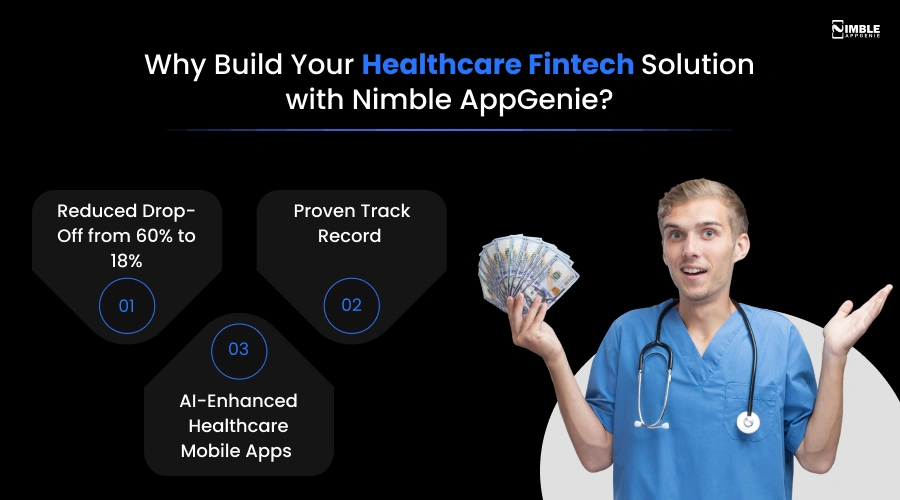
1. Reduced Drop-Off from 60% to 18%
Nimble AppGenie applies progressive disclosure UI/UX, streamlining KYC workflows, and further implementing AI-driven chatbots. We optimize the UI/UX and frictionless KYC/AML integration.
2. Proven Track Record
We offer a track record via 8+ years of experience, by successfully delivering over 700 projects with a 95% client retention rate. Our company has successfully delivered over 350 financial products comprising eWallets, neobanks, and lending platforms.
3. AI-Enhanced Healthcare Mobile Apps
Our team helps you build an AI-enhanced healthcare mobile app by leveraging AI for delivering personalized medical services. These healthcare apps analyze the user data to predict the health status. We are the top AI-powered app development company specializing in fintech and custom mobile apps.
Not only fintech, but we also have a specialization in converting the healthcare software idea into reality, as we are the top healthcare app development company.
Conclusion
Fintech in healthcare does offer digital financial services to the medical industry. This solution allows for transparent tracking of revenue cycles, minimizes administrative friction, and further results in financial reimbursement.
Fintech solutions for healthcare are patient-centric financing and BNPL solutions, technology in insurance, automating revenue cycle management (RCM), and B2B supply chain finance, offering security and privacy, and further leading to a sustainable healthcare system.
Connect with the targeted company to proceed with the integration of fintech solutions for healthcare.
FAQs
The fintech in healthcare applies digital financial tools to medical services. It streamlines the medical billing, digitalizes insurance claims, and offers patient financing options. This further allows the patients to easily manage the out-of-pocket costs and even medical loans.
The fintech solutions in healthcare refer to the integration of digital financial tools into the medical sector. The different solutions in healthcare for fintech are patient financing and BNPL, technology in insurance, autonomous revenue cycle management, B2B supply chain finance, and sustainable healthcare systems.
Diversified fintech solutions for healthcare are available as patient financing, technology in insurance, autonomous revenue control, and simplifying cross-border transactions.
The core features of a healthcare fintech solution are point-of-care financing, automated claims management, electronic health record, security and regulatory framework, along with AI-driven insurance verification.
The overall cost to create a healthcare fintech solution can vary from $20,000 to $80,000. This cost can vary depending on factors such as the complexity of features, technology complications, and the growing demands of the users.
You should create your healthcare fintech solution because it bridges the gap between medical needs and financial capability, which makes care affordable, transparent, and accessible.

Niketan Sharma, CTO, Nimble AppGenie, is a tech enthusiast with more than a decade of experience in delivering high-value solutions that allow a brand to penetrate the market easily. With a strong hold on mobile app development, he is actively working to help businesses identify the potential of digital transformation by sharing insightful statistics, guides & blogs.
Table of Contents




No Comments
Comments are closed.