

 Free Consultation
 PCI-DSS Compliant
 GDPR Ready
 ISO 27001
 NDA Protected
 AI Services
 AI App Development
 Generative AI Development
 AI Chatbot Development
 AI Integration Services
 AI Consulting Services
 AI For Fintech
 AI Financial Assistant Solution
 AI Insurance Agent Development
 Tech Stack
 OpenAI / GPT-4
 Claude / Anthropic
 Gemini / Google AI
 Llama / Open Source
 LangChain / LlamaIndex
 Pinecone / Pgvector
 AWS / Azure AI


 Fintech Solution
 Core Fintech
 App Development
 Neobank Solutions
 eWallet Solutions
 Lending Software
 Banking Solutions
 BNPL Solutions
 BNPL Solutions
 Insurance App
 Wealth Management
 Crypto & DeFi
 Blockchain Development
  Payroll Software
 DeFi Solutions
 Crypto Wallet
 Crypto On/Off Ramp
 Crypto Exchange
 Trading Platform
 Payments
 Compliance
 Regulations & Compliance
 Fraud Detection
 Lending Ecosystem
 P2P Lending Platform
 Mortgage Software
 Engagement
 Fintech Outsourcing

 Mobile Development
 Mobile App Dev
 iOS App Development
 Android App Development
 React Native
 Flutter Development
 Web Solution
 Node.js Development
 React.js Development
 Angular Development
 App Services
 UI/UX Design
 App Maintenance
 By Stage
 MVP Development
 Industry Solutions
 Healthcare App Dev
 Education App Dev
 Travel App Dev
 Real Estate App Dev
 Logistics Software
 Social Media App

 Hire Mobile Developers
 Hire iPhone Developers
 Hire Android Developers
 Hire React Native Devs
 Hire Flutter Developers
 Hire Web Developers
 Hire Node.js Developers
 Hire Angular Developers
 Hire PHP Developers
 Hire Laravel Developers
 How It Works
 Pre-Vetted Developers
 Ready In 48 Hours
 NDA From Day One
 Replace Guarantee
 Company
 About Us
 Our Work Process
 Portfolio
 Case Studies
 Blog / Insights
 Careers
 Contact Us
 Awards
 Recognition


 Offices


Key Takeaways:
- The global crypto wallet market is worth $15.5 billion in 2025 and is projected to hit $100.8 billion by 2033, growing at 26.6% a year. The demand for a well-built app like Trust Wallet is real and growing.
- Trust Wallet itself is used by over 60 million people across 70+ blockchains, proving the non-custodial, multi-chain model works at scale.
- You have three build paths: from scratch, clone script, or white-label, and each changes your cost, timeline, and how much of the product you actually own.
- A basic wallet costs $20,000–$40,000; a multi-chain wallet with DeFi and swaps runs $50,000–$120,000; enterprise-grade, MPC secured builds go beyond $150,000.
- Security is not a feature you add later; private key handling, biometric login, and a third-party audit have to be part of sprint one, not an afterthought.
- Compliance depends on what you build: a pure non-custodial wallet has the lightest KYC/AML load, but adding fiat on-ramps or swaps pulls in MiCA, FinCEN, or FCA obligations.
- Nimble AppGenie has shipped 350+ fintech and crypto products over 8+ years, and builds Trust Wallet-style apps with security and compliance baked in from day one, not bolted on before launch.
“How much does it cost to build an app like Trust Wallet?” Well, it depends on whether you build a crypto wallet app like Trust Wallet from scratch, go white-label, or license a clone script. This is the first question almost every founder types into Google or asks ChatGPT before writing a single requirement.
This guide answers all the relevant questions properly, in-depth, and walks through everything else you need, like the tech stack, features, real cost ranges, security decisions that matter, and compliance rules that apply to your specific build. It’s written for founders and product teams evaluating whether to build a crypto wallet like Trust Wallet, not only people curious about how one works.
What “Building an App Like Trust Wallet” Actually Means
Trust Wallet is a non-custodial, multi-chain crypto wallet. Non-custodial means the user holds their own private keys – you, as a business, never touch or store their funds. Multi-chain means the wallet connects to multiple blockchains (Bitcoin, BNB Chain, Ethereum, Solana, and many more) rather than just one.
When someone says they want to build an app like Trust Wallet, they usually mean a mobile app that lets users:
- Generate a wallet and control their own recovery phase.
- Store, send, and receive multiple cryptocurrencies and tokens.
- Swap tokens and connect to DeFi apps directly from the wallet.
- Store NFTs alongside coins.
- Do all of this with bank-grade security, without a bank in the middle.
You are not building a blockchain or a coin. You are building the application layer – the interface, the key management, and the connections to networks that already exist.
Why Build a Wallet App Like This in 2026?
The numbers make the opportunity clear. According to Grand View Research, the crypto wallet market was valued at $15.5 billion in 2025 and is projected to reach $100.8 billion by 2033, growing at a compound annual rate of 26.6%. Grand View Research also notes that hot wallets (the mobile, always-connected kind Trust Wallet represents) held 56.2% of the market in 2025, and Android is the dominant operating system for this category.
| 60M+ people use Trust Wallet globally across 70+ blockchains, according to Coinweb’s 2026 wallet statistics report, proving the non-custodial, multi-chain model has mainstream staying power, not just crypto-native appeal. |
There’s also a structural shift happening right now that most “how to build a crypto wallet” guides haven’t caught up to. Wallets are starting to add AI agent capabilities on top of the core wallet, like automated portfolio monitoring, agent-to-agent payments, and fraud detection.
Trust Wallet itself started routing parts of its infrastructure through external AI vendors via what it calls the Trust Wallet Agent Kit in early 2026. If you are building a wallet today, planning for an AI layer from the start – not retrofitting it in 18 months – is a real competitive edge.
Founders also underestimate one thing: DeFi and NFT support are no longer “nice to have”. Users expect to swap tokens, stake for yield, and view NFTs in the same app they use to send crypto. A wallet that only stores and sends coins already feels dated to a 2026 crypto user.
What Trust Wallet Gets Right And Where the Gaps Are
Before you move ahead with Trust Wallet clone app development, knowing the gaps will help you identify the challenges you have to confront.
Trust Wallet wins on multi-chain breadth, built-in dApp browser, and clean interface. Where it draws constant criticism, based on community discussion and user reviews, is customer support response times and occasional performance hiccups during high network traffic – both fixable gaps for a new entrant with a sharper support model.
Where Most Competitor “Build Like Trust Wallet” Guides Fall Short
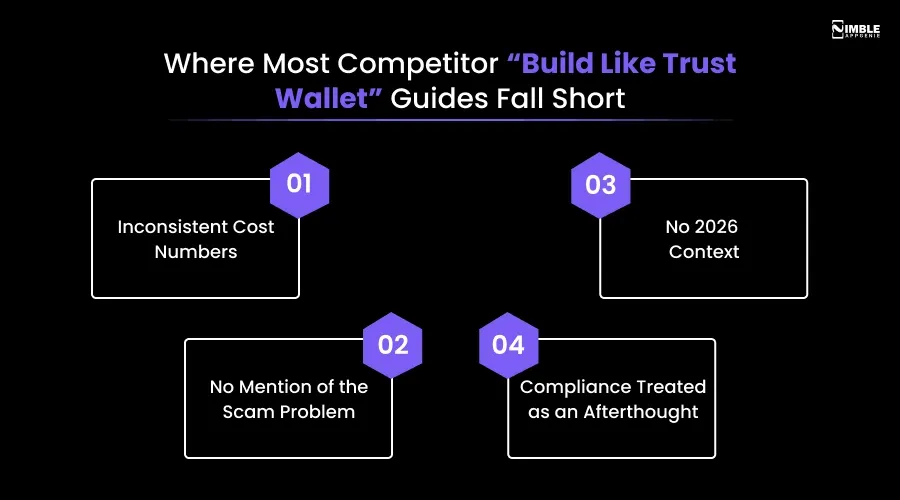
► Inconsistent Cost Numbers
Search this topic, and you will find quotes from $5,000 to $200,000 for what sounds like the same app, with no explanation for the gap. It usually comes down to build type – scratch, clone Trust Wallet, or white-label, which most guides never separate clearly.
► No Mention of the Scam Problem
A huge share of real search traffic around Trust Wallet is people worried about fake balances and phishing scams using the Trust Wallet name – a trust and safety issue almost no competitor content addresses, even though it directly impacts how users perceive any wallet app.
► No 2026 Context
AI-agent integration, MPC-based key management, and account abstraction (ERC-4337) are reshaping wallet architecture right now, and most existing guides were written before these became standard topics of conversation.
► Compliance Treated as an Afterthought
Most guides mention KYC/AML in one line. Whether you need it at all depends completely on whether your wallet touches fiat money or stays purely non-custodial.
Scratch vs. Clone Script vs. White-Label: Pick the Right Path First
This single decision affects timeline, cost, and how defensible your product is long-term. Get this wrong, and you either overspend on something a trust wallet clone script could have handled, or underinvest in something that demanded custom architecture.
| Approach | Typical Cost | Timeline | Best For | Trade-off |
| Build from scratch | $70,000 – $200,000+ | 4 – 9 months | Startups planning long-term scale, fundraising, or a differentiated product | Highest cost and time, but full IP ownership and unlimited customization |
| Clone script | $10,000 – $15,000 | 2 – 6 weeks | Fast market entry, testing demand before a bigger investment | Cheapest and fastest, but limited customization and shared codebase risk |
| White-label solution | $15,000 – $70,000 | 6 – 12 weeks | Businesses wanting their brand on a proven wallet engine without building from zero. | Faster than custom, but you depend on the vendor’s roadmap and security practices. |
A rule of thumb: If your business model depends on the wallet being your core differentiator, build from scratch or with a heavily customized white-label. If the wallet is a feature of a budget product (like an exchange or a super app), a well-audited white-label or clone script can get you to market faster without draining your budget.
Must-Have Features For a Trust Wallet-Style App
Consider the below features for your crypto wallet app like Trust Wallet.
1. User-Facing Features
| Feature | Description |
| Non-custodial wallet creation | A 12–24 word recovery phrase generated on-device, with biometric backup options for easier onboarding. |
| Multi-currency and multi-chain support | Bitcoin, Ethereum, BNB Chain, Solana, and major ERC-20/BEP-20/TRC-20 tokens at a minimum. |
| Biometric and 2FA login | Face ID, fingerprint, and two-factor authentication for account access and transaction signing. |
| In-app swap | Let users exchange one token for another without leaving the app -a core revenue feature, not just a convenience. |
| dApp browser | Direct connection to decentralized apps and DeFi protocols from inside the wallet. |
| NFT support | Store, view, and transfer NFTs alongside coins and tokens. |
| Staking | Let users earn rewards on supported assets directly in-app. |
| QR code send/receive | Fast, error-free transfers without typing long wallet addresses. |
| Transaction history | A clear, searchable log of past activity with real-time status. |
| Backup and recovery flows | Simple, well-explained recovery so a lost device doesn’t mean lost funds. |
2. Admin & Back-End Features
| Feature | Description |
| Real-time monitoring dashboard | Track wallet creation, transaction volume, and flagged activity. |
| Node and API management | Manage blockchain node connections and third-party API integrations centrally. |
| Push notification engine | Alerts for received funds, price movements, and security events. |
| Analytics layer | Usage data to guide which chains, tokens, or features to prioritize next. |
Advanced Features That Differentiate You in 2026
Once the core wallet is stable, these features are what separate a forgettable clone from a wallet people actually choose over Trust Wallet or MetaMask.
| Feature | Description |
| Account abstraction (ERC-4337) | Enables gasless transactions and simpler onboarding – no need for users to hold native tokens just to pay network fees. |
| MPC-based key management | Multi-party computation splits key control across multiple parties instead of one seed phrase, reducing the “lose the phrase, lose everything” risk. |
| Transaction simulation | Show users exactly what a smart contract interaction will do before they approve it – a major trust signal in 2026. |
| AI-powered fraud and scam detection | Flag suspicious addresses, phishing attempts, and wallet drainers in real time. |
| Social or guardian-based recovery | Let trusted contacts help a user regain access without centralizing custody. |
| Fiat on/off ramps | Partner integrations (like MoonPay or Transak) so users can buy and cash out without leaving the app. |
Tech Stack For Building an App Like Trust Wallet
Below is the list of essential tech stack to consider when you plan to develop crypto wallet apps like Trust Wallet.
| Layer | Recommended Options |
| Mobile frontend | React Native or Flutter for cross-platform speed; native Swift/Kotlin for maximum hardware-security control. |
| Backend | Node.js or Go for real-time performance; Python for analytics and risk scoring. |
| Blockchain integration | Web3.js and Ethers.js for Ethereum-compatible chains; chain-specific SDKs for Bitcoin, Solana, and others. |
| Database | PostgreSQL for transactional data; MongoDB for flexible, high-volume logs and analytics. |
| Security | iOS Secure Enclave and Android StrongBox/Keystore for key storage; AES-256 encryption; TLS 1.3 in transit. |
| Key management (enterprise) | MPC frameworks such as Fireblocks for institutional-grade custody options. |
Step-by-Step Development Process of Trust Wallet Clone App
Here’s the process developers follow when they create a Trust Wallet clone, the answer to your obvious question, “how to build a crypto wallet app like Trust Wallet?”.
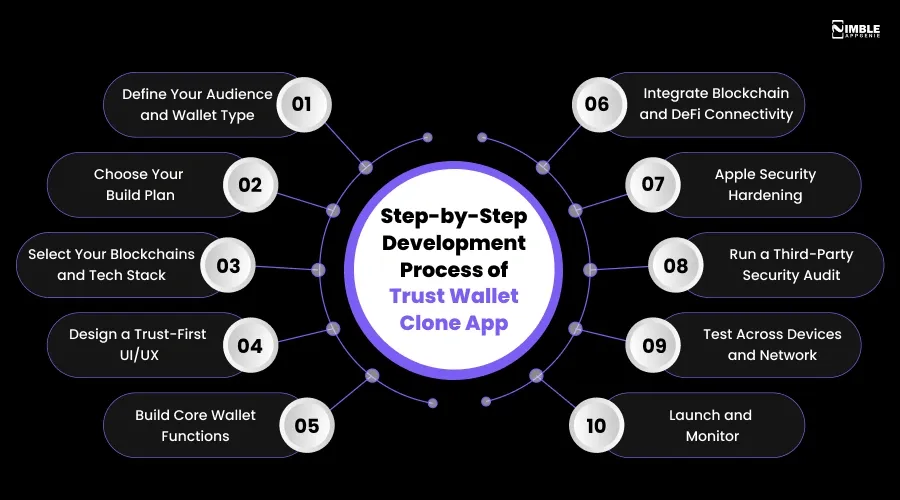
- Define Your Audience and Wallet Type: Beginners demand simplicity; traders need advanced tools and speed. So, decide before you design anything.
- Choose Your Build Plan: Scratch, clone script, or white-label – based on the comparison above.
- Select Your Blockchains and Tech Stack: Start with 2-3 major chains; expand once usage data tells you what to add next.
- Design a Trust-First UI/UX: Every screen involving real money should reduce anxiety, not create it. Test with real users before full development.
- Build Core Wallet Functions: Encrypted storage, key generation, transaction history, and send/receive come first.
- Integrate Blockchain and DeFi Connectivity: Add staking, swap, and dApp browser functionality.
- Apple Security Hardening: Encryption, secure hardware storage, and biometric login 2FA – non-negotiable before any real funds touch the app.
- Run a Third-Party Security Audit: Code review and penetration testing before mainnet launch, not after.
- Test Across Devices and Network: Performance, functional, and security testing on a blockchain testnet first.
- Launch and Monitor: Deploy to app stores, then track usage, support tickets, and transaction success rates closely in the first 90 days.
How Much Does It Cost to Build an App Like Trust Wallet?
Our guide started with the same question. Here’s the direct answer, broken down by what you are actually building.
| Wallet Type | Estimated Cost | Timeline |
| Basic non-custodial wallet (2–3 chains) | $20,000 – $40,000 | 3 – 4 months |
| Multi-chain wallet with swap & DeFi | $50,000 – $120,000 | 5 – 8 months |
| Enterprise-grade, MPC-secured wallet | $150,000 – $200,000+ | 8 – 12 months |
| Clone script (basic customization) | $10,000 – $15,000 | 2 – 6 weeks |
| White-label (branded, mid customization) | $15,000 – $70,000 | 6 – 12 weeks |
| Why this range is so wide: Security architecture and blockchain integrations generally consume 25-40% of the total budget on custom builds. The more chains, the more security layers, and the more compliance obligations, the higher the number climbs. Anyone quoting a fixed price without asking about your chain list, target market, or security requirements is skipping a step. |
Read our related guide on the complete crypto wallet app development process for a broader cost and feature breakdown that isn’t tied to any single competitor model.
Security and Compliance Essential
Crypto wallets don’t just store data; they store money. There’s no bank to call if security fails. That reality should shape each technical decision you make.
Non-Negotiable Security Practices
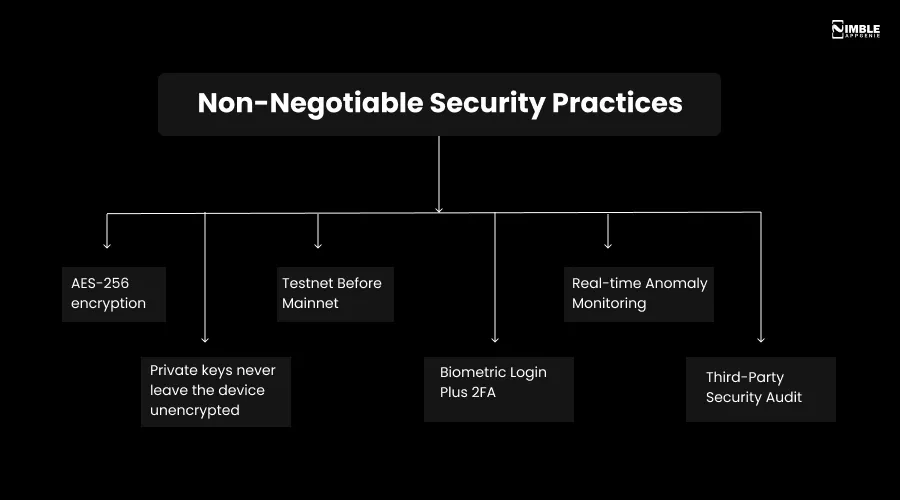
► AES-256 encryption
For all sensitive data at rest, and TLS 1.3 for everything in transit.
► Private keys never leave the device unencrypted
Use Android StrongBox/Keystore and iOS Secure Enclave for hardware-backed storage.
► Testnet Before Mainnet
Every wallet function should run clean on a blockchain testnet before real funds are involved.
► Biometric Login Plus 2FA
For account access, with a second confirmation step for high-value transactions.
► Real-Time Anomaly Monitoring
Flag logins from new devices or unusually large transfers, and alert users instantly.
► Third-Party Security Audit
An external team should test for vulnerabilities you can’t notice from inside your own build.
Compliance: What Actually Applies to Your Crypto Wallet App like Trust Wallet
A pure non-custodial wallet (you never touch user funds, no fiat features) carries the lightest regulatory load. The moment you add fiat on-ramps, exchange partnerships, or swaps, you step into regulated territory:
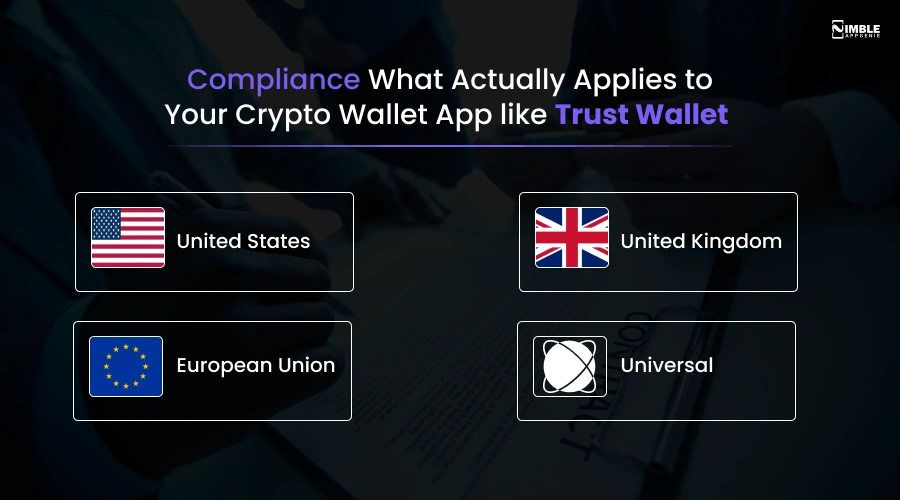
♦ United States
FinCEN registration as a Money Services Business, plus state-level Money Transmitter Licenses if you handle fiat conversion.
♦ United Kingdom
FCA registration under the MLR 2017 anti-money laundering regime for any crypto asset business.
♦ European Union
MiCA (Markets in Crypto-Assets) authorization applies if you offer crypto-asset services, with passporting rights across all 27 member states.
♦ Universal
KYC/AML checks are needed the moment fiat money or exchange functionality enters the picture, regardless of jurisdiction.
Start your compliance and legal review in parallel with design, not after development is finished. It’s the single most common reason wallet launches get delayed. For a deeper look at fintech-wide obligations, see our fintech regulations guide.
The Trust Problem: Scams That Use the Trust Wallet Name
Here’s something most technical guides skip completely, but that matters the most if you are entering this space: a large share of real search and support traffic around Trust Wallet is not about development – it’s people asking whether a wallet showing funds they never deposited is a scam. It is.
This is a documented pattern: victims are shown a fake balance and told to pay a fee or hand over banking details to “unlock” money that was never real.
- If you are building your own wallet app, this matters for two reasons. First, address it directly in your onboarding and help content – users searching for reassurance about wallet scams are exactly the audience you want landing on your product with confidence, not confusion.
- Second, build your UX so it never resembles this pattern: never show a balance a user didn’t fund, and never gate withdrawals behind a mandatory “unlock fee.” Getting this right is both a genuine safety feature and a trust signal.
How Nimble AppGenie Builds Wallet Apps Like Trust Wallet
Nimble AppGenie is a fintech app development company with 8+ years of experience and 350+ delivered projects across the US, UK, UAE, and beyond. Our fintech practice covers crypto wallet development for founders building exactly the kind of app this guide covers. We also work with teams building out DeFi protocols and broader eWallet products, so if your roadmap extends past a single wallet, that experience carries over too.
What that looks like in practice:
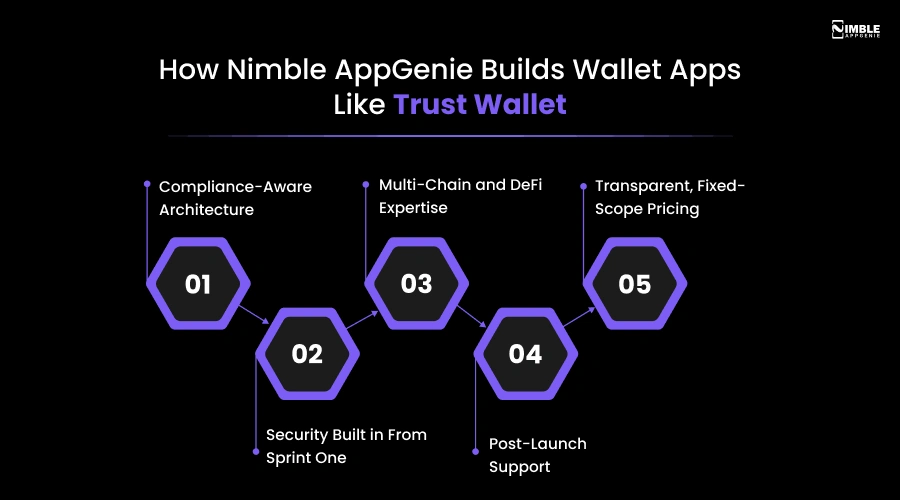
➤ Compliance-Aware Architecture
GDPR, KYC/AML, PCI-DSS, and region-specific requirements mapped to your product from day one.
➤ Security Built in From Sprint One
Hardware-backed key storage, independent audits before launch, and biometric and 2FA login, not after a scare.
➤ Multi-Chain and DeFi Expertise
Real experience integrating Bitcoin, Solana, EVM-compatible networks, Ethereum, swaps, plus staking, and dApp connectivity.
➤ Post-Launch Support
Ongoing maintenance, monitoring, and feature integration once your wallet is live.
➤ Transparent, Fixed-Scope Pricing
No surprise costs halfway through the build. Whether you are validating an MVP or building an enterprise-grade wallet with MPC security, our team can scope your project and give you a clear timeline and cost estimate within 48 hours.
Conclusion
Building an app like Trust Wallet is a real, growing business opportunity – the market data backs that up. But the wallets that win in 2026 are not the ones that copy features fastest. They are the ones that treat compliance and security as part of the product, not paperwork bolted on before launch, and that address the very real trust and safety concerns users already have about crypto wallets.
Pick your build path deliberately, budget for security and compliance from the start, and work with a team that has actually shipped regulated fintech products before, not only mobile apps. That’s the difference between a wallet that launches and one that lasts.
FAQs

Niketan Sharma, CTO, Nimble AppGenie, is a tech enthusiast with more than a decade of experience in delivering high-value solutions that allow a brand to penetrate the market easily. With a strong hold on mobile app development, he is actively working to help businesses identify the potential of digital transformation by sharing insightful statistics, guides & blogs.
Table of Contents




No Comments
Comments are closed.