

 Free Consultation
 PCI-DSS Compliant
 GDPR Ready
 ISO 27001
 NDA Protected
 AI Services
 AI App Development
 Generative AI Development
 AI Chatbot Development
 AI Integration Services
 AI Consulting Services
 AI For Fintech
 AI Financial Assistant Solution
 AI Insurance Agent Development
 Tech Stack
 OpenAI / GPT-4
 Claude / Anthropic
 Gemini / Google AI
 Llama / Open Source
 LangChain / LlamaIndex
 Pinecone / Pgvector
 AWS / Azure AI


 Fintech Solution
 Core Fintech
 App Development
 Neobank Solutions
 eWallet Solutions
 Lending Software
 Banking Solutions
 BNPL Solutions
 BNPL Solutions
 Insurance App
 Wealth Management
 Crypto & DeFi
 Blockchain Development
  Payroll Software
 DeFi Solutions
 Crypto Wallet
 Crypto On/Off Ramp
 Crypto Exchange
 Trading Platform
 Payments
 Compliance
 Regulations & Compliance
 Fraud Detection
 Lending Ecosystem
 P2P Lending Platform
 Mortgage Software
 Engagement
 Fintech Outsourcing

 Mobile Development
 Mobile App Dev
 iOS App Development
 Android App Development
 React Native
 Flutter Development
 Web Solution
 Node.js Development
 React.js Development
 Angular Development
 App Services
 UI/UX Design
 App Maintenance
 By Stage
 MVP Development
 Industry Solutions
 Healthcare App Dev
 Education App Dev
 Travel App Dev
 Real Estate App Dev
 Logistics Software
 Social Media App

 Hire Mobile Developers
 Hire iPhone Developers
 Hire Android Developers
 Hire React Native Devs
 Hire Flutter Developers
 Hire Web Developers
 Hire Node.js Developers
 Hire Angular Developers
 Hire PHP Developers
 Hire Laravel Developers
 How It Works
 Pre-Vetted Developers
 Ready In 48 Hours
 NDA From Day One
 Replace Guarantee
 Company
 About Us
 Our Work Process
 Portfolio
 Case Studies
 Blog / Insights
 Careers
 Contact Us
 Awards
 Recognition


 Offices


TL;DR
- Most vibe-coded apps break in the same six places: auth, payments, database performance, error handling, state management, and mobile responsiveness.
- You rarely need a full rewrite. A paid code audit (2-6 hours) tells you what’s actually broken before you commit anything bigger.
- Hire for debugging and refactoring skills, not “can you build from scratch” – reading someone else’s (or an AI’s) code is a different skill completely.
- Fintech and payment apps need an extra layer of vetting: ask about PCI-DSS awareness, OWASP familiarity, and how they handle secrets and auth – AI-generated code fails at these more often than anywhere else.
- Realistic budget: a code audit runs a few hundred dollars; fixing and hardening a broken MVP typically lands between $2,000 and $15,000+ depending on scope.
- If you would rather skip the vetting process entirely, Nimble AppGenie runs a structured audit-fix-harden process, particularly for AI-built apps – more on that below.
“How do I hire a developer to fix my Vibe-coded app?” If you are trying to hire a developer to fix AI-generated code, you are already past the hardest part: admitting the demo is not the product.
The good news is that fixing a vibe-coded app is a well-understood job with a repeatable process; all you need to do is just hire for the right skill and ask the right questions before you pay.
You used Claude, Cursor, Lovable, or Bolt and shipped an app in a weekend. The landing page looks sharp, and the demo works well. But then, real users show up: someone logs in from an old Android phone, someone’s card gets charged twice, or someone hits the back button mid-checkout.
Suddenly, you are prompting your way through fix after fix, but end up with each one opening two new bugs. This is not a sign you did something wrong – it’s a predictable gap between code that survives a demo and code that survives production.
Why AI-Generated Code Breaks Under Real Users
This is not guesswork; it is measured. Independent research on AI coding tools keeps coming to the same conclusion: AI is excellent at writing code that works, and inconsistent at writing code that is safe or complete.
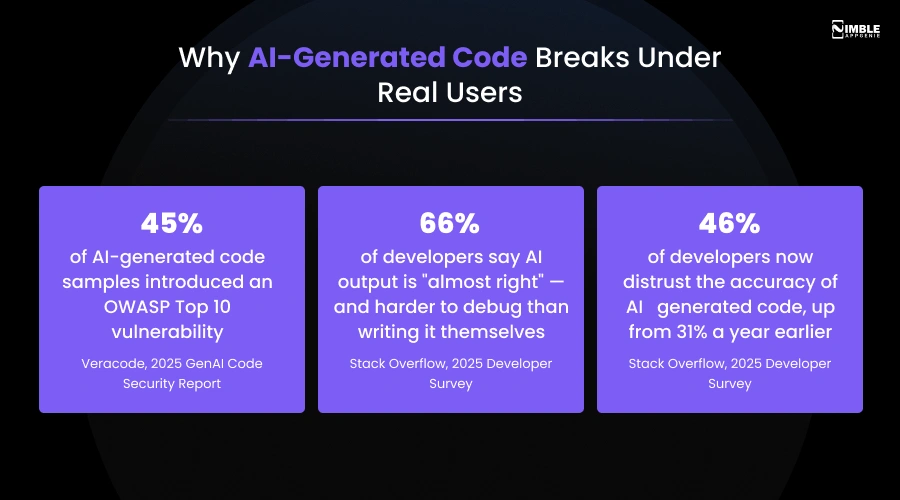
According to Veracode’s 2025 GenAI Code Security Report, which tested 100+ large language models across 80 real coding tasks, AI-generated code failed security testing in 45% of cases, and the failure rate didn’t improve as models got expanded or newer.
Java-generated code failed 72% of the time; cross-site scripting defences failed in 86% of relevant samples. Separately, Stack Overflow’s 2025 Developer Survey of over 49,000 developers found that while 84% now use AI coding tools, trust in the accuracy of that output has reduced to 29%, and 75% of developers say they would still rather ask a human than trust an AI answer they are unsure about.
A recurring observation in developer communities is that LLMs tend to amplify existing programming skills. Experienced engineers can guide AI toward clean, maintainable code, but inexperienced developers are more likely to end up with fragile, difficult-to-maintain code.
None of these states AI tools are bad. It just means the code they produce needs a second, human pass before it touches real users’ data or money, which is exactly the job you are hiring for.
How Do You Know If Your Vibe-Coded App Needs a Developer?
Founders usually search for this help after one of these moments:
- Authentication works for you but breaks for users on certain browsers, devices, or after a password reset.
- You have prompted the same bug five different ways, and it keeps coming back in a new form.
- Your Stripe or payment integration has silently failed, double-charged, or granted access without payment.
- You need to raise funding or pass a partner/security review; you don’t know what’s actually in your codebase.
- The app was fast with 10 test users and crawled with 100 real ones.
- You genuinely don’t know whether the app is safe to launch, and no amount of prompting will answer that for you.
If two or more of these sound familiar, it’s time to bring in a developer – not to start over, but to look under the hood.
Fix It or Rewrite It? How to Decide
This is the first fear every founder has; it is almost always overblown. In the vast majority of cases, fixing beats rewriting; a full rewrite throws away working code along with the broken parts and costs far more money and time than the requirements.
| Situation | Fix | Rewrite |
| Core features work, but bugs show up in edge cases | yes | — |
| Auth or payments are broken, but the flow logic is sound | yes | — |
| Performance issues only appear with real production data | yes | — |
| AI chose a tech stack that can’t support your actual use case. | — | yes |
| No clear architecture at all – every feature touches every file | maybe | likely |
| Security vulnerabilities run through the entire codebase, not one module | — | yes |
The question that actually matters: Does the underlying architecture make sense for what you are building? If the AI picked React or Next.js for a web app, or React Native for mobile, your project has a robust foundational architecture; a developer can fix the implementation without starting over. A rewrite only makes sense when the foundation itself can’t support the product.
A good developer will not tell you to “rewrite everything” before they have actually read your code. That’s the single clearest signal of whether someone is being honest with you or padding a quote.
What to Look For When Hiring a Developer to Fix AI-Generated Code?
Hiring someone to fix an existing, AI-generated codebase is a different job from hiring someone to build from scratch. You need a developer who is comfortable reading code they didn’t write – including code an AI wrote and can explain what’s wrong in plain language. If you need to fix my Vibe-coded app, the right developer can identify issues, clean up the code, and make the application more reliable.
Must-Have Skills
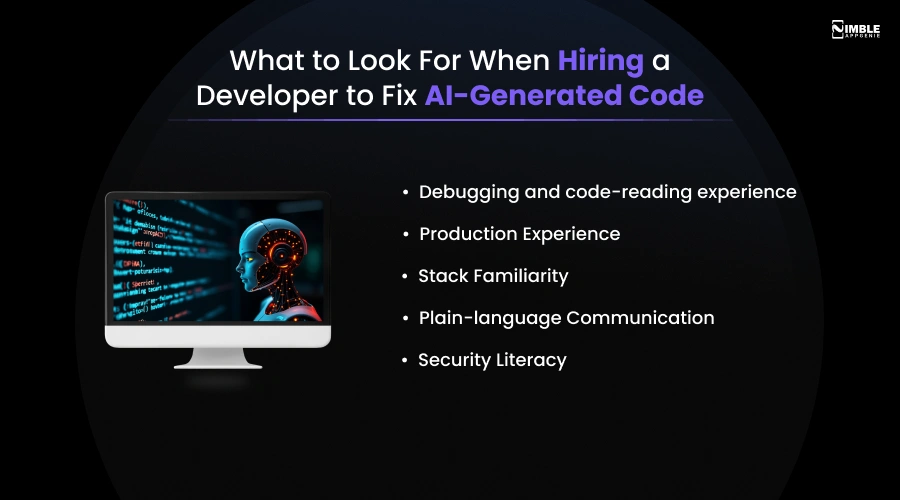
- Debugging and code-reading experience. Ask: “Walk me through how you would audit a codebase you have never seen.” A strong answer mentions checking auth, dependencies, and data flow before touching a single feature.
- Production Experience: Ask for real, shipped products, not only side projects or portfolio demos. Someone who has taken an app through a launch knows what breaks at scale.
- Stack Familiarity: Most vibe-coded apps run on React, Node.js, Next.js, Firebase, or Supabase. Don’t hire a specialist in the wrong stack only because they are available.
- Plain-language Communication: If they can’t explain what’s broken without jargon, they may not complete it either.
- Security Literacy: Ask directly whether they check for OWASP Top issues (broken auth, injection, exposed secrets) as part of their process, not as an afterthought you have to request.
Extra Vetting If You Are Building in Fintech or Handling Payments
If your app touches identity, money, or personal financial data, the stakes on a messed-up fix are higher, and so should your vetting. Look for developers or teams who can speak comfortably about:
- PCI-DSS basics, if you are processing card payments directly through a processor.
- Authorization logic, not only authentication – i.e, checking that a logged-in user can only access their own data, a gap researchers have found even top coding models consistently miss.
- How they handle secrets management – API keys and credentials should never live in source code, a common AI-generated mistake.
- Experience with compliance-adjacent builds (audit trails, KYC flows, encrypted data at rest).
If you want to go deeper on this specific angle, our guide on fintech app development covers the compliance layer that most generic “fix my code” advice skips completely.
Red Flags to Walk Away From
- Says “we need to rewrite everything before reading a single line of your code.”
- Pushes new features instead of focusing on what is actually broken.
- Can’t give even a rough estimate after seeing the codebase.
- Wants to bill hourly with no scope, no audit phase, and no cap first.
- Has only built side projects – nothing that has handled real users or real payments.
Questions to Ask Before You Hire
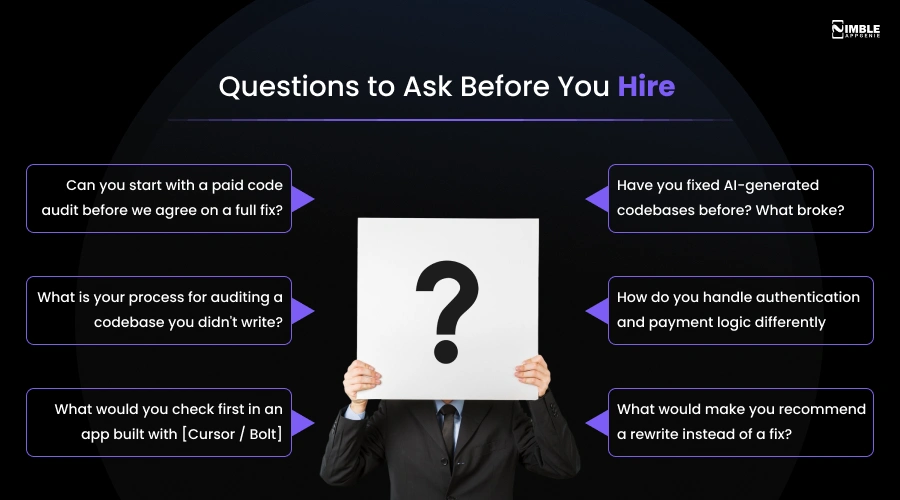
- “Can you start with a paid code audit before we agree on a full fix?”
- “What is your process for auditing a codebase you didn’t write?”
- “What would you check first in an app built with [Cursor / Bolt / Lovable / ChatGPT]?”
- “Have you fixed AI-generated codebases before? What broke?”
- “How do you handle authentication and payment logic differently from a typical feature?”
- “What would make you recommend a rewrite instead of a fix?”
What to Expect: Timeline and Cost
Costs vary by region, scope, and whether you hire a freelancer, a dev platform, or an agency, but the process is consistent. Treat these as planning ranges, not quotes.
| Phase | Typical Time | What Happens |
| Code audit | 2–6 hours | Developer reviews the codebase, flags critical issues, and estimates the real fix timeline |
| Critical fixes | 1–3 weeks | Auth, payments, security gaps, and anything blocking a safe launch |
| Hardening & polish | 1–3 weeks | Performance, mobile responsiveness, error handling, edge cases |
| Launch support | 1–2 weeks | Deployment, monitoring, first-week bug response |
Most founders should expect a total range of roughly $2,000 to $15,000+ to take a broken vibe-coded MVP to a genuinely launchable product – the wide range reflects how much was actually broken versus cosmetic.
The audit step is what turns a guess into a real number, so insist on it before signing anything larger.
Where to Find a Developer?
You generally have three routes, each with a different tradeoff:
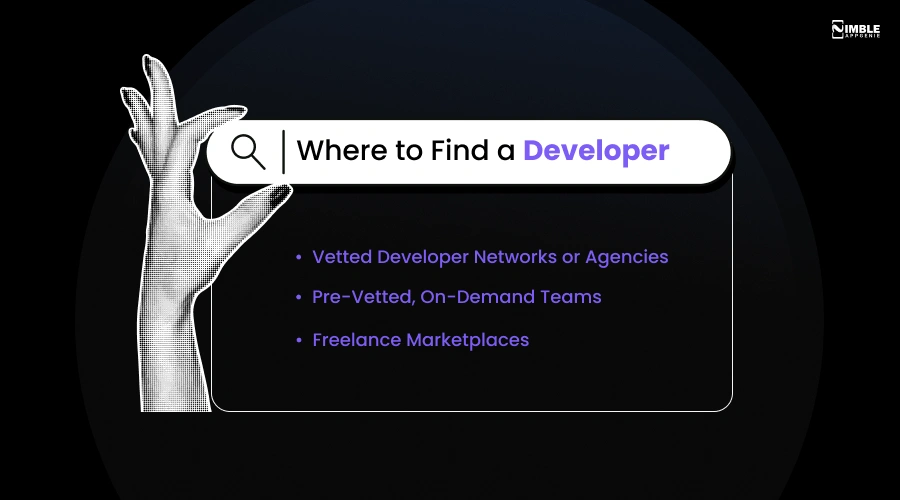
- Vetted Developer Networks or Agencies: Slower to start, but someone else has already done the skill-vetting. Better for anything touching payments or user data.
- Pre-Vetted, On-Demand Teams: For founders who want the audit-to-launch process handled end-to-end without managing multiple hires. This is where hiring pre-vetted developers through an established team tends to save the most time.
- Freelance Marketplaces: Fastest and cheapest to start, but vetting quality is completely on you. Use the checklist above strictly.
How Nimble AppGenie Approaches a Broken AI-Built App?
We built our process around the exact pattern this guide describes: founders come to us with an app that looks flawless and works perfectly. Rather than quoting a rewrite on sight, we run a structured, four-step engagement.
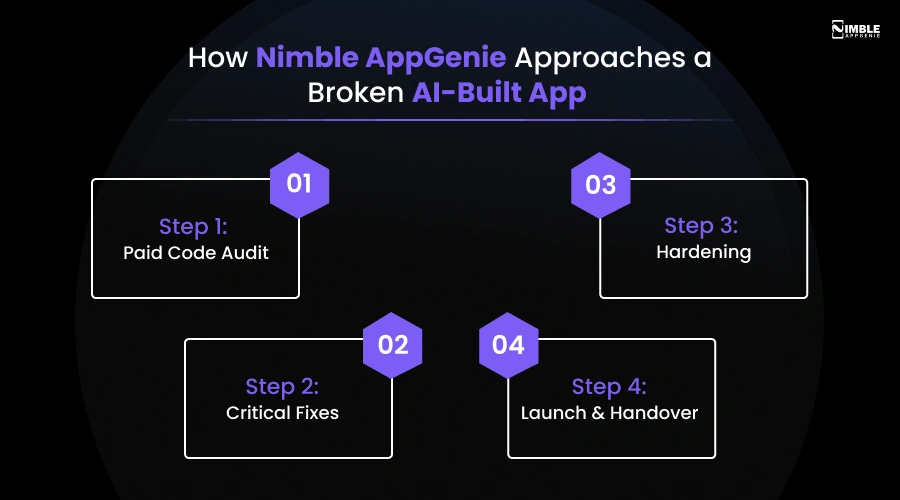
Step 1: Paid Code Audit
We review your codebase against the same failure points covered in this guide – payments, auth, OWASP-level security gaps, and data handling- and give you a plain-language report, not a sales pitch.
Step 2: Critical Fixes
We fix what’s actually broken first: payment logic, authentication, and anything that could expose user data, before touching cosmetic issues.
Step 3: Hardening
Performance under real load, error handling, and mobile responsiveness – the layer that separates a demo from a product, especially for fintech and payment-handling apps.
Step 4: Launch & Handover
Deployment, monitoring, and a clean handover, including documentation that your next developer (or in-house hire) can actually read.
We are an ISO 27001-certified, PCI-DSS-compliant development team that has shipped 350+ products across fintech and consumer apps, which is exactly the vetting bar this guide asks you to look for in every developer, including us.
If you would like the full breakdown of how we structure this for AI-built apps specifically, that’s coming in a dedicated walkthrough soon.
Conclusion
A broken vibe-coded app is not a dead end – it’s a normal checkpoint in building with AI tools. The path forward is rarely a full rewrite. It’s a clear-eyed audit, a developer who can read AI-generated code as fluently as their own, and a fix scoped to what is actually wrong.
Ask the question in this guide before you hire anyone, insist on a paid audit before a big commitment, and treat security and compliance as non-negotiable if your app touches money or personal data.
If you would rather have that audit done for you than run the vetting process solo, talk to our team – we will tell you plainly what’s broken and what it will take to fix it.
FAQs
Most engagements fall between $2,000 and $15,000+, depending on how much is actually broken. A code audit alone (2-6 hours)typically runs a few hundred dollars and gives you a real number before you commit to anything larger.
In most cases, fixing beats rewriting. A rewrite only makes sense when the underlying architecture can’t support your use case or security issues run through the entire codebase. A good developer will tell you which situation you are in after an audit, not before.
Prioritize debugging and code-reading experience over “build from scratch” portfolios, confirm they know your stack (usually React, Next.js, or Node.js), and ask directly how they handle security basics like authorization, authentication, and secrets management areas where AI-generated code usually fails.
Generally, no. Independent testing has found AI-generated code introduces OWASP Top 10 vulnerabilities in roughly 45% of cases. If your app handles user accounts, personal data, or payments, a security-focused code review before launch is not optional – it’s the single highest-leverage step you can take.
You can use freelance marketplaces, an agency, or a vetted developer network that runs a full audit-to-launch process. If you want the vetting done for you, Nimble AppGenie’s pre-vetted developers are available to review your codebase directly.
Yes. Apps that touch KYC, payments, or personal financial data should be vetted for PCI-DSS awareness, proper secrets management, and authorization logic, not just general debugging skill. Read our guide on fintech app development for a compliance layer specific to financial products.

Madan is the Backend Solutions Architect at Nimble AppGenie, specializing in the design of secure, high-concurrency systems that power complex mobile ecosystems. With deep expertise in server-side logic and database management, he ensures every platform is built with enterprise-grade security. In his free time, he is an avid researcher of emerging technologies; he spends his time deconstructing the latest backend frameworks and reading technical papers to ensure our solutions remain at the absolute forefront of industry innovation.
Table of Contents




No Comments
Comments are closed.