


Socializing and meeting new people have undergone significant changes over the years. Gone are the days when you had to approach a stranger or depend on a friend to set you up! Today, there are apps for it.
Dating apps like Bumble and Tinder offer a quick way for people to find partners. Users can easily browse profiles, initiate conversations, and make plans all from the comfort of their own homes.
Dating apps today are so powerful that people have started looking towards them as a potential business investment. But to be the next big dating app on the market, you need the right tools, and that is what we are going to discuss in this post!
As one builds a user-friendly interface for the user, to perfect matchmaking, curating a well-defined dating app tech stack plays a crucial role in preparing the necessary tools to build a successful and profitable dating platform.
With the right tech stack for a dating app, your solution can be the cupid of the business world, connecting matchmaking with profits like never before.
What is the App Tech Stack?
Let’s lay the foundation for your dating app. The tech stack is the first step. Get to know it, and you will have a lot of clarity.
A tech stack represents the list of software applications, programming languages, frameworks, and tools used together to form a digital product. It is the blueprint that guides the developers while they go ahead to create all your application’s features, functionalities, and user experience.
Think of it this way: the front end is the appearance of your app, what the users will see and interact with, and then there’s the back end for all the handling of data, logic, and server communication.
The heart of all this would be the database where all this information is stored and organized. The cloud platform is the home, providing the infrastructure to run your app.
Choosing the right tech stack is crucial for the success of your dating app because it might determine issues like performance, scalability, security, and development costs.
So before you swipe right on a tech stack, make sure that the tech stack and components of the tech stack are going to be just right for your digital love story app.
Components of a Dating App Tech Stack
A dating application’s tech stack is a carefully chosen set of technologies that work in harmony to create a seamless and exciting user experience.
Here are the major parts :
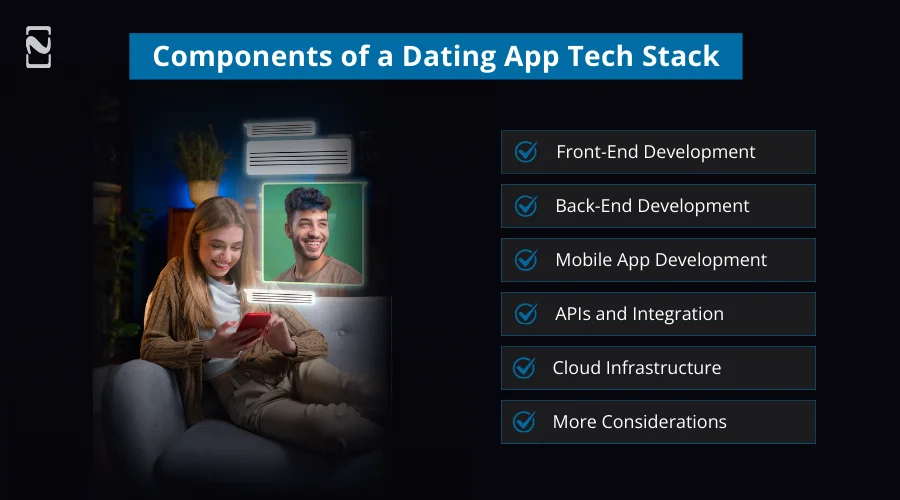
1. Front-End Development
- User Interface (UI): It refers to all the visual elements that users see during their interaction with the app, including the buttons, menu items, and profile information.
- User Experience (UX): It explains the overall feel and usability of an app to facilitate a delightful user experience journey.
- Programming Languages: The most commonly used programming languages are JavaScript, HTML, and CSS.
- Frameworks: In addition to this, major frameworks like React, Angular, and Vue.js also decrease the complexity of the back-end development process.
2. Back-End Development
- Server: It is just a computer that takes requests from users and produces the computed data.
- Programming Languages: Commonly used programming languages are Python, Ruby, and Java.
- Frameworks: Types of frameworks used – Django, Ruby on Rails, and Spring Boot.
- Database: This will hold user information such as profiles, matches, and messages. The most used databases are MySQL, PostgreSQL, and MongoDB.
3. Mobile App Development
- Platforms: With iOS (Swift or Objective-C), and with Android (Java or Kotlin)
- Cross-Platform Development: Applications can be developed using tools like React Native and Flutter, where the application can easily target multiple platforms using a codebase.
4. APIs and Integration
- Third-Party APIs: APIs of social media platforms, payment gateways, and location services to enhance functionality in the app.
- Authentication: Ensure that safe authentication methods like OAuth protect users’ information.
5. Cloud Infrastructure
- Cloud Providers: Utilize the scalable infrastructure of AWS, Google Cloud Platform, or Azure for the application.
- Serverless Architecture: Use serverless functions to perform specific tasks without server management.
6. More Considerations
- Real-Time Features: For dating app features, such as providing real-time messaging and push notifications using WebSockets.
- Machine Learning: Apply a machine learning algorithm to personalized recommendations and matchmaking.
- Security: Secure the app and data with measures like encryption and access control.
- Scalability: Design the app to scale as the number of users grows.
Using careful selection and a combination of such components will enable you to build a robust and engaging dating app that will help meet the demands of your targeted audience.
What is a Dating App Tech Stack?
A dating app tech stack is the backbone on which different features and functionalities are constructed. It is, in fact, a highly selected integration of technologies used to create a dating app that cooperates perfectly to make the experience smooth and engaging.
The main components of a dating platform include the front end, which designs and visualizes user interactions with the mobile application, and the back end, which deals with server-side logic and management of data.
The system has stored user information in the database. The development framework of the mobile app allows for cross-platform compatibility for the applications.
A set of tools ensures real-time communication, which means instant messaging and notifications as well. Authentications also serve to protect user data on the cloud platform.
With the right tech stack, developers can make a dating app that can meet the needs of all users while, at the same time, offering a valuable and profitable experience.
Let’s take a look at the table to understand this better :
| Components | Technology | Key Characteristics | Advantages | Use cases |
| Front-End | React Native | Cross-platform mobile development; component-based | Reusable components, fast development, and wide community support | Building the user interface for both iOS and Android apps |
| Flutter | Cross-platform UI toolkit; single codebase for mobile | High performance, expressive UI, hot reload | Developing high-performance, visually rich apps | |
| Swift (iOS) | Native development for iOS; modern, type-safe | Optimal performance and access to iOS-specific features | Building iOS-specific features and applications | |
| Kotlin (Android) | Native development for Android; modern language | Enhanced safety and performance; concise syntax | Developing Android-specific features and applications | |
| Back-End | Node.js + Express | Asynchronous, event-driven, lightweight, and scalable | High performance; easy to handle concurrent connections | |
| Django (Python) | High-level Python framework; follows the “batteries-included” philosophy | Rapid development, robust security features | Building a secure and scalable back-end architecture | |
| Ruby on Rails | Convention over configuration; rapid development | Mature ecosystem; built-in tools for common tasks | Developing and maintaining web applications quickly | |
| Database | PostgreSQL | Relational database; ACID compliance | Strong consistency, complex queries, and data integrity | Storing user profiles, messages, and match data |
| MySQL | Relational database, open-source | High performance, widely used, large community | Storing structured data with a proven track record | |
| MongoDB | NoSQL document database; flexible schema | Scalable: handles unstructured data; high performance. | Storing user-generated content and flexible data structures | |
| Authentication | Auth0 | Identity management service supports various auth methods | Easy integration; secure and scalable authentication | User login, registration, and password management |
| Firebase Authentication | Backend service for authentication; integrates with Firebase | Simple setup; supports multiple authentication providers | Handling user sign-ups and logins across platforms | |
| Real-Time Messaging | WebSocket + Redis | Real-time bidirectional communication; in-memory data store | Low latency; supports real-time features like chat | Real-time chat between users and live notifications |
| Firebase Cloud Messaging | Cross-platform messaging solution; supports notifications | Easy to use, reliable delivery, free tier available | Sending notifications for matches, messages, and updates | |
| Cloud Hosting | AWS (Amazon Web Services) | Scalable cloud infrastructure; various services available | Scalable resources; pay-as-you-go; high availability | Hosting the app infrastructure and databases |
| Microsoft Azure | Cloud services with a focus on enterprise solutions | Integrated with Microsoft tools and enterprise-level security | Enterprise cloud solutions and large-scale deployments | |
| Payment Gateway | Stripe | Payment processing service; supports multiple payment methods. | Easy integration, secure transactions, and global reach | Handling in-app purchases and subscription payments |
| PayPal | Online payment system: accepted | User trust supports various payment methods | Processing transactions and managing payments | |
| Braintree | Payment gateway: supports a variety of payment types | Flexibility, easy integration, and global reach | Managing payments and subscriptions in multiple currencies | |
| Analytics | Google Analytics | User behavior tracking; event-based analytics | Comprehensive data analysis; integration with other Google services | Tracking user interactions, app usage patterns, and engagement metrics |
| Mixpanel | Product analytics: event-based tracking | Deep insights into user behavior; easy integration | Understanding user engagement and retention | |
| Push Notifications | Firebase Cloud Messaging | Cross-platform messaging solution; supports notifications | Easy to implement, reliable delivery, free tier available | Sending notifications for matches, messages, and updates |
| OneSignal | Push notification service supports multiple platforms | Easy to set up, high deliverability, detailed analytics | Managing push notifications for app users |
This table gives you a great overview of the options available when it comes to building and maintaining a dating app.
Now, enough about the dating app tech stack and its components, another question that would be looming in your mind is: “Why is choosing the right dating app tech stack important?”
Importance of a Dating App Tech Stack
Similar to a dating app, choosing the right tech stack is like finding your perfect match. As the technology company responsible for running the dating app smoothly, it scales effortlessly and delivers a seamless experience that keeps users coming back for more.
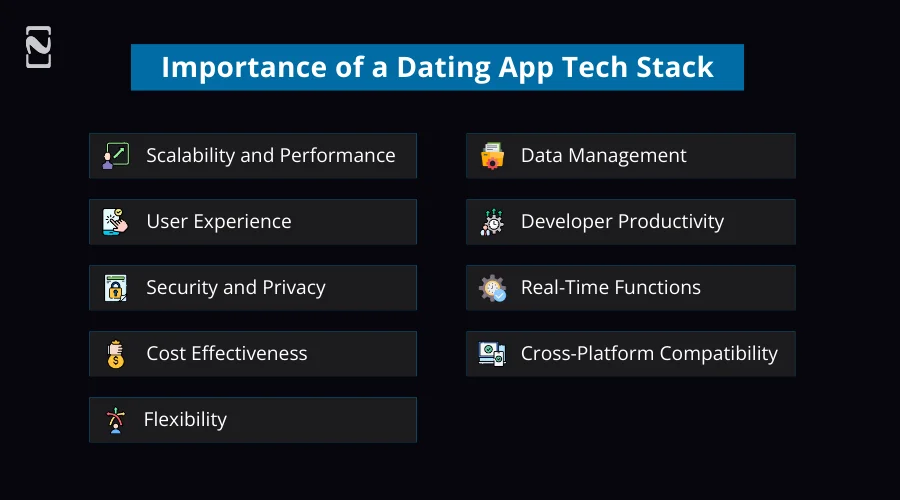
♦ Scalability and Performance
- A well-crafted tech stack keeps the dating app scalable, so it continues to stay on top and perform well under increased users.
- If scaling is good, growth will not become hazardous due to failure in service.
- Ensure your dating app tech stack is optimized towards delivering a smooth and responsive UX, user performance, even when users are being pushed to their maximum.
♦ User Experience
- Your tech stack goes straight to influencing the user experience.
- Choose technologies that make for seamless, intuitive interfaces, meaning that the application should be user-friendly.
- Reduced loading times and lags; consistency across devices.
♦ Security and Privacy
- Keep your users’ personal information safe by having good security.
- Applying encryption, authentication, and access controls to prevent unauthorized access and trespassing of data.
- Follow privacy regulations and industry standards to gain users’ confidence.
♦ Cost Effectiveness
- You’ll be able to save unnecessary costs to develop a dating app and maintenance if you select the best available tech stack.
- You could have avoided unnecessary costs if you had opted for cost-effective and scalable technologies.
- Choose open-source technology as well as cloud-based services to reduce the expenses on infrastructure.
♦ Flexibility
- You would be able to add new features and functionalities with ease if your dating app tech stack is flexible, which allows it to keep pace with changes in your application.
- Choose solutions that are flexible and can adapt to changes in market trends and user preferences. Avoid vendor lock-in by opting for open-source or vendor-agnostic solutions.
♦ Data Management
- Effective data management is needed for user profiles, preferences, and interaction management.
- Guarantees a fast retrieval of relevant data; thus, a user can enjoy a better service.
- Helps in generating timely and accurate matchmaking algorithms, resulting in better matchmaking.
♦ Developer Productivity
- Tools, frameworks, and libraries that update development.
- Makes use of pre-built components and industry standards.
- Quality, reliable tools, and support ensure that cleaner code is written in the first place.
♦ Real-Time Functions
- Messages and notifications are instant, ensuring a very interactive user base.
- Instant feedback and updates keep the users engaged for a longer period.
- Live chat, activity feeds, and real-time alerts.
- Ensures better overall app responsiveness and higher user satisfaction.
♦ Cross-Platform Compatibility
- Reduces development time and maintenance costs because there will be no code written for specific platforms.
- Streamline updates and feature rollouts on various devices.
- Testing and maintenance become easier because there is one code to be updated, thus ensuring stability and quality.
Now, with that, the question might be how to choose the right tech stack for dating apps.
How to Choose the Right Dating App Tech Stack?
Selecting the right dating app tech stack is necessary for its long-term success and scalability. But the thing is, it is a complex process. To make sure you make the right decision.
Here are some important tips you should consider :
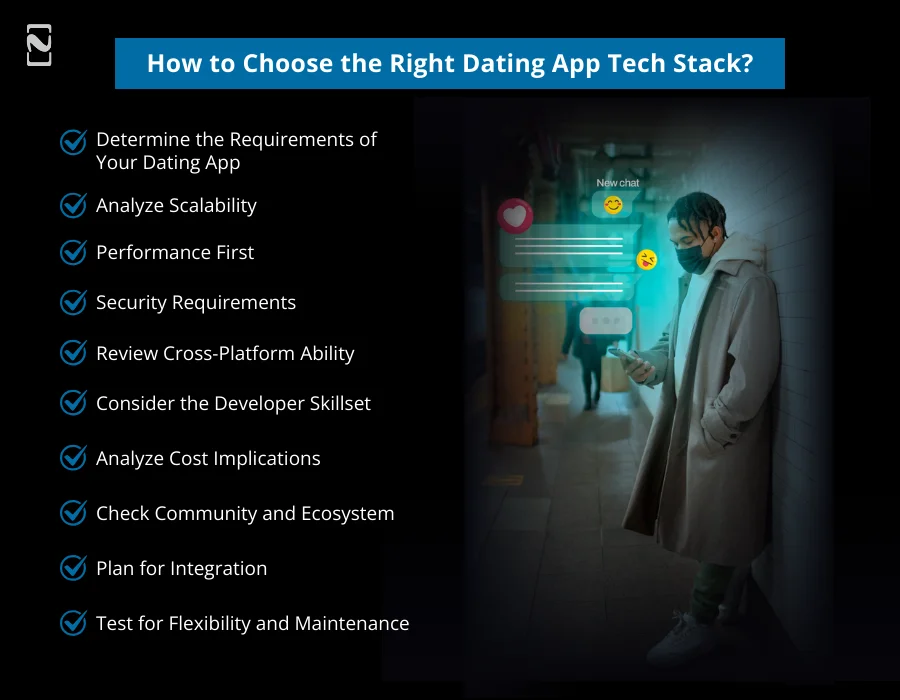
► Determine the Requirements of Your Dating App
To choose the right tech stack for a dating app, core features and functionalities should be identified. Determining the basic requirements is essential, including real-time messaging, user profiles, and matchmaking algorithms. Hence, proper alignment of the tech stack based on core features will ensure effective and efficient dating applications.
For instance, if your dating app idea is innovative and involves a lot of sophistication in algorithms, then an advanced technology stack that supports sophisticated data processing and analytics can be considered.
Then, testing whether your technology will be able to meet such requirements would be crucial in the development process of a strong and feature-rich app.
► Analyze Scalability
Scalability is of top importance when choosing the right tech stack for your dating app, mainly because the dating app landscape changes quickly. Choose technologies that support a growing number of users year on year and in which growing volumes of data do not degrade performance.
Technologies that support horizontal scaling will allow your app to scale smoothly as users grow. By ensuring your tech stack supports scalability, you set your app up to absorb future growth without the risk of hitting bottlenecks that could adversely impact user experience and satisfaction.
► Performance First
Performance directly affects the user experience, so it’s important to consider this while deciding on a tech stack. An inappropriate technology stack can cause huge performance issues.
Therefore, to avoid development mistakes in dating apps, you should choose fast and effective technologies that make your application as quick as possible while remaining reliable and responsive.
The factors for dating applications will include quick loading time, fast retrieval of data, and real-time interfaces. High-performance technology will instantly elevate the user experience by providing instant updates and smooth navigation, essential to keep engagement and satisfaction with the application.
► Security Requirements
There is sensitive information involved in the dating app. As such, this tool will demand a robust security stack that not only protects users’ information but also prevents data breaches and ensures adherence to relevant data protection laws and regulatory compliance.
This includes encryption for data in transit and at rest, secure authentication mechanisms, and strict access controls.
Ensure that security concerns are handled, thus leading to the establishment of trust by users and making sure that your app comes with standards on privacy, thus giving risk management for data as well as unauthorized access breaches.
► Review Cross-Platform Ability
Use a tech stack that supports cross-platform development to make sure that you build an app with the best reach. This way, you can develop one codebase that works on the iOS device and on the Android device, hence experiencing continuity.
A cross-platform solution can make development easier, more cost-effective, and retain the universality of the app. The user base for such apps is very diverse, and trends are highly competitive. This allows a cross-platform solution to reach a wider audience with uncompromised quality.
► Consider the Developer Skillset
The choice of tech stack can be directly related to your team’s expertise. Development efficiency depends highly on choosing a suitable tech stack according to the best fit for your development team.
Select technologies for which your team is already experienced, so that you can build on their existing knowledge, thus narrowing steep learning curves, saving the acceleration of development time, and cutting down on mistakes.
Applied to solving the development challenges of a dating app, experience in the tools and technologies being used makes problem-solving faster and neater, leading to a more successful and timely launch of an app.
► Analyze Cost Implications
You need to evaluate the cost of your tech stack so that the development and operational expenses are balanced.
Think of the initial development costs and the ongoing maintenance fees concerning the technologies you pick. Aim for a cost-effective solution that yields good value for your money while fulfilling all of your technical requirements.
Additionally, by understanding how dating apps make money, i.e., revenue, be it in-app purchases, subscriptions, etc, you can select the most appropriate tech stack for effective and efficient implementation of a monetization strategy.
► Check Community and Ecosystem
Select those technologies that have a healthy community with a rich ecosystem. What is called an active community is a great source of resources like documentation, forums, and third-party integrations that are quite useful during the development and fixing of things.
With a good tech stack comes the possibility of tools and libraries that can enhance functionality while also streamlining development. Through this community access, a quick realization of issues can be facilitated while taking updates and improvements, and ensuring that your app keeps up with recent dating app trends.
► Plan for Integration
Third-party services like payment gateways, analytics tools, and social media channels will be integrated seamlessly with the help of your tech stack. The standout thing that makes the app have good functionality and user engagement is its ability to integrate seamlessly.
For instance, through integrations in payment solutions, which will possibly implement monetization strategies or analytics tools that describe the behavior and preferences of users?
This ensures that your dating app meets the integrations mentioned above, meaning that it not only caters to user needs but also meets the business goals of supporting the business and enhancing its performance.
► Test for Flexibility and Maintenance
Choose a tech stack that will easily update and maintain your dating app; these are what keep a dating app relevant and running. Flexibility in the tech stack is ensured for responsiveness to new features, fixing bugs, and responding to changes in user requirements without much hassle.
This flexibility will be needed in making things right with some of the challenges when developing a dating app, and for positive responses to user feedback.
A straightforward maintenance process of the tech stack will keep your app updated, in the growth of being sufficiently competitive in the dynamic landscape of dating apps.
Popular Dating App Tech Stacks – Bumble, Tinder, & More
Generally, businesses that plan to enter the dating app market are inspired by the current solutions in the market.
If you, too, have planned to start your journey after looking at the success of Bumble, Tinder, Hinge, or any other player in the market, then you must take a look at the tech stacks used by these popular dating apps.
Here are some popular dating apps and their tech stacks for your reference –
➤ Tinder
One of the leading and most popular dating apps, Tinder, leads the pack when it comes to dominating the market. The application is synonymous with the right swipe, which is often used as the ultimate way to interact with a dating app.
It is a feature that every other application looks forward to recreating in its own way, but has certainly failed, as it has become an ultimate brand identity for Tinder. However, all this impact on the market is not created with just an idea.
Here’s a tech stack that powers the engine that keeps Tinder going –
- Frontend: React Native
- Backend: Node.js and Express.js
- Database: MongoDB, Redis
- Hosting: AWS
- AI/ML: Machine learning models for match optimization
- Other Tools: Kafka for event handling, Elasticsearch for search
All these technologies used by the app allow it to implement some of the most valuable features that help it stand apart. Special features like a smart matching algorithm based on user behavior and location, and real-time chat using WebSockets for instant messaging, allow users to be more active on the platform in the long run.
➤ Hinge
Known for its accurate matching and highly protected user privacy, Hinge is another key player in the market.
While dating apps are often considered to be a place where you keep meeting new people, Hinge proposes that it is “an app designed to be deleted,” pushing the motto of fostering serious relationships among the matches that it makes.
This unique proposition makes it an ideal place for individuals seeking long-lasting relationships. To ensure that they create an experience that feels serious and gives their user the right match.
They use the following tech stack –
- Frontend: React Native, TypeScript
- Backend: Python (Django)
- Database: PostgreSQL, Amazon DynamoDB
- Hosting: AWS
- ML Algorithms for personalization.
- Instant Notifications: Firebase Cloud Messaging
Providing modern and advanced filtering options for the preferences of the users, Hinge ensures that their users stick to the platform once they have installed it.
Though the sign-up process is quite tedious, it definitely filters out the users who are not looking for anything serious, meeting the requirements of the platform.
➤ Bumble
Combining all the aspects of connecting with strangers, from finding a partner to business networking, Bumble is a one-stop destination for many users. The platform offers different modes for dating, friendship, and networking.
The platform is a hit among female users as it follows the ladies-first approach. What this means is that in an heterosexual match, female users have the leverage of making the first contact.
This gives them extra freedom to choose where they want to interact. The positioning of the brand is quite solid, and it is only possible because of the solid technology working behind the scenes.
Here’s the tech stack for a dating app like Bumble –
- Frontend: Swift (iOS), Kotlin (Android)
- Backend: Node.js
- UI Library: MUI (Material UI)
- Database: Amazon DynamoDB, Redis
- Hosting: AWS
- AI/ML: Python with TensorFlow. OpenAI for matching
The dating app tech stack used in Bumble allows it to offer real-time chat, swipe-based matching, and integration of geolocation and push notifications for better engagement.
All these technologies may appear to be the same; however, it is the implementation of these tech stacks that gives these market-leading apps a unique identity and place in the market.
To make an impact and deliver on the expectations of the users who are looking for a fresh solution, you need to ensure that the tech stack for a dating app that you choose is a combination of necessary solutions, along with modern-day technologies like artificial intelligence and machine learning.
Not to forget, you also need a solid dating app development team that gets the job done easily. If you are wondering who can help with that, keep on reading, as in the next section, we have just the right solution for you!
Nimble AppGenie: Your Partner to Build a Top Dating App
Dating applications are becoming popular, and so is the need to have a special application that captures your users’ hearts.
Your dating app should not only meet but exceed the user’s expectations; for this, you need a team of experts knowledgeable in this competitive field.
Nimble AppGenie is the best dating app development company that is here to be your strategic partner in building a top-tier dating app.
From seamless matchmaking algorithms to engaging user interfaces, we deliver a comprehensive solution that’ll make sure your app is poised for success and make you leave your mark in the dating app market.

Conclusion
Dating apps are among the most important things in today’s increasingly digital life and are one of the vital aspects of social interaction and relationship building.
Building a successful dating app is impossible unless the chosen tech stack suits your application’s goals, the target audience, and the desired features.
Knowing how to break down the components of a dating app tech stack and which of those factors, like scalability, performance, security, or user experience, is the most important, will lead you to one of the best applications that distinguishes itself in this competitive market.
Remember, the right tech stack is not just a technical choice but also an investment in the future success of your app.
FAQs
Some of the most commonly used combinations include:
- Front-end: React, Angular, Vue.js
- Back-end: Node.js, Python (Django), Ruby on Rails
- Mobile: React Native, Flutter
- Databases: PostgreSQL, MySQL, MongoDB
- Cloud: AWS, Google Cloud Platform, Azure
The best choice depends on your specific needs, team expertise, and project goals.
Consider the following factors when selecting a tech stack:
- App features and functionality.
- Development team expertise.
- Scalability and performance.
- Cost and time constraints.
- Future-proofing.
Some emerging technologies include:
- Artificial intelligence (AI): For personalized matchmaking and recommendations.
- Augmented reality (AR): For interactive features and virtual experiences.
- Blockchain: For secure and transparent data management.
- Voice assistants: For hands-free interaction and voice-controlled features.

Niketan Sharma, CTO, Nimble AppGenie, is a tech enthusiast with more than a decade of experience in delivering high-value solutions that allow a brand to penetrate the market easily. With a strong hold on mobile app development, he is actively working to help businesses identify the potential of digital transformation by sharing insightful statistics, guides & blogs.
Table of Contents
No Comments
Comments are closed.