Free Consultation
 PCI-DSS Compliant
 GDPR Ready
 ISO 27001
 NDA Protected
 AI Services
 AI App Development
 Generative AI Development
 AI Chatbot Development
 AI Integration Services
 AI For Fintech
 AI Financial Assistant Solution
 AI Insurance Agent Development
 Tech Stack
 OpenAI / GPT-4
 Claude / Anthropic
 Gemini / Google AI
 Llama / Open Source
 LangChain / LlamaIndex
 Pinecone / Pgvector
 AWS / Azure AI


 Fintech Solution
 Core Fintech
 Fintech App Development
 Neobank App Development
 eWallet App Development
 Payment Integration
 Lending Software
 BNPL Solution
 BNPL App Development
 Insurance App
 Investment App Dev
 Wealth Management App
 Crypto & DeFi
 DeFi App Development
 Crypto Wallet Dev
 Crypto Exchange Dev
 Trading Platform Dev
 Payments
 Compliance
 RegTech App Dev
 Fraud Detection
 Lending Ecosystem
 P2P Lending Platform
 Mortgage Lending
 Engagement
 Outsourcing Dev


 Mobile Development
 Mobile App Dev
 iOS App Development
 Android App Development
 React Native
 Flutter Development
 Web Development
 Node.js Development
 React.js Development
 Angular Development
 PHP / Laravel
 App Services
 UI/UX Design
 App Maintenance
 By Stage
 MVP Development
 Industry Solutions
 Healthcare App Dev
 Education App Dev
 Travel App Dev
 Real Estate App Dev
 Logistics Software
 Social Media App


 Hire Mobile Developers
 Hire iPhone Developers
 Hire Android Developers
 Hire React Native Devs
 Hire Flutter Developers
 Hire Web Developers
 Hire Node.js Developers
 Hire Angular Developers
 Hire PHP Developers
 Hire Laravel Developers
 How It Works
 Pre-Vetted Developers
 Ready In 48 Hours
 NDA From Day One
 Replace Guarantee

 Company
 About Us
 Portfolio
 Case Studies
 Blog / Insights
 Careers
 Contact Us
 Recognition


 Offices


TL;DR
- A contactless payment system lets a customer pay by tapping a card, phone, or wearable near a terminal, using NFC or RFID to transmit encrypted payment data instead of swiping or inserting a card.
- From March 2026, the UK’s FCA is removing the fixed £100 contactless limit, letting banks and payment providers set their own limits based on their fraud controls – the biggest regulatory shift in contactless payments this year.
- SoftPOS (Tap to Phone) is turning ordinary NFC-enabled smartphones into payment terminals, removing the need for separate POS hardware for many small merchants.
- Security relies on tokenization, encryption, and device authentication – not the tap itself.
- Nimble AppGenie builds PCI-DSS-compliant contactless and e-wallet payment solutions for fintechs and merchants worldwide.
Long queues, card swipes, and exact change that never work the first time are ancient history now. Today, a tap of a card, watch, or phone is enough.
That ease runs on the contactless payment system: a mix of NFC, tokenization, RFID, and banking infrastructure that authorizes a transaction in a couple of seconds. It’s also evolving rapidly in 2026, more than at almost any point since contactless limits were first introduced.
This guide covers how contactless payments work, the methods and technologies behind them, the regulatory change currently revolutionizing the UK market, and where the technology is headed next.
Contactless Payments and Their Rise in Popularity
Contactless payments are not new – they link back to the late 1990s, using Radio Frequency Identification (RFID) in closed-loop systems, like prepaid transit cards, usable just within a single network.
With the maturing technology, it moved into open-loop systems – card issuance by Mastercard, Visa, and other networks that work anywhere, not only one transit system or store. That shift is what made contactless mainstream. See the practical difference in our open-loop and closed-loop payment systems guides.
- Nowadays, contactless is the most chosen in-store payment method across the US and UK, with adoption increasing to 50% of routine transactions in both markets.
- The global contactless payments market is expected to reach $12.5 trillion by 2032, up from $2.4 t rillion in 2022.
- Ahead, one industry prediction puts contactless transaction value at $15.7 trillion by 2029, driven mainly by ticketing and SoftPOS adoption – more on both below.
What Is a Contactless Payment System? How Does It Work?
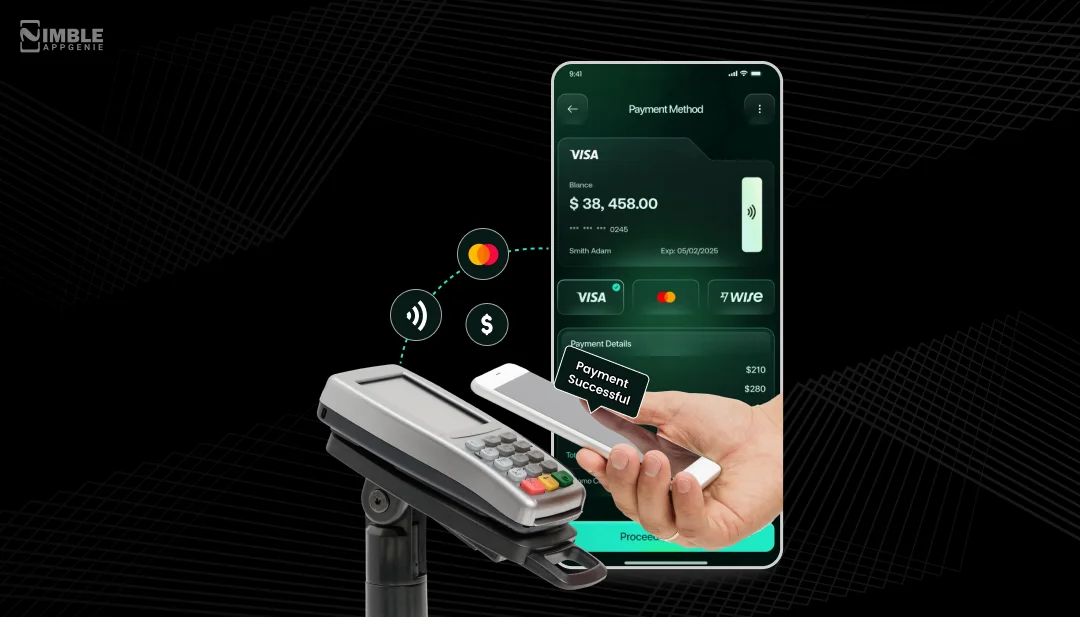
A contactless payment system allows a user to pay by tapping a smartphone, wearable, or card near a compatible terminal, without inserting or swiping anything.
The transaction flows in three steps:
- Step 1: The customer taps their smartphone or card on the payment terminal or card reader.
- Step 2: The terminal receives the signal and verifies the account information with the customer’s bank.
- Step 3: Once authenticated, the transaction completes and funds move to the merchant.
All of this happens in a matter of seconds, with the bank directly involved at each step, which is also what makes the transaction trail reliable for both sides.

NFC vs. RFID vs. Contactless: Clearing Up the Confusion
Consider “contactless” as an umbrella term, and NFC and RFID as the two technologies mostly used to strengthen it. They are usually used interchangeably by mistake:
- NFC (Near Field Communication): Short-range (a few centimeters), two-way communication, used in Apple Pay, modern tap-to-pay cards, and Google Pay. See our NFC mobile payments guide.
- RFID (Radio Frequency Identification): Can be read from a far-away distance, generally one-directional, more common in closed-loop systems, such as transit passes, than in open-banking transactions.
Practically, most modern bank-issued contactless cards use NFC, while RFID stays more common in single-purpose, closed-loop cards.
Types & Technologies Behind Contactless Payments
Contactless payments come in several forms, each powered by one or more technologies mentioned below:
| Method | Underlying Tech | Hardware Needed | Typical Use Case |
| Tap-to-Pay Cards (EMV) | NFC + EMV chip | NFC-enabled card + terminal | Everyday retail purchases |
| Digital Wallets | NFC or QR | Smartphone with wallet app | In-store and online checkout |
| Biometric Payments | NFC + biometric sensor | Smartphone with fingerprint/Face ID | High-security or high-value taps |
| QR Code Payments | Camera + payment app | Smartphone only | Small merchants, P2P, emerging markets |
| Wearables | NFC | Smartwatch, ring, or band | Transit, fitness-adjacent retail |
| Closed-Loop RFID Cards | RFID | RFID card + proprietary reader | Transit passes, campus/venue payments |
| SoftPOS / Tap to Phone | NFC | Merchant’s own NFC smartphone — no separate terminal | Small businesses, delivery, pop-up retail |
Every type has its dedicated deep dive: see our guides on QR code payments, biometric authentication, and how eWallets, mobile wallets, and digital wallets differ.
SoftPOS: The Fastest-Growing Contactless Format
SoftPOS (also known as Tap to Phone) turns an ordinary NFC-enabled smartphone into a payment terminal – no separate card reader needed.
A merchant just installs an app, and customers tap their phone or card directly on the merchant’s device. This removes a major cost barrier for small businesses and mobile merchants who previously required dedicated POS hardware to accept contactless payments entirely.
Advantages of Contactless Payment Systems
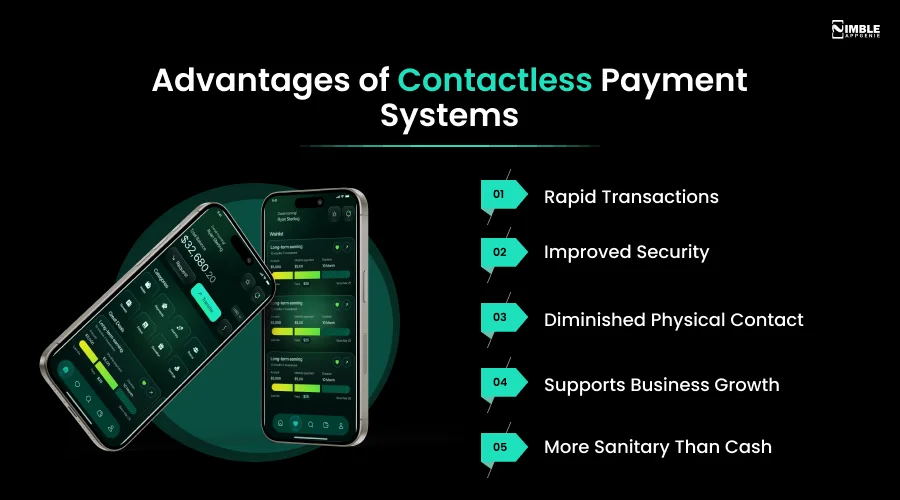
1. Rapid Transactions
No signature, no PIN entry, and no waiting – a tap accomplishes the transaction in seconds for routine purchases.
2. Improved Security
Contactless transactions depend on encryption, tokenization, and dynamic data authentication so the card number is never revealed to the merchant.
This is the same security backbone covered in our eWallet security guide, and that’s why any contactless solution Nimble AppGenie builds is created under ISO 27001-certified, PCI-DSS-compliant processes from day one.
3. Diminished Physical Contact
No handling of shared PIN pads or cash, just a small but real hygiene and convenience benefit at high-traffic checkouts.
4. Supports Business Growth
Faster checkout decreases queue abandonment, and contactless infrastructure eases the layering in loyalty programs and discounts.
5. More Sanitary Than Cash
Post-pandemic patterns have stuck – various users now default specifically to tap-and-pay to avoid excessive physical contact.
Disadvantages of Contactless Payment Systems
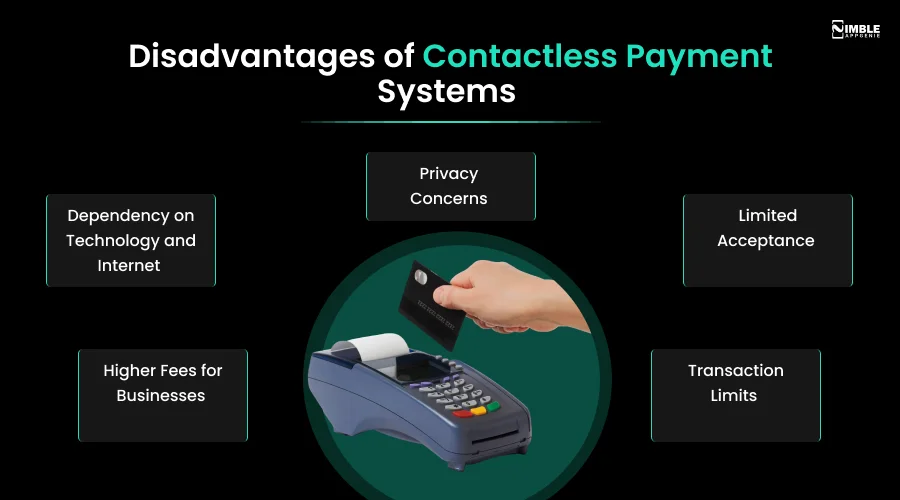
1. Dependency on Technology and Internet
POS infrastructure still needs connectivity and power to verify transactions with the bank, and a breakdown can interrupt service.
2. Higher Fees for Businesses
Merchants generally face pre-transaction fees and POS costs for contactless acceptance, which can be a consideration for thin-margin businesses.
3. Transaction Limits
Contactless payments have usually been capped at lower-value purchases, requiring a PIN for larger transactions; that’s what’s changing in the UK in 2026.
4. Limited Acceptance
While expanding fast, contactless is still not accepted universally by every merchant, specifically in smaller or cash-preferring markets.
5. Privacy Concerns
Digital transactions naturally exchange more identifying data than a cash exchange, which is a legitimate concern for privacy-conscious users.
Future of Contactless Payments: What’s Changing in 2026
Right now, contactless payments are shifting this way, not just incrementally enhancing:
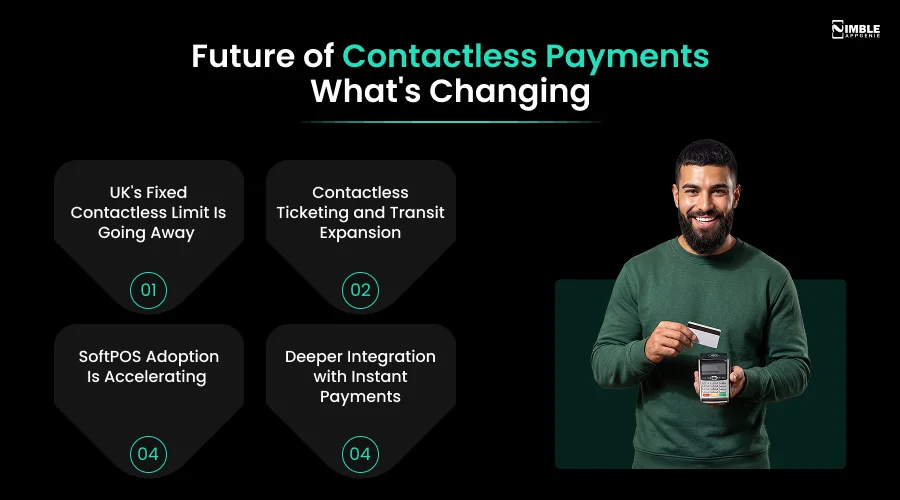
UK’s Fixed Contactless Limit Is Going Away
Over the years, the UK’s contactless limit has risen from £10 in 2007 to £100 in 2021. From March 2026, the UK’s Financial Conduct Authority will eliminate the single fixed national cap.
Banks and payment providers directly adjust or disable their own limits. For merchants, this means payment processing infrastructure and POS need to handle variable, issuer-specific limits, making checkout seamless.
Contactless Ticketing and Transit Expansion
Beyond retail, contactless ticketing for events and transit is one of the rapidly growing contactless use cases globally, with US markets particularly launching new contactless ticketing infrastructure.
SoftPOS Adoption Is Accelerating
As covered above, SoftPOS removes the hardware barrier to accepting contactless payments, and forecasts point to it becoming a chief driver of contactless growth through the end of the decade – mainly for small businesses, pop-up retail, and delivery services.
Deeper Integration with Instant Payments
Contactless is progressively the front-end experience for back-end instant payment rails – see our breakdown of the global evolution of instant payments and how these two trends connect.
How Nimble AppGenie Helps Businesses Adopt Contactless Payment Technology
Most businesses that delay contactless adoption are not held back by the technology – they are held back by not having the right implementation partner.
At Nimble AppGenie, we help businesses adopt contactless payment technology end-to-end, with expertise in e-wallet app development, PCI-DSS-compliant architecture, and SoftPOS integration built in from the first sprint. Our QA team aims particularly at reducing transaction-failure edge cases that quietly erode customer trust in a contactless rollout.
If your approach includes supporting international customers, our guide on building a multi-currency wallet covers that build process in detail, and our work on AI-powered fraud detection shows how we handle the security layer behind every tap.
Conclusion
Contactless payments are no longer an advanced option; they are the standard now. In 2026, you will witness the biggest structural change coming your way, explaining how contactless payments work, from the UK’s limit overhaul to SoftPOS bypassing hardware obstacles for small merchants.
Contactless is only one layer of the broader mobile payment technology stack – understanding where it fits helps you plan a payment strategy that won’t demand rebuilding every time underlying trends shift.
FAQs
Yes. Contactless payments use tokenization, encryption, and dynamic data authentication to protect transaction data; the card number is never revealed to the merchant during the transaction.
NFC works over a very short range and supports two-way communication, making it the standard for modern bank-issued contactless cards and mobile wallets. RFID can be read from a greater distance and is typically one-directional, more common in closed-loop systems like transit cards.
The most common methods include NFC and RFID cards, digital wallets like Apple Pay and Google Pay, QR codes, wearables, and increasingly, SoftPOS on the merchant side.
SoftPOS, or Tap to Phone, turns an ordinary NFC-enabled smartphone into a payment terminal, letting merchants accept contactless payments without buying separate card-reader hardware.
Adoption is high in markets like the US and UK, where over 50% of everyday transactions are contactless, but acceptance isn’t universal – some smaller or cash-preferring merchants still don’t support it.
Yes. From March 2026, the UK’s FCA will remove the fixed £100 national limit, allowing individual banks and payment providers to set their own contactless limits based on their fraud controls, with customers able to adjust or disable their own limits.
Historically, yes, varying by country and card issuer, though regulatory changes like the UK’s 2026 update are moving toward issuer-set, flexible limits rather than one fixed national cap.
Businesses should contact their current POS provider to check contactless compatibility, upgrade terminal hardware or adopt a SoftPOS solution, and enable acceptance of major wallets like Apple Pay, Google Pay, and PayPal.

Niketan Sharma, CTO, Nimble AppGenie, is a tech enthusiast with more than a decade of experience in delivering high-value solutions that allow a brand to penetrate the market easily. With a strong hold on mobile app development, he is actively working to help businesses identify the potential of digital transformation by sharing insightful statistics, guides & blogs.