

 Free Consultation
 PCI-DSS Compliant
 GDPR Ready
 ISO 27001
 NDA Protected
 AI Services
 AI App Development
 Generative AI Development
 AI Chatbot Development
 AI Integration Services
 AI Consulting Services
 AI For Fintech
 AI Financial Assistant Solution
 AI Insurance Agent Development
 Tech Stack
 OpenAI / GPT-4
 Claude / Anthropic
 Gemini / Google AI
 Llama / Open Source
 LangChain / LlamaIndex
 Pinecone / Pgvector
 AWS / Azure AI


 Fintech Solution
 Core Fintech
 App Development
 Neobank Solutions
 eWallet Solutions
 Lending Software
 Banking Solutions
 BNPL Solutions
 BNPL Solutions
 Insurance App
 Wealth Management
 Crypto & DeFi
 Blockchain Development
  Payroll Software
 DeFi Solutions
 Crypto Wallet
 Crypto On/Off Ramp
 Crypto Exchange
 Trading Platform
 Payments
 Compliance
 Regulations & Compliance
 Fraud Detection
 Lending Ecosystem
 P2P Lending Platform
 Mortgage Software
 Engagement
 Fintech Outsourcing

 Mobile Development
 Mobile App Dev
 iOS App Development
 Android App Development
 React Native
 Flutter Development
 Web Solution
 Node.js Development
 React.js Development
 Angular Development
 App Services
 UI/UX Design
 App Maintenance
 By Stage
 MVP Development
 Industry Solutions
 Healthcare App Dev
 Education App Dev
 Travel App Dev
 Real Estate App Dev
 Logistics Software
 Social Media App

 Hire Mobile Developers
 Hire iPhone Developers
 Hire Android Developers
 Hire React Native Devs
 Hire Flutter Developers
 Hire Web Developers
 Hire Node.js Developers
 Hire Angular Developers
 Hire PHP Developers
 Hire Laravel Developers
 How It Works
 Pre-Vetted Developers
 Ready In 48 Hours
 NDA From Day One
 Replace Guarantee
 Company
 About Us
 Our Work Process
 Portfolio
 Case Studies
 Blog / Insights
 Careers
 Contact Us
 Awards
 Recognition


 Offices


Key Takeaways:
- Swift (SwiftUI) is the top standard for performance-critical, Apple-ecosystem-deep iOS apps in 2026.
- React Native’s New Architecture (Fabric + JSI) has closed the performance gap lately, making it a genuine option even for mid-complexity apps.
- For startups and companies needing iOS + Android, React Native cuts development time by 30–40% without meaningful quality sacrifice.
- SwiftUI has reached genuine maturity in 2026; it is no longer experimental, and Apple’s own apps now lean heavily on it.
- Nimble AppGenie has built 350+ iOS and cross-platform apps across both frameworks – Swift or React Native for iOS apps? We help you choose the right one for your goals, then build it right.
The Swift vs React Native for iOS 2026 debate has essentially shifted this year, and the framework you would have chosen earlier, three years ago, may be the wrong choice today.
Two major forces have changed everything: React Native’s new architecture, which is a stable reality, not a roadmap promise anymore, and SwiftUI, which is mature now as an Apple-recommended UI framework used in production by the globe’s most demanding apps.
For years, the answer to the question – want performance? Choose Swift. Want cross-platform reach and speed? Choose React Native. Now, this has become obsolete.
Both frameworks have won their games, and the right choice depends on your product goals, budget, timeline, and team.
This guide is written for business owners, project managers, and startup founders who need a clear, genuine framework comparison before they commit to a development path. We have structured it so you can quickly scan the verdict table, explore your specific use case, and walk ahead with confidence.
At Nimble AppGenie, we have developed iOS and cross-platform apps for startups, enterprises, and everyone in between, and this guide draws on that real-world experience.
Quick Verdict: Swift vs React Native – Head-to-Head Comparison Table
Below is the breakdown at a glance. This table is created for your quick reference.
| Factors | Swift / SwiftUI | React Native | Nimble AppGenie Verdict |
| Performance | ★★★★★ Native-grade | ★★★★☆ Near-native (New Arch) | Swift for GPU-heavy apps; React Native for most others |
| Dev Speed | ★★★☆☆ Slower (iOS only) | ★★★★★ Faster (shared codebase) | React Native saves 30-40% development time on dual-platform builds |
| Cost | Higher (dedicated team) | Lower (one team, two platforms) | React Native wins for budget-conscious MVPs |
| UI/UX Fidelity | ★★★★★ Pixel-perfect native | ★★★★☆ Near-native with Fabric | Swift for luxury, premium feel |
| Cross-Platform | iOS / macOS only | iOS + Android + Web | React Native if you need Android now or soon |
| Apple Ecosystem | ★★★★★ Full (Widgets, Watch, CarPlay, Apple Intelligence) | ★★★☆☆ Partial via bridges | Swift for deep Apple-native features |
| Security | ★★★★★ Hardened native sandbox | ★★★★☆ Strong with care | Swift for banking/health/fintech |
| Talent Pool | Smaller, premium salaries | Larger, more accessible | React Native lowers hiring friction globally |
| Long-Term Scale | ★★★★★ Best for complex apps | ★★★★☆ Solid with the right architecture | Depends on roadmap — we scope this for you |
| Best For | Premium iOS-first, complex native features | Startups, MVPs, cross-platform | Talk to us — it depends on your product goals |
| Nimble AppGenie Verdict – There is no universally correct answer. Swift wins on performance, Apple depth, and long-term native quality. React Native wins on budget, time-to-market, and cross-platform reach. The majority of our clients in 2026 use React Native for their MVP, then layer in Swift modules for performance-critical features as they scale. |
What is Swift (2026 State of Play)?
Swift is Apple’s native programming language for iOS, watchOS, macOS, and tvOS development. Rolled out in 2014, it took the place of Objective-C and, since then, has become the definitive way to create apps that run deep inside the Apple ecosystem.
In 2026, SwiftUI – Apple’s declarative UI framework for Swift has attained a level of maturity that makes native iOS development rapid and more accessible than ever.
SwiftUI’s maturity in 2026 is a real game-changer. Earlier, the versions were limited, debugging was challenging, components were missing, and many mobile app developers were stuck with UIKit unavoidably. That era is mostly over.
Now, SwiftUI supports complicated custom components, deep system integration, and fluid animations, including Live Activities, Apple Intelligence, and interactive widgets, all without workarounds or bridges.
Swift directly compiles to native machine code, which implies it pulls the maximum performance from Apple silicon. For applications that depend on ARKit, Metal, CoreML, or HealthKit, there is effectively no faster or more integrated option available.
► Who Uses Swift in 2026?
- Fintech and banking apps need Secure Enclave access and hardware-level security.
- Augmented reality experiences developed on ARKit and RealityKit.
- Fitness and healthcare platforms integrating with Apple Watch, Motion, and HealthKit.
- Enterprise apps are excessively embedded in the Apple ecosystem (iPhone, iPad, Mac, Watch, and Vision Pro).
- Premium consumer apps where the brand needs a pixel-perfect native feel.
- Apps using on-device AI automation and Apple Intelligence.
| Industry Note – RentAMac’s 2025 iOS Developer Survey found SwiftUI adoption accelerating rapidly among professional iOS developers, with teams that previously relied on UIKit increasingly migrating to SwiftUI for new projects. |
What is React Native (2026 State of Play)?
React Native is Meta’s open-source framework that allows developers to write JavaScript (or TypeScript) code that runs as native Android or iOS components. It was developed on a simple premise: write once and deploy on both major platforms.
That promise is far more real this year than it was three years ago, thanks to the complete release of the React Native New Architecture 2026.
The New Architecture, including the React Native Fabric architecture rendering engine and JSI (JavaScript Interface), eliminates the old asynchronous JavaScript bridge, React Native’s major performance obstacle.
JSI enables direct, synchronous communication between native code and JavaScript, which translates to rapid startup times, better responses to user input, and smoother animations.
React Native iOS development 2026 is a fundamentally different proposition.
React Native benefits from the huge JavaScript and TypeScript talent pool and the React ecosystem.
Teams that already build web products in React can spread their knowledge directly into mobile, considerably diminishing hiring complexity and onboarding friction. This is a useful business advantage for startups.
► Who Uses React Native in 2026?
- Social and content apps with standard UI patterns.
- Startups shipping an MVP to Android and iOS simultaneously.
- Companies with existing React web teams seeking to expand into mobile.
- E-commerce and marketplace apps (Walmart and Shopify both have used React Native in production).
- SaaS products are adding a mobile companion app.
- Businesses require cross-platform iOS development without any mess of maintaining two separate codebases.
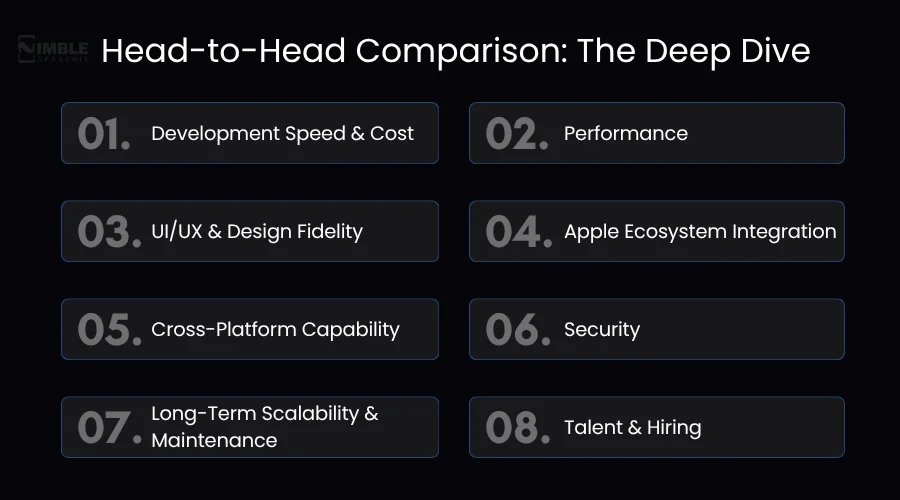
Head-To-Head Comparison: The Deep Dive
Now, let’s talk about Swift vs React Native for iOS 2026, picking different aspects one by one.
1. Development Speed & Cost
Here, React Native has the clear advantage. A single TypeScript codebase focusing on Android and iOS both typically saves 30-40% in development time compared to maintaining two separate native codebases. For a company or startup with budget constraints, that figure translates directly to lower investment and faster time-to-market.
Native iOS app development cost with Swift is higher, not because Swift developers are less efficient, but because you are paying for a specialist skill set covering a single platform. When you add Android, you are actually doubling the cost.
That said, Swift is quicker for simple iOS-only apps or when you already have a Swift team. The cost calculation modifies if you have Swift experts and only need iOS – adding React native would bring on its ramp-up cost.
| Verdict – React Native wins on speed and cost for cross-platform builds. Swift wins for iOS-only apps with an existing native team. |
2. Performance
Swift wins on performance, and that gap, however narrowed, still exists in 2026. Swift compiles to native machine code and runs directly on Apple’s hardware without any intermediary layer.
For apps that push the GPU, require sub-millisecond UI responsiveness, or process real-time sensor data, Swift is the clear choice.
With the New Architecture, React Native is notably faster than its predecessors. The JSI-based bridge eliminates the async issue, and Fabric brings concurrent rendering to mobile.
For the majority of business apps, including social, ecommerce, productivity, and marketplace categories, React Native performance is more than enough. The performance gap only becomes a business decision for real-time video processing, graphics-intensive games, highly complex animations, and AR/VR applications.
| Verdict – Swift vs React Native performance, Swift is suitable for peak-performance apps, and React Native is for everything else – the gap is no longer an issue for mainstream applications. |
3. UI/UX & Design Fidelity
SwiftUI delivers pixel-perfect native iOS components. Haptic feedback, custom transitions, Dynamic Island integrations, Apple-native navigation patterns, and fluid system animations – all these are top-class in SwiftUI.
If your brand wants the premium feel of apps like Headspace, Robinhood, or Apple’s own applications, Swift delivers that.
React Native with Fabric in 2026 renders true native UI components, not web views in a mask. The visual gap between a well-developed React Native app and a Swift app is now narrow enough that most end users can’t tell the difference.
However, non-standard animations, highly custom UI work, and interactions that need deep system integration still feel more natural in Swift.
For standard UI patterns – forms, lists, navigation, cards, tabs, and navigation – React Native in 2026 delivers an experience that is indistinguishable visually from native apps.
The platform choice becomes meaningful only in the context of custom design.
| Verdict – Swift for premium, bespoke, custom-designed experiences. React Native for standard UI patterns – the gap has closed largely. |
4. Apple Ecosystem Integration
Apple ecosystem integration of Swift is matchless. App Clips, Widgets, Apple Watch, CarPlay, Apple Intelligence APIs, Live Activities, Apple Pay, Passkeys, ARKit, CoreML, and Sign in with Apple – all of these are seamlessly supported in Swift.
Apple creates its own frameworks for Swift first, and third-party packages and bridges typically come later.
Through custom native modules and community packages, React Native can access various Apple ecosystem features, but there’s always some latency. When Apple rolled out a major new API, like the Apple Intelligence automation layer added to iOS 18, Swift developers can use it on day one.
React Native developers usually wait for weeks or months for a stable community bridge.
If your application’s core value proposition depends on native Apple features, like health data, spatial computing, wearables, and on-device intelligence, Swift is not only recommended, it is actually just the sensible choice.
| Verdict – Swift wins entirely on Apple ecosystem depth. React Native can cover most cases, but it will always be one step behind. |
5. Cross-Platform Capability
Swift is a programming language for iOS, watchOS, macOS, and tvOS. It doesn’t build Android apps. If Android is on your product roadmap, even 12 months away, building in Swift means ultimately maintaining two separate codebases or making an expensive migration.
React Native was crafted for cross-platform iOS development from day one. Shopify’s 2025 React Native migration achieved 86% shared code across iOS and Android; one of the most cited real-world examples of cross-platform efficiency at scale. Web support via React Native Web adds one more layer of reusability. For teams thinking ahead of iOS, this is a major structural advantage.
The exception: If your mobile app is really iOS-only and will always be that, think of a Vision Pro experience, an Apple Watch companion app, and a macOS utility – React Native’s cross-platform ability is irrelevant, and you must choose Swift.
| Verdict – React Native wins decisively on cross-platform. Swift is not a cross-platform option. |
6. Security
When built accurately, both frameworks produce secure iOS apps, but Swift’s native access to Apple’s security hardware – the Face ID/Touch ID biometrics, Secure Enclave, and hardware-level keychain integration offers it a structural edge for higher-security apps.
Banking apps, enterprise tools, and healthcare platforms managing sensitive data benefit from direct access to such APIs without any bridge layer.
React Native mobile apps running on the New Architecture are no less secure than their native equivalents for standard security needs.
OWASP’s 2025 Mobile Security Testing guide rates these frameworks for standard threat models. The difference unveils edge cases: jailbreak detection depth, hardware key storage, and real-time certificate pinning.
| Verdict – Swift for fintech, health, and enterprise security. React Native is sufficient for consumer apps with standard security needs. |
7. Long-Term Scalability & Maintenance
Swift’s architecture enforces separation of concerns and benefits from Apple’s Swift Concurrency model and rigid type system. Large-scale Swift codebases are well-tooled, well-understood (Xcode, Swift Package Manager), and benefit from Apple’s commitment to backward compatibility. Major mobile apps like LinkedIn and Airbnb have created and maintained Swift codebases at an important scale.
React Native’s scalability depends largely on the architecture decisions made initially. An incorrectly structured React Native app becomes a maintenance issue at scale. A well-crafted one, leveraging clean component libraries, rigid TypeScript, and proper state management scales excellently.
Companies like Discord and Shopify operate React Native at a notable scale with a robust engineering discipline.
The honest answer: frameworks scale well with the right architecture. React Native has more room for architectural mistakes, but also more ecosystem tooling to help you go right.
| Verdict – Swift has a slight edge on long-term maintainability at scale. React Native is competitive with disciplined architecture. |
8. Talent & Hiring
React Native developers are more accessible and generally command lower salaries than dedicated Swift iOS developers. The JavaScript/TypeScript talent pool is vast, and React web developers can transition to React Native with relatively less investment. For companies that want to hire developers quickly or on a limited budget, React Native removes the barrier significantly.
Swift developers are specialists. They command premium salaries (Glassdoor’s December 2025 data shows React Native developers averaging $112,865 in the US (range $85K–$153K), with dedicated Swift/iOS specialists typically commanding a 10–15% premium reflecting the narrower talent pool). They are also challenging to find, with the pipeline more dependent on Apple’s developer community than on the wider web development ecosystem.
If you are planning to hire iOS app developers in-house, consider your lasting hiring roadmap. React Native offers you a huge candidate pool and more flexibility as your team grows.
| Verdict – React Native wins on talent availability and hiring cost. Swift requires more targeted recruitment. |

When to Choose Swift – Real Use Cases
Choose Swift when Apple ecosystem depth and native performance are a necessity for your product, not nice-to-haves.
If any of the below describes your app, Swift is almost certainly the right framework.
- Your app is iOS-only and will stay iOS-only indefinitely.
- Your app handles sensitive financial, health, or biometric data and needs Secure Enclave access.
- Your brand requires a premium, polished feel that mirrors Apple’s own design standards.
- You are scaling a large, complex application and want the tightest possible code quality guarantees.
- You need real-time processing: CoreML inference, AR/VR, live video, or heavy 3D graphics.
- You are building for Apple-exclusive hardware: Apple Watch, Apple Vision Pro, Apple TV, or CarPlay.
- You need day-one support for new Apple APIs, including Apple Intelligence automation features.
► Real-World Example: HealthKit-Integrated Wellness Platform
Nimble AppGenie Case Study
We built a B2C wellness app for a US-based health startup that required continuous real-time integration with Apple Watch sensors, HealthKit data syncing, and a Live Activity on the Dynamic Island showing active workout metrics.
The combination of real-time sensor data processing, privacy-sensitive health information, and a requirement to respond to Apple Watch hardware events within milliseconds made Swift the only viable choice.
The app launched on the App Store with a 4.8-star rating and was consistently praised for its smoothness and native feel. React Native would have introduced latency at every hardware touchpoint – this was a Swift job from day one.
When to Choose React Native – Real Use Cases
When speed, cross-platform reach, and budget matter more than hitting the absolute benchmark of iOS performance, choose React Native. In 2026, that covers a broader range of apps than most people anticipate.
- You need Android and iOS from the start or within 12 months.
- Your app is data-driven, content-heavy, or e-commerce – standard UI patterns apply.
- You are building an MVP and need to move quickly without compromising quality.
- Your team has existing JavaScript/TypeScript or React web experience.
- You need to hire iOS app developers quickly from a broader talent pool.
- Budget is a genuine constraint – you need to maximize output per engineering dollar.
- Your app’s core value lives in the data layer, not in custom native animations.
► Real-World Example: Cross-Platform Marketplace App
Nimble AppGenie Case Study
A UK-based e-commerce startup came to us requiring a consumer marketplace app for iOS and Android with a 16-week runway before a fundraising demo. Their catalogue featured a real-time inventory layer, thousands of SKUs, push notifications, and Stripe payment integration.
We built in React Native with TypeScript, shared 78% of the codebase across platforms, and shipped both apps in 15 weeks. The client raised their seed round two weeks after launch.
A native Swift + Kotlin dual build would have taken an estimated 24–28 weeks at roughly 55% higher cost. React Native was the right call.
The Hybrid Approach – What Most Successful Apps Do in 2026
Swift vs React Native for iOS 2026 is the chief matter of discussion here.
The real pattern that we see more often this year is that the most commercially successful applications don’t choose a binary framework. They leverage React Native as the primary application layer and pick Swift native modules for particular features that need them. This is not a compromise – it’s a thoughtful architecture strategy.
React Native has always been a supporter of native modules. This year, New Architecture’s JSI made native Swift code non-functional with the React Native layer, with considerably lower overhead than before. This implies you can create 80-90% of your app in React Native, enjoy the cost and speed advantages, and write Swift for the 10-20% that demands the Apple-exclusive APIs and raw native performance.
Common hybrid architecture we witness in production: Swift modules for biometric authentication, React Native shell app with Swift modules for payment processing (using Apple Pay directly), and Swift for any HealthKit or CoreMotion integration.
The React Native layer manages screens, business logic, and biometric authentication. Swift handles the hardware touchpoints.
2026-Specific Trends Shaping The Decision
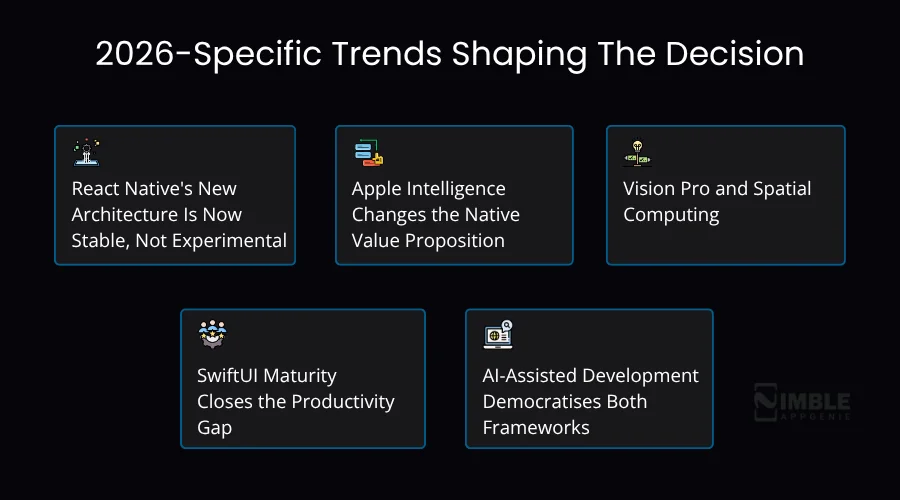
1. React Native’s New Architecture Is Now Stable, Not Experimental
React Native 0.76+ ships with the New Architecture enabled by default. This is no longer an opt-in experiment or a beta feature.
The React Native new architecture in 2026 means the performance influences that dominated the 2020-2023 debate have significantly decreased. An iOS app development framework comparison that cites the old bridge architecture as a React Native weakness is outdated.
2. Apple Intelligence Changes the Native Value Proposition
Apple Intelligence – Apple’s on-device AI automation layer is extremely embedded in iOS 18 and beyond. Actions, writing intents, and extensions for Apple Intelligence are right now a Swift-first experience.
React Native developers can easily access some of these APIs through community bridges, but Swift offers day-one access to new APIs.
If your app’s roadmap embraces AI-powered features that interact with the system level – writing tools, summarization, App intents, and smart replies, here the Swift’s advantage is significant this year.
3. Vision Pro and Spatial Computing
Apple Vision Pro showcases a completely new computing paradigm, and it is Swift-only.
If your product roadmap includes any spatial computing ambitions, even exploratory ones, developing your iOS foundation in Swift means a natural extension path to visionOS. React Native’s visionOS support is promising.
4. SwiftUI Maturity Closes the Productivity Gap
SwiftUI maturity 2026 means native iOS development is swifter than it was in 2020. The days of choosing UIKit again for missing SwiftUI components are over.
It shrinks the development speed benefit that React Native held, though it doesn’t entirely remove it, specifically for cross-platform development.
5. AI-Assisted Development Democratises Both Frameworks
AI coding tools (including GitHub Copilot, Claude Code, and others) have enhanced developer productivity across React Native and Swift significantly. The blockage to entry for Swift has been eliminated as AI assistance helps junior developers write more casual Swift.
This partially balances the talent-availability advantage that React Native had, though the wider hiring pool for JavaScript developers remains a real advantage.
How Nimble AppGenie Can Help You Build the Right iOS App?
Choosing between React Native and Swift is not chiefly a technical question – it’s a business and product strategy question.
The answer modifies depending on your roadmap, runway, and what you are actually trying to create.
We have been through this decision hundreds of times, and the first thing we do is help our clients see it clearly.
What you will see when partnering with us as your iOS app development company.
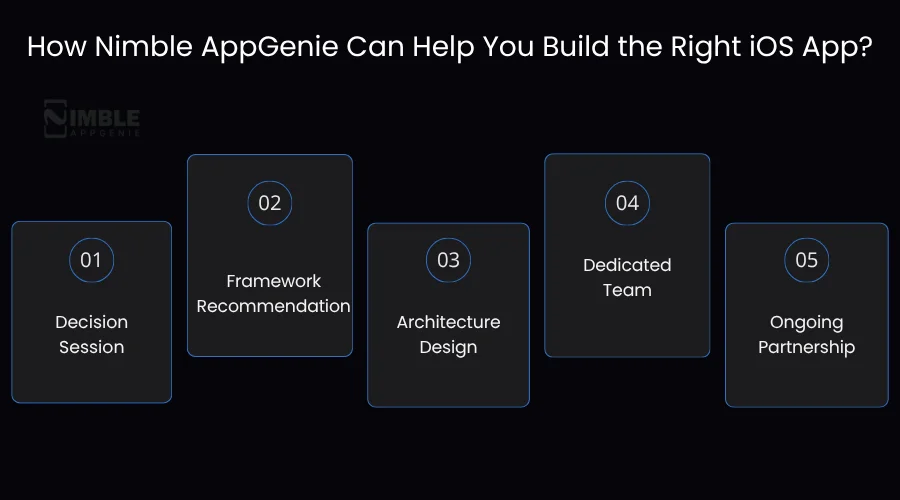
► Decision Session
We begin with your product objectives, not any tech preferences. We ask about your monetization model, user expectations, timeline, and growth plans before we ever suggest a framework.
► Framework Recommendation
Based on your discovery, we offer you a direct recommendation – React Native, Swift, or a defined hybrid with a transparent rationale you can present to your investors or board.
► Architecture Design
We craft the technical architecture before we begin developing. This is where the difference between a $150K app and a $300K app often lives, making the accurate structural decisions early.
► Dedicated Team
We assign a team with the right skills for your chosen approach. Our Swift developers are active in the Apple developer community. Our React Native team contributes to open-source packages used by thousands of applications globally.
► Ongoing Partnership
We stay connected after launch. We provide post-launch support, scale-up architecture guidance, and performance monitoring as your user base expands.
| Our Track Record:- 350+ apps built. Clients include funded startups, fast-growing consumer brands, and FTSE-listed enterprises. We have shipped apps in healthtech, fintech, e-commerce, logistics, edtech, and social categories, using both Swift and React Native, based on what each product actually needed. |
Ready to start? Book a free 30-minute iOS strategy call with Nimble AppGenie. We will tell you which framework fits your product, honestly, not commercially.

Conclusion
Swift vs React Native for iOS Development? Well, both are excellent frameworks. The question is never which is better; it is which is better for what you are building with your existing team and the objectives you want to hit.
If you are developing an iOS-only premium product that needs to push Apple hardware, integrate with native APIs on day one, or meet enterprise-grade needs, Swift and SwiftUI.
If you are a startup that wants iOS and Android, spend its budget on product rather than on platform overhead, and move fast – React Native with the New Architecture delivers exact quality that was impossible three years ago.
And if your application sits somewhere in the middle, which various real-world apps do, the hybrid approach offers you both. The iOS development frameworks comparison only gets challenging when you are trying to apply a universal answer to a specific product.
Stop doing that, and witness the right call becoming clear.
Contact Nimble AppGenie today for a free iOS strategy consultation. Tell us what you are building, and we will tell you how to build it right.
FAQs
Native iOS app development using Swift typically costs more than cross-platform alternatives because it requires a dedicated iOS development team and platform-specific expertise.
On average, the cost depends on complexity:
- Basic apps: $25,000 – $60,000
- Mid-level apps: $60,000 – $150,000
- Complex apps (fintech, health, real-time features): $150,000+
The higher cost comes from building specifically for iOS, deeper Apple ecosystem integration, and the need for experienced Swift developers. However, this investment delivers superior performance, security, and long-term scalability, especially for premium or enterprise-grade applications.
The timeline for iOS development varies based on features, design complexity, and integrations.
Typical timelines are:
- Simple apps: 3-5 months
- Moderate apps: 4-8 months
- Complex apps: 8-18+ months
Using Swift and SwiftUI can accelerate development compared to older UIKit-based approaches, but native development still takes longer than cross-platform frameworks when building for both iOS and Android separately. For startups, timelines can be reduced by prioritizing an MVP and scaling features post-launch.
Swift is the best choice when your app requires deep integration with Apple’s ecosystem, high performance, or a premium user experience.
You should choose Swift when:
- Your app is iOS-only (or Apple ecosystem-focused).
- You need high performance (AR/VR, real-time processing, heavy animations).
- Your app handles sensitive data (fintech, healthcare, enterprise apps).
- You want a pixel-perfect, native iOS experience.
- You rely on Apple frameworks like ARKit, CoreML, HealthKit, or Apple Pay.
- You need day-one access to new Apple features.
In short, Swift is ideal when performance, security, and Apple-native capabilities are central to your product, not optional.

Niketan Sharma, CTO, Nimble AppGenie, is a tech enthusiast with more than a decade of experience in delivering high-value solutions that allow a brand to penetrate the market easily. With a strong hold on mobile app development, he is actively working to help businesses identify the potential of digital transformation by sharing insightful statistics, guides & blogs.
Table of Contents




No Comments
Comments are closed.