

 Free Consultation
 PCI-DSS Compliant
 GDPR Ready
 ISO 27001
 NDA Protected
 AI Services
 AI App Development
 Generative AI Development
 AI Chatbot Development
 AI Integration Services
 AI Consulting Services
 AI For Fintech
 AI Financial Assistant Solution
 AI Insurance Agent Development
 Tech Stack
 OpenAI / GPT-4
 Claude / Anthropic
 Gemini / Google AI
 Llama / Open Source
 LangChain / LlamaIndex
 Pinecone / Pgvector
 AWS / Azure AI


 Fintech Solution
 Core Fintech
 App Development
 Neobank Solutions
 eWallet Solutions
 Lending Software
 Banking Solutions
 BNPL Solutions
 BNPL Solutions
 Insurance App
 Wealth Management
 Crypto & DeFi
 Blockchain Development
  Payroll Software
 DeFi Solutions
 Crypto Wallet
 Crypto On/Off Ramp
 Crypto Exchange
 Trading Platform
 Payments
 Compliance
 Regulations & Compliance
 Fraud Detection
 Lending Ecosystem
 P2P Lending Platform
 Mortgage Software
 Engagement
 Fintech Outsourcing

 Mobile Development
 Mobile App Dev
 iOS App Development
 Android App Development
 React Native
 Flutter Development
 Web Solution
 Node.js Development
 React.js Development
 Angular Development
 App Services
 UI/UX Design
 App Maintenance
 By Stage
 MVP Development
 Industry Solutions
 Healthcare App Dev
 Education App Dev
 Travel App Dev
 Real Estate App Dev
 Logistics Software
 Social Media App

 Hire Mobile Developers
 Hire iPhone Developers
 Hire Android Developers
 Hire React Native Devs
 Hire Flutter Developers
 Hire Web Developers
 Hire Node.js Developers
 Hire Angular Developers
 Hire PHP Developers
 Hire Laravel Developers
 How It Works
 Pre-Vetted Developers
 Ready In 48 Hours
 NDA From Day One
 Replace Guarantee
 Company
 About Us
 Our Work Process
 Portfolio
 Case Studies
 Blog / Insights
 Careers
 Contact Us
 Awards
 Recognition


 Offices



In a Nutshell
- The role of Backend as a Service for Business Apps is to manage data, users, APIs, and scalability for smooth app operations.
- BaaS helps businesses launch apps faster by reducing backend complexity and development time.
- It reduces DevOps dependency by removing the need for a full infrastructure management team.
- Enables modern features like real-time updates, notifications, and AI-driven capabilities that manage users’ seamless journey with the app.
- Businesses must consider challenges like vendor lock-in, cost scaling, and limited customization.
- Nimble AppGenie helps businesses choose the right backend approach and build scalable applications.
If you own a business and are thinking of entering the app world, then understanding the fundamentals will protect you from fraud and losing your resources to an unskilled person.
Backend as a Service is one of the important fundamental concepts that will help you to evaluate why you need to adopt this platform for your business.
BaaS is an important concept that helps developers to focus on frontend code and user experience, and accelerates development by scaling efforts.
In this guide to backend as a service, we will discuss the complete role of backend as a service for business apps, along with its working process, benefits, and demerits. It will help you to clarify whether you should use BaaS for your next app or not.
Let’s proceed together with this backend as a service guide for businesses.
What is Backend as a Service (BaaS)?
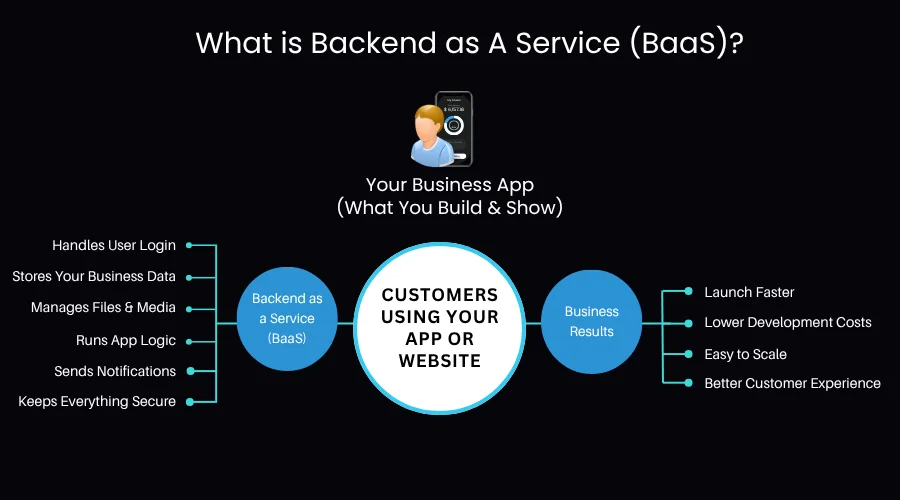
Backend as a Service (BaaS) is a cloud computing model in which developers outsource server-side infrastructure, including authentication, databases, and API management, to a service provider.
The key features of BaaS are:
- Database Management
- User Authentication
- Cloud Storage
- APIs Management
- SDK Management
- Push Notifications
- Real-Time Data Sync
- Security and Data Protection
- Scalability
- Server functions
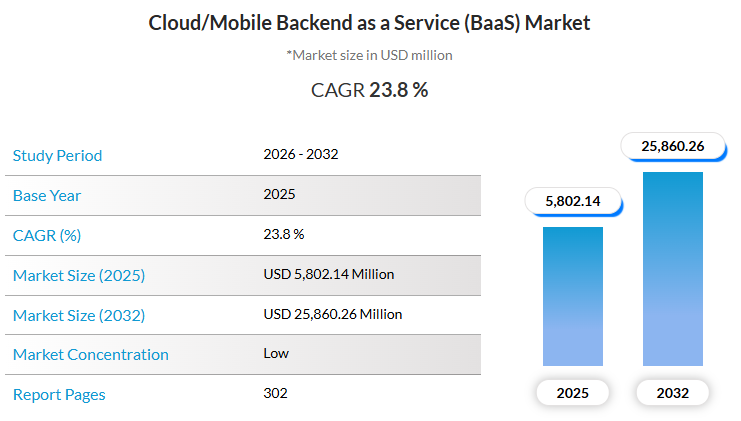
Additionally, the global cloud mobile backend as a service (BaaS)market size was estimated at USD 5,802.14 million in 2025 and is projected to reach USD 25,860.26 million by 2032, growing at a CAGR of 23.8%.
Hence, there is a great opportunity for you as a business to build your next app on BaaS.
This might seems you complicated to understand, right?
Relax!
We can make it simple to understand.
Think BaaS is like a MasterChef’s kitchen, where every professional chef has to cook a different dish.
Hence, for every dish, these professionals require different ingredients, but they already have a ready-made or MasterChef’s kitchen where they can get all the ingredients in a simple way.
However, they still need to cook with different ingredients to deliver a seamless service to their customers.
Similarly, BaaS acts as an effective platform to provide those services that enable developers to write server-side code in a single platform, where they can use the services as much as they can and then develop the app’s unique requirements.
And now, the only job left is to write the required logic for your application, which will interact with the users. Here, you need to hire mobile app developers for your business application.
This service allows the developers to focus on the frontend code and user experience, fostering the development process, reducing DevOps, server maintenance, and scaling efforts.
Why Traditional Backend Development Slows Down Businesses?
Traditional backend development is all about creating and writing code and building the whole backend manually. This is a type of development that slows down businesses by creating technical bottlenecks and increasing time to market.
Here are some of the reasons you can relate to as a business:
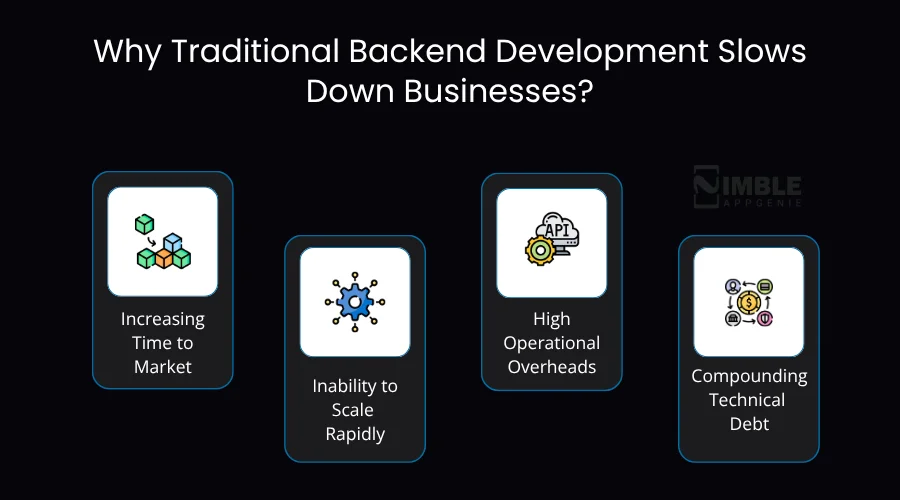
► Increasing Time to Market
A traditional backend development system requires more time to market, as here the code is run manually and is subject to contention. Its inability to scale efficiently further leads to sluggish performance of the app.
► Inability to Scale Rapidly
Another important issue that you might face in traditional backend development is their inability to scale quickly with the latest technologies and ecosystem. A poorly designed database structure can create issues when traffic increases.
► High Operational Overheads
For traditional backend systems, you will be bound to pay extra for every feature, whether it’s integrating a cloud server, building an API, adding a DB, or provisioning servers for managing the Kubernetes clusters, rather than focusing on the product.
Businesses that require greater control over their infrastructure often choose cloud hosting to support custom backend deployments, Kubernetes environments, and long-term application scalability.
► Compounding Technical Debt
If you have once used the traditional backend system, you must be well aware of how clumsy it gets when it comes to maintenance. Here, architecture remains unsuitable, which will force you to rewrite the application.
Additionally, without any built- in security, the traditional backend system will increase your overall cost to build a mobile app.
Now, are you ready to switch to BaaS?
Well, then, first understand how it works in the following section.
How Backend as a Service Works?
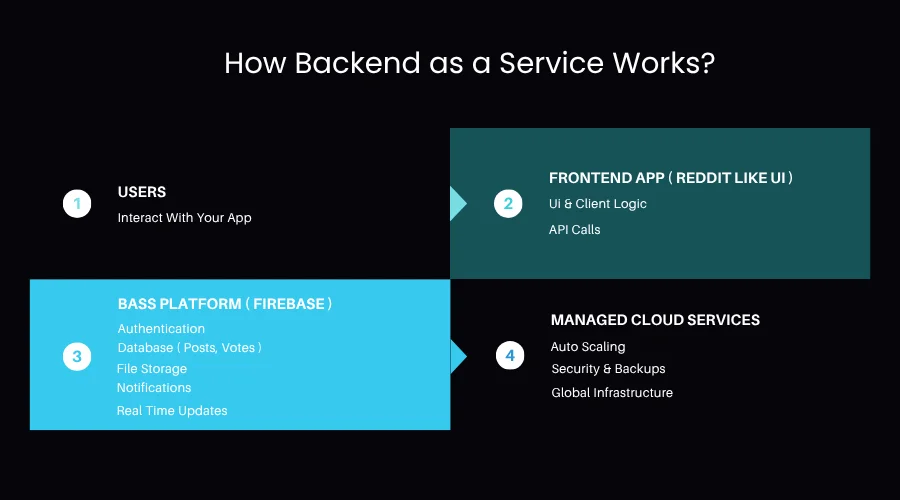
The process of Backend as a Service begins when a developer signs up for a BaaS provider such as Firebase. Then proceed with app integration, follow client requests, opt for automated processing, and scale automatically.
Here’s a step-by-step workflow of Backend as a Service:
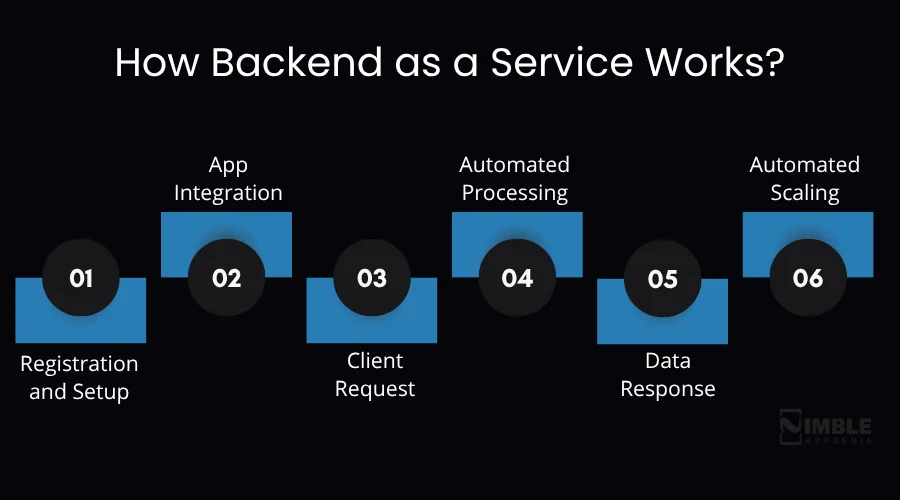
1. Registration and Setup
In the early stage, the developer logs in to a BaaS provider and creates the complete project. Then, this platform automatically provisions the initial infrastructure, which comprises a database and an authentication layer.
2. App Integration
The developer adds the provider’s software development kit (SDK) to their mobile apps. This SDK contains pre-written libraries and allows the frontend to talk to the backend.
3. Client Request
When a user interacts with your app, the frontend sends information to an API gateway. This request is sent to the API via a server that is pre-built on the BaaS platform.
4. Automated Processing
Then the BaaS platform receives the request and triggers its pre-built internal services to fulfil the request. The types of requests differ, such as verifying a password or uploading a file.
5. Data Response
Once the task is finished, the platform then sends a request back to the app with the result. This result gets updated in real-time on the user’s screen.
6. Automated Scaling
When the app gains more users, the provider automatically allocates more server resources for managing and handling the growing traffic.
Let’s have a simple business flow diagram to clearly understand the working process of BaaS, and take an example of an app like Reddit.
Well, if you have understood the use of BaaS, let’s evaluate whether it’s helpful in the following section.
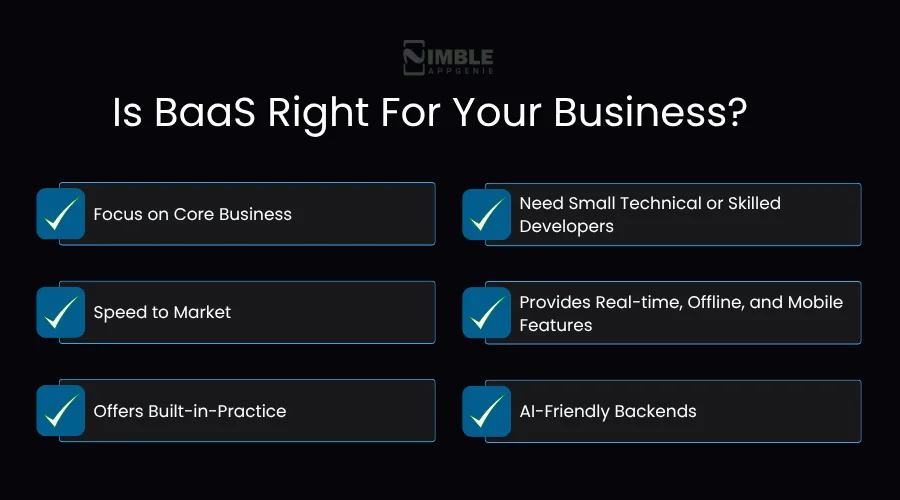
Is BaaS Right For Your Business?
Yes, BaaS is valid for any type of industry and business. To build a mobile app, you should know how!
Let’s discover the complete set of benefits for using BaaS for businesses:
♦ Focus on Core Business
Once you opt for BaaS, you can focus on the core functionalities of your business. This platform will help you to outsource the standardized, complex technical tasks to the server-side development.
♦ Speed to Market
Do you know that most of the apps fail because they never get in front of the users? This is where BaaS comes into the picture. It compresses the distance between the idea and the shipped MVP. Here, your project begins with a running database, an auth system, and HTTPS APIs.
♦ Offers Built-in-Practice
BaaS provides built-in practice for your app through offering a pre-built, managed, and standardized backend infrastructure that helps developers skip any tedious processes. This platform offers you built-in modules for handling and managing the routine tasks.
♦ Need Small Technical or Skilled Developers
Here, you do not need to hire a complete DevOps team, but you still need a small technical team that can manage the integrations between services, monitor performance, and handle complex deployments. Also, they should optimize database usage, ensure mobile app data security, and plan migrations if required.
♦ Provides Real-Time, Offline, and Mobile Features
Modern users do expect live data as well as cross-device continuity. Several BaaS platforms do provide real-time subscriptions, built-in push notifications for iOS and Android, as well as offline-first syncing so that the mobile keeps working.
♦ AI-Friendly Backends
With BaaS, you can ensure the adoption of AI-friendly platforms, frameworks, and even architectural styles that are designed to speed up the development processes and allow an AI coding agent to simply generate, manage, and understand the database schemas.
Bonus Read: AI Technology for Automated Mobile App Development
Additionally, BaaS offers security, convenience, ease of recovery, and affordability.
After discussing the benefits, let’s proceed with the role of BaaS for businesses.
Role of Backend as a Service For Business Apps
The key roles of backend as a service is it stores and manage business data, help in application logic execution, opt for a notification engine, and help in real-time data synchronization.
Let’s discuss in detail what is the role of backend as a service for businesses.
➤ Manages and Stores Business Data
Backend as a service manages and stores the complete data through leveraging a third-party managed cloud infrastructure. Further, it automates the entire backend process by replacing manual backups.
➤ User Identity Management
Backend as a service helps to manage user identity by providing a secure, compliant infrastructure with pre-built functionality that simplifies the tasks of user identity.
➤ Application Logic Execution
This platform helps in application logic execution by providing developers to offload server-side tasks, enabling faster development and automating scalability for traffic.
➤ Helps in Real-Time Data Synchronization
With the help of BaaS, your target users can enjoy real-time data. It helps in automating data changes from the server to all connected clients. It helps developers to manually build and maintain complex communication layers and resolve conflicts.
➤ File and Media Sharing
Backend as a Service (BaaS) helps in managing the storage and delivery of images, videos, and documents securely. This platform handles the complex tasks of storing, processing, and distributing large assets successfully.
➤ API Provider
This platform acts as an API provider and a bridge between the frontend apps and backend systems. It exposes a suite of pre-built and managed backend services such as user authentication, databases, and storage.
➤ Scalability Manager
Through the scalability manager in BaaS, the developers can automatically adjust resources that are based on user demand. It helps to automate the complex infrastructure adjustments that are required to handle overall app growth.
Well, if you are still confused about whether to use BaaS or not, then let’s explore some of the popular examples that have used BaaS and have built an efficient application, leading the competitive landscape.
Real World Examples: How Popular Apps Use BaaS?
To complete trust in BaaS, you should evaluate some of the best mobile apps that have used BaaS and have an attractive user base.
Let’s have a handful of examples in the given table:
| App | How BaaS is Used | Business Impact |
| Used backend services (early on via cloud platforms) for storing photos, user data, and scaling quickly. | Rapid growth without heavy infrastructure investment. | |
| Uber | Uses real-time databases, notifications, and cloud backend services (BaaS-like) for live tracking and matching riders. | Seamless real-time experience for millions of users. |
| Relied on scalable backend infrastructure and real-time messaging systems (similar to BaaS concepts). | Extremely fast and reliable global messaging. | |
| Airbnb | Uses cloud backend services for user data, bookings, payments, and storage. | Efficient handling of global listings and transactions. |
| Duolingo | Uses managed backend services for user progress tracking, notifications, and data storage. | Personalized learning at scale with low infrastructure overhead. |
Well, if you are ready to go for Backend as a Service, then let’s look at how the integration of AI is taking BaaS to the next level.
How AI is Reshaping BaaS?
Artificial intelligence is reshaping the BaaS by fundamentally transforming the static set of tools into intelligent and proactive systems.
This system automates the database management, API development, optimizes resource infrastructure scaling, and accelerates the complete development process.
- Smarter Backend Automation: AI handles tasks like database optimization, scaling, and error detection automatically.
- Built-in Intelligence: BaaS platforms now offer AI features (recommendations, chatbots, predictions) without extra development.
- Faster App Development: AI tools generate backend logic, APIs, and workflows, reducing development time.
- Better User Personalization: AI analyzes user behavior to deliver customized content and experiences.
- Predictive Scaling & Cost Control: AI forecasts traffic and optimizes resource usage to reduce costs.
- Enhanced Security: AI detects unusual activity and potential threats in real time.
Now, the next question is how businesses can connect with these platforms.
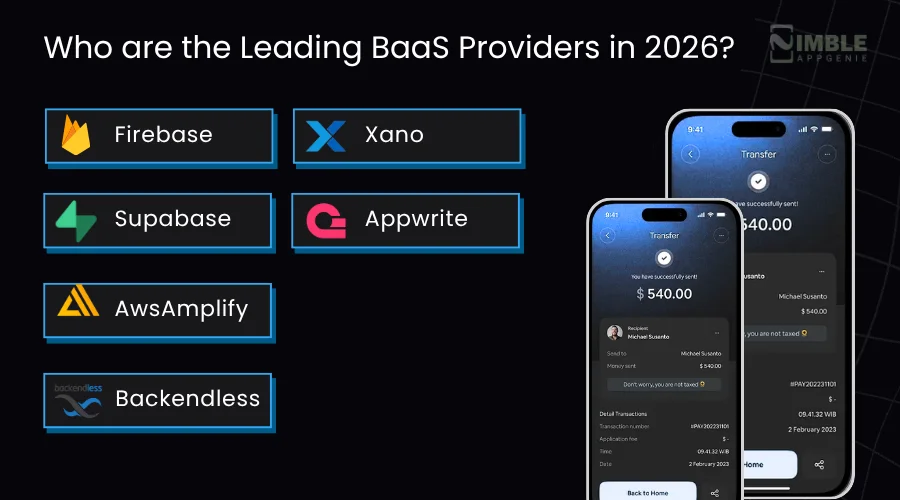
Who Are the Leading BaaS Providers in 2026?
The leading BaaS providers are Firebase, Supabase, AWS Amplify, Appwrite, Backendless, and Xano.
Let’s learn more about them in this guide to use the backend as a Service below:
► Firebase
Firebase is a comprehensive Google backend mobile and web application development platform that provides a serverless backend-as-a-service (BaaS). This platform helps you to build an enriched, collaborative application that allows secure access to the database.
► Supabase
Supabase is a leading Backend as a Service (BaaS) platform that is built on PostgreSQL. Designed as a developer-friendly platform. This platform provides instant managed APIs, real-time subscription, and file storage, which helps developers build scalable apps without managing servers.
► AWS Amplify
AWS Amplify helps to deploy server-side rendered and static frontend apps, add features like auth and storage, scale apps, and connect to real-time data sources. Here, you should deploy an app frontend with easy Git-based workflows to support any server-side web framework.
► Appwrite
Appwrite is a secure BaaS platform that helps developers to develop, design, and help developers to build web, mobile, and backend applications faster. This platform do provides a pre-build services such as user authentication, database management, as well as serverless functions.
► Backendless
Backendless is a visual app development platform (VADP) as well as a BaaS that helps developers to build web and mobile apps without engaging in managing server infrastructure. This platform offers a codeless approach for app development.
► Xano
Xano is a no-code platform that allows developers to build scalable server-side apps, APIs, and databases to build robust apps, featuring a managed PostgreSQL API builder, and even a business logic editor.
When you switch to BaaS from a traditional backend system to design your app, there are some of the barriers that you should be aware of.
The next section discusses the same.
What Are the Challenges in Choosing a BaaS?
The key challenges for choosing a BaaS are cost unpredictability, limited customization, a learning curve, and integration limitations.
- Vendor Lock-in: Difficult to migrate your app and data to another platform later.
- Limited Customization: Not ideal for highly complex or unique backend requirements. This can also be a mobile app development challenge for your app.
- Cost Unpredictability: Pricing can increase significantly as your user base grows.
- Performance Limitations: May not handle very high-scale or specialized workloads efficiently.
- Security & Compliance Concerns: Less control over data handling and regulatory requirements.
- Dependency on Provider: Outages or changes from the provider directly impact your app.
- Integration Limitations: Challenges when connecting with other tools or legacy systems.
- Learning Curve: Teams must adapt to the specific platform’s way of working.
Well, if you still find it difficult to adopt BaaS, connect with the experts.
How Nimble AppGenie Can Help Build Smarter and Faster Apps?
Nimble AppGenie is a leading mobile app development company that offers solutions such as building apps, designing apps, and even maintaining apps.
Our developers are tech professionals who know well if there is a need for BaaS for your platform or if it should be built as per traditional backend processes.
You can discuss your complete business project with our experts, and we are pleased to help you in every aspect of either building a complete backend for your app or creating your app via BaaS. We are ready to discuss with you what BaaS will do for your app and how you can scale your app if you are stuck with a traditional backend.
Connect with our team for more information and discuss your idea for free.
Conclusion
Backend as a Service (BaaS) is transforming how businesses build and scale applications by removing the complexity of backend infrastructure. It enables faster time to market, reduces dependency on large DevOps teams, and allows businesses to focus on delivering better user experiences.
With features like real-time data sync, authentication, and scalability, BaaS simplifies app development while supporting growth. However, businesses must also consider challenges like vendor lock-in and cost scalability.
As AI continues to enhance BaaS capabilities, it is becoming a powerful solution for modern apps, helping businesses stay competitive, agile, and efficient in an increasingly digital landscape.
FAQs

Madan is the Backend Solutions Architect at Nimble AppGenie, specializing in the design of secure, high-concurrency systems that power complex mobile ecosystems. With deep expertise in server-side logic and database management, he ensures every platform is built with enterprise-grade security. In his free time, he is an avid researcher of emerging technologies; he spends his time deconstructing the latest backend frameworks and reading technical papers to ensure our solutions remain at the absolute forefront of industry innovation.
Table of Contents




No Comments
Comments are closed.