

 Free Consultation
 PCI-DSS Compliant
 GDPR Ready
 ISO 27001
 NDA Protected
 AI Services
 AI App Development
 Generative AI Development
 AI Chatbot Development
 AI Integration Services
 AI Consulting Services
 AI For Fintech
 AI Financial Assistant Solution
 AI Insurance Agent Development
 Tech Stack
 OpenAI / GPT-4
 Claude / Anthropic
 Gemini / Google AI
 Llama / Open Source
 LangChain / LlamaIndex
 Pinecone / Pgvector
 AWS / Azure AI


 Fintech Solution
 Core Fintech
 App Development
 Neobank Solutions
 eWallet Solutions
 Lending Software
 Banking Solutions
 BNPL Solutions
 BNPL Solutions
 Insurance App
 Wealth Management
 Crypto & DeFi
 Blockchain Development
  Payroll Software
 DeFi Solutions
 Crypto Wallet
 Crypto On/Off Ramp
 Crypto Exchange
 Trading Platform
 Payments
 Compliance
 Regulations & Compliance
 Fraud Detection
 Lending Ecosystem
 P2P Lending Platform
 Mortgage Software
 Engagement
 Fintech Outsourcing

 Mobile Development
 Mobile App Dev
 iOS App Development
 Android App Development
 React Native
 Flutter Development
 Web Solution
 Node.js Development
 React.js Development
 Angular Development
 App Services
 UI/UX Design
 App Maintenance
 By Stage
 MVP Development
 Industry Solutions
 Healthcare App Dev
 Education App Dev
 Travel App Dev
 Real Estate App Dev
 Logistics Software
 Social Media App

 Hire Mobile Developers
 Hire iPhone Developers
 Hire Android Developers
 Hire React Native Devs
 Hire Flutter Developers
 Hire Web Developers
 Hire Node.js Developers
 Hire Angular Developers
 Hire PHP Developers
 Hire Laravel Developers
 How It Works
 Pre-Vetted Developers
 Ready In 48 Hours
 NDA From Day One
 Replace Guarantee
 Company
 About Us
 Our Work Process
 Portfolio
 Case Studies
 Blog / Insights
 Careers
 Contact Us
 Awards
 Recognition


 Offices



Key Takeaways:
- Remote software developers are reshaping how companies build products, with the market expected to reach $1.1T+ by 2027.
- Hiring locally is slow (4–6 months) and expensive ($200K–$350K+ per developer annually).
- Hiring remote developers reduces costs by 40–75% and cuts hiring time to 2–4 weeks.
- You get access to a global talent pool of 28.7M developers, not just local candidates.
- Top companies like Google, Zapier, and Doist already use distributed teams at scale. Remote teams offer faster scaling, better flexibility, and lower overhead costs. They can ship products 20–30% faster with async workflows and better documentation.
- Nimble AppGenie offers vetted developers, ISO processes, and 95%+ retention. You get dedicated managers, SLA-backed delivery, and fixed pricing.
The global software development market is predicted to outshine at around $578.20 billion in 2026 and will likely reach $1,148 billion by 2027.
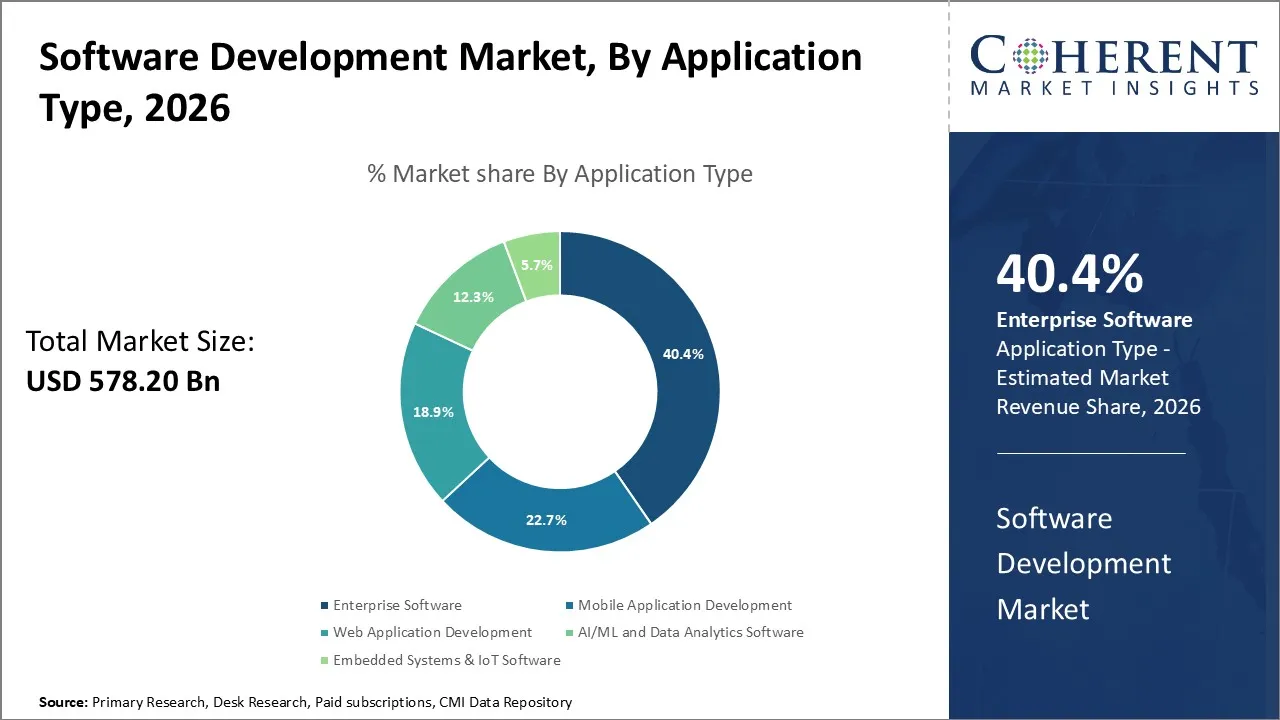
This growth is not concerning bigger budgets; it’s basically reshaping how companies build software. The catalyst? Remote software developers.
Why Top Companies Are Hiring Remote Developers Right Now?
Suppose you have a product vision and you need skilled developers. But local hiring takes 4 to 6 months and costs around $2000k+ per developer annually.
When you hire remote developers despite the slow and expensive local hiring:
- Onboarding takes 2-4 weeks,
- Costs are cut by 40-70%,
- You get access to a global pool of skilled software developers,
- Faster development cycles,
- Flexible scaling, and
- Zero overhead for infrastructure or office space.
Global tech leaders are well aware of this reality:
- Google: 50%+ distributed workforce
- Facebook: Pioneered remote hiring
- Buffer: 100+ employees, 15+ countries
- Zapier: $5B+ company, fully distributed
- Doist (Todoist): 100% distributed, 40+ countries
Turning back pages, during the 2008 financial crisis, this was considered a cost-cutting measure, and today it has evolved as a strategic competitive advantage.
This guide shows you exactly how to hire remote developers and manage them.
Why Hire Remote Developers? The Business Case
You save overhead costs, get access to a global talent pool, and accelerate development.
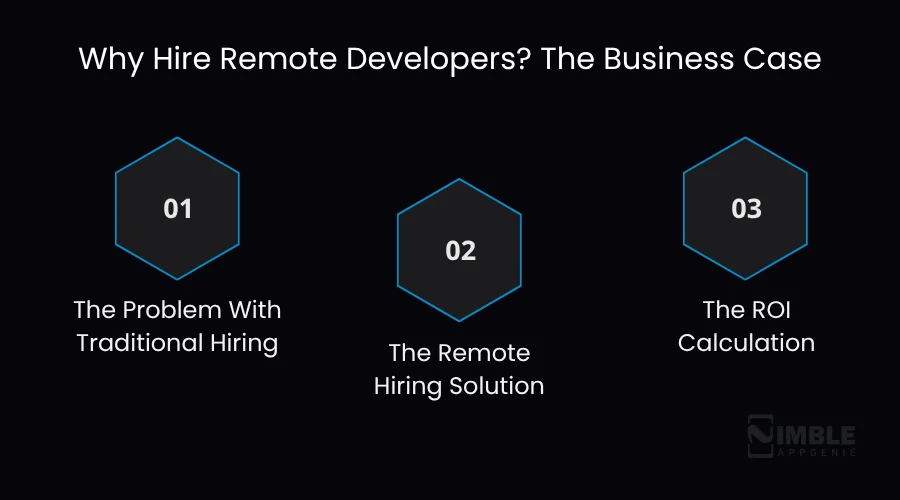
► The Problem With Traditional Hiring
The concept of local hiring doesn’t make any sense:
- 6-month recruitment cycle: You post a job, you interview, and you negotiate. You wait for notice periods, and your roadmap slips.
- $200K-$350K/year per developer: Senior developers in SF, NYC, and London expect six-figure salaries. Add benefits, taxes, and office space. Burn rate climbs.
- Limited talent pool: Your city has 50-100 qualified developers. 28.7 million exist worldwide. You compete for leftovers.
- Geographic limitations: The best developer for your project might live 3,000 miles away, and local-only hiring means you miss them.
High turnover risk: Every hire is one market shift away from a competitor offer. Retention is expensive.
► The Remote Hiring Solution
Hiring remote developers flips every limitation into an advantage:
- Hire in 2-4 weeks: Save 6 months. Vetting to hire dedicated development teams takes 2-4 weeks from the first call to a signed contract.
- 60-75 percent cost savings: Senior dev SF: $250K/year. Same dev from Eastern Europe: $60-90K/year. Same quality at 1/3 the cost.
- Access 28.7 million developers: No geographic limits and free to hire the perfect specialist for your stack, regardless of location.
- Faster scaling: Need 3 developers, then hire 3. Need 10 in 3 months, then scale without office constraints.
- Better retention: Remote devs are 22 percent more likely to stay 3+ years. They control the environment and avoid commutes.
► The ROI Calculation
Suppose you want to hire a remote development team of 5 people for over 12 months:
| Model | Year 1 Cost (Approx.) | Time to Full Team |
| Local Hiring (SF) | $1,250,000 + overhead | 16-20 months |
| Remote Development Team | $400,000-$500,000 | 4-6 weeks |
Savings: $750,000 in Year 1 that you can reinvest in product, marketing, and sales.
Benefits of Hiring Remote Software Development Teams
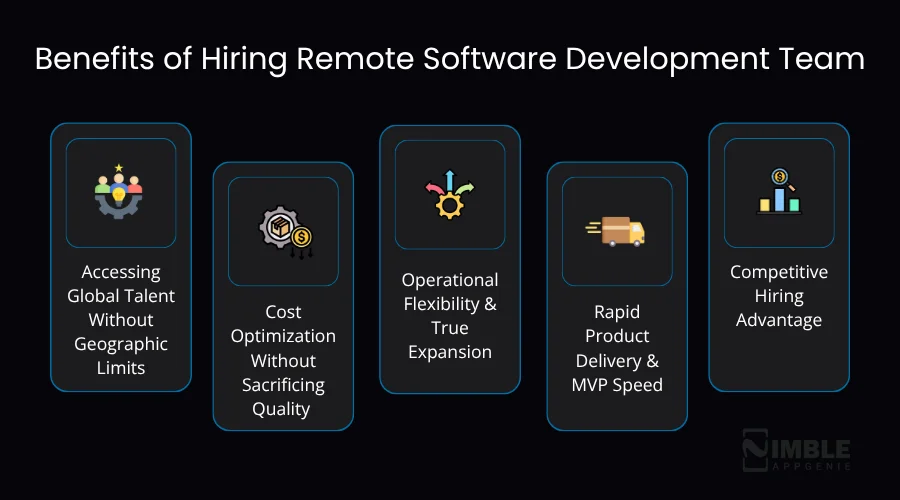
1. Accessing Global Talent Without Geographic Limits
The remote development teams resolve the talent pool constraint at first.
In the United States, there are about 4.4 million software developers. But worldwide, there are 28.7 million software developers.
More essentially, they are distributed:
- Eastern Europe (Poland, Romania, Ukraine): 680,000 developers, high English proficiency
- India: 5.2 million developers, diverse skill specializations
- Southeast Asia (Vietnam, Philippines, Thailand): 1.2 million developers, rising specialization
- Latin America (Brazil, Mexico, Colombia): 890,000 developers, favorable time zones for US companies
2. Cost Optimization Without Sacrificing Quality
Here, the match becomes compelling. The real cost comparison for mid-level developers with 5-7 years of experience:
| Region | Monthly Cost (Approx.) | Annual Cost (Approx.) | Annual Savings vs. U.S. |
| San Francisco, US | $20,800 | $249,600 | Baseline |
| Austin, US | $16,900 | $202,800 | 19% savings |
| Toronto, Canada | $15,400 | $184,800 | 26% savings |
| London, UK | $14,200 | $170,400 | 32% savings |
| Berlin, Germany | $12,100 | $145,200 | 42% savings |
| Warsaw, Poland | $9,800 | $117,600 | 53% savings |
| Prague, Czech Republic | $9,200 | $110,400 | 56% savings |
| Bangalore, India | $4,500 | $54,000 | 78% savings |
| Ho Chi Minh, Vietnam | $3,800 | $45,600 | 82% savings |
3. Operational Flexibility & True Expansion
Traditional hiring moves in steps – like if you need 3 developers, you hire 3. In 6 months, if you need 2 more, it creates hiring inertia and uneven growth.
A remote team for software development enables granular scaling, such as:
- Adding one specialist contractor from Bulgaria for 3 months.
- Bringing in a technical writer from Canada for 6 weeks.
- Hiring a part-time DevOps engineer from Singapore.
- Staffing up for a specific sprint without permanent headcount.

4. Rapid Product Delivery & MVP Speed
Distributed teams of experienced remote developers ship faster than your expectations. Usually, they ship 20-30% faster than co-located teams performing on the same project.
Why? Because:
- Better Documentation: The decision documentation needs improvement. This diminishes context-switching.
For example, when a new developer joins, they go through 3 pages of architecture decisions smoothly without wasting 2 weeks in person-to-person knowledge transfer.
- Fewer Synchronous Meetings: Co-located teams have to bear ‘meeting culture’, but a mature remote development team replaces these with async updates.
For example, a Slack message drops asking, ‘Why did you implement it this way?’ + async response takes 1 hour total. Whereas a meeting to discuss the same takes 30 minutes, and 8 developers means 4 hours lost.
- Reduced Context Switching: Remote developers aren’t disturbed by open-office noise because they can control their environment. They work in flow state – the state where developers write the most efficient code, which happens usually.
- Follow-the-Sun Development: Yes, a 24-hour development cycle is possible.
For example, a bug discovered at 4 PM in San Francisco is reviewed and resolved by engineers by midnight in Poland. In India, engineers test this fix when in San Francisco, the time was 8 AM. This is not science fiction; companies like Stripe and GitHub have mastered this model.
5. Competitive Hiring Advantage
- Diversity: With automatic geographic diversity, companies can create increased diverse perspectives and problem-solving approaches.
- Retention: Remote employees are 22% more likely to stay 3+ years.
Where and How to Hire Remote Developers?
You have three options to choose from: three hiring models to hire remote developers.
You have three options:
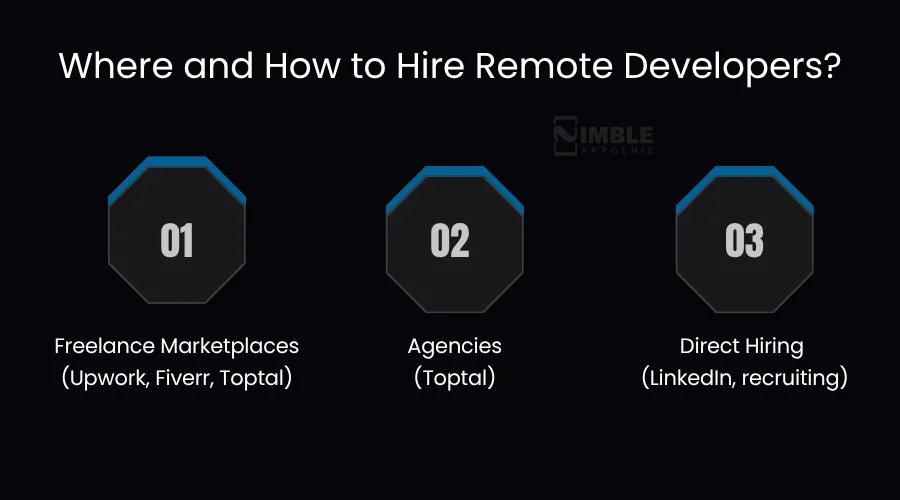
1. Freelance Marketplaces (Upwork, Fiverr, Toptal)
- Pros: Easy to find, quick turnaround
- Cons: High turnover, inconsistent quality, no accountability
- Best For: Small tasks, short projects
2. Agencies (Toptal)
- Pros: Vetted talent, quality guarantees, dedicated manager, SLAs
- Cons: Higher rates than freelancers, commitment-based
- Best For: Core team, long-term projects, 2+ year relationships
3. Direct Hiring (LinkedIn, Recruiting)
- Pros: Long-term employees, deep integration
- Cons: 6+ months of hiring, higher overhead
- Best For: CTO/VP roles, significant work
Why Nimble AppGenie Wins
| Factor | Freelance | Premium Agency | Nimble AppGenie |
| Vetting | Self-submitted | Top 3-5 percent | ISO certified, 350+ projects |
| Commitment | 20-30 percent context switching | Dedicated | Fully dedicated |
| Price | $20-80/hr | $60-150/hr | $30-60/hr |
| Delivery Success | 65-70 percent | 90-95 percent | 95 percent+ |
| Account Manager | Self-managed | Dedicated | Dedicated PM + Account Manager |
Note: We are not the cheapest. We offer the best value with 95% client retention.
How to Hire Remote Developers (Step-by-Step)
When you hire remote software development teams, the process doesn’t need to be complicated. All you need is the right structure, and you are good to move ahead from idea to execution in only a few weeks.
Here is a practical yet simple process:
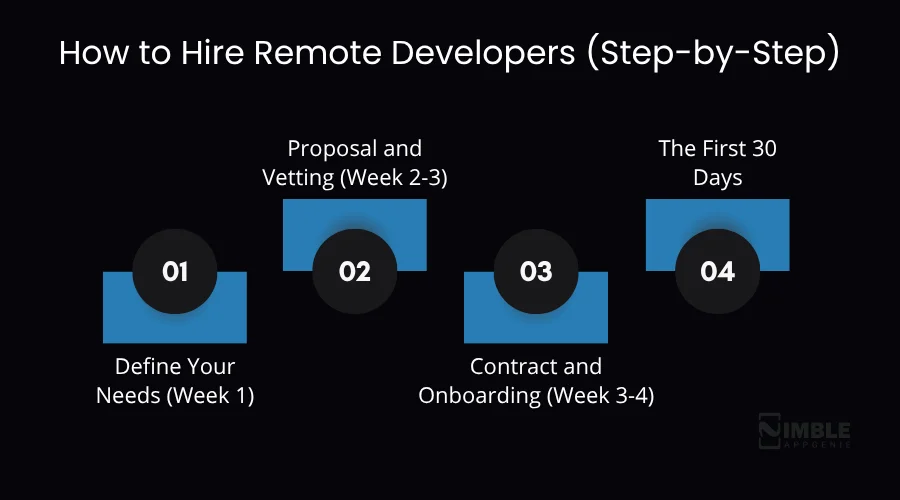
1. Define Your Needs (Week 1)
First, get clear on what you are seeking. This doesn’t mean it should be extremely detailed, just enough to guide the hiring process efficiently.
Think about:
- Your tech stack (React, Node, Python, Laravel, etc.)
- Experience level (junior, mid, or senior)
- Team size (one developer or an entire team)
- Project timeline and start date
- Engagement model (full-time, flexible, or project-based)
- Communication style (async or daily check-ins)
Tip: Put this into a short 1-page “Developer Brief.” It saves time later and keeps everyone aligned.
2. Proposal and Vetting (Week 2-3)
Once you have transparent requirements, the hiring partner can suggest a few best-fit candidates.
Typical Flow:
- You share your Developer Brief
- 2-3 pre-vetted developers are proposed
- You review their profiles and past work
- Conduct a short technical interview (optional but recommended)
While reviewing, you should look for their work consistency and relevance to your technology stack. Well, a quick 30 to 45 minute evaluation is generally enough to pick a strong fit.
3. Contract and Onboarding (Week 3-4)
After selecting your remote dev team, things move faster.
- Contracts and agreements are finalized.
- Background checks and NDAs are completed.
- Onboarding begins (usually within a few days)
When the remote developer starts contributing, like when they push their first PR within the first week, it’s a good sign that you opted for an efficient setup.
Meanwhile, your hiring partner manages admin tasks, such as compliance, HR, and payroll. So, you can stay focused on the product while running your software development company.
4. The First 30 Days
The first month is all about alignment and momentum.
- Week 1-2: Getting familiar with the codebase and workflows
- Week 3-4: Reaching near full productivity
- Regular async updates or quick standups help maintain clarity
- Weekly check-ins ensure everything stays on track
- Code reviews keep quality consistent
During this phase, clear communication makes a big difference. It helps the new remote software development team integrate swiftly and perform at their best.
When you hire a remote development team, it’s not just about filling a role; it’s about developing a system that allows you to scale efficiently.
Pro Tip: With a structured approach, you can diminish hiring time, maintain consistent quality, and start shipping rapidly.
Red Flags To Avoid While You Hire Remote Development Teams
When you know precisely what to avoid, you can make your decision to hire a remote software development team sound profitable.
Here are the most common reg flags with quick context for your ease on why they matter to be ignored.
10 Red Flags When Hiring Remote Developers –
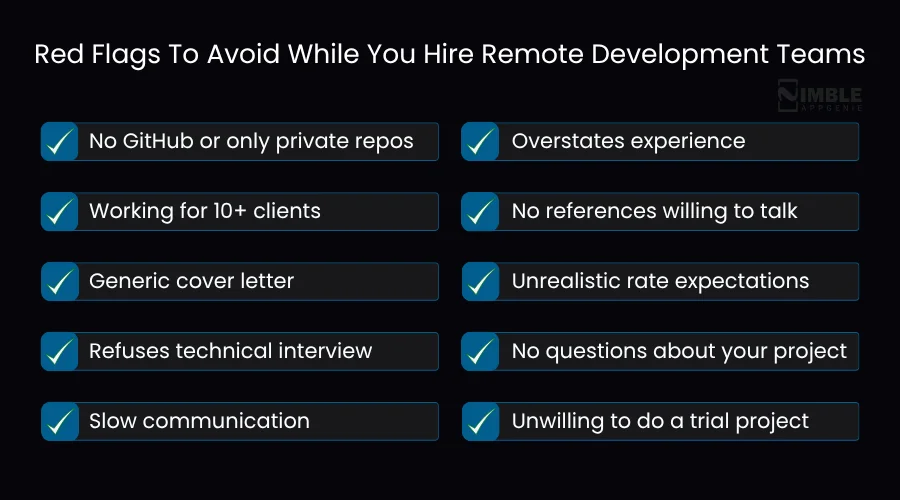
1. No GitHub or only Private Repos
You can’t have an actual way to evaluate their code quality or consistency if you don’t have visible code or contributions.
2. Working for 10+ Clients
Too many active clients typically means slower delivery, divided attention, and missed deadlines.
3. Generic Cover Letter
If you get a copy-paste response, it shows a lack of effort and signals that they are genuinely not interested in your software development project.
4. Refuses Technical Interview
When you overlook the technical evaluation, it usually indicates a lack of confidence and skill gaps.
5. Slow Communication
If you notice, they are taking 24+ hours to reply during hiring; expect even slower responses once they start working.
6. Overstates Experience
Inflated resumes can result in underperformance when actual work doesn’t fit claimed expertise.
7. No References Willing to Talk
A hesitance to share references may show poor, unreliable work history or poor past performance.
8. Unrealistic Rate Expectations
Too high or too low rates can create trust issues, quality concerns, and negotiation friction.
9. No Questions About Your Project
Lack of curiosity leads to low ownership. A good, dedicated web development team usually asks thoughtful, relevant questions.
10. Unwilling to do a Trial Project
Denying even a small test task can reveal fear of evaluation or low confidence.
How To Manage A Remote Development Team?
You can attain this by setting clear expectations, focusing on results over constant supervision, and communicating async-first.
Once you hire remote developer teams, your half job is done. Yes, the real success arrives when you know how to manage them.
When it comes to managing remote software developers, most companies struggle and fail. It’s not because of talent, but because of vague communication and no proper structure.
Let’s get deeper to know exactly how to manage a remote development team.
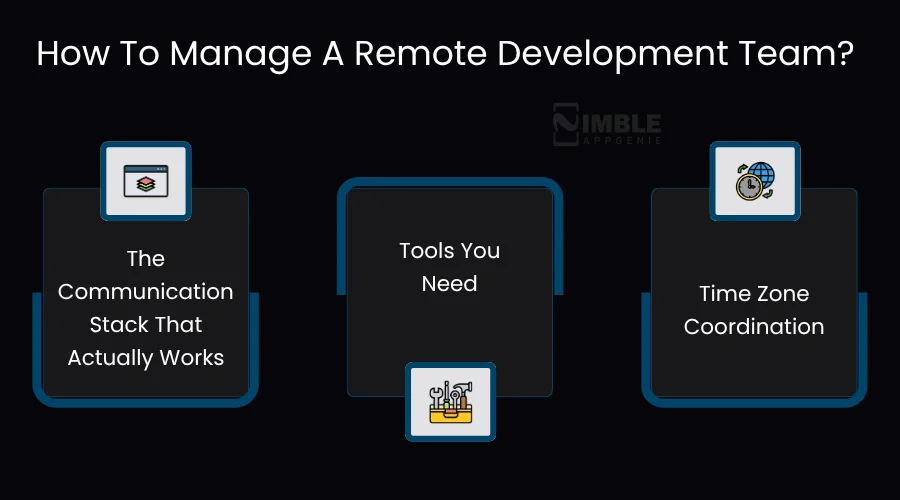
1. The Communication Stack That Actually Works
A robust remote setup is created on transparency and consistency, not regular meetings.
- Async-first, sync when necessary: Prioritize written communication to align everyone across time zones. Opt for calls only for blockers, onboarding, or important discussions.
- Daily async standups: Keep it simple: a fast update covering yesterday, blockers, and today. It creates accountability without wasting time.
- Weekly 1-on-1s (30 mins): Leverage this time for progress check-ins, feedback, and addressing concerns, not task updates.
- Code review for every PR: It ensures code quality, motivates knowledge sharing, and keeps all aligned on standards.
- Monthly retrospectives: Pause for a while to evaluate what’s working properly, what’s not, and what needs to change.
2. Tools You Need
You can make remote collaboration effortless with the right tools:
- GitHub / GitLab for code management and pull request reviews
- Jira / Asana for sprint planning and task tracking
- Slack for daily communication and async updates
- Google Drive / Notion for documentation and knowledge sharing
- Figma for design collaboration and clear specifications
3. Time Zone Coordination
It can be advantageous to work across time zones if managed well.
- Make async communication your default approach.
- Identify a 2–3 hour overlap window for real-time discussions\
- Set clear expectations (e.g., PR reviews within 24 hours)
- Use recorded videos for complex explanations instead of long calls
- Document everything – decisions, workflows, and architecture
What Not to Do:-
To save your remote setups from failing, don’t make the following common mistakes:
- Don’t micromanage, focus on outcomes, not activity
- Don’t use tracking software; it breaks trust and morale
- Don’t expect constant availability; respect time zones
- Don’t rely on memory; always document context
- Don’t ignore communication gaps; fix them early
Well, remote management is not about control; it’s about developing the right systems.
Pro Tip: Async communication, clear expectations, and mutual trust can turn a distributed yet dedicated development team into a high-performing one.
Why Hire Remote Software Developers From Nimble AppGenie?
You can find good developers or maybe average ones, but along with that, you can attract vetting and management risk, your choice.
When you hire remote developers from Nimble AppGenie, they take all your burden off.
Here Is What You Get:
- 95 percent+ client retention: Clients stay because we deliver. We are Clutch, G2, and DesignRush verified.
- 350+ projects delivered: 8+ years of experience since 2017. Seen every project type, failure, and success.
- ISO 9001:2015 certified: Formal quality processes. Code reviewed by multiple people.
- AWS Partner | Intel IoT | NASSCOM: Embedded in tech ecosystem. Our engineers stay current.
- Dedicated account manager: Single point of contact. Issues escalated and resolved.
- SLA guarantees: Response time, delivery, and quality are written into the contract.
- Industry specialization: Fintech, Healthcare, or E-commerce? We have specialists.
- 60-75 percent savings: Same quality, 1/3 price. Fixed pricing.
How Nimble AppGenie prevents red flags (described in this blog)?
- Senior engineers review every developer’s GitHub and real code.
- Move with controlled work to ensure focus (no overbooking).
- Early evaluation of communication and behavioral skills.
- Verified references with past clients.
- Technical assessments validate actual expertise
- NDAs are signed before any project access
- A strong retention rate reflects consistent quality and reliability
Real Numbers:
- Time to hire: 2-4 weeks (vs 16+ weeks local)
- Developer cost: $40-70/hr (vs $200-300/hr local)
- Client retention: 95%+
- On-schedule delivery: 95%+
- Avg team size: 3-5 developers per account
Pricing and Models:
| Level | Hourly | Monthly FT | Best For |
| Junior (1-3 yrs) | $25-40/hr | $4,000-6,500 | Feature implementations |
| Mid (3-7 yrs) | $40-60/hr | $6,500-9,500 | Code review and corrections |
| Senior (7+ yrs) | $60-90/hr | $9,500-15,000 | Architecture Designing, and Planning |
Fixed-price projects: Quote-based on scope, timeline, and complexity.
Minimum: Most start 40-80 hrs/month (part-time), scale up.
Conclusion
Now you are ready. You have the product vision; you only need to hire a remote development team that can bring it to life. Ensure you don’t compromise on cost, quality, or speed with traditional local hiring that can limit your growth.
Hiring remote developers is simpler than you think:
Step 1: Define tech stack, seniority, timeline (30 min)
Step 2: Schedule a call with Hiring Experts (20 min)
Step 3: Review candidates (30 min)
Step 4: Interview top choice (45 min)
Step 5: Sign contract (2 days)
Step 6: Developer shipping code by Week 4
By opting to hire remote developers, you enjoy reduced costs, faster hiring, and access to a global talent pool with no usual bottlenecks.
The companies you see scaling faster today are the ones that build remote development teams efficiently. If you are also planning to hire dedicated development teams, it’s time now to start, stay flexible, move fast, and focus on execution.
FAQs

Richard Thomas is the Lead Architect at Nimble AppGenie, where he oversees the design and development of scalable, secure, and high-performance digital solutions. With deep expertise in software architecture, cloud infrastructure, and system integration, he plays a key role in transforming complex business requirements into robust technical frameworks. When he’s not architecting systems, he enjoys exploring emerging technologies and staying ahead of industry trends.
Table of Contents




No Comments
Comments are closed.