

 Free Consultation
 PCI-DSS Compliant
 GDPR Ready
 ISO 27001
 NDA Protected
 AI Services
 AI App Development
 Generative AI Development
 AI Chatbot Development
 AI Integration Services
 AI Consulting Services
 AI For Fintech
 AI Financial Assistant Solution
 AI Insurance Agent Development
 Tech Stack
 OpenAI / GPT-4
 Claude / Anthropic
 Gemini / Google AI
 Llama / Open Source
 LangChain / LlamaIndex
 Pinecone / Pgvector
 AWS / Azure AI


 Fintech Solution
 Core Fintech
 Fintech App Development
 Neobank App Development
 eWallet App Development
 Lending Software
 Banking Software Development
 BNPL Solution
 BNPL App Development
 Insurance App
 Wealth Management App
 Blockchain Development
 Payroll Software Development
 DeFi App Development
 Crypto Wallet Dev
 Crypto On Ramp Off Ramp
 Crypto Exchange Dev
 Trading Platform Dev
 Payments
 Compliance
 Fintech & Digital Regulations
 Fraud Detection
 Lending Ecosystem
 P2P Lending Platform
 Mortgage Software
 Engagement
 Outsourcing Dev

 Mobile Development
 Mobile App Dev
 iOS App Development
 Android App Development
 React Native
 Flutter Development
 Web Solution
 Node.js Development
 React.js Development
 Angular Development
 App Services
 UI/UX Design
 App Maintenance
 By Stage
 MVP Development
 Industry Solutions
 Healthcare App Dev
 Education App Dev
 Travel App Dev
 Real Estate App Dev
 Logistics Software
 Social Media App

 Hire Mobile Developers
 Hire iPhone Developers
 Hire Android Developers
 Hire React Native Devs
 Hire Flutter Developers
 Hire Web Developers
 Hire Node.js Developers
 Hire Angular Developers
 Hire PHP Developers
 Hire Laravel Developers
 How It Works
 Pre-Vetted Developers
 Ready In 48 Hours
 NDA From Day One
 Replace Guarantee
 Company
 About Us
 Our Work Process
 Portfolio
 Case Studies
 Blog / Insights
 Careers
 Contact Us
 Awards
 Recognition


 Offices


In a Nutshell
- AI in social media is not a new concept. It has powered the core platform features via recommendation algorithms and machine learning.
- The implementation of AI in social media matters because, it provides data-driven analytics, offers personalization, and due to growing market of AI.
- Furthermore, the AI social media app market is projected to grow to USD 10.33 billion in 2029.
- The top use cases of AI in social media are content generation, AI-driven social listening, automated postings, trend detection, and ethical AI & compliance.
- The top AI tools and platforms for social media are ChatGPT, Hootsuite, Canva Magic Studio, Jasper AI, and Predic.AI.
- Partnering with an advanced company as Nimble AppGenie can help you to seamlessly integrate AI in social media platforms.
The major role of AI in Social Media is to automate the complete content creation process, personalizing the user experiences via recommendation algorithms, and later performing data analysis.
The global AI in social media market size is projected to grow from USD 2.20 billion in 2024 to USD 10.33 billion in 2029, at a CAGR of 36.2%
Well, this growth depicts the growing use of AI applications in social media apps. This growth is driven primarily by social media management tools that improve user engagement through data analysis and trend identification.
If, as an entrepreneur, you are still confused about integrating AI into social media, then evaluating the case studies of top players and learning about their depth of integration is important.
In this guide to AI in social media, we will be discussing use cases, different AI tools, and how to build an AI-enabled social media workflow, as well as the challenges involved in integrating AI.
Hence, without any ado, let’s get started.
Why AI in Social Media Matters?
AI helps social media platforms to build smart content, helps to reach the target audience, and further boosts engagement.
You can deliver personalized content with the help of social media platforms. Further, it helps in creating repetitive tasks such as scheduling posts, replying to common messages, and further moderating comments.
Let’s figure out all the reasons to integrate AI in social media in 2026:
1. Provides Data-Driven Insights
AI do offers a data-driven insights through collecting the user data, and then analyzing it to evaluate the current demands of the users with respect to social media usage.
Additionally, AI automates the entire data lifecycle, from ingestion and cleaning to visualization and analysis, enabling real-time decision-making. To start a social media business, you should be well aware of what users prefer the most.
2. Offers Personalization
AI in social media platforms offers personalization. How?
Well, through AI, you can help to evaluate the needs of the users and their core interests towards scrolling feeds, watching short or long videos. Then providing them with suggestions accordingly.
3. Growing Market
One of the aspects to note is market growth. In 2025, the AI in the social media market was valued at $2.69 billion, and is anticipated to reach $9.25 billion by 2030, expanding at a CAGR of 28.04%.
Thus, investing in artificial intelligence is one of the significant parameters to consider for trend forecasting, chatbots for real-time customer service, and AI-driven influencer matching.
Well, after discovering these reasons, let’s get ahead with the top use cases of AI in social media, in the following section:
What are the Top 12 Use Cases of AI in Social Media?
With the top use cases of AI in social media apps, you can evaluate how the implementation of AI is boosting the overall performance of the apps.
Here are the top use cases of AI in Social Media:
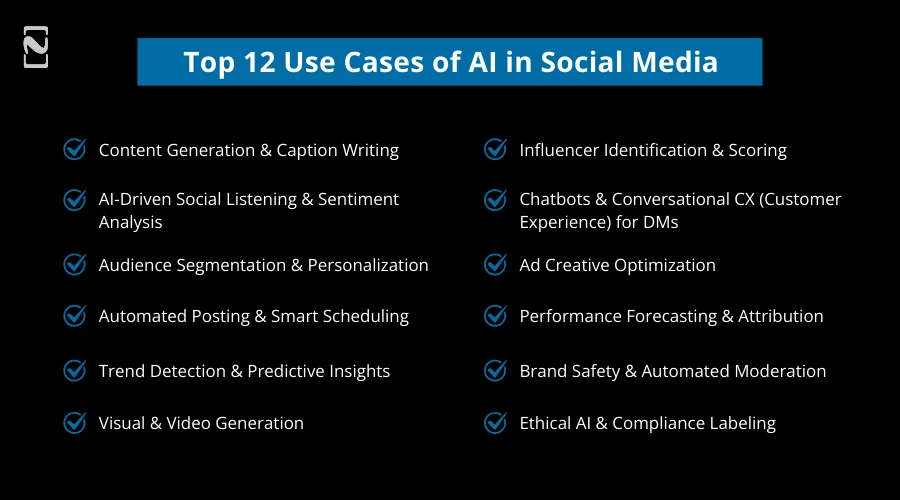
1. Content Generation & Caption Writing
With AI, brands can create top-quality social media content at scale, maintaining the required consistency or tone.
Role of AI:
- AI generates captions, CTAs, and post ideas.
- The technology adapts the tone for various platforms ( like formal for LinkedIn and conversational for Instagram).
- It suggests hashtags according to reach and relevance.
Why AI in content generation matters for SEO & growth:
- It diminishes content fatigue.
- AI improves posting frequency with no extra workload.
- It backs long-tail keyword targeting in captions.
For Example:
There are various apps, such as Instagram, TikTok, and YouTube, that use AI for personalized feeds.
Here, TikTok uses AI for content generation and caption writing via both in-app features and to identify the “white space” in your niche, as well as the golden opportunities, to convert the undeserved topic into a popular one.
2. AI-Driven Social Listening & Sentiment Analysis
In real-time, AI scrutinizes millions of social conversations to comprehend what audiences are trying to say and how they actually feel.
Key capabilities:
- AI helps in brand sentiment tracking, whether it’s positive, negative, or neutral.
- Competitive benchmarking.
- Early detection of trending discussions or PR risks.
Business value:
- AI social listening provides rapid crisis response.
- It helps with robust brand reputation management.
- It makes better product and campaign decisions.
For Example:
Instagram uses AI-driven social listening & sentiment analysis through using machine learning algorithms and data analysis techniques to evaluate the sentiments of the Instagram users. Later providing them with content accordingly.
3. Audience Segmentation & Personalization
By categorizing users based on interests, intent, and behavior, AI delivers hyper-personalized social experiences.
How AI helps:
- AI foretells the preference of content per distinct segment.
- It delivers personalized messages at scale
- The technology enhances relevance across paid and organic campaigns.
Outcomes: AI in audience segmentation and personalization result in better retention, higher engagement rates, and improved conversion metrics.
For Example:
Facebook is one of the leading social media platforms using Audience segmentation & personalization for identifying and understanding users’ emotions and then dividing the personalization factor accordingly.
4. Automated Posting & Smart Scheduling
Using AI, digital marketers don’t have to guess about posting time, as AI suggests optimal posting times based on audience behavior and historical performance.
AI advantages:
- Platform-specific scheduling.
- It’s best for auto-rescheduling based on engagement trends.
- The technology performs frequency optimization to prevent audience fatigue.
SEO impact: AI in automated posting and smart scheduling leads to consistent publishing that improves brand visibility and engagement signals.
For Example:
The use of AI in social media platforms, such as Instagram helpful for scheduling posts and reels, which further helps the users, especially the marketers, to schedule posts for later.
5. Trend Detection & Predictive Insights
Before the emerging trends reach their peak, AI detects them, allowing brands to be the early adopters.
Use cases:
- AI is used for predicting content performance.
- It also identifies viral formats and hashtags.
- The technology plan campaigns consider upcoming trends.
Why it’s powerful: AI in trend detection and predictive insights makes you the first-mover, which helps increase shareability and reach.
For Example:
Many platforms, such as Instagram and Facebook uses AI to identify which reel or post is going viral among the users and then promote the content accordingly.
6. Visual & Video Generation
One of the major engagement and ranking factors on social platforms is visual storytelling, which accelerates when marketers use AI in social media.
Capabilities include:
- AI helps automate resizing for platform formats.
- AI-generated images and short videos.
- Also, the technology provides captions and smart thumbnails for Reels and Shorts.
Digital Marketing benefit: An online video editor can further simplify the production process by helping marketers quickly refine and publish content optimized for different social platforms.
For Example:
There are wide examples under this category, where the platform, such as Meta (Instagram & Facebook), allows users to generate images and videos from text prompts.
Additionally, TikTok uses AI for video generation, which allows users to create, trim, edit, and add music directly with the app.
7. Influencer Identification & Scoring
Influencers harness AI to remove their guesswork, which helps them analyze audience quality, authenticity, and performance history.
AI evaluates:
- Audience demographics
- Engagement authenticity
- Brand fit and predicted ROI
Results: Use of AI in influencer marketing provides smarter partnerships and improved influencer campaign results.
Agencies like Socially Powerful are also leveraging AI-driven insights to help brands identify suitable creators and optimize campaign performance through data-backed influencer selection.
For Example:
Instagram identifies influencers through a thorough combination of AI-driven analysis for user engagement and content consistency. Here, the key factors comprise high engagement rates and follower count.
8. Chatbots & Conversational CX (Customer Experience) for DMs
AI-powered chatbots are best for managing direct messages and comments, while maintaining a human-like tone.
Common uses:
- Chatbots answering FAQs.
- It also helps with order tracking and support.
- It performs lead qualification to check if the leads match the business.
Why it converts: AI chatbots help with prompt responses that boost customer experience and elevate lead capture from social platforms.
For Example:
Facebook uses 24/7 automated agents to manage high-volume comments and direct messages. Through leveraging Meta’s official APIs and third-party tools, the businesses on Facebook convert passive followers into active leads and personalized conversations.
9. Ad Creative Optimization
AI holds the caliber to constantly test and optimize social media ad creatives for expected performance. From a fortune 500 advertiser dataset, the brands can use insights to compare advertising approaches, and to benchmark creative trends.
How AI improves ads:
- It auto-tests visuals, headlines, and CTAs.
- AI pauses creatives that are falling short.
- It scales winning variations.
Outcome: AI in ad creative optimization leads to higher ROAS (Return On Ad Spend), lower cost per client (CPC), and rapid optimization cycles. Many marketers now rely on an AI video generator for social media ads to test creatives faster.
For Example:
Ad creative optimization uses AI in social media and comprises leveraging machine learning to automatically generate test and real-time copy.
10. Performance Forecasting & Attribution
AI predicts the performance and allot value across campaigns, assisting the teams in proving ROI.
AI insights include:
- Engagement and conversion forecasts
- Budget allocation recommendations
- Multi-touch attribution modeling
Why this matters: AI knows the importance of data from leadership. Thus, it converts social metrics into business metrics.
For Example:
The Meta’s platforms, such as Instagram and Facebook uses performance forecasting & attribution that allows advertisers to predict the outcome of their campaigns and then measure the direct business impact.
11. Brand Safety & Automated Moderation
AI in social media detects non-compliant or harmful content swiftly, thereby protecting brands.
Use cases:
- Spam and hate-speech detection
- Policy enforcement at scale
- Comment moderation
Business Impact: This helps businesses with safer online communities and diminished reputational risk.
For Example:
The AI-powered social media apps, such as Instagram, are using brand safety and automated moderation to ensure the brands and businesses’ safety.
12. Ethical AI & Compliance Labeling
AI focuses on evolving social media regulations, and when it encounters such, it helps brands foster transparency and trust.
Key considerations:
- During this, marketers avoid biased outputs
- They label AI-generated content
- Ensure alignment with the platform and legal guidelines
Why it’s critical: With the use of ethical AI, you can reinforce credibility and lasting audience trust.
For Example:
The social media apps as Facebook, ensure ethical AI and compliance by following effective practices and all the standard legislation.
Top AI Tools & Platforms For Social Media
Obviously, when it comes to “digital” marketing, you can’t save yourself from an overwhelming amount of data that’s generated daily.
Here, AI’s role comes into play, which manages a huge data volume coming from social media platforms.
Leveraging AI tools, you can improve features of social media platforms and stay ahead in handling social media activities across different use cases, like social media monitoring, text and visual content creation, brand awareness campaigns, influencer research, and more.
Let’s check out the best AI tools for social media marketing 2026 :
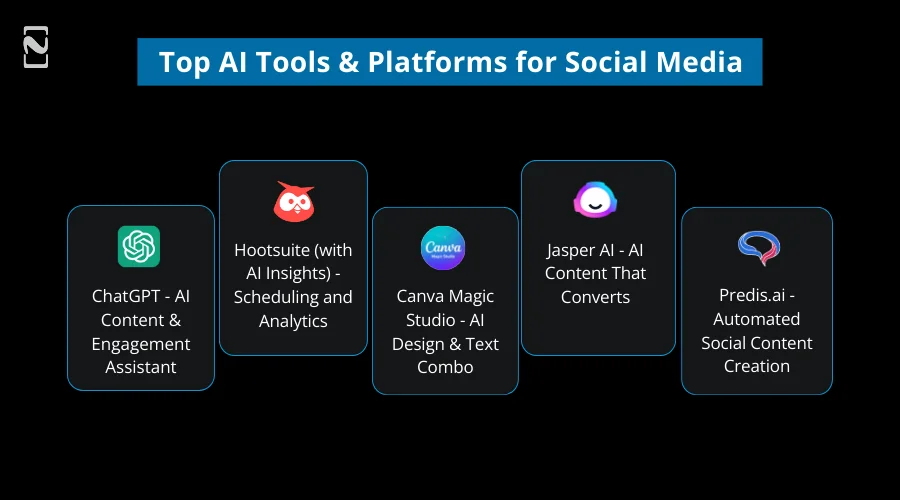
1. ChatGPT – AI Content & Engagement Assistant
Best for: Content generation, engagement replies, idea brainstorming, and customer interaction.
ChatGPT uses generative AI for social media to quickly create captions, audience responses, post ideas, and campaign copy, which makes it the most versatile tool for marketers in 2026.
However, marketers should still review AI-generated outputs for issues such as AI hallucinations, ensuring that social media content remains accurate, trustworthy, and aligned with brand messaging.
ChatGPT comes with the power to adapt style, tone, and messaging across different platforms; thus, this AI tool is perfect for speedy content workflows.
Use cases:
- ChatGPT draft DM replies or FAQs.
- It generates captions tailored to every platform.
- It creates engaging hooks and CTAs for posts.
2. Hootsuite (With AI Insights) – Scheduling and Analytics
Best for: Planning, analytics, scheduling, and performance insights in one place.
The capability of AI enhancements in Hootsuite streamlines recommendations for the best posting times, assists you in understanding the engagement patterns, and optimizes scheduling.
The teams that have to juggle with several channels, this tool works magically by linking creative results with measurable performance, leading to smarter and easier execution.
Why it matters:
- It helps with centralized publishing and an analytics dashboard.
- The tool offers AI recommendations for optimization and timing.
- It performs across every major social platform.
3. Canva Magic Studio – AI Design & Text Combo
Best for: Visual content creation and text generation.
Canva is constantly dominating, being a user-friendly design platform. Above that, Magic Studio, a feature of Canva, now incorporates AI-enabled text and image assistance.
Users can craft visuals and even generate hashtags/captions in a unified workspace that notably mitigates the time required to create professional-level social content.
Standout benefits:
- AI-generated templates and visuals
- Caption and branding suggestions
- Auto-resizing for stories, reels, posts
4. Jasper AI – AI Content That Converts
Best for: Copywriting and high-converting content across platforms.
Among the digital marketers, Jasper stays the #1 choice for social media copy, branded posts, and ads. The AI tool fuses AI creativity with conversion-targeting writing templates to help your content convert, besides just engaging.
If your social activity backs lead gen, sales, or landing page tracking, Jasper AI is an ideal choice for you.
The overall cost to develop a platform like Jasper AI can vary from $250,000 and $500,000. Depending on the different factors, such as the complexity of AI and its features.
Use cases:
- It helps create ad copy and carousel text.
- Campaign messaging frameworks.
- The tool creates social captions aligning with your brand voice.
5. Predis.ai – Automated Social Content Creation
Best for: Full post creation (including text, visuals, and hashtags).
Predis.ai holds the caliber to turn simple prompts into full social media posts, embracing captions, visuals, and hashtag suggestions.
This is extremely useful for solopreneurs or small teams who demand maintaining a constant publishing schedule with no extra expense of hiring a larger creative team.
Why it’s valuable:
- Predis.ai is best for end-to-end post-generation.
- It arrives with in-built scheduling support.
- The AI tool is ideal for platforms like Facebook, Instagram, and LinkedIn.
A Quick Comparison Between Top AI Tools and Platforms for Social Media
| Tool | Best For | Strength |
| ChatGPT | Content + engagement | Versatility and adaptability |
| Hootsuite | Scheduling + insights | Centralized workflow + AI analytics |
| Canva Magic Studio | Visual design + copy | All-in-one content creation |
| Jasper AI | High-converting content | Tailored, strategic copy |
| Predis.ai | Complete post automation | End-to-end content pipeline |
Tip: If you are looking for a pro workflow, use all these tools together and boost efficiency.
How to Build an AI-Enabled Social Media Workflow
Well, if you are planning to adopt AI in social media, it doesn’t mean you are replacing your marketing team. It’s just that you are creating a scalable, yet smarter workflow that delivers constant engagement and ROI.
You should follow a well-structured implementation process, not just adopt a random AI tool.
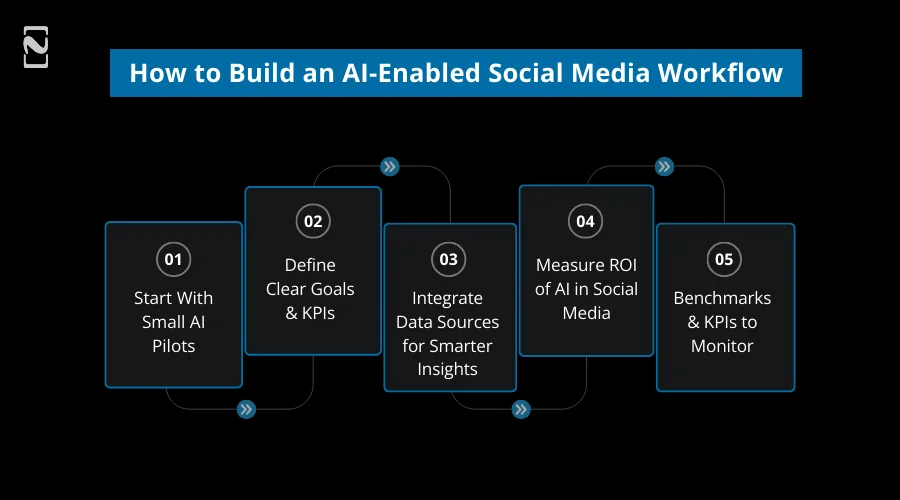
1. Start With Small AI Pilots
Digital marketers should avoid implementing AI in every social channel for once and all. Successful teams don’t do this; they start with pilot projects.
Recommended pilot areas:
- AI-based scheduling and post-timing optimization
- Caption and content generation for 1 to 2 platforms
- Automated DM replies for lead qualification or FAQs
Why this works: With small pilots, you can reduce risk, boost adoption, and assist teams in fostering confidence in AI-driven workflows before you scale.
2. Define Clear Goals & KPIs
You should ensure you map your AI use case with marketing and business objectives.
Examples of goal alignment:
- For reducing response time, pick AI chatbots for DMs.
- To elevate engagement rate, choose AI content optimization.
- For improving campaign ROI, go for AI performance forecasting.
Key KPIs to define early:
- Content production time
- Engagement rate
- Lead volume from social channels
- Cost per engagement (CPE)
Thus, you can ensure AI tools help you attain expected outcomes.
3. Integrate Data Sources for Smarter Insights
AI demands smooth access to connected data to perform best, so no isolated dashboards for sure.
Core systems to integrate:
- AI in CRM helps with lead source tracking and attribution
- AI in analytics tools boosts engagement, reach, conversions
- AI in content calendar, publish schedules, and create performance history.
Outcome: Digital marketers get a unified data ecosystem that analyzes real customer behavior to optimize timing, content, and targeting.
Bonus: 90-Day AI Adoption Plan for Social Media Teams
An organized launch keeps marketing teams aligned and outcomes predictable.
| Days 1–30: Foundation & Testing | Days 31–60: Optimization & Expansion | Days 61–90: Scale & Automate |
| Audit existing social media workflows. | Analyze pilot performance data. | Scale AI workflows across every active channel. |
| Recognize repetitive or time-consuming jobs. | Optimize prompts, workflows, and scheduling rules. | Automate reporting and performance insights. |
| Choose 1 or 2 AI tools for pilots. | Increase AI usage on additional platforms or formats. | Increase AI usage on additional platforms or formats. |
| Train team on AI best practices and limitations. | Introduce AI-based analytics and social listening. | Introduce AI-based analytics and social listening. |
| Milestone: First AI-generated content rollout with baseline metrics captured. | Checkpoint: Engagement trends and time savings documented. | Milestone: AI becomes an essential part of the social media operating model. |
4. Measure ROI of AI in Social Media
Leadership buy-in relies on transparent ROI measurement. AI success should be measured across efficiency, cost metrics, and performance.
Key ROI Metrics to Track
Engagement Lift
- % increase in likes, comments, shares
- Growth in follower engagement rate
Time Savings
- Drop in content creation hours
- Quicker response times for DMs and comments
Cost Reductions
- Lower agency or outsourcing costs
- Diminished ad spend wastage through AI optimization
5. Benchmarks & KPIs to Monitor
- Engagement rate improvement: 10 to 30% within 90 days
- Content production time reduction: 30 to 50%
- Response time improvement: up to 70% faster
- Cost per engagement (CPE): measurable decline
By tracking these benchmarks, you can prove that AI is not only efficient, but it’s profitable.
Risks, Ethics & Best Practices to Follow
When you, being a leading brand, embed AI in social media workflows, you should maintain equilibrium between innovation and your responsibility.
Ethical AI use is now critical to foster brand trust, long-term credibility, and compliance.
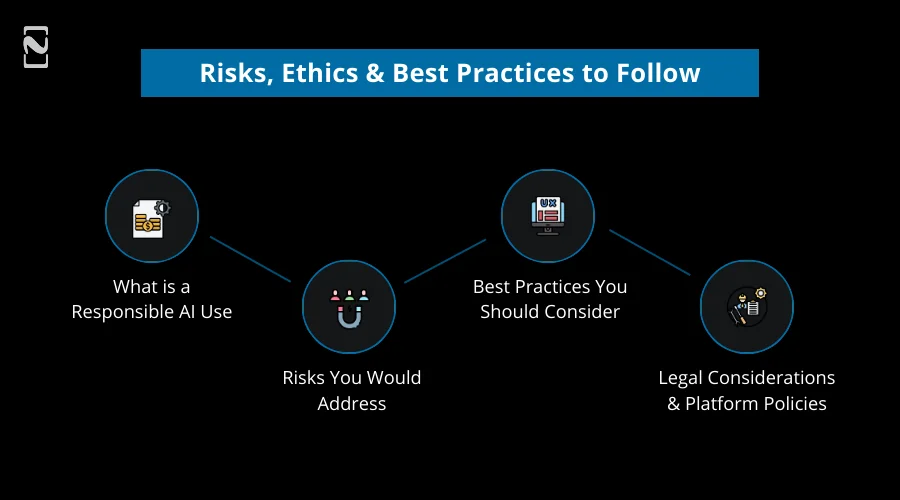
1. What is a Responsible AI Use?
Well, for that, you should maintain a distance from false positives, deepfakes, and bias.
Undoubtedly, AI systems learn from data. With biased or incomplete datasets, you can lead to unfair targeting, misrepresentation, or incorrect moderation decisions.
2. Risks You Would Address
- Bias in content recommendations: If your training data is not present in a variety, AI may surface certain viewpoints or demographics.
- False positives in moderation: Chances are high that legitimate posts or comments may be removed or incorrectly flagged.
- Deepfake content risks: AI-generated videos or visuals, if not clearly revealed, may mislead audiences.
3. Best Practices You Should Consider
- Your brand should consistently audit AI outputs for inaccuracies and bias.
- Also, maintain human review for high-impact content and moderation.
- Avoid using AI in sensitive content edges, like health, politics, and finance.
- With responsible management, AI will boost creativity with no compromise on integrity.
4. Legal Considerations & Platform Policies
Enterprise AI social media platforms for brands and regulators are increasingly analyzing AI-generated content.
Brands should consider:
- Data privacy laws: You should be compliant with regulations, such as data protection frameworks and GDPR.
- Copyright & IP: Also, AI-generated content may still hold the rights and originality risks. Plagiarism is the most common of those risks, and using a plagiarism changer catches that before posts go live.
- Platform-specific rules: Networks, like LinkedIn, TikTok, and Instagram, demand disclosure of manipulated or synthetic data.
Verdict: Remember to align AI workflows with regional legal standards and platform policies, and prefer consulting with legal teams when scaling AI deployment.
How Nimble AppGenie Can Help You Leverage AI in Social Media?
Apart from AI tools, for implementing AI in social media, you need the right strategy, execution, and integration.
Here, Nimble AppGenie kicks in.
By hiring a leading AI development company, Nimble AppGenie, the AI consultants help brands shift from just experimentation to measurable outcomes.
Key Highlights
- End-to-End AI Strategy for Social Media
- Custom AI Integration & Automation
- AI-Driven Insights & Performance Optimization
- Responsible & Ethical AI Implementation
- Scalable Solutions for Growing Businesses
We offer to build scalable AI solutions for startups and enterprises that grow with their social media strategy, leading to lasting success and competitive advantage.
Why Brands Choose Nimble AppGenie?
- Have proven expertise in AI-powered digital solutions.
- Create custom strategies tailored to business goals.
- Experience in social media app development
- Focus on ROI, sustainability, and compliance.
- Provide end-to-end support, from planning to execution, and ahead.
AI in Social Media: Real-World Case Study
Client Type: Mid-sized consumer brand
Challenge: Low engagement, manual content workflows, and inconsistent posting.
AI Solution We Implemented:
- AI-powered caption generation
- Smart scheduling & posting optimization
- AI-based sentiment analysis
- Automated DM responses
Results (Within 90 Days):
- 32% increase in engagement rate
- 45% reduction in content creation time
- 60% faster response to customer messages
- Lower cost per engagement across paid campaigns
Key Takeaway: AI didn’t replace the social media team; it just strengthened performance and efficiency.
Conclusion
Are you looking to implement AI in social media workflows, want to know how to implement the same for social media apps, or planning for integration in mobile apps?
First, you should learn how AI is revolutionizing social media marketing. We have discussed the use cases of AI in social media, AI tools that you can choose, risks you should avoid, best practices you should follow, and more to let your brand scale with AI.
Collaborate with Nimble AppGenie to boost your content, engagement, and ROI with regular personalized social media audits.
FAQs
The cost varies based on tools and scalability :
- Entry-level AI tools: $20–$100/month (approx.)
- Mid-sized business platforms: $100–$500/month (approx.)
- Enterprise AI social media solutions: $1,000+/month (approx.)
Many brands witness increased ROI through higher engagement, time savings, and diminished ad waste.
Yes. If used responsibly, AI is safe for brands.
- AI maintains human oversight.
- It monitors AI-generated content for accuracy and tone
- Also, it follows platform policies and disclosure guidelines
Without supervision, AI can surface risks, like tone mismatch or misinformation. By following best practices, you can reinforce your brand consistency and trust.
Modern teams should have expertise in :
- AI prompt writing & content review skills
- Data interpretation & performance analysis
- Strategic thinking and creative direction
- Ethical AI awareness and compliance knowledge
Platforms with algorithm-driven feeds benefit the most, including:
- TikTok
AI helps brands align their content with how these platforms distribute posts and rank.
Absolutely. Various AI tools are crafted for solopreneurs and small teams, providing:
- Automated post creation
- Smart scheduling
- Basic analytics
Within 30 to 90 days, you can witness outcomes from AI in social media, including:
- Faster content production
- Higher engagement rates
- Improved response times
Besides, the results rely on tool selection, execution quality, and objectives.
Start small :
- Identify repetitive tasks
- Choose 1–2 AI tools
- Run a 30-day pilot
- Measure performance and ROI
- Scale gradually with governance
Partner with an experienced AI solutions provider, like Nimble AppGenie, to reduce risk and accelerate results.

Niketan Sharma, CTO, Nimble AppGenie, is a tech enthusiast with more than a decade of experience in delivering high-value solutions that allow a brand to penetrate the market easily. With a strong hold on mobile app development, he is actively working to help businesses identify the potential of digital transformation by sharing insightful statistics, guides & blogs.
Table of Contents


No Comments
Comments are closed.