

 Free Consultation
 PCI-DSS Compliant
 GDPR Ready
 ISO 27001
 NDA Protected
 AI Services
 AI App Development
 Generative AI Development
 AI Chatbot Development
 AI Integration Services
 AI Consulting Services
 AI For Fintech
 AI Financial Assistant Solution
 AI Insurance Agent Development
 Tech Stack
 OpenAI / GPT-4
 Claude / Anthropic
 Gemini / Google AI
 Llama / Open Source
 LangChain / LlamaIndex
 Pinecone / Pgvector
 AWS / Azure AI


 Fintech Solution
 Core Fintech
 App Development
 Neobank Solutions
 eWallet Solutions
 Lending Software
 Banking Solutions
 BNPL Solutions
 BNPL Solutions
 Insurance App
 Wealth Management
 Crypto & DeFi
 Blockchain Development
  Payroll Software
 DeFi Solutions
 Crypto Wallet
 Crypto On/Off Ramp
 Crypto Exchange
 Trading Platform
 Payments
 Compliance
 Regulations & Compliance
 Fraud Detection
 Lending Ecosystem
 P2P Lending Platform
 Mortgage Software
 Engagement
 Fintech Outsourcing

 Mobile Development
 Mobile App Dev
 iOS App Development
 Android App Development
 React Native
 Flutter Development
 Web Solution
 Node.js Development
 React.js Development
 Angular Development
 App Services
 UI/UX Design
 App Maintenance
 By Stage
 MVP Development
 Industry Solutions
 Healthcare App Dev
 Education App Dev
 Travel App Dev
 Real Estate App Dev
 Logistics Software
 Social Media App

 Hire Mobile Developers
 Hire iPhone Developers
 Hire Android Developers
 Hire React Native Devs
 Hire Flutter Developers
 Hire Web Developers
 Hire Node.js Developers
 Hire Angular Developers
 Hire PHP Developers
 Hire Laravel Developers
 How It Works
 Pre-Vetted Developers
 Ready In 48 Hours
 NDA From Day One
 Replace Guarantee
 Company
 About Us
 Our Work Process
 Portfolio
 Case Studies
 Blog / Insights
 Careers
 Contact Us
 Awards
 Recognition


 Offices


Key Takeaways:
- Crypto exchange app development like Binance takes more than coding. You also need strong security, legal compliance, and a clear business plan.
- A centralised exchange is the best choice for most businesses because it is easier to manage and quicker to launch.
- Your app should include secure wallets, user verification, a fast trading system, and real-time market updates from the start.
- The cost to build a crypto exchange app like Binance usually ranges from $40,000 to $300,000+, based on features and project size.
- Starting with an MVP helps you launch faster, reduce costs, and add advanced features as your user base grows.
- Choosing a trusted crypto app development company can help you build a secure, scalable, and reliable exchange that is ready for future growth.
Build a crypto exchange app like Binance, and you are taking on a financial product, not just a mobile app. People ask this question every day, expecting a straight answer on cost, features, and time. This guide gives you one.
Binance handles billions of dollars in daily trading volume across spot, futures, and margin markets. That scale took years. But the core development, a working exchange with a matching engine, wallet system, KYC checks, and a clean trading interface, is achievable for most serious founders in months, not years, if the scope is right.
This guide walks through the features you actually need, the build process, the tech stack, realistic costs, legal requirements, and the mistakes that sink most crypto exchange projects.
What is a Binance App?
Binance is a centralised cryptocurrency exchange where users buy, sell, and trade crypto assets like Bitcoin and Ethereum. It’s the world’s largest exchange by trading volume and user count, which is why its feature set has become the industry benchmark.
The platform reports 323 million registered users, roughly 43% of everyone who owns crypto worldwide. It controls close to 39% of the global centralised exchange spot market share in early 2026. Also, it offers spot trading, futures, margin, staking, a token launch platform, and its own blockchain.
| App | Availablity | Downloads | Rating |
| Binance | iOS & Android | 100M + | 4.6/5 |
Should You Build a Centralised Exchange, a Decentralised Exchange, or a Hybrid?
Most founders building an app like Binance should start with a centralised exchange. It gives you full control over compliance, speed, and liquidity, the same model that Binance, Coinbase, and Kraken run on.
There are three models to choose from:
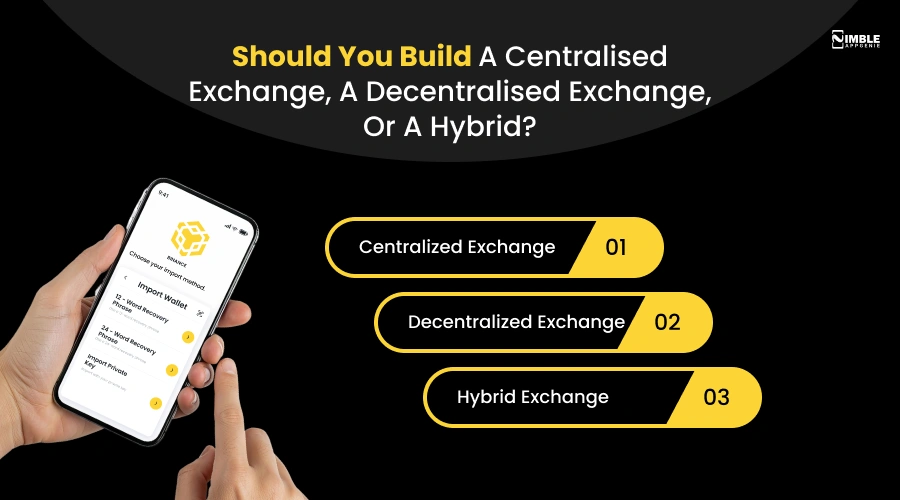
► Centralized Exchange
A company holds user funds and matches trades through its own order book. Fast, liquid, and easier to use, but it requires licensing and holds custody risk. This is what Binance is.
► Decentralized Exchange
Trades happen directly between wallets through smart contracts. No custody risk for the operator, but lower speed, thinner liquidity for new tokens, and a steeper learning curve for average users.
► Hybrid Exchange
It combines CEX-level speed with DEX-style self-custody. Powerful, but the most expensive and technically demanding option to build.
For a first product aimed at mainstream users, a CEX is the practical starting point. You can add DEX or hybrid features once the core exchange has real trading volume.
What Features Do You Need to Build a Crypto Exchange App Like Binance?
A Binance-like crypto platform development needs four feature groups at minimum: user onboarding and KYC, a trading engine with wallet integration, an admin dashboard, and security infrastructure like 2FA and cold storage.
Let’s take a look at them.
| Feature | What it does |
| Spot trading engine | Matches buy and sell orders instantly through a real-time order book for fast and accurate trade execution. |
| Multiple order types | Supports market, limit, and stop-loss orders to accommodate different trading strategies. |
| Live price charts | Displays real-time market prices with essential technical indicators for market analysis. |
| Margin and futures (advanced) | Enables leveraged trading with margin and futures contracts for experienced traders. |
| Staking and earn (advanced) | Allows users to stake supported cryptocurrencies and earn rewards or passive income. |
| Multi-currency wallet | Provides a secure wallet to store, send, receive, and manage multiple cryptocurrencies and tokens. |
| Hot and cold storage split | Uses hot wallets for daily transactions and cold wallets for long-term asset security. |
| Deposit and withdrawal | Supports secure deposits and withdrawals with transparent fee calculations and transaction processing. |
| Transaction history | Maintains a searchable and filterable record of all deposits, withdrawals, and trading activities. |
| KYC verification | Verifies user identities through document and ID checks to meet regulatory requirements. |
| AML monitoring | Detects and flags suspicious transactions using automated anti-money laundering monitoring. |
| Two-factor authentication | Adds an extra layer of security for account login and withdrawal approvals. |
How to Build a Crypto Exchange App Like Binance?
Building a crypto exchange app follows eight steps: market and legal research, choosing your exchange model, UI/UX design, backend and matching engine development, wallet integration, security testing, compliance setup, and phased launch.
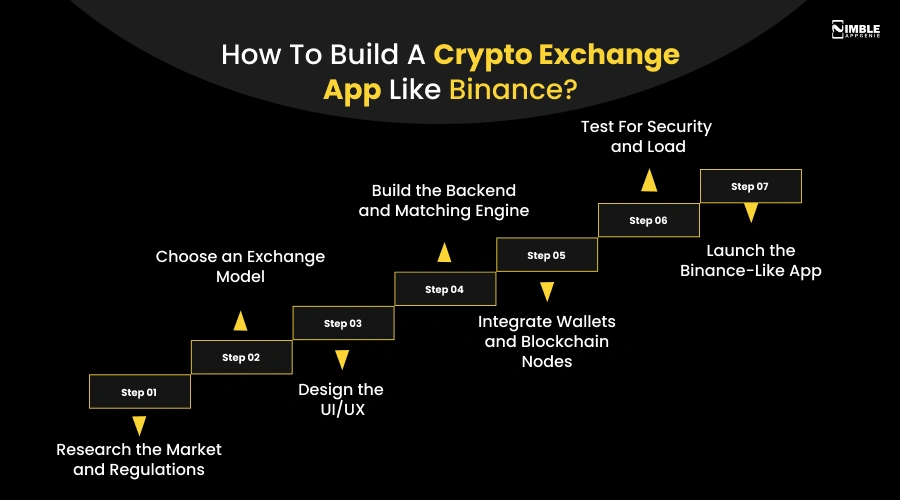
1. Research the Market and Regulations
Decide which countries you’ll operate in before writing a single line of code. This choice sets your KYC rules, your licensing path, which coins you’re allowed to list, and how much legal budget you need upfront.
Look at what competitors in your target region already offer, where the gaps are, and which user segment is underserved. Talk to a compliance lawyer early, even before you finalise the product spec.
Founders who skip this step often build a full product, then discover a required license takes a year to get, and have to redesign core flows around requirements they should have known from day one.
2. Choose an Exchange Model
Lock in centralised, decentralised, or hybrid based on your target users, how much custody risk you’re willing to hold, and how fast you need to launch. A centralised exchange gives you control over speed, liquidity, and compliance, but it means you are legally responsible for user funds.
A decentralised model removes that custody risk but is harder to build, slower to trade on, and tougher for average users to understand.
Most founders targeting mainstream, non-technical users start with a centralised model because it matches what users already expect from an app, then layer in decentralised features later once the core product proves itself.
3. Design the UI/UX
Wireframe the trading screen, wallet, onboarding, and KYC flow before any backend work starts. Trading apps live or die on how fast a user can place an order, so every extra tap or screen at signup costs you real conversions.
Map the full user journey first: signup, identity verification, first deposit, first trade, first withdrawal. Test wireframes with real target users, not just your internal team, since traders and first-time crypto buyers have very different expectations.
Get this validated on paper before a single screen gets built in code; it’s far cheaper to fix a flow on a wireframe than to rebuild it after launch.
4. Build the Backend and Matching Engine
This is the core of the app, the system that pairs buy and sell orders in real time. It needs to handle order spikes during volatile markets without slowing down or dropping orders.
This is why most serious platforms avoid standard relational databases for this layer and instead use custom, memory-based engines built for speed.
Alongside the matching engine, you will build the order book, the pricing feed, the fee calculation logic, and the APIs that connect the trading interface to the backend. This is typically the longest and most technically demanding phase of the entire build.
5. Integrate Wallets and Blockchain Nodes
Connect to the blockchains and coins you plan to support, and set up your hot wallet for daily transactions alongside cold storage for the bulk of user funds.
This step also includes building your deposit and withdrawal flows, confirming transaction speeds on each chain you support, and deciding whether you’ll run your own blockchain nodes or rely on a third-party node provider.
Wallet architecture decisions made here are expensive to change later, so get input from a blockchain security specialist before finalising how funds move between hot and cold storage.
6. Test For Security and Load
Run third-party penetration testing, audit your smart contracts if you use any, and simulate high-volume trading spikes before you go live.
This is also when you stress-test the matching engine under peak order volume to confirm it holds up when a market moves fast, and thousands of orders hit the system at once.
Budget real time for this phase; rushing security testing to hit a launch date is one of the most common reasons new exchanges get exploited in their first few months.
7. Launch the Binance-Like App
Start with a limited coin list, a capped user base, and close monitoring, then expand gradually once the system holds up under real trading load.
A phased rollout catches problems while the stakes are still small, and it gives your team room to fix issues without a public incident.
Once the core exchange is stable, add new coins, higher volume limits, and advanced features like margin or staking one at a time, watching how each addition affects system performance before moving to the next.

What Tech Stack Do You Need to Develop a Crypto Exchange App Like Binance?
A crypto exchange app typically runs on a React or Flutter frontend, a Node.js or Java backend, a low-latency matching engine written in C++ or Java, PostgreSQL or MongoDB for data, and blockchain nodes or APIs for each supported coin.
The table below shows the tech stack that you must use when you build a crypto exchange app like Binance.
| Layer | Common choices |
| Frontend (web/mobile) | React, React Native, Flutter, Swift, Kotlin. |
| Backend | Node.js, Java, Go. |
| Matching engine | C++, Java (built for microsecond-level speed). |
| Database | PostgreSQL, MongoDB, and Redis for caching. |
| Blockchain layer | Node connections or APIs for Bitcoin, Ethereum, and other supported chains. |
| Infrastructure | AWS or Azure, Kubernetes, load balancers. |
| Security | HSM key management, DDoS protection, WAF. |
The matching engine is the part most teams underestimate. A standard web-app database can’t handle order matching at trading speed. Serious platforms use custom, memory-based engines built to process large order volumes with very low latency.
How Much Does It Cost to Build an App Like Binance?
The cost to build a crypto exchange app like Binance ranges between $40,000 for a basic MVP and $300,000 or more for a full Binance-scale platform. It depends on the trading engine, security features, supported cryptocurrencies, wallet integration, and compliance requirements.
Here is the table showing the Binance app development cost with different complexities.
| Complexity | Estimated Cost | Estimated Time |
| MVP (spot trading only) | $40,000 – $100,000 | 3–5 months |
| Mid-tier (spot + margin + staking) | $100,000 – $200,000 | 6–9 months |
| Full Binance-scale platform | $200,000 – $300,000+ | 12+ months |
| White-label/clone script | $10,000 – $50,000 | 4–8 weeks |
Other factors that affect the overall budget include UI/UX design, mobile and web app development, third-party API integrations, cloud infrastructure, smart contract development, regulatory compliance, testing, deployment, and ongoing maintenance.
If you are planning to launch a global crypto exchange, you will also need to account for security audits, licensing, and infrastructure that can handle millions of transactions with high availability and low latency.
What Are the Legal and Compliance Requirements For a Crypto Exchange App?
Yes, running a crypto exchange requires a license in nearly every regulated market. In the US, that’s state money transmitter licenses or FinCEN registration; in the UK, FCA authorisation; in the EU, MiCA authorisation covers all 27 member states. Compliance is not a post-launch task.
It has to run alongside development from day one:
- KYC: Verifying user identity at signup with ID and document checks.
- AML: Monitoring transactions for suspicious patterns and filing reports where required.
- Licensing: Money transmitter licenses (US), FCA authorisation (UK), MiCA authorisation (EU), or the equivalent in your target markets.
- Data protection: GDPR in the EU, similar frameworks elsewhere.
- Travel Rule compliance: Sharing sender/receiver information on transfers above set thresholds.
Getting a license can take anywhere from a few months to two years, depending on the country and whether you’re applying for a state-by-state or national license. Start this process before development wraps up.
Challenges of Building a Crypto Exchange App Like Binance & Its Solutions
The challenges are underestimating compliance costs, launching without enough liquidity, treating security as an afterthought, and adding too many features before proving demand for core trading.
Each has a practical solution if you plan for it early.
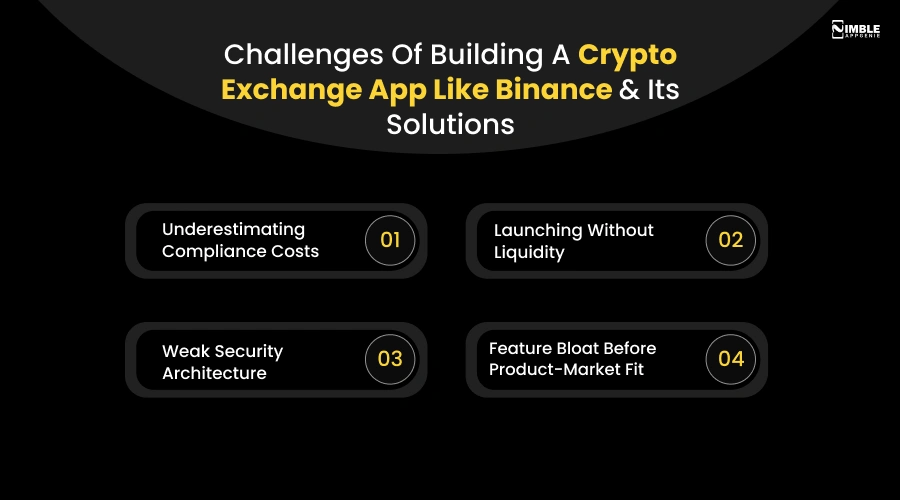
♦ Underestimating Compliance Costs
Legal and licensing fees regularly get treated as a footnote when they should be a line item from day one.
Solution:
You have to allocate your budget 15–20% of the total project cost for legal, licensing, and compliance work before development starts, and bring in a compliance advisor during the planning phase, not after you’ve already built the product.
♦ Launching Without Liquidity
An exchange with no active buyers and sellers has empty order books, and users leave within days of signing up.
Solution:
Line up a liquidity provider or market maker before launch, and consider a limited coin list at first so the volume you do have is concentrated instead of spread thin.
♦ Weak Security Architecture
Retrofitting security after a breach costs far more than building it in from the first sprint, and a single hack can end user trust permanently.
Solution:
Treat cold storage, 2FA, and encryption as core architecture decisions, not add-ons, and schedule a third-party security audit before launch rather than after an incident.
♦ Feature Bloat Before Product-Market Fit
Staking, Launchpads, and NFT modules mean nothing if spot trading itself isn’t fast and reliable.
Solution:
You can launch with a focused MVP like spot trading, wallet, and compliance, and add advanced features only once trading volume shows real demand for them.
Why Work With Nimble AppGenie to Build Your Crypto Exchange App Like Binance?
Nimble AppGenie is a blockchain development company that develops fintech products. We have delivered crypto wallet, DeFi, and exchange projects for founders in the US, UK, and other regulated markets.
We are built around ISO 9001:2015 quality processes and compliance frameworks like KYC, AML, PCI-DSS, and GDPR from day one, not bolted on afterwards.
If you are planning to build a crypto exchange app like Binance, the team can help scope the right model, the right feature set for your budget, and a realistic compliance path for your target markets.
Talk to Nimble AppGenie about your crypto exchange project and get a clear build plan before you commit to a budget.
Conclusion
Building a crypto exchange app like Binance is not just about creating a trading platform. It also means making sure your app is safe, easy to use, and follows the rules in the countries where you plan to launch.
You can start with the right features and add more as your business grows. It is often the best approach. With the right dedicated development team, you can build a crypto exchange app like Binance that meets user needs and supports your business goals.
FAQs

Niketan Sharma, CTO, Nimble AppGenie, is a tech enthusiast with more than a decade of experience in delivering high-value solutions that allow a brand to penetrate the market easily. With a strong hold on mobile app development, he is actively working to help businesses identify the potential of digital transformation by sharing insightful statistics, guides & blogs.
Table of Contents




No Comments
Comments are closed.