


Mobile app development is an intricate process. Not because there are so many things involved, but there are several right things to do.
You see, when developing a mobile app, more things can go wrong than right, hence you need to have a clear plan of action and a solid team of experienced developers.
The emphasis on experience is crucial, as development mistakes often lead to complete failure of the application in the long run.
The app development process seems the same for all types of solutions; however, implementing them is not as easy as even the master developers make several mistakes that can ruin the experience of the user.
In this post, let us take a look at some of the mistakes that you must avoid in mobile app development to make sure that your application is flawless before you release it to users.
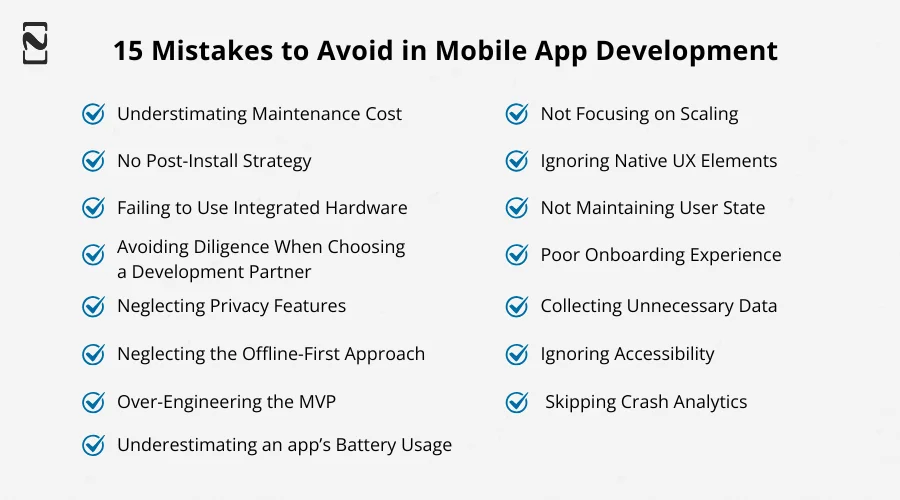
15 Mistakes to Avoid in Mobile App Development
Mistakes when building a mobile app are a common occurrence. It is bound to happen as an app goes through different stages and different hands when being developed. No team makes mistakes or leaves these loopholes in your application.
In fact, many developers are often unaware that the practices they are following are not exactly fruitful for the final app. What are these mistakes you ask?
Here are some mobile app development mistakes you should avoid at all costs :
1. Understimating Maintenance Cost
One of the common mistakes that mobile app owners make is underestimating the cost of maintenance when planning their app development budget.
It is like buying a fancy car with all the money you have without factoring in the regular maintenance and fuel costs.
When your app is new, it takes its course to identify how exactly it should be used. During the early days, your solution needs proper maintenance as it is relatively new.
Not to mention, over time, as more and more users start using your app, it will need regular updates and bug fixes. Businesses often do not account for the maintenance cost when building an app, which makes it difficult for the app to function properly even after it is completely built. This is also one of the core reasons why mobile apps fail.
Hence, to avoid such issues, you must calculate your mobile app development cost based on all the expenses that may go into the process and future expenses related to maintenance and updates. This will help you manage your costs and app performance better!
2. Not Focusing on Scaling
No business can sustain itself with a limited number of clients. Over the years, the number of clients increases, the working force increases, and that is how a business thrives.
Now think of the business as your mobile app. The number of users will increase, and you will have to add more features, without compromising on the quality of the user experience.
And that is where the role of scalability comes into play.
When developing an app, you must focus on choosing technologies, features, and functionalities that can be scaled with the increasing number of users and the demand of the users.
Not focusing on scaling when going through mobile app development is one of the most common and foolish mistakes that many startups make in their early days.
This often happens when you are working on a set budget and a limited vision for your app. It is highly recommended that you first explore the entire potential of the business that you are entering. This way, you have an idea of what kind of app you need and can accordingly choose the tech stack.
3. No Post-Install Strategy
Did you know that 21% of users abandon an app after the first use? This is just one of the mobile app statistics about uninstall metrics, and is enough to give you a heads up.
This usually happens when the user is not interested in what they saw, or they cannot figure out how to get things done in the app due to its complicated nature.
Either way, apps end up losing a valuable user while massively increasing the uninstall rate of the application. The mistake behind this is that when developing an app, businesses do not pay attention to the post-install strategy.
When an app is relatively new, or when a business is planning an app, its core objective is to reach massive audiences.
In the initial days, all a business is generally focused on is bringing a user to their platform. However, without a post-install strategy, you can no longer make the most of the users that you have converted to install your app.
To ensure that you do not make this mistake, you must invest in creating simple and effective onboarding steps so that a user is guided on how to use your app. Introduce interactive feedback mechanisms and track your user preferences based on what they have interacted with after installation, to personalize their experience.
This gives your users a reason to stay while simplifying their experience when they are using the app.
4. Ignoring Native UX Elements
Native ways to use a device are something that no one teaches a user, but they adapt as per their devices. Which brings us to the next mistake that you should avoid when planning a mobile app, i.e., not adhering to the native UX elements. A poorly designed UI/UX is among the leading reasons users choose to uninstall apps.
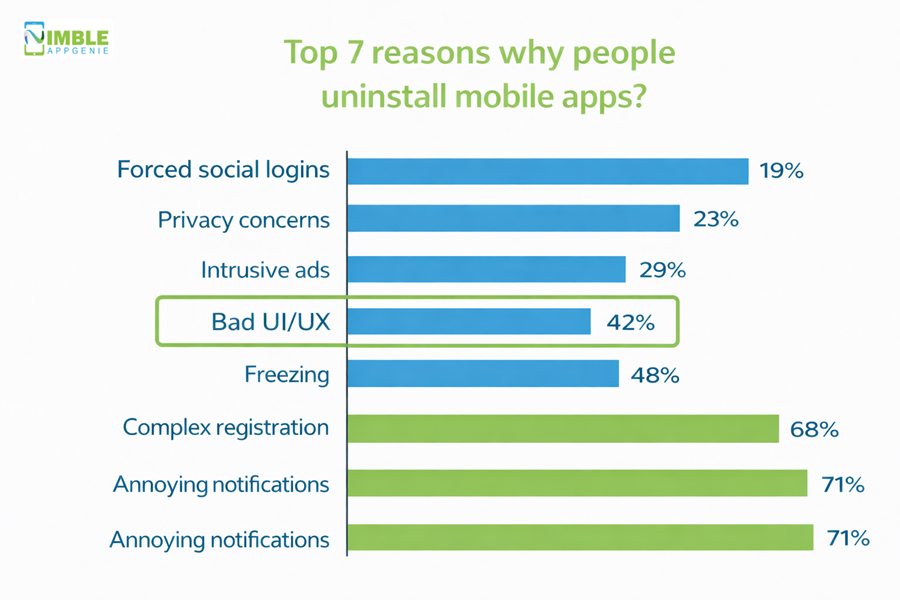
For any user, navigating through their smartphone is almost embedded in their heads. It is also the first rule of every mobile app design guide to leverage this familiarity to make the user more comfortable.
With the updated gesture navigation that is used on both iOS and Android devices, people subconsciously know where swiping up, down, or sideways takes them when using their devices.
However, many app developers and business owners tend to avoid this comfort of the user by adding complex navigation mechanisms in the app.
Instead of focusing on creating a new UX that stands out, you need to simplify the experience of the user by giving them what they have already been using to navigate on their smartphone.
This makes your users more comfortable with the app, helping you gain better retention and longer activity time from the users.
Making the user interface attractive is surely something you should pursue; however, playing around with user experience, especially with native elements related to navigation and more, can become a serious mobile app development mistake you must avoid.
5. Failing to Use Integrated Hardware
The integrated hardware of a device can be a game-changer, considering that modern smartphones come with a lot of hardware that can be leveraged to enhance your user’s experience and security.
However, businesses often fail to use the integrated hardware capabilities of a device. Which is a mistake you must avoid when planning your app?
We’ve already seen native mobile applications leverage the camera sensor, gyroscope, vibration motors, and more common hardware to make the app respond more effectively.
You might have even come across some smartphones that integrated something extra as hardware to make their devices stand out.
While you should not direct your app based on a dedicated sensor that a device might or might not have, camera sensors, vibration motors, gyroscope, etc., are some sensors that are found in almost every modern smartphone.
This can also improve your app security as it simplifies biometric authentication and makes it easier for users to access their application faster while being more and more secure.
6. Not Maintaining User State
The modern-day applications are smart and intuitive. What makes them more desirable is their way of understanding a user and helping them continue from where they left off.
Though user sessions are created for security in fintech apps, not maintaining a user state across different apps can be a huge mistake.
If your application functions statelessly, which means irrespective of prior usage, every new interaction is registered as something new, then it may not be relevant for the users.
Whereas, when your app is not maintaining user state, it eats up more bandwidth, as a user will keep sending the same data again and again every time they use the application.
A user state can be something as basic as whether the user stays logged in or not, and as complex as remembering the context of a particular task that the user had left, allowing a user to continue from where they left off.
Using AI and machine learning in mobile app development can help you integrate user state properties, making your application more user-friendly and giving your app more modern features.
7. Avoiding Diligence When Choosing a Development Partner
A mistake that often costs a lot of money and time to businesses is not choosing the development partner diligently.
The idea of simply outsourcing mobile app development and letting the experts do the job seems quite comfortable; however, for it to be a pleasing experience, you do have to make the decision only after evaluating the company on different fronts.
You see, your development partner is the ultimate player on whom your entire final application depends. Hence, if you can spend some time, check for reviews and look for references before you hire developers for your application.
Running a quick background check on your application can certainly give you better insights and help you avoid making a mistake when choosing your app development partner.
8. Poor Onboarding Experience
Think of it this way, you decide to eat at a restaurant that looks promising and has great reviews. However, to eat there, you have to take a lot of your identification documents along with a dedicated dress code.
While the restaurant will still function just as it does, and maybe it has the best food, too. However, when additional conditions are presented to a customer, they might not be as interested in eating in as it is a lot of work.
Similarly, if your application does everything well, delivers on all the promises, but still has a poor onboarding experience, you may not be able to convert as many users as you should.
Keep your onboarding simple. Let users register using their social media accounts, let them save their passwords, and keep it simple for them to access their accounts from their regular devices.
Complicating the onboarding process for your applications is a mistake that you should avoid at all costs.
9. Neglecting Privacy Features
Privacy is not always about mobile app security and authentication methods. Privacy features refer to the internal functionalities offered by the app for a user to manage their data and presence on the platform.
Have you ever wondered why the biggest players in social media apps like Instagram and Snapchat offer an internal feature to delete and deactivate a user’s account?
Like, why would a platform want people to delete their accounts?
Well, the reason is to give their users privacy and a sense of security that all the data that they have generated in the course of using the app is still in their hands.
And that is exactly why you need to integrate privacy features.
Without these privacy features, a user may not be confident enough to interact with your application with complete confidence, making it a serious mistake to avoid when building a mobile app.
10. Collecting Unnecessary Data
With AI and machine learning making it easier for apps to process data to yield valuable insights on user behavior, it is understandable that apps need some context about the users.
However, you need to establish a filter and identify only the key insights that you might need.
Collecting unnecessary data from the users, asking for permissions directly to internal storage or the gallery, puts your app under suspicion of data theft, which is not good for your application.
It sure depends on the type of application that you plan to develop. However, the majority of apps today use cloud-based solutions, which means they hardly need access to internal storage.
As far as your application is concerned, it can function simply based on the user-generated information that allows your app to understand what to recommend to your user.

11. Neglecting the Offline-First Approach
When building an app business, always give preference to features that can be easily molded into an app and accessed from anywhere in the world.
However, what this means is neglecting the countries and users who do not have access to stable connectivity.
To ensure that the app can be used even in the most remote areas, you should take the offline-first approach, which gives your users some features to easily access when they are not connected.
The idea of not being able to use a favorite feature when the network is unavailable can be a driving force contributing to users abandoning your platform completely.
Hence, if you are planning a utility app that a user might access regularly, we highly recommend that you focus on adding features that are offline-centric, as avoiding this approach during mobile app prototyping can be a mistake you might realize in the long run.
12. Ignoring Accessibility
Giving your users features to customize their user experience, giving them accessibility features like choosing their font style, their way of navigation, and more, is a must-have for modern-day applications.
Ignoring accessibility features often makes your application appear stagnant, as it cannot be customized completely to the user’s will. If the features are excellent but not according to the user’s preference, they are of no use.
Hence, ignoring accessibility features is a mistake that you must avoid when working on a mobile app. It is also advised that you should oversimplify things too,o as too many customizations often tend to confuse the user.
An average user only needs a few things to make an app usable as per their standards. Give them that, and you will be fine.
13. Over-Engineering the MVP
Perfection is a myth when it comes to building an MVP for mobile applications.
An MVP refers to creating a minimal viable product that can help you determine what your app can achieve without going full-fledged with the development process.
However, many businesses tend to focus too much on creating an MVP that they end up overworking on the same thing.
This is a mistake that they make when planning their startup app development, as it not only wastes your time and funds but can also trick you into believing that the final product may not be marketable or the right fit for the market.
To ensure that you use an MVP correctly, you must keep in mind that the only job of an MVP in the process is to validate your mobile app idea and give you a somewhat prototype of how it would work.
Avoid over-engineering the MVP if you want to speed up the process without compromising your funds for practically nothing.
14. Skipping Crash Analytics
Failure to integrate crash analytics is certainly a mistake that a lot of mobile app developers and businesses make.
Mobile apps are bound to crash, especially when they are newly developed. You, as the owner of the app, must keep in mind that every crash that may occur when a user is using the application can be a way to understand the intricacies of your app.
Instead of simply trying to fix the crash once it has happened, you must integrate a mechanism that helps you access the crash analytics.
This will help look at the bigger picture and identify exactly why the application crashed or what may be the possible environment in which the app tends to crash.
These insights help in identifying the vulnerabilities in your app, keeping you a step ahead of these sudden crashes and allowing you time to fix these crashes much better.
15. Underestimating an App’s Battery Usage
Users today are very particular about the efficiency of their smartphones. Especially the battery, as it is the juice that the device runs on.
Users tend to track their screentime, app usage, and overall device engagement to identify exactly how efficient the device is and how they can make it more efficient.
Now imagine when one such user is using your app, and he finds out that your app has been eating battery all day, what would be the first step? That’s right, your app will be the first thing to be uninstalled.
Underestimating the battery consumption of your app can be a deal breaker in today’s user scenario, as it makes no sense for a user to keep a battery-hungry app on their device.
Hence, make sure you optimize the battery usage before deploying the solution.
Going through all of these mistakes, you might have gotten an idea about common practices that are not exactly the best for any mobile app. In order to ensure that your application is free of these errors, you must pay attention when finalizing your mobile app development partner.
Who Can Help in Avoiding All the Mistakes? Nimble AppGenie
You see, while you might lack the technical expertise to develop an app on your own, you sure have the flexibility to choose the right team for the process.
Having an understanding of what mobile app development mistakes to avoid, you may be wondering who can help you avoid them all.
Nimble AppGenie is one of the leading solution providers of mobile app development services and can easily help you avoid common mistakes when working on your application.
In case you are wondering why Nimble AppGenie is the right choice for you, well, they are one of the handful of companies that leverage AI development practices to not only develop an application, but also to add futuristic features and functionalities.
With 350+ projects delivered over the past 8+ years, Nimble AppGenie is one of the most authentic mobile app development companies that you can hire. Our experienced developers make it their priority to ensure that the final solution you get is free of errors.

Conclusion
Mistakes when developing a mobile app can be minimized when you are careful and considerate of the different factors involved in both development and curation of the solution.
Keeping different stakeholders accountable for their respective jobs, letting professionals take care of the development process, can simplify the development and deployment of any mobile app.
Hopefully, all these listed mistakes give you a sneak peek into the do’s and don’ts of mobile app development. That will be all for this post. In case of any queries, feel free to connect with our mobile app development team as they can surely give you better insights based on your specific needs.
FAQs

Niketan Sharma, CTO, Nimble AppGenie, is a tech enthusiast with more than a decade of experience in delivering high-value solutions that allow a brand to penetrate the market easily. With a strong hold on mobile app development, he is actively working to help businesses identify the potential of digital transformation by sharing insightful statistics, guides & blogs.
Table of Contents
No Comments
Comments are closed.