

 Free Consultation
 PCI-DSS Compliant
 GDPR Ready
 ISO 27001
 NDA Protected
 AI Services
 AI App Development
 Generative AI Development
 AI Chatbot Development
 AI Integration Services
 AI Consulting Services
 AI For Fintech
 AI Financial Assistant Solution
 AI Insurance Agent Development
 Tech Stack
 OpenAI / GPT-4
 Claude / Anthropic
 Gemini / Google AI
 Llama / Open Source
 LangChain / LlamaIndex
 Pinecone / Pgvector
 AWS / Azure AI


 Fintech Solution
 Core Fintech
 App Development
 Neobank Solutions
 eWallet Solutions
 Lending Software
 Banking Solutions
 BNPL Solutions
 BNPL Solutions
 Insurance App
 Wealth Management
 Crypto & DeFi
 Blockchain Development
  Payroll Software
 DeFi Solutions
 Crypto Wallet
 Crypto On/Off Ramp
 Crypto Exchange
 Trading Platform
 Payments
 Compliance
 Regulations & Compliance
 Fraud Detection
 Lending Ecosystem
 P2P Lending Platform
 Mortgage Software
 Engagement
 Fintech Outsourcing

 Mobile Development
 Mobile App Dev
 iOS App Development
 Android App Development
 React Native
 Flutter Development
 Web Solution
 Node.js Development
 React.js Development
 Angular Development
 App Services
 UI/UX Design
 App Maintenance
 By Stage
 MVP Development
 Industry Solutions
 Healthcare App Dev
 Education App Dev
 Travel App Dev
 Real Estate App Dev
 Logistics Software
 Social Media App

 Hire Mobile Developers
 Hire iPhone Developers
 Hire Android Developers
 Hire React Native Devs
 Hire Flutter Developers
 Hire Web Developers
 Hire Node.js Developers
 Hire Angular Developers
 Hire PHP Developers
 Hire Laravel Developers
 How It Works
 Pre-Vetted Developers
 Ready In 48 Hours
 NDA From Day One
 Replace Guarantee
 Company
 About Us
 Our Work Process
 Portfolio
 Case Studies
 Blog / Insights
 Careers
 Contact Us
 Awards
 Recognition


 Offices


Key Takeaways:
- Building a platform like Uniswap means building an AMM-based DEX: smart contracts that hold liquidity pools and price trades with a formula, not an order book.
- Cost ranges from $25,000–$150,000 for a clone-based build to $250,000+ for a custom protocol with unique features.
- You need three technical pieces at minimum: smart contracts (factory, pool, router), a front-end swap interface, and enough liquidity to make the platform usable on day one.
- Security audits are not optional. Most DEX fund losses trace back to unaudited or rushed smart contract code.
- Nimble AppGenie builds AMM-based DEX platforms, liquidity pool systems, and DeFi wallets for fintech founders who want a working, audited product instead of a risky first attempt.
How do you build a platform like Uniswap? You build an AMM-based decentralised exchange: smart contracts that hold token pairs in liquidity pools and price trades using a formula, instead of a traditional buyer-seller order book. That’s the short answer.
That sounds simple, but building a platform like Uniswap takes much more than writing smart contracts. So, if you are planning to launch a DeFi platform, it’s easy to get overwhelmed by the technical side.
There are dozens of decisions to make, from selecting the blockchain and defining features to planning security audits and estimating development costs.
This guide breaks the entire process into simple steps. You will know how platforms like Uniswap work, what features you need, the technology behind them, how much development costs, and the common mistakes to avoid before you start building.
What is a Uniswap Platform?
Uniswap is a decentralised exchange (DEX) that allows users to swap crypto tokens directly from their own wallets, using smart contracts instead of a company-run order book. It runs on the automated market maker (AMM) model, has processed close to $trillion in cumulative trading volume since its 2018 launch, and charges a 0.3% fee on most trades, split with liquidity providers.
Founders want to build a DeFi app like Uniswap or something similar for practical reasons:
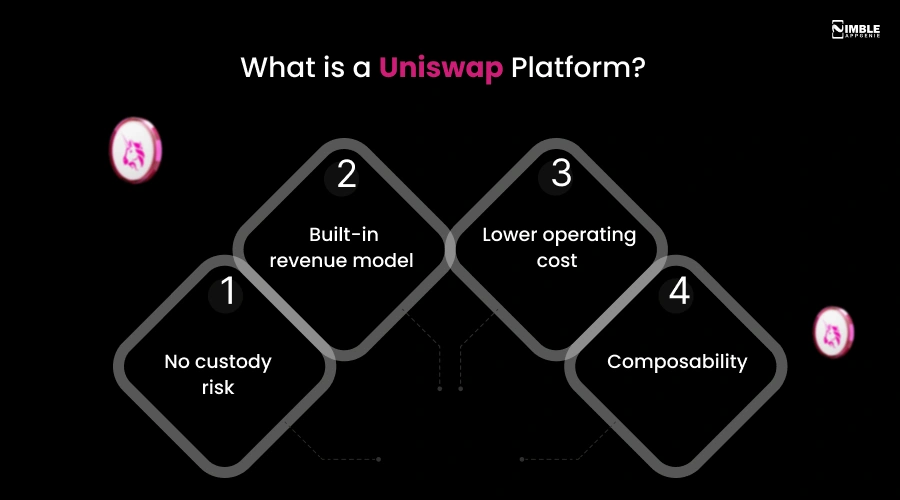
► No Custody Risk
A DEX never holds user funds, which removes a huge chunk of regulatory and security burden compared to a centralised exchange.
► Built-in Revenue Model
Every swap pays a small fee, split between liquidity providers and, depending on your setup, the protocol itself.
► Lower Operating Cost
There is no need for a matching engine, large ops team, or custodial infrastructure.
► Composability
DEX contracts are open and can be integrated into wallets, aggregators, and other DeFi products, which creates natural distribution.
The Trade-Off: A DEX is financial infrastructure sitting on public, immutable code. A coding mistake here is not a bug you patch next sprint; it can drain every pool permanently. That single fact should shape your entire build process, not just your security section.
What Do You Need to Build a Platform Like Uniswap?
To build a platform like Uniswap, you need five core components: smart contracts, a front-end, blockchain infrastructure, security systems, and compliance support. If you miss any one of these, it is the most common reason early-stage DEX launches fail.
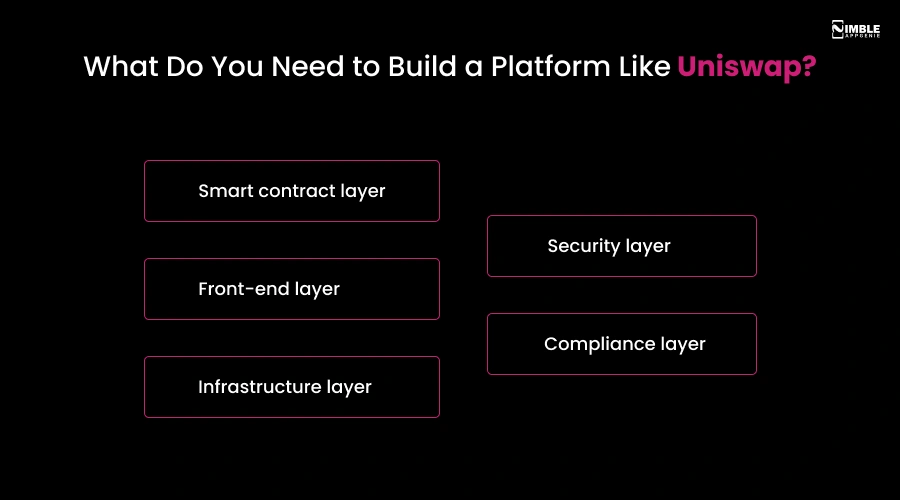
♦ Smart contract Layer
- Factory contract: It deploys a new liquidity pool contract for each token pair, and keeps a registry of every pool that exists.
- Pool (pair) contract: It holds the two token reserves and runs the pricing formula on every swap.
- Router contract: The layer users actually interact with; it handles adding liquidity, removing liquidity, and multi-hop swaps across pools.
♦ Front-End Layer
- Wallet connection (MetaMask, WalletConnect, Coinbase Wallet SDK, and similar); see our breakdown of eWallet API integration options if you are deciding which wallet SDKs and providers to support.
- Swap interface showing live price impact, slippage tolerance, and minimum received amount before confirmation.
- Liquidity provider dashboard for depositing, withdrawing, and tracking fees earned per pool.
- Transaction history, pool analytics, and a Total Value Locked (TVL) view.
♦ Infrastructure Layer
- Node/RPC access to the blockchain you deploy on Infura, Alchemy, or self-hosted nodes.
- An indexing layer (The Graph or a custom indexer) so the front-end can query pool data without hitting the chain directly on every page load.
- If your platform also needs users to move between fiat and crypto, not just swap tokens they already hold, you will need a separate fiat on-ramp/off-ramp integration, which is a distinct build from the DEX contracts themselves.
♦ Security Layer
- An independent third-party smart contract audit before any mainnet deployment that touches real funds.
- Multi-signature controls on any admin function (fee changes, contract upgrades, emergency pauses).
- Real-time monitoring for abnormal withdrawal patterns, flash loan activity, or price manipulation attempts.
♦ Compliance Layer
- Legal review of every jurisdiction you plan to market or operate in. Even though the contracts are permissionless, the fiat-facing parts of your business may not be. Our money transmitter license guide walks through when this actually applies and when narrow exemptions hold up.
- Front-end level geofencing for restricted regions, even though the contracts themselves are permissionless.
- Terms of service that clearly define the platform as non-custodial, plus risk disclosures around smart contract and impermanent loss risk.
How to Build a Platform Like Uniswap?
To create a platform like Uniswap, you have to run through seven phases: discovery and business model definition, architecture and tokenomics design, smart contract development, security audit and testing, front-end and wallet integration, liquidity bootstrapping and testnet launch, and mainnet launch with ongoing monitoring.
Each phase has its own deliverable, and skipping one is the most common reason launches get delayed or exploited.
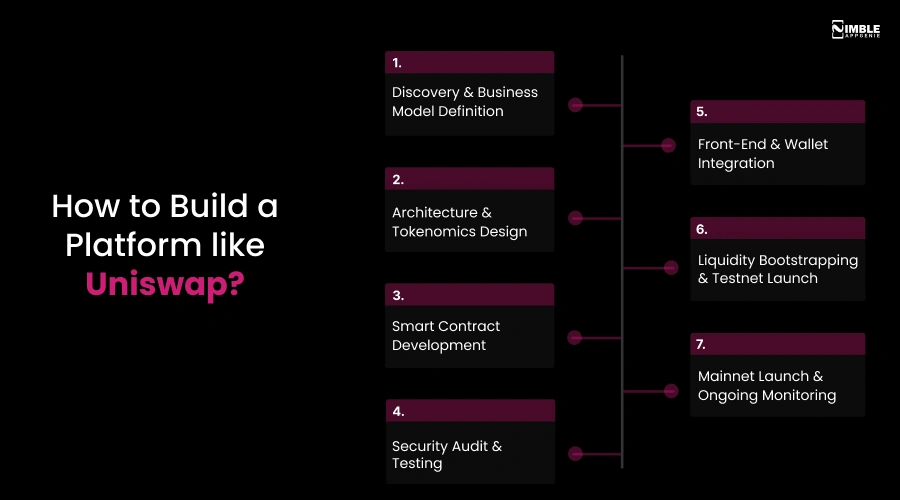
1. Discovery & Business Model Definition
Goal: Lock down the business decisions that every later technical choice depends on.
What happens in this phase:
- Define your fee percentage and how it’s split between the protocol and liquidity providers.
- Decide your target chain(s): Ethereum mainnet, an L2, or a multi-chain rollout.
- Identify your target user: retail traders, institutions, or a specific asset class.
- Decide whether you need a governance token or whether fee revenue alone is the business model.
Deliverable: A written scope document covering the fee model, target chain, and target user, signed off by both technical and business stakeholders.
2. Architecture & Tokenomics Design
Goal: Design the pool mechanics and fee logic before writing a single contract.
What happens in this phase:
- Choose the AMM curve: constant-product, concentrated liquidity (V3-style, capital efficient but complex), or a custom curve for specific asset types.
- Design the liquidity incentive structure, and how you will reward early LPs before organic volume exists.
- Map out every smart contract you will need and how they connect.
- Define admin controls and what, if anything, an admin key can change post-launch.
Deliverable: A technical architecture document and contract interaction diagram that your development and audit teams both work from.
3. Smart Contract Development
Goal: Write or fork and then customise the factory, pool, and router contracts.
What happens in this phase:
- Fork and modify existing audited contracts where possible instead of writing from scratch.
- Write custom logic only where your business model requires it, a different fee split, a new pool type, or added governance functions.
- Run internal unit and integration tests covering every function, not just the main swap path. It helps blockchain development for startups to stay secure and reliable.
- Run static analysis tools to catch common vulnerability patterns before human review.
Deliverable: A complete, internally-tested contract codebase ready to hand to an independent auditor, with test coverage reports attached.
4. Security Audit & Testing
Goal: Get independent verification that the contracts are safe to deploy with real funds.
What happens in this phase:
- Engage a third-party auditor with specific DeFi/AMM experience.
- Fix every finding classified as critical or high severity before proceeding; document your reasoning on any medium/low findings you choose not to fix.
- Run a second audit pass on the fixes themselves; a patch that introduces a new bug is a common failure mode.
- Set up a bug bounty program to run in parallel with, not instead of, the formal audit.
Deliverable: A public audit report, a documented list of resolved findings, and an active bug bounty before mainnet deployment.
5. Front-End & Wallet Integration
Goal: Build the interface that real users will actually trade through.
What happens in this phase:
- Building the swap interface with clear, upfront display of price impact, slippage, and minimum received, hidden or buried fee/slippage info is a top reason users abandon DEXs.
- Integrate wallet connections like MetaMask, WalletConnect, Coinbase Wallet, and test across desktop and mobile browsers.
- Build the LP dashboard for deposits, withdrawals, and fee tracking.
- Load-test the front-end against your indexing layer under simulated high-traffic conditions.
Deliverable: A tested, responsive front-end connected to live testnet contracts, with wallet flows verified across at least three major wallet providers.
6. Liquidity Bootstrapping & Testnet Launch
Goal: Make sure the platform is actually usable before it goes live.
What happens in this phase:
- Deploy to a public testnet and run a structured beta with real users, not just internal QA.
- Finalise your liquidity mining program: reward rates, duration, and which pools get incentives first.
- Line up market maker partnerships or seed capital commitments so your top pools are not empty at launch.
- Set circulating price-impact thresholds and slippage defaults based on testnet trading data, not guesswork.
Deliverable: A funded liquidity plan with committed initial capital for your top 3–5 pools, and a testnet report with no unresolved critical issues.
7. Mainnet Launch & Ongoing Monitoring
Goal: Go live and keep the platform monitored and maintained after launch.
What happens in this phase:
- Deploy final contracts to mainnet with a phased rollout (limited pools first, then expand).
- Set up real-time on-chain monitoring for unusual withdrawal volume, price manipulation, or flash loan patterns.
- Maintain an incident response plan, who gets notified, what gets paused, and how users get informed if something goes wrong.
- Track TVL, trading volume, and LP retention weekly to catch liquidity problems before they compound.
Deliverable: A live, monitored platform with a documented incident response process and a regular reporting cadence for TVL and volume.
Tech Stack For DeFi Platform Development Like Uniswap
A typical Uniswap-style DEX is built with Solidity for smart contracts, Hardhat or Foundry for testing and deployment, React with ethers.js or viem for the front-end, The Graph for indexing, and Ethereum or an L2 like Arbitrum or Base as the settlement layer.
| Layer | Common Tools |
| Smart contracts | Solidity, OpenZeppelin libraries, Uniswap V2/V3 core contracts (if forking). |
| Testing & deployment | Hardhat, Foundry, Tenderly for simulation. |
| Front-end | React or Next.js, ethers.js or viem, wagmi for wallet hooks. |
| Wallet connectivity | WalletConnect, MetaMask SDK, RainbowKit. |
| Indexing & data | The Graph subgraphs, Dune Analytics for public dashboards. |
| Blockchain layer | Ethereum mainnet, or Layer 2s like Arbitrum, Base, Optimism, for lower gas fees. |
| Oracles | Chainlink price feeds (needed for certain pool types or lending integrations). |
| Security tooling | Slither and MythX for static analysis, plus a manual third-party audit. |
Uniswap Clone vs Custom DEX: Which Should You Choose?
Choose a clone (fork) if your priority is speed to market on a proven, already-audited codebase. Also, choose custom development if you need a different AMM curve, specific compliance features, or deep integration with a product you already run; a stock fork cannot flex to fit those needs.
| Factor | Clone / Fork | Custom Build |
| Cost | $25,000–$150,000 | $40,000–$250,000+ |
| Timeline | 4–8 weeks | 3–6 months |
| Code risk | Lower — contracts are battle-tested | Higher — new code needs a full audit cycle |
| Differentiation | Limited to UI, branding, and fee % | Full control over pricing logic, fees, and governance |
| Best for | Fast market entry, MVP validation, regional launch | Institutional platforms, unique AMM logic, embedded DeFi in an existing product. |
A common, lower-risk path: launch a fork to validate real demand and trading volume, then reinvest into custom features once you have usage data to justify the spend. Building fully custom before you know anyone wants to trade on your platform is the single most common overspend we see from first-time founders.
How Much Does It Cost to Develop a Platform Like Uniswap?
The cost to build a platform like Uniswap ranges between $25,000-$250,000+, depending on the platform’s features, blockchain integration, security requirements, and overall project scope. Audits, infrastructure, and liquidity incentives are separate ongoing costs on top of the development itself.
Let’s have a look at the table below of estimated Uniswap platform development costs.
| Development Type | Cost Range | What’s Included |
| Clone/white-label | $25,000–$150,000 | Forked contracts, basic UI, single chain, one light audit |
| Custom MVP | $70,000–$200,000 | Original contract logic, custom UI/UX, one full audit |
| Enterprise platform | $150,000–$250,000+ | Multi-chain support, advanced features (concentrated liquidity, governance), multiple audits, compliance tooling |
Line items to budget separately, regardless of which development type you choose:
- Smart contract audits cost around $10,000-$50,000, depending on contract complexity and auditor reputation.
- Ongoing infrastructure costs around $5000-$15,000/month for nodes, indexing, and monitoring tools.
- Liquidity incentives are variable, but plan for a dedicated budget to reward early LPs. This is not optional if you want usable pools at launch.
- Legal and compliance review can cost $5000-$25,000, depending on how many jurisdictions you are targeting.
If you want a broader fintech cost baseline beyond crypto specifically, our fintech app development cost breakdown covers how compliance and platform choice move the number across financial products generally.
Challenges to Develop a Platform Like Uniswap & How to Solve Them
The challenges to building a platform like Uniswap are smart contract exploits, thin liquidity at launch, front-running and MEV, regulatory gaps across regions, and a confusing user experience. Each has a particular, known fix rather than a vague best practice.
Let’s take a look at challenges along with their solutions.
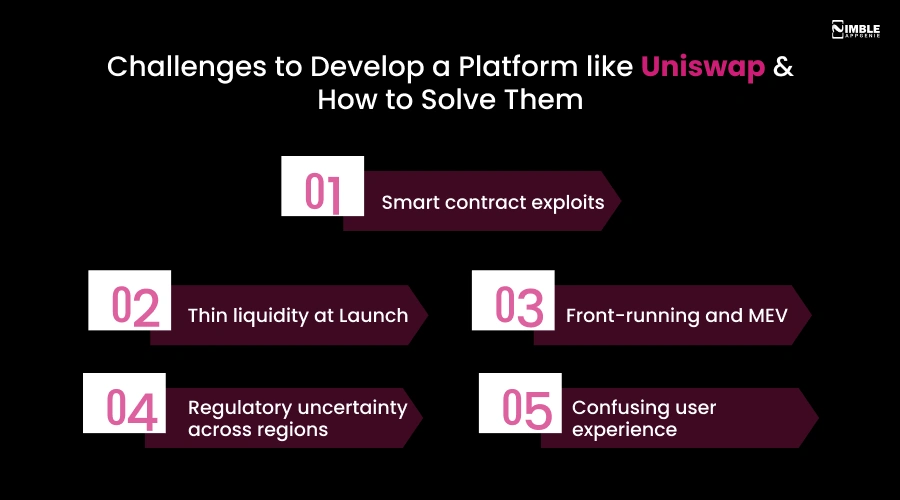
➤ Smart Contract Exploits
Public, immutable contracts holding real funds are a direct target for reentrancy attacks, price manipulation, and flash loan exploits.
Solution:
You should run at least one independent audit from a firm with particular AMM/DeFi experience, follow it with a live bug bounty program, and avoid custom logic anywhere a proven, audited pattern already exists.
➤ Thin Liquidity at Launch
New pools launch empty, which causes high slippage, which drives away the first traders who try the platform.
Solution:
It is vital to budget a specific liquidity mining program, like extra token rewards or a temporary fee-share boost, and line up at least one market maker partnership before the main network launch.
➤ Front-Running and MEV
Bots can see pending transactions in the public mempool and insert their own trades ahead of a user’s swap to profit at their expense.
Solution:
The dedicated development team implements slippage protection defaults, considers private mempool/relay integrations, and designs router logic that limits how much a single transaction can move the price.
➤ Regulatory Uncertainty Across Regions
Rules on token listings, marketing, and disclosures differ by country and are still evolving, which creates legal exposure if ignored.
Solution:
You must get legal review before launch, covering every jurisdiction you plan to actively market in, add front-end geofencing where needed, and keep clear risk disclosures in your terms of service.
➤ Confusing User Experience
Many DEX interfaces expose technical details like gas estimates, slippage settings, and price impact in ways that intimidate non-crypto-native users.
Solution:
You can design the swap flow around clarity first: show price impact and fees plainly, set sensible slippage defaults, and test the interface with users who have never used a DEX before, not just crypto-native testers.
How Nimble AppGenie Can Help You Build a Platform Like Uniswap?
If you are planning to build a DEX, the technical decisions you make early are hard to undo later. Nimble AppGenie is a blockchain development company that works with fintech founders and enterprises on exactly this kind of development.
Here is what that looks like in practice, mapped to the phases above:
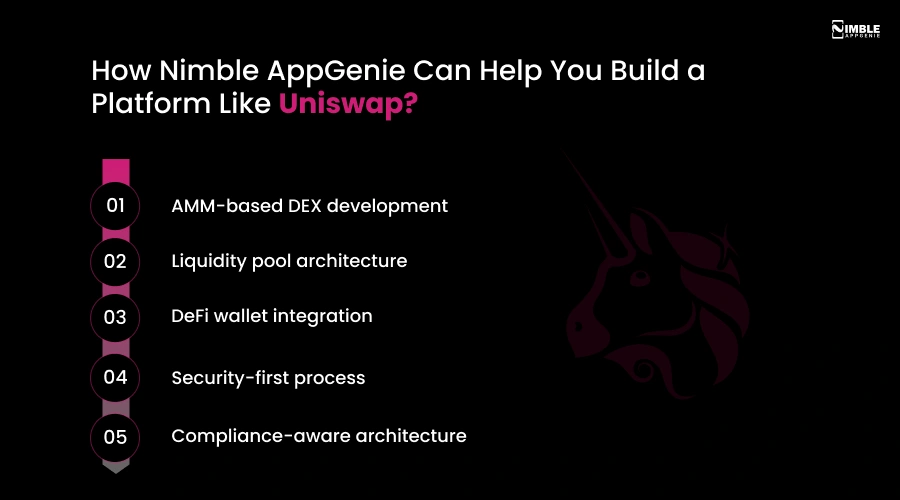
1. AMM-Based DEX Development
We build Uniswap-style automated market makers, including factory, pool, and router contracts, with front-running protection and MEV resistance built in rather than bolted on.
2. Liquidity Pool Architecture
From constant-product models to concentrated liquidity setups, we design pool logic around your actual trading volume goals, not a generic template.
3. DeFi Wallet Integration
If your DEX needs a companion wallet, our team also builds non-custodial wallets with multi-chain support and built-in swap functionality.
4. Security-First Process
Every contract goes through structured testing before we recommend a third-party audit, so you’re not paying for an audit on code that is not ready.
5. Compliance-Aware Architecture
Coming from broader fintech software development work, we develop KYC/AML hooks and jurisdiction-aware front-end logic from the start when your business model needs it.
If you are still weighing a centralised model against a DEX, our guide on building a crypto exchange like Coinbase covers those decisions in more depth. It is usually the first call we help founders make, based on compliance appetite, target users, and budget.
Conclusion
Developing a platform like Uniswap is a well-understood process now; the mechanics, the cost ranges, and the risks are documented. What separates a working platform from a drained one usually comes down to two things.
How seriously you take contract security, and whether you plan for liquidity from day one instead of after launch.
If you are evaluating whether to fork or build a platform like Uniswap with customisations, consult with a DeFi development company that can walk you through particular requirements and give you a realistic cost and timeline before you commit.
FAQs

Niketan Sharma, CTO, Nimble AppGenie, is a tech enthusiast with more than a decade of experience in delivering high-value solutions that allow a brand to penetrate the market easily. With a strong hold on mobile app development, he is actively working to help businesses identify the potential of digital transformation by sharing insightful statistics, guides & blogs.
Table of Contents




No Comments
Comments are closed.