

 Free Consultation
 PCI-DSS Compliant
 GDPR Ready
 ISO 27001
 NDA Protected
 AI Services
 AI App Development
 Generative AI Development
 AI Chatbot Development
 AI Integration Services
 AI Consulting Services
 AI For Fintech
 AI Financial Assistant Solution
 AI Insurance Agent Development
 Tech Stack
 OpenAI / GPT-4
 Claude / Anthropic
 Gemini / Google AI
 Llama / Open Source
 LangChain / LlamaIndex
 Pinecone / Pgvector
 AWS / Azure AI


 Fintech Solution
 Core Fintech
 App Development
 Neobank Solutions
 eWallet Solutions
 Lending Software
 Banking Solutions
 BNPL Solutions
 BNPL Solutions
 Insurance App
 Wealth Management
 Crypto & DeFi
 Blockchain Development
  Payroll Software
 DeFi Solutions
 Crypto Wallet
 Crypto On/Off Ramp
 Crypto Exchange
 Trading Platform
 Payments
 Compliance
 Regulations & Compliance
 Fraud Detection
 Lending Ecosystem
 P2P Lending Platform
 Mortgage Software
 Engagement
 Fintech Outsourcing

 Mobile Development
 Mobile App Dev
 iOS App Development
 Android App Development
 React Native
 Flutter Development
 Web Solution
 Node.js Development
 React.js Development
 Angular Development
 App Services
 UI/UX Design
 App Maintenance
 By Stage
 MVP Development
 Industry Solutions
 Healthcare App Dev
 Education App Dev
 Travel App Dev
 Real Estate App Dev
 Logistics Software
 Social Media App

 Hire Mobile Developers
 Hire iPhone Developers
 Hire Android Developers
 Hire React Native Devs
 Hire Flutter Developers
 Hire Web Developers
 Hire Node.js Developers
 Hire Angular Developers
 Hire PHP Developers
 Hire Laravel Developers
 How It Works
 Pre-Vetted Developers
 Ready In 48 Hours
 NDA From Day One
 Replace Guarantee
 Company
 About Us
 Our Work Process
 Portfolio
 Case Studies
 Blog / Insights
 Careers
 Contact Us
 Awards
 Recognition


 Offices



If you have been searching for how to build a neobank app, how to develop a digital banking platform, or how to create a neobank from scratch, you have landed in the right place.
Is building a neobank a good business idea in 2026?
The global neobank market is growing at a rapid pace and for good reason. According to Fortune Business Insights, the global neobank market valuation is predicted to grow from $310.15 billion in 2026 to $7,661.57 billion by 2034, at a CAGR of 49.30% during the forecast period.
Consumers no longer want to walk into a branch to open an account, transfer money, or apply for a loan. They want it done in seconds, from their phone. That shift has created one of the biggest opportunities in fintech, and businesses, startups, and even traditional banks are moving fast to capitalize on it.
But here’s the challenge most people run into: building a neobank is not like building a standard mobile app. It involves banking compliance, KYC/AML flows, real-time payment integrations, data security, and a user experience that has to earn financial trust from the very first screen.
This guide is built to walk you through all of it, from understanding what a neobank actually is, to the exact steps involved in developing one, the features that make or break user retention, what it realistically costs, and how to generate revenue once you’re live.
Whether you are a startup founder exploring your first fintech product, an enterprise looking to launch a digital banking arm, or a business that wants to understand the development process before hiring a team, this is the resource you need.
Let’s get into it.
Why Invest in a Neobank App?
Now you may be wondering why one should invest that much into a Neobanking app? Well, the concern is correct, as today everything looks promising, but it is not always the best investment.
However, in this case, the investment seems a vital decision as several factors are currently going in favor of Neobanks.
The market is certainly growing and is set to grow exponentially shortly. Other than these numbers, different factors make this investment a good decision.
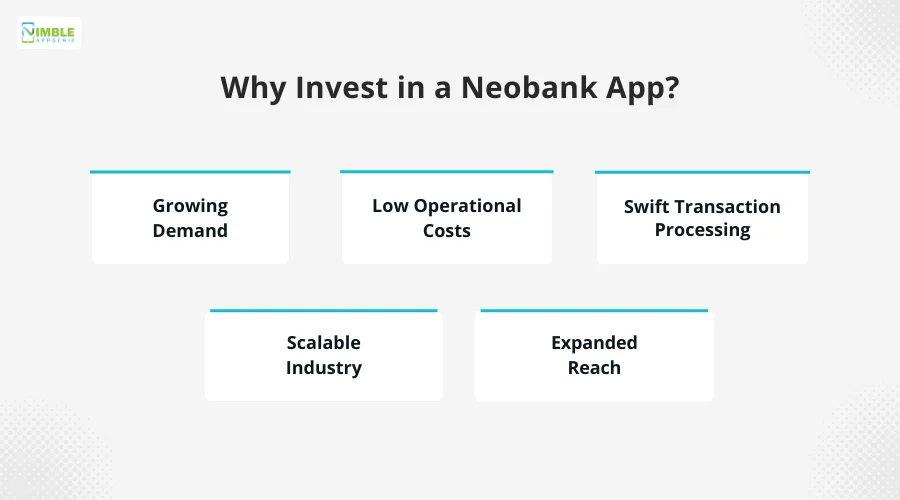
♦ Growing Demand
The market for such applications is a growing one. With more and more people getting access to smartphones and seamless internet, the demand for online banking services will increase in the upcoming years.
This offers a great opportunity to start your fintech startup, as people on the internet are always looking for better options, irrespective of what they currently use.
♦ Low Operational Costs
One of the biggest issues why not too many players wanted to enter the banking sector was the resource-hungry nature of the business.
A traditional bank requires physical branches, human resources, ATMs, etc., to cater to a user. In comparison, operating a neobank costs only a fraction of what traditional banking operations require.
♦ Swift Transaction Processing
Since the entire banking process is automated, it can speed up the transactions significantly. This means better settlements and higher success rates.
This transaction processing will help your business thrive as more and more satisfied customers start spreading their positive experiences with others, helping you grow your business.
♦ Scalable Industry
Finance as an industry is deeply rooted in our society. With a Neobank app of your own, you can not only penetrate the market but can even scale your business in no time.
You can start as an online bank affiliated with a traditional bank and slowly make your way to offline banking by offering additional services like physical cards, credit lines, etc. The possibilities are endless.
♦ Expanded Reach
If you are already in the banking and finance business and planning to expand your reach, developing a Neobank app can be a vital step.
You see, in an offline business, your reach is restricted to a limited area, as you can only reach people who are in your local area.
However, an online application can help you reach the masses, expanding your reach.
How to Build a Neobank App? Steps to Know
If you are wondering how to build a neobank app from scratch, the process starts with understanding your target users, choosing the right compliance framework, and partnering with an experienced fintech development team.
Learning how to build a neobank isn’t just about coding; it involves mapping out KYC flows, API integrations, and a security-first architecture before a single line of code is written.
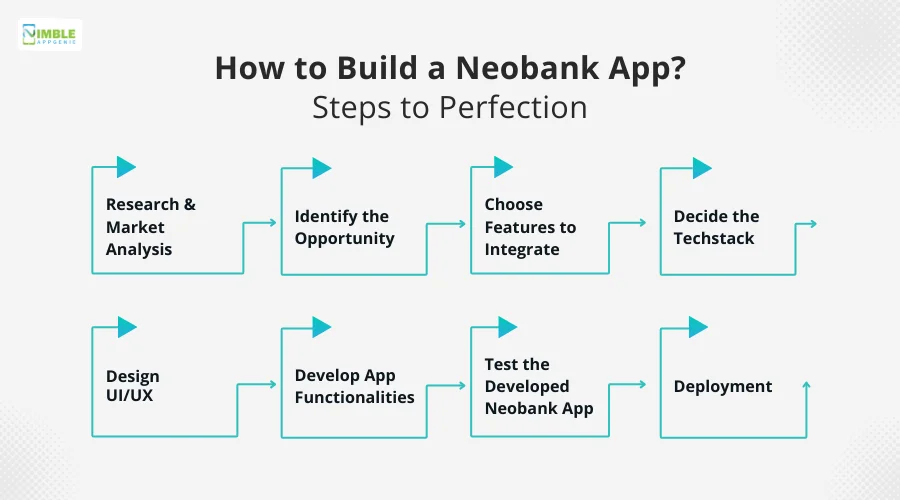
Here are the steps that can help you build a Neobank app –
Step 1: Research & Market Analysis
The first thing you need to do is research the app market appropriately. With the rise of fintech, the market for online banking services is certainly growing and slowly getting cluttered with new and upcoming apps.
Hence, understand the market and find out everything you can before you commence building your solution.
Step 2: Identify the Opportunity
Based on your research, you need to identify the right opportunity for your service. Design a business plan and craft your value proposition.
It is crucial to place your Neobank in the market correctly, as that decides how people perceive it. You can address the gaps that you find during your research and develop a Neobank app that solves that issue to find your value proposition.
Step 3: Choose Features to Integrate
Based on your market understanding and how you want to approach the market, you can choose the set of features that you want to integrate into your banking app.
You must identify the features and decide on them firsthand, as it helps the further process. Choosing the features makes the picture clearer for the users.
Step 4: Decide on the Techstack
What tech stack is used to build a neobank app?
Tech Stack to Build a Neobank App:
| Layer | Technology Options |
| Frontend (Mobile) | React Native, Flutter |
| Frontend (Web) | React.js, Angular, Vue.js |
| Backend | Node.js, Python (Django/Flask), Java (Spring Boot) |
| Database | PostgreSQL, MySQL, MongoDB |
| Cloud Infrastructure | AWS, Google Cloud, Microsoft Azure |
| Authentication & Security | OAuth 2.0, JWT, Auth0, Okta |
| KYC / Identity Verification | Onfido, Jumio, Sumsub |
| Payment Processing | Stripe, Adyen, Galileo, Marqeta |
| Banking-as-a-Service (BaaS) | Synapse, Unit, Solaris, Railsr |
| Fraud Detection | Featurespace, Feedzai, AWS Fraud Detector |
| Push Notifications | Firebase (FCM), APNs |
| API Management | Kong, Apigee, AWS API Gateway |
| Data Analytics | Apache Kafka, Mixpanel, Amplitude |
| DevOps & CI/CD | Docker, Kubernetes, GitHub Actions, Jenkins |
| Encryption | AES-256, TLS/SSL |
| Compliance & Monitoring | ComplyAdvantage, Chainalysis, Datadog |
If you are looking for a complete picture of how banking apps work beyond neobanks, our guide on how to create a mobile banking app covers the full spectrum, from traditional banking apps to digital-first platforms.
The features of Neobank applications are functionalities that require technology to power them. Hence, you need to decide the tech stack according to your banking app features.
There are several components of an app for which you need to choose the technologies. The components are – Fronten. Backend, Database, APIs, Cloud Platforms, and additional advanced technologies like AI & ML.
Step 5: Design UI/UX
After you have the features and technologies to power them, it is time to design the application layout and user experience.
This is the step where your Neobank app starts taking shape. You can manage the interface and design the placement of features, navigation, and other aspects of your application. The more intuitive and unique your design is, the better it works for the users.
Step 6: Develop App Functionalities
Once the entire layout is ready, it’s time for the development phase. This is where your application comes to life. The developers start building functionalities one after the other.
Since these functionalities are developed according to the app’s requirements, the process might take some time. This is also the reason why this is the most time-consuming step of the entire process.
Step 7: Test the Developed Neobank App
While the developers do their job with perfection, the systems they use are high-performance, and hence, the built functionalities might start acting up when the environment changes.
To ensure that there are no bugs and no performance issues, a dedicated team of quality assurance engineers is deployed.
These experts make it their priority to identify problems that may have developed during the development process.
Step 8: Deployment
Once all the issues are identified and both testing and development teams are satisfied with their work, the application is deployed to designated stores.
What Features Does A Neobank App Need To Have?
Below is the complete answer.
Behind every successful neobank is a series of features that power it. It is crucial to identify what features a Neobank must have, and what are some good features to have but are not necessarily found in every Neobank app.
Must-Have Features of a Neobank App
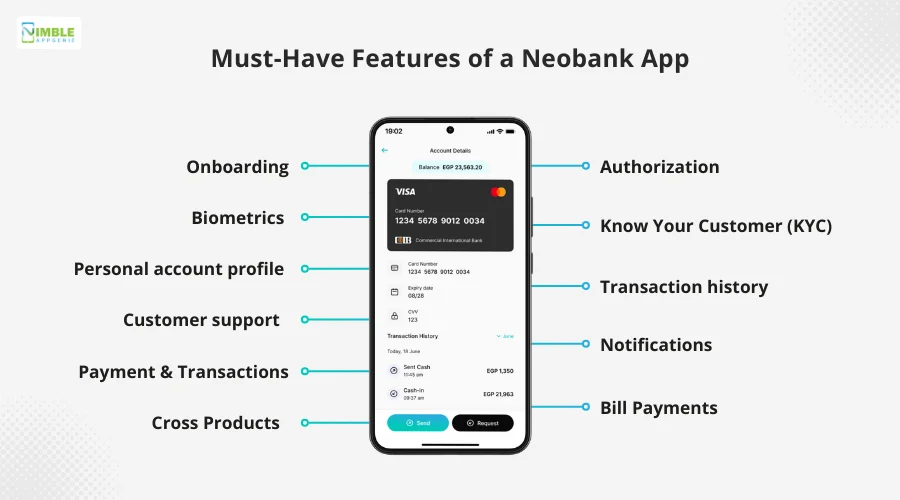
- Onboarding
- Authorization
- Biometrics
- Know Your Customer (KYC)
- Personal account profile
- Transaction history
- Customer Support
- Notifications
- Payment & Transactions
- Bill Payments
- Cross Products
Good To Have Features
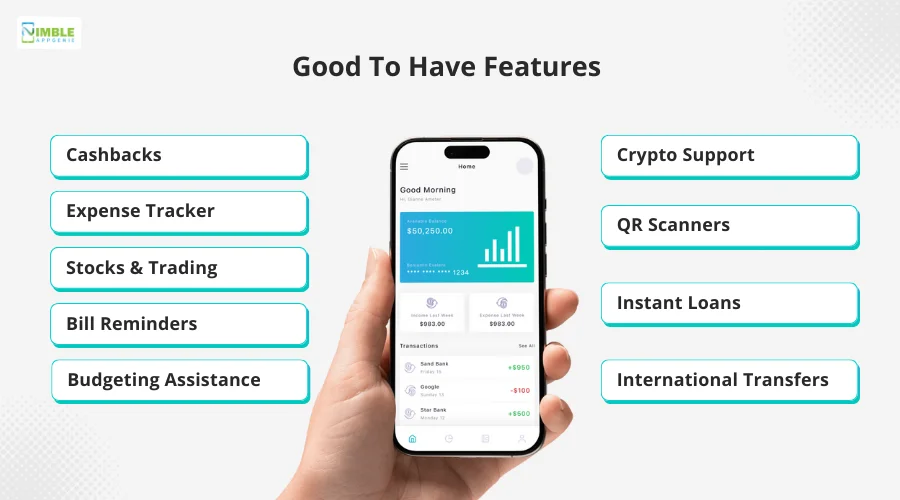
- Cashback
- Crypto Support
- Expense Tracker
- QR Scanners
- Stocks & Trading
- Instant Loans
- Bill Reminders
- International Transfers
- Budgeting Assistance
With all these features backing a Neobank, it is difficult for the banking market to ignore Neobanks as they bring along functionalities, convenience, and ease of access.
Many of the core features in a neobank overlap with eWallet functionality. To understand the nuanced differences, read our breakdown of eWallet vs Digital Wallet vs Mobile Wallet.
How Much Does It Cost To Build A Neobank App?
Well, overall, the cost to develop a neobank app typically ranges from $30,000 to $300,000, depending on various factors.
Founders also ask: “How long does it take to develop a neobank app?”
A neobank MVP typically takes 4–9 months, while a full-featured platform can take 9–12 months or more.
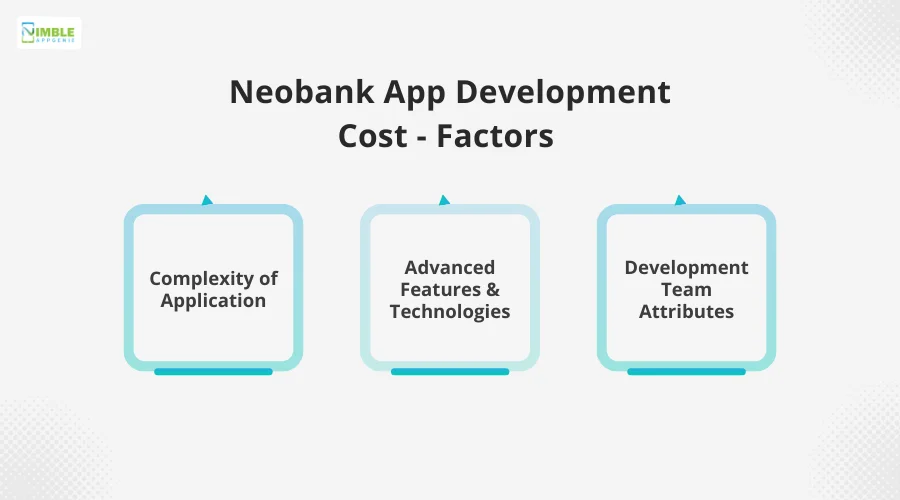
Some of the core factors that define the cost to build Neobank app include.
1] Complexity of Application
The cost of your neobanking app solution can vary significantly depending on the complexity and the framework you choose.
If you plan to go for native app development and build them individually for OSs, it will cost you more, whereas when you go for hybrid development, the process is less time & resource-consuming, making it less expensive.
2] Advanced Features & Technologies
Use of advanced technologies can also significantly raise your investment, as these technologies require expensive resources and highly qualified developers who have expertise with those technologies.
All of these amount to an additional cost, which often ends up making the Neobanking app an expensive affair.
3] Development Team Attributes
One of the key factors that usually affects the cost to create a banking app is the development team you hire.
Attributes like where the developers work from, the number of resources deployed on the project, the per-hour cost of these developers, etc. Define the overall cost of your app.
Other than these factors, the framework of application, whether you choose Native or Hybrid app development, also makes a significant difference.
Top Neobank App Examples That Inspire the Market
It’s time to look at some popular neobanks to better understand the concept.
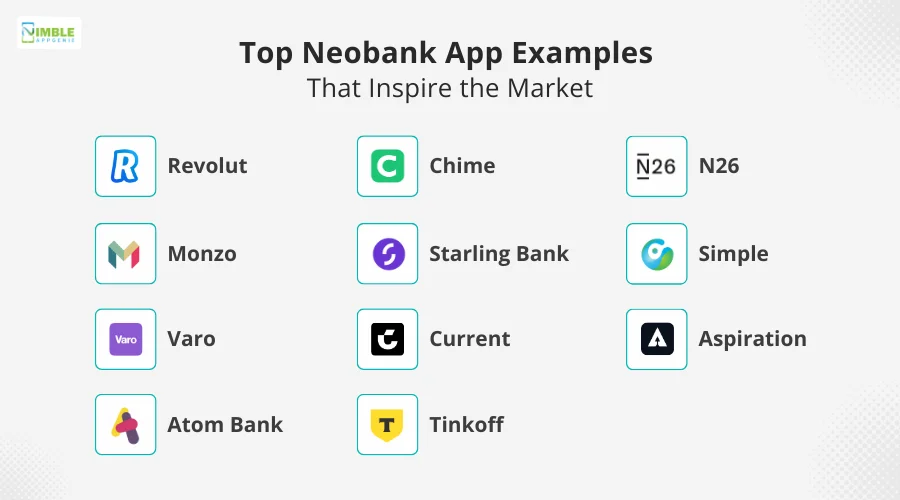
Therefore, these are, as mentioned below:
► Revolut
Revolut is a UK-based neobank known for its multi-currency accounts and low-fee international transfers.
It offers features like budgeting tools, cryptocurrency trading, and stock trading, making it a versatile financial app.
Revolut’s success stems from its user-friendly interface, competitive pricing, and continuous innovation in financial services.
► Chime
Chime is an American Neobank that focuses on providing fee-free banking services.
It offers early direct deposit, automatic savings, and a user-friendly mobile app.
Chime’s success can be attributed to its no-fee structure, simplicity, and a strong emphasis on customer service and financial health tools.
No wonder people want to create a Chime clone.
► N26
N26, based in Germany, offers a sleek mobile banking experience with features like real-time spending notifications, automatic categorization of expenses, and zero-fee foreign transactions.
Its success lies in its seamless user experience and robust security features, making it a favorite among tech-savvy users.
Also Read: Cost to Build an App Like N26
► Monzo
Ever wondered why so many people want to develop an app like Manzo?
Another UK-based neobank is known for its transparent fee structure and innovative features such as bill splitting, instant notifications, and budgeting tools.
Monzo’s community-driven approach and commitment to transparency have contributed to its rapid growth and popularity.
► Starling Bank
Starling Bank is a UK Neobank offering a full range of personal and business banking services.
It’s known for its competitive interest rates on savings accounts and integrated financial management tools.
Starling’s success comes from its comprehensive service offering and strong customer support.
► Simple
Simple, based in the US, focuses on helping users manage their money better with tools for budgeting and saving.
It offers features like Safe-to-Spend, which calculates how much money users can safely spend after accounting for upcoming expenses.
Simple’s clear focus on financial management and user education makes it stand out.
► Varo
Varo is an American Neobank that provides fee-free banking with features like high-yield savings accounts, early direct deposits, and budgeting tools.
Varo’s success is due to its user-centric approach and commitment to offering fee-free banking services.
► Current
Currently based in the US, it targets younger users with features like instant spending notifications, budgeting tools, and fee-free overdrafts.
It also offers a unique feature called “Teen Banking” aimed at helping teenagers manage their money.
The current focus on young users and their financial education contributes to its popularity.
► Aspiration
Aspiration is an American Neobank with a focus on sustainability and ethical banking. It offers cash back for socially conscious spending and high interest rates on savings.
Aspiration’s unique value proposition of combining banking with ethical consumerism has driven its success.
► Atom Bank
Atom Bank, based in the UK, operates entirely through its mobile app, offering competitive mortgage rates, savings accounts, and business loans.
Its success is driven by its innovative approach to banking, offering better rates and a more streamlined user experience compared to traditional banks.
► Tinkoff
Tinkoff, a Russian Neobank, offers a wide range of financial products, including credit cards, loans, insurance, and investment services.
Its extensive product range and focus on digital innovation have made it one of the most successful neobanks in its region.
These neobanks have leveraged technology, customer-centric services, and innovative features to disrupt traditional banking, providing users with more efficient and accessible financial solutions.
How Do Neobanks Make Money?
Neobanks make money by accumulating a small amount as fees when customer use their debit cards, offering loans, charging for premium account subscriptions, and earning commissions through financial partner referrals.
Can a neobank be profitable without charging fees? A good question asked by fintech companies. Yes, interchange fees, credit interest, premium subscriptions, and BaaS partnerships allow neobanks to generate revenue without charging customers upfront.
Now, let’s get deeper to know how neobanks make money:
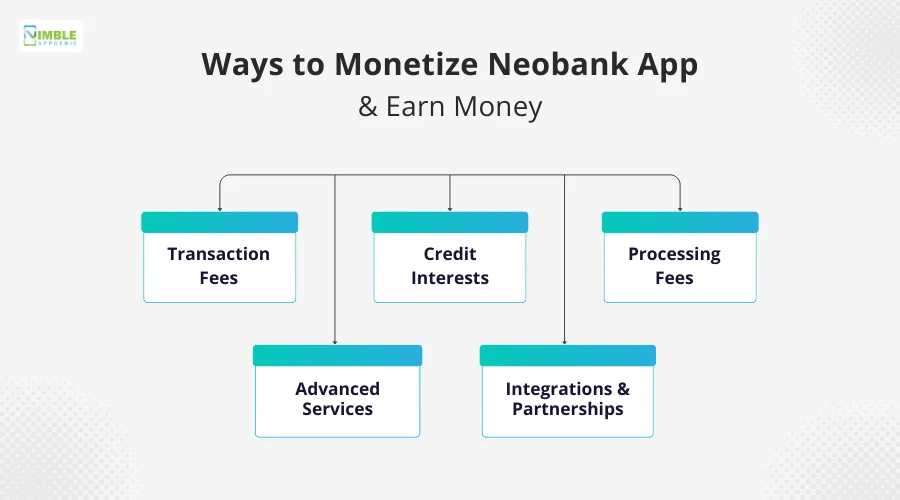
1. Transaction Fees
A neobank can charge a minimal amount as a transaction fee for every transaction that it facilitates. While it seems a small amount that matters to the customer, it can be highly beneficial for your business when high-volume transactions start coming in.
2. Credit Interest
If your neobank offers a credit line to users, it can surely fetch solid revenue for your business in the form of credit interest. These are a great way to monetize your application, however, you need proper credit risk assessment tools to stay on top of these transactions.
3. Processing Fees
For any request that you process for a user through your platform, be it a bill payment or a third-party platform payment, you can charge a processing fee. This processing fee allows you to maintain the infrastructure that you have built and can contribute to some serious revenue.
4. Advanced Services
You can also offer advanced services at a fee inside your app. Services like checking credit scores, additional insurance plans, and more can be bought through a Neobank in exchange for additional charges. This is another great way to monetize your app.
5. Integrations & Partnerships
In-app purchases, brand integrations, and affiliate partnerships also bring along a great deal of revenue for the users. You can decide the price for those integrations, along with the terms and conditions to make the most of this revenue stream.
Other than these, a Neobank can include subscriptions and other services that can help generate revenue for the users. Needless to say, the opportunities that Neobank apps bring along are endless.
Why Build Your Neobank With Nimble AppGenie?
If you are looking to create a neobank that’s compliant, scalable, and actually ready for real users, you already know the hardest part is not the idea. It’s finding a banking software development company that understands both the technology and the financial complexity behind it. That’s exactly where Nimble AppGenie comes in.
Fintech startups usually have confusion about which is the best company to build a neobank app. Well, if you are searching for the best company to build your neobank app, the answer depends on your region, budget, and compliance needs, but experience with fintech-specific development and regulatory compliance is non-negotiable. Our neobank app development team can help here.
We have spent years building fintech products that go beyond good-looking interfaces, products that handle real money, real regulations, and real user expectations.
Here’s what that means for your neobank:
- We know fintech compliance inside out – KYC flows, AML protocols, PCI-DSS, GDPR, PSD2, these are not afterthoughts for us.
- We have solved the problems you haven’t hit yet, from BaaS integration and card processor APIs to fraud detection systems and real-time transaction infrastructure; we have built these before.
- We build for scale, not just launch.
- We work the way you need us to. Whether you want a dedicated team, a specific team of fintech app developers, or end-to-end delivery, we match your engagement model, timeline, and budget.
Conclusion
The question most founders and businesses are now asking is: how do I build a neobank that actually wins in this market?
This guide has walked you through everything that an answer requires: what a neobank is and how it works, how to develop a neobank step by step, the features that drive retention, what it realistically costs to create a neobank from scratch or as an MVP, and how to generate sustainable revenue once you are live.
The neobank market is growing fast, but the brands that will define it are the ones being built right now, with the right foundations.
If you are ready to move from research to execution, want to understand the cost to develop your neobank, scope out your MVP, specific fintech solutions like KYC integration, payment processing, or fraud detection infrastructure, or simply talk to someone who has built this before, our fintech app development experts are ready when you are.
FAQs
Yes, a focused MVP with core features like onboarding, KYC, account management, and transfers can be built starting from $30,000–$50,000 with the right development team.
White-label solutions can get your neobank to market in 1–3 months at a lower cost, but they limit customization and scalability. Building from scratch takes longer and requires a larger investment, but provides complete ownership, flexibility, and long-term growth potential. Many startups begin with a Banking-as-a-Service (BaaS) or white-label platform and later transition to a custom-built solution.
The cost of developing a neobank from scratch typically ranges between $150,000 and $500,000+, depending on the feature set, target market, technology stack, and development team. This investment generally covers backend infrastructure, KYC/AML integrations, card processing, UI/UX design, and compliance requirements. Additional maintenance and regulatory costs should also be considered after launch.
Yes, if you focus on essential features only. By using a Banking-as-a-Service (BaaS) provider, adopting a cross-platform framework such as React Native or Flutter, and limiting the scope to onboarding, KYC, account management, transfers, and notifications, you can launch an MVP within a $50,000 budget. This approach is ideal for validating your concept, attracting early users, and securing investor interest before scaling.
A Neobank is a digital, online-only bank that offers an intuitive user interface and makes it easier for individuals to manage their banking from the comfort of their homes. On the other hand, mobile banking apps are associated with traditional banks. While these apps offer enough online functionalities, the majority of the core banking services are only available offline.
Neobanks are highly viable solutions and can be used to generate revenue. The application offers several services, features, and processes that can be monetized through processing fees, transaction fees, in-app purchases, and more.
A neobank app deals with a lot of sensitive data, along with the financial information of a user. Hence, it must comply with banking regulations, including obtaining necessary licenses, adhering to anti-money laundering (AML) and know your customer (KYC) protocols, and ensuring data protection and privacy.

Niketan Sharma, CTO, Nimble AppGenie, is a tech enthusiast with more than a decade of experience in delivering high-value solutions that allow a brand to penetrate the market easily. With a strong hold on mobile app development, he is actively working to help businesses identify the potential of digital transformation by sharing insightful statistics, guides & blogs.
Table of Contents




No Comments
Comments are closed.