

 Free Consultation
 PCI-DSS Compliant
 GDPR Ready
 ISO 27001
 NDA Protected
 AI Services
 AI App Development
 Generative AI Development
 AI Chatbot Development
 AI Integration Services
 AI Consulting Services
 AI For Fintech
 AI Financial Assistant Solution
 AI Insurance Agent Development
 Tech Stack
 OpenAI / GPT-4
 Claude / Anthropic
 Gemini / Google AI
 Llama / Open Source
 LangChain / LlamaIndex
 Pinecone / Pgvector
 AWS / Azure AI


 Fintech Solution
 Core Fintech
 App Development
 Neobank Solutions
 eWallet Solutions
 Lending Software
 Banking Solutions
 BNPL Solutions
 BNPL Solutions
 Insurance App
 Wealth Management
 Crypto & DeFi
 Blockchain Development
  Payroll Software
 DeFi Solutions
 Crypto Wallet
 Crypto On/Off Ramp
 Crypto Exchange
 Trading Platform
 Payments
 Compliance
 Regulations & Compliance
 Fraud Detection
 Lending Ecosystem
 P2P Lending Platform
 Mortgage Software
 Engagement
 Fintech Outsourcing

 Mobile Development
 Mobile App Dev
 iOS App Development
 Android App Development
 React Native
 Flutter Development
 Web Solution
 Node.js Development
 React.js Development
 Angular Development
 App Services
 UI/UX Design
 App Maintenance
 By Stage
 MVP Development
 Industry Solutions
 Healthcare App Dev
 Education App Dev
 Travel App Dev
 Real Estate App Dev
 Logistics Software
 Social Media App

 Hire Mobile Developers
 Hire iPhone Developers
 Hire Android Developers
 Hire React Native Devs
 Hire Flutter Developers
 Hire Web Developers
 Hire Node.js Developers
 Hire Angular Developers
 Hire PHP Developers
 Hire Laravel Developers
 How It Works
 Pre-Vetted Developers
 Ready In 48 Hours
 NDA From Day One
 Replace Guarantee
 Company
 About Us
 Our Work Process
 Portfolio
 Case Studies
 Blog / Insights
 Careers
 Contact Us
 Awards
 Recognition


 Offices


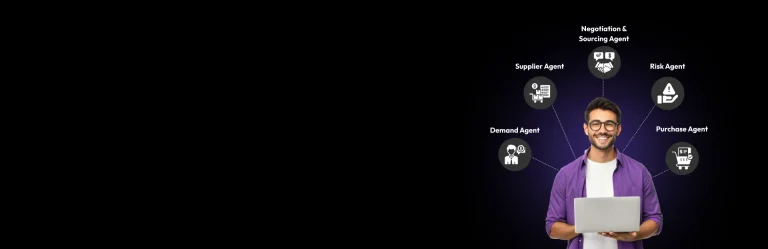
Key Takeaways:
- Multi-agent procurement systems automate sourcing, supplier evaluation, negotiation, approvals, and purchasing.
- Specialized AI agents work together through an orchestration layer to manage complex procurement workflows.
- Key features include ERP integration, quote comparison, smart recommendations, and inter-agent communication.
- Governance controls, human approvals, spending limits, and audit trails improve security and accountability.
- Building a multi-agent procurement system can cost between $20,000 and $160,000.
- Connect with Nimble AppGenie to build a multi-agent procurement system for your business.
Imagine a procurement platform where your platform can handle different types of tasks, such as searching for vendors in case of a material shortage and then selecting the best vendor for your project.
Well, this can all be done if you build a multi-agent procurement system for your platform.
Hence, what are you waiting for?
You can build a multi-agent procurement system by clarifying your agents, setting up tasks, defining the procurement flow, designing the data and integration layer, and then building the complete platform.
In this guide to creating a multi-agent procurement system, we will walk you through different measures to create a multi-agent procurement system, key features, costs, and challenges.
Hence, without further ado, let’s get started.
What is a Multi-Agent Procurement System?
A multi-agent procurement system is a network of specialized AI agents that work together to automate, coordinate, and optimize the entire purchasing and supply chain lifecycle. Instead of using a single AI tool or rigid rules-based software for one isolated task, a multi-agent system divides labor among different expert agents.
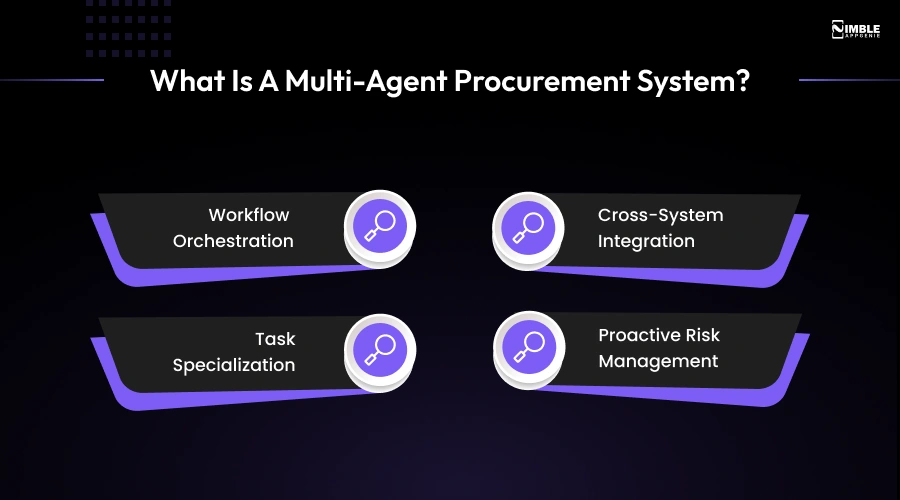
The key roles of a multi-agent procurement system are:
- Workflow Orchestration
- Task Specialization
- Cross-System Integration
- Proactive Risk Management
The core example of a multi-agent procurement system is a supply chain management platform.
Here, in a car manufacturing unit, when steel falls short, a multi-agent procurement system notices this and notifies another agent to find out the current market rates of steel.
This agent evaluates the current steel prices, identifies the vendors from whom procurement can be done quickly, and then places an order. On the other hand, another agent talks to the steel vendor and locks the deal with the vendor.
This is how a multi-agent procurement system works in case of a supply chain management.
You can also check for “how to use AI technology for developing an automated mobile app?”
Now, most of the startups and entrepreneurs ask what are the key features can be included in a multi-agent procurement system.
For features, let’s consider the next section.
What are the Key Features of a Multi-Agent Procurement System?
The key features of a multi-agent procurement system are an orchestration layer and specialized agent roles, cross-system integration, and shared context.
For building a multi-agent procurement system, you should include the right features.
Let’s discuss the complete list of key features of a multi-agent procurement system before you catch up on how to create a multi-agent procurement system:
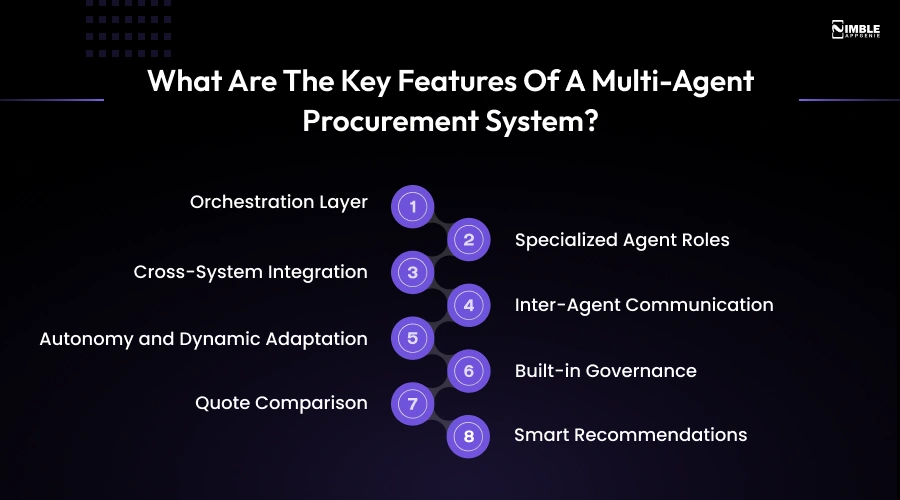
1. Orchestration Layer
A central management framework coordinates activities, assigns tasks, and handles execution handoffs. It is a software middleman that coordinates and manages how different AI agents work together in a procurement process.
Monitoring metrics such as App uninstall rate can also help businesses evaluate user engagement and identify areas for improvement.
2. Specialized Agent Roles
This feature divides the buying process into distinct, expert tasks that allow this system to break down complex purchasing tasks into smaller, expert-driven jobs.
3. Cross-System Integration
A cross-system integration connects a multi-agent procurement system with external platforms like enterprise resource planning (ERP), inventory databases, and supplier portals. This is among the top AI features in mobile apps that revolutionize user experience.
4. Inter-Agent Communication
Inter-agent communication is a key feature because it lets independent software agents share data, negotiate terms, and coordinate actions to buy goods efficiently.
5. Autonomy and Dynamic Adaptation
The autonomous agents, as a feature of a multi-agent procurement system, let the agents adjust workflows based on shifting market data or operational context rather than following rigid, and hardcoded paths.
6. Built-in Governance
The governance frameworks are built into the multi-agent procurement system that is a combination of policies, technical controls, monitoring capabilities, and organizational processes that ensure transparency.
7. Quote Comparison
It compares supplier quotes, contract terms, shipping costs, and payment conditions. It is a tool that automatically collects, analyzes, and ranks supplier bids.
8. Smart Recommendations
Smart recommendations act as a core engine in a multi-agent procurement system that uses AI to suggest the best suppliers, products, or purchasing choices to buyers.
Well, after understanding the key features, let’s focus on how to build a multi-agent procurement system in the next section.
How to Build a Multi-Agent Procurement System?
You can create a multi-agent procurement system by defining the procurement workflow, identifying the required agents, setting clear agent responsibilities, creating a shared communication layer, building the procurement rules, and then testing each agent.
Here is the list of key steps to create a multi-agent procurement system:
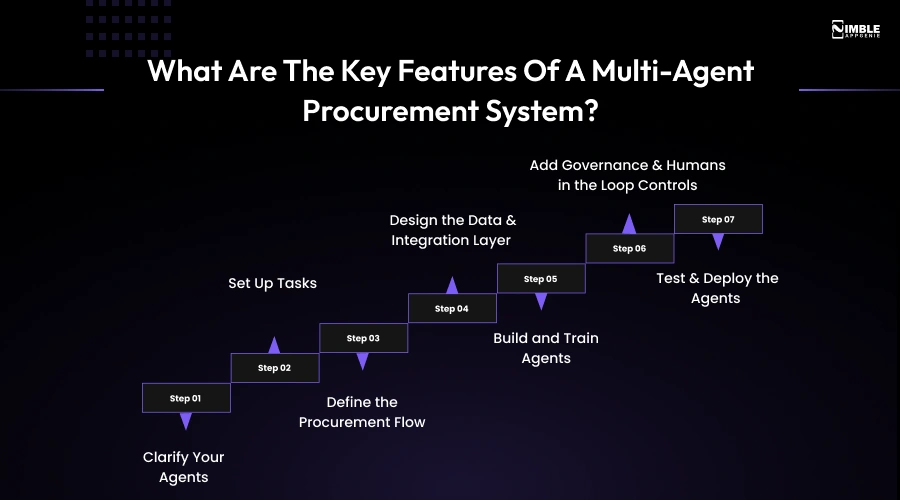
Step 1: Clarify Your Agents
This is the first step, where you should clarify your agents and why you need a multi-agent procurement system. Along with this, you should specify what kind of multi-agent procurement system you want.
Here’s what you need to:
- Identify whether it will simplify your decisions in your business.
- Sourcing and supplier vetting agent.
- Examine what kind of agent your system needs.
- Map each step of your workflow.
Step 2: Set Up Tasks
Now, you should state what type of tasks you want your multi-agent procurement system to perform. You should define clear descriptions and expected outputs, and then should clarify the roles, such as vendor research, contract review, and pricing analysis for each agent.
Here’s what you need to do:
- Sourcing & supplier agent
- Compliance and risk agent
- Approval and orchestration supervisor
- Negotiation tasks
Step 3: Define the Procurement Flow
In this first step, you should set up a central orchestrator, define specialized domain agents, and connect them securely to enterprise data. It is all about discovering why you need a multi-agent procurement system and what will be the result of the same.
This is what you should do:
- Identify the Business Needs
- In this step, you should identify the right orchestration layer for your business.
- The type of orchestration layer can be LangGraph, Crew AI, AutoGen, or Semantic Kernel.
- Design the data and integration layer via ERP/SAP/Oracle connectors and a vector DB for suppliers.
Step 4: Design the Data & Integration Layer
Now, in this step, you should design the data and integration layer, which is the architectural step where you choose how to store, structure, and move data securely between your system components and outside services.
This is what you should do:
- Coordinating with specialized AI agents to handle end-to-end source-to-pay workflows.
- Integrate a wide and easy-to-type prompting space.
- Design the multi-agent procurement system as per the requirements.
Note: some of the agents require continuous monitoring of data streams and identifying meaningful signals. While some agents act by triggering workflows, executing updates, and sending timely notifications.
Step 5: Build and Train Agents
Now, you should add the procurement rules and controls. This is all about adding the technicalities, such as coordinating independent software agents to handle tasks such as sourcing, negotiating, and even purchasing goods.
Businesses can improve operational efficiency by adopting AI automation solutions that streamline repetitive workflows, reduce manual tasks, and help teams manage complex processes more effectively.
This is what you should do:
- Now you should opt for LLM selection, prompt/tool design, and orchestration of specialized AI agents that are connected via tool protocols to the enterprise systems.
- AI in app development will help in continuously training the agents and making them the best version in handling users’ requests.
- Training will help the agents to offer better responses to the end users.
Note: The more you train the agent, the more responsibly and accurately it will generate the next response.
Step 6: Add Governance & Humans in the Loop Controls
In this step, you should add governance and humans-in-the-loop controls to a multi-agent procurement system by setting clear decision gates, spending limits, as well as audit trails before deployment.
This is what you should do:
- Embed risk-based approval gates, immutable audit logging, and centralized orchestration directly into the agent distribution path.\
- Implement stateful interruptions such as state checkpointing, interaction patterns, routing, and thresholds.
- Enforce logging and accountability that comprise immutable audit trails and assigned ownership.
Step 7: Test & Deploy the Agents
Now, you should test the complete multi-agent procurement system by testing individual specialist agents before validating the orchestration layer that coordinates them.
For testing the agent, you can adopt the following testing strategies:
- Unit testing: test each sub-agent independently, its functionality, and mock tool outputs before connecting them to the network.
- Contract testing: Contract testing ensures that autonomous software agents can communicate reliably without breaking each other’s code.
- Workflow simulation: Test the complete workflow by evaluating every function and its workflow.
- Human-in-the-loop gates: Human-in-the-loop gates are the mandatory checkpoints where a person reviews and approves agent actions before a multi-agent procurement system.
With the key steps to create a multi-agent procurement system, let’s get ahead of the cost in the next section.
What is the Cost to Create a Multi-Agent Procurement System?
The overall cost to build a multi-agent procurement system varies from $20,000 to $160,000. This cost depends on agent intelligence, the AI model, API usage, data integration, and compliance frameworks.
Here is the complete cost breakdown for a multi-agent procurement system development:
| Cost factor | Basic system: $20,000–$45,000 | Advanced system: $80,000–$160,000 |
| Agent intelligence and workflow design | $4,000–$10,000 | $20,000–$40,000 |
| AI model selection and integration | $3,000–$8,000 | $15,000–$30,000 |
| API usage and automation | $2,000–$5,000 | $10,000–$25,000 |
| Data and ERP integration | $4,000–$10,000 | $15,000–$30,000 |
| Procurement rules and compliance frameworks | $2,000–$5,000 | $10,000–$20,000 |
| User dashboard and approval workflows | $3,000–$5,000 | $8,000–$15,000 |
| Testing, security, deployment, and support | $2,000–$7,000 | $12,000–$25,000 |
| Estimated total | $20,000–$45,000 | $80,000–$160,000 |
Bonus Read: “AI App Development Cost”
Following the cost breakdown parameters, let’s discuss the use cases of multi-agent systems in the next section.
Use Cases of Multi-Agent Systems
Several multi-agent systems are leading the world. If you are thinking of building a multi-agent procurement system, you should be aware of your competitors.
Therefore, here is the complete list of use cases of multi-agent systems:
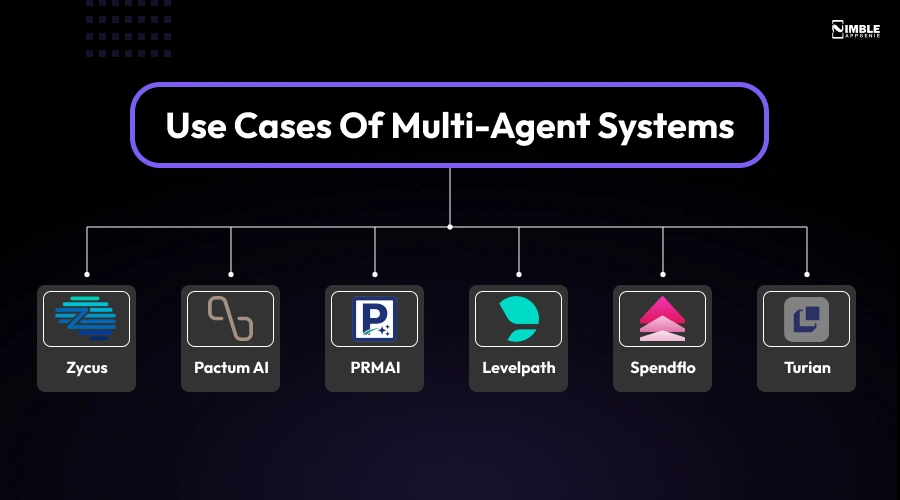
1. Zycus
Zycus operates as a multi-agent procurement system that runs multiple coordinated agents across intake-to-pay, including a dedicated autonomous negotiation agent (ANA) that works alongside a Merlin intake agent and turns requests into actions.
2. Pactum AI
A multi-stage agentic system that picks up requisitions, reviews them against policy, and executes commercial terms autonomously, connecting natively with SAP Ariba and Coupa.
3. PRMAI
PRMAI is an AI-first source-to-pay procurement platform, where the agents handle sourcing, vendor management, purchasing, and invoice processing, coordinated through a central orchestration engine.
4. Levelpath
Levelpath is a multi-agent procurement system that works across your most complex procurement workflows, delivering ranked suppliers, contract insights, and risk signals so your team spends time on the decisions only they can make.
5. Spendflo
Spendflo is an AI-native procurement and spend management platform that uses a connected, multi-agent workforce to run the entire intake-to-pay procurement lifecycle. Instead of acting merely as a dashboard or a ticketing assistant, Spendflo operates on behalf of lean finance.
6. Turian
Turian functions as an agentic AI platform that automates multi-step procurement and supply chain workflows by integrating autonomous digital assistants into your communication channels and even enterprise systems.
Well, are you still wondering whether you should build or buy a custom multi-agent procurement system?
If yes, let’s get ahead with the differences in the next section.
Build vs Buy: Should You Build a Custom Multi-Agent Procurement System?
The difference between build vs buy illustrates whether you should opt for building the multi-agent procurement system or it would be better to buy a complete multi-agent procurement system.
Let’s get ahead with the differences list below:
| Factor | Build (Custom) | Buy (Off-the-Shelf) |
| Upfront Cost | Higher development, infrastructure, and integration costs | Lower subscription/license-based |
| Time to Launch | Longer (months): discovery, design, build, testing | Faster (weeks): pre-built, ready to configure |
| Customization | Full control over agent logic, workflows, and rules | Limited to vendor’s configuration options |
| ERP/System Integration | Built exactly for your existing stack (SAP, Oracle, legacy tools) | May require workarounds for non-standard or legacy systems |
| Ongoing Maintenance | Your team owns updates, bug fixes, model tuning | Vendor handles updates and infrastructure |
| Scalability | Scales however you architect it | Scales within vendor’s platform limits |
| Data Ownership & Privacy | Full control, data stays in your environment | Shared with vendor’s infrastructure/cloud |
| Competitive Differentiation | High proprietary workflows competitors can’t replicate | Low; same tool available to competitors |
| Best For | Enterprises with unique workflows, compliance needs, or long-term AI strategy | Businesses needing quick deployment with standard procurement processes |
Whether you opt for build or buy, it is essential to identify the risks and governance considerations.
Hence, let’s get ahead with the risks and governance landscape in the next section.
Risks & Governance Considerations
There are multiple risks and governance considerations that might impact the complete process of creating a multi-agent procurement system.
Let’s evaluate the risks and governance considerations:
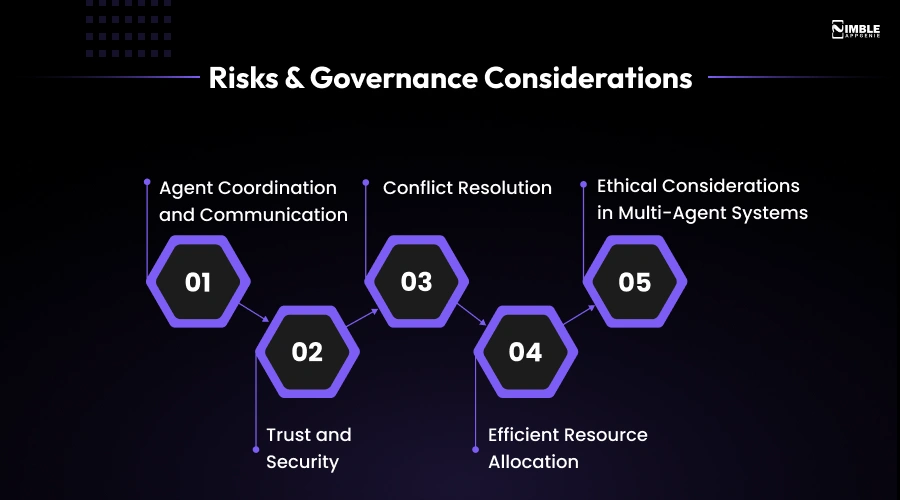
1. Agent Coordination and Communication
The coordination among the agents is one of the most critical challenges that multi-agent procurement systems often face. Lack of coordination results in conflicts that can break the entire supply chain. Like a well-orchestrated dance, agents should move in harmony.
2. Trust and Security
The multi-agent procurement system handles a large amount of sensitive data. Bad actors can continuously hack or trick these systems into making unauthorized purchases or leaking private company data.
3. Conflict Resolution
Here, different agents have different goals. Here, a budget agent wants low costs, while a quality agent wants high standards. Therefore, systems are required to solve these arguments and conflicts by framing clear rules.
4. Efficient Resource Allocation
In multi-agent systems, the resources can range from computational power to data access privileges. As the system scales, the competition for these resources intensifies. Here, efficient allocation becomes crucial to prevent bottlenecks and to ensure smooth operations.
5. Ethical Considerations in Multi-Agent Systems
The ethical challenges in multi-agent systems are opaque and emergent decision-making, accounting and error attribution, and algorithmic bias and fairness. If the multi-agent system is not ethical, it can result in increased data risks and invite cyberattacks.
Which is the Best Company to Create a Multi-Agent Procurement System?
Nimble AppGenie is the best AI Agent Development Company that plans, uses tools, and completes multi-step tasks autonomously. From customer support to financial analysis and code review, AI agents are developed to manage knowledge work.
Here’s why you need to select Nimble AppGenie for building a multi-agent procurement system:
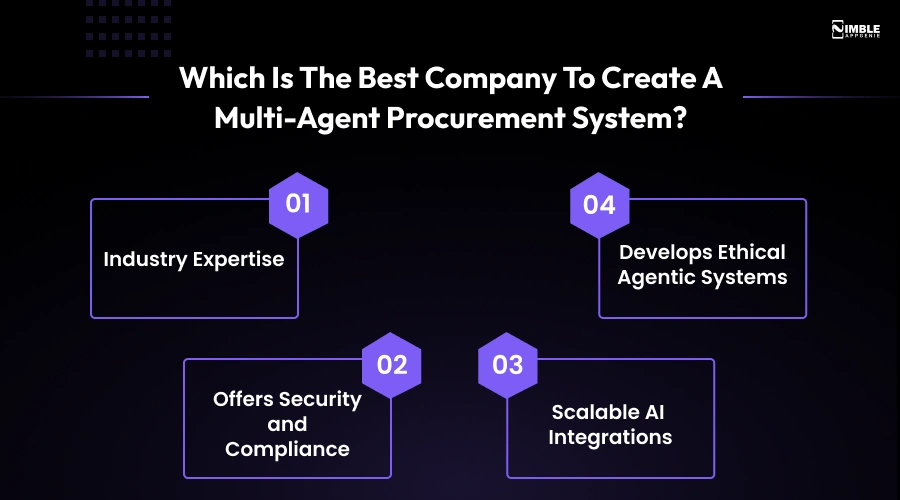
- Industry Expertise: Nimble AppGenie is the best fintech software development company that ensures businesses get the finest and most prominent experience while creating a multi-agent procurement system.
- Offers Security and Compliance: With every multi-agent procurement system, Nimble AppGenie offers security and compliance practices.
- Scalable AI Integrations: Nimble AppGenie focuses on user-centric designs, combined with robust backend intelligence, ensuring deployed features remain performant.
- Develops Ethical Agentic Systems: The engineers at Nimble AppGenie offer ethical agentic systems that ensure morality with every prompt input. Additionally, our team implements the latest technological advancements when it comes to creating a multi-agent procurement system.
Conclusion
For building a multi-agent procurement system, one should follow a complete process from market study to technical development and launch. Features that can be included in a multi-agent procurement system are an orchestration layer, specialized agent roles, cross-system integration, and built-in governance.
The overall cost to make a multi-agent procurement system varies due to different factors such as agent intelligence, API usage, data integration, and compliance frameworks.
Diversified risks involved in creating a multi-agent procurement system are agent coordination, trust and security, conflict resolution, and ethical considerations.
FAQs
The key features to include in a multi-agent procurement system are an orchestration layer, specialized agent roles, cross-system integration, inter-agent communication, quote comparison, and built-in governance.
The overall cost to build a multi-agent procurement system varies $20,000 to $160,000. This cost further varies depending on factors such as agent intelligence, the AI model, API usage, data integration, and compliance frameworks.
A multi-agent procurement system is an artificial intelligence network where multiple agents coordinate, automate, and optimize the entire purchasing and supply chain lifecycle. The core components of a multi-agent procurement system are a sourcing agent, a contract agent, and a risk agent.

Niketan Sharma, CTO, Nimble AppGenie, is a tech enthusiast with more than a decade of experience in delivering high-value solutions that allow a brand to penetrate the market easily. With a strong hold on mobile app development, he is actively working to help businesses identify the potential of digital transformation by sharing insightful statistics, guides & blogs.
Table of Contents




No Comments
Comments are closed.