

 Free Consultation
 PCI-DSS Compliant
 GDPR Ready
 ISO 27001
 NDA Protected
 AI Services
 AI App Development
 Generative AI Development
 AI Chatbot Development
 AI Integration Services
 AI Consulting Services
 AI For Fintech
 AI Financial Assistant Solution
 AI Insurance Agent Development
 Tech Stack
 OpenAI / GPT-4
 Claude / Anthropic
 Gemini / Google AI
 Llama / Open Source
 LangChain / LlamaIndex
 Pinecone / Pgvector
 AWS / Azure AI


 Fintech Solution
 Core Fintech
 App Development
 Neobank Solutions
 eWallet Solutions
 Lending Software
 Banking Solutions
 BNPL Solutions
 BNPL Solutions
 Insurance App
 Wealth Management
 Crypto & DeFi
 Blockchain Development
  Payroll Software
 DeFi Solutions
 Crypto Wallet
 Crypto On/Off Ramp
 Crypto Exchange
 Trading Platform
 Payments
 Compliance
 Regulations & Compliance
 Fraud Detection
 Lending Ecosystem
 P2P Lending Platform
 Mortgage Software
 Engagement
 Fintech Outsourcing

 Mobile Development
 Mobile App Dev
 iOS App Development
 Android App Development
 React Native
 Flutter Development
 Web Solution
 Node.js Development
 React.js Development
 Angular Development
 App Services
 UI/UX Design
 App Maintenance
 By Stage
 MVP Development
 Industry Solutions
 Healthcare App Dev
 Education App Dev
 Travel App Dev
 Real Estate App Dev
 Logistics Software
 Social Media App

 Hire Mobile Developers
 Hire iPhone Developers
 Hire Android Developers
 Hire React Native Devs
 Hire Flutter Developers
 Hire Web Developers
 Hire Node.js Developers
 Hire Angular Developers
 Hire PHP Developers
 Hire Laravel Developers
 How It Works
 Pre-Vetted Developers
 Ready In 48 Hours
 NDA From Day One
 Replace Guarantee
 Company
 About Us
 Our Work Process
 Portfolio
 Case Studies
 Blog / Insights
 Careers
 Contact Us
 Awards
 Recognition


 Offices



Key Takeaways:
- Composable banking architecture is a modular design approach that replaces monolithic systems with independent and reusable building blocks.
- MACH framework is used in composable banking architecture, with the core elements including microservices, API-first, cloud-native, and headless.
- To build a composable banking architecture, one should assess the current core system, identify the compatibility blocks, should design the API layer, select the orchestration layer, and should implement governance.
- Overall cost to build a composable banking architecture varies from $30,000 to $80,000+. This cost further varies depending on different factors such as vendor and software licensing fees, integration, legacy migration, and cloud operations.
- Connecting with Nimble AppGenie can help you build a composable banking architecture with the right features.
In 2026, it is projected that the net interest income in the banking market worldwide will reach a staggering amount of US$9.22 trillion.
One of the reasons behind this growing banking market is composable banking architecture.
Traditional banking systems often rely on rigid, monolithic cores that make innovation, integration, and scalability difficult. A composable banking architecture offers a smarter alternative by combining modular services, APIs, cloud technologies, and specialized partners to create flexible financial products.
But how to build a composable banking architecture?
The process requires more than connecting different platforms. Banks must assess their existing infrastructure, define business capabilities, select the right BaaS and technology partners, establish strong governance, and ensure security and compliance.
In this blog, we explore the essential steps, best practices, and considerations for building a scalable, resilient, and future-ready banking ecosystem.
What is a Composable Banking Architecture?
Composable banking architecture means replacing a single, monolithic core with a set of independent, API-connected modules, each responsible for one specific function.
Instead of building one large banking system, businesses should combine independent components such as payments, accounts, cards, lending, and KYC through APIs.
Composable banking is where a systematic architecture model is built on modular, interchangeable components. Each component, whether it’s a service, function, or capability, can be developed, deployed, and even scaled independently.
At the core of this is an API-first strategy, where every service is consumed via standardized interfaces.
The core characteristics of composable banking architecture are:
- API-first design
- Microservices
- Packaged Business Capabilities (PBCs)
The core principles comprise microservices and APIs, cloud-native design, and standardization with BIAN.
Under this architecture, MACH plays an important role by laying the technical foundation for banks. It breaks down the rigid, old-fashioned core systems into flexible and independent software components.
So, what is the MACH framework?
Well, this framework helps businesses to choose the right and best tools by making the structure flexible and easy to add to.
For more information, let’s get ahead with understanding the MACH framework.
MACH Framework Explained
MACH is an enterprise technology framework that stands for microservices, API-first, cloud-native, SaaS, and headless.
The use of the MACH framework offers businesses the freedom to choose from the best tools on the market and maintains a structure that makes it easy to add, replace, or remove those tools in the future.
Let’s discuss the complete MACH framework below:
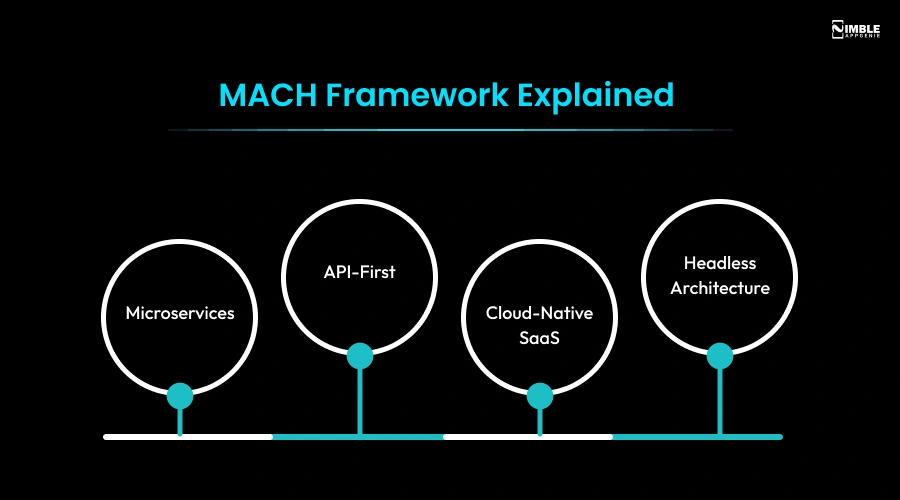
- Microservices: Small, modular pieces of business functionality that are independently developed, deployed, and managed.
- API-first: All functionality is explained in APIs that allow every microservice to talk to other software or AI tools. The connection interface is designed before anything else is built.
- Cloud-native SaaS: The cloud-native SaaS framework refers to vendor-managed software that is built entirely for the cloud, utilizing automatic scaling and managed infrastructure rather than running on local servers.
- Headless Architecture: Headless architecture under the MACH framework refers to the front-end user experience that allows for complete design freedom in creating the user interface and for connecting to other devices and channels.
If you want to explore the features, let’s get ahead with the same in the next section.
Features of Composable Banking Architecture
The key features of composable banking architecture are microservices architecture, API-first design, and cloud-native infrastructure.
The composable banking architecture is the complete control plane that coordinates the modular banking components into one operating model.
Here is the complete list of composable banking architecture features:
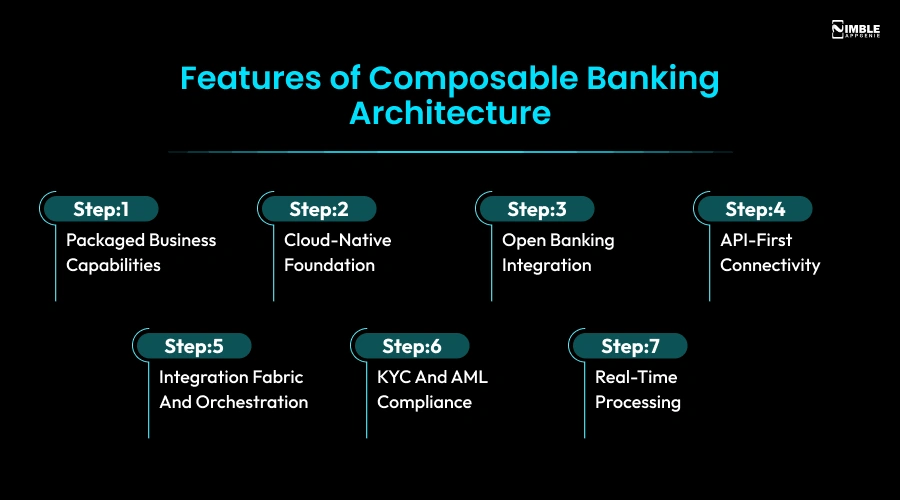
1. Packaged Business Capabilities (PBCs)
Packaged business capabilities are the independent, modular building blocks that bundle the data, business logic, and event channels to perform a distinct financial function with a composable banking framework.
2. Cloud-Native Foundation
Cloud-native foundation is a vendor-neutral, open-source hub which is hosted by the Linux Foundation that builds and supports modern cloud computing architectures.
3. Open Banking Integration
The open banking integration acts as a natural extension of composable banking architecture, where it shares financial data between banks and third-party companies using APIs. This is one of the core banking app features to consider.
4. API-First Connectivity
API-first connectivity is the design practice for building every banking feature and service to be accessible through standardized APIs before creating user interfaces or surrounding applications. With Nimble AppGenie, you can opt for fintech API integration services to enable API-first connectivity.
5. Integration Fabric and Orchestration
Integration fabric and orchestration function as the mandatory connective tissue and intelligence layer, making sure these independent modules act as a unified and coherent ecosystem.
6. KYC and AML Compliance
KYC and AML compliance is a key feature that verifies customer identities and monitors the user check-in process. KYC and AML compliance for fintech prohibits the entry of any unexpected person.
7. Real-time Processing
Real-time processing is a key feature that supports instant transaction updates, notifications, fraud monitoring, and payment updates.
You can include these features while building a composable banking architecture. Now, let’s get ahead with the key benefits of creating a composable banking architecture.

Benefits of Building a Composable Banking Architecture
The key benefits of creating a composable banking architecture comprise seamless integration with new models, multi-service and omnichannel capabilities, faster time to market, as well as future-proof scalability.
Let’s discuss the complete list of benefits below:
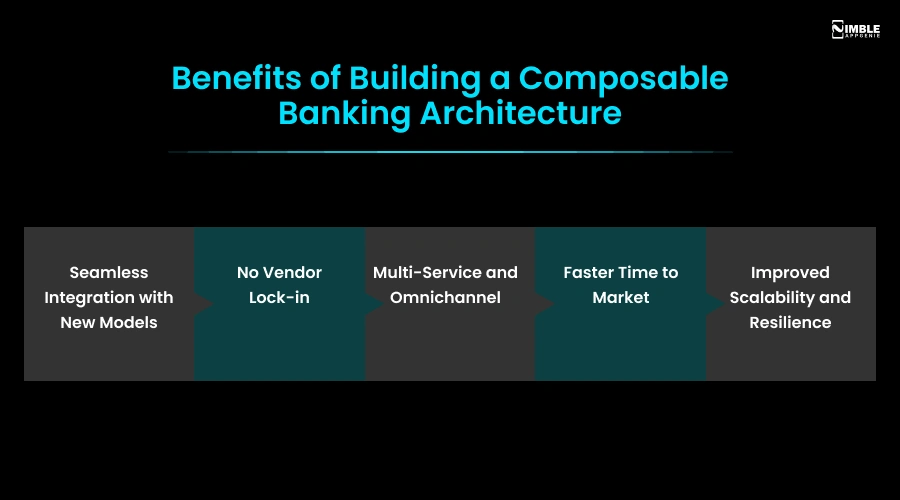
1] Seamless Integration with New Models
The composable banking architecture allows financial institutions to plug in advanced technologies such as artificial intelligence or third-party financial services without disrupting their existing core operations.
2] No Vendor Lock-in
The composable banking architecture offers financial organizations the flexibility to select which components or services are best suited for their needs without relying on a single vendor.
3] Multi-Service and Omnichannel
The multi-service capabilities and omnichannel delivery are the core pillars of a composable banking architecture that enables banks to break away from rigid, monolithic systems and build a customer-centric financial ecosystem.
4] Faster Time to Market
When it comes to banking or any fintech industry, it is important to have a faster time to market. With the help of composable banking architecture, it lets financial institutions launch new products and features in days or weeks instead of months.
5] Improved Scalability and Resilience
Composable banking architecture enhances scalability and resilience by helping banks to scale or fix individual modular services without breaking the whole system.
Well, now, as you are aware of the features and concepts, many of the startups and entrepreneurs often ask, “How to build a composable banking architecture?”
How to Build a Composable Banking Architecture?
To create a composable banking architecture, one should follow the right process, starting with studying the market, understanding the banking app, and selecting the right infrastructure.
Let’s evaluate the complete process to create a composable banking architecture:
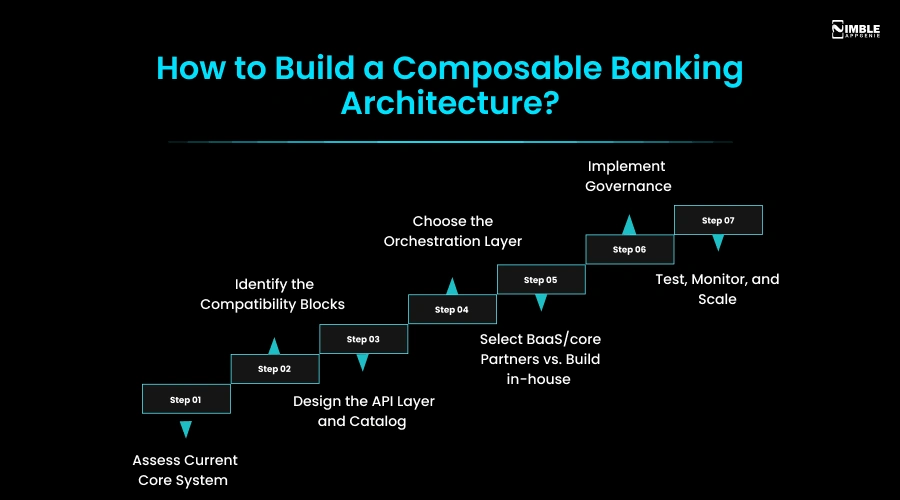
Step 1: Assess Current Core System
Is your banking system ready for the composable banking architecture?
If yes, you should proceed with developing a composable banking architecture; otherwise, you should remain with your current software.
But how to assess whether your banking system is ready for a composable banking architecture or not?
Well, for this, let’s examine the following points:
- You should check the product complexity, customization needs, integration requirements, and the speed you need to deliver your services in the market.
- Evaluate the modularity and data access patterns of your software.
- Identify the business logic coupling, infrastructure, and deployment patterns.
Step 2: Identify the Compatibility Blocks
In this step, you should evaluate what compatibility measures one should consider. Here, you should examine different parameters like onboarding, payments, API capability, data access, business logic coupling, and infrastructure.
For identifying the compatibility blocks, you must decompose core banking functions into autonomous and business-aligned units.
- Create a compatibility matrix
- Verify properties of your banking software
- Simplify and find maximal subgraph
- Draw the compatibility graph
Step 3: Design the API Layer and Catalog
Designing an API layer and catalog is the second and most important step, and it requires separate runtime engineering from discovery and management. In this step, you should separate your core banking engines from your external channels via an API gateway.
This is what you should do while designing an API layer and catalog:
- Use a layered API architecture that comprises different layers, including experience APIs, domain APIs, platform APIs, and integration APIs.
- Establish the canonical banking concepts as the foundational step in building a banking architecture.
- Design the APIs around the banking software commands and queries.
Same as in the banking app design, you should consider the API layer and catalog formation.
Step 4: Choose the Orchestration Layer
Selecting the orchestration layer for a composable banking architecture requires evaluating the platforms that coordinate the deterministic workflows and human interventions. It acts as the central nervous system of a composable banking architecture.
This is what you should do:
- Choose the control tower that coordinates data
- User interactions across independent systems without hard-coding point-to-point links.
- It requires you to balance rigid regulatory compliance and deterministic financial logic with flexible multi-vendor microservices.
Hence, to build a composable banking architecture, orchestration layers play a critical role because it ties the independent modular services together into a smooth, unified customer experience.
Step 5: Select BaaS/core Partners vs. Build in-house
Now, you should select what type of blocks are required to build while selecting a composable banking architecture. This is an important step where you should decide which blocks to build vs which blocks to integrate via BaaS providers.
This is what you should do in this step:
- For this, you need a capability map.
- Then classify the capabilities into three groups such as building internally, buy or partner, and keep replaceable.
- Select a weighted decision model.
You need to select the core partner and should identify the key capabilities that are required to be outsourced completely with the help of capability mapping.
Step 6: Implement Governance
For implementing governance in a composable banking architecture, you should replace slow paper-based reviews with automated guardrails, standard domain models, and self-service platforms.
This is what you should do:
- Establish clear ownership and standards where you should define who owns each capability, API, event, data domain, and control.
- Create an architecture and API review process
- Automate governance through the catalog and delivery pipeline.
In the composable banking architecture, governance matters because of consistent standards, controlled access, risk management, and increasing the efficiency of your banking platform.
Step 7: Test, Monitor, and Scale
Now, in the process of making a composable banking architecture, you should test, monitor, and scale the complete process for building a composable banking architecture.
This is what you should adopt for banking mobile app testing:
- Implement contract testing
- Virtualize third-party banking APIs
- It requires you to shift from traditional monolithic testing to a decoupled, API-first strategy.
Now, following these steps to create a composable banking architecture, you should be aware of the different cost parameters.
Bonus Read: How to Create a Mobile Banking App?
Therefore, let’s identify how much it does cost to create a composable banking architecture in the next section.
How Much Does it Cost to Create a Composable Banking Architecture?
The overall cost to make a composable banking architecture varies from $30,000 to $80,000+.
Here is the cost breakdown showing the complete cost to build a composable banking architecture:
| Scope | Estimated Cost | Timeline | What’s Included |
| Pilot / Single Module | $30,000 – $45,000 | 6–10 weeks | One decoupled capability (e.g., onboarding or payments), API layer for that module, basic integration with existing core |
| Mid-Scale (Multi-Module) | $45,000 – $65,000 | 3–5 months | 2–4 modules (onboarding, payments, lending, KYC), API gateway setup, orchestration/middleware layer, governance basics |
| Full Composable Transformation | $65,000 – $80,000+ | 5–9 months | Complete MACH-based architecture, API catalog, multiple BaaS/core integrations, headless front-end, compliance and monitoring layer |
Other than the above-stated cost differentiation by project scope, let’s discover the different factors impacting the complete cost to make a composable banking architecture.
For the diversified factors impacting the complete cost to make a composable banking architecture, let’s evaluate the list below:
| Factor | Cost Impact |
| Number of capability modules | $5,000 – $15,000 per module |
| Legacy system integration | $8,000 – $20,000 |
| API design & governance | $5,000 – $12,000 |
| Orchestration/Banking OS layer | $10,000 – $18,000 |
| Compliance & regulatory scope (PCI DSS, GDPR, RBI) | $8,000 – $15,000 |
| Headless front-end development | $6,000 – $12,000 |
| Cloud infrastructure & DevOps setup | $5,000 – $10,000 |
| Security & data protection layer | $6,000 – $12,000 |
| Build vs. BaaS partner integration | Can reduce cost by 15–30% |
These factors do impact the complete cost to build a mobile banking app.
Now, when you build a composable banking architecture, there can be certain challenges that your banking software might face.
Let’s consider these challenges in the next section.
Challenges in Creating a Composable Banking Architecture
The key challenges in building a composable banking architecture are data fragmentation, process redesign, fintech integration, standardization gaps, and legacy coexistence.
Let’s discover the complete list of challenges in creating a composable banking architecture:
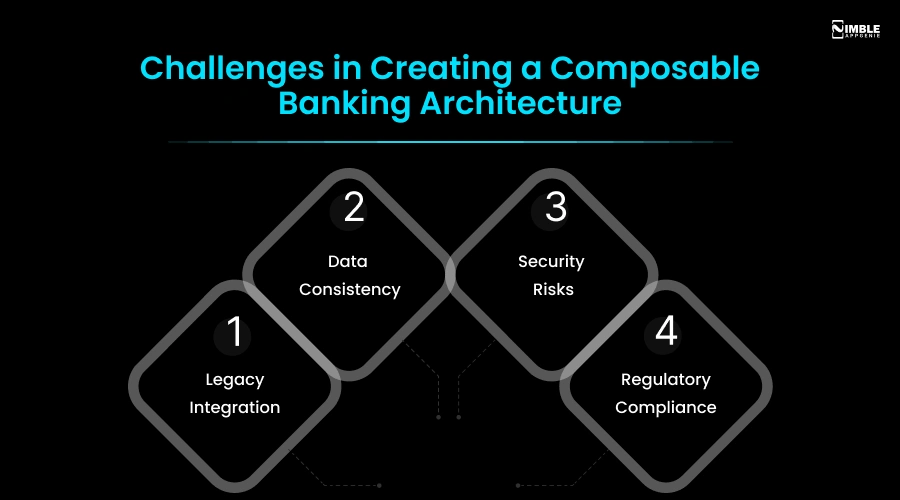
1. Legacy Integration
Connecting the modern composable banking architecture with the old technologies of banking is one of the core challenges for legacy integration.
Legacy integration is hard because of monolithic design, batch processing, custom code, and security risks.
Adopting complex technology measures is the ultimate solution in this process.
2. Data Consistency
Keeping the customer data and transactions synchronized and accurate in real time across many independent microservices is challenging.
Data consistency is a challenge because of no shared databases, network failures, asynchronous communication, and regulatory demands.
The right solution is to establish a unified data foundation decoupled from application logic, combined with real-time event orchestration.
3. Security Risks
Security risks are a key challenge for composable banking because opening the core systems through APIs increases the number of potential entry points for cyberattacks.
Different banking app security measures can impact the complete composable banking architecture, including API vulnerabilities, broken access control, and supply chain attacks.
To overcome these security challenges, you can rely on a well-known app development company such as Nimble AppGenie, whose engineers use robust security patterns and technologies to secure banking software.
4. Regulatory Compliance
If you are unaware of the right compliance practices for building a composable banking architecture, this can result in a critical challenge.
Under regulatory compliance, several challenges to overcome include audit trails, data governance, third-party risk management, consistent policy enforcement, and legacy integration.
You should opt for fintech and digital payments regulations and compliance to overcome any regulatory challenges while creating a composable banking architecture.

Which is the Best Company to Create a Composable Banking Architecture?
Nimble AppGenie, as the best banking software development company, is suitable for you to connect and create a composable banking architecture.
The engineers at Nimble AppGenie are well-skilled in delivering software solutions and apps catering to user-centric needs.
Here’s why Nimble AppGenie is the best company for your banking software development.
- Fraud Detection & Prevention: Nimble AppGenie offers fraud prevention and detection by embedding multi-layered, AI-driven security architectures directly into the financial and lending applications.
- AI-Powered Compliance: The engineers at Nimble AppGenie offer AI-powered compliance by integrating automated identity verification, document processing, and risk monitoring into the banking apps.
- Offers Cloud-Ready Scaling: Nimble AppGenie offers cloud-ready scaling by architecting fintech and mobile applications on cloud-native foundations from the initial design phase.
Conclusion
To create a composable banking architecture, one should begin by assessing the current core system architecture, identifying the compatibility blocks, designing the API layer, selecting the orchestration layer, implementing governance, and testing the architecture.
Creating a composable banking architecture offers diversified benefits such as seamless integration with new models, no vendor lock-in, faster time to market, and offers improved scalability.
The key challenges to overcome while building a composable banking architecture are legacy integration, data consistency, security risks, and regulatory compliance. Connecting with a well-recognized company can help you in building a composable banking architecture.
FAQs
To create a composable banking architecture, one should proceed with assessing the current core system, identify the compatibility blocks, design the API layer, choose the orchestration layer, implement governance, and test the complete architecture.
The key features to create a composable banking architecture are packaged business capabilities, cloud-native foundation, open banking integration, API-first connectivity, and real-time processing.
The core tech stack that is used to create composable banking platforms is RESTful APIs, GraphQL, and event-driven message brokers that allow secure, real-time communication between modules without any hardwired dependencies.
The key risks of composable banking architecture are operational complexity and fragmentation, multiplication of security boundaries, integration and fintech partnership function, and orchestration failures.
The overall cost to create a composable banking system varies from $30,000 to $80,000+. This cost is further impacted by different factors such as the number of capability modules, legacy system integration, API design, orchestration, compliance and regulatory scope, and cloud infrastructure.
Choosing between building a custom banking platform and buying a composable banking-as-a-service provider depends on time to market, budget, and core strategy.

Niketan Sharma, CTO, Nimble AppGenie, is a tech enthusiast with more than a decade of experience in delivering high-value solutions that allow a brand to penetrate the market easily. With a strong hold on mobile app development, he is actively working to help businesses identify the potential of digital transformation by sharing insightful statistics, guides & blogs.
Table of Contents




No Comments
Comments are closed.