

 Free Consultation
 PCI-DSS Compliant
 GDPR Ready
 ISO 27001
 NDA Protected
 AI Services
 AI App Development
 Generative AI Development
 AI Chatbot Development
 AI Integration Services
 AI Consulting Services
 AI For Fintech
 AI Financial Assistant Solution
 AI Insurance Agent Development
 Tech Stack
 OpenAI / GPT-4
 Claude / Anthropic
 Gemini / Google AI
 Llama / Open Source
 LangChain / LlamaIndex
 Pinecone / Pgvector
 AWS / Azure AI


 Fintech Solution
 Core Fintech
 App Development
 Neobank Solutions
 eWallet Solutions
 Lending Software
 Banking Solutions
 BNPL Solutions
 BNPL Solutions
 Insurance App
 Wealth Management
 Crypto & DeFi
 Blockchain Development
  Payroll Software
 DeFi Solutions
 Crypto Wallet
 Crypto On/Off Ramp
 Crypto Exchange
 Trading Platform
 Payments
 Compliance
 Regulations & Compliance
 Fraud Detection
 Lending Ecosystem
 P2P Lending Platform
 Mortgage Software
 Engagement
 Fintech Outsourcing

 Mobile Development
 Mobile App Dev
 iOS App Development
 Android App Development
 React Native
 Flutter Development
 Web Solution
 Node.js Development
 React.js Development
 Angular Development
 App Services
 UI/UX Design
 App Maintenance
 By Stage
 MVP Development
 Industry Solutions
 Healthcare App Dev
 Education App Dev
 Travel App Dev
 Real Estate App Dev
 Logistics Software
 Social Media App

 Hire Mobile Developers
 Hire iPhone Developers
 Hire Android Developers
 Hire React Native Devs
 Hire Flutter Developers
 Hire Web Developers
 Hire Node.js Developers
 Hire Angular Developers
 Hire PHP Developers
 Hire Laravel Developers
 How It Works
 Pre-Vetted Developers
 Ready In 48 Hours
 NDA From Day One
 Replace Guarantee
 Company
 About Us
 Our Work Process
 Portfolio
 Case Studies
 Blog / Insights
 Careers
 Contact Us
 Awards
 Recognition


 Offices



TL;DR
- Fintech CAC runs higher than most industries because of KYC, identity verification, and account-funding friction – the metric that actually matters is the LTV: CAC ratio, not CAC alone.
- Most fintech companies should aim for an LTV: CAC ratio of roughly 3:1 or better before scaling acquisition spend.
- The fastest way to lower CAC is usually fixing onboarding drop-off and early retention, not adding a new channel.
- The 12 strategies below span product-led growth, embedded finance, compliance-first onboarding, SEO, paid acquisition, affiliates, partnerships, referrals, trust signals, niche targeting, retention, and attribution.
- Referral programs and retention optimization are covered in dedicated guides – this article shows how they fit into the broader acquisition strategy.
- Partner with Nimble AppGenie to build the onboarding, referral, and compliance infrastructure that makes fintech customer acquisition affordable to run.
Fintech customer acquisition is one of the most costly line items in the complete business model. Unlike a retail app where a download is close to the finish line, a fintech signup is just the start of a longer, trust-heavy funnel – KYC, identity verification, funding an account, making a first transaction. Each extra step is a place where a paid click quietly turns into a sunk cost.
That’s why fintech CAC/Customer Acquisition Cost tends to run several times higher than in most other app categories, and why “just spend more on ads” stops working the moment a market gets competitive. The fintechs that scale profitably are not the ones who found one magic channel – they are the ones who treat acquisition as a system: the right channel mix, a funnel built for regulated products, and a CAC that’s actually measured against lifetime value.
This guide walks through 12 fintech customer acquisition strategies for 2026, with a look at where costs come from, how to benchmark them, and which levers actually move the number.
What Is a Good CAC for a Fintech Company?
A good CAC for a fintech company is not a fixed number – it’s whatever keeps your LTV: CAC ratio at roughly 3:1 or better, since acceptable CAC varies significantly by vertical. The products themselves carry extremely different levels of trust and transaction value.
| Fintech Vertical | Why CAC Differs |
| Payments / P2P transfer | Low-consideration, high-frequency use – generally the cheapest to acquire |
| Digital banking / neobanking | Higher trust bar, regulated onboarding, mid-to-high CAC |
| Lending & BNPL | High-intent but high-scrutiny; CAC swings with credit risk and approval rates |
| Wealth Management/investing | Long consideration cycle, highest CAC, but highest LTV |
| RegTech / B2B fintech | Long sales cycles, CAC calculated per contract, not per app install |
Anything close to a 1:1 LTV: CAC ratio means growth is being funded by unsustainable spend rather than a working business model – a signal to fix the funnel before scaling budget further.
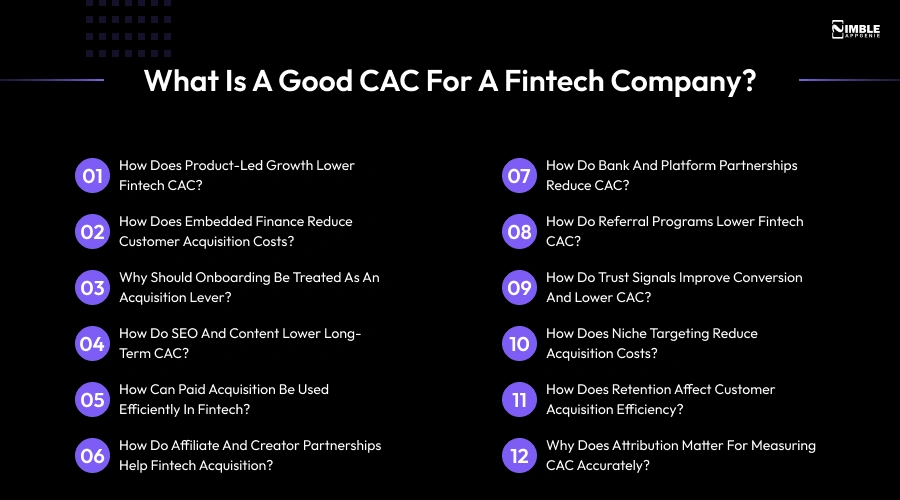
1. How Does Product-Led Growth Lower Fintech CAC?
Product-led growth lowers CAC by giving away something useful before asking for a signup – a loan affordability calculator, a free credit-score check, and a savings rate estimator. Such tools solve a real problem, rank well organically, and put your brand in front of someone at the exact moment they are making a financial decision, which is a far warmer lead than a cold ad click.
The catch is that these tools need to be genuinely embedded in your product experience, not a marketing gimmick bolted on separately. If you are weighing whether to build this as a standalone feature or fold it into your core app, it’s worth reading our breakdown on fintech app development costs to scope the investment properly.
2. How Does Embedded Finance Reduce Customer Acquisition Costs?
Embedded finance reduces CAC by acquiring users through a platform that already has them, instead of one at a time – a payroll provider, a marketplace, an e-commerce checkout. This is how many BNPL and lending products scale: the distribution partner brings volume, and you bring the financial infrastructure.
This channel trades acquisition cost for integration cost, and it works best when the underlying product architecture is designed for it from day one – see our guide on BNPL app development for how risk assessment and checkout integration typically get structured.
3. Why Should Onboarding Be Treated as an Acquisition Lever?
Onboarding should be treated as an acquisition lever because a huge share of fintech “acquisition spend” is wasted not on getting someone to click an ad, but on losing them during KYC. If 40% of signups abandon during identity verification, your effective CAC just doubled – even though the marketing worked fine.
Reducing onboarding friction (pre-fill from bank data, progressive KYC, clear progress indicators) is one of the highest-leverage, lowest-cost ways to improve acquisition economics. This overlaps closely with compliance architecture – our KYC & AML compliance guide covers how to build verification flows that don’t bleed users.

4. How Do SEO and Content Lower Long-Term CAC?
SEO and content lower long-term CAC because organic search is owned media, not rented – once a piece ranks, it keeps generating signups without repetitive spend. Fintech buyers research heavily before trusting a product with their money, so long-form, genuinely useful content around comparisons, “how does X work,” and cost breakdowns tends to convert well and compounds over time instead of resetting every month, as ad spend does.
This only works if the content targets queries that map to real purchase intent – not just any fintech keyword. Fintech market-sizing and trend data, like what’s in our fintech statistics roundup, can also help justify content investment internally when building the business case.
5. How Can Paid Acquisition Be Used Efficiently in Fintech?
Paid acquisition can be used efficiently in fintech by tying spend to the conversion event that actually matters – a funded account or activated user – rather than cost-per-click or cost-per-install. The CAC ceiling you can tolerate depends entirely on your product’s LTV: a payments app with thin margins per transaction can’t sustain the same cost-per-install as a wealth management platform earning fees for years.
The mistake most fintech marketers make is optimizing for the metric that’s easiest to report instead of the one that’s tied to revenue. Fix the measurement first, then scale the budget.
6. How Do Affiliate and Creator Partnerships Help Fintech Acquisition?
Affiliate and creator partnerships help fintech acquisition by borrowing trust that would otherwise take months to build. Personal finance creators, comparison sites, and niche affiliates carry built-in credibility with exactly the audience fintechs need to reach. Performance-based deals – pay per funded account, not per click – keep this channel CAC-efficient because you’re only paying for outcomes that matter.
This channel tends to work especially well for products with a clear, comparable value proposition – cashback percentages, interest rates, fee structures – where a creator can make a direct case for why your product wins.
7. How Do Bank and Platform Partnerships Reduce CAC?
Bank and platform partnerships reduce CAC by handing you a warm, pre-qualified audience instead of cold traffic – a bank white-labeling your lending product, an employer offering your app as a benefit, a real estate platform bundling your mortgage tool. These partnerships also tend to lower compliance risk, since the partner has often already done reputational diligence on your business, which can shorten your own trust-building runway with end users.
8. How Do Referral Programs Lower Fintech CAC?
Referral programs lower fintech CAC because financial trust travels through personal networks – people are far more likely to try a financial product a friend already uses than one they saw in an ad. Done right, referral acquisition can meaningfully lower blended CAC while also lifting LTV, since referred users tend to retain better.
The mechanics of building this well – reward structure, attribution tracking, KYC-integrated fraud prevention – are involved enough that we have covered them in a dedicated guide: How to Design a Fintech Referral Program. If referrals are the acquisition channel you are prioritizing, this is the resource to build from.
9. How Do Trust Signals Improve Conversion and Lower CAC?
Trust signals improve conversion and lower CAC because every acquisition channel gets more efficient once the landing experience reduces perceived risk. Security certifications (PCI-DSS, ISO 27001), third-party reviews, visible customer counts, and transparent fee disclosures are not just brand polish in fintech; they are a direct lever on conversion rate, and conversion rate is the denominator in every CAC calculation.
10. How Does Niche Targeting Reduce Acquisition Costs?
Niche targeting reduces acquisition costs by allowing you to speak directly to a specific pain point instead of competing on broad, costly financial keywords. “Fintech for everyone” positioning is pricey to advertise against because you are up against every generalist player in the category. Narrowing to a segment – small business owners, gig workers, a specific community or segment underserved by traditional banking – usually lands at a fraction of the CPC of broad financial terms.
This is also where product design and acquisition strategy intersect: a neobank built for a specific underserved segment can market with much sharper messaging than a generic digital bank competing on interest rates alone.
11. How Does Retention Affect Customer Acquisition Efficiency?
Retention affects acquisition efficiency because both sit on either side of the same LTV: CAC equation – acquisition and retention are not separate departments. If your 30-day retention is weak, the fix generally is not spending more on acquisition; it’s fixing the product experience that’s causing the leak, because every acquired user who churns early makes each future acquisition dollar less efficient.
We go deep on the mechanics of fixing this in our guide to user retention in fintech apps – worth reading alongside this piece if your CAC looks fine on paper, but growth still feels expensive.
12. Why Does Attribution Matter for Measuring CAC Accurately?
Attribution matters for measuring CAC accurately because last-click models systematically undercount channels like partnerships and content that influence a decision weeks before signup. Cohort-based analysis – tracking CAC and LTV by acquisition month and channel – reveals which channels are compounding versus which ones look good in a single month’s dashboard and fall apart over a 12-month view.
Building this measurement layer is as much a product and data problem as a marketing one, and it’s often where AI-assisted personalization and predictive scoring start to pay off – see our AI in fintech guide for where that’s heading.

How Do You Build an Acquisition Stack That Actually Lowers CAC?
You build an acquisition stack that lowers CAC by sequencing these strategies rather than running at 12 at once. The typical order looks like:
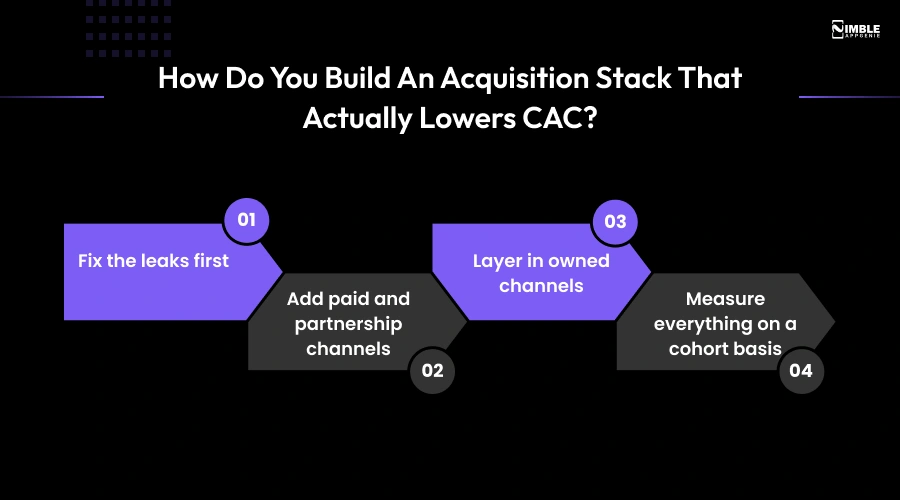
- Fix the leaks first: Onboarding friction and early retention, since these make every other channel look worse than it is.
- Add paid and partnership channels, once you know what CAC ceiling you can actually afford.
- Layer in owned channels: Content, SEO, and a well-designed referral program, since these compound and get cheaper over time.
- Measure everything on a cohort basis: Avoid measuring everything on a monthly spend report, so you can tell the difference between a channel that’s working and one that’s just spending.
The common thread across: Acquisition strategy and product architecture are not separate conversations in fintech. A referral program needs fraud-proof KYC integration. A partnership needs compliance-ready APIs. An onboarding flow needs to be fast and regulator-compliant. Getting the technical foundation right is often what determines whether a customer acquisition strategy is actually affordable to run.
Conclusion
Lowering fintech CAC is not about chasing a single “best” channel – it’s about sequencing the right mix, fixing the funnel leaks that quietly inflate every channel’s cost, and measuring performance against LTV instead of vanity metrics. Product-led tools, compliance-first onboarding, embedded finance, content, paid, partnerships, affiliates, referrals, trust signals, retention, niche targeting, and attribution all pull the same lever from different angles: making growth spend sustainable while still enabling fast growth.
The businesses that get this right tend to treat acquisition and product engineering as the same project, not two separate teams working in parallel. If your onboarding, referral system, or compliance layer is the bottleneck standing between your marketing spend and a lower CAC, that’s a build problem as much as a marketing one.
FAQs
There’s no single number; it depends entirely on the vertical and the product’s LTV. The metric to watch is the LTV: CAC ratio; most fintech operators target roughly 3:1 or better as a sign that growth spend is sustainable.
Fintech products carry more trust friction and regulatory steps (KYC/AML, identity verification, account funding) than most consumer apps, which means more of the funnel is lost to drop-off before a user ever becomes “acquired” in a revenue sense, inflating effective CAC even when marketing costs are reasonable.
Usually not a new channel; it’s fixing onboarding drop-off and early retention first, since those multiply the cost of every channel you’re already running.
Most sustainable growth comes from a mix, but organic channels (content, SEO, referrals) tend to have a lower long-term CAC because they compound, while paid channels scale faster but get more expensive as competition increases.
Referral programs can meaningfully lower blended CAC because referred users typically cost less to acquire, convert, and retain better than users from cold channels, but only when the program includes proper fraud prevention and compliance controls. See our fintech referral program guide for the full build process.
Nimble AppGenie builds the onboarding flows, referral architecture, embedded finance integrations, and compliance layers that determine whether a fintech acquisition strategy is actually affordable to run at scale.

Niketan Sharma, CTO, Nimble AppGenie, is a tech enthusiast with more than a decade of experience in delivering high-value solutions that allow a brand to penetrate the market easily. With a strong hold on mobile app development, he is actively working to help businesses identify the potential of digital transformation by sharing insightful statistics, guides & blogs.
Table of Contents




No Comments
Comments are closed.