

 Free Consultation
 PCI-DSS Compliant
 GDPR Ready
 ISO 27001
 NDA Protected
 AI Services
 AI App Development
 Generative AI Development
 AI Chatbot Development
 AI Integration Services
 AI Consulting Services
 AI For Fintech
 AI Financial Assistant Solution
 AI Insurance Agent Development
 Tech Stack
 OpenAI / GPT-4
 Claude / Anthropic
 Gemini / Google AI
 Llama / Open Source
 LangChain / LlamaIndex
 Pinecone / Pgvector
 AWS / Azure AI


 Fintech Solution
 Core Fintech
 Fintech App Development
 Neobank App Development
 eWallet App Development
 Lending Software
 Banking Software Development
 BNPL Solution
 BNPL App Development
 Insurance App
 Wealth Management App
 Blockchain Development
 Payroll Software Development
 DeFi App Development
 Crypto Wallet Dev
 Crypto On Ramp Off Ramp
 Crypto Exchange Dev
 Trading Platform Dev
 Payments
 Compliance
 Fintech & Digital Regulations
 Fraud Detection
 Lending Ecosystem
 P2P Lending Platform
 Mortgage Software
 Engagement
 Outsourcing Dev

 Mobile Development
 Mobile App Dev
 iOS App Development
 Android App Development
 React Native
 Flutter Development
 Web Solution
 Node.js Development
 React.js Development
 Angular Development
 App Services
 UI/UX Design
 App Maintenance
 By Stage
 MVP Development
 Industry Solutions
 Healthcare App Dev
 Education App Dev
 Travel App Dev
 Real Estate App Dev
 Logistics Software
 Social Media App

 Hire Mobile Developers
 Hire iPhone Developers
 Hire Android Developers
 Hire React Native Devs
 Hire Flutter Developers
 Hire Web Developers
 Hire Node.js Developers
 Hire Angular Developers
 Hire PHP Developers
 Hire Laravel Developers
 How It Works
 Pre-Vetted Developers
 Ready In 48 Hours
 NDA From Day One
 Replace Guarantee
 Company
 About Us
 Our Work Process
 Portfolio
 Case Studies
 Blog / Insights
 Careers
 Contact Us
 Awards
 Recognition


 Offices



In a Nutshell:
- B2B app is a complete software that is designed for improving communication and even improving productivity between businesses.
- The global market of B2B apps is expected to grow to USD 1079.7 million by 2030.
- You should create a B2B app because it helps in scalability, provides technical support, streamlines business operations, enhances user experience, and offers rich data insights.
- Different types of B2B apps are customer relationship management, enterprise resource planning apps, project management apps, B2B eCommerce apps, and even supply chain management apps.
- A B2B app development process begins with conducting market research, defining the problems, considering user experience, developing a tech stack, regular testing, deployment, and app maintenance.
- The overall cost to build a B2B app varies from $20,000 to $80,000+. It depends on different factors such as complexity and the skills of developers.
- Connect with Nimble AppGenie and build your B2B apps under the right guidance.
Did you know that the B2B app market is projected to reach USD 1079.7 million by 2030?
Well, this is not just a number, that’s a massive window of opportunity for a business like yours.
In this growing digital world, investing in a B2B app is not just a potenial investment, it is a strategic move to engage and retain other businesses. B2B app development is building digital bridges that empower businesses and offers scalability.
B2B app development process covers market research, identifying the problem, evaluating features, designing the app, selecting the tech stack, and then launching it.
Well, if you are an entrepreneur or an investor, looking for building your next B2B app, this guide is for you!
Here, we will walk you through
- What is a B2B app and why invest in it.
- Different types and working process of app.
- Features and the complete process of B2B app development.
- Cost to build a B2B app and strategies to be good at it.
Without further ado, let’s get started.
What is a B2B App?
A B2B app is a software application designed for streamlining operations, enhancing communications, and even boosting productivity between businesses.
When you invest in a B2B app, you can lead to enhanced efficiency, cost savings, and even better collaboration with partners and clients.
These apps are designed to connect businesses to other businesses.
Core Operational & Functional Terms
- B2B customer support
- Company Profile
- Company account
- Future flexibility
- Streamlines operations
Now, let’s look at the mobile app statistics of B2B Apps.
A Glance at the B2B App Market
Here is a glance at the B2B app market:
- The global B2B marketplace platforms market is projected to grow from USD 688 million in 2024 to USD 1079.7 million by 2030, at a CAGR of 7.8%.
- However, the global B2B ecommerce market is valued at USD $36 trillion by 2026.
- There are over 42% enterprises that use mobile-first solutions for driving operational efficiency, reflecting a shift in the mobile app market industry.
With these market statistics, it can be stated that the market of B2B apps is increasing, and it is important to invest in it if you want to scale your B2B enterprise.
Well, if you are still confused, let’s get ahead with the reasons to create a B2B app in the following section.
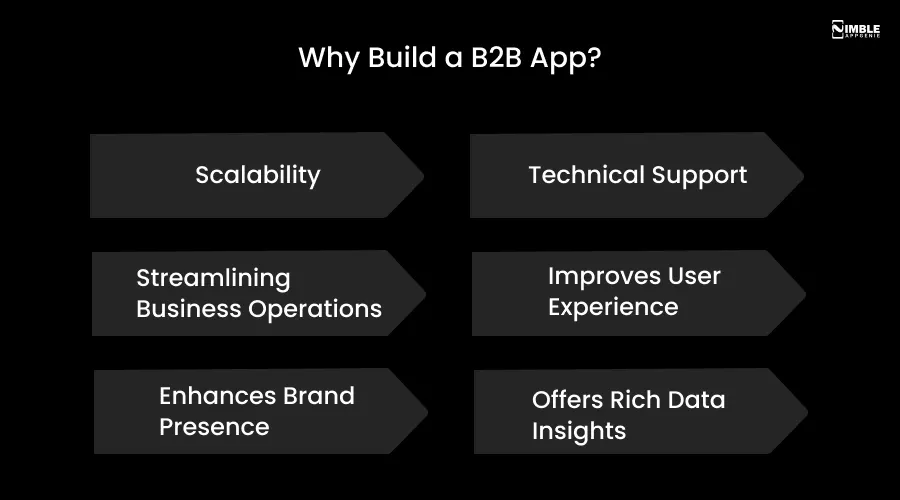
Why Build a B2B App?
You should build a B2B app because it streamlines operations, strengthens client relationships, and helps to boost productivity.
These apps do provide 24/7 access to services, automated workflows, and even personalized and secure experiences.
Here are other reasons to invest in a mobile app for your business.
► Scalability
When you build a B2B app for your enterprise, it offers scalability to your business by creating the ability to handle the intricate complexity of the enterprise-level operations.
It offers scalability from extensive and even hyper-customized product catalogs to processing large orders. Hence, building a B2B app is a crucial parameter.
► Technical Support
The B2B apps provide technical support by offering businesses a platform where they can communicate and connect with other businesses over the app.
This helps businesses like you to have a combination of omnichannel communication, account-centric service models, and even AI-driven automation models that are developed to fulfill their business requirements.
► Streamlining Business Operations
With a B2B mobile app, your business can enhance overall communication, analytics, support, and efficiency, which helps to streamline the collective business operations.
The sole idea of this benefit is to cut down on all the unnecessary tasks in a particular initiative. Additionally, with a mobile app, you can make a more modern approach to the business operations.
► Improves User Experience
The B2B apps improve the user experience through prioritizing efficiency, seamless integration, and even offering a simple design as well as speedy loading times for a smooth navigation that results in an increased user experience.
These apps are built to reduce friction and to increase productivity for the users. It reduces the friction associated with the complex apps and helps users to browse the apps seamlessly.
► Enhances Brand Presence
The B2B apps improve the overall brand presence through completely transforming the respective professional relationships into customized ones.
It helps the other brands to know and identify your brand, which increases the chances of connectivity because the more you are visible to the other businesses, the more they will trust you to build professional relationships.
► Offers Rich Data Insights
When you create a B2B app, it will help you to gather a large volume of business data, even for other businesses. This data can be helpful to make prompt decisions, helpful to make changes in marketing, and helpful to enhance the product line.
Additionally, these apps are developed for centralizing all the cluttered business information. This helps to transform this data into actionable information.
Well, along with the information related to the reasons to create a B2B app, lets get ahead with the different types of B2B mobile apps available in the market.
Types of B2B Mobile Apps
Different types of B2B mobile apps that are available in the market are customer relationship apps, enterprise resource planning apps, project management apps, and many others.
Let’s get ahead of time to learn all the types of B2B mobile apps in brief:
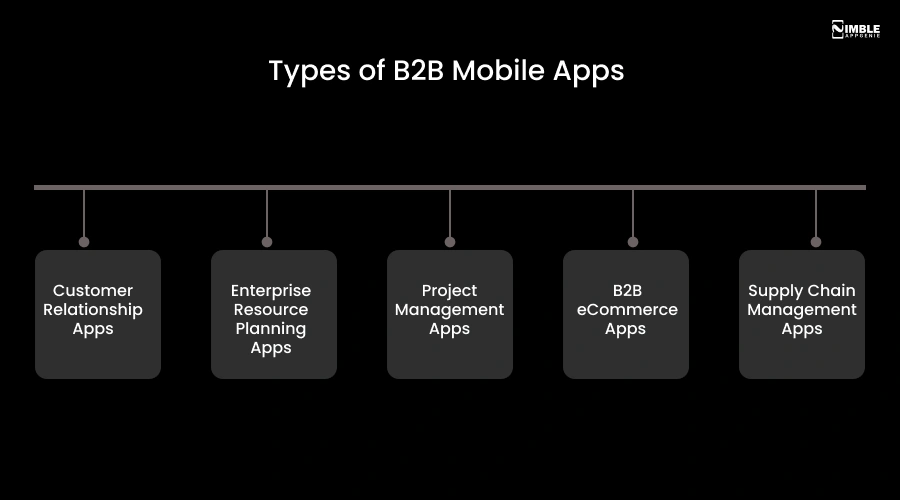
1. Customer Relationship Apps
The customer relationship apps do enable teams to manage client data, track interactions, and even update pipelines on the go. The major goal of this type of app is to manage interactions with the current and even the potential customers.
2. Enterprise Resource Planning Apps
The enterprise resource planning apps are designed to manage all diversified parts of a business’s functions, such as finance, supply chain, HR, and even the product development lifecycle.
These kinds of apps work in the best possible ways for streamlining the operations, improving the data accuracy, and further offering real-time insights.
3. Project Management Apps
These types of apps assist in planning, organizing, and even managing the diversified resources for achieving overall project goals.
The project management apps do assist in assigning and tracking the overall project tasks. These apps allocate resources and even help in scheduling.
4. B2B eCommerce Apps
The eCommerce apps for B2B help to facilitate diversified online transactions between businesses. These apps are designed to support multiple payment methods.
These platforms enable businesses to sell their services directly to other businesses. The key features of this type of app are that it helps to provide account management support for the customers and helps businesses to track and keep all the data for making effective decisions.
5. Supply Chain Management Apps
The supply chain management apps tend to oversee the flow of goods and services. It further helps in managing the complete stock level and even replenishment.
This type of app helps in monitoring the supplier and the overall performance of the app. The key functions of supply chain management apps are inventory control, transportation management, and even warehouse management.
Well, after that, you have decided the type of B2B mobile apps, let’s get ahead with the complete working process of B2B apps in the following section.
How Does a B2B App Work?
The working process of a B2B app begins when a business logs in to your platform. Then, it pursues continuous syncs & updates.
Let’s dive into the complete process of a B2B app:
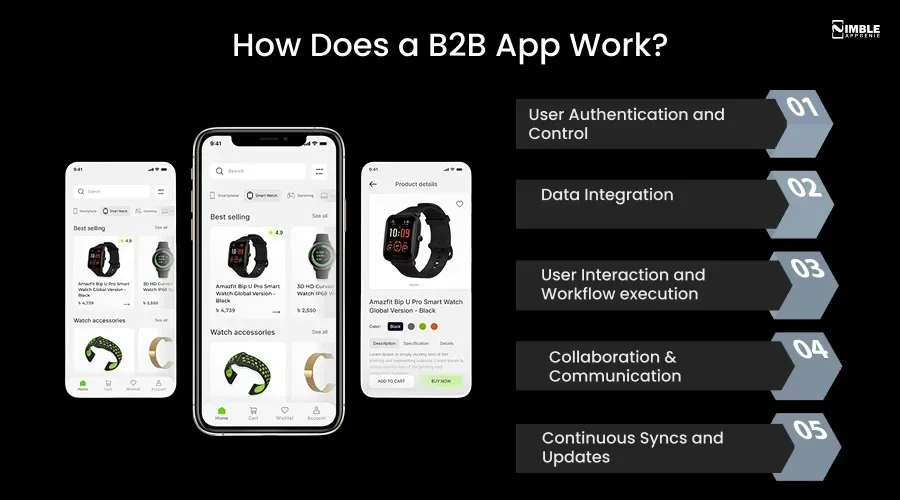
1. User Authentication and Control
One of the most important steps is the user authentication and control. It is a two-factor process where one business connects to the other and provides all the respective details related to what they want from the other business.
2. Data Integration
Now, the app stores the complete data and then provides the results based on the user’s data. It is a process where the business documents are exchanged, and trust is built by reading the documents. The app reads all the uploaded documents, and then the user’s interaction is perceived.
3. User Interaction and Workflow Execution
The business user performs actions within the app, places an order, and approves the requests, generating a report, updating a record, and even communicates with a vendor. Then, the complete workflow execution is processed.
4. Collaboration & Communication
Now, the businesses collaborate and communicate via chats, files, task assignments, and even via comment threads. This step does help the teams and even the external partners to communicate with respect to the purpose of the project.
5. Continuous Syncs and Updates
In this step, you can continuously sync and update the apps in real-time. Additionally, any update made by one team member is instantly updated in real-time.
This represents that the app helps businesses to collaborate and achieve each other’s purpose. Now, let’s get ahead with the list of features to include in the B2B apps in the following section.
What are the Key Features of B2B App?
The key features to include in a B2B app are user authentication, dashboard analysis, APi and third-party integrations, push notifications, and workflow automations.
Evaluating the right features to include in a B2B app will be helpful in identifying what kind of features you should consider for your next B2B app.
The key features of B2B apps are:
| Feature | Description |
| User Authentication & Role-Based Access | Secure login with SSO or MFA, assigning different permissions to different user roles |
| Dashboard & Analytics | Real-time visual reports, KPIs, and business insights accessible from a single screen |
| API & Third-Party Integrations | Seamless connection with CRM, ERP, accounting, and other existing business tools |
| Push Notifications & Alerts | Instant real-time alerts for order updates, approvals, deadlines, and critical events |
| In-App Communication & Collaboration | Built-in chat, file sharing, and task threads to keep teams and partners aligned |
| Order & Inventory Management | End-to-end tracking of orders, stock levels, and procurement workflows in real time |
| Workflow Automation | Automated task routing, approvals, and follow-ups that eliminate manual processes |
| CRM Integration & Lead Management | Manage client relationships, track deals, and monitor the full sales pipeline on mobile |
| Document Management | Secure upload, storage, sharing, and e-signing of contracts, invoices, and reports |
| Multi-Currency & Multi-Language Support | Enabling seamless transactions and communication across global markets and regions |
| Offline Mode | Allowing users to access key data and perform actions even without an internet connection |
| Enterprise-Grade Security & Compliance | End-to-end encryption, audit trails, and compliance with GDPR, HIPAA, and other standards |
| Scalability & Multi-Tenant Architecture | Infrastructure built to support growing teams, users, and business volume without performance loss |
Now, after evaluating the complete list of features to include in a B2B app development process, let’s learn how to build a B2B app in 2026 in the following section.
How to Create a B2B App in 2026?
You can create a complete B2B app by following a complete series of steps.
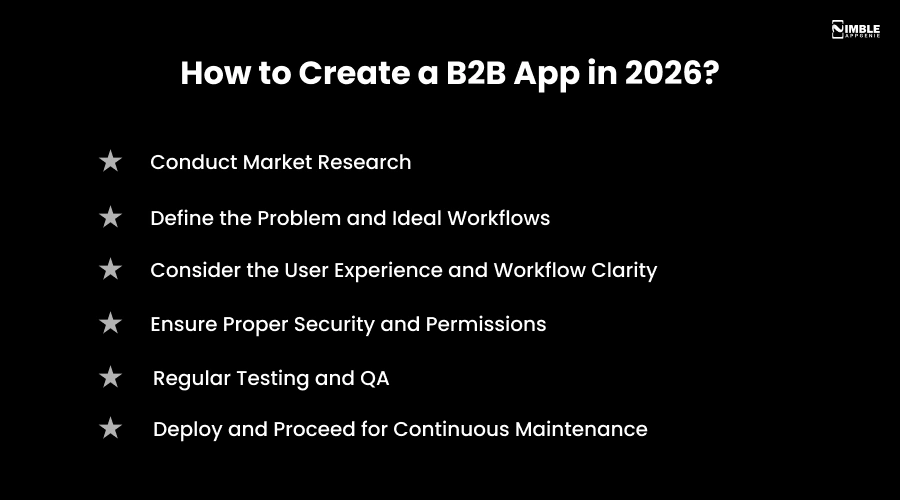
➤ Conduct Market Research
You should explore the complete user’s preferences, like what the target B2B market demands and looks for. This will help you to evaluate the market gap and then proceed with the type of features required to fulfill this type of demands of your target market.
Here’s what you need to do in this step to create a B2B app:
- Look for the demographics
- Target audience and their demands
- Market Trends and Size
- Competitive landscape
➤ Define the Problem and Ideal Workflows
You should be very clear about why you are looking to create your B2B app. Here, you should state the objective, such as simplifying the manual process of B2B or solving a genuine or unique problem and market gap of the businesses.
This is what you should consider in this step:
- Mapping and understanding the end-to-end workflows
- This is the step where multiple departments are involved
- Define who is going to operate your app
- Be clear about what your current business challenges are
➤ Consider the User Experience and Workflow Clarity
For B2B mobile apps, the user experience is the utmost requirement. You should focus on defining a clear user workflow and even the user journey. The executives must consider the KPI dashboards for selecting a prompt design for your app.
Here’s what you need to do:
- Build Prototypes and even mobile app wireframes.
- Intuitive navigation, contextual help, and selecting the right features.
- Create an MVP first and design it accordingly.
- Create a complete workflow for your app.
➤ Develop the Complete Tech Stack
In this step, you should finally create the complete technology stack that comprises frontend technologies such as Swift, Kotlin, and for cross-platform, Flutter, and React Native. And for the backend, you can use technologies such as Node.js, Python, Java, and Go (Golang).
Here’s a short table stating the mobile app tech stack for your B2B app:
| Component | Technologies |
| Frontend | React Native, Flutter, Swift, Kotlin |
| Backend | Node.js, Python (Django), Java (Spring Boot), Go |
| Database | PostgreSQL, MongoDB, MySQL, Redis |
| API & Communication | REST API, GraphQL, WebSockets, gRPC |
| Cloud & Hosting | AWS, Google Cloud (GCP), Microsoft Azure |
| Authentication & Security | OAuth 2.0, JWT, SSO, SSL/TLS, Auth0 |
| Push Notifications | Firebase Cloud Messaging (FCM), Twilio, OneSignal |
| Analytics & Monitoring | Google Analytics, Mixpanel, Sentry, Datadog |
| DevOps & CI/CD | GitHub, Docker, Kubernetes, Jenkins, Fastlane |
| Third-Party Integrations | Salesforce, Stripe, SAP, Zapier, Slack API |
➤ Ensure Proper Security and Permissions
For the security and permissions, the factors should not be ignored. Here, you should adopt least privilege permissions, where you should opt for only necessary permissions. Especially when sensitive business information is involved, you should encrypt the data with security protocols.
Here’s what you need to consider for mobile app security:
- Multi-factor authentication
- Single sign-on integration
- Certificate pinning
- Encryption at rest
➤ Regular Testing and QA
Now, you should perform a complete mobile app testing, which is all about conducting quality analysis of what you have built. It will help identify any prospective errors, bugs, and even the mistakes that might impact your overall app performance and can result in failure.
Here is what you need to opt for regular testing:
- Integration testing
- System testing
- Acceptance testing
- Functional testing
➤ Deploy and Proceed for Continuous Maintenance
Now, you should deploy your app on the targeted platforms whether its Play Store or App Store. After deployment, you should proceed for the mobile app maintenance support. It is important to opt for 15-20% of the total budget to this step.
Here’s what you should do:
- Pre-deployment & preparation
- Deployment execution
- Opt for maintenance
- Keep 15% to 20% of the original development cost
Now, with the key steps of B2B app development process, lets get ahead with the complete cost to make such an app in the following section.
How Much Does it Cost to Create a B2B App?
The overall cost to build a B2B app can vary from $20,000 to $80,000+ depending on the complexity of the app, design of the app, technologies used in the app, choice of platforms, skills of developers, and even the security protocols.
Lets evaluate the complete B2B app development cost in the following table:
| Cost Factor | Impact Level | Estimated Cost Contribution (USD) | How It Affects Cost |
| App Complexity | High | $8,000 – $30,000 | More features (dashboards, integrations, workflows) increase dev time and cost |
| UI/UX Design Quality | Medium–High | $3,000 – $12,000 | Custom, user-centric designs cost more than basic templates |
| Technology Stack | High | $4,000 – $15,000 | Advanced stacks (AI, real-time systems, microservices) raise development effort |
| Developer Expertise | High | $5,000 – $20,000 | Senior developers/teams charge more but deliver faster and higher quality |
| Security & Compliance | Medium–High | $2,000 – $10,000 | Encryption, data protection, compliance (e.g., GDPR-like standards) add cost |
| Third-Party Integrations | Medium | $2,000 – $8,000 | APIs (CRM, payment, analytics) require setup and maintenance |
| Scalability Requirements | Medium–High | $2,000 – $10,000 | Building for high user load or future growth increases backend complexity |
| Testing & Quality Assurance | Medium | $2,000 – $8,000 | More complex apps need deeper testing cycles |
| Maintenance & Updates | Ongoing | $1,000 – $5,000+ | Post-launch support, bug fixes, feature updates |
After evaluating the mobile app development cost, lets get ahead with the time-taken to create a B2B app in the following section.
Timeline to Build a B2B App
The overall timeline to create a B2B app can vary from 5 to 12 months depending on the complexity of the features, skills of the developers, and even on the process you opt for B2B app development.
Lets have a table below to representing how much time does it takes to build a mobile app:
| Phase | Activities | Duration |
| Discovery & Planning | Requirement gathering, market research, defining scope | 2 – 3 Weeks |
| UI/UX Design | Wireframing, prototyping, design approvals | 3 – 5 Weeks |
| Frontend Development | Building app screens, navigation, and user interface | 4 – 8 Weeks |
| Backend Development | Server setup, database, business logic, and APIs | 6 – 10 Weeks |
| Third-Party Integrations | CRM, ERP, payment gateway, and API integrations | 3 – 5 Weeks |
| Testing & QA | Functional, performance, security, and UAT testing | 3 – 5 Weeks |
| Bug Fixing & Optimization | Resolving issues, refining performance and UX | 2 – 3 Weeks |
| Deployment & Launch | App store submission, server deployment, go-live | 1 – 2 Weeks |
| Post-Launch Support | Monitoring, updates, feedback integration | 4 – 6 Weeks |
| Total Timeline | End-to-End B2B App Development | 5 – 12 Months |
Now, lets get ahead with what are the effective strategies to make a good B2B app in the next section.
What Makes a Good B2B App?
You can make a good B2B app through identifying the complexity of the app, understanding the target audience, and then integrating effective softwares in the app.
Lets learn all the strategies related to what makes a good B2B app:
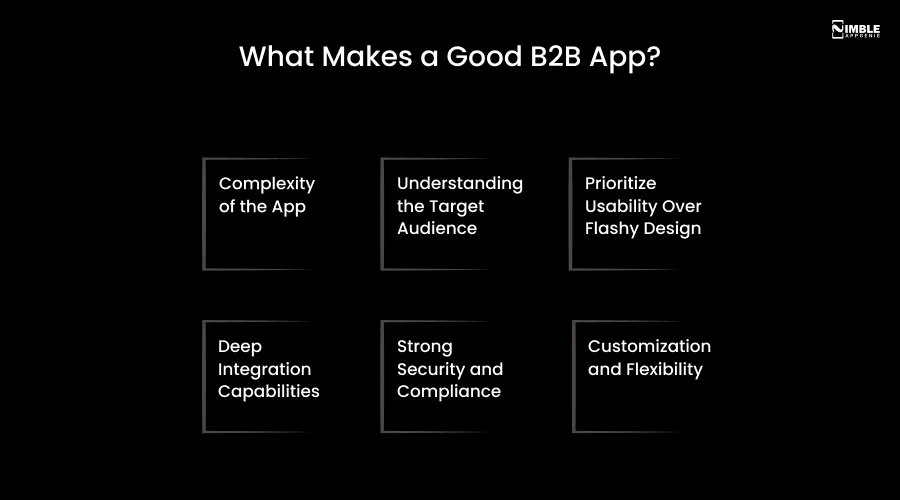
♦ Complexity of the App
Identifying the complexity of the app refers to evaluating the in-depth functionality of your app while creating it. This can be evaluated through the volume of logic, security requirements, and even the data integration.
♦ Understanding the Target Audience
You should understand the overall nature of the target audience. It is important to understand the features of products and services. Here, you should research the complete market, and needs to create the buyer personas.
♦ Prioritize Usability Over Flashy Design
When you proceed for B2B app development, it is significant that you prioritize the usability of your app. Here, you should identify what the users actually needs and then design the app accordingly.
♦ Deep Integration Capabilities
Identify the integration capabilities for your overall app. Here, you should check REST or GraphQL standards. You need to proceed with the data synchronization and consistency. Here, you will have an encrypted data transfers, and should provide an access control for third party apps.
♦ Strong Security and Compliance
This is an important practice that comprises of effective programs that are made to blend the technical safeguards with the administrative governance that do protects the sensitive data. It will help you to function according to the recent standards and compliance of B2B.
♦ Customization and Flexibility
The customization and flexibility will empower your business by connecting more to the targeted clients and other business owners. Thus, while opting for the B2B app development, you should consider customization and even AI personalization as per the current trends.
Why Connect With Nimble AppGenie For B2B App Development?
Are you looking for an experienced and experts when it comes to B2B app development?
No need to worry, Nimble AppGenie is the leading mobile app development company focused on delivering quality apps. This is an award-winning company that has delivered approximately 350+ projects, and have an experience of 8+ years.
Our developers knows well what your app needs by evaluating the complete market of app development as well as your industry in depth.
You can hire mobile app developers from our best team as per your requirements. We are experts in building B2B apps that too with quality and scalable solutions for enterprises and startups.
Conclusion
Building a B2B app in 2026 is no longer a luxury, it’s a strategic necessity for businesses looking to streamline operations, strengthen partnerships, and scale efficiently. From understanding the right features and tech stack to managing development costs, every decision matters.
Whether you’re a startup or an established enterprise, the right B2B app can transform how you operate and collaborate. The B2B app development process begins with market research and ends on deployment and launch of an app.
To make a good B2B app, all you need is to evaluate the complexity of the app, prioritizing usability, and opting for a secure development protocols.
FAQs

Sunil serves as the Lead Android Engineer at Nimble AppGenie, recognized for his expertise in building robust, scalable mobile solutions across diverse industries. From seamless API integrations to optimizing OS-level performance, Sunil focuses on delivering high-speed, secure applications that stand out in a crowded market. Outside of the tech world, Sunil is a fitness enthusiast who enjoys morning runs and finds his peace playing badminton on the weekends.
Table of Contents




No Comments
Comments are closed.