

 Free Consultation
 PCI-DSS Compliant
 GDPR Ready
 ISO 27001
 NDA Protected
 AI Services
 AI App Development
 Generative AI Development
 AI Chatbot Development
 AI Integration Services
 AI Consulting Services
 AI For Fintech
 AI Financial Assistant Solution
 AI Insurance Agent Development
 Tech Stack
 OpenAI / GPT-4
 Claude / Anthropic
 Gemini / Google AI
 Llama / Open Source
 LangChain / LlamaIndex
 Pinecone / Pgvector
 AWS / Azure AI


 Fintech Solution
 Core Fintech
 App Development
 Neobank Solutions
 eWallet Solutions
 Lending Software
 Banking Solutions
 BNPL Solutions
 BNPL Solutions
 Insurance App
 Wealth Management
 Crypto & DeFi
 Blockchain Development
  Payroll Software
 DeFi Solutions
 Crypto Wallet
 Crypto On/Off Ramp
 Crypto Exchange
 Trading Platform
 Payments
 Compliance
 Regulations & Compliance
 Fraud Detection
 Lending Ecosystem
 P2P Lending Platform
 Mortgage Software
 Engagement
 Fintech Outsourcing

 Mobile Development
 Mobile App Dev
 iOS App Development
 Android App Development
 React Native
 Flutter Development
 Web Solution
 Node.js Development
 React.js Development
 Angular Development
 App Services
 UI/UX Design
 App Maintenance
 By Stage
 MVP Development
 Industry Solutions
 Healthcare App Dev
 Education App Dev
 Travel App Dev
 Real Estate App Dev
 Logistics Software
 Social Media App

 Hire Mobile Developers
 Hire iPhone Developers
 Hire Android Developers
 Hire React Native Devs
 Hire Flutter Developers
 Hire Web Developers
 Hire Node.js Developers
 Hire Angular Developers
 Hire PHP Developers
 Hire Laravel Developers
 How It Works
 Pre-Vetted Developers
 Ready In 48 Hours
 NDA From Day One
 Replace Guarantee
 Company
 About Us
 Our Work Process
 Portfolio
 Case Studies
 Blog / Insights
 Careers
 Contact Us
 Awards
 Recognition


 Offices



Key Takeaways:
- Plaid is a software connection that allows you to connect with fintech apps and helps developers to build secure connections.
- While using the Plaid integration users opens fintech apps first, selects their bank accounts, uses security logins, connects to the bank data, and shows useful information.
- Different fintech apps that can use Plaid include personal finance and budgeting, neobanks and digital banking apps, lending and cash advance apps, small business financial tools, and money transfer apps.
- The step-by -step Plaid integration process includes creating a Plaid developer account, installing Plaid’s SDK, creating a link token, sending and receiving the link token, requesting the user’s approved financial data, and handling updates.
- Nimble AppGenie is the best company for Plaid integration for fintech apps, that offers effective services in API integration.
Plaid helps software to connect with financial apps securely. Many developers and startups use this integration for fintech apps to offer secure connections and offering a seamless integration practices.
However, if you are unaware of what a Plaid integration is and how to integrate it into fintech apps, this Plaid integration guide will help you.
Here, we will walk you through a detail on the Plaid integration, its working process, and the step-by-step integration process.
Let’s begin this guide together.
What Is Plaid and Why Do Fintech Apps Use It?
Plaid integration is a software connection that allows financial apps to securely link to a user’s bank account. Plaid acts as a middleman that helps to connect your financial accounts to the eligible apps and services of your choosing.
Additionally, you might choose to share your account information to get access to a service or product. As per Plaid, it makes sense for these connections to be handled by a third party because of the complexity involved.
Plaid acts as a bridge between your bank accounts and budgeting. Additionally, it uses various security measures to keep your financial data private.
These are among the best fintech API integrations to select for optimizing and improving your app’s performance.
Mainly, when a team wants to find out about Plaid integration, they basically try to understand whether it is a product, a platform, or a financial intermediary. It is an infrastructure that enables apps to connect with the user’s bank accounts safely.
In this Plaid integration guide, let’s get ahead with the working process of Plaid.
How Does Plaid Work?
The working process of Plaid begins with selecting a bank, logging in, verifying ownership, and sharing the data.
More than 12,000 financial institutions in the United States use Plaid software to securely connect to customers’ bank accounts.
Let’s understand how Plaid integration works:
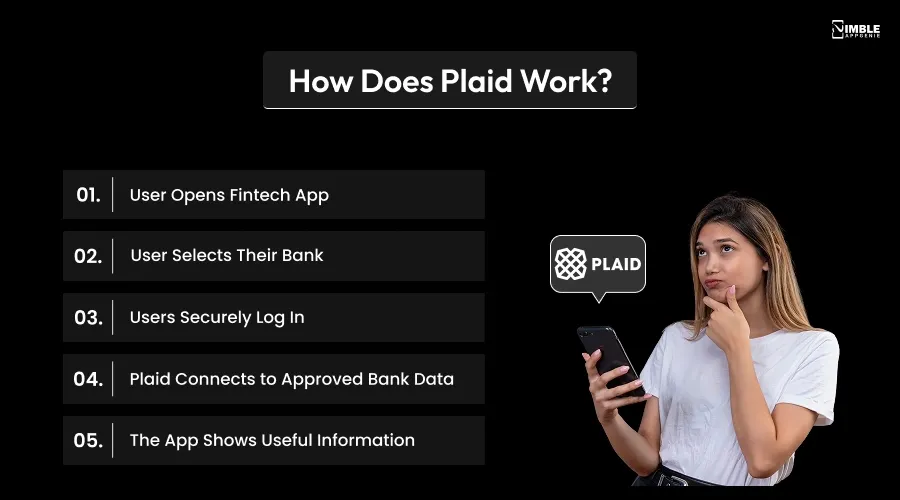
Step 1: User Opens Fintech App
In this first step, the user opens the fintech app and fills in basic information like phone number, name, and location, important for the app to access further details.
Step 2: User Selects Their Bank
With the help of an in-app search tool, users can select their bank on a fintech app or can choose from a list of popular institutions powered by open banking aggregators.
Step 3: Users Securely Log In
Now, users can securely log in to Plaid via a client-side module called Plaid Link, which acts as a secure, sandboxed bridge between a financial app and a user’s bank.
Step 4: Plaid Connects to Approved Bank Data
In this step, Plaid connects to approved bank data with the help of a secure application programming interface (APIs) and tokenization without sharing your actual bank password with the app.
Step 5: The App Shows Useful Information
On the customer’s screen, the app shows all the useful information using a user-friendly interface window called Plaid Link.
You might also check “What is API Integration?”
Next, we’ll cover which fintech apps can use Plaid.
Which Fintech Apps Can Use Plaid?
Almost any fintech application that needs to securely connect to a user’s bank account, verify balances, or process transfers can use Plaid.
Here is the list of fintech apps that can use Plaid:
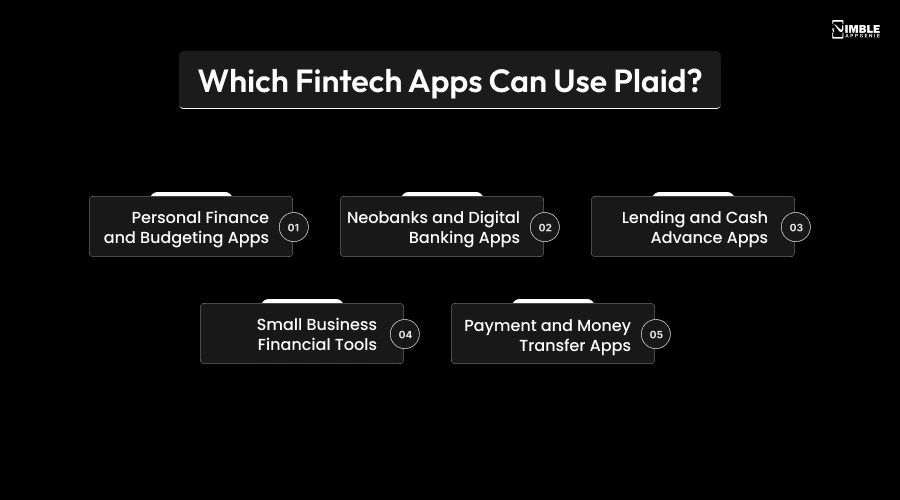
1. Personal Finance and Budgeting Apps
Personal finance and budgeting apps are digital tools that connect to your bank accounts and credit cards.
It uses secure digital infrastructure to assist users in managing their money, tracking spending, and building savings.
Furthermore, personal finance and budgeting apps use Plaid as a secure bridge to connect directly to a user’s bank accounts, credit cards, and investment portfolios without storing the user’s login credentials.
2. Neobanks and Digital Banking Apps
Neobanks and digital banking apps use Plaid as a secure bridge to connect user accounts from traditional financial institutions.
Additionally, neobanks and digital banking apps use Plaid in different ways, such as for account linking, data aggregation, identity verification, and instant account funding.
These apps use fintech technology by integrating application programming interfaces (APIs), open banking frameworks, and software partnerships to deliver fast, branchless financial services. For development services and integration, the experts at a custom neobank development company can help.
3. Lending and Cash Advance Apps
The lending and cash advance apps use financial technology to replace the slow paperwork with automated, data-driven mobile platforms.
These fintech apps use Plaid to securely connect to users’ bank accounts, verify identity and income, and further evaluate credit risks in real time.
Such apps help to securely connect with users’ bank accounts, verify the financial data, and further help to automate financial decisions.
4. Small Business Financial Tools
Small business financial tools use Plaid integration for securely connecting business bank accounts to third-party financial software.
With the help of Plaid integration, you can securely connect business bank accounts, credit cards, and even loan platforms to the third-party software without requiring manual login sharing and slow micro-deposits.
It is a secure bridge that helps to directly connect to commercial bank accounts, checking accounts, and credit lines.
5. Payment and Money Transfer Apps
The payment and money transfer apps use Plaid as a secure digital bridge between your bank account and the app.
Payment and money transfer app development is a type of fintech app that uses Plaid as a secure bridge to connect users’ bank accounts without exposing sensitive login credentials.
Additionally, these types of apps use Plaid for account linking, user authentication, data encryption, and token sharing. AI in fintech also helps in the integration process by offering seamless integration options.
Now that you know that fintech apps use Plaid, let’s get ahead with how Plaid integration works in this guide to plaid integration for fintech apps.

How Does Plaid Integration Work?
Plaid integration works by following the right procedure, from user integration, bank authentication, token exchange, and data retrieval.
This type of integration lets your app connect to a user’s bank account through Plaid Link, then access the approved financial data via Plaid’s API.
Here’s how Plaid integration works:
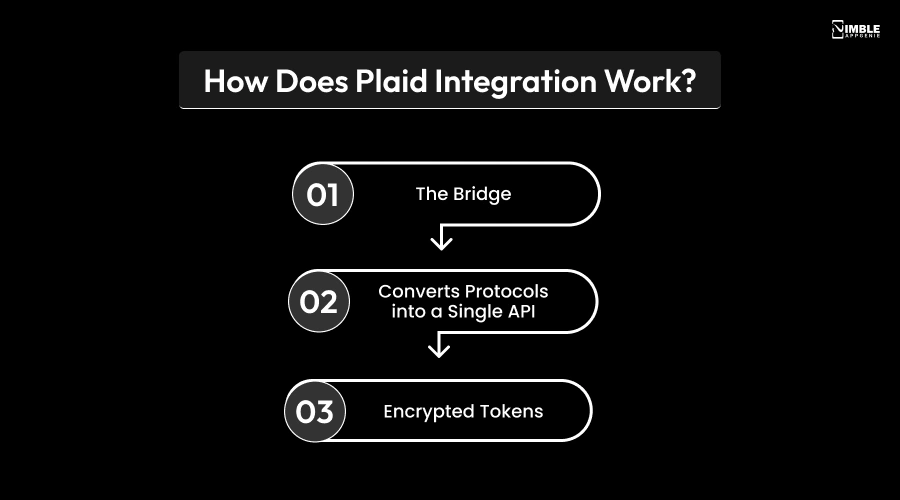
Step 1: The Bridge
Plaid integration acts as a bridge for handling bank credentials and multi-factor authentication (MFA) safely.
Additionally, Plaid acts as a secure intermediary to capture the bank login and MFA codes for verification without letting the external app ever see or store your credentials.
Step 2: Converts Protocols into a Single API
Plaid makes mobile transactions more accessible and safer by converting the varying bank protocols into a single, clean API for products like auth and Plaid transactions.
Additionally, Plaid converts thousands of disparate bank data pipelines into a single, unified API by acting as an abstraction layer and universal translator.
Step 3: Encrypted Tokens
The encrypted tokens do not convert different communication protocols into a single API. They secure the data payloads or even exchange the user identity claims across different systems via standard formats such as JSON Web Tokens.
With the help of a Security Token Service (STS) converts different authentication protocols are converted into a single unified API by exchanging and translating diverse token formats into a standard format.
Following these steps of how Plaid integration works, let’s proceed with the step-by-step Plaid integration process in the next section.
Step-by-Step Plaid Integration Process
The complete step-by-step Plaid integration process begins with building a Plaid developer account install Plaid’s SDK or API client.
Additionally, this process connects a user’s bank account to your application using a secure frontend UI widget and backend API token exchange.
For a developer and a startup, it is essential to know the complete Plaid integration process.
Here is the complete process:
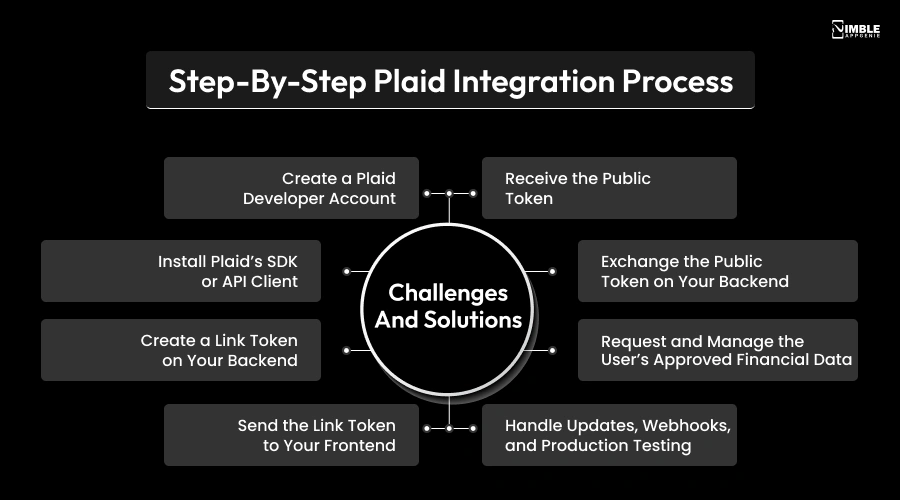
Step 1: Create a Plaid Developer Account
Within the Plaid dashboard, you need to create an application, obtain your client ID, and an environment-specific secret.
You can sign up for a developer profile at the Plaid dashboard signup for building your Plaid developer portal.
Select the products you need, such as-
- Auth for account and routing numbers
- Transactions for transaction history
- Identity for account holder information
- Balance for current balances
Step 2: Install Plaid’s SDK or API Client
For installing Plaid’s official API client libraries or even the front-end SDKs, select the command that matches your development environment.
This is what you need to do:
- Identify the type of SDK that your app or software requires.
- Add the appropriate SDK for your backend language and frontend platform.
- Match the SDK library to your frontend platform.
- Install the official server library via your package manager.
- Initialize the client using your secret and client_ID.
Step 3: Create a Link Token on Your Backend
Building a link token is a mandatory first step that is required to initialize a Plaid link session. Here, you need to call the link token endpoint with information such as:
- Stating your application name
- User ID
- Supported countries
- Language
- Plaid products, such as transactions or Auth
- Optional webhook URL
Step 4: Send the Link Token to Your Frontend
Sending the link token to your frontend is all about bridging step in the Plaid integration process. It connects your secure backend server to the client-side application.
This is the step that initializes the tokenization process in the software, so users can securely connect their bank accounts.
You should opt for the following parameters:
- Your backend must expose an API endpoint that the frontend can call.
- The frontend should always be created on the bank server.
- Expose a secure HTTP GET or POST endpoint on your backend.
Step 5: Receive the Public Token
In this step, to receive the temporary public token in Plaid, you should launch the Plaid Link on your frontend. This process takes place after the user successfully logs into their bank or any financial institution with the help of the Plaid Link interface.
It is the client-side UI widget that your users interact with to connect their bank accounts.
This is what you should do:
- Use a secure, backend-generated link token to initialize the client-side UI.
- Replace the older legacy public key methods.
- Capture it from the client side in the success callback after a user successfully logs into their financial institution.
Step 6: Exchange the Public Token on Your Backend
In this step, you send the public token securely to your backend, and it is a critical step where your app trades a temporary client-side token for a permanent access token.
This step trades a short-lived, client-side token for a permanent, secured access token that allows your server to talk to bank data safely.
This is what you should do:
- Your server calls public_token, and Plaid returns an access_token and item_ID.
- This access token represents the user’s connected financial institution.
- It is a bridge that converts a temporary client-side user action into a permanent data pipeline.
Step 7: Request and Manage the User’s Approved Financial Data
This is the step in which requesting and managing user-approved financial data within Plaid requires initializing the complete Plaid link, exchanging the tokens, and even listening for lifecycle webhooks.
This is what you should do:
- Store the access_token securely on the server, and further use it with Plaid’s API.
- Exchange a temporary public token for a persistent access token on your server.
- It creates a link token, exchanging a public token for a persistent access token.
Step 8: Handle Updates, Webhooks, and Production Testing
Handle updates, webhooks, and production testing as a central milestone in your Plaid integration process. Here, you must transition your application to create a secure, event-driven listener pipeline and a robust verification matrix before opening the live financial traffic.
This is what you should opt for:
- It requires setting up secure server endpoints and listening to background event notifications.
- Moving safely from the test environments to the live bank data.
- Configuring and securing webhooks consists of setting up a listener, passing the URL, and implementing best practices.
Also Read: What is API Development?
Now, as you are aware of the Plaid integration process, let’s get ahead with the architecture to use while plaid integration for a fintech app in the next section.
Plaid Integration Architecture for a Fintech App
The key Plaid integration architectures for a fintech app used are react native, Flutter, React.js/Next.js, Swift, Kotlin, Node.js, Python, PostgreSQL, and AWS Lambda.
Here is the complete table stating the Plaid integration architecture for a fintech app:
| Layer | Function | Tech Stack |
| Frontend / Client | Launches Plaid Link, captures public_token | React Native, Flutter, React.js/Next.js, Swift, Kotlin |
| Plaid Link SDK | Secure bank login & account selection UI | Plaid Link (JS/iOS/Android SDK) |
| Backend Server | Creates link_token, exchanges tokens, calls Plaid APIs | Node.js, Python (FastAPI/Django), PHP (Laravel), Go |
| Plaid Client Library | Server-side SDK for API calls | plaid-node, plaid-python, plaid-java |
| Database | Stores encrypted access_token, transactions, balances | PostgreSQL / MySQL, Redis (caching) |
| Webhook Listener | Real-time sync (transactions, errors, item updates) | AWS Lambda / Node.js endpoint |
| Security Layer | Encrypts tokens, manages secrets | AES-256, AWS KMS / HashiCorp Vault |
| Hosting/Infra | Runs backend & webhook services | AWS / GCP / Azure, Docker |
| Monitoring | Tracks API failures & latency | Datadog / Sentry |
Here, most of the startups and even developers ask what the right security practices are for the Plaid integration.
Well, let’s catch up in the next section.
Security Best Practices for Plaid Integration
For securing a Plaid integration, you should manage the credentials safely, protect the access tokens, and enforce strict encryption protocols for your backend infrastructure.
Security is one of the most important practices to adopt for successfully adopting the Plaid integration.
Different layers that you should implement for the Plaid integration are:
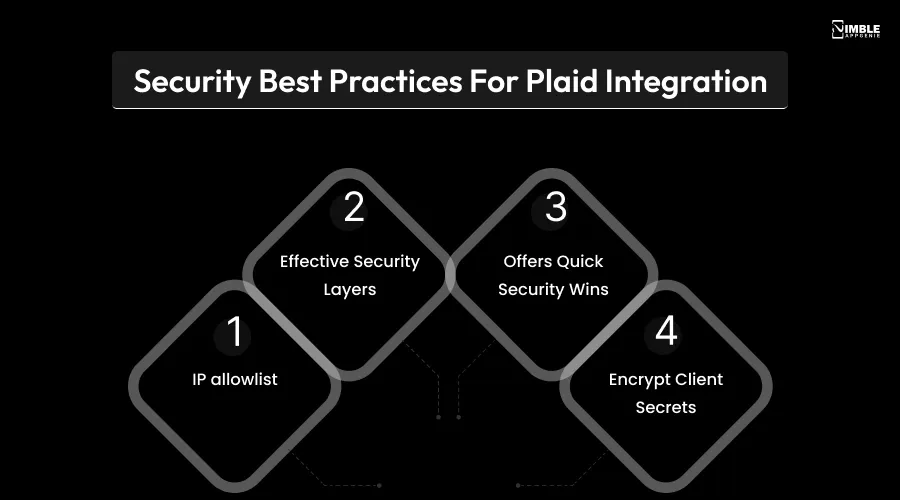
- IP allowlist: Allowlist Plaid’s IP addresses in your firewall, WAF, or security vendor configuration. It prevents the API traffic from being blocked.
- Effective Security Layers: Different security layers to adopt for the Plaid integration include transport security such as TLS, authentication, validation, authorization, and lifecycle.
- Offers Quick Security Wins: Plaid integration offers quick security wins by adopting HTTPS, the use of PKCE for mobile, and encrypting client secrets.
- Encrypt Client Secrets: Never store them in plain text; use a secrets manager or vault.
Furthermore, in this Plaid integration guide for fintech apps as a startup or a developer, you might face key challenges in the process; Nimble AppGenie has covered them too in the next section.
Common Plaid Integration Challenges and Solutions
The common Plaid integration challenges comprise connection failures, user authentication friction, and data sync inconsistencies across different fintech apps.
Here is the list of the common challenges that you should consider:
1. Connection Failures
Connection failures often happen in the Plaid integration due to expired credentials, bank outages, or missing OAuth permissions.
Solution: Implement robust error handling with clear user messages, retry logic, webhook monitoring, and Plaid updates for reauthenticating failed bank connections.
2. User Authentication Friction
User authentication friction stems from confusing reauthentication flows, multi-factor authentication, as well as poor error messaging that causes drop-offs.
Solution: The solution for removing the authentication friction is to create risk-reduction measures.
3. Data Sync Inconsistencies
Data sync inconsistencies in Plaid happen when the transaction records or account balances in your app’s database fall out of step with the user’s actual bank account due to missed events and even delayed updates.
Solution: It requires moving past basic connectivity to focus heavily on data architecture.
Well, while you create a Plaid integration for fintech apps, you will be required to identify the cost of Plaid integration in fintech apps in the following section.
Cost of Plaid Integration in Fintech Apps
The overall cost of Plaid integration in fintech apps can vary from $3,000 to $100,000+ for initial software development, plus recurring API fees based on your usage and active accounts.
Here’s a short cost breakdown table for Plaid integration in fintech apps, spanning basic to enterprise-scale builds:
| Integration Tier | Cost Range | What’s Included |
| Basic (MVP/Startup) | $3,000 – $10,000 | Single Plaid product (Auth or Transactions), sandbox-to-production setup, basic Link token flow, minimal UI |
| Standard | $10,000 – $30,000 | Multiple Plaid products (Auth, Balance, Transactions, Identity), webhook integration, data normalization layer, basic error handling |
| Advanced | $30,000 – $60,000 | Full product suite (+ Income, Assets, Signal), custom middleware, multi-institution scaling, security/compliance hardening (PCI-DSS/SOC2 readiness) |
| Enterprise | $60,000 – $100,000+ | Multi-aggregator architecture (Plaid + backup provider), advanced fraud/risk workflows, dedicated compliance & audit layer, high-availability infra, ongoing DevOps support |
| Plaid Platform Fees (separate from dev cost) | ~$500/month+ (usage-based) | Plaid’s own subscription/API usage charges — scales with active users and products used |
When you build the complete software, one of the key questions that you might face is: how much does it cost to create a fintech app?
Well, integrating Plaid is one of the important drivers that can impact the total cost. And if you are building the app from scratch, Plaid integration cost will be included in the same. However, the total cost can vary from $20,000 to $300,000.

Which is the Best Fintech App Development Company for API Integration?
Nimble AppGenie is the best fintech app development company for API integration. The company has expertise in securing fintech apps, offering scalable and robust API integration across banking, payment, and even compliance systems.
Here’s why you should connect with Nimble AppGenie:
- Comprehensive Fintech Expertise: Nimble AppGenie offers niche expertise in fintech solutions and helps startups as well as enterprises to combine specialized regulatory knowledge, advanced security frameworks, and even scalable cloud infrastructure.
- Secure and Scalable Cloud Tech: The engineers at Nimble AppGenie use auto-scaling and container tools so that apps can stay relevant and speedy.
- Offers Advanced Features: Nimble AppGenie uses advanced features and techniques for Plaid integration as per the customized apps.
- Provides Best Integration Services: Nimble AppGenie offers the best fintech API integration services, where the team helps in connecting your apps with the best services.
Conclusion
Plaid integration for fintech apps refers to the secure software that lets financial technology apps talk to a user’s bank and even the financial institutions. The different types of fintech apps that use API integration are personal finance and budgeting, neobanks and digital banking, lending and cash advance apps, and small business financing.
The right integration process of Plaid integration comprises creating a Plaid developer account, installing Plaid’s SDK, creating a link token, sending the link token to your frontend, receiving the token, and managing the user’s approved financial data. WIth the help of right developers, you can opt for Plaid integration.
FAQs
Plaid integration is a software connection that allows financial apps to securely link to a user’s bank account. Here, Plaid often acts as a middleman that helps to connect your financial accounts to the apps and services of your choice.
Different types of fintech apps that use Plaid integration are personal finance and budgeting apps, neobanks and digital banking, lending and cash advance apps, along with payment and money transfer apps.
When the user opens the fintech app, they select their bank account in the search bar, then the user securely logs in to the app with Plaid; it connects to the approved bank data, and then the app shows all the useful information.
The right process for Plaid integration includes creating a Plaid developer account, installing Plaid’s SDK, creating a link token, exchanging the public token on your backend, and requesting as well as managing the user’s approved financial data.
The overall cost to integrate Plaid into fintech apps varies from $3,000 to $100,000+. This cost further depends on different drivers such as complexity of the app, technologies used for integration, multi-aggregator architecture, and Plaid’s own subscription plan.
The key challenges of Plaid integration for fintech apps comprise connection failures, user authentication friction, and data synchronization inconsistencies. Adopting the right solutions, such as implementing robust product handling, adopting risk-reduction measures, and moving beyond basic connectivity, are solutions to address these key challenges.

Niketan Sharma, CTO, Nimble AppGenie, is a tech enthusiast with more than a decade of experience in delivering high-value solutions that allow a brand to penetrate the market easily. With a strong hold on mobile app development, he is actively working to help businesses identify the potential of digital transformation by sharing insightful statistics, guides & blogs.
Table of Contents




No Comments
Comments are closed.