

 Free Consultation
 PCI-DSS Compliant
 GDPR Ready
 ISO 27001
 NDA Protected
 AI Services
 AI App Development
 Generative AI Development
 AI Chatbot Development
 AI Integration Services
 AI Consulting Services
 AI For Fintech
 AI Financial Assistant Solution
 AI Insurance Agent Development
 Tech Stack
 OpenAI / GPT-4
 Claude / Anthropic
 Gemini / Google AI
 Llama / Open Source
 LangChain / LlamaIndex
 Pinecone / Pgvector
 AWS / Azure AI


 Fintech Solution
 Core Fintech
 App Development
 Neobank Solutions
 eWallet Solutions
 Lending Software
 Banking Solutions
 BNPL Solutions
 BNPL Solutions
 Insurance App
 Wealth Management
 Crypto & DeFi
 Blockchain Development
  Payroll Software
 DeFi Solutions
 Crypto Wallet
 Crypto On/Off Ramp
 Crypto Exchange
 Trading Platform
 Payments
 Compliance
 Regulations & Compliance
 Fraud Detection
 Lending Ecosystem
 P2P Lending Platform
 Mortgage Software
 Engagement
 Fintech Outsourcing

 Mobile Development
 Mobile App Dev
 iOS App Development
 Android App Development
 React Native
 Flutter Development
 Web Solution
 Node.js Development
 React.js Development
 Angular Development
 App Services
 UI/UX Design
 App Maintenance
 By Stage
 MVP Development
 Industry Solutions
 Healthcare App Dev
 Education App Dev
 Travel App Dev
 Real Estate App Dev
 Logistics Software
 Social Media App

 Hire Mobile Developers
 Hire iPhone Developers
 Hire Android Developers
 Hire React Native Devs
 Hire Flutter Developers
 Hire Web Developers
 Hire Node.js Developers
 Hire Angular Developers
 Hire PHP Developers
 Hire Laravel Developers
 How It Works
 Pre-Vetted Developers
 Ready In 48 Hours
 NDA From Day One
 Replace Guarantee
 Company
 About Us
 Our Work Process
 Portfolio
 Case Studies
 Blog / Insights
 Careers
 Contact Us
 Awards
 Recognition


 Offices


Key Takeaways:
- The major difference between OpenAI API vs Google Gemini API vs Anthropic Claude API can be found in their building quality, the type of functionalities, and their cost.
- OpenAI API is good for its ecosystem, advanced reasoning, image and video generation, and its search embeddings.
- Google Gemini API has a cost-effective nature and is good for processing tasks that require different data types and extracting data from large datasets.
- Anthropic Claude API is good for resolving complicated tasks and is used for ensuring security. Thus, it is good for industries such as fintech, banking, and finance.
- You can select the right AI API by identifying the requirements of your app, evaluating your budget, and discussing the functionalities you require.
- Partner with Nimble AppGenie to select and integrate the right AI API for your app.
Three world-class AI APIs: OpenAI API vs Google Gemini APIs vs Anthropic Claude API, each one has different functions, and each one is genuinely good at its core functionalities. But the issue, as a startup and a founder, is that most guides you to choose one API without even identifying what your software actually needs.
Well, you’re not alone in this race; most of the businesses and startups are struggling with this issue in this AI era.
But what is the solution?
The solution is to identify your platform, connect with the top developers, and integrate the right AI API into your software.
How?
It’s simple: learn about all the types of AI APIs, evaluate their concept, what’s best in them, what they will offer to your software, how they will be of use, which one of them will maximize your software’s functionality, and then connect to the developers to integrate it.
But it will take a lot of time?
Yes! Indeed. Therefore, in this guide of comparison between OpenAI API, Gemini API, and Anthropic Claude API, we have done all of this for you. Additionally, this guide will help developers to evaluate the cost of integrating AI APIs among the three.
Ready to explore! Let’s start together.
What is An AI API?
AI API is a software bridge that connects external applications and software to interact with pre-trained AI models and use their capabilities without the need to build these APIs from scratch.
Before you reach the differences between the OpenAI API, Google Gemini API, and Anthropic Claude API, you should know what we are actually doing here.
If you do not want to use AI technology to build an app from scratch or are struggling to integrate AI API further, then knowing about AI API is significant.
AI API helps businesses and startups like you to integrate artificial intelligence into their software, enabling them to improve overall performance for their application users.
Key components of AI API:
- AI Model – Processes prompts and generates intelligent responses.
- API Endpoint – The gateway that connects your application to the AI model.
- Authentication – API keys or OAuth for secure access.
- Prompt & Response Handling – Sends user input and receives AI-generated output.
- Context Management – Maintains conversation history and user context.
- Function Calling – Enables AI to interact with external tools and APIs.
- Multimodal Support – Processes text, images, audio, and video (depending on the API).
- Token Usage & Billing – Tracks API usage for pay-as-you-go pricing.
- Safety & Moderation – Filters harmful or inappropriate content.
- Monitoring & Analytics – Measures API performance, usage, and reliability.
Well, now let’s get ahead with what these three APIs are all about.
What are the OpenAI API, Google Gemini API, and Anthropic Claude API?
To connect with AI integration services, you should be clear about the APIs and what a particular API is all about.
Before you get into differences, let’s understand each of these APIs:
1. OpenAI API
The OpenAI API is a cloud-based platform that allows developers and businesses to integrate advanced AI capabilities into their own software, apps, and websites.
This API belongs to the GPT-5 family and is the largest developer ecosystem, with the most mature tooling, and this API offers the best third-party integration support.
2. Gemini API
The Gemini API do allows the developers for integrating Google’s most advanced and natively multimodal AI models into their own applications.
The Gemini API model covers most of the things that developers are looking for. It comes with fine-tuning support, context coaching, code execution, structured outputs, document processing, and video, image, and audio understanding.
3. Anthropic Claude API
Anthropic Claude API is a RESTful programming interface that allows developers to integrate Anthropic’s Claude family, which belongs to the artificial intelligence models, that can be directly integrated within external software applications, workflows, and websites.
The features of the Anthropic Claude API comprise model capabilities, tools, tool infrastructure, context management, and files and assets.
As per the growing AI trends in 2026, AI API has become a compulsion for startups and businesses to sustain the competitive landscape.
Now, let’s get into the differences among the three in the following section.
OpenAI API vs Google Gemini API vs Anthropic Claude API
The major difference between these APIs is not only the cost, but also their functionality and usage limits.
Here is the complete table defining the differences and comparisons:
| Factor | OpenAI API | Google Gemini API | Anthropic Claude API |
| Best Model (2026) | GPT-5.4 | Gemini 3.1 Pro | Claude Opus 4.8 |
| Input Price (per 1M tokens) | $2.50 | $1.25 | $5.00 |
| Output Price (per 1M tokens) | $15.00 | $10.00 | $25.00 |
| Free Tier | $5 credits | Yes — generous | No free tier |
| Context Window | 1M tokens | 1M tokens (GA) | 200K standard |
| Multimodal Support | Text + Images | Text + Image + Video + Audio | Text + Images only |
| Response Speed | Moderate | Fastest at scale | Fastest TTFT |
| Rate Limits (Tier 1) | ~1,000 RPM | High | ~50 RPM |
| Safety & Compliance | Moderate | Moderate | Highest |
| Developer Ecosystem | Largest | Growing | Smaller but engaged |
| Cloud Integration | Azure AI | Google Cloud / Vertex AI | AWS Bedrock |
| Best For Startups | General-purpose MVPs | Budget-first MVPs | Compliance-first MVPs |
| Best For Enterprises | Org-wide AI integration | High-volume workflows | Legal, fintech, and regulated industries |
| Ideal For | Ecosystem + multimodal | Cost efficiency + scale | Reasoning + compliance |
Following these differences, you should know what each API is best at.
What Each AI APIs is Best At?
When you are looking for API integration, you should be aware of each API’s benefits.
Whether it’s about OpenAI API vs Google Gemini APIs or Google Gemini API vs Anthropic Claude API, or OpenAI API vs Anthropic Claude API, everyone has their own benefits.
Well, to evaluate the But what each API does at its best:
1. OpenAI API
- OpenAI APIs are where the general-purpose integration matters.
- One can find multimodal applications (images + text).
- Here, apps require real-time audio/video (Realtime API).
- You can find here teams that want maximum third-party tool support.
- The API does offer enterprise chatbots, knowledge management, and customer support.
2. Google Gemini API
- This Google Gemini API is best at building high-volume, cost-sensitive applications (Gemini Flash is 10x cheaper than competitors at budget tier).
- These are good for the apps that process videos, audio, and even mixed media natively.
- Here, budget startups validate ideas before committing to API costs.
3. Anthropic Claude API
- Anthropic Claude API is for fintech, healthcare, legal, and compliance-critical applications.
- If you want an AI API for apps requiring precise, predictable instruction-following.
- One can follow long document analysis, including contracts, reports, and codebases.
- These are for apps where “going off-script” is unacceptable with regulated output.
Well, if you are a developer, you can evaluate the difference between Anthropic Claude API vs Google Gemini API vs OpenAI below.
What are the Differences Between OpenAI API, Google Gemini API vs Anthropic Claude APIs based on Developers Perspective?
Furthermore, if you’re a developer and you’re finding out the differences from an integration perspective.
Here is a table to follow:
| Factor | OpenAI | Gemini | Claude |
| Documentation Quality | Excellent — most comprehensive | Good — improving fast | Excellent — most technically precise |
| SDK Support | Python, JS, Go, Java, .NET | Python, JS, Go | Python, JS (TypeScript), Java |
| Third-Party Integrations | Massive — LangChain, LlamaIndex, Zapier, etc. | Growing | Strong for agentic frameworks |
| Playground/Testing Tool | OpenAI Playground | Google AI Studio (best free sandbox) | claude.ai (limited) |
| Rate Limits (Tier 1) | ~1,000 RPM (most generous) | High | ~50 RPM (most restrictive at entry) |
| Error Messages | Descriptive, easy to debug | Moderate | Clear |
| Embedding Support | Native | Native (multimodal) | None — requires Voyage AI |
| Migration Effort | Baseline | 1–2 days from OpenAI | 1–2 days from OpenAI |
| Community/Stack Overflow | Largest by far | Growing | Smaller, but high quality |
These AI development tools vary depending on the software and customization perspectives.
But the question still follows: “Which API to integrate among OpenAI API vs Google Gemini API vs Anthropic Claude API”.
The given section states the brief.
Which API to Integrate: OpenAI API vs Google Gemini API Vs Anthropic Claude API?
To identify which API to integrate, irrespective of evaluating an API development guide, you should know the right steps.
Here are the steps stating which API to integrate:
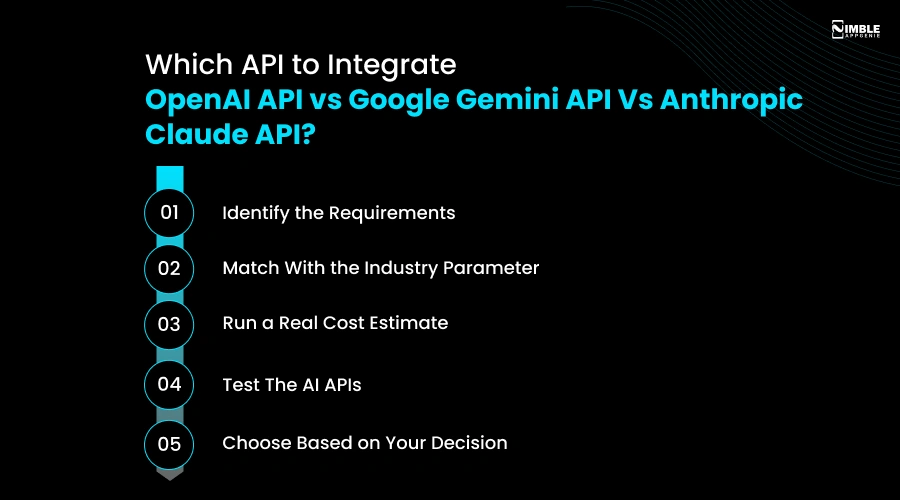
► Identify the Requirements
You should evaluate and analyze your app or software completely to identify the complete requirements and to explore the type of model and tools that will support your app.
First, you should be aware of the use case for your software. Is it for a chatbot, document processing, coding tool, content generation, or multimodal?
This use case requirement will help you to eliminate at least one AI API.
► Match With the Industry Parameter
You should explore what your competitors are doing, how they are approaching AI API, and what tools they are actively following.
Such as for fintech app development, you should choose Anthropic Claude API, while for the general-purpose ecosystem or on-demand industry, you can select OpenAI API.
► Run a Real Cost Estimate
You can run a real cost estimate by multiplying your estimated token volume by the skilled developers’ rates.
Every AI API has its own pricing for integrating it into the app or software. You should run the numbers calculated through all three AI APIs to identify the best one for you.
► Test The AI APIs
Now, under this step, you should test the AI APIs with respect to your app or software. This will help you to examine which API is best with respect to your software.
Here, you should evaluate the probabilistic nature of AI responses along with the standard API performance.
► Choose Based on Your Decision
Now, it’s time to select the right API based on your determinants and factors, for aligning the business goals with the technical, cultural, and complexity constraints.
Under this step, you can hire mobile app developers based on the particular requirements of your app.
Now, if you’re confused about whether to integrate an AI API or build an API from scratch, then let’s clear it up in the following section.
Why Integrate AI API, Why Not Build From Scratch?
You should integrate the AI API because it takes less time to integrate the API than creating an API from scratch.
Here is the comparison between AI API and whether to build it from scratch:
| Factor | Integrate AI API | Build From Scratch |
| Development Time | Days to weeks | Months to years |
| Cost | $5–$500/month (usage-based) | $500,000–$5M+ (model training) |
| Technical Expertise Needed | Moderate (API integration) | Very High (ML/AI research team) |
| Time to Market | Fast — launch in weeks | Slow — 12–24 months minimum |
| Maintenance | Managed by provider | Fully your responsibility |
| Model Quality | World-class (GPT-5, Claude, Gemini) | Depends entirely on your data and team |
| Scalability | Instant — provider handles it | Complex — requires dedicated infrastructure |
| Compliance & Safety | Built-in by the provider | Must be built and maintained yourself |
| Best For | Startups, SMBs, and enterprises adding AI features | Large tech companies with unique AI needs |
| Risk | Low — proven models | Very High — most AI builds fail |
Now, when you select an API, it is significant to identify the cost parameters. Let’s get ahead with the same in the following section.
What’s the Cost to Integrate AI APIs?
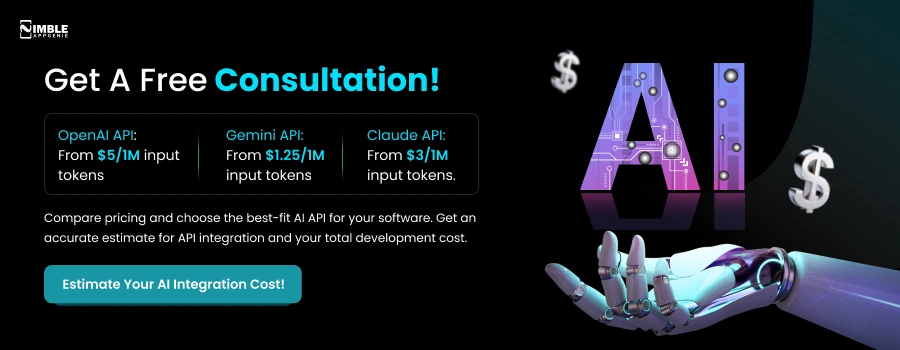
The cost to integrate AI APIs varies from $1.50/month to $18/month based on the different parameters such as model and usage, development and engineering scope, ongoing maintenance, and infrastructure of the app or software.
Here is the cost breakdown for AI API selection among OpenAI API, Google Gemini API, and Anthropic Claude APIs:
| Factor | OpenAI API | Google Gemini API | Anthropic Claude API |
| Free Tier | $5 credits at signup | Yes — generous | No free tier |
| Budget Model | GPT-5 Nano | Gemini 2.5 Flash-Lite | Claude Haiku 4.5 |
| Budget Input Price | Not publicly listed | $0.10 / 1M tokens | $1.00 / 1M tokens |
| Budget Output Price | Not publicly listed | $0.40 / 1M tokens | $5.00 / 1M tokens |
| Flagship Model | GPT-5.4 | Gemini 3.1 Pro | Claude Opus 4.8 |
| Flagship Input Price | Not publicly listed | $2.00 / 1M tokens | $5.00 / 1M tokens |
| Flagship Output Price | Not publicly listed | $12.00 / 1M tokens | $25.00 / 1M tokens |
| Batch Discount | 50% off | 50% off | 50% off |
| Business Plan | $20/user/month | N/A | N/A |
| Cheapest Overall | — | $0.10 input | — |
Connect With Nimble AppGenie and Integrate Your API
You should partner with Nimble AppGenie, the best AI Development Company in the world. Our developers allow you to ensure your product is AI-native from day one.
The major reasons to partner with us are:
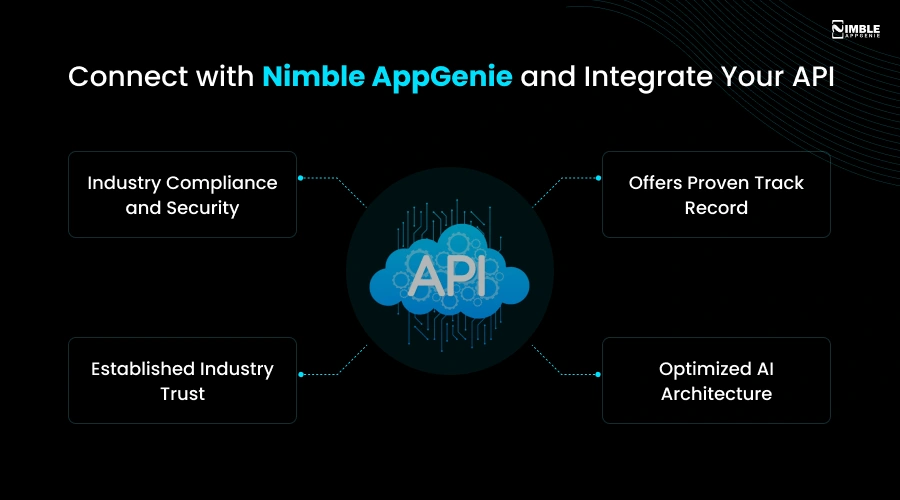
♦ Industry Compliance and Security
We offer highly specialized security compliance, such as GDPR practices. Along with this, Nimble AppGenie has ISO 27001 certification, and it is a PCI-DSS-compliant company.
♦ Established Industry Trust
Our company is an ISO 9001:2015 certified company, is a NASSCOM member, and is an AWS partner. Over Clutch, we have 5/5 ratings with 14 reviews.
♦ Offers Proven Track Record
Nimble AppGenie has 8+ years of experience in app development and has delivered 350+ apps to date.
♦ Optimized AI Architecture
Our company has an optimized AI architecture, integrating AI-native development in the core architecture of every app or software.
Conclusion
The major difference between the OpenAI API,vs Google Gemini API, and Anthropic Claude API is related to their structure, the type of models they are using, and how efficient they are during the integration process.
OpenAI API leads to ecosystem maturity, multimodal support, and availability during integrations.
Google Gemini API is suitable and well known for its cost-effectiveness, while Anthropic Claude leads on reasoning precision and safety guardrails; this API is best for fintech as well as compliance-critical applications.
One should select the AI API based on their software requirements, after analyzing the cost, its functionalities, and what it can offer the best.
FAQs

Niketan Sharma, CTO, Nimble AppGenie, is a tech enthusiast with more than a decade of experience in delivering high-value solutions that allow a brand to penetrate the market easily. With a strong hold on mobile app development, he is actively working to help businesses identify the potential of digital transformation by sharing insightful statistics, guides & blogs.
Table of Contents




No Comments
Comments are closed.