

 Free Consultation
 PCI-DSS Compliant
 GDPR Ready
 ISO 27001
 NDA Protected
 AI Services
 AI App Development
 Generative AI Development
 AI Chatbot Development
 AI Integration Services
 AI Consulting Services
 AI For Fintech
 AI Financial Assistant Solution
 AI Insurance Agent Development
 Tech Stack
 OpenAI / GPT-4
 Claude / Anthropic
 Gemini / Google AI
 Llama / Open Source
 LangChain / LlamaIndex
 Pinecone / Pgvector
 AWS / Azure AI


 Fintech Solution
 Core Fintech
 App Development
 Neobank Solutions
 eWallet Solutions
 Lending Software
 Banking Solutions
 BNPL Solutions
 BNPL Solutions
 Insurance App
 Wealth Management
 Crypto & DeFi
 Blockchain Development
  Payroll Software
 DeFi Solutions
 Crypto Wallet
 Crypto On/Off Ramp
 Crypto Exchange
 Trading Platform
 Payments
 Compliance
 Regulations & Compliance
 Fraud Detection
 Lending Ecosystem
 P2P Lending Platform
 Mortgage Software
 Engagement
 Fintech Outsourcing

 Mobile Development
 Mobile App Dev
 iOS App Development
 Android App Development
 React Native
 Flutter Development
 Web Solution
 Node.js Development
 React.js Development
 Angular Development
 App Services
 UI/UX Design
 App Maintenance
 By Stage
 MVP Development
 Industry Solutions
 Healthcare App Dev
 Education App Dev
 Travel App Dev
 Real Estate App Dev
 Logistics Software
 Social Media App

 Hire Mobile Developers
 Hire iPhone Developers
 Hire Android Developers
 Hire React Native Devs
 Hire Flutter Developers
 Hire Web Developers
 Hire Node.js Developers
 Hire Angular Developers
 Hire PHP Developers
 Hire Laravel Developers
 How It Works
 Pre-Vetted Developers
 Ready In 48 Hours
 NDA From Day One
 Replace Guarantee
 Company
 About Us
 Our Work Process
 Portfolio
 Case Studies
 Blog / Insights
 Careers
 Contact Us
 Awards
 Recognition


 Offices



Key Takeaways:
- LLM-powered app development costs can range from $25,000 to $300,000+, relying on the app’s complexity, AI approach, development team, and compliance requirements.
- The highest costs to make an LLM-powered app factors are LLM approach, feature complexity, data preparation, infrastructure, security, and ongoing model usage costs.
- API-based LLM apps are the most affordable and fastest to launch, while fine-tuned and custom-trained solutions require a larger investment but offer greater control and customization.
- Monthly LLM operating costs can range from $500 to $15,000+, covering API token usage, cloud infrastructure, vector databases, monitoring tools, and maintenance.
- Building an LLM MVP app first is the most cost-effective strategy, allowing businesses to validate their idea, gather user feedback, and avoid unnecessary development expenses.
- Choosing the right development partner, AI model, and technology stack can reduce LLM-powered app development costs while helping businesses launch faster and scale efficiently.
The cost question every founder and CTO is asking right now: how much does it cost to develop an LLM-powered app? The answer can range from $25,000 to $300,000+, depending on app complexity, the LLM approach chosen, team location, and industry-specific compliance needs.
If you are a startup founder, a product manager, a CTO, or an enterprise decision-maker, you have seen what GPT, Claude, and Llama can do. From customer support to business automation, companies are exploring how LLM can create new products and improve operations.
The opportunity is significant. 88% of organizations now use AI in at least one business function, up from 78% a year ago. At the same time, the enterprise LLM market is expected to grow from $5.91 billion in 2026 to $48.25 billion by 2034.
Now you are asking the same question many businesses are asking: how much does LLM-powered app development cost? A real number you can bring to a budget meeting.
This guide gives you exactly that. We break down the LLM-powered app development cost by app type, team structure, technology approach, and industry.
So, let’s begin!
What Is an LLM-Powered App?
An LLM-powered app is a software application that uses a large language model like GPT, Claude, Llama, or Gemini to process language, generate responses, analyze documents, or automate tasks.
These apps connect to an AI model either through an API or by running a model directly. The common examples are AI chatbots, document analyzers, code assistants, and customer support automation tools.
You can develop these apps in three ways:
- By calling a hosted model via API
- By fine-tuning an existing model on proprietary data
- By training a model from scratch.
Who Is Building LLM Apps Right Now?
Here are some examples of LLM-powered apps that businesses are building right now:
| Stakeholder | What They’re Building | Why They’re Building It |
| Startup Founders | AI-first SaaS products, copilot tools, niche vertical AI apps | Competitive differentiation and investor demand for AI-native products |
| CTOs & Tech Leads | Internal knowledge assistants, code review tools, data extraction pipelines | Developer productivity and cost reduction |
| Product Managers | Customer-facing chatbots, onboarding assistants, recommendation engines | Retention, engagement, and support cost reduction |
| Healthcare CIOs | Clinical documentation AI, patient intake automation, EHR summarization | Physician burnout reduction, HIPAA-compliant workflow automation |
| Legal Tech Teams | Contract review AI, legal research assistants, document drafting tools | Billable hour efficiency and client service differentiation |
| Finance Executives | Risk analysis tools, regulatory compliance AI, financial report summarization | SEC/FINRA compliance and analyst productivity |
| E-Commerce & Retail | AI shopping assistants, personalized recommendation engines, returns automation | Conversion rate improvement and customer service cost reduction |
LLM-Powered App Development Cost at a Glance
The cost to develop an LLM-powered app starts at around $25,000 for a basic API-integrated chatbot and can reach $300,000 or more for a custom enterprise AI platform.
Most business AI app development costs fall between $50,000 and $200,000. The monthly running costs range from $500–$15,000, depending on usage volume, model choice, and infrastructure complexity.
The table below shows the estimated breakdown of cost to build an LLM-powered application.
| App Type | Development cost (One-Time) | Monthly Running Cost |
| Simple AI chatbot | $25,000-$50,000 | $300-$2500 |
| RAG-based knowledge assistant | $50,000-$100,000 | $500-$4000 |
| Fine-tuned LLM app (domain-specific) | $100,000-$180,000 | $800-$6000 |
| Multi-agent AI platform | $180,000-$250,000 | $1000-$10,000 |
| Custom-trained enterprise LLM app | $250,000-$300,000+ | $3000-$15000 |
Note: All the cost to build an LLM app estimates are composite figures based on 2026 market data. Your actual number relies on multiple factors by geography, team structure, and particular requirements.
It is best to consult with a qualified AI development partner for a project-specific estimate.
8 Factors That Affect the Cost to Develop an LLM-Powered Application
The 8 main factors that affect the LLM-powered app development cost are:
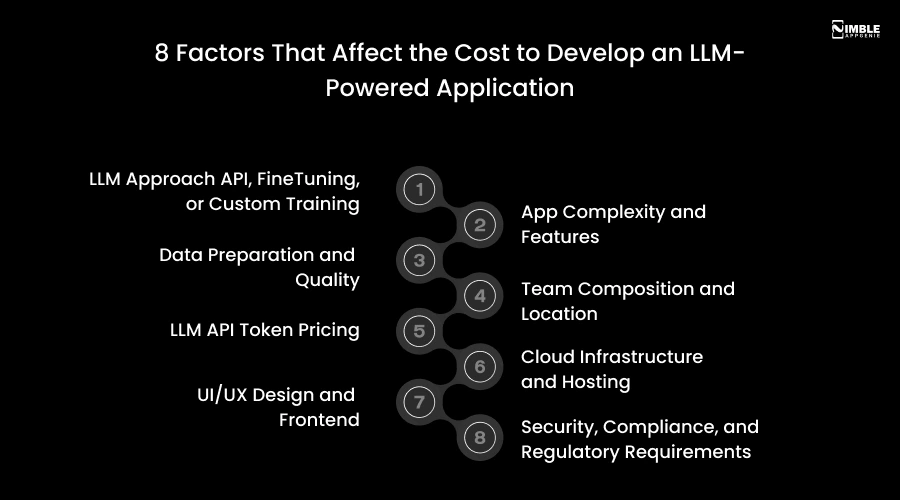
Each factor adds cost at different stages of the development lifecycle. Let’s take a look at them:
1. LLM Approach: API, Fine-Tuning, or Custom Training
This is the biggest cost decision you will make. Before anything else, you decide how you are going to use the LLM. This one decision shapes 60–70% of your total budget. There are three paths:
| Approach | What It Means | Typical Cost Range |
| API-based | You call a hosted model like GPT or Claude through an API. No training needed. | $25,000-$80,000 development + API fees/month |
| Fine-tuning | You take an existing model and train it on your own data to specialize it. | $80,000-$200,000 development + hosting |
| Custom training | You build or train a model from scratch. Only for large enterprises. | $200,000-$300,000+ |
By 2030, performing inference on an LLM with one trillion parameters will cost providers over 90% less than it did in 2025. This means API-based apps will get cheaper to run over the next 3–4 years, strengthening the case for starting with an API approach now.
2. App Complexity and Features
A basic chatbot and a multi-agent workflow platform are both LLM apps. The features you choose determine how complex the build becomes, and complexity drives cost. A simple chatbot costs far less than a multi-agent AI platform. Here’s what adds complexity:
Multi-turn conversations with memory, integration with your database or CRM, document ingestion and RAG pipelines, and multi-language support.
| Feature | Complexity Level | Added Cost Range |
| Basic text input/output interface | Low | Included in base build |
| Multi-turn conversation with memory | Medium | + $5,000 – $15,000 |
| Document ingestion (PDF, Word, CSV) | Medium | + $8,000 – $20,000 |
| RAG pipeline with vector search | Medium-High | + $15,000 – $40,000 |
| CRM / ERP integration (Salesforce, HubSpot) | High | + $15,000 – $35,000 |
| Multi-language support | Medium | + $8,000 – $20,000 |
| Voice input / Speech-to-text | High | + $15,000 – $30,000 |
| Agentic workflows (model takes actions) | Very High | + $40,000 – $120,000 |
| Real-time web search grounding | High | + $15,000 – $30,00 |
| Analytics dashboard and usage monitoring | Medium | + $10,000 – $25,000 |
Note: Every added feature increases development hours. Development hours directly drive LLM app development pricing. You should prioritize features that deliver measurable business value at launch, add the rest in later phases.
3. Data Preparation and Quality
This is the most underestimated cost in LLM development. If your app needs to learn from your own data, contracts, manuals, support tickets, someone has to clean and prepare that data first before the model can use it.
| Data Scenario | Typical Cost Range | Why It Costs This Much |
| Clean, structured dataset (under 10K docs) | $2,000 – $10,000 | Minimal preprocessing. Standard ingestion pipeline |
| Medium dataset with mixed formats (PDFs, Word, CSVs) | $10,000 – $30,000 | Format normalization, chunking strategy, deduplication |
| Large, messy enterprise dataset (50K+ docs) | $30,000 – $80,000 | Domain expert annotation, PII scrubbing, quality validation |
| Medical imaging labels or clinical records (HIPAA) | $40,000 – $120,000 | Domain specialist labeling, HIPAA-compliant data handling |
| Multi-language or multilingual data corpus | $20,000 – $60,000 | Language-specific preprocessing, translation validation |
Research Note: Domain-expert annotation for medical or legal data can cost $30,000 or more on its own. In these sectors, data quality is not optional; it directly determines whether the model is safe to use.
4. Team Composition and Location
Who builds your app is one of the highest controllable cost to develop an LLM-powered app variable. A US-based agency and an Asia-based dedicated development team of the same seniority develop comparable quality, but at very different rates. Take a look:
| Role | US/Canada ($/hr) | UK/Western Europe ($/hr) | What They Do |
| AI/ML Engineer | $200 – $300 | $150 – $250 | LLM integration, fine-tuning, pipeline engineering |
| Backend Developer | $150 – $250 | $100 – $180 | API development, data architecture, server logic |
| Frontend Developer | $120 – $200 | $80 – $150 | UI design, chat interface, dashboard development |
| DevOps / MLOps Engineer | $150 – $250 | $100 – $180 | Deployment, monitoring, scaling, cost optimization |
| Prompt Engineer | $120 – $200 | $100 – $160 | Prompt design, RAG tuning, evaluation |
| UI/UX Designer | $100 – $180 | $80 – $140 | User flows, visual design, prototyping |
| QA / Test Engineer | $80 – $150 | $60 – $120 | Functional, performance, and safety testing |
Average AI engineer salaries in the US reached $206,000 in 2025, a $50,000 increase over the prior year. LLM fine-tuning specialists command a 25–40% premium above that baseline.
This is why most startups and enterprises work with a specialist offshore partner rather than building and maintaining a US-based in-house LLM team.
5. LLM API Token Pricing
If you use a hosted API, you pay per token, roughly per word processed. This is not a one-time cost. It compounds every day your app runs.
| Model | Provider | Input (per 1M tokens) | Output (per 1M tokens) | Best For |
| GPT-4.1 | OpenAI | $2.00 | $8.00 | General-purpose high quality |
| Claude Sonnet 4.6 | Anthropic | $3.00 | $15.00 | Long-form reasoning, code, writing |
| Gemini 2.5 Flash | $0.15 | $0.60 | High-volume, budget-sensitive apps | |
| DeepSeek V3.2 | DeepSeek | $0.14 | $0.28 | Lowest cost, near-frontier quality |
| Llama 4 Maverick (via Fireworks) | Meta/Open | $0.22 | $0.88 | Open-source with self-host option |
| GPT-4.1 Mini | OpenAI | $0.40 | $1.60 | Mid-tier quality, lower cost |
| Claude Haiku 4.5 | Anthropic | $1.00 | $5.00 | Fast, affordable Anthropic option |
Token Cost Reality Check: An app with 1,000 daily active users, each having a 10-turn conversation, can easily consume 5–10 million tokens per day. At GPT-4.1 pricing, that is $10,000–$80,000 per month in API fees alone.
At DeepSeek V3.2 pricing, the same load costs $700–$2,800 per month. Model selection is a financial decision, not just a technical one.
6. Cloud Infrastructure and Hosting
To automate your business with AI, you need infrastructure that can reliably power your application. API-based AI apps usually require a lean infrastructure setup. This makes them more cost-effective to launch and maintain.
However, if you are using self-hosted or fine-tuned models, infrastructure costs can quickly become one of the largest parts of your development budget due to the need for GPUs, storage, security, and ongoing maintenance.
| Infrastructure Component | API-Based App (Monthly) | Fine-Tuned / Self-Hosted (Monthly) |
| Cloud compute (AWS / GCP / Azure) | $500 – $3,000 | $2,000 – $15,000 |
| Vector database (Pinecone / Weaviate) | $500 – $2,500 | $500 – $2,500 |
| GPU instance for model inference (H100/A100) | Not required | $3,000 – $20,000 |
| Storage (S3, GCS) | $100 – $500 | $500 – $3,000 |
| Observability/logging (LangSmith, Helicone) | $0 – $500 | $500 – $2,500 |
| CDN and load balancing | $200 – $1,000 | $500 – $2,000 |
7. UI/UX Design and Frontend
How users interact with your app matters. A plain text interface is cheap. A polished, branded AI product with dashboards, custom components, and smooth UX costs more.
| Design Scope | Typical Cost Range | Suitable For |
| Minimal chat UI (basic interface) | $3,000 – $8,000 | Internal tools, MVPs, developer-facing tools |
| Custom branded chat + basic dashboard | $10,000 – $25,000 | Consumer apps, startup MVPs with UX focus |
| Full product design with analytics and admin | $25,000 – $60,000 | SaaS platforms, customer-facing enterprise tools |
| Enterprise-grade design with multiple roles/views | $50,000 – $120,000 | Large enterprise deployments, multi-stakeholder tools |
8. Security, Compliance, and Regulatory Requirements
This factor is non-negotiable for regulated industries. Healthcare, finance, legal, and government applications carry significant compliance requirements that add directly to LLM app development costs.
If you’re in healthcare, finance, or legal, you need extra work like HIPAA compliance, SOC2 audit readiness, and GDPR compliance.
| Compliance Requirement | Industry | Added Cost Range |
| HIPAA compliance (healthcare data protection) | Healthcare | $15,000 – $40,000 |
| SOC 2 Type II audit readiness | SaaS / Enterprise | $20,000 – $50,000 |
| GDPR data handling and consent architecture | EU-facing apps | $10,000 – $30,000 |
| SEC/FINRA auditability (7-year prompt logs) | Fintech / Finance | $20,000 – $60,000 |
| PII masking and data scrubbing pipeline | Any regulated sector | $8,000 – $25,000 |
| Red teaming and AI safety evaluation | All customer-facing LLM apps | $5,000 – $20,000 |
| FDA AI/ML Software guidance compliance | Medical devices / Diagnostics | $50,000 – $150,000 |
Research Note: Healthcare or financial services LLM deployment can add $100,000–$200,000 on top of the baseline cost to develop an LLM-powered app when full compliance, audit trails, and red teaming are factored in.
It is vital to make a budget for compliance before kickoff, not after legal review.
How Much Does It Cost to Build an LLM-Powered App Across Different Industries?
LLM app development cost for startups varies by different industries. For example, healthcare apps requiring HIPAA compliance start at $80,000–$200,000 for an MVP. While AI financial assistant apps like Cleo with regulatory requirements cost $100,000–$300,000+.
Legal tech document AI runs $70,000–$200,000. Enterprise internal tools range from $50,000–$250,000 depending on data complexity and integrations.
| Industry | Typical Use Case | Who Builds It | Estimated Build Cost | Key Cost Driver |
| Healthcare | Clinical documentation AI, patient intake bot, EHR summarization | Healthcare CIOs, digital health startups | $80,000 – $300,000 | HIPAA compliance + domain-specific data |
| Legal Tech | Contract review AI, legal research assistant, document drafting | Legal tech startups, Am Law 100 firms | $70,000 – $200,000 | RAG precision + citation accuracy |
| Fintech / Finance | Risk analysis AI, regulatory report summarization, audit assistant | Finance teams, RegTech startups | $100,000 – $350,000 | SEC/FINRA compliance + security |
| E-Commerce / Retail | AI shopping assistant, personalized recommendations, returns AI | Product teams, D2C brands | $40,000 – $120,000 | CRM integration + real-time inventory data |
| HR & Recruitment | Resume screening AI, onboarding assistant, HR policy chatbot | HR tech companies, enterprise HR teams | $40,000 – $100,000 | Data privacy + multi-language support |
| Education / EdTech | AI tutoring, personalized learning path, essay evaluation | EdTech startups, universities | $50,000 – $150,000 | Content quality + adaptive reasoning |
| Enterprise Internal Tools | Knowledge base AI, IT help desk bot, meeting summarizer | Enterprise CTOs, IT departments | $50,000 – $250,000 | Data ingestion + access control |
LLM App Development Cost by App Type
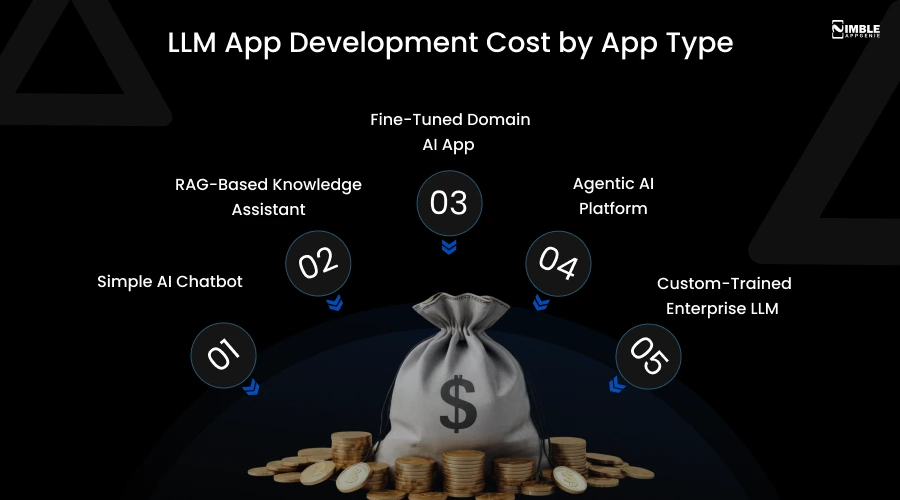
The cost to build an LLM-powered application can be affected by different types of applications you want to build. For example, a simple AI chatbot, a RAG-based knowledge assistant, a fine-tuned domain AI app, an agentic AI platform, and so on.
Let’s understand these factors affecting the custom LLM development cost below.
1. Simple AI Chatbot
You can develop a simple AI chatbot using a third-party API like OpenAI or Claude. No custom training is required. It works best for FAQ bots, lead capture, and basic customer support.
- Timeline: 4–8 weeks
- Team: 2–3 developers, 1 designer
- Good for: Small businesses, MVPs, internal tools
2. RAG-Based Knowledge Assistant
If you want to build a RAG-based knowledge assistant app with AI app development frameworks, you can connect your LLM to your own documents, policies, or databases. The model retrieves relevant information before generating a response that reduces hallucinations.
- Cost: $15,000 – $45,000
- Timeline: 8–16 weeks
- Needs: Vector database, embedding pipeline, document ingestion system
- Good for: Legal, HR, customer support, e-commerce
3. Fine-Tuned Domain AI App
You take an existing model and train it on thousands of your own examples. This gives you a model that behaves exactly the way you want it to.
- Cost: $50,000 – $100,000
- Timeline: 3–6 months
- Requires: Clean labeled dataset, ML engineers, GPU compute
- Good for: Medical, legal, finance, any domain with specialized language
4. Agentic AI Platform
The agentic AI app does not just respond; it takes actions. It can browse the web, call APIs, fill forms, and manage multi-step workflows autonomously. For teams that prefer not to maintain their own browser fleet, an AI browser agent can host the same loop on managed Chromium so agent autonomy survives on protected targets.
- Cost: $150,000 – $200,000
- Timeline: 4–8 months
- Requires: Orchestration layer, tool integrations, safety guardrails
- Good for: Enterprise automation, sales ops, research tools
5. Custom-Trained Enterprise LLM
You can create a custom enterprise LLM-powered app or train a model from scratch. Very few businesses need this. If your use case can be served by an API or fine-tuned model, this is overkill.
- Cost: $200,000 – $300,000+
- Timeline: 6–18 months
- Requires: Massive compute budget, ML research team, proprietary data
- Good for: Defense, frontier AI labs, large regulated enterprises
Build vs. Buy: Which LLM Approach Costs Less?
Using a third-party LLM API costs less upfront that is often 50-70% cheaper than fine-tuning or custom training. But API integration costs scale with usage, so at high volumes, fine-tuning can become cheaper over 2-3 years.
For most startups, it is best to start with an API-based approach and switch to fine-tuning only when the business case is proven.
| Factor | API-Based (Buy) vs. Fine-Tuned (Build) |
| Upfront cost | API: Low ($15K–$80K) | Fine-tuned: High ($80K–$200K+) |
| Monthly running cost | API: Variable (scales with tokens) | Fine-tuned: Fixed hosting cost |
| Time to launch | API: 4–12 weeks | Fine-tuned: 3–6 months |
| Customization | API: Limited | Fine-tuned: High |
| Data privacy | API: Data goes to provider | Fine-tuned: You control the model |
| Best for | API: MVPs, startups, varied tasks | Fine-tuned: Regulated industries, scale |
Our recommendation: You can start with an API, launch fast, prove value, and fine-tune when you have volume and a clear ROI.
What Are the Hidden Costs of LLM App Development?
The most overlooked costs in LLM-powered app development are:
- Token usage fees that grow with users
- Vector database storage and query costs
- Ongoing prompt engineering and maintenance
- Model update adaptation
- Compliance or security auditing
These can add 30-50% to your annual budget beyond the initial development cost.
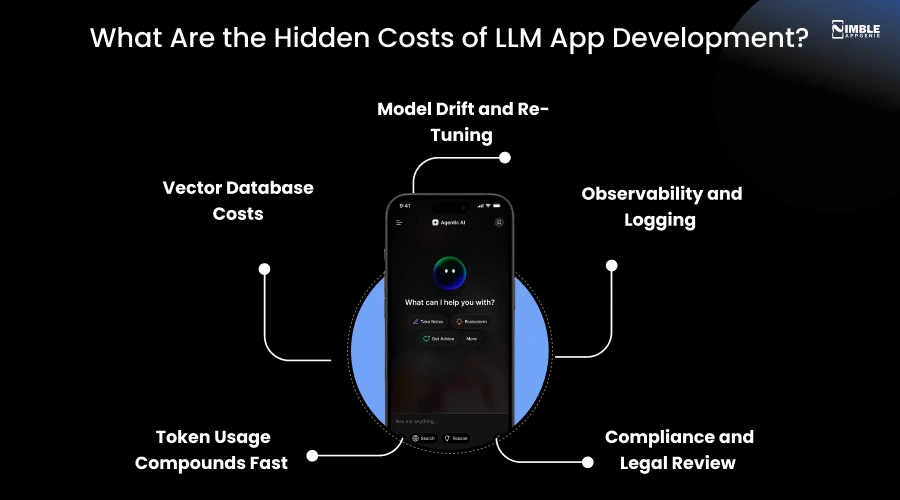
1. Token Usage Compounds Fast
A 1000-user application where each user has a 10-turn conversation can burn through 5-10 million tokens a day. At GPT-4.1 prices, that is $10,000-$80,000 per month. You can plan for this before you launch.
2. Vector Database Costs
If you are developing an RAG application with AI personalization, you need a vector database to store and search document embeddings. Pinecone, Weaviate, and similar tools cost $500 – $2,500/month depending on size and query volume.
3. Model Drift and Re-Tuning
LLM APIs update regularly. When the model behind GPT or Claude changes, your app’s outputs can change too, sometimes badly. You will need ongoing monitoring and occasional prompt re-engineering. You can budget $1,000 – $5,000/month for maintenance and monitoring.
4. Observability and Logging
You need to know what your model is doing. Tools like LangSmith, Helicone, or custom logging add cost. There is a basic version for free tiers available, and the production-grade cost is around $500 – $2,500/month.
5. Compliance and Legal Review
If your AI app makes decisions in healthcare, finance, or legal, you need compliance work. This is not optional. Budget $10,000 – $50,000 for initial compliance review, plus $5,000 – $15,000/year to maintain it.
How to Reduce the Cost to Develop an LLM-Powered App?
To reduce the cost to make an LLM app, you can start with an API-based MVP before training, use cheaper open-source models like Llama 4 or DeepSeek for lower-stakes tasks, enable prompt caching to cut token costs by up to 90%, build offshore with a quality partner, and launch an MVP first to validate before spending on advanced features.
Let’s take a deeper look below.
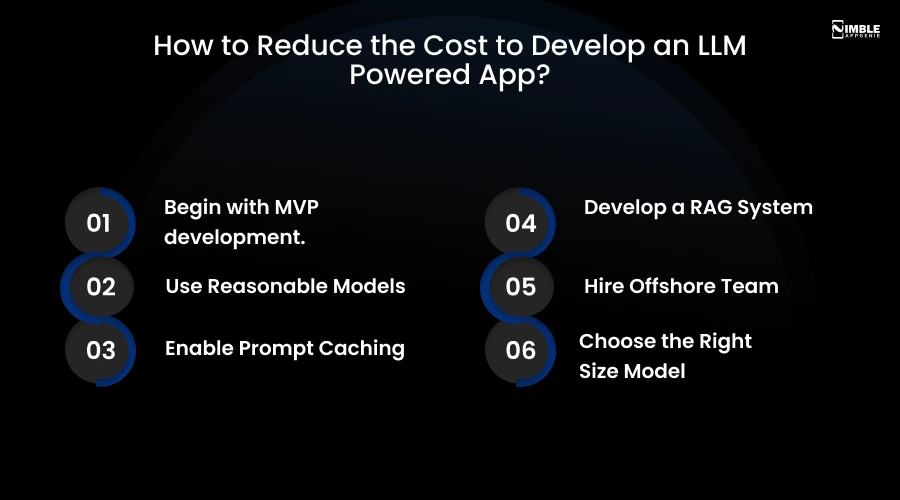
1. Begin with MVP development
First, you can start with an API-based MVP. It helps in validating your app idea before committing to fine-tuning or custom training. Also, the MVP app development cost is one of the major factors in reducing the LLM cost.
2. Use Reasonable Models
You can use cheaper models for simple tasks. You do not need GPT-4.1 for an FAQ bot. DeepSeek V3.2 or Gemini Flash can handle it at 10x less cost.
3. Enable Prompt Caching
Besides, you can enable prompt caching. Anthropic offers 90% off repeated input prefixes. OpenAI’s Batch API is 50% cheaper. These save real money at scale.
4. Develop a RAG System
You can build a RAG system before fine-tuning. RAG is faster to build, cheaper to run, and easier to update than a fine-tuned model.
5. Hire Offshore Team
It is best to offshore your development. A quality AI app development team in Asia delivers the same output at 40–60% lower cost than US-based teams.
6. Choose the Right-Size Model
You must choose the right size for your model. Test the cheapest model that does the job. But only upgrade when you have a clear reason to.
How Nimble AppGenie Can Help You Develop an LLM-Powered App?
Nimble AppGenie is a generative AI development company that has helped startups and enterprises to build AI-powered products. Our team excels in LLM-powered app development, from simple API-integrated chatbots to complex RAG systems, fine-tuned domain models, and multi-agent AI platforms.
We combine senior AI development talent with transparent pricing and an MVP-first development philosophy.
What do we build?
- API-based LLM integrations
- RAG pipelines with vector database
- Fine-tuned domain models for healthcare, legal, finance, and e-commerce
- Multi-agent AI platforms with autonomous workflow orchestration
- LLM-powered mobile apps (iOS and Android)
- Compliance-ready AI builds for HIPAA, SOC 2, and GDPR environments
| Engagement stage | What we do | Why it matters |
| Discovery (Week 1–2) | We define the LLM approach, map data requirements, select models, and produce a detailed cost estimate. | No budget surprises. You know the number before we start. |
| MVP Build (Week 2–12) | We ship the core LLM feature fast. One use case. One interface. Real users. Real feedback. | Validates the product before you spend $200K on features nobody needs. |
| Iteration (Month 3+) | We add features based on real user data, including RAG, integrations, and fine-tuning when the ROI is proven. | Every dollar spent is justified by actual usage evidence. |
| Ongoing Support | Monthly model monitoring, prompt optimization, cost reduction reviews, and new feature development. | Your app does not degrade as models update. We stay on top of it. |
Why Clients Choose Nimble AppGenie?
The clients choose us because:
- Transparent pricing: you get a real cost estimate before project kickoff, not a range that doubles by launch.
- MVP-first philosophy, we do not push you into a $300,000 development when a $50,000 MVP will validate your app idea.
- You get senior AI developers, not juniors learning on your project.
- Cross-domain experience: legal, finance, e-commerce, SaaS, enterprise internal tools.
- End-to-end ownership, from discovery and design to development, deployment, and post-launch optimization.
If you are planning to create an LLM-powered app, just tell us what you want to build; we will tell you exactly what it costs, how long it takes, and what team you need.
Conclusion
The cost to develop an LLM-powered app is not one number. It is a range shaped by choices. Choices about your LLM approach, your features, your team, your compliance requirements, and your long-term user volume.
The LLM market is moving fast. According to McKinsey, 88% of organizations are already using AI in at least one function. The gap between companies using AI and those capturing real financial returns from it is growing.
If you are not sure where to start, or what your specific build will cost, Nimble AppGenie can help. We have built LLM-powered apps across industries, and we will give you an estimated budget.
FAQs
Using an LLM API is significantly cheaper upfront, typically 50–70% less than fine-tuning. API costs scale with usage, so at high volumes, fine-tuning can become more economical over 18–24 months. For most startups and SMBs, start with an API and fine-tune only when scale and ROI justify the investment.
LLM-powered app development costs start at $15,000 for a simple API-based chatbot and can reach $300,000+ for a custom enterprise AI platform. Most mid-market business apps cost $50,000–$150,000 to build. Monthly LLM integration costs add $500–$15,000 depending on usage volume and model choice.
An API-based LLM chatbot takes 4–8 weeks to build. A RAG-based knowledge assistant takes 8–16 weeks. A fine-tuned domain AI takes 3–6 months. A multi-agent enterprise platform takes 4–8 months. Timeline depends on app complexity, data readiness, and team size.
The monthly running cost for an LLM-powered app depends on user volume and model choice. A small app with 500 daily users costs $300–$2,000/month. A mid-scale app with 5,000 daily users costs $2,000–$15,000/month. At 50,000 daily users, monthly API + infrastructure costs can reach $50,000–$150,000. Switching to budget models like DeepSeek or Gemini Flash can reduce monthly costs by 80–90%.
No. Most businesses should not train their own LLM from scratch. It costs $300,000 to $5 million or more and requires a dedicated ML research team. Instead, use a hosted API for general tasks, build a RAG system to incorporate your own data, or fine-tune an existing open-source model like Llama 4 for domain-specific language needs. Training from scratch is only justified for frontier AI labs and large regulated enterprises with massive proprietary data.

Madan is the Backend Solutions Architect at Nimble AppGenie, specializing in the design of secure, high-concurrency systems that power complex mobile ecosystems. With deep expertise in server-side logic and database management, he ensures every platform is built with enterprise-grade security. In his free time, he is an avid researcher of emerging technologies; he spends his time deconstructing the latest backend frameworks and reading technical papers to ensure our solutions remain at the absolute forefront of industry innovation.
Table of Contents




No Comments
Comments are closed.