

 Free Consultation
 PCI-DSS Compliant
 GDPR Ready
 ISO 27001
 NDA Protected
 AI Services
 AI App Development
 Generative AI Development
 AI Chatbot Development
 AI Integration Services
 AI Consulting Services
 AI For Fintech
 AI Financial Assistant Solution
 AI Insurance Agent Development
 Tech Stack
 OpenAI / GPT-4
 Claude / Anthropic
 Gemini / Google AI
 Llama / Open Source
 LangChain / LlamaIndex
 Pinecone / Pgvector
 AWS / Azure AI


 Fintech Solution
 Core Fintech
 App Development
 Neobank Solutions
 eWallet Solutions
 Lending Software
 Banking Solutions
 BNPL Solutions
 BNPL Solutions
 Insurance App
 Wealth Management
 Crypto & DeFi
 Blockchain Development
  Payroll Software
 DeFi Solutions
 Crypto Wallet
 Crypto On/Off Ramp
 Crypto Exchange
 Trading Platform
 Payments
 Compliance
 Regulations & Compliance
 Fraud Detection
 Lending Ecosystem
 P2P Lending Platform
 Mortgage Software
 Engagement
 Fintech Outsourcing

 Mobile Development
 Mobile App Dev
 iOS App Development
 Android App Development
 React Native
 Flutter Development
 Web Solution
 Node.js Development
 React.js Development
 Angular Development
 App Services
 UI/UX Design
 App Maintenance
 By Stage
 MVP Development
 Industry Solutions
 Healthcare App Dev
 Education App Dev
 Travel App Dev
 Real Estate App Dev
 Logistics Software
 Social Media App

 Hire Mobile Developers
 Hire iPhone Developers
 Hire Android Developers
 Hire React Native Devs
 Hire Flutter Developers
 Hire Web Developers
 Hire Node.js Developers
 Hire Angular Developers
 Hire PHP Developers
 Hire Laravel Developers
 How It Works
 Pre-Vetted Developers
 Ready In 48 Hours
 NDA From Day One
 Replace Guarantee
 Company
 About Us
 Our Work Process
 Portfolio
 Case Studies
 Blog / Insights
 Careers
 Contact Us
 Awards
 Recognition


 Offices


Key Takeaways:
- A multi-agent AI system comprises multiple autonomous agents who collaborate to solve complicated problems that are difficult for a single agent to handle.
- The working process of a multi-agent AI system begins with request intake, task planning, and parallel execution, and ends with collaboration.
- One of the critical pain points that a multi-agent AI system resolves is that it helps to overcome the limitations of single AI models.
- Enterprises are moving to multi-agent AI systems to improve performance, better accessibility for complex workflows, increased automation, and reduce operational costs.
- The enterprises deploy the AI agent networks through identifying the business requirements, designing the architecture, building an orchestration layer, implementing memory, ensuring security, and monitoring the performance.
- Partner with Nimble AppGenie and deploy AI agent networks for improving overall business performance.
The overall multi-agent system platform market size is projected to expand from USD 7.81 billion in 2025 and USD 11.54 billion in 2026 to USD 78.53 billion by 2031.
This growing share of multi-agent AI systems offers a great opportunity for AI startups and entrepreneurs to invest in multi-agent systems. If you are interested in this growth and want to invest or want to resolve the limitations of a single AI model, then this is the right time.
Multi-agent AI systems divide the complex, multi-stage tasks into smaller, specialized agents that communicate and collaborate; these systems conquer limitations in context, accuracy, and scope.
In this guide, multi-agent AI systems are explained, along with how enterprises are deploying AI agent networks.
Let’s learn it all together.
What is a Multi-Agent AI System?
The multi-agent AI system comprises multiple autonomous AI agents collaborating to solve complex problems that are very difficult for a single agent to handle. These systems can leverage different models for different steps, integrate various APIs, and process multiple parts of a problem concurrently.
This is a system where multiple agents interact with each other and their environment to achieve their individual and collective goals.
A few examples of multi-agent systems in business include:
- Customer service
- Supply chain
- Security and fraud detection
Additionally, the main components of a multi-agent system are:
- Agents: These are individual AI programs powered by LLMs; these programs act as the “brain,” using tools such as calculators or databases to execute tasks.
- Environment: This is a digital or physical space where agents operate, such as a cloud server, coding environment, and a robotic workspace.
- Coordination Layer: This is the system’s decision-making engine. This layer manages the workflow, decides which tasks run sequentially, resolving conflicts between the agents.
- Communication: These are the rules and formats that dictate how agents “talk” to each other. This is a connective tissue that allows agents to ask for data, pass on tasks, and handle exceptions without human interference.
Now, let’s get ahead with the working process of a multi-agent AI system.
How Does a Multi-Agent AI System Work?
A multi-agent AI system works by dividing a complicated problem into smaller, manageable tasks and assigning them to a team of specialized AI agents. Here is the complete process of how a multi-agent AI system works:
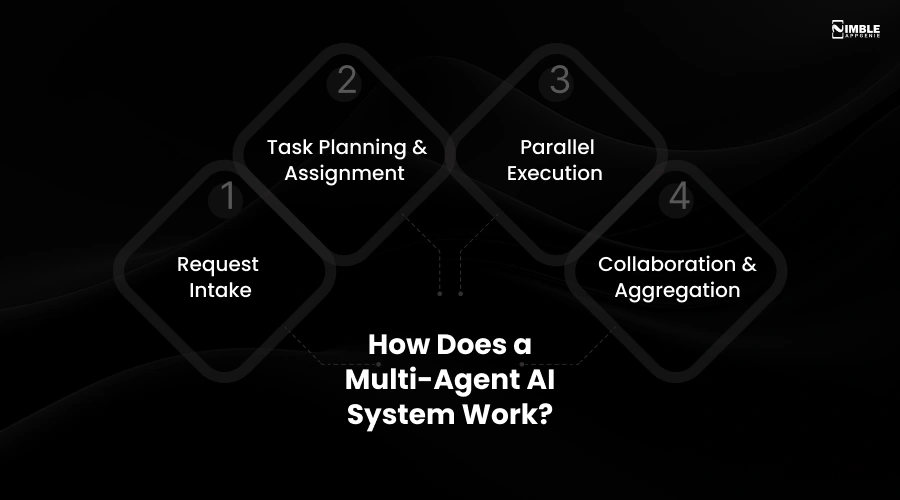
Step 1: Request Intake
The system receives a user request, a query, and the business process trigger. This is the initial phase where the initial prompt and task are captured into a multi-agent AI system.
Instead of a single AI trying to do everything, this multi-agent AI system quickly understands the exact need and delegates the work to the most qualified agents.
Step 2: Task Planning & Assignment
Under this step, the orchestrator agent analyzes the request and assigns tasks to the specialized agents who know how to handle that particular query.
This further includes breaking a large user goal into smaller, manageable subtasks and then routing them to a specialized agent.
Step 3: Parallel Execution
The multiple agents perform their assigned tasks simultaneously, such as data retrieval, analysis, validation, or decision-making.
They are well-trained agents that identify which tasks depend on previous steps and which ones can run independently.
Step 4: Collaboration & Aggregation
In this step, the agents share results, and the orchestrator combines outputs into a unified response or recommendation.
This synthesises the agreed-upon data points into a single actionable output.
Now, as we have analyzed the complete working process of multi-agent AI systems, let’s learn the reason related to why enterprises are moving to multi-agent AI in 2026.
Why Enterprises are Moving to Multi-Agent AI in 2026?
The enterprises are moving to multi-agent AI in 2026 to transform the basic chatbots into autonomous, end-to-end workflow execution. Here is the list of complete reasons:
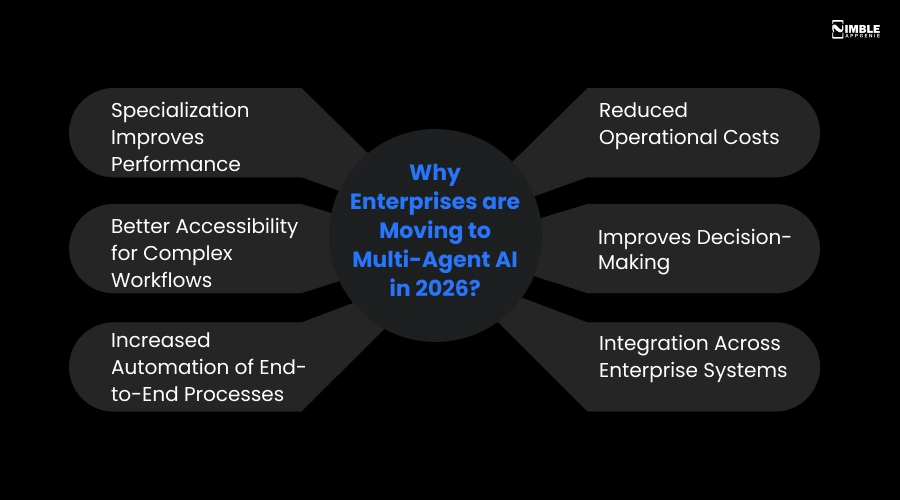
1. Specialization Improves Performance
Implementing multi-agent AI systems can help you to optimize your different agents for different tasks. For instance, research agents gather information, planning agents create workflows, coding agents generate software, compliance agents check regulations, etc.
This specialization of multi-agent AI systems produces more accurate and reliable outcomes than a single general-purpose AI.
2. Better Accessibility for Complex Workflows
Adopting the multi-agent AI system offers better accessibility for the complicated workflows through dividing a massive, overarching issue into smaller, more manageable tasks.
Instead of asking one large AI program to do everything, individual AI agents focus on individual agents to focus on dsicreate tasks, which helps to resolve the complicated tasks simply.
3. Increased Automation of End-to-End Processes
The multi-agent AI system increases the automation of end-to-end processes through dividing complicated tasks among specialized, autonomous AI agents.
This teamwork allows systems to autonomously run, manage, and complete entire workflows without any human intervention.
4. Reduced Operational Costs
The multi-agent AI systems do minimizes operational costs through replacing the isolated automation with coordinated, collaborative networks of specialized AI agents.
Instead of one tool doing everything, each agent has a specific job; these agents communicate, share information, and divide the tasks to operate more cheaply and quickly.
5. Improves Decision-Making
Multi-agent AI systems do help in improving decision-making through dividing complicated tasks among specialized, autonomous agents that collaborate, debate, and share data.
Multi-agent AI systems act like a team of human experts; this collaborative approach results in faster execution, minimizes AI errors, and offers greater ability to handle complicated scenarios.
6. Integration Across Enterprise Systems
Multi-agent systems do offer integration across enterprise systems by replacing rigid, hard-coded data pipelines with networks of specialized AI agents that can discover, interpret, and act upon disconnected software.
Instead of building complicated custom code for every system, the enterprises do deploy agents that understand the intent of a request and use standard APIs to complete tasks automatically.
Well, now, as you are aware, the key reasons why enterprises are moving to multi-agent AI, as an entrepreneur, you might be thinking of how an enterprise should deploy it. In the following section, you can evaluate it successfully.
How Enterprises Are Deploying AI Agent Networks?
The enterprises deploy advanced systems via a structured approach to infrastructure, architecture, and governance.
Here is how an enterprise is deploying AI agent networks:
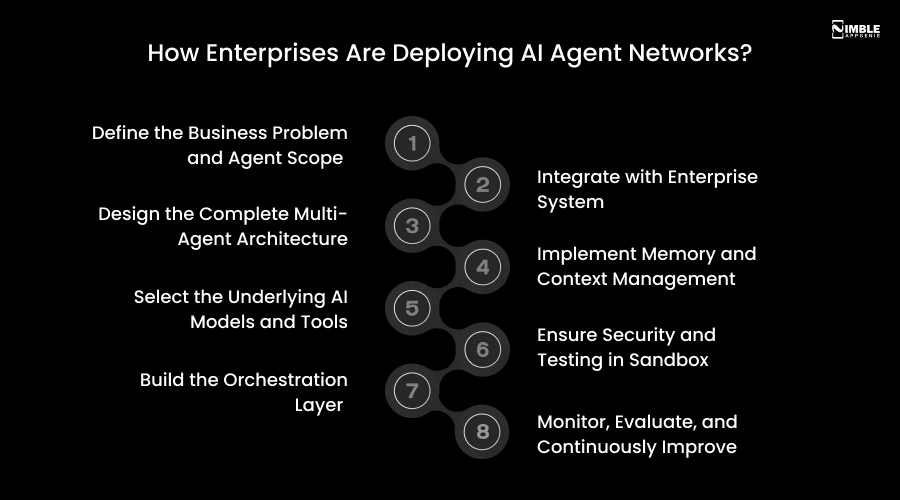
Step 1: Define the Business Problem and Agent Scope
This is the first step where you define the business problem and issues. You should evaluate the need for your multi-agent AI system, which is the foundational phase of building or implementing an AI agent.
Invest in a multi-agent AI system only when it seems critical for your business. This comprises identifying a specific operational workflow to improve, defining measurable objectives, and setting clear boundaries.
Step 2: Design the Complete Multi-Agent Architecture
Under this step, we design a complete multi-agent architecture that further helps you to coordinate through an orchestrator, share a persistent memory layer, and access enterprise tools via standard communication protocols.
Here, our team creates an outline defining how autonomous agents will interact, share data, and even collaborate to accomplish specific business objectives.
Step 3: Select the Underlying AI Models and Tools
In this step, we select the right AI models and tools for enterprise agent networks that require aligning the business goals with specific technology capabilities. Here, we began by aligning agent objectives with specific business key performance indicators (KPIs).
Under this step, we have a set of critical production metrics before assigning them to act as the “brains” of an agent network.
Step 4: Build the Orchestration Layer
This is the step where we build the complete orchestration layer, which is the control system that coordinates all agents, assigning tasks, managing context windows, and ensuring no agent exceeds its defined scope.
Under this step, we create the coordination infrastructure that allows multiple, specialized AI agents to work together securely on the complex enterprise workflows.
Step 5: Integrate with Enterprise System
Here, we integrate the multi-agent AI system, which is the critical phase where intelligent agents are securely connected to a company’s existing data sources, workflows, and applications.
This step transforms standalone AI models into autonomous “digital workers” that can execute multi-step tasks such as checking inventory, updating tickets, and transferring funds across the internal systems.
Step 6: Implement Memory and Context Management
In this phase of deploying an AI agent network, enterprises configure short-term memory, long-term memory, and shared memory.
This ensures that the agents maintain context, learn from previous interactions, and avoid repeating work already completed by other agents in the network.
Step 7: Ensure Security and Testing in Sandbox
Before any production deployment, the enterprises define what agents can and cannot do autonomously. Here, the multiple agents require human approval, have their outputs reviewed before execution, and are escalated to a human operator.
Our experts ensure security and testing in the Sandbox. We enforce strict hardware-level isolation, zero-trust network policies, and automated continuous testing.
Step 8: Monitor, Evaluate, and Continuously Improve
This is the last step in how enterprises are deploying AI agent networks, where we monitor, evaluate, and regularly improve your multi-agent AI systems.
Sustainability of your multi-agent AI system will ensure system stability, resource management, cost efficiency, and real-world adaptability.
The top AI app development companies follow this process to integrate multi-agent AI networks. Well, even if you’re confused about multi-agent AI system integration, the following section of real-world case studies will walk you through practical answers.
Real Enterprise Case Studies
Learning about the real enterprise case studies will help you to evaluate how the AI agent networks are assisting enterprises in the real world. Let’s have a look at case studies:
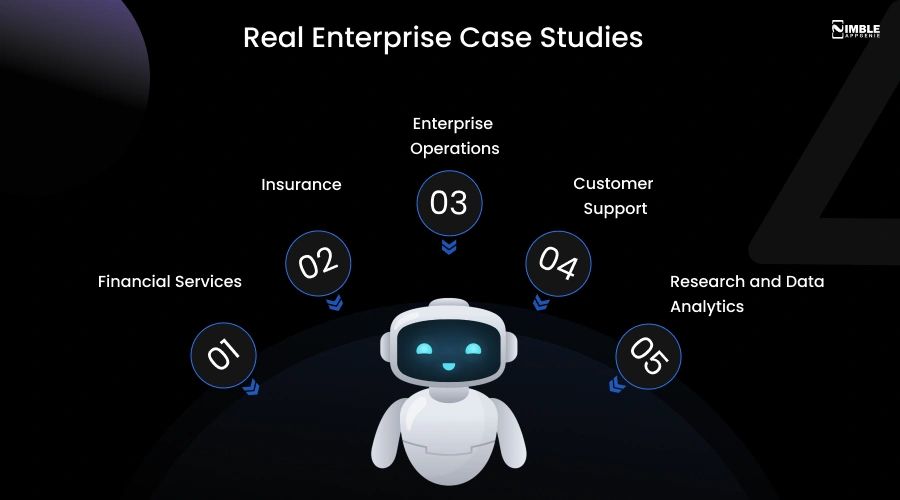
1. Financial Services
A multi-agent system handles loan applications end-to-end, where one agent extracts and verifies borrower documents.
Another queries credit bureaus and calculates risks, while the third one checks all the related regulatory requirements.
Here, the orchestrator agent compiles the final underwriting decision with a complete audit trail, reducing underwriting time from days to minutes. These enterprises connect with the best fintech solution experts to integrate multi-agent AI systems.
2. Insurance
The specialized agents do handle claim intake, document verification, fraud patterns, policy coverage validation, and payout calculation.
Here, all these tasks are segregated to different agents, where one does document verification, one evaluates the fraud patterns, and another performs payout calculation.
The insurance automation software solution does help in managing the end-to-end claims pipeline and escalating edge cases to human adjusters.
3. Enterprise Operations
The teams build purpose -built agents that handle tasks across sales, support, operations, and even in marketing.
This multi-agent AI network breaks down complicated multi-step workflows into parallel tasks handled by specialized, autonomous AI agents.
These agents collaborate, share data, and process tasks such as research, compliance, analytics, and execution, performing significantly better than a single, monolithic model.
4. Customer Support
Agents that gather the context, analyze issues, and provide effective solutions. These bodies collaborate to resolve complex issues, instead of a single bot handling everything.
These support integrations securely with the enterprise tools to perform background tasks, including updating records and processing funds.
A triage agent classifies the request, a knowledge-retrieval agent finds relevant solutions, and an action agent executes the fix.
5. Research and Data Analytics
The multi-agent research pipelines deploy a data-gathering agent, an analysis agent, and a verification agent, where each agent performs distinct tasks.
These agents are deployed to produce research outputs with built-in fact-checking that a single agent pass would miss.
Here, the research and data analytics agents divide the complex end-to-end data pipelines into modular, collaborative workflows.
Now, as you are ready to implement multi-agent AI systems, let’s get ahead with the comparison table of diversified multi-agent AI systems in the next section.
Comparison of Multi-Agent AI Systems Frameworks
The comparison of the frameworks will assist you in choosing the right orchestration framework that shapes your entire system’s flexibility, governance capability, and scalability.
Here is the table defining the complete list of frameworks:
| Framework | Best For | Strength | Learning Curve |
| LangGraph | Enterprise production systems | Durable execution, state graphs, used by JPMorgan, BlackRock | High |
| Microsoft AutoGen | Conversational multi-agent collaboration | Mature, Microsoft-backed, 32,000+ GitHub stars | Medium |
| CrewAI | Role-based agent teams | Fast prototyping, intuitive role design, 22,000+ stars | Low-Medium |
| AgentOps | Monitoring & observability (not a framework) | Production monitoring, cost optimization, debugging | Low (add-on) |
| Dust | No-code multi-agent platform | Shared context across departments, 50+ integrations | Low |
| Microsoft Copilot Studio | M365-native agent building | Fastest deployment in the Microsoft ecosystem | Low |
| Google Vertex AI Agent Builder | Multimodal enterprise agents | Text, image, audio, and video processing at scale | Medium-High |
A caveat in using the frameworks is that you should be very well aware of the challenges in your business and the requirements of the multi-agent AI framework.
Now, as you are getting ahead, you need a team of experts who can perform this task on your behalf.
Why Connect with Nimble AppGenie to Build Your Multi-Agent AI System?
Nimble AppGenie is the best AI app development company offering services such as:
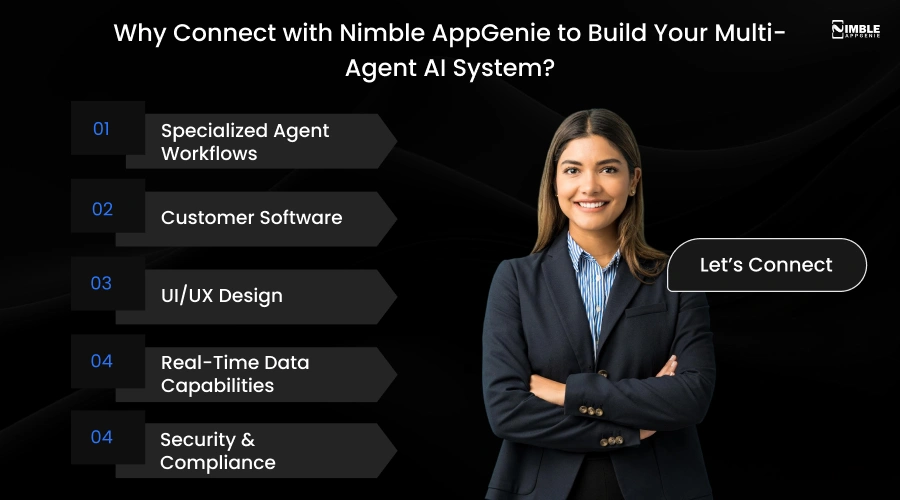
1. Specialized Agent Workflows
Our team offers specialized agent workflows by combining predictive analytics, natural language processing, and deterministic actions to automate complicated industry operations. We are the leading fintech app development company that specializes in combining finance with technology via AI and all the latest technologies.
2. Customer Software
We combine AI-native engineering with deep industry expertise. Our experts offer full-lifecycle development from market research, identifying the right features, to building the complete multi-agent AI system for your platform.
3. UI/UX Design
Our team has professional designers who know how to design your multi-agent AI system that stands out from the vast competition. We design interfaces that provide transparency and enable human-in-the-loop, and handle asynchronous actions.
4. Real-Time Data Capabilities
Nimble AppGenie offers real-time data capabilities primarily through integrating advanced AI algorithms. Our team utilizes AI and cloud-based architecture to deliver instantaneous with high-volume data synchronization.
5. Security & Compliance
We understand that security is not to be built at the end, but it is the process that begins with initiating a complete AI agent development cycle through privacy by design, zero-trust architecture, and fintech-grade encryption.
Conclusion
The multi-agent AI system comprises multiple autonomous AI agents collaborating to resolve complicated problems that are too difficult for a single agent to handle. These agents divide the tasks into smaller chunks. The working procedure of a multi-agent AI system begins with request intake, task planning, parallel execution, and collaboration.
Furthermore, the enterprise can deploy multi-agent AI systems by defining business problems, designing the multi-agent architecture, selecting the AI models, building an orchestration layer, and integrating with the enterprise system.
Connecting with an experienced company can help you integrate the right multi-agent AI system successfully.
FAQs

Madan is the Backend Solutions Architect at Nimble AppGenie, specializing in the design of secure, high-concurrency systems that power complex mobile ecosystems. With deep expertise in server-side logic and database management, he ensures every platform is built with enterprise-grade security. In his free time, he is an avid researcher of emerging technologies; he spends his time deconstructing the latest backend frameworks and reading technical papers to ensure our solutions remain at the absolute forefront of industry innovation.
Table of Contents




No Comments
Comments are closed.