

 Free Consultation
 PCI-DSS Compliant
 GDPR Ready
 ISO 27001
 NDA Protected
 AI Services
 AI App Development
 Generative AI Development
 AI Chatbot Development
 AI Integration Services
 AI Consulting Services
 AI For Fintech
 AI Financial Assistant Solution
 AI Insurance Agent Development
 Tech Stack
 OpenAI / GPT-4
 Claude / Anthropic
 Gemini / Google AI
 Llama / Open Source
 LangChain / LlamaIndex
 Pinecone / Pgvector
 AWS / Azure AI


 Fintech Solution
 Core Fintech
 App Development
 Neobank Solutions
 eWallet Solutions
 Lending Software
 Banking Solutions
 BNPL Solutions
 BNPL Solutions
 Insurance App
 Wealth Management
 Crypto & DeFi
 Blockchain Development
  Payroll Software
 DeFi Solutions
 Crypto Wallet
 Crypto On/Off Ramp
 Crypto Exchange
 Trading Platform
 Payments
 Compliance
 Regulations & Compliance
 Fraud Detection
 Lending Ecosystem
 P2P Lending Platform
 Mortgage Software
 Engagement
 Fintech Outsourcing

 Mobile Development
 Mobile App Dev
 iOS App Development
 Android App Development
 React Native
 Flutter Development
 Web Solution
 Node.js Development
 React.js Development
 Angular Development
 App Services
 UI/UX Design
 App Maintenance
 By Stage
 MVP Development
 Industry Solutions
 Healthcare App Dev
 Education App Dev
 Travel App Dev
 Real Estate App Dev
 Logistics Software
 Social Media App

 Hire Mobile Developers
 Hire iPhone Developers
 Hire Android Developers
 Hire React Native Devs
 Hire Flutter Developers
 Hire Web Developers
 Hire Node.js Developers
 Hire Angular Developers
 Hire PHP Developers
 Hire Laravel Developers
 How It Works
 Pre-Vetted Developers
 Ready In 48 Hours
 NDA From Day One
 Replace Guarantee
 Company
 About Us
 Our Work Process
 Portfolio
 Case Studies
 Blog / Insights
 Careers
 Contact Us
 Awards
 Recognition


 Offices



Key Takeaways:
- Predictive analytics in finance helps banks, fintech companies, and financial institutions predict future risks, customer behavior, fraud, cash flow, and investment trends using AI, machine learning, and financial data analysis.
- The most common predictive analytics use cases in financial services include fraud detection, credit risk assessment, loan default prediction, cash flow forecasting, investment portfolio optimization, customer churn prediction, and compliance monitoring.
- Compared to traditional financial analysis, predictive analytics gives faster and more accurate forecasting, real-time insights, proactive decision-making, and stronger fraud prevention with the help of historical and live financial data.
- The biggest benefits of predictive analytics in the financial system are reduced financial losses, better risk management, faster fraud detection, improved customer experience, lower operational costs, and smarter business decisions for financial institutions.
- The main challenges of predictive analytics in financial technology include poor data quality, legacy banking system integration, a lack of AI and data science talent, and meeting regulatory compliance and explainable AI requirements.
- Nimble AppGenie helps fintech businesses and financial institutions build custom AI-powered apps with predictive analytics built in.
Finance used to be about looking backward. You’d review last quarter’s numbers, study last year’s trends, and then make your best guess about what comes next.
That approach does not cut it anymore. Today, the most successful banks, fintech companies, and financial institutions are no longer reacting to what happened. They are predicting what is about to happen and making decisions before problems even arrive.
That’s what predictive analytics in finance makes possible. This guide will walk you through the use cases, benefits, types, challenges, trends, and implementation of predictive analytics in financial apps.
So, let’s begin!
What is Predictive Analytics in Finance?
Predictive analytics in finance means using data, AI, and statistics to forecast future financial outcomes. Instead of just asking “What happened last quarter?”, it answers “What is most likely to happen next, and why?”
It works by feeding large amounts of historical data into machine learning models.
Historical data are transactions, customer behavior, credit histories, and other important information used in fintech security. These models find patterns that humans cannot see easily, and use those patterns to make predictions.
Simple Analogy: A weather forecast does not tell you what yesterday’s weather was. It uses past data to predict tomorrow’s conditions. Predictive analytics does the same thing, but for your finances.
How Predictive Analytics is Different from Traditional Financial Analysis?
The table below showcases the comparison between traditional and predictive analytics. Take a look:
| Feature | Traditional Analysis | Predictive Analytics |
| Focus | Past performance | Future outcomes |
| Data used | Structured, historical only | Historical + real-time + alternative data |
| Speed | Monthly or quarterly | Continuous or real-time |
| Forecast accuracy | Around 80% | 85% – 95% + accuracy |
| Cost | Lower upfront | Higher upfront, higher ROI |
| Fraud detection | Rule-based, reactive | AI-driven, proactive |
| Decision type | Reactive | Proactive |
In short, traditional analysis tells you what happened. But predictive analytics tells you what to do next.
Why Predictive Analytics Matters in Finance Right Now?
The financial world is moving faster. Markets shift in seconds. Fraud evolves daily. Regulatory pressure keeps growing. In this environment, waiting for last month’s report to make this month’s decision is a losing strategy.
Here’s what the data says:
- Around 77% of financial institutions have now started using AI-driven predictive analytics. It is nearly double the share from five years ago.
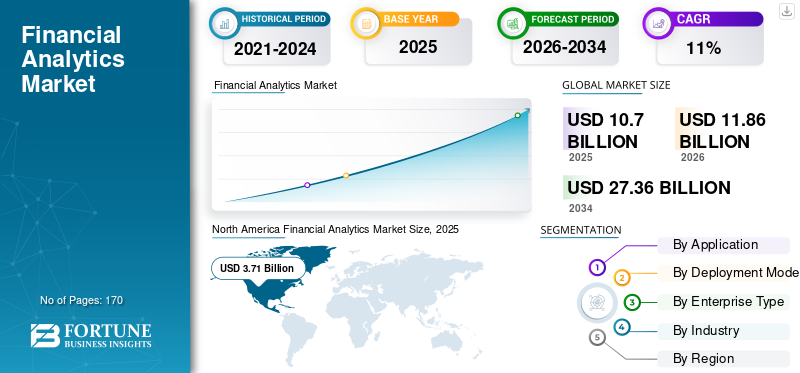
- The worldwide financial analytics market size was valued at $10.7 billion in 2025 and is forecasted to reach $27.36 billion by 2034.
- Around 82% of enterprise CFOs are leveraging generative AI. And it is more than half invested, particularly in predictive analytics functions.
- According to Deloitte, 22% of companies are already using predictive analytics in their finance departments.
The message is very clear. Adoption is accelerating, and the gap between companies using predictive analytics and those that are not growing wider every quarter.
What Are the Key Predictive Analytics Models Used in Finance?
There are four main types of predictive models used in financial applications.
| Model type | What it does in finance |
| Regression models | It predicts continuous numbers like future revenue, loan amounts, or stock prices. They find relationships between variables and estimate future values. |
| Classification models | It sorts data into categories like high risk vs. low risk for a loan applicant, or fraudulent vs. legitimate for a transaction. These are power credit scoring and fraud detection. |
| Time series models | It analyzes data that changes over time. For instance, market prices, seasonal cash flows, or payment patterns, and project how those trends will continue. |
| Anomaly Detection Models | It flags unusual activity that deviates from normal patterns. Critical for catching fraud early, spotting compliance violations, and identifying operational risks. |
In most real-world finance applications, multiple models work together, each contributing to a more accurate, complete picture.
Top Use Cases of Predictive Analytics in Financial Apps
This is where predictive analytics delivers its most concrete, measurable value. Here are the use cases that matter most right now.
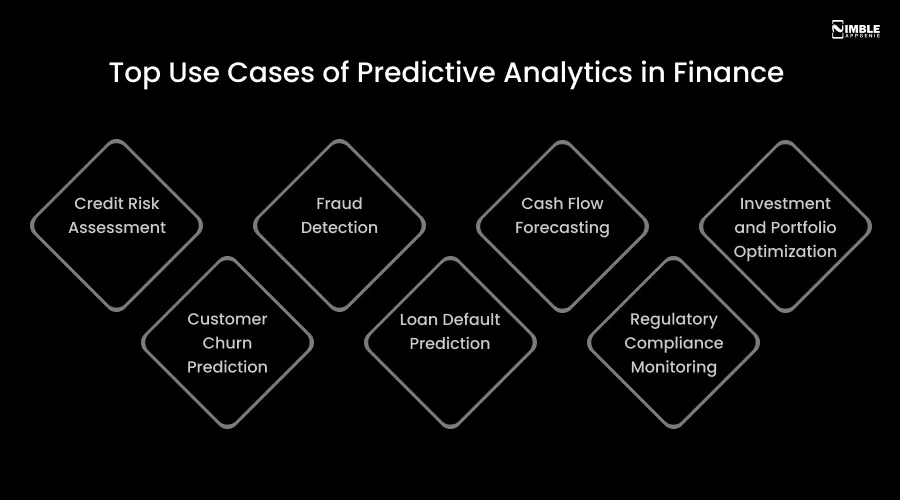
1. Credit Risk Assessment
Traditional credit scoring uses a limited set of variables. For instance, credit history, income, debt-to-income ration. The problem? It misses a lot of context.
Predictive analytics builds a much richer picture by incorporating repayment histories, digital transaction behaviour, income patterns, and alternative data like utility bill payments and rental history.
| The result: Faster loan approvals, more accurate risk assessment, and fewer defaults. Predictive active models boost accuracy by 25% compared to traditional scoring systems. It uses alternative data like utility bills and rental payments. |
2. Fraud Detection
Fraud is one of the biggest threats in financial services, and fraudsters constantly change their tactics. AI fintech fraud detection system models monitor every transaction in real time.
When something looks unusual, a transaction at an odd time, an unexpected location, or an unusual amount, the system flags it immediately.
| The impact: Predictive Fraud detection has been shown to reduce false positives by 30-75% and catch fraud 58% faster than rule-based systems. It is less fraud slipping through. Fewer innocent transactions are getting blocked. Happier customers all around. |
3. Cash Flow Forecasting
Running out of cash can be catastrophic even for a profitable business. Predictive models analyze receivables, payables, seasonality, and external economic drivers to generate highly accurate cash flow forecasts.
They do not just tell you what cash flow looked like last month. Also, they tell you when customers will pay, when you will need to make payments, and where shortfalls might appear, weeks in advance.
| Research shows this approach forecasts accuracy by up to 30%. This gives finance teams the visibility to optimize working capital and avoid expensive short-term borrowing. |
4. Investment and Portfolio Optimization
Predictive models analyze market microtrends, economic indicators, and historical performance data to predict price movements and identify high-potential investments.
This helps portfolio managers build more balanced, risk-adjusted portfolios and respond to market changes in real time rather than after the fact. JPMorgan, hedge funds, and asset managers have used this approach for years. It is now accessible to smaller firms too.
5. Customer Churn Prediction
Acquiring a new banking customer costs significantly more than retaining an existing one. Predictive analytics helps financial institutions identify which customers are at risk of leaving, before they actually go.
By analyzing transaction frequency, product usage, service interactions, and behavioral signals, predictive models can flag at-risk customers early. This gives relationship managers time to intervene with targeted offers or outreach.
One European bank that adopted this approach reduced its churn rate by 15%, a significant win in a highly competitive market.
6. Loan Default Prediction
For lenders, knowing which borrowers are likely to default before they miss a payment is valuable. Predictive models analyze payment histories, income changes, external economic signals, and behavioural patterns to generate default probability scores for each borrower.
This does not just reduce losses. It also helps lenders structure more appropriate terms and intervene early with borrowers showing signs of financial stress.
SwiftCredit Lending adopted a dynamic scoring model and saw loan approvals jump by 40% while defaults fell by 25%, all within six months.
7. Regulatory Compliance Monitoring
Financial institutions face a constantly evolving regulatory environment. Missing a fintech regulation and compliance requirement can mean huge fines and serious reputational damage.
Predictive analytics continuously monitors transactions, reporting patterns, and internal processes, flagging potential compliance gaps before they become violations. Governance dashboards can track compliance status in real time and maintain the audit trails that regulators expect.

Real-World Examples: Companies Using Predictive Analytics in Financial Apps
The technology is not theoretical. Here’s how some of the world’s biggest companies are using predictive analytics in financial apps right now.
| Company | What They Did and the Results |
| JPMorgan Chase | They invested $17 billion in AI technology, embedding predictive tools into workflows for 200,000+ employees. Also, it improved client service speed by 95%, saved an estimated $1.5 billion, and boosted revenue by 20%. |
| Capital One | They created real-time predictive data systems for fraud detection using AWS Lambda. They cut operational costs by 90% while dramatically improving detection accuracy. |
| HSBC | They integrated predictive risk models across operations. Financial institutions in this category reported a 20-40% reducion in losses through better risk modelling. |
| Santander Consumer USA | They used the FICO predictive platform to improve default predictions by 43% and speed up credit risk assessments. Additionally, they won the 2025 FICO Decisions Award for this approach. |
They are not just edge cases. They are the new standard, and the gap between institutions using predictive analytics and those that are not is growing every year.
What Are the Benefits of Predictive Analytics in Financial Apps?
When you implement AI in fintech well, predictive analytics delivers measurable improvements across the board. Take a look:
| Benefit | What It Means in Practice |
| Better decision-making | Finance teams spot trends and risks weeks before they show up in traditional reports, and have time to act before the damage is done. |
| Reduced financial losses | Institutions using predictive risk models report a 20-40% reduction in losses |
| High forecasting accuracy | Predictive models improved corporate forecasting accuracy from 80%-90% + |
| Faster fraud detection | AI models catch fraud 58% faster, with 30-75% fewer false alarms. |
| Lower operational costs | Operational costs drop by up to 25% as manual processes are automated |
| Better customer experience | Personalized offers, faster approvals, and proactive outreach increase loyalty and lifetime value |
| Regulatory confidence | Continuous compliance monitoring reduces violations and simplifies audit preparation |
Challenges of Predictive Analytics in the Financial System and How to Overcome Them
Adopting predictive analytics is not without challenges. Here is what to expect, and what to do about each one.
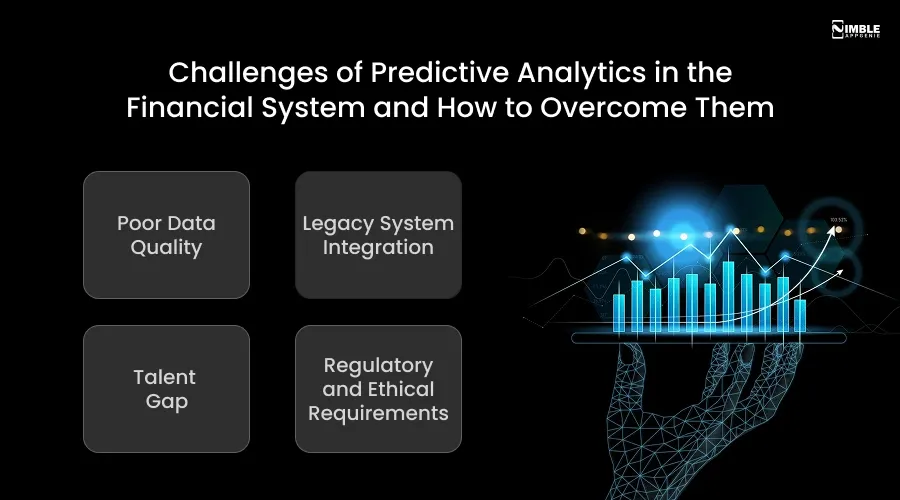
Challenge 1: Poor Data Quality
Predictive models are only as good as the data they learn from. Poor data quality can cost organizations staggering amounts; some estimates put it at $15 trillion annually across industries.
Solution:
You must implement strict data governance policies and use AI-powered tools to monitor data quality continuously. Besides, you should run regular audits to catch and fix data issues before they corrupt your models.
Challenge 2: Legacy System Integration
Most financial institutions run on older core banking systems that were not built for modern AI. Integrations can be quite complex.
Solution:
You can use a phased approach. Connect predictive tools to specific, high-value data streams first rather than attempting a full system replacement all at once.
Related Read: Legacy Systems in Banking
Challenge 3: Talent Gap
Building predictive models needs a mix of data science, finance domain expertise, and engineering. Many institutions do not have this blend in-house.
Solution:
It is best to partner with the best AI development company. You get access to the full skill set without the cost of developing an internal team from scratch.
Challenge 4: Regulatory and Ethical Requirements
Predictive models must be transparent, fair, and explainable. AI frameworks and bias detection tools are increasingly required by regulators.
Solution:
You can build explainable AI frameworks and bias detection tools into your models from the start. It is significantly easier than retrofitting them after the fact.
How to Implement Predictive Analytics in Financial Apps?
To implement predictive analytics in financial apps, you need to start by using financial data, AI models, and forecasting tools. It predicts future trends, reduces risks, detects funds, and supports smarter business decisions. Below are the steps to implement predictive analytics in finance.
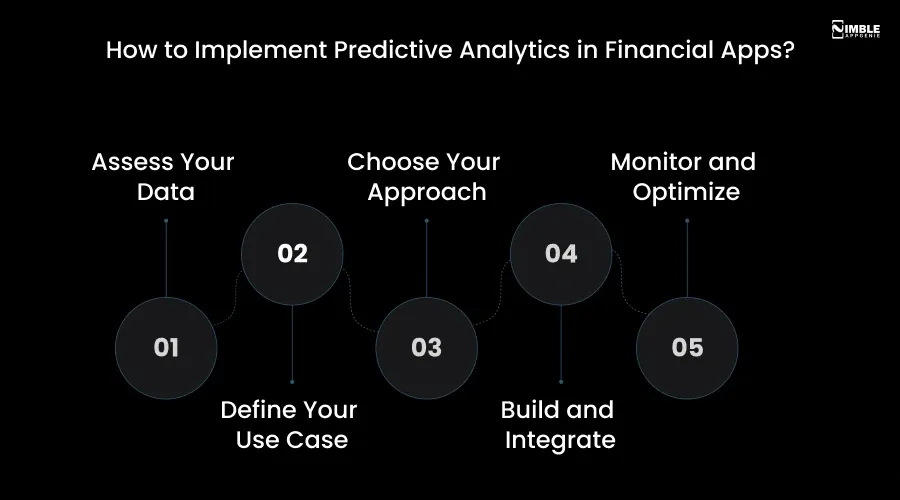
1. Assess Your Data
Before developing any model, it is vital to understand what data you have, where it lives, how clean it is, and whether you can access the data streams that matter most. For example, transaction history, customer behaviour, and market feeds.
2. Define Your Use Case
Do not try to solve everything at once. You can choose one or two high-value applications built from there. Fraud detection and cash flow forecasting are the most common starting points.
3. Choose Your Approach
Now, decide whether to use off-the-shelf analytics tools, build custom models, or partner with a dedicated development team.
Off-the-shelf tools are faster to deploy but harder to customise. Custom solutions take longer but align precisely with your data, your compliance requirements, and your goals.
4. Build and Integrate
After choosing the approach, you can develop your predictive models and integrate them into existing workflows.
No matter if it is a mobile banking app, a lending management system, or an internal dashboard. The experienced fintech developers who understand both AI and finance are critical here.
5. Monitor and Optimize
Predictive models shift over time as the world changes. You can build in regular auditing, retraining schedules, and performance monitoring from day one. Besides, you can track forecasting accuracy, fraud detection rate, and false positive rate against your baseline.
Future Trends in Predictive Analytics for Finance
The future of predictive analytics in finance is becoming more advanced and data-focused. It will help businesses improve forecasting, detect fraud faster, gain real-time insights, and deliver better customer experiences.
The table below shows the future trends in predictive analytics in financial services.
| Trend | What to Expect |
| Real-time analytics | Predictive models will update and act on fresh data in milliseconds, not hours or days. Decisions that currently take days will happen automatically. |
| Blockchain integration | Combining predictive models with blockchain’s tamper-proof transaction records will create fraud prevention and compliance systems that are both transparent and verifiable. |
| ESG-driven predictions | Environmental, social, and governance factors are becoming part of predictive risk models. Investors and regulators are demanding it, and leading institutions are already building ESG signals into their forecasts. |
| Explainable AI | As regulators need institutions to explain how AI makes decisions, models that can clearly explain why a loan was denied or a transaction was flagged, will become the mandatory standard. |
| Alternative data | Satellite imagery tracking supply chains, IoT sensors from factories, and social media sentiment analysis are expanding what is possible beyond traditional financial metrics. |
| Predictive compliance | AI tools will monitor regulatory changes in real time and automatically flag when existing operations need updating, reducing the risk of inadvertent violations. |
How Nimble AppGenie Can Help Build a Predictive Analytics for Finance?
Developing a predictive analytics system for finance is not just a data science project. It needs deep expertise in fintech app architecture, regulatory compliance, AI development, and product design, all at the same time.
That is what Nimble AppGenie brings to the table. We are the leading fintech app development company that has helped startups and established financial institutions build AI-powered products that work in the real world, not just in a demo.
What does working with Nimble AppGenie look like?
- Discovery and data assessment: We start by knowing your data landscape, business goals, and compliance needs. No cookie-clutter solutions.
- Custom model development: We create predictive models tailored to your specific data, industry, and use cases, not a generic tool that sort of fits.
- Seamless integration: Models are integrated into your existing workflows and platforms, no matter if that is a mobile banking app, a lending management system, or an internal dashboard.
- Compliance-first architecture: Every solution is developed with regulatory needs in mind, and data privacy, explainability, and audit readiness are built in from the start.
No matter if you are a fintech startup building your first AI-powered product or an established financial institution ready to modernize your analytics stack, Nimble AppGenie has the team, the tools, and the track record to get you there.
Conclusion
Predictive analytics in finance is not a future technology. It is a present-day competitive advantage, and it is already separating the institutions winning in this market from those still running on last quarter’s numbers.
The institutions using it are catching fraud faster, approving better loans, forecasting with greater accuracy, and serving customers with a level of personalization that simply was not possible a few years ago.
The institutions not using it are falling further behind, and the gap is widening. If you are a bank, a fintech startup, or a lending platform, the data you already have is worth more than you think.
With the right predictive analytics foundation and the right development partner, it can transform how you operate, grow, and complete.
FAQs

Niketan Sharma, CTO, Nimble AppGenie, is a tech enthusiast with more than a decade of experience in delivering high-value solutions that allow a brand to penetrate the market easily. With a strong hold on mobile app development, he is actively working to help businesses identify the potential of digital transformation by sharing insightful statistics, guides & blogs.
Table of Contents




No Comments
Comments are closed.