

 Free Consultation
 PCI-DSS Compliant
 GDPR Ready
 ISO 27001
 NDA Protected
 AI Services
 AI App Development
 Generative AI Development
 AI Chatbot Development
 AI Integration Services
 AI Consulting Services
 AI For Fintech
 AI Financial Assistant Solution
 AI Insurance Agent Development
 Tech Stack
 OpenAI / GPT-4
 Claude / Anthropic
 Gemini / Google AI
 Llama / Open Source
 LangChain / LlamaIndex
 Pinecone / Pgvector
 AWS / Azure AI


 Fintech Solution
 Core Fintech
 App Development
 Neobank Solutions
 eWallet Solutions
 Lending Software
 Banking Solutions
 BNPL Solutions
 BNPL Solutions
 Insurance App
 Wealth Management
 Crypto & DeFi
 Blockchain Development
  Payroll Software
 DeFi Solutions
 Crypto Wallet
 Crypto On/Off Ramp
 Crypto Exchange
 Trading Platform
 Payments
 Compliance
 Regulations & Compliance
 Fraud Detection
 Lending Ecosystem
 P2P Lending Platform
 Mortgage Software
 Engagement
 Fintech Outsourcing

 Mobile Development
 Mobile App Dev
 iOS App Development
 Android App Development
 React Native
 Flutter Development
 Web Solution
 Node.js Development
 React.js Development
 Angular Development
 App Services
 UI/UX Design
 App Maintenance
 By Stage
 MVP Development
 Industry Solutions
 Healthcare App Dev
 Education App Dev
 Travel App Dev
 Real Estate App Dev
 Logistics Software
 Social Media App

 Hire Mobile Developers
 Hire iPhone Developers
 Hire Android Developers
 Hire React Native Devs
 Hire Flutter Developers
 Hire Web Developers
 Hire Node.js Developers
 Hire Angular Developers
 Hire PHP Developers
 Hire Laravel Developers
 How It Works
 Pre-Vetted Developers
 Ready In 48 Hours
 NDA From Day One
 Replace Guarantee
 Company
 About Us
 Our Work Process
 Portfolio
 Case Studies
 Blog / Insights
 Careers
 Contact Us
 Awards
 Recognition


 Offices



Key Takeaways:
- Enterprise AI architecture is the blueprint that governs how AI connects to data, systems, and business workflows across the organization.
- It’s built from eight core layers: data, model/AI, orchestration, AI gateway, MLOps/LLMOps/AgentOps, infrastructure, application, and governance.
- The right architecture drives real scalability, enabling seamless integration, high-volume performance, and reusable components across the enterprise.
- Governance must be built in, not just bottled on; weak oversight and late compliance are the biggest sources of AI risk.
- Most AI failures are architecture failures, with 88% of projects failing to show ROI and only 21% reaching production; the gap is almost always structural.
- The right partner makes it easier to get enterprise AI architecture as per your demand. Nimble AppGenie helps businesses design secure, scalable enterprise AI architecture built to go beyond the pilot stage.
Did you know that 88% of enterprises’ AI projects fail to show ROI, while only 21% reach production?
Yes! But why, and is your enterprise struggling in this same race?
If the answer is “Yes,” then the problem is not AI; it is the complete architecture. Most of the companies do not fail at AI because they picked the wrong LLM. These companies fail because they never built the right architecture for connecting data, models, governance, and business workflows into one coherent system.
Thus, when you read about this system, you will find that it has a name, which is called enterprise AI architecture.
This guide covers the complete concept of enterprise AI architecture, its components, steps to build, challenges, and best practices.
Let’s begin with the complete guide.
What is Enterprise AI Architecture?
An enterprise AI architecture is a complete blueprint that governs how the AI capabilities are designed, implemented, operated, and is functional across the enterprise. A robust AI architecture defines how the AI systems ingest data, train, deploy models, and execute decisions within the business workflow.
It is the company’s master plan that securely connects artificial intelligence to the everyday business processes.
This architecture serves as the digital foundation that allows AI to smoothly talk to company data, to follow strict corporate rules, and then collaborate with employees across diversified departments.
Here are the Core Architectural Layers:
- Data Foundation: It standardizes, aggregates, cleans, and governs an organization’s raw data.
- Intelligence and Model Layer: It trains and executes the machine learning algorithms and handles model inference, fine-tuning, and integrates the foundational models from different providers.
- Governance and control layer: It is a proactive runtime and design-time boundary.
- Monitoring and optimization layer: This layer ensures that models remain reliable, cost-effective, and aligned with the business goals once in production.
Enterprise AI architecture is not just an AI trend for business growth; it’s a compulsion to survive in this AI world.
Now, let’s get ahead with how an enterprise AI architecture is beneficial for your business in the following section.
How is Enterprise AI Architecture Beneficial for Your Business?
Enterprise AI architecture offers businesses a structured, scalable framework for securely integrating AI across departments. Diversified organizations do encounter friction when scaling AI because early projects were not designed for enterprise requirements.
Here is the list of the benefits of enterprise AI architecture:
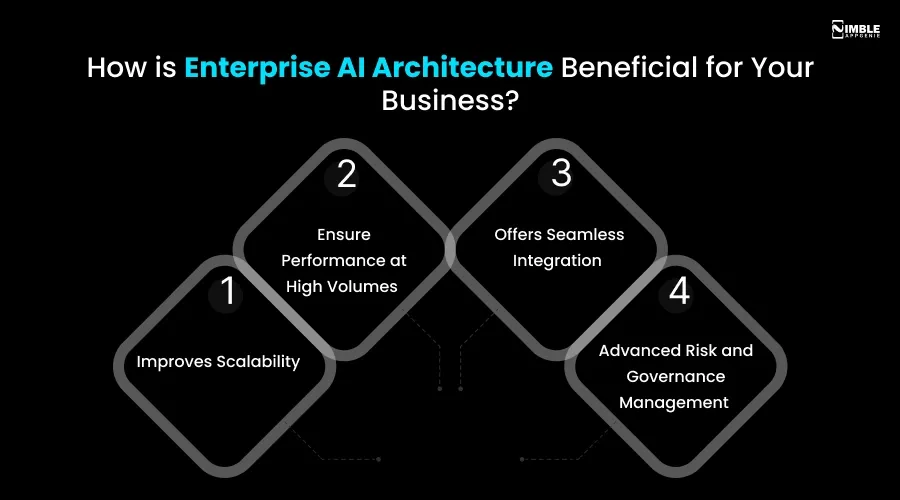
1. Improves Scalability
Enterprise AI architecture does enhance scalability through automating complicated operations, pooling cloud resources, and enabling seamless reuse of components.
This architecture establishes robust technical foundations such as unified data lakes as well as MLOps, which allow data volumes as well as concurrent workloads to grow seamlessly.
2. Ensure Performance at High Volumes
The enterprise AI architecture ensures performance, reliability, and availability at high volumes. This AI architecture handles high volumes via distributed computing, caching, model tiering, and asynchronous processing.
The AI tasks are broken into independent microservices, which allows IT to scale specific components without scaling the complete application.
These capabilities make it easier to support AI solutions that need to handle changing workloads without affecting the performance of the overall system.
3. Offers Seamless Integration
Enterprising AI architecture taps into the real-time, valuable data from interconnected software, transforming static infrastructure into a dynamic and real-time processing environment.
The modern enterprise AI architecture is designed to offer seamless AI integration across legacy systems, cloud environments, and external SaaS platforms.
4. Advanced Risk and Governance Management
The enterprise AI architecture offers advanced risk and governance management via embedding automated controls, continuous monitoring, and security directly into the AI lifecycle.
This architecture does offer advanced risk and governance management through continuous observability and monitoring; AI architecture replaces this via continuous oversight for enforcing compliance and mitigating security risks.
But what is included in enterprise AI architecture? Let’s get into the details in the following section.
What is included in Enterprise AI Architecture?
Different layers comprise the enterprise AI architecture:
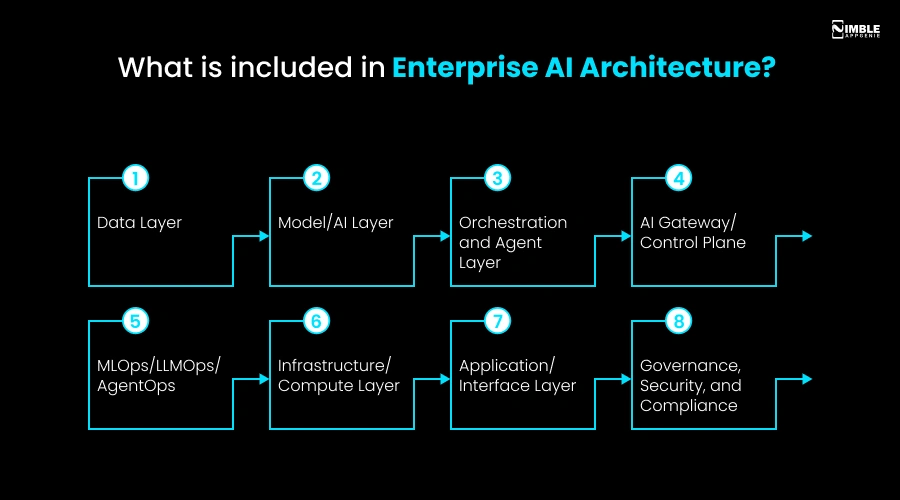
1] Data Layer
The foundational data layer in an enterprising AI architecture is the foundational bedrock that bridges raw, distributed organizational data and AI/ML applications through unifying, contextualizing, and preparing your software so that it becomes AI-ready.
It offers data governance and lineage, as well as unified access across the siloed enterprise sources.
2] Model/AI Layer
The model/AI layer of an enterprise AI architecture acts as the computational engine that manages the development, selection, deployment, as well as the lifecycle of the machine learning algorithms, as well as large language models (LLMs).
This layer of the enterprising AI architecture also comprises model selection and routing logic, which comprises which model handles which job.
3] Orchestration and Agent Layer
The orchestration and agent layer execute specialized, autonomous tasks. It breaks the tasks into sub-tasks and then assigns them to the correct agents, as well as manages parallel execution.
This layer acts like a project manager, controlling the workflows, enforcing the governance, managing memory, and translating prompts into the executable, step-by-step enterprise workflows.
4] AI Gateway/Control Plane
The enterprise AI architectural layer acts as the centralized middleware and governance layer that sits between the applications and the underlying AI models.
Here, the trained models are deployed as scalable services, APIs, or microservices. This layer does allow different business applications to easily consume AI capabilities.
5] MLOps/LLMOps/AgentOps
Here, the enterprise AI architecture offers operational discipline, including CI/CD for models, deployment automation, monitoring, retraining pipelines, drift detection, and specific to agents.
MLOps automates the lifecycle of classical predictive models, which are trained on structured data. While LLMOps is a specialized discipline for managing applications powered by foundational models. AgenOps systems operate with autonomy to execute real-world tasks.
6] Infrastructure/Compute Layer
The infrastructure layer is the physical and virtual foundation of an AI infrastructure architecture. It offers the high-speed networking and orchestration that is required to train models and even run real-time inference.
The infrastructure layer opts for the physical and virtual foundation of an enterprising AI architecture.
7] Application/Interface Layer
Enterprise AI architecture offers an application and interface layer, which is the top-most tier of an enterprise AI architecture.
Here, AI is embedded in the existing platforms, custom internal tools, and natural language interfaces. It ensures AI initiatives align with actual business capabilities and workflows.
8] Governance, Security, and Compliance
The governance, security, and compliance layer is an enterprise AI architecture that is the foundational trust and guardrail framework.
This layer ensures AI systems are deployed safely, ethically, and in alignment with the legal and business standards.
Most of the fintech startups often ask, “How to design your enterprise AI architecture?”
Well, it is a set of processes that developers follow for translating the complex machine learning outputs into actionable and user-friendly experiences.
How to Design Your Enterprise AI Architecture?
Designing your enterprise AI architecture extends far beyond the traditional AI architecture. Unlike the conventional systems, which process predefined workflows and help to make intelligent decisions at scale.
Here is the step-by-step process to design your enterprise AI architecture:
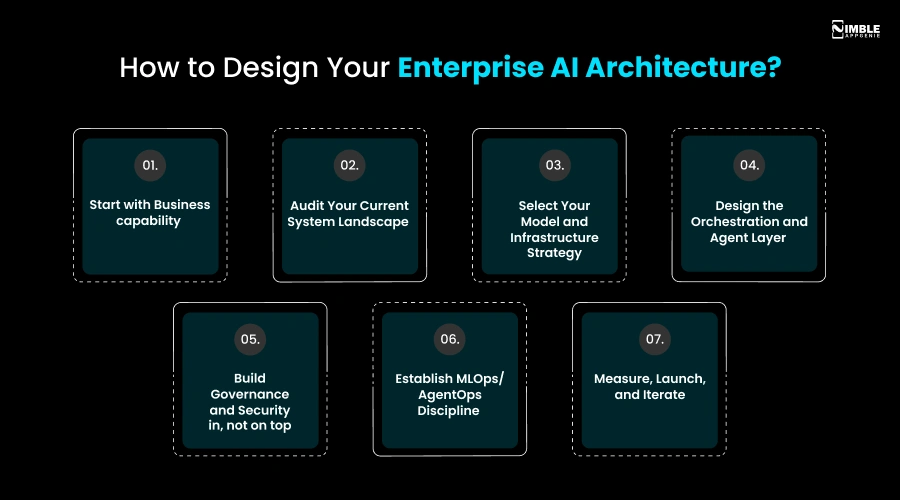
Step 1: Start with Business capability
In this step, you should identify the overall business capabilities before touching a data pipeline and mapping which business outcomes AI needs for driving which workflows it touches.
Ignoring this can be a root cause of architects that cites for “pilot purgatory,” where teams build infrastructure for AI.
Step 2: Audit Your Current System Landscape
At this step, you should audit your current data as well as your system landscape for inventory data sources, quality, access controls, and existing silos.
Here, you should decide early on a data strategy pattern: centralized, decentralized, or federated. Under this step, you should also classify your use cases, as not all AI needs the same architecture.
Step 3: Select Your Model and Infrastructure Strategy
Under this step, you should select your enterprise AI model and decide on proprietary APIs vs. self-hosted open models based on the data sovereignty needs and cost.
You should match compute strategy to your highest-sensitivity use case, since that’s usually the constraint that drives the whole architecture.
Step 4: Design the Orchestration and Agent Layer
In this step, you should define how workflows are coordinated, for knowledge grounding, single-agent for now, and multi-agent only once you have governance maturity for the same.
Under this step, you can have built-in memory state management and tool-access controls from the start, even if agents aren’t your first use case.
Step 5: Build Governance and Security in, not on top
Creating security and governance does require aligning the risk management with the business strategy. This is an operating model decision as much as a technical one.
Under this step, for establishing a robust framework, you need to mandate and execute buy-in, and then clearly define the roles as well as responsibilities.
Step 6: Establish MLOps/AgentOps Discipline
Establishing MLOps and AgentOps is all about building an operational stack that safely governs, monitors, and continuously improves the autonomous AI agents.
Under this step, you set up deployment automation, monitoring, drift, and retraining pipelines, helpful to decide the complete architecture for your enterprise.
Step 7: Measure, Launch, and Iterate
Now, it’s time to measure the complete enterprise AI architecture by testing its every aspect and then launching it successfully.
Then, you should launch the enterprise AI architecture successfully based on your requirements and as per the purpose of your business. Additionally, track ROI per use case, not just as per model accuracy.
Well, here, many AI startups and businesses often ask, “Are there any challenges that my business might face while implementing the enterprise AI architecture?”
For challenges, let’s look into the following section.
Challenges to Adopt Enterprise AI Architecture
The key challenges to adopt for enterprise AI architecture are legacy system integration, high implementation costs, lack of AI-talented personnel, integration with existing systems, ethical and compliance challenges, and AI scalability and maintenance.
Let’s study the challenges in adopting enterprise AI architecture in detail:
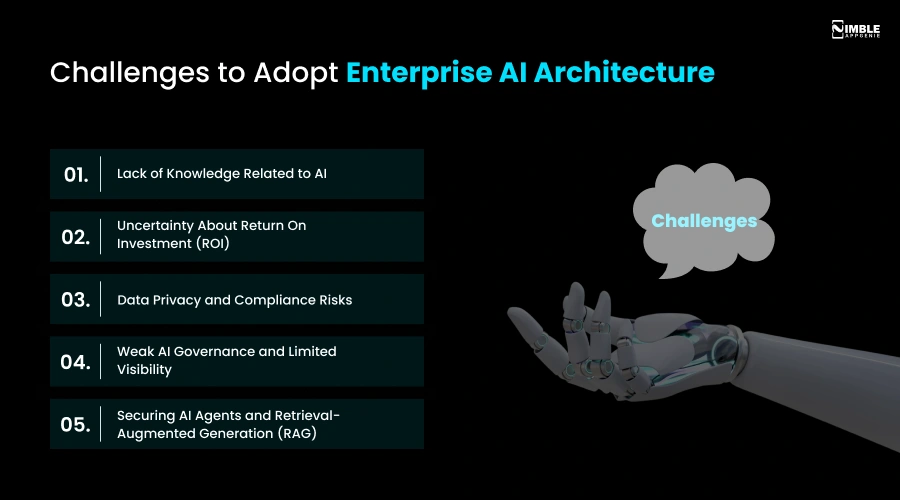
► Lack of Knowledge Related to AI
The lack of understanding related to artificial intelligence can result in fear and resistance. This can act as a massive roadblock that can cause poor tool selection, widespread integration failures, and even severe governance gaps.
Poor knowledge related to AI causes critical gaps in strategic vision, data readiness, and governance.
► Uncertainty About Return On Investment (ROI)
Artificial intelligence promises significant benefits, such as process automation, customer personalization, and enhanced decision-making.
The uncertainty of ROI is a major challenge in an enterprise AI architecture because organizations struggle to map the localized productivity boost to the quantifiable P&L outcomes.
► Data Privacy and Compliance Risks
The data privacy and compliance risks are a challenge for adopting enterprise AI architecture because traditional data management methods cannot handle how AI models ingest, process, and output information.
Additionally, the AI models generate a vast amount of unstructured data and information. They risk exposing personal data, violating cross-border privacy regulations, and facing financial penalties.
► Weak AI Governance and Limited Visibility
The weak AI governance and limited visibility are the major bottlenecks in the enterprise AI architecture adoption because enterprises often launch AI initiatives without even establishing centralized governance.
Additionally, businesses use separate AI models in different teams, connect to different datasets, and deploy third-party AI. This can further result in inconsistent policies, increased compliance risks, and limited visibility.
► Securing AI Agents and Retrieval-Augmented Generation (RAG)
Data security is a complicated concept. AI agents can handle different business applications and retrieve diversified information from the enterprise knowledge base.
Security is a core challenge in adopting and implementing enterprise AI architecture because when dynamic access controls are absent, the operational risks for exposing data increase.
The AI startups and businesses often struggle to find the appropriate solutions for these challenges; hence, they look for the best practices and solutions for enterprise AI architecture.
Best Practices of Enterprise AI Architecture
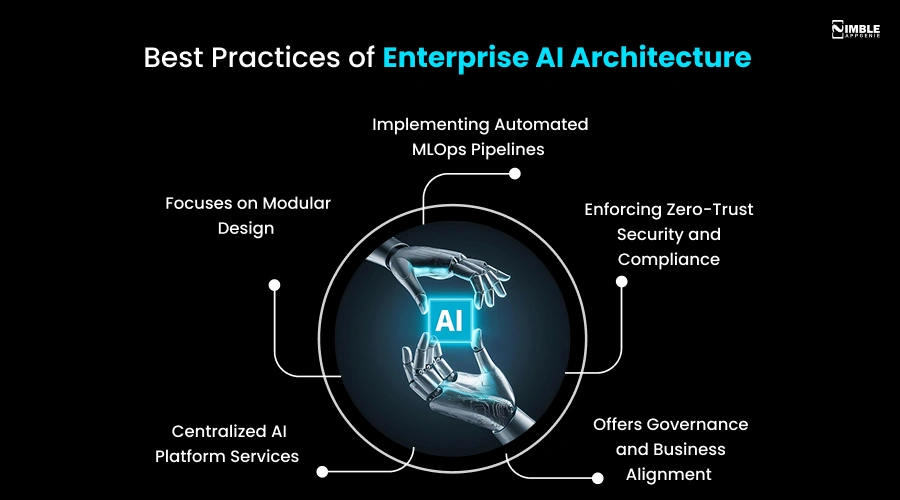
The core practices to adopt the enterprise AI architecture are establishing a unified data foundation, embedding security, implementing MLOps and modelOps, as well as building a strategic and scalable foundation.
Here is the list of best practices of enterprise AI architecture:
-
Implementing Automated MLOps Pipelines
Adopting enterprise AI architecture brings together DevOps principles, machine learning lifecycle management, and governance controls for streamlining the deployment, monitoring, and retraining of machine learning models at scale.
-
Enforcing Zero-Trust Security and Compliance
Enforcing zero-trust security and compliance in enterprise AI ensures rigorous data governance and dynamic validation of both human and autonomous machine identities, zero-trust security, and strategy.
-
Offers Governance and Business Alignment
With the help of enterprise AI architecture, you can offer governance and business alignment that transforms AI from an experimental IT project into a measurable and scalable driver of strategic value. It ensures that AI initiatives directly serve corporate goals and follow ethical standards.
-
Centralized AI Platform Services
The centralized AI platforms do offer a unified infrastructure layer that consolidates compute, data, models, and governance. Instead of teams building disconnected AI tools, these platforms act as a command center. Hence, you should opt for centralized AI platform services.
-
Focuses on Modular Design
You should focus on the modular design, which is the core best practice for enterprise AI architecture, because it breaks the complex systems into independent and interchangeable components.
Partner with Nimble AppGenie and Build an Enterprise AI Architecture for Your Business
Connect with Nimble AppGenie, the best AI development company, which is known for blending artificial intelligence with robust and secure infrastructure. Our company builds capabilities such as generative AI and intelligent automation directly into one core framework.
Here’s why you need to connect with us:
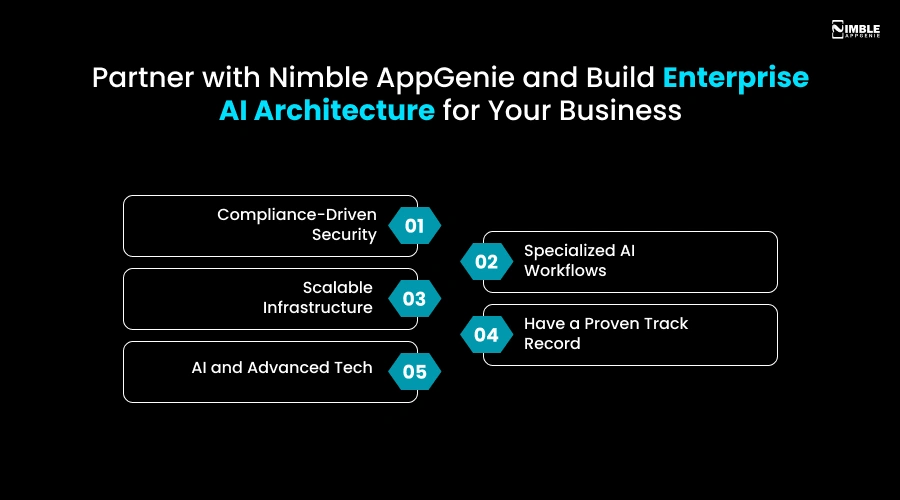
1. Compliance-Driven Security
Nimble AppGenie offers compliance-driven security through developing apps with strict data privacy guidelines and integrating AI-enhanced monitoring systems. This company offers strict regulatory frameworks such as GDPR, CCPA, and AML.
2. Specialized AI Workflows
Our company offers specialized AI workflows for automating complex and domain-specific tasks. Through tailoring machine learning and NLP into tailored mobile and web apps, Nimble AppGenie can help you in implementing AI operations successfully.
3. Scalable Infrastructure
Nimble AppGenie offers scalable infrastructure by utilizing the cloud-native architecture. Our AI services help businesses and enterprises handle sudden traffic spikes without any backend intervention.
4. Have a Proven Track Record
Till now, our company has a proven track record of delivering over 350+ projects, that too with a 95% client retention rate. This represents that our company is trustworthy, and its specialized development across highly demanding sectors is validated by industry recognition as well as high-performance solutions.
5. AI and Advanced Tech
Nimble AppGenie offers advanced technology and AI through architecting applications around them from day one. Our company is an advanced tech solutions provider that enables AI-driven personalization, fraud detection, and automated AML monitoring for fintech apps.
Conclusion
Enterprise AI architecture is a complete blueprint that weaves data, models, APIs, and even security controls together, which allows organizations to scale AI safely across their operations.
Other benefits of enterprise AI architecture are hyper-automation, real-time data activation, predictive foresight, and secure governance. Additionally, businesses can design their enterprise AI architecture that starts with business capabilities, auditing their current system, selecting their infrastructure strategy, and helping to build governance.
The core challenges include a lack of knowledge, uncertainty about return on investment, data privacy and compliance risks, weak AI governance, and securing AI agents.
FAQs
It’s the complete blueprint that governs how AI is designed, deployed, and operated across an organization. This covers how data flows in, how models are trained and run, and how outputs get executed within actual business workflows, rather than existing as isolated tools.
Most failures trace back to architecture, not the models themselves. Teams build AI infrastructure in isolation per department (“pilot purgatory”), skip governance until after deployment, or can’t map AI output to measurable business outcomes. This is why only a small fraction of pilots ever reach production.
The main layers are the data layer, model/AI layer, orchestration and agent layer, AI gateway/control plane, MLOps/LLMOps/AgentOps, infrastructure/compute layer, application/interface layer, and the governance, security, and compliance layer. Each of these layers handles a distinct part of how AI moves from raw data to a real business decision.
There’s no fixed timeline; it depends on organizational maturity, regulatory exposure, and how much of the current data/system landscape needs to be audited and restructured first. Following the step-by-step process (business capability → system audit → model/infrastructure strategy → orchestration → governance → MLOps → measure and iterate) matters more for success than speed.
Weak governance and limited visibility tend to be the most damaging. When different teams deploy separate models against different datasets without centralized oversight, it creates inconsistent policies, compliance exposure, and security risks that are expensive to unwind later.
Both approaches are common. Many enterprises, especially in regulated industries like fintech, partner with an experienced AI development company to get compliance-driven security, scalable infrastructure, and a proven implementation framework. It is all about building every layer from scratch internally.

Madan is the Backend Solutions Architect at Nimble AppGenie, specializing in the design of secure, high-concurrency systems that power complex mobile ecosystems. With deep expertise in server-side logic and database management, he ensures every platform is built with enterprise-grade security. In his free time, he is an avid researcher of emerging technologies; he spends his time deconstructing the latest backend frameworks and reading technical papers to ensure our solutions remain at the absolute forefront of industry innovation.
Table of Contents




No Comments
Comments are closed.