

 Free Consultation
 PCI-DSS Compliant
 GDPR Ready
 ISO 27001
 NDA Protected
 AI Services
 AI App Development
 Generative AI Development
 AI Chatbot Development
 AI Integration Services
 AI Consulting Services
 AI For Fintech
 AI Financial Assistant Solution
 AI Insurance Agent Development
 Tech Stack
 OpenAI / GPT-4
 Claude / Anthropic
 Gemini / Google AI
 Llama / Open Source
 LangChain / LlamaIndex
 Pinecone / Pgvector
 AWS / Azure AI


 Fintech Solution
 Core Fintech
 App Development
 Neobank Solutions
 eWallet Solutions
 Lending Software
 Banking Solutions
 BNPL Solutions
 BNPL Solutions
 Insurance App
 Wealth Management
 Crypto & DeFi
 Blockchain Development
  Payroll Software
 DeFi Solutions
 Crypto Wallet
 Crypto On/Off Ramp
 Crypto Exchange
 Trading Platform
 Payments
 Compliance
 Regulations & Compliance
 Fraud Detection
 Lending Ecosystem
 P2P Lending Platform
 Mortgage Software
 Engagement
 Fintech Outsourcing

 Mobile Development
 Mobile App Dev
 iOS App Development
 Android App Development
 React Native
 Flutter Development
 Web Solution
 Node.js Development
 React.js Development
 Angular Development
 App Services
 UI/UX Design
 App Maintenance
 By Stage
 MVP Development
 Industry Solutions
 Healthcare App Dev
 Education App Dev
 Travel App Dev
 Real Estate App Dev
 Logistics Software
 Social Media App

 Hire Mobile Developers
 Hire iPhone Developers
 Hire Android Developers
 Hire React Native Devs
 Hire Flutter Developers
 Hire Web Developers
 Hire Node.js Developers
 Hire Angular Developers
 Hire PHP Developers
 Hire Laravel Developers
 How It Works
 Pre-Vetted Developers
 Ready In 48 Hours
 NDA From Day One
 Replace Guarantee
 Company
 About Us
 Our Work Process
 Portfolio
 Case Studies
 Blog / Insights
 Careers
 Contact Us
 Awards
 Recognition


 Offices


| Quick Answer: For AI chatbots: Use LangChain + OpenAI API · For deep learning: TensorFlow or PyTorch · For RAG systems: LlamaIndex · For multi-agent AI: CrewAI · For NLP with pre-trained models: Hugging Face Transformers · For rapid prototyping: Keras |
Key Takeaways:
- AI app development frameworks reduce build time for AI-powered applications by providing pre-built tools, libraries, and ML pipelines.
- TensorFlow and PyTorch together power over 80% of production deep learning systems globally.
- LangChain is used by 100,000+ organizations worldwide and has 90,000+ GitHub stars, making it the most adopted LLM framework.
- Hugging Face hosts 500,000+ models and 250,000+ datasets as of 2026, the largest open-source AI model hub in the world.
- Google AI Overviews now appear in 58% of all searches as of early 2026; choosing the right AI stack is a business-critical decision.
- The best AI app development tools depend on your business goals, technical requirements, team expertise, and scalability needs.
Which AI app development framework should I use for my project?
The answer depends on what you are building. Some AI app development frameworks and tools are designed for ML and deep learning. Others are built for AI chatbots, large language models, automation, and enterprise AI applications.
You are probably a startup founder deciding which technology stack to invest in. Or a CTO comparing frameworks before committing development resources. You might be a product manager evaluating AI solutions for a new feature or business initiative.
Whatever your role, choosing the right AI framework can affect development time, costs, scalability, and long-term maintenance.
This blog compares the most popularly used AI frameworks and tools. For each framework, we explain what it does, where it works best, and what limitations you should know before making a choice.
What is an AI App Development Framework?
AI app development frameworks are software toolkits that provide pre-built libraries, APIs, and structures for building AI-powered applications, eliminating the need to code machine learning pipelines from scratch.
AI developers use these frameworks to train models, process data, run predictions, and deploy AI features faster. Most AI apps need to do similar things. For example, process large datasets, run ML models, handle language input, or connect to external APIs.
Frameworks give you tools for all of this out of the box. For businesses, using the right app development framework means faster development, fewer bugs, and a more stable product.
How to Choose the Right AI Framework for Your Business?
Match the framework to your specific use case first. For LLM-powered apps and chatbots, use LangChain or LlamaIndex.
For deep learning and custom model training, use TensorFlow or PyTorch. And for quick prototyping, Keras or Scikit-learn work well. Then factor in your team’s skills, budget, and whether you need a cloud-hosted or self-hosted solution.
Here are the main factors to evaluate before committing to a framework:
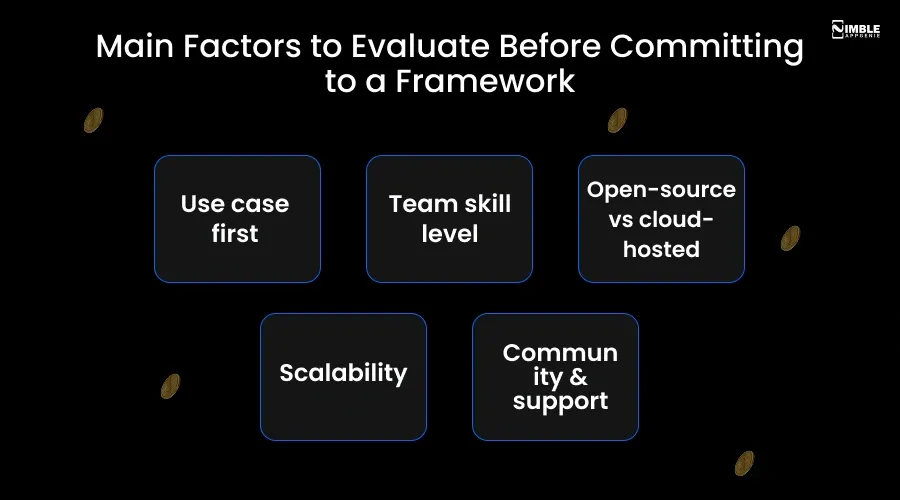
- Use case first: Chatbot? Image recognition? Recommendation engine? Each has a better-suited tool.
- Team skill level: Some frameworks require strong Python or ML knowledge. Others are beginner-friendly.
- Open-source vs cloud-hosted: Open-source tools are free but require more setup. Cloud services cost more but are easier to manage.
- Scalability: Choose a framework that can grow with your user base from day one.
- Community & support: Active communities mean more tutorials, faster bug fixes, and regular updates.
Quick Comparison: Top AI Frameworks at a Glance
Here is a quick comparison of the best AI development tools for businesses. TensorFlow and PyTorch are best for deep learning. LangChain and Llamalndex are best for LLM-powered applications.
Keras and Scikit-learn work well for simpler ML tasks. AWS SageMaker and OpenAI API are managed cloud options. Hugging Face gives access to thousands of pre-trained NLP models.
| Framework | Best For | Skill Level | Open Source | Cost | GitHub Stars | Latest (2026) |
| TensorFlow | Enterprise ML | Intermediate | Yes | Free | 185k+ | v2.17 |
| PyTorch | Research & ML | Intermediate | Yes | Free | 82k+ | v2.3 |
| LangChain | LLM/Chatbots | Beginner+ | Yes | Free | 90k+ | v0.3 |
| Hugging Face | NLP & LLMs | Beginner+ | Yes | Free / Paid | 132k+ | Transformers v4.4 |
| Keras | Fast Prototyping | Beginner+ | Yes | Free | 62k+ | v3.4 |
| Scikit-learn | Classic ML | Beginner+ | Yes | Free | 59k+ | v1.5 |
| LlamaIndex | RAG Systems | Intermediate | Yes | Free | 37k+ | v0.11 |
| AWS SageMaker | Cloud ML/MLOps | Intermediate | No | Free | — | 2026 release |
| OpenAI API | GPT Apps | Beginner | No | Free | — | GPT-4o / o3 |
| CrewAI | AI Agents | Intermediate | Yes | Free | 24k+ | v0.80 |
Best 10 AI App Development Frameworks and Tools
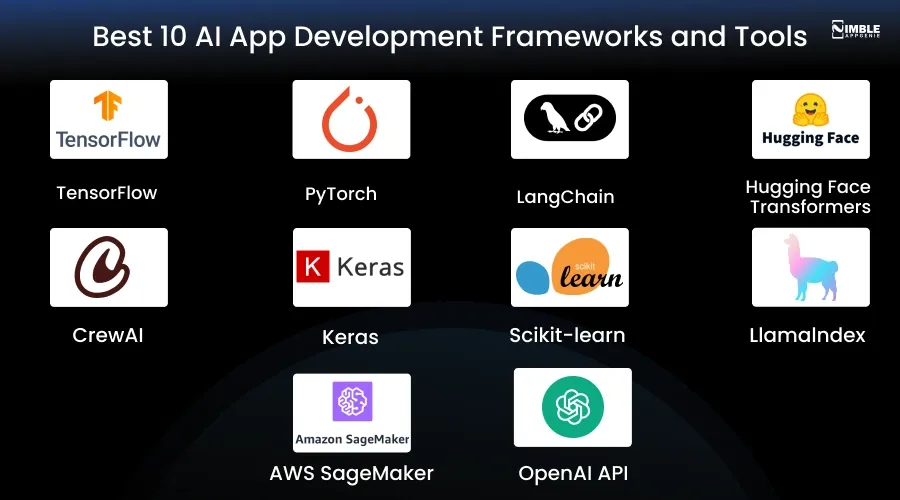
The top 10 AI app development frameworks in 2026 are TensorFlow, PyTorch, LangChain, Hugging Face Transformers, Keras, Scikit-learn, LlamaIndex, AWS SageMaker, OpenAI API, and CrewAI.
Each serves a different purpose, from deep learning and model training to LLM-powered apps and AI agent workflows. Let’s understand each one of them:
1. TensorFlow
TensorFlow is Google’s open-source ML framework and the industry standard for enterprise-grade AI at scale.
Released in 2015 and now on version 2.17, it powers AI systems at Google Search, Gmail, and Google Photos, and is used by companies including Airbnb, Twitter, and Coca-Cola for production ML workloads. It runs across CPUs, GPUs, and Google’s custom TPUs.
Best for: Enterprise-grade machine learning, image recognition, and complex model deployment.
Pros:
- Handles very large datasets and complex models well
- Has a strong production deployment toolkit
Cons:
- Steeper learning curve than Keras or PyTorch
- Can feel verbose for simple tasks
Business use case: Good for companies building AI at scale, think fraud detection systems, large recommendation engines, or computer vision tools.
2. PyTorch
PyTorch is Meta’s open-source deep learning framework and the dominant choice for AI research, powering over 70% of AI research papers published on Papers With Code in 2024.
Its dynamic computation graph makes it far easier to debug and experiment with than TensorFlow, which is why most university ML courses and AI startups default to it.
Best for: Research, custom model development, NLP tasks, and computer vision.
Pros:
- Easier to debug and prototype than TensorFlow
- Large and active developer community
Cons:
- Less optimized for production deployment out of the box
- Documentation can be inconsistent for advanced use cases
Business use case: Good for teams that want control over their model architecture or are building something custom that does not fit a standard template.
3. LangChain
LangChain is the most widely used and best AI framework for mobile app development, powered by large language models. Around 32.9% of developers use LangChain. It connects your app to GPT-4, Claude, Mistral, and other models. It has over 90,000 GitHub stars and is used by more than 100,000 organizations worldwide.
Best for: Chatbots, AI assistants, document Q&A tools, and apps that need to connect an LLM to external data or APIs.
Pros:
- Fast to get started, lots of integrations
- Supports chains, agents, memory, and retrieval out of the box
Cons:
- Updates frequently; code can break between versions
- Can be overkill for simple LLM calls
Business use case: If you want to build an internal knowledge base chatbot, a customer support AI, or a document search tool, LangChain is a strong default choice.
4. Hugging Face Transformers
Hugging Face is a platform and framework for working with pre-trained NLP and AI models. It has a library of over 50,000 models you can use directly or fine-tune for your needs.
Best for: Natural language processing, text classification, summarization, translation, and building on top of GPT or BERT-style models.
Pros:
- Huge model library; you can find a model for most NLP tasks
- Works with both PyTorch and TensorFlow
Cons:
- Running large models requires significant compute resources
- Some models are not optimized for production latency
Business use case: Great for teams that want to add language AI to their product without training a model from scratch.
5. CrewAI
CrewAI is among the best open-source AI app development frameworks for building multi-agent AI systems. Instead of one AI doing everything, CrewAI allows you to create a team of AI agents with different roles that work together.
Best for: Automating complex workflows, research tasks, content pipelines, and any process that benefits from multiple AI roles working in parallel.
Pros:
- It is great for automating multi-step business processes
- It is easy to define agent roles and tasks
Cons:
- Still a relatively new framework, less battle-tested than LangChain
- Complex workflows can be hard to debug
Business use case: If you want to automate sales research, content generation pipelines, or customer onboarding flows using AI, CrewAI is worth exploring.
6. Keras
Keras is a high-level neural network API that runs on top of TensorFlow. It was built to make deep learning easier and more accessible.
Best for: Beginners learning deep learning, fast prototyping, and teams that want simple code without sacrificing capability.
Pros:
- Very beginner-friendly with clean, readable code
- Great for building and testing models quickly
Cons:
- Less flexible for highly customized model architectures
- Smaller community than TensorFlow or PyTorch
Business use case: Good for internal tools or proof-of-concept AI features where speed of development matters more than fine-grained control.
7. Scikit-learn
Scikit-learn is a Python library for classical machine learning, not deep learning. It covers regression, classification, clustering, and more.
Best for: Traditional ML tasks like predictive analytics in finance, customer segmentation, and anomaly detection.
Pros:
- Very easy to learn and use
- Excellent documentation and a large community
Cons:
- Not designed for deep learning or large-scale neural networks
- Limited GPU support
Business use case: Ideal for businesses that want to add predictive features to their app without deep learning. For example, churn prediction or lead scoring.
8. Llamalndex
It was previously called GPT Index. Llamalndex is a framework created for RAG, which means Retrieval-Augmented Generation. It helps LLMs work with your own data. Instead of just using a model’s built-in knowledge, it allows your app to pull answers from your documents, databases, or APIs.
Best for: Enterprise search, document Q&A, knowledge management tools, and any app that needs an LLM to work with private or structured data.
Pros:
- Best-in-class for RAG pipelines
- Supports a wide range of data sources and vector databases
Cons:
- It can be complex to set up for non-technical users.
- Performance depends heavily on your data quality.
Business use case: If you want an AI that answers quotations based on your company’s internal documents, contracts, or product data, Llamalndex is the right AI app development framework.
9. AWS SageMaker
AWS SageMaker is Amazon’s managed platform for creating, training, and deploying machine learning models. It is cloud-hosted, which means less infrastructure management for your team.
Best for: Enterprise teams already using AWS, and businesses that want MLOps without managing servers.
Pros:
- Fully managed services that handle compute, storage, and deployment
- Integrates with the rest of the AWS ecosystem.
Cons:
- Costs can rise quickly at scale
- Vendor lock-in to AWS infrastructure
Business use case: Good for companies that already run on AWS and want a one-stop destination for AI model training and deployment without building their own MLOps pipeline.
10. OpenAI API
The OpenAI API gives developers access to GPT-4, GPT-4o, DALL-E, and other OpenAI models. It is not a framework in the traditional sense; it is a cloud API you call to get AI capabilities.
Best for: Text generation, summarization, code generation, image creation, and building AI features fast without training any model.
Pros:
- Very fast to integrate; you can have a working demo in hours
- No model training required
Cons:
- Ongoing API costs; this is not a free tool
- You are dependent on OpenAI’s infrastructure and pricing changes
Business use case: It is best for startups that need AI features quickly and can absorb API costs. Also, good for enterprise tools where off-the-shelf GPT capabilities are sufficient.
Which AI Development Framework Should You Pick?
You can choose LangChain or the OpenAI API if you want to build an AI chatbot or assistant quickly. However, if you want custom deep learning models, then use TensorFlow or PyTorch. Let’s take a look at the table below that you can choose based on your business goal:
| Description | Best AI Frameworks | Why |
| Building a customer-facing chatbot | LangChain + OpenAI API | Fastest path to production; built-in memory & tool integrations |
| Adding AI to your internal documents or knowledge base | LlamaIndex | Best-in-class RAG pipelines; supports vector DBs like Pinecone, Weaviate |
| Predicting customer behavior or business outcomes | Try Scikit-learn or PyTorch | Scikit for classic ML; PyTorch for neural net-based prediction |
| Running AI at enterprise scale with full managed infrastructure | Choose AWS SageMaker | Fully managed MLOps; handles training, deployment, monitoring |
| Automating multi-step workflows with AI | Explore CrewAI | Multi-agent system; assign roles, tasks & parallel execution |
| Working with NLP tasks using pre-trained models | Use Hugging Face Transformers | 500k+ models; fine-tune BERT, Mistral, or Llama in hours |
| Rapid prototyping before committing to a full build | Start with Keras | Minimal code, readable syntax, built on TensorFlow |
The best choice is the one that fits your team and your timeline, not the one with the most GitHub stars.
LangChain vs LlamaIndex: What’s the Difference?
This is one of the most frequently searched questions in AI development in 2026. Here’s the direct answer:
1. LangChain is best when…
You need to build an AI that takes actions, calling APIs, using tools, maintaining conversation memory, or running multi-step agent workflows.
2. LlamaIndex is best when…
You need an AI that retrieves answers from your own data, PDFs, databases, Notion docs, SQL, with high accuracy. It excels at RAG pipelines.
Note: In practice, many teams use both together. LlamaIndex handles data indexing and retrieval. LangChain handles the agent orchestration layer on top.
Why Choose Nimble AppGenie for AI App Development?
As an AI app development company, we believe that successful AI products start with the right strategy, not just the right technology. We help you figure out the right approach before a single line of code is written.
That includes helping you choose the right AI app development frameworks for your particular project goals.
Take a look at what makes us stand out from others:
- We have hands-on experience with the frameworks in this list. Our team has built AI apps using LangChain, TensorFlow, PyTorch, OpenAI API, and more. Also, we know where each one shines and where it creates problems at scale.
- We work with founders, CTOs, and enterprise teams. Whether you are validating an idea or scaling an existing product, we adjust our approach to where you are in the journey.
- Also, we do not recommend technology for the sake of it. If a simpler solution gets you to market faster, we will say so. We are not here to over-engineer your product.
- We build for scale from day one. The frameworks we choose and the architecture we design are meant to hold up as your user base grows.
- We are transparent about costs and time. So, we do not promise vague estimates and time. We give you a clear picture of what it will take to build what you have in mind.
We have worked with early-stage startups shipping their first AI feature and with enterprise clients replacing legacy systems with AI. Both have different needs. We understand that. If you are evaluating AI development partners, we are happy to have a conversation about your project.
Real-Time Client Case Study
How a D2C e-commerce brand cut customer support costs by 40% using LangChain + GPT-4o?
A retail client with 50,000+ monthly support tickets needed to automate first-line customer responses. Our team built a LangChain-based agent connected to their Shopify order database and product catalog using LlamaIndex for RAG.
The system handles 68% of all incoming queries without human escalation. This reduces support costs by 40% in the first quarter post-launch.
Stack used: LangChain v0.3 · LlamaIndex · GPT-4o · Pinecone · AWS Lambda
Conclusion
Choosing the right AI app development framework comes down to one question: what does your AI actually need to do?
For most businesses in 2026, the answer is a combination: LangChain or LlamaIndex for LLM-powered features, PyTorch or TensorFlow for custom model training, and AWS SageMaker or OpenAI API for managed infrastructure.
You don’t need to master all 10 AI app development frameworks; you need to pick the right two or three for your use case and build from there.
If you want help choosing the right AI stack for your product, Nimble AppGenie has built AI-powered apps across industries using the frameworks in this guide. Get a free consultation!
FAQs
LangChain is the best framework for building a chatbot in 2026. It connects to 50+ LLM providers including GPT-4o, Claude 3.5, and Mistral, and provides built-in memory, tool use, and agent capabilities. For chatbots that need to answer questions from internal documents, combine LangChain with LlamaIndex for RAG. For simple single-turn bots, calling the OpenAI API directly is faster and cheaper.
PyTorch is generally better for most business apps in 2026 due to its easier debugging, faster iteration, and stronger community growth. TensorFlow is better if you’re deploying at Google Cloud scale, need TensorFlow Lite for mobile/edge deployment, or are integrating with existing Google infrastructure. For small-to-mid-size teams starting fresh, PyTorch is the easier entry point.
For most startups, LangChain and the OpenAI API are the fastest way to ship an AI product. They require minimal ML expertise and let you add AI features without training custom models. If your product involves proprietary data retrieval, add LlamaIndex. As your app scales, layer in TensorFlow or PyTorch for custom model training. Start simple; complexity can always be added later.
TensorFlow Lite is designed for running AI models on mobile and edge devices. PyTorch also supports mobile deployment via PyTorch Mobile. If you are using the OpenAI API, the AI runs on the cloud, so there is no framework is needed on the device itself.
You can start with your use case. Ask what exactly the AI should do in your app. Then match it to the right tool. For language tasks, use LLM frameworks. For predictions and classification, use ML libraries. And for managed deployment, consider cloud platforms. If you are unsure, talking to an AI development team before committing can save you months of rework.
TensorFlow models can be deployed using TF Serving (self-hosted), Google Cloud Vertex AI (managed), or TensorFlow Lite (mobile/edge). PyTorch models can be deployed using TorchServe, AWS SageMaker, or converted to ONNX format for cross-platform deployment. For both, Docker containerization is the standard production approach. AWS SageMaker supports deploying both TensorFlow and PyTorch models with minimal infrastructure management.

Madan is the Backend Solutions Architect at Nimble AppGenie, specializing in the design of secure, high-concurrency systems that power complex mobile ecosystems. With deep expertise in server-side logic and database management, he ensures every platform is built with enterprise-grade security. In his free time, he is an avid researcher of emerging technologies; he spends his time deconstructing the latest backend frameworks and reading technical papers to ensure our solutions remain at the absolute forefront of industry innovation.
Table of Contents




No Comments
Comments are closed.