

 Free Consultation
 PCI-DSS Compliant
 GDPR Ready
 ISO 27001
 NDA Protected
 AI Services
 AI App Development
 Generative AI Development
 AI Chatbot Development
 AI Integration Services
 AI Consulting Services
 AI For Fintech
 AI Financial Assistant Solution
 AI Insurance Agent Development
 Tech Stack
 OpenAI / GPT-4
 Claude / Anthropic
 Gemini / Google AI
 Llama / Open Source
 LangChain / LlamaIndex
 Pinecone / Pgvector
 AWS / Azure AI


 Fintech Solution
 Core Fintech
 App Development
 Neobank Solutions
 eWallet Solutions
 Lending Software
 Banking Solutions
 BNPL Solutions
 BNPL Solutions
 Insurance App
 Wealth Management
 Crypto & DeFi
 Blockchain Development
  Payroll Software
 DeFi Solutions
 Crypto Wallet
 Crypto On/Off Ramp
 Crypto Exchange
 Trading Platform
 Payments
 Compliance
 Regulations & Compliance
 Fraud Detection
 Lending Ecosystem
 P2P Lending Platform
 Mortgage Software
 Engagement
 Fintech Outsourcing

 Mobile Development
 Mobile App Dev
 iOS App Development
 Android App Development
 React Native
 Flutter Development
 Web Solution
 Node.js Development
 React.js Development
 Angular Development
 App Services
 UI/UX Design
 App Maintenance
 By Stage
 MVP Development
 Industry Solutions
 Healthcare App Dev
 Education App Dev
 Travel App Dev
 Real Estate App Dev
 Logistics Software
 Social Media App

 Hire Mobile Developers
 Hire iPhone Developers
 Hire Android Developers
 Hire React Native Devs
 Hire Flutter Developers
 Hire Web Developers
 Hire Node.js Developers
 Hire Angular Developers
 Hire PHP Developers
 Hire Laravel Developers
 How It Works
 Pre-Vetted Developers
 Ready In 48 Hours
 NDA From Day One
 Replace Guarantee
 Company
 About Us
 Our Work Process
 Portfolio
 Case Studies
 Blog / Insights
 Careers
 Contact Us
 Awards
 Recognition


 Offices



Key Takeaways:
- The cost to build an MVP app can be around $10,000-$100,000 or more, depending on your project requirements.
- The factors of MVP app development cost are app complexity, features, platform choice, development team’s location, third-party integrations, security, and compliance.
- To reduce the cost to develop an MVP, you have to prioritize features, start with a web app first, go cross-platform, and choose an offshore team.
- The hidden MVP development costs are security audit, App Store Fees, cloud hosting, post-launch bug fixes, analytics tools, and legal.
- The difference between an MVP and a full product is mainly the scope. An MVP focuses only on the core user flow and validation, while a full-scale product includes advanced features.
- Building an MVP app is one of the safest ways for startups to validate an app idea before investing heavily in full product development.
- Teams like Nimble AppGenie help startups build MVP apps with the right balance of speed, functionality, and budget.:
MVP app development cost is one of the first things founders search for and one of the hardest to get a straight answer on. Some agencies quote $20,000. Others come back with $200,000 for what sounds like the same project.
That gap is real, and it has reasons. This guide explains what those reasons are and gives you the exact cost. Before getting into the numbers, here is what most people actually want to know:
- How much does MVP development cost?
- What factors affect MVP development cost?
- Is $50,000 enough to build an MVP?
- How long does it take to build an MVP?
- What is the average cost for a startup MVP?
- Do I need an MVP before raising a seed round?
These questions come up at every stage, from startup founders writing their first briefs to CTOs evaluating development partners. The answers are not always the same, because the cost depends heavily on what you are developing and where.
There is no single right number. An MVP for a telemedicine app in the USA costs very differently from a basic marketplace MVP developed by an offshore team. Both are MVPs. The cost is not the same.
What you will get in this blog are real cost ranges, what drives them up or down, how different team models compare, hidden costs, and honest advice on where to save without damaging the product.
So, let’s begin!
What is an MVP App?
An MVP is the simplest working version of your app. It covers only the features required to test your core idea with real users. The goal is to validate demand before spending on a full-fledged app.
Uber did not launch with surge pricing, ride scheduling, and driver ratings. It launched with one button: request a ride. Airbnb started as a basic website with photos of one apartment. Instagram launched with filters and a feed.
An MVP is not a cheap or incomplete product. It is a focused one. You build an MVP app that proves your idea works, then you build the rest. For businesses, this matters for three reasons:
- It reduces financial risk before a full investment.
- It gives you real user data instead of assumptions.
- It makes it easier to raise funding.
How Much Does MVP App Development Cost in 2026?
The MVP development cost can range from $10,000-$100,000. A basic MVP costs $10,000-$30,000. A medium-complexity build runs $30,000-$60,000. High-complexity products with integrations and compliance requirements can exceed $100,000. The formula:
Total mobile MVP Development Cost = Development Hours * Hourly Rate.
There is no single number. But here is a realistic cost map for 2026:
| MVP Type | Cost Range | Timeline | What It Covers |
| Simple MVP | $10,000-$30,000 | 4-8 weeks | Single-core features, basic UI, minimal integrations |
| Medium MVP | $30,000-$60,000 | 8–6 weeks | User accounts, payments, APIs, dashboard |
| Complex MVP | $100,000. | 16–28 weeks | Multi-role, real-time features, compliance, integrations |
Most startups building their first product land in the $25,000–$75,000 range. That is enough to validate your app idea without betting the farm. One thing founders often miss, the hourly rate multiplied by total hours is just the development cost.
You still need to budget for design, testing, project management, and post-launch fixes.
What Factors Affect the Cost to Develop an MVP App?
The factors that drive minimum viable product development cost are:
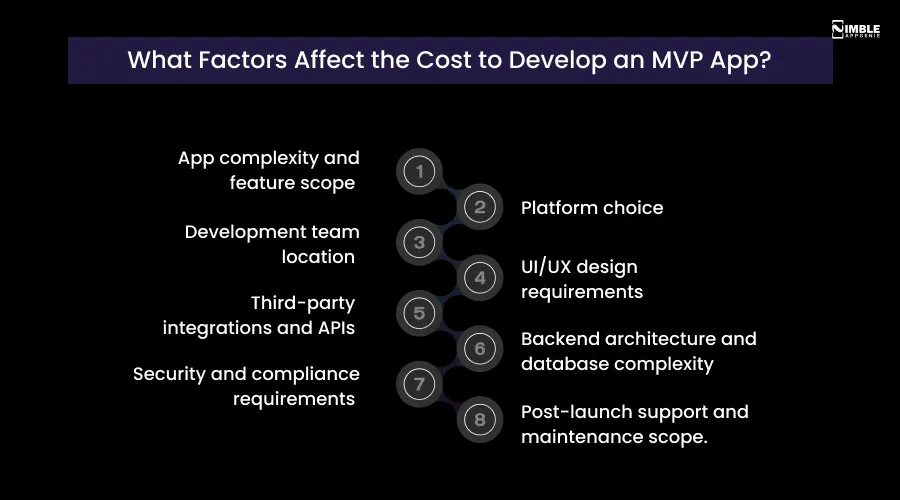
Let’s have a quick-reference overview of all factors before we break each one down:
| Cost Factor | Cost Impact | Budget Add-On |
| App Complexity & Feature Scope | Very High | +10–30% per extra feature |
| Platform Choice (iOS / Android / Web) | High | Native dual-build = +60–80% |
| Development Team Location & Model | Very High | US vs India = 60–80% cost gap |
| UI/UX Design Requirements | Medium | $5,000 – $25,000 |
| Third-Party Integrations & APIs | Medium-High | $2,000 – $15,000 per integration |
| Backend Architecture & Database | Medium-High | $8,000 – $15,000 |
| Security & Compliance Requirements | High | $10,000 – $30,000+ |
| Post-Launch Support & Maintenance | Medium | 15–20% of dev cost/year |
1. App Complexity and Feature Scope
More features mean more hours and a higher development cost. A login screen and one core action might take 200-400 hours. You can add a chat system, push notifications, a dashboard, and an admin panel. You are now at 1000+ hours.
Rule of thumb: Every new feature adds 10-30% to your total budget. You can define your must-haves ruthlessly before the first line of code is written.
| Feature Set | Dev Hours | Estimated Cost |
| Login + 1 core feature only | 200 – 400 hrs | $3,000 – $8,000 |
| Accounts + payments + dashboard | 600 – 900 hrs | $9,000 – $15,000 |
| Chat + notifications + admin panel | 900 – 1,400 hrs | $5,000 – $8,000 |
| Real-time + multi-role + integrations | 1,400 – 2,000 hrs | $10,000 – $20,000 |
2. Platform Choice
Developing a native iOS and Android app separately costs 60-80% more than a cross-platform solution. Additionally, frameworks like Flutter and React Native give you both platforms at roughly 60-70% of the cost of developing a mobile app separately. A web-first MVP is almost always the cheapest starting point.
| Platform option | Relative cost | Time to build | Best for |
| Web app only | Lowest-baseline | 4-10 weeks | SaaS, B2B tools, early idea validation |
| Progressive Web App (PWA) | Low — +10–15% | 5 – 12 weeks | Mobile-like web without App Store |
| Cross-Platform (Flutter/React Native) | Medium — +30–50% | 8 – 18 weeks | Most consumer-facing MVPs |
| Native iOS Only | Medium-High — +50–70% | 8 – 16 weeks | App Store launch, iOS-first audience |
| Native Android Only | Medium-High — +50–70% | 8 – 16 weeks | Android-first markets |
| Native iOS + Native Android | Highest — +80–120% | 14 – 28 weeks | Large budgets with distinct UX needs |
If you want to compare cross-platform frameworks before making a decision, read our article on Flutter vs React Native.
3. Development Team Location and Model
This is one of the biggest cost lavers you have on MVP app development cost. Dedicated development team hourly rates vary significantly by region, and the team model adds another layer of variability.
| Region | Hourly Rate | Notes |
| USA/Canada | $100 – $200/hr | Premium quality, compliance expertise |
| Western Europe | $80-$150/hr | Strong PM, good English communication |
| Asia | $15-$25/hr | Best cost-quality ratio for most startups |
| Eastern Europe | $40 – $70/hr | High technical quality, growing talent |
| Latin America | $30 – $70/hr | US-timezone advantage, rising quality |
| Southeast Asia | $20 – $50/hr | Budget-first option, quality varies |
Asia and Eastern Europe offer the best cost-to-quality ratio for most startups. Senior developers in Asia match the output of teams in New York at a fraction of the rate.
4. UI/UX Design Requirements
Custom app design adds $5,000-$25,000 to your MVP cost. For a first MVP, you can use established design systems like Material UI or iOS Human Interface Guidelines. This reduces design hours by 40-60% and still looks professional. You can save the bespoke brand experience for version 2.
| Design Approach | Cost Range | Time | Best For |
| UI component library (Material UI, Tailwind) | $2,000 – $5,000 | 1 – 2 weeks | Fast MVPs, B2B tools, internal products |
| Template-based custom design | $5,000 – $12,000 | 2 – 4 weeks | Consumer apps with standard UX patterns |
| Fully custom UI/UX design | $12,000 – $25,000 | 4 – 8 weeks | Brand-driven consumer products |
| Custom design + user testing rounds | $20,000 – $30,000 | 6 – 12 weeks | HealthTech, FinTech, accessibility-first apps |
5. Third-Party Integrations and APIs
Each API and payment gateway integration adds $2,000-$15,000 to your project. When you add more integrations, your development hours will increase, QA cycles, and potential failure points you introduce.
| Integration Type | Common Tools | Cost to Integrate | Complexity |
| Payment Gateway | Stripe, Razorpay, PayPal | $3,000 – $8,000 | Medium |
| Authentication / SSO | Auth0, Firebase, Google OAuth | $1,500 – $5,000 | Low-Medium |
| Maps & Geolocation | Google Maps, Mapbox | $2,000 – $6,000 | Medium |
| Communication (SMS/Email) | Twilio, SendGrid, Mailchimp | $1,500 – $4,000 | Low |
| Cloud Storage | AWS S3, Google Cloud | $1,000 – $3,000 | Low |
| Analytics & Tracking | Mixpanel, Firebase, Amplitude | $1,000 – $3,000 | Low |
| CRM / ERP Integration | Salesforce, HubSpot, SAP | $5,000 – $15,000 | High |
| Banking / Open Banking API | Plaid, TrueLayer, Razorpay X | $8,000 – $20,000 | Very High |
List every integration you need before getting a quote. Surprises here are the most common reason MVPs go over budget.
6. Backend Architecture and Database Complexity
The backend is the engine of your MVP, and it is where cost overruns hide. A simple CRUD app with basic user records is far cheaper to build than a product that needs real-time data syncing, complex business logic, or multi-tenant database architecture.
| Backend Type | Cost Range | Use Case | Examples |
| Simple REST API + SQL database | $5,000 – $9,000 | Standard CRUD, single user type | Booking app, directory, simple SaaS |
| Multi-role API + relational DB | $3,000 – $7,000 | Admin + user roles, dashboards | Marketplace, project management tool |
| Real-time backend (WebSockets) | $5,000 – $10,000 | Live updates, chat, tracking | Delivery app, messaging, live auction |
| Microservices architecture | $15,000 – $25,000 | High scalability from day one | FinTech platforms, large SaaS products |
| AI / ML backend integration | $20,000 – $30,000 | Recommendations, predictions, NLP | AI-powered products, personalisation engines |
For an MVP, you should always start with the simplest backend that works. Monolith over microservices. SQL over complex NoSQL. You can refactor for scale after you have validated the product; premature optimisation is a common and expensive mistake.
7. Security and Compliance Requirements
This is the most underestimated MVP app development cost factor for startups. If you are developing in a regulated industry like fintech, healthtech, or edtech for children, mobile app data privacy compliance is not optional. It must be developed from day one.
| Compliance / Security Requirement | Applies To | Cost to Implement | When to Budget |
| GDPR (EU data protection) | Any product with EU users | $3,000 – $7,000 | Pre-launch always |
| HIPAA (US healthcare data) | HealthTech, telemedicine | $5,000 – $10,000 | Before the first line of code |
| PCI-DSS (payment card data) | FinTech, e-commerce with payments | $10,000 – $15,000 | Before payment integration |
| SOC 2 Type I/II (data security) | B2B SaaS targeting enterprise clients | $7,000 – $20,000 | Pre-sales / Series A stage |
| SSL, encryption, secure APIs | All products | $2,000 – $5,000 | Built into MVP always |
| Penetration testing/security audit | Any customer-facing product | $5,000 – $12,000 | Pre-launch for regulated apps |
If you add compliance after the MVP is built, it can cost 3–5x more than creating it from the start. Also, if your industry is regulated, factor this in before you finalise your MVP budget.
Is $50,000 Enough to Build an MVP Version?
Yes, for most startups, MVPs, $50,000 is a realistic and workable budget. With an offshore mobile app development team in Asia or Europe, $50,000 covers a medium-complexity MVP.
It includes user accounts, payments, one or two API integrations, and an intuitive UI. It is not enough for a fintech or healthtech product that needs compliance work, which can increase costs to $80,000-$120,000+.
The table below shows the $50,000 breaks down with an offshore agency:
| Cost Component | Typical Share | Estimated Amount |
| Backend Development | 40% | $12,000 |
| Frontend/Mobile Development | 30% | $10,000 |
| UI/UX Design | 15% | $7,500 |
| QA and Testing | 10% | $5,000 |
| Project Management | 5% | $2,500 |
If your mobile app idea needs heavy compliance like HIPAA, PCI DSS, real-time features, or dual-platform builds from day one, $50,000 may be tight. For a focused, single-platform web or mobile MVP? It is enough.
How Do I Reduce My MVP Development Cost for Startups?
To reduce the cost to create an MVP app, you can prioritise only must-have features, choose cross-platform over native, start with a web MVP before going mobile, and lock your scope before development starts. Let’s have a look at the ways to reduce the cost to make an MVP.
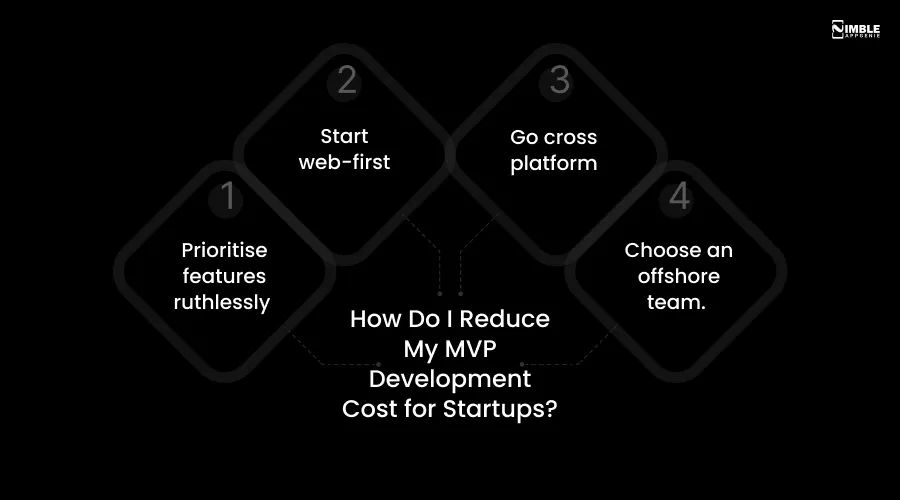
1. Prioritise features ruthlessly
You can use the MoSCoW method. It means Must-have, Should-have, Could-have, and Won’t-have. You should only build must-have mobile app features in version one.
2. Start web-first
A web application or progressive web app is cheaper to build and still validates your idea on mobile. So, you can start with web app development first and then go for a full mobile app.
3. Go cross-platform
To reduce the cost of building an MVP app, you can go for cross-platform development. The frameworks like Flutter or React Native save 30–40% versus separate iOS and Android builds.
4. Choose an offshore team
A senior developer in Asia or Eastern Europe delivers the same output as a US developer at 25–40% of the rate. So, it is best to hire mobile app developers from developing countries rather than developed countries.
What Is the Cheapest Way to Build an MVP App?
The cheapest way to develop an MVP app is to focus on only one feature, use cross-platform frameworks, and depend on existing APIs. This way, you can reduce the cost up to $8,000-$25,000.
A low-cost MVP usually includes:
- One main user problem
- Basic UI and user flow
- Limited integrations
- Cross-platform development
- Pre-built tools and APIs
But the biggest mistake businesses make is trying to build too many features before validating the idea.
Can I launch an app MVP with one feature only?
Yes, you can launch an MVP with only one feature. The goal of an MVP is not to develop a complete product. It is to test whether users actually want the solution. Launching with one helps you:
- Reduce development cost
- launch faster
- Collect user feedback early
- Avoid wasting money on unused features.
For most startups, a single-feature MVP is the fastest and safest way to validate an app idea before scaling.
What is the fastest way to launch an MVP app?
The fastest way to launch an MVP app is to keep the scope small, use cross-platform development, and develop only the features required for validation.
Most MVP apps launch faster when startups avoid custom infrastructure and use ready-made services for payments, authentication, and analytics.
How Much Does it Cost to Build a Startup MVP in Different Industries?
MVP app development costs vary across different industries. Fintech and healthtech MVPs cost $20,000-$120,000 due to compliance and security requirements.
Edtech and SaaS MVPs are cheaper, around $10,000-$80,000. The industry you create directly determines your compliance burden, integration complexity, and security standards.
| Industry | MVP Cost Range | Main Cost Driver | Example |
| FinTech / Payments | $20,000 – $120,000 | KYC, PCI-DSS compliance, banking APIs | Lending or payment app |
| HealthTech / Telemedicine | $20,000 – $100,000 | HIPAA compliance, EHR integrations | Telemedicine booking MVP |
| EdTech / E-Learning | $10,000 – $80,000 | Video delivery, quiz engine, LMS setup | Course marketplace |
| E-Commerce / Marketplace | $15,000 – $70,000 | Cart, payments, vendor management | Two-sided marketplace |
| SaaS / B2B Tools | $10,000 – $80,000 | Multi-tenant architecture, subscription billing | Project management SaaS |
| On-Demand / Delivery | $10,000 – $60,000 | Real-time tracking, dual-app build | Hyperlocal delivery app |
| Social / Community | $10,000 – $50,000 | User content, moderation, notifications | Community platform |
If you are developing an MVP app in a regulated space like fintech or healthtech, factor in compliance work from day one. But if you add it later, it can cost three times as much.
What Are the Hidden MVP Costs Most Startups Do Not Plan For?
Beyond development, you need to budget for App Store Fees, cloud hosting, post-launch bug-fixes, legal compliance, and analytics tools. These hidden costs often add $10,00-$30,000 in the first year and are rarely included in initial development quotes.
When you calculate MVP app development pricing, most quotes only cover the build. Here is what they leave out:
| Hidden Cost | Estimated Budget | When It Hits |
| App Store Fees (Apple + Google) | $125 one-time + $99/yr | Pre-launch |
| Cloud Hosting (AWS / GCP / Azure) | $50 – $2,000/month | Month 1 onwards |
| Post-Launch Bug Fixes | 15–20% of dev cost | First 3 months |
| Analytics Tools (Mixpanel, Firebase) | $0 – $500/month | Month 1 onwards |
| Legal (Privacy Policy, T&Cs, GDPR) | $2,000 – $10,000 | Pre-launch |
| Security Audit | $5,000 – $20,000 | Pre-launch (regulated apps) |
| UI/UX Iteration (user feedback rounds) | $3,000 – $8,000 per round | Post-launch |
Rule of thumb: Budget 15-20% of your development cost for the first year of maintenance and fixes. A $50,000 MVP needs a $7,500-$10,000 post-launch buffer.
What Is the Difference Between MVP and Full Product Cost?
An MVP usually costs 15-25% of a full-scale product development. A full product that would cost $400,000 at scale can often be validated with an MVP at $50,000-$80,000. The MVP covers only the core value proposition and primary user flow.
The full product adds all secondary features, advanced UX, admin tools, integrations, and scalability infrastructure.
| Dimension | MVP | Full Product |
| Cost | $15,000 – $150,000 | $150,000 – $300,000+ |
| Timeline | 4 – 28 weeks | 6 – 24 months |
| Features | Core flow only | Full feature set |
| Users | Early adopters/testers | General market |
| Goal | Validate and learn | Scale and grow |
| Design | Functional, clean | Polished, branded |
| Infrastructure | Minimal, scalable-ready | Production-grade, load-tested |
The smartest use of an MVP budget is to answer one question. Will people pay for this? Once the answer is yes, you invest in the full product with confidence. Without the MVP, you are betting $400,000 on an assumption.
How to Decide the Right Investment Level for Your MVP App?
The right MVP budget depends on what you are trying to prove in the first version of your product. Some startups only need a simple app to test demand. Others need stronger infrastructure, custom workflows, or security from the beginning.
If your goal is early validation, keeping the MVP lean usually makes more sense. If the product handles payments, sensitive data, or complex operations, a larger investment is often necessary.
Most MVP app development costs fall between $10,000 and $100,000+, depending on app complexity, platform choice, integrations, and long-term scalability goals.
When Does It Make Sense to Spend More on an MVP App?
Higher investment makes sense when the app needs stability, scalability, or advanced functionality from the beginning. The typical examples are:
| Different platforms | Estimated cost |
| Multi-role platforms | $40,000-$80,000 |
| Fintech apps | $50,000-$120,000+ |
| Real-time systems and live tracking | $40,000-$90,000 |
| Enterprise SaaS platforms | $50,000 |
This approach works best when the product needs to perform reliably for customers, investors, or enterprise clients from day one.
When Should You Keep Your MVP App Lean?
A lean MVP works best when the goal is fast validation with minimal financial risk. Instead of developing a full-fledged app, startups focus on one core problem and launch quickly.
| Scope Level | Typical Cost |
| Single-feature MVP | $10,000-$20,000 |
| Basic startup app | $15,000-$35,000 |
| Web-first MVP | $10,000-$30,000 |
This keeps the MVP app development cost lower while still allowing businesses to collect real user feedback before scaling further.
How to Align MVP App Investment With Risk and Validation Goals?
Your MVP budget should match the level of uncertainty around the product idea. The less validated the idea is, the more carefully you should invest.
| Validation stage | Investment range | Main goal |
| Early idea testing | $10,000-$25,000 | Validate core concept |
| Product improvement | $25,000-$50,000 | Improve features and UX |
| Growth preparation | $50,000-$100,000+ | Prepare for scale |
Choosing the right budget is ultimately about balancing product goals, technical needs, and market validation. A focused MVP with the right investment level is often more valuable than an expensive product built too early.
Why Nimble AppGenie is the Best Choice for MVP App Development?
Hundreds of development agencies will take your MVP project. Most will give you a quote, take the deposit, and hand you something that works, but barely. Here is what makes Nimble AppGenie different.
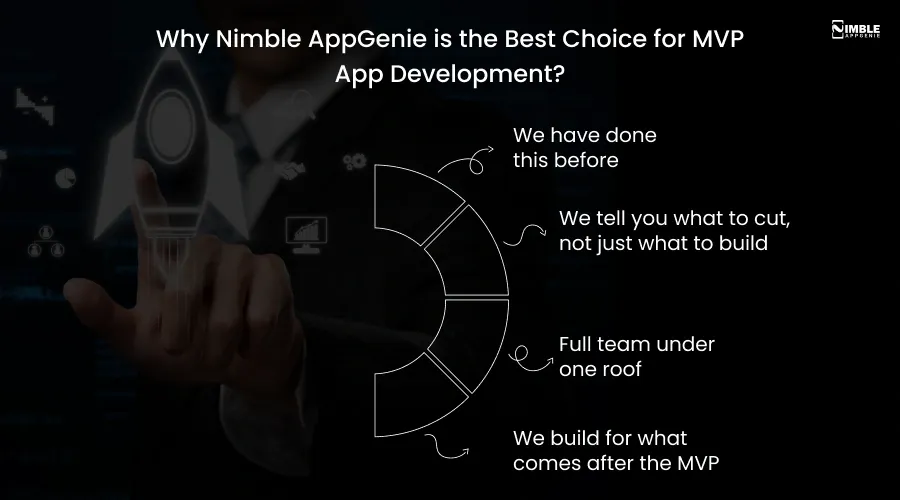
- We have done this before: As an MVP app development company, we have delivered over 300 products shipped across FinTech, HealthTech, EdTech, E-commerce, and SaaS. That experience means we know where projects go wrong and how to prevent them.
- We tell you what to cut, not just what to build: Most agencies build whatever you ask for. We push back when a feature does not serve the MVP goal. That saves you money and ships the product faster.
- Full team under one roof: Product strategy, UI/UX design, development, QA, and post-launch support, all in-house. You deal with one team, one point of contact, no hand-offs between vendors.
- We build for what comes after the MVP: An MVP is a starting point. We write clean, documented code so your product is easy to scale. You will not need to rebuild from scratch when version 2 comes.
| 300+ | MVPs shipped |
| 8+ | Years in MVP development |
| 15+ | Industries served |
| 92% | On-time delivery rate |
We are not the right fit for every project. But if you want an MVP built on time, within budget, and ready to scale, we are worth talking to. Book a free consultation now.
Conclusion
The MVP app development cost in 2026 is not a fixed number. It is a function of what you build, who builds it, and how tightly you control scope. Most startups can develop a functional, investor-ready MVP for $10,000-$100,000.
That budget is enough to validate your core idea, attract early users, and start a funding conversation. Your goal is not to spend the least. But to learn the most before you commit to the full development.
Additionally, you can choose the right team model, freeze your scope, and prioritize features. The companies that win are not the ones that spent the most on their MVP. They are the ones who learned the most and fastest.
FAQs
The cost to develop an MVP app can range from $10,000 to $100,000+. Most startups spend $25,000–$75,000. The simple apps with one core feature sit at the lower end. But the complex products in regulated industries can exceed $100,000.
The hidden costs are cloud hosting, post-launch bug fixes, App Store fees, legal compliance, and analytics tools. You should plan for an additional $10,000–$30,000 in the first year beyond your development quote.
In 2026, most seed investors expect one. A working MVP with real user data puts you in a much stronger negotiating position than a prototype or pitch deck alone.
A prototype is a visual mockup; it looks like the app but does not work. An MVP is a working product that real users can use. Investors and users need an MVP; a prototype is only useful for internal planning or early investor demos.
Yes, you can build for simple idea validation. Tools like Bubble, Webflow, and Glide allow no-code MVPs to be built for $3,000–$15,000. However, no-code platforms have scalability and customisation limits that make them best for validating demand before committing to a custom build.
The cost to develop an MVP can typically range between 15-25% of a full-scale product development. A full product that would cost $400,000 at scale can often be validated with an MVP at $50,000-$80,000.

Madan is the Backend Solutions Architect at Nimble AppGenie, specializing in the design of secure, high-concurrency systems that power complex mobile ecosystems. With deep expertise in server-side logic and database management, he ensures every platform is built with enterprise-grade security. In his free time, he is an avid researcher of emerging technologies; he spends his time deconstructing the latest backend frameworks and reading technical papers to ensure our solutions remain at the absolute forefront of industry innovation.
Table of Contents




No Comments
Comments are closed.