

 Free Consultation
 PCI-DSS Compliant
 GDPR Ready
 ISO 27001
 NDA Protected
 AI Services
 AI App Development
 Generative AI Development
 AI Chatbot Development
 AI Integration Services
 AI Consulting Services
 AI For Fintech
 AI Financial Assistant Solution
 AI Insurance Agent Development
 Tech Stack
 OpenAI / GPT-4
 Claude / Anthropic
 Gemini / Google AI
 Llama / Open Source
 LangChain / LlamaIndex
 Pinecone / Pgvector
 AWS / Azure AI


 Fintech Solution
 Core Fintech
 App Development
 Neobank Solutions
 eWallet Solutions
 Lending Software
 Banking Solutions
 BNPL Solutions
 BNPL Solutions
 Insurance App
 Wealth Management
 Crypto & DeFi
 Blockchain Development
  Payroll Software
 DeFi Solutions
 Crypto Wallet
 Crypto On/Off Ramp
 Crypto Exchange
 Trading Platform
 Payments
 Compliance
 Regulations & Compliance
 Fraud Detection
 Lending Ecosystem
 P2P Lending Platform
 Mortgage Software
 Engagement
 Fintech Outsourcing

 Mobile Development
 Mobile App Dev
 iOS App Development
 Android App Development
 React Native
 Flutter Development
 Web Solution
 Node.js Development
 React.js Development
 Angular Development
 App Services
 UI/UX Design
 App Maintenance
 By Stage
 MVP Development
 Industry Solutions
 Healthcare App Dev
 Education App Dev
 Travel App Dev
 Real Estate App Dev
 Logistics Software
 Social Media App

 Hire Mobile Developers
 Hire iPhone Developers
 Hire Android Developers
 Hire React Native Devs
 Hire Flutter Developers
 Hire Web Developers
 Hire Node.js Developers
 Hire Angular Developers
 Hire PHP Developers
 Hire Laravel Developers
 How It Works
 Pre-Vetted Developers
 Ready In 48 Hours
 NDA From Day One
 Replace Guarantee
 Company
 About Us
 Our Work Process
 Portfolio
 Case Studies
 Blog / Insights
 Careers
 Contact Us
 Awards
 Recognition


 Offices



In a Nutshell:
- Fraud is increasing in digital finance, impacting wallets, BNPL, and lending apps.
- Traditional rule-based systems are slow, inaccurate, and miss new types of fraud.
- AI analyzes user behavior, transactions, and device signals in real time to catch fraud quickly.
- Different AI approaches work together: supervised learning, unsupervised learning, deep learning, predictive analytics, and reinforcement learning.
- Key features include behavioral biometrics, real-time monitoring, device fingerprinting, AI anomaly detection, risk scoring dashboards, rule customization, AML/KYC integration, and regulatory reporting.
- The system architecture includes data collection, processing, AI/ML models, decision engines, and monitoring & feedback layers.
- Development costs vary by system complexity: MVP $40k–$80k, mid-level $90k–$180k, enterprise $200k–$500k+.
- Custom AI systems give fintech platforms scalability, compliance, and a competitive edge over off-the-shelf APIs or in-house solutions.
- Common challenges include data quality, false positives, model bias, real-time processing, and regulatory compliance, which can be managed with robust design and monitoring.
- Partnering with a specialized fintech AI development company ensures expertise, regulatory readiness, and a scalable, future-proof fraud detection system.
With the booming digital finance, fraud is also mounting, and fraudsters are chiefly targeting fintech platforms, be it digital wallets, BNPL, or lending apps, leading to financial losses, regulatory headaches, and damaged customer trust.
| Did you know that around 60% of financial institutions and fintech firms detected a surge in fraud, and about one-third of financial organizations lost $1million and even more in direct fraud losses. |
In such a severe condition, traditional rule-based systems fail to keep up with static fraud rules that generate high false positives, miss new attack patterns, and are unable to handle high-velocity transactions.
Here, AI-powered fintech fraud detection system development emerges as an ultimate savior with the strength of real-time analysis of millions of data points, learning from user behavior, and growing threats to accurately detect anomalies.
The power of AI not only safeguards revenue but also promises compliance and fosters customer trust.
CTOs, tech teams, product managers, executives, fintech founders, and compliance officers should build an AI fraud detection system to scale securely, protect transactions, and maintain a competitive edge.
In this blog, we will explore AI fintech fraud detection systems, explain how machine learning and real-time fraud detection work, and break down the AI fintech fraud detection system development process.
Let’s get started!
What is an AI Fintech Fraud Detection System?
First, let’s be clear – what is AI fraud detection in fintech?
An AI fintech fraud detection system is a solution that recognizes and prevents fraudulent activities in digital finance platforms, such as payments, digital wallets, and lending.
Unlike traditional rule-based systems, an AI-powered fraud detection system utilizes the power of machine learning, behavioral analytics, and real-time analysis to automatically address anomalies and evolving fraud patterns.
It holds the strength to analyze millions of transactions in only milliseconds, and ahead of time, generates risk scores and alerts to help businesses prevent fraud before it can even affect revenue or customers.
What are the Types of Fraud in Fintech Applications?
A variety of fraud risks impact fintech platforms that can risk revenue, customer trust, and compliance. Some common types of fraud in fintech applications are:
Types of Fraud in Fintech Applications:
| Types of Fraud | Description | Impact on Fintech Platforms |
| Payment Fraud | Unauthorized transactions in digital wallets, cards, or banking apps | Financial loss, customer dissatisfaction |
| Account Takeover (ATO) | Fraudsters gain access to user accounts to steal funds or sensitive data | Revenue loss, trust erosion |
| Identity & Synthetic Identity Fraud | Fake or manipulated identities are used to access loans, credit, or services | Loan defaults, compliance risks |
| Loan & Credit Fraud | Manipulating lending platforms to secure unauthorized credit | Financial loss, increased risk exposure |
| Chargeback & Transaction Fraud | Disputes or reversals caused by fraudulent purchases | Operational costs, revenue leakage |
| AML-Related Transaction Laundering | Illicit funds hidden within legitimate transactions | Regulatory penalties, reputational damage |
So, it’s imperative to understand these fraud types to build an AI fintech fraud detection system holding the power to detect, adapt, and prevent surging threats effectively.
Why Build an AI Fintech Fraud Detection System
By creating a custom fintech fraud detection system, you can position your fintech platform ahead of the curve by proactively preventing fraud, scaling securely, and ensuring compliance.

Fintech platforms encounter rapidly evolving fraud threats, from account takeovers and synthetic identities to transaction laundering.
“By leveraging AI, businesses can shift their fraud management resources to where it matters, investigating the key issues, rather than dealing with endless false positives, boosting efficiency.”
– VP of Fintech Market Research at Juniper
A custom fraud detection software development for fintech ensures:
Reason#1. Tailored Security
Custom-built rules and models suit your platform’s transaction patterns and risk profile, where generic off-the-shelf solutions fail.
Reason#2. Real-Time Protection
AI can instantly process millions of transactions, mitigating false positives and fraud losses.
Reason#3. Scalability
With your expanding business, systems also grow, managing increased volumes without delaying approvals or user experience.
| Worldwide business spend on an AI-powered financial fraud detection and prevention strategy platform will likely surpass $10 billion in 2027, which was recorded to be $6.5+ billion in 2022. |
Reason#4. Regulatory Compliance
Fintech organizations can seamlessly integrate KYC, AML, PCI-DSS, and other applicable, region-specific needs directly into their workflow.
Reason#5. Competitive Advantage
With secure user trust, data-driven insights, and faster fraud detection, fintechs can attain an operational edge.
Reason#6. Cost Efficiency in the Long Run
You can save on reactive remediation or fines by streamlining monitoring and preventing fraud, which is possible by developing a real-time fraud detection system.
| The increasing use of AI in fintech businesses by 285% will lead to cost savings in 2027, reaching $10.4 billion globally, up from $2.7 billion in 2022. |
These facts and figures highlight the urgency for fintech platforms to adopt AI-powered fraud detection systems.
Stakeholders seeking to protect reputation, revenue, and customer trust should choose custom AI fintech development.
How AI-Powered Fraud Detection Works?
So next, find out how AI detects fraud in digital payments.
By analyzing a huge amount of user data and transactions, an AI fintech fraud detection system identifies fraud in real-time.

Below is how the process works:
- Step 1: Data Collection: First, the system accumulates user behavior, transactions, third-party sources, and device information.
- Step 2: Data Preprocessing: Next, it cleans and organizes data in a well-structured format to ensure precise analysis.
- Step 3: Feature Engineering: It recognizes patterns and risk indicators that simplify spotting anomalies.
- Step 4: Model Training: Here, machine learning fraud detection algorithms help catch known and emerging fraud patterns.
- Step 5: Risk Scoring: Ahead, it assigns real-time risk scores to transactions for rapid decision-making.
- Step 6: Decision Engine: It automatically blocks, evaluates, or approves transactions to evade fraud.
- Step 7: Continuous Learning: In the end, models adapt to new threats, reducing false positives and improving detection.
This AI-driven approach combines behavioral analytics, predictive modeling, risk scoring models, and anomaly detection in fintech to deliver real-time fraud protection for platforms, while fostering customer trust and compliance.
Core Features of an AI Fintech Fraud Detection System
A powerful AI fintech fraud detection system incorporates multiple features to guard transactions, ensure compliance, and boost operational efficiency.
| Features | Description | Value for Fintech Platforms |
| Real-Time Transaction Monitoring | Analyze every transaction instantly to detect anomalies | Prevent fraud before it impacts revenue |
| Behavioral Biometrics | Track user behavior patterns across devices and apps | Identify suspicious activity accurately |
| Device Fingerprinting | Recognize devices, IPs, and locations using browser fingerprinting techniques that persist across sessions. | Prevent account takeovers and unauthorized access |
| Risk Scoring Dashboard | Assign risk scores to transactions in real time | Enable quick, automated decision-making |
| AI/ML-Based Anomaly Detection | Continuously learn from historical and new data to detect unusual patterns | Detect emerging fraud patterns dynamically |
| Rule Engine Customization | Set thresholds and business-specific rules | Tailor fraud detection to platform needs |
| Multi-Layer Authentication Integration | Incorporate multiple verification steps | Strengthen account and transaction security |
| AML & KYC Integration | Automate compliance and regulatory checks | Ensure adherence to AML/KYC regulations |
| Case Management System | Investigate alerts efficiently and maintain records | Streamline fraud investigations and audits |
| Regulatory Reporting Tools | Generate reports for compliance requirements | Reduce manual effort and regulatory risk |
The above features ensure fintech platforms can detect fraud proactively, diminish false positives, and maintain customer trust and revenue.
AI Fintech Fraud Detection System Architecture
You should understand the AI fraud detection system architecture to strengthen your fintech platforms with scalable and real-time fraud prevention capabilities.
Beyond algorithms, there’s an effective system that relies on a layered framework, which integrates processing pipelines, data ingestion, a decision engine, machine learning models, and continuous monitoring.

An expandable AI fraud detection system architecture is developed in layered components that smoothly process data in real-time, apply ML models, and activate automated decisions with consistent feedback optimization.
1. Data Layer
Components: Transaction data, device & IP data, user behavior data, and third-party data sources.
Purpose / Value: This layer piles up structured and unstructured data from several sources, forming the base for precise fraud analysis. A robust data layer diminishes blind spots and improves detection precision.
2. Processing Layer
Components: Stream processing, feature engineering pipeline, and batch processing.
Purpose / Value: It manages historical and real-time data transformation. Through stream processing, it enables instant fraud detection, while batch processing enhances model training. The feature engineering pipeline converts raw inputs into model-ready variables.
3. AI/ML Layer
Components: Classification models, clustering models, and deep learning models.
Purpose / Value: This layer empowers the core intelligence of the AI fraud detection system architecture.
- Classification models detect known fraud patterns.
- Clustering models identify unusual behavioral groups.
- Deep learning models unveil complex and evolving fraud strategies.
4. Decision Engine
Components: Risk score thresholds, manual review triggers, and automated approval/decline.
Purpose / Value: It converts model outputs into actionable results. The decision ensures score transactions in real-time, approves or declines them automatically, or escalates them for manual review depending on predefined thresholds.
5. Monitoring & Feedback Layer
Components: Model retraining, performance monitoring, and false positive optimization.
Purpose / Value: The monitoring and feedback layer ensures consistent improvement. It monitors detection accuracy, retrains models with new fraud patterns, and optimizes false positives to balance security and user experience.
Compliance & Regulatory Considerations
An AI fraud detection system for fintech platforms should go beyond technical accuracy. It should operate within rigid regulatory frameworks to ensure customer trust, compliance, and audit readiness.

Enterprise-grade systems are crafted with compliance embedded directly into the architecture.
1. AML (Anti-Money Laundering)
AI-powered fraud systems support AML compliance by:
- Monitoring suspicious transaction patterns
- Maintaining audit logs for regulatory review
- Generating automated suspicious activity reports (SARs)
- Detecting structuring, transaction laundering, and unusual fund flows
Impact: By integrating AML logic into the fraud detection workflow, you can reduce regulatory risk and prevent financial crime exposure.
2. KYC (Know Your Customer)
Fraud detection systems should integrate seamlessly with KYC processes to:
- Detect synthetic identity fraud.
- Verify customer identities during onboarding.
- Enable ongoing customer due diligence (CDD)
- Flag inconsistencies between behavioral and identity data
Insight: With tight KYC integration, you can ensure identity validation and risk profiling are ongoing, not one-time events.
3. GDPR (General Data Protection Regulation)
Fintech platforms operating in Europe should be compliant with GDPR.
AI fraud detection systems must:
- Ensure lawful data processing
- Implement data minimization principles
- Maintain secure data storage and encryption standards
- Support right-to-access and right-to-erasure requests
Impact: Privacy-by-design architecture is crucial for enterprise adoption and regulatory approval.
4. PCI-DSS (Payment Card Industry Data Security Standard)
A system that processes cardholder data needs to be PCI-DSS compliant.
Key considerations include:
- Restricted access controls
- Continuous vulnerability monitoring
- Secure logging and incident response mechanisms
- Secure transmission and encryption of payment data
Impact: If they fail to comply, it will result in reputational damage and heavy fines.
5. Regional Fintech Regulations
Fraud detection systems must adapt to jurisdiction-specific needs:
- Africa: Central bank compliance frameworks, AML reporting mandates, and digital payment regulations.
- Europe: PSD2 requirements, Strong Customer Authentication (SCA), and GDPR alignment.
- India: RBI digital lending guidelines, KYC norms, and data localization requirements.
Impact: If you want your scalable AI fraud detection system to adapt across various markets, it should support configurable compliance rules.
Technology Stack for AI Fraud Detection System Development
A scalable AI fintech fraud detection system demands a powerful and modular technology stack that backs real-time data processing, cloud stability, machine learning workflows, and secure API integrations.
By choosing the right tools and technologies, you can directly influence model accuracy, performance, enterprise readiness, and system reliability.
Core AI Fraud Detection Tech Stack
| Category | Technologies | Purpose in AI Fraud Detection System |
| Programming Language | Python | Core language for ML model development, data processing, and backend logic |
| Machine Learning Frameworks | TensorFlow, PyTorch | Build, train, and deploy deep learning and predictive fraud detection models |
| Real-Time Data Streaming | Apache Kafka | Enables real-time transaction monitoring and streaming analytics |
| Big Data Processing | Apache Spark | Handles large-scale batch processing and distributed feature engineering |
| Cloud Infrastructure | AWS, Microsoft Azure | Scalable infrastructure for model hosting, storage, and high-availability deployment |
| API Layer | REST APIs | Secure integration with fintech apps, payment gateways, and third-party services |
| Architecture Patterns | Microservices Architecture | Modular deployment for scalability, resilience, and independent model updates |
| Database Layer | PostgreSQL, MongoDB | Store transaction logs, risk scores, and behavioral data |
| DevOps & CI/CD | Docker, Kubernetes | Containerization, orchestration, and automated deployment pipelines |
| Security Layer | OAuth 2.0, JWT, Encryption Standards | Secure authentication, access control, and data protection |
What is the Cost to Develop an AI Fintech Fraud Detection System?
The cost to develop a fraud detection system relies on data scale, system complexity, real-time processing requirements, and regulatory requirements.

Below is a practical breakdown based on implementation maturity levels.
1. MVP AI Fraud Detection System
Estimated Cost: $40,000 – $80,000
Timeline: 3 – 5 months
Includes:
- Basic transaction monitoring
- Rule-based engine with simple ML model
- Limited behavioral analysis
- Risk scoring mechanism
- Cloud deployment (single-region)
Team Composition:
- 1 ML Engineer
- 1 Backend Developer
- 1 Data Engineer
- 1 QA Engineer
- 1 Project Manager
Infrastructure Costs: $1,000-$3,000/month (cloud hosting + storage)
Ongoing Model Training:
- Periodic retraining (quarterly)
- Minimal automation
Best for: Early-stage fintech startups validating fraud prevention capabilities.
2. Mid-Level AI Fraud Detection System
Estimated Cost: $90,000 – $180,000
Timeline: 5 – 8 months
Includes:
- Real-time transaction monitoring
- Behavioral biometrics integration
- Advanced ML models (classification + clustering)
- Device fingerprinting
- AML & KYC integration
- Case management dashboard
Team Composition:
- 2 ML Engineers
- 2 Backend Developers
- 1 Data Engineer
- 1 DevOps Engineer
- 1 QA Engineer
- 1 Product Manager
Infrastructure Costs:
- $3,000 – $8,000/month
- Real-time streaming infrastructure (Kafka/Spark)
- Scalable cloud deployment
Ongoing Model Training:
- Automated retraining pipelines
- Monthly performance optimization
Best for: Growing fintech platforms handling high transaction volumes.
3. Enterprise-Grade AI Fraud Detection Solution
Estimated Cost: $200,000 – $500,000+
Timeline: 8 – 14 months
Includes:
- Full AI fraud detection system architecture
- Deep learning models
- Multi-layer authentication integration
- Regulatory reporting automation
- Multi-region deployment
- Advanced risk scoring dashboard
- False positive optimization engine
- Real-time decision engine with sub-second latency
Team Composition:
- 2 – 3 ML Engineers
- 3 Backend Engineers
- 2 Data Engineers
- 1 DevOps/Cloud Architect
- 1 Security Engineer
- 2 QA Engineers
- 1 Technical Architect
- 1 Product Owner
Infrastructure Costs:
- $8,000-$25,000+/month
- Multi-region cloud infrastructure
- High-availability architecture
- Data warehousing + monitoring stack
Ongoing Model Training:
- Continuous retraining pipelines
- Real-time feedback loops
- Dedicated ML monitoring tools
- Ongoing compliance audits
Best for: Large fintech enterprises, digital banks, BNPL platforms, and payment processors.

What Influences Development Cost?
- Transaction volume
- Real-time processing requirements
- Regulatory jurisdictions
- Data complexity
- AI model sophistication
- Cloud architecture scale
Quick AI Fintech Fraud Detection System Development Cost Comparison Overview:
| System Type | Estimated Cost | Timeline | Best For | Infrastructure (Monthly) |
| MVP AI Fraud Detection System | $40,000 – $80,000 | 3 – 5 months | Early-stage fintech startups | $1,000 – $3,000 |
| Mid-Level AI Fraud System | $90,000 – $180,000 | 5 – 8 months | Scaling fintech platforms | $3,000 – $8,000 |
| Enterprise-Grade Solution | $200,000 – $500,000+ | 8 – 14 months | Digital banks & large fintech enterprises | $8,000 – $25,000+ |
Build vs Buy: Should You Develop or Integrate?
Fintech platforms need to make critical decisions when implementing fraud detection: build in-house, integrate a third-party API, or invest in a fully custom AI system.

Every approach has unique benefits, limitations, and strategic importance.
1. In-House Development
Fraud detection system development internally gives your team complete control over models, data, and system architecture.
You are free to design algorithms and thresholds tailored particularly to your transaction patterns.
Pros:
- Full ownership of data and intellectual property
- Complete control over ML models and risk scoring
- Ability to customize workflows and reporting
Cons:
- Longer development timelines.
- Continuous model monitoring and maintenance are required.
- High initial hiring cost for data scientists, ML engineers, and DevOps staff.
Best for: Large fintechs or digital banks with robust internal AI/engineering teams and resources.
2. Third-Party Fraud APIs
The pre-built solutions that fintech firms can quickly integrate. APIs manage anomaly detection, fraud scoring, and periodic compliance workflows, enabling swift deployment.
Pros:
- Fast time-to-market
- Lower upfront development cost
- Minimal internal technical effort
Cons:
Limited customization; models are generic
Vendor lock-in risk:
- Less adaptability to emerging or platform-specific fraud patterns
- Limited compliance flexibility
Best For: Early-stage fintech startups or MVP launches demanding immediate fraud protection.
3. Custom AI Fraud Detection System
An end-to-end custom AI system development takes place, tailored for your compliance needs, risk profile, and transaction patterns. It’s scalable, deeply integrates into your platform, and dynamically adapts to new fraud patterns.
Pros:
- Tailored architecture and risk scoring models
- Full compliance flexibility (AML, KYC, regional regulations)
- Real-time monitoring and multi-layered defenses
- Long-term competitive advantage
- Reduced false positives, higher detection accuracy
Cons:
- Higher initial development cost
- Requires strategic planning and an expert team
Best For: Growth-stage or enterprise fintech platforms looking to scale securely and distinguish from competitors.
Quick-Scan Comparison Table
| Approach | Pros | Cons | Best For |
| In-House Development | Full control, custom models, data ownership | High hiring cost, long timelines, and maintenance required | Large fintechs with internal AI teams |
| Third-Party Fraud APIs | Fast deployment, low upfront cost, minimal engineering | Generic models, vendor lock-in, limited scalability & compliance | Early-stage fintechs, MVPs |
| Custom AI Fraud Detection System | Tailored, scalable, compliant, competitive advantage, reduced false positives | Higher initial investment, needs an expert team |
What are the Challenges in Developing AI Fraud Detection Systems?
AI fintech fraud detection system development is robust, but comes with hurdles. It’s imperative to understand these challenges with possible solutions for successful implementation.
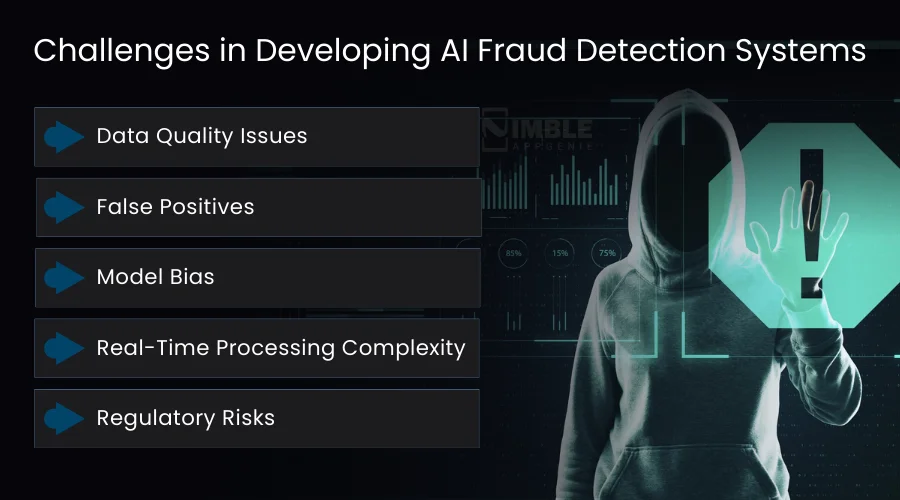
Challenge #1. Data Quality Issues
Inconsistent, incomplete, or noisy data can diminish model accuracy and increase false positives.
Solution:
- Implement robust data cleaning pipelines
- Standardize formats and transaction logs
- Use feature engineering to extract meaningful patterns
- Integrate multiple data sources for completeness
Challenge #2. False Positives
Extremely sensitive models flag legitimate transactions, impacting customer experience and operational efficiency.
Solution:
- Apply risk scoring thresholds and adaptive rules
- Include behavioral analytics for context-aware decisions
- Continuously retrain models with feedback loops
- Leverage hybrid systems combining rules + AI
Challenge #3. Model Bias
Models trained on biased or unbalanced data may unfairly flag specific user groups or regions.
Solution:
- Use diverse, representative datasets
- Apply bias detection and mitigation techniques
- Monitor model fairness metrics continuously
- Incorporate human review loops for flagged transactions
Challenge #4. Real-Time Processing Complexity
Detecting fraud immediately across millions of transactions is computationally intensive and can strain infrastructure.
Solution:
- Utilize stream processing frameworks like Kafka and Spark
- Deploy a microservices architecture for scalability
- Optimize ML models for low-latency inference
- Implement load balancing and distributed computing
Challenge #5. Regulatory Risks
Non-compliance with AML, KYC, PCI-DSS, or regional regulations can lead to fines and reputational damage.
Solution:
- Embed compliance rules into the AI system from day one
- Ensure audit trails and automated reporting
- Keep up-to-date with regional fintech regulations
- Partner with compliance experts for system validation
Why Partner with a Fintech Development Company?
It’s complex to implement an AI fintech fraud detection system as it demands deep technical proficiency, regulatory awareness, and domain knowledge.
Choosing a specialized fraud detection software development company can help you with the creation of a secure and compliant platform, while accelerating time-to-market.
Let us reduce your efforts and unveil the name of a leading fintech development company, Nimble AppGenie. Yes, having years of experience and expertise in offering fintech software development services, we have created a proven track record.
Key Advantages of Partnering with Nimble AppGenie, an AI Development Company
- Custom AI Model Development
- Fintech Domain Expertise
- Compliance-Ready Architecture
- Scalable Infrastructure
- End-to-End Development Support
Real-Time Case Study
Client Type: Leading digital payments platform in the fintech sector (Project name and client details are confidential.)
Challenges They Faced:
- High volume of daily transactions with rising fraud attempts
- Inconsistent fraud detection across regions
- Need for real-time monitoring without impacting user experience
- Compliance with AML, KYC, and regional regulations
Solutions Offered:
- We developed custom AI/ML fraud detection models tailored to transaction patterns.
- Integrated behavioral analytics, device fingerprinting, and risk scoring engines
- Implemented a real-time decision engine with automated approvals/declines
- Ensured regulatory compliance through embedded AML, KYC, and reporting workflows
- Built a scalable microservices architecture for multi-region operations
Results Attained:
- 35%+ reduced false positives
- Enabled real-time fraud detection for millions of transactions per day
- Improved regulatory compliance and reporting efficiency
- Delivered scalable infrastructure for future growth
- Strengthened customer trust and platform security

Conclusion
With the rapidly expanding fintech landscape, fraud is a consistent threat that can compromise regulatory compliance, revenue, and customer trust.
Implementing a custom AI fintech fraud detection system is mandatory to scale securely and seize a competitive edge in the long run.
A well-crafted AI fraud system holds the caliber to protect your business while offering actionable insights.
Partnering with an experienced fintech software development company ensures that your solution is future-ready and scalable, adapting to evolving threats, diminishing false positives, and embedding compliance from the start.
Whether you are a growing fintech startup or an established digital bank, investing in a custom AI fraud detection system is lucrative to foster customer trust, boost operational efficiency, and maintain lasting security.
It’s time to take a step ahead to protect your platform, optimize your fraud prevention approach, and catch up with a scalable competitive advantage by choosing a fintech AI development expert.
FAQs
The cost depends on system complexity:
- MVP system: $40,000 – $80,000
- Mid-level AI system: $90,000 – $180,000
- Enterprise-grade solution: $200,000 – $500,000+
Costs include development, infrastructure, ongoing model training, and compliance integration.
Development timelines vary by complexity:
- MVP system: 3 – 5 months
- Mid-level system: 5 – 8 months
- Enterprise-grade system: 8 – 14 months
Timelines include design, development, testing, and deployment.
- Programming: Python
- ML Frameworks: TensorFlow, PyTorch
- Big Data & Streaming: Apache Spark, Apache Kafka
- Cloud: AWS, Azure
- Architecture: Microservices
- APIs & Integration: REST APIs
- Security: OAuth 2.0, JWT, encryption standards
- Early-stage fintechs: Third-party APIs for fast deployment
- Growth-stage or enterprise platforms: Custom AI fraud detection systems for scalability, compliance, and competitive advantage.
Common challenges include:
- Data quality issues
- False positives
- Model bias
- Real-time processing complexity
- Regulatory risks
Solutions: Robust data pipelines, continuous model retraining, bias monitoring, scalable architecture, and compliance integration.

Niketan Sharma, CTO, Nimble AppGenie, is a tech enthusiast with more than a decade of experience in delivering high-value solutions that allow a brand to penetrate the market easily. With a strong hold on mobile app development, he is actively working to help businesses identify the potential of digital transformation by sharing insightful statistics, guides & blogs.
Table of Contents




No Comments
Comments are closed.