

 Free Consultation
 PCI-DSS Compliant
 GDPR Ready
 ISO 27001
 NDA Protected
 AI Services
 AI App Development
 Generative AI Development
 AI Chatbot Development
 AI Integration Services
 AI Consulting Services
 AI For Fintech
 AI Financial Assistant Solution
 AI Insurance Agent Development
 Tech Stack
 OpenAI / GPT-4
 Claude / Anthropic
 Gemini / Google AI
 Llama / Open Source
 LangChain / LlamaIndex
 Pinecone / Pgvector
 AWS / Azure AI


 Fintech Solution
 Core Fintech
 App Development
 Neobank Solutions
 eWallet Solutions
 Lending Software
 Banking Solutions
 BNPL Solutions
 BNPL Solutions
 Insurance App
 Wealth Management
 Crypto & DeFi
 Blockchain Development
  Payroll Software
 DeFi Solutions
 Crypto Wallet
 Crypto On/Off Ramp
 Crypto Exchange
 Trading Platform
 Payments
 Compliance
 Regulations & Compliance
 Fraud Detection
 Lending Ecosystem
 P2P Lending Platform
 Mortgage Software
 Engagement
 Fintech Outsourcing

 Mobile Development
 Mobile App Dev
 iOS App Development
 Android App Development
 React Native
 Flutter Development
 Web Solution
 Node.js Development
 React.js Development
 Angular Development
 App Services
 UI/UX Design
 App Maintenance
 By Stage
 MVP Development
 Industry Solutions
 Healthcare App Dev
 Education App Dev
 Travel App Dev
 Real Estate App Dev
 Logistics Software
 Social Media App

 Hire Mobile Developers
 Hire iPhone Developers
 Hire Android Developers
 Hire React Native Devs
 Hire Flutter Developers
 Hire Web Developers
 Hire Node.js Developers
 Hire Angular Developers
 Hire PHP Developers
 Hire Laravel Developers
 How It Works
 Pre-Vetted Developers
 Ready In 48 Hours
 NDA From Day One
 Replace Guarantee
 Company
 About Us
 Our Work Process
 Portfolio
 Case Studies
 Blog / Insights
 Careers
 Contact Us
 Awards
 Recognition


 Offices



| Quick Answer: Wallet-as-a-Service (WaaS) is a cloud-based model that enables businesses to offer branded digital wallets to their customers without building or maintaining the basic wallet infrastructure themselves. |
TL;DR
- WaaS providers handle security, infrastructure, and compliance; the business manages branding and customer relationships.
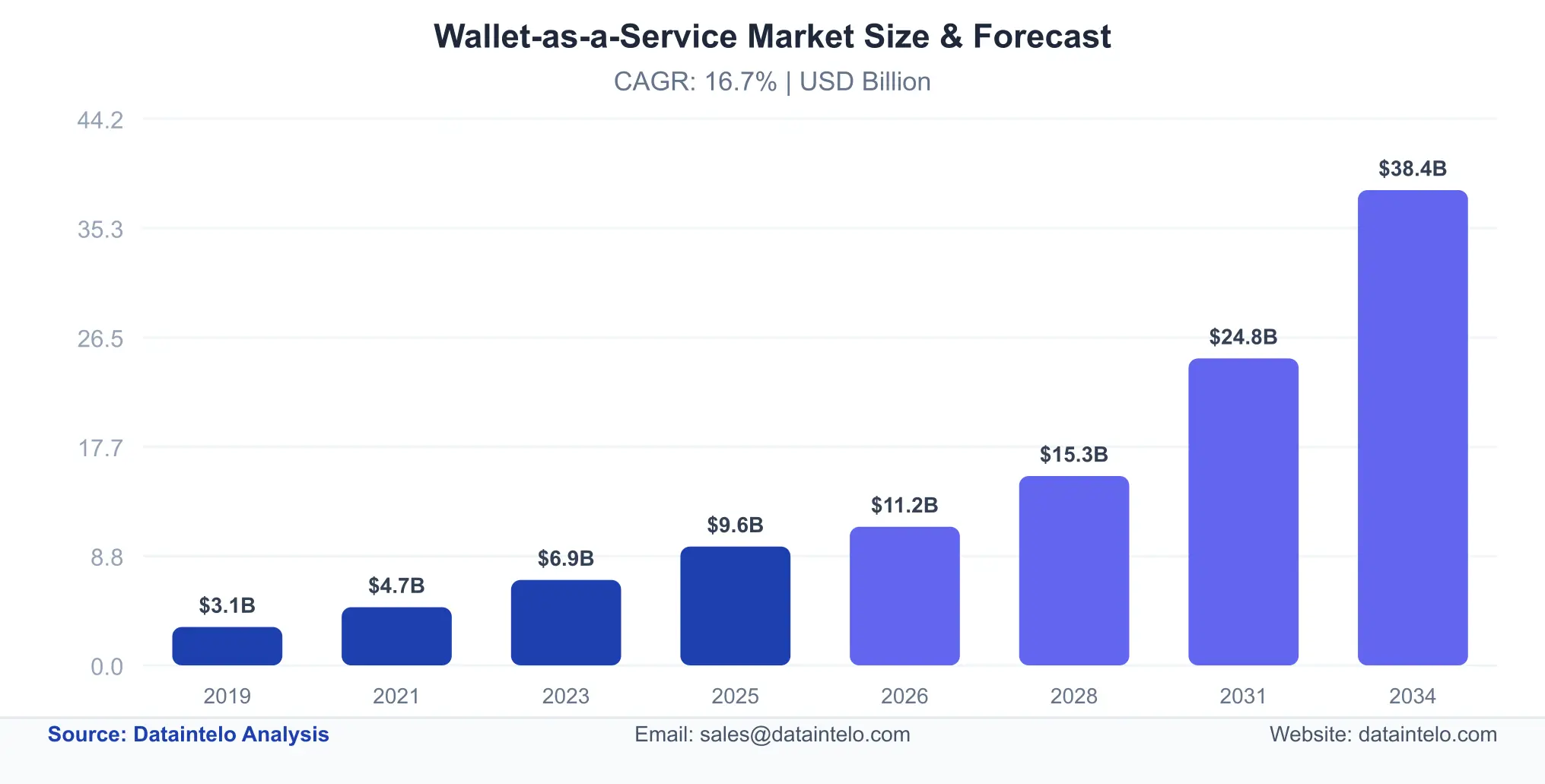
- The global Wallet-as-a-Service (WaaS) market was valued at $9.6 billion in 2025 and is expected to reach $38.4 billion by 2034, expanding at a 16.7% CAGR from 2026 to 2034, according to Dataintelo’s latest projections, verified through April 2026.
- Digital wallets are responsible for 56% of global online spending and 33% of in-person spending in 2025, making them the leading payment method across both channels, according to the 2026 Global Payments Report data cited in Dataintelo’s September 2026 update.
- WaaS trades customization and lasting control for dramatically faster time-to-market and lower upfront cost than building a custom eWallet.
- International remittance flows through embedded wallet platforms exceeded $830 billion in 2025, a chief driver of WaaS adoption.
- Nimble AppGenie builds custom eWallet platforms and WaaS integrations, matched to what a business’s growth stage actually needs.
Digital wallets have become integral for every business. Thanks to the digitization of stores and financial institutions, people today choose to pay or receive funds digitally rather than waiting for cash.
This also means businesses planning to go digital should build their own e-wallet. However, that’s not always feasible for small and medium businesses; that’s where Wallet-as-a-Service comes into play.
With the surge of embedded financial services, any digital business, even one with nothing to do with finance, can integrate fintech services like e-wallets and BNPL directly into its platform.
Nimble AppGenie’s experts created this guide that covers what WaaS is, how it works, verified market data, and how it compares to building a custom eWallet from scratch.
What Is Wallet-as-a-Service? WaaS Explained
Wallet-as-a-Service (WaaS) is a modern financial model that lets businesses offer electronic wallets to customers without building and maintaining their own wallet infrastructure.
This model runs on a cloud-based platform offered by a third party that manages complex elements of digital wallet operations such as security, technology updates, and compliance.
Imagine giving users an efficient, secure way to transact, store value, and manage loyalty points, all under your brand, without starting from scratch. That’s WaaS, like renting a shop in a busy market instead of building one from the ground up.
WaaS lets companies embed financial services into their offerings, adding value for customers and creating new revenue streams, especially when customers expect services to integrate smoothly.
To understand what WaaS is replacing, see our full breakdown of what a digital wallet is and how traditional wallets are built.
Key Terms
- Embedded Finance: Financial services (lending, wallets, payments) created directly into a non-financial company’s product.
- API/SDK: The technical interface a business uses to connect its app to a WaaS provider’s wallet infrastructure.
- White-label: A product built by one company but branded and sold as another’s, which is how most WaaS integrations appear to end users.
How Big Is the Wallet-as-a-Service Market?
The WaaS market is large, though various research firms report notably distinct figures depending on scope and methodology:
- Dataintelo’s WaaS page was updated in April 2026 and now reports $9.6B in 2025, reaching $38.4B by 2034 at 16.7% CAGR. (Source: Dataintelo – Wallet-as-a-Service Market.)
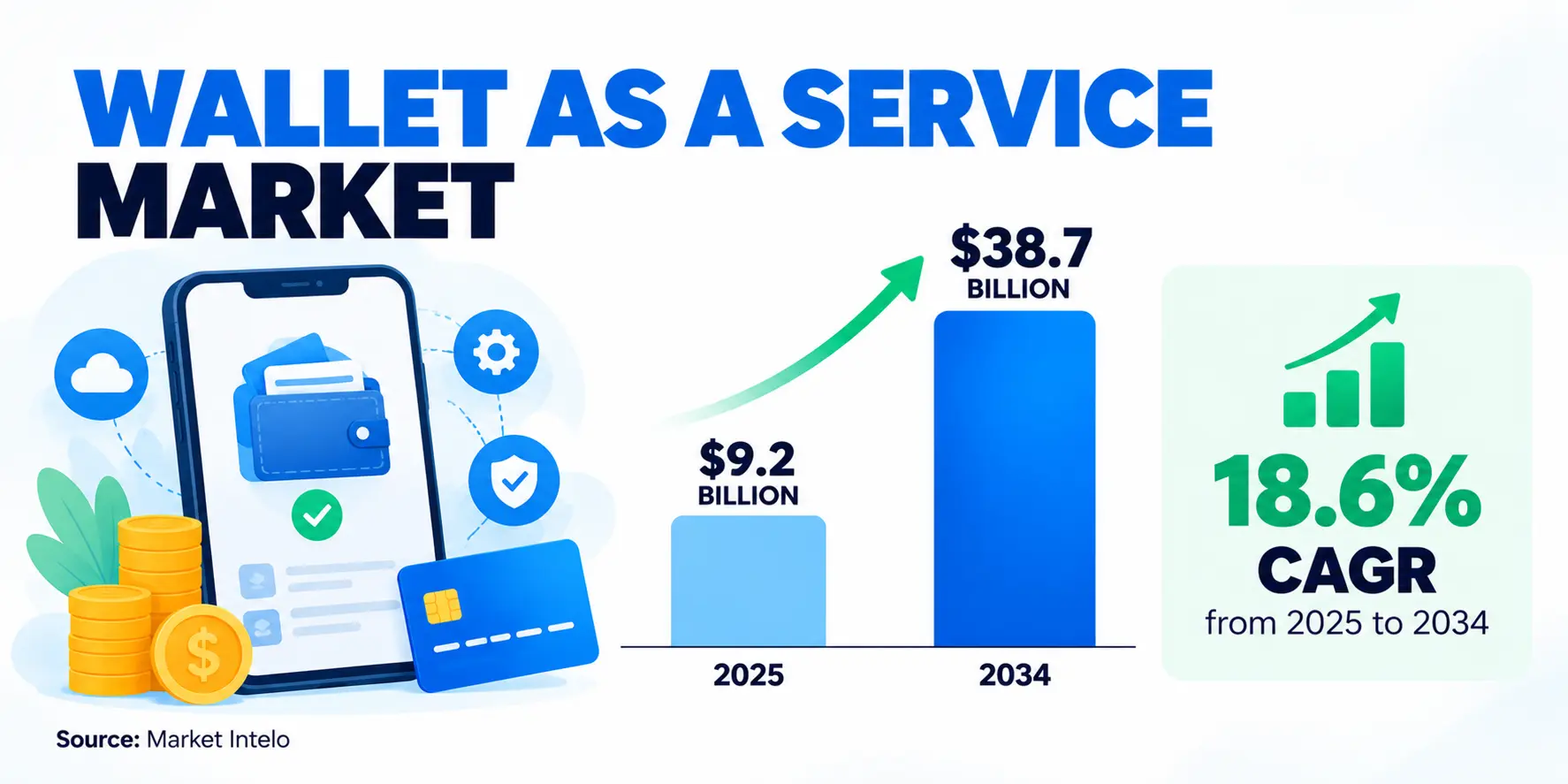
- A report on the same market shows 2025 at $9.2 billion and reaching $38.7 billion by 2034 at an 18.6% CAGR, about double Dataintelo’s figure, showcasing how much scope definitions vary across research firms. (Source: Market Intelo – Wallet-as-a-Service Market.)
- Asia Pacific commands the biggest regional share at 42.3% of the global WaaS market, driven by mobile-first populations and rising cross-border payment volumes.
Whichever estimate proves closer to reality, both point in the same direction: WaaS is a large and fast-growing category, not a niche add-on.
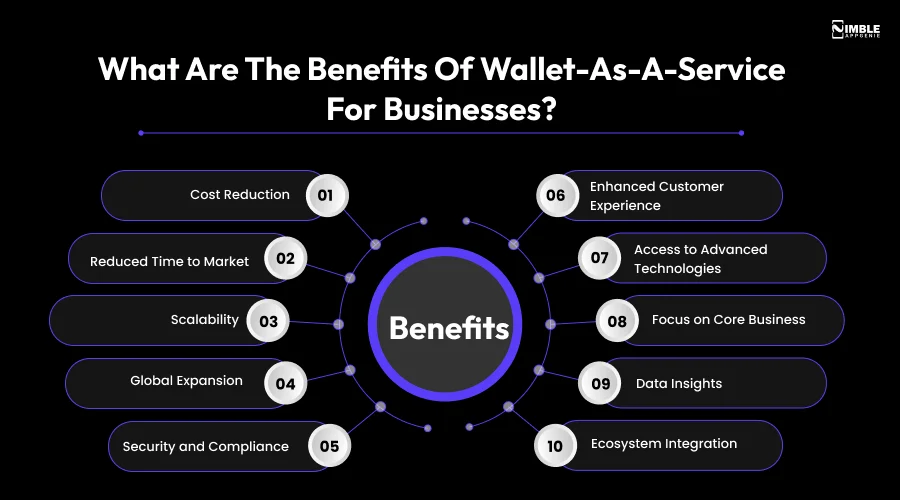
What Are the Benefits of Wallet-as-a-Service for Businesses?
The idea of Wallet-as-a-Service has opened up a multitude of advantages for businesses looking to integrate digital payment solutions.
Benefits like low cart abandonment, higher conversion rates, and more loyal customers are just the beginning, as WaaS offers a lot of flexibility for businesses.
Check them out below:
1. Cost Reduction
Building a financial service from scratch requires substantial capital investment in development, infrastructure, and security measures.
All in all, the cost to build a fintech app is high.
WaaS, on the other hand, operates on a subscription-based model, which dramatically lowers entry and operational costs.
By utilizing a WaaS provider, businesses can save on the expenses associated with hiring specialized staff, purchasing hardware, and obtaining the necessary certifications.
2. Reduced Time to Market
Developing a wallet solution in-house can be a lengthy process, potentially taking years to launch.
WaaS providers offer ready-to-use platforms that can be quickly integrated, enabling businesses to go to market in a fraction of the time.
This rapid deployment is crucial in today’s fast-moving digital economy.
Here, being first can often mean the difference between leading the market and playing catch-up.
3. Scalability
The ability to scale services in response to customer demand is critical.
WaaS platforms are designed to handle a wide range of transaction volumes, from small startups to large enterprises, without any service disruption.
What this means is that businesses can start small and grow their financial services at their own pace, without the need for significant upfront investment in scalable infrastructure.
4. Global Expansion
WaaS providers often support multiple currencies and languages. This can facilitate businesses in their international expansion efforts.
This global reach capability can open new markets and customer segments without the complexity and regulatory challenges associated with international financial transactions.
This is one of the biggest advantages for businesses that need a multi-currency wallet without the overhead of building currency conversion infrastructure from scratch.
5. Security and Compliance
WaaS providers are responsible for maintaining high levels of security.
This includes compliance with industry standards such as PCI DSS.
They employ advanced security technologies like biometric authentication, end-to-end encryption, and continuous fraud monitoring systems.
All of this is to safeguard users’ funds and data.
6. Enhanced Customer Experience
With WaaS, businesses can offer a seamless and intuitive user experience that’s consistent across all platforms.
This ease of use can result in higher customer satisfaction and loyalty.
Plus, it also helps with a reduction in customer support calls related to transaction issues.
7. Access to Advanced Technologies
WaaS providers continuously innovate and incorporate advanced technologies such as artificial intelligence, machine learning, and blockchain into their platforms.
Businesses that partner with WaaS providers benefit from these innovations without the need to invest in R&D or risk falling behind technologically.
8. Focus on Core Business
Fintech outsourcing lets the business focus on its core functions.
Utilizing WaaS allows businesses to concentrate on their core products and services, rather than diverting resources to the development and maintenance of a financial infrastructure.
This can lead to better products, services, and overall business performance.
9. Data Insights
WaaS platforms often come with robust analytics and reporting tools.
Thus, providing businesses with valuable insights into customer behavior and transaction patterns.
These insights can inform strategic decisions.
The reason is that these help businesses to better meet the needs of their customers.
10. Ecosystem Integration
A WaaS solution can integrate with other services and APIs, creating a comprehensive ecosystem for the business and its customers.
For instance, integrating loyalty programs, rewards, and offers with the wallet service can enhance the value proposition and increase user engagement.
These benefits underscore why WaaS is becoming the go-to strategy for businesses aiming to provide digital wallet services.
If you were able to relate to the benefits and identified some that you want to align with, then implementing a wallet-as-a-service is definitely something that you need. In the next section, let us take a look at how exactly WaaS is implemented and how you can make the most of it.
How Does Wallet-as-a-Service Work?
To make the most out of your solution and use WaaS to its full potential, you need to understand how it works and how it is implemented into your existing solution.
There is a series of steps that are involved in the working of wallet-as-a-service. Let’s take a look at those steps below!
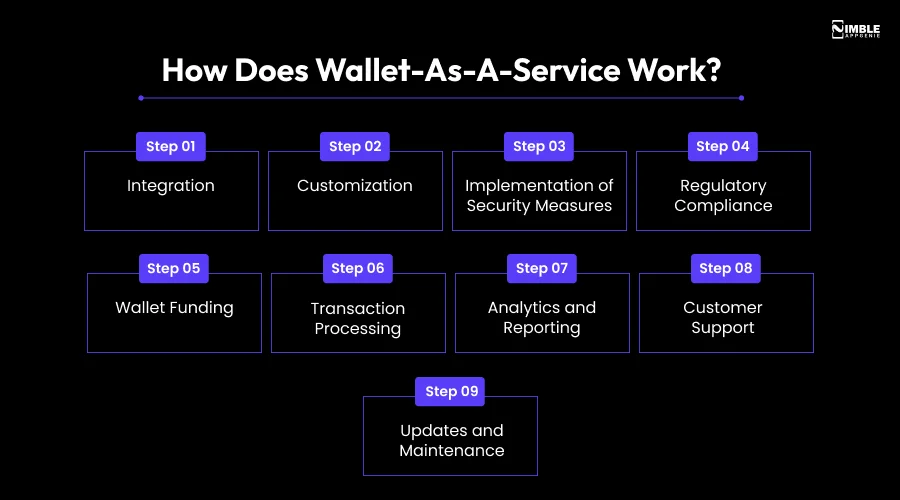
Step 1: Integration
The first step for any business adopting WaaS is to integrate the WaaS provider’s API or SDK into its existing systems.
This is a crucial phase where technical compatibility and functionality are established.
This involves setting up communication protocols that will allow the business applications to interact seamlessly with the WaaS platform.
Step 2: Customization
Once the integration is complete, businesses can proceed to customize the look and feel of the wallet to align with their brand identity.
Wallet-as-a-Service platforms are typically designed with flexibility in mind, allowing for a high degree of personalization.
This might include tweaking the user interface, setting up the wallet’s features, and localizing the content for different markets.
Step 3: Implementation of Security Measures
The WaaS provider implements robust security measures.
This includes data encryption, two-factor authentication, and regular security audits.
These measures are designed to protect against unauthorized access and financial fraud, providing peace of mind for both the business and its end-users.
Step 4: Regulatory Compliance
In tandem with the security implementation, WaaS providers ensure that the wallet complies with the relevant financial regulations and standards.
This can vary from region to region.
The fintech compliance is ongoing, with the WaaS provider keeping abreast of and adapting to any changes in the regulatory landscape.
Step 5: Wallet Funding
The business’s customers can now begin funding their wallets.
This can be done through various methods such as credit/debit card payments, bank transfers, or even cash deposits at designated points.
The digital wallet as a service platform manages the complexities involved in processing these transactions.
Step 6: Transaction Processing
Once funded, customers can use the wallet to make payments, transfer money, and perform other financial transactions.
The WaaS platform handles transaction processing, ensuring that transactions are completed quickly and securely.
Step 7: Analytics and Reporting
The WaaS platform provides businesses with detailed analytics and reporting tools.
These tools allow businesses to monitor transaction volumes, user behavior, and other key metrics, which can be used to inform business decisions and improve the service.
Step 8: Customer Support
WaaS providers typically offer customer support services as part of their packages.
This can range from technical support for the business to user support for the end customer, dealing with any issues that arise in the use of the wallet.
Step 9: Updates and Maintenance
The WaaS provider is responsible for the ongoing maintenance and updates of the wallet platform.
This includes adding new features, updating security measures, and ensuring the platform remains operational and efficient.
After all these steps are completed, you have an optimized wallet as a service solution, ready to be used by your users.
Keep in mind that this implementation brings along several features for both your users and your business. What are these features? Let’s find out in the next section!
What Are the Key Features of Wallet-as-a-Service?
The key features of Wallet-as-a-Service include secure digital wallet infrastructure, multi-currency support, payment processing, KYC/AML compliance, APIs and SDKs, transaction management, fraud prevention, and real-time reporting.
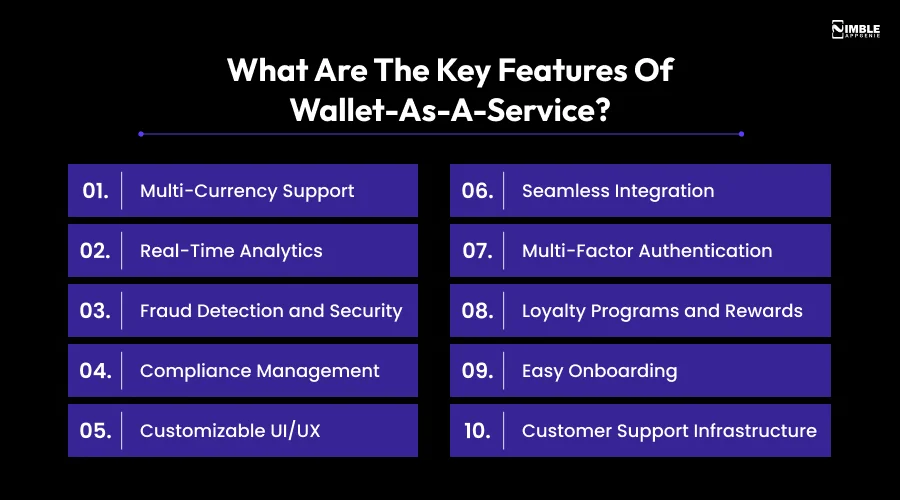
1. Multi-Currency Support
Support for major world currencies and digital currencies, including cryptocurrencies, lets businesses meet the needs of a global audience and cross-border activity.
2. Real-Time Analytics
Comprehensive dashboards offer insights into user engagement, transaction volumes, growth metrics, marketing strategy, and trends.
3. Fraud Detection and Security
A strong, real-time fraud detection system using machine learning to flag suspicious activity and reduce risk.
4. Compliance Management
Adherence to legal frameworks such as KYC and AML directives and PCI DSS, with the provider staying updated on regulatory changes.
5. Customizable UI/UX
A highly customizable interface reflects the business’s branding and design philosophy, from color schemes to the full user journey.
6. Seamless Integration
APIs for CRM systems, e-commerce platforms, and other financial services, creating a unified experience for the user and business.
7. Multi-Factor Authentication
MFA options, including biometric authentication and SMS verification, add a crucial security layer. Our full eWallet security guide covers exactly what any wallet provider, custom or WaaS, must have in place.
8. Loyalty Programs and Rewards
Integration of loyalty programs and rewards, letting users earn and redeem points directly through their wallet.
9. Easy Onboarding
An intuitive onboarding process, including a streamlined KYC flow to reduce friction for new users.
10. Customer Support Infrastructure
In-app messaging, chatbots, and a dedicated live service offering users access to help when they encounter wallet problems.
How Do You Choose the Right Wallet-as-a-Service Provider?
To choose the right Wallet-as-a-Service (WaaS) provider, evaluate its compliance capabilities, security, payment and currency support, API flexibility, integration options, scalability, customer support, and pricing against your business requirements.
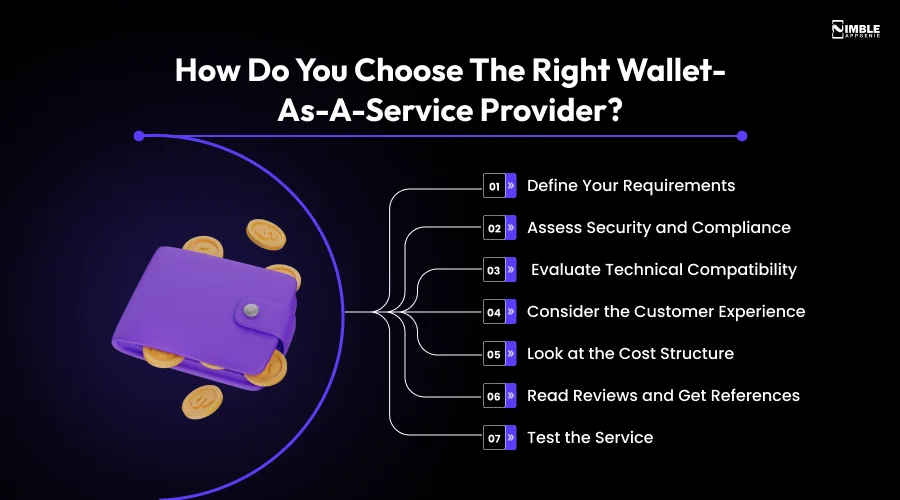
1. Define Your Requirements
Before you start comparing providers, it’s important to understand your own needs. Consider the following:
- Transaction Volume: Estimate the number of transactions you expect to process.
- Market Reach: Determine if you need a provider with a global or regional focus.
- Currencies: Decide which currencies you need to support, including any cryptocurrencies.
- Compliance Needs: Understand the regulatory requirements of the markets you operate in.
- Technological Capabilities: Assess the level of technology integration required for your service.
2. Assess Security and Compliance
Given the sensitive nature of financial services, prioritize providers with robust security protocols and a strong track record of compliance.
- Security Standards: Look for providers that adhere to top industry security standards like PCI DSS.
- Regulatory Track Record: Check if the provider has a history of regulatory issues.
- Data Privacy: Ensure their data privacy policies align with your business standards and the jurisdictions you operate in.
3. Evaluate Technical Compatibility
The WaaS provider you choose should seamlessly integrate with your existing systems tech stack.
- API and SDK Quality: Test the ease of integration of their APIs and SDKs.
- Customization: Make sure the level of customization offered matches your branding requirements.
- Scalability: Ensure the provider’s platform can scale with your business growth.
4. Consider the Customer Experience
Your customers’ interaction with the WaaS platform directly affects their perception of your brand.
- User Interface: Choose a provider with a user-friendly and intuitive interface.
- Support Services: Look at the provider’s customer support services and determine if they meet your standards.
- Onboarding Process: A streamlined onboarding process for your users is essential for adoption.
5. Look at the Cost Structure
Examine the pricing models of various WaaS providers and how they align with your business model.
- Subscription Fees: Assess the monthly or annual costs and what they include.
- Transaction Fees: Understand the fees per transaction and how they might scale.
- Additional Costs: Consider any setup fees, customization costs, or other potential charges.
6. Read Reviews and Get References
Research what other businesses say about the providers you’re considering.
- Customer Reviews: Look for reviews from businesses similar to yours.
- Case Studies: Request case studies or references from the provider to better understand their track record.
7. Test the Service
If possible, engage in a trial period to see how well the service integrates with your operations and meets your expectations.
- Pilot Program: Run a pilot program to get firsthand experience of the provider’s service.
- Support Response: Evaluate the responsiveness and effectiveness of the provider’s support team during the trial.
Should You Choose Wallet-as-a-Service or Custom eWallet Development?
Choose Wallet-as-a-Service (WaaS) if you need lower upfront costs, faster deployment, and ready-made wallet infrastructure. Choose custom eWallet development if you need complete control over user experience, features, the underlying technology, and integrations, and can accommodate higher costs and a longer development timeline. Here’s the direct comparison:
| Aspect | WaaS | Custom eWallet Development |
| Initial Cost | Lower | Higher |
| Time to Market | Faster | Slower |
| Customization | Limited | Extensive |
| Branding | Standard, with some customization | Fully branded |
| Security & Compliance | Handled by the provider | Must be handled in-house or outsourced |
| Scalability | Highly scalable | Scalable, depending on initial build quality |
| Maintenance | Provider’s responsibility | Business’s responsibility |
| Control Over Data | Shared with the provider | Exclusive to the business |
| Market Differentiation | Limited | High |
| Ongoing Costs | Subscription and transaction fees | Varies based on maintenance |
Advantages of WaaS
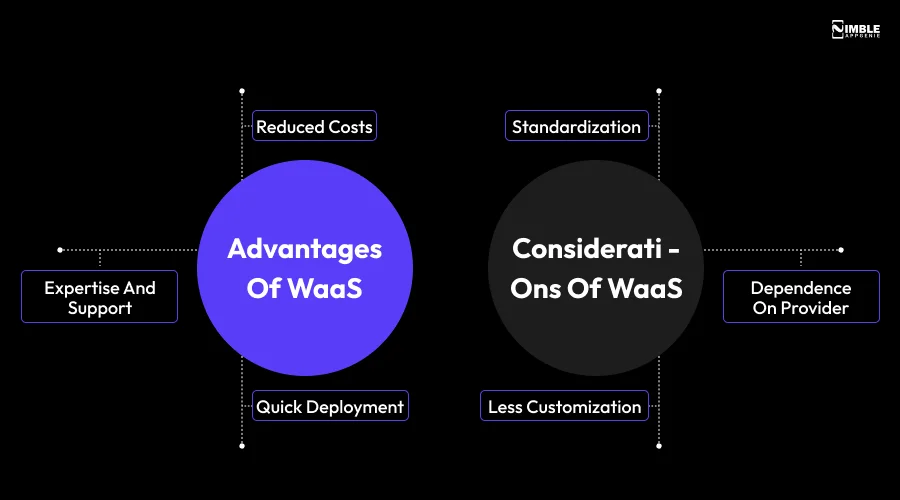
- Reduced Costs: Eliminates substantial upfront investment and ongoing maintenance costs.
- Quick Deployment: WaaS can be integrated and launched comparatively quickly.
- Expertise and Support: WaaS providers bring specialized security and compliance knowledge.
Considerations
- Dependence on Provider: The business’s service depends on the WaaS provider’s stability and performance.
- Less Customization: WaaS customization generally doesn’t match what a custom solution can offer.
- Standardization: Features may be standardized and shared with competitors using the same provider.
Nimble AppGenie Is Here to Help You
Nimble AppGenie has extensive experience in eWallet app development and guides businesses through the WaaS-versus-custom decision-making process.
Nimble AppGenie’s expertise spans custom eWallet solutions and integration of Wallet-as-a-Service platforms. The e-wallet app development company helps clients meet their specific needs, weigh the trade-offs, and choose the approach that aligns with their business goals.
Whether a business needs a unique, completely branded solution or a quick-to-market WaaS integration, Nimble AppGenie’s team delivers either path, ensuring the resulting eWallet is compliant, secure, user-friendly, and built for expansion in the digital payment ecosystem.
Conclusion
In a world where digital transformation is not just an advantage but a necessity, Wallet-as-a-Service emerges as a key facilitator for businesses eager to streamline their financial transactions.
Businesses from across the globe, be it a financial institution or any other business, can utilise wallet-as-a-service and make the most of it without having to spend a lot.
The whole experience depends on what kind of service provider you choose or delegate the task to. Make your decision wisely, and the rest will automatically fall into place. With that said, we have reached the end of this post.
FAQs
Wallet-as-a-Service (WaaS) is a cloud-based platform that allows businesses to offer digital wallet functionalities without building their own system.
WaaS providers typically employ rigorous security protocols, including encryption, fraud detection, and compliance with global standards.
Yes, WaaS solutions are designed to scale easily, accommodating growing transaction volumes and user bases.
WaaS providers offer APIs and SDKs for integration with various business systems and applications.
While WaaS solutions provide customization options for branding and functionality, they may not be as extensive as custom-built solutions.
WaaS typically offers quicker deployment, lower upfront costs, and reduced need for in-house expertise in maintenance and security.
Consider your specific needs, required features, budget, target market, and the provider’s track record, security, and compliance standards.
Yes, businesses can start with a WaaS and transition to a custom solution as they scale and require more tailored features.
WaaS providers generally handle compliance with financial regulations, which can significantly ease the burden on businesses.
A good WaaS solution enhances the customer experience by providing a secure, fast, and smooth transaction process.

Niketan Sharma, CTO, Nimble AppGenie, is a tech enthusiast with more than a decade of experience in delivering high-value solutions that allow a brand to penetrate the market easily. With a strong hold on mobile app development, he is actively working to help businesses identify the potential of digital transformation by sharing insightful statistics, guides & blogs.
Table of Contents




No Comments
Comments are closed.