


Your website or app is the first impression customers get of your business. Just think of a potential customer visiting your website, but it is slow, cluttered, or hard to navigate. Chances are, they will leave and might never come back. That’s a problem many businesses face today.
But the good news is? The right front-end technology can solve this. Frontend tools and frameworks control everything users see and interact with.
When you choose it correctly, these technologies make your website or app fast, responsive, and easy to use. This doesn’t just improve the user experience. It builds trust in your brand and can increase conversions.
But what are these frontend technologies? Well, this guide will discuss the 15 top frontend technologies to use in 2026, explain what they do, and show you how to choose the right tools for your business goals.
What are Frontend Technologies?
Let’s understand this in simple terms. Frontend technologies are the tools and frameworks mainly used to develop everything your users see and interact with in your website or app. They design the look, feel, and performance of your website and control both the design and functionality.
These technologies handle :
- Layout and design
- Interactive elements
- Performance
- User experience
For businesses, frontend technologies are not just a technical mobile app tech stack. They are strategic assets. A clean, modern, and fast frontend improves user experience and keeps visitors engaged, builds credibility and trust in your brand.
Additionally, it boosts conversions by making actions like purchases or sign-ups easier. In short, front-end technologies are the face of your business online.
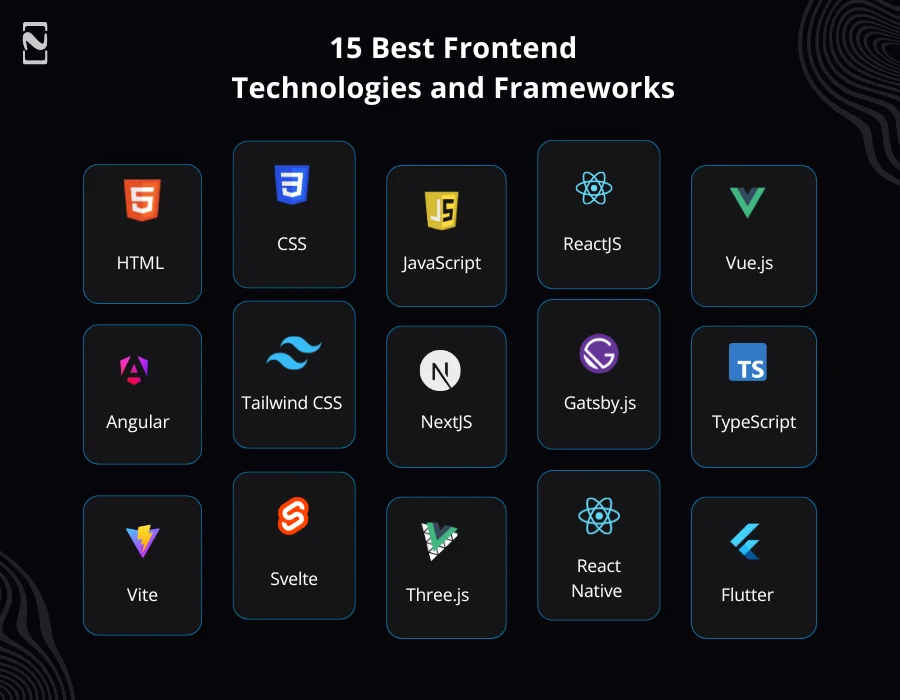
15 Best Frontend Technologies and Frameworks
Picking the right frontend technology is more than a technical decision. It is a business decision. The tools you use shape how fast, reliable, and engaging your website or app is. In 2026, there are a plethora of options available, each with pros for different business requirements.
Let’s take a look at the top frontend technologies to consider:
1. HTML
HTML is also known as HyperText Markup Language. It is one of the top frontend technologies that forms the backbone of every website and web app. It creates a structure of your content, like headings, paragraphs, images, buttons, forms, and links.
Without HTML, your web page would have no structure or organization. For businesses that are looking to develop a website, a clean and well-organized HTML is vital for SEO, accessibility, and consistent display on every device.
It also ensures that search engines can index your content more effectively. Also, it ensures improving visibility and drives more potential customers.
Moreover, HTML works smoothly with CSS and JavaScript to create interactive, visually appealing websites. This helps to boost user experience, build up brand credibility, and raise engagement.
Key Features :
- Structures and organizes web page content
- Compatible with all devices and browsers
- Improves accessibility for screen readers and assistive tools
- SEO-friendly markup for better search rankings
2. CSS
Another common frontend technology is CSS. This controls the layout and style of the web content. Basically, CSS is responsible for the visual appearance of your website. It manages colours, typography, layout, and responsiveness, which allows your website to adapt to all devices.
CSS is more than design. It communicates brand identity. Consistent styling builds trust and makes sure users have a good experience. CSS works along with HTML to create clean, professional, and engaging interfaces.
With responsive CSS, your website adapts to desktops, tablets, and smartphones to keep customers satisfied and reduce bounce rates. A well-organized CSS makes maintenance easier, saving your mobile app development time and resources while ensuring an intuitive online presence.
Key Features :
- Control colours, fonts, and layouts
- Ensures responsive design on all devices
- Easy maintenance and updates
- Supports animations and visual effects
- Boost brand consistency
3. JavaScript
JavaScript adds life to your website. It is a programming language that brings web pages to life. It allows interactivity, dynamic content updates, animations, and real-time features like chatbots or live feeds.
JavaScript is essential for creating engaging websites that keep users engaged. No matter if it’s a product carousel, interactive forms, or personalized user experiences, JavaScript allows companies to deliver smooth functionality without slowing down the website.
If you combine JavaScript with HTML and CSS, you can create responsive, interactive applications that boost user engagement and improve conversions. Its versatility makes it suitable for everything from small websites to complex enterprise platforms.
Key Features :
- Support animation and dynamic content
- Adds interactivity to web pages
- Works on browsers and devices
- Enhances user experience and engagement
- Integrates with frameworks like React, Angular, and Vue
4. ReactJS
React.js is a JavaScript library for building scalable and interactive user interfaces. It allows developers to create dynamic pages efficiently by using reusable components.
Additionally, its virtual DOM technology improves performance by updating only the parts of the page that have changed. This results in seamless navigation and faster load times. Also, React has a very large developer community.
This means reliable support, frequent updates, and a rich ecosystem of technologies. A web development team can create dashboards, single-page apps, or interactive web platforms that benefit from its flexibility and performance.
Key Features :
- Develop reusable UI components
- Component-based architecture
- Strong community support
- Best for dynamic, interactive UI
- High performance with virtual DOM
5. Vue.js
VueJS is one of the top frontend technologies for developing dynamic and visually appealing applications. It is a progressive JavaScript framework designed for creating user interfaces efficiently.
Besides, its gentle learning curve makes it best for businesses that seek fast web development with a minimum budget. Vue’s reactive data binding ensures that changes in data are reflected instantly in the UI. This improves the user experience.
It offers flexibility, scalability, and a balance between simplicity and power. Its ecosystem covers supporting tools for routing, state management, and testing.
This assistant team is to deliver consistent and high-performance applications. VueJS is best for smaller projects or those requiring quick iterations. This allows businesses to bring ideas to market faster.
Key Features :
- Lightweight and fast framework
- Flexible and easy to integrate
- Best for small to medium projects
- Integrates with existing projects
6. Angular
Angular is a comprehensive JavaScript framework developed by Google for creating large-scale, feature-rich mobile applications. It provides built-in tools for routing, forms, HTTP requests, and testing, which reduces the need for third-party libraries.
You can choose Angular for your enterprise-level projects due to its scalability, maintainability, and structured architecture. With TypeScript integration, Angular offers type safety. This reduces bugs and improves long-term reliability.
Additionally, its modular design enables dedicated development teams to work on large projects collaboratively without conflicts. If you are using Angular, you can manage complex platforms like dashboards, CRMs, or CMS while ensuring consistent performance and long-term growth.
Key Features :
- It offers built-in tools
- TypeScript support for error reduction
- Scalable architecture for large projects
- Built-in tools for routing and forms
- Modular and maintainable code

7. Tailwind CSS
Tailwind CSS is a utility-first framework that streamlines front-end design by providing ready-to-use classes. Instead of writing custom CSS for each project, mobile app developers can instantly apply prebuilt styles to create responsive, consistent designs.
This frontend technology reduces development time and ensures an intuitive look on multiple pages and products. It also simplifies maintenance. This makes it a lot easier to update designs without breaking functionality.
Tailwind’s approach allows teams to prototype faster and focus on functionality while maintaining brand consistency. Many companies choose Tailwind to develop a mobile app. They benefit from shorter development cycles, lower costs, and the ability to scale their projects efficiently.
Key Features :
- Utility-first CSS framework
- Rapid prototyping
- Consistent design across projects
- Responsive and adaptive layouts
- Reduces maintenance complexity
8. NextJS
Next.js is a React framework that makes websites faster to optimize for search engines. It offers server-side rendering and static website generation. This improves loading speed and visibility on Google.
Additionally, this means a better user experience, higher rankings, and increased traffic. Next.js also supports scalable applications, which makes it suitable for both startups and large enterprises.
Its built-in routing, API support, and easy integration with popular tools, allow a mobile app development team to work efficiently and deliver reliable web solutions. By using Next.js, you can launch websites that load quickly and perform well under heavy user traffic.
Key Features :
- Server-side rendering for speed
- Static site generation for SEO
- Easy routing and API integration
- Scalable for small and large apps
- Optimized performance for user experience
9. Gatsby.js
Gatsby.js is one of the best frontend technologies for creating websites. It is also a React-based framework that preloads content and makes pages load faster for users. It improves SEO and provides amazing website speed, which makes it a popular choice among businesses.
It also works great for content-heavy websites like blogs, e-commerce stores, or marketing platforms. Also, Gatsby supports plugins and API integrations that make it easy to connect to CMSs, databases, and third-party services.
It facilitates reliability, speed, and better search rankings that help in attracting and retaining users. It also reduces development time and maintenance complexity.
Key Features :
- Preload content for instant page load
- Optimized for SEO
- Works well with CMSs and databases
- Fast and reliable performance
- Plugin ecosystem for added functionality
10. TypeScript
TypeScript is a superset of JavaScript that adds types to your code. It is among the top frontend technologies that help front-end developers catch errors before they happen. This means fewer errors, easier maintenance, and more reliable applications.
It’s particularly useful for large projects with multiple developers, where code consistency is essential. TypeScript works seamlessly with frameworks like React, Angular, and Vue. This makes it flexible for different projects.
Companies benefit from better code quality, smoother collaboration, and long-term stability. Using TypeScript can save time and reduce cost to develop a mobile app by minimizing debugging and ensuring applications perform correctly for customers.
Key Features :
- Adds type safety to JavaScript
- Reduces runtime errors
- Supports large, complex projects
- Compatible with popular frameworks
- Improves maintainability and collaboration
11. Vite
Vite is a modern front-end technology that focuses on speed and simplicity. It provides instant updates during development. This allows developers to see changes in real-time. This means faster project delivery and more efficient workflows.
Vite also reduces build times, which saves teams valuable time during releases. It works well with modern frameworks like Vue, React, and Svelte that offer flexibility for different projects.
Using Vite helps web developers to launch products quickly, maintain a smooth development process, and keep development costs under control while ensuring high-quality results.
Key Features :
- Fast build times
- Real-time updates during development
- Supports multiple frameworks
- Simplifies project setup and management
- Speeds up delivery for businesses
12. Svelte
Svelte is a modern front-end framework that compiles code into highly efficient JavaScript that produces lightweight and fast applications. Unlike other mobile app development frameworks, it does not depend on a virtual DOM.
This improves performance and reduces code complexity. Svelte means quicker load times, smaller bundle sizes, and a better user experience. It is ideal for projects where speed and efficiency are essential.
Svelte’s simplicity allows developers to build interactive apps faster. This makes it suitable for startups and companies that want to move quickly without sacrificing quality or performance.
Key Features :
- Compiles into lightweight, fast code
- No virtual DOM, better performance
- Smaller bundle sizes
- Simplifies development and maintenance
- Great for startups and performance-focused projects
13. Three.js
Three.js is a JavaScript library used to create 3D graphics in the browser. It allows developers to build interactive product demos, visualizations, and immersive experiences.
It helps showcase products or mobile app ideas in a more engaging way to improve customer understanding and interaction. Additionally, it can be used for e-commerce, architecture, gaming, and marketing campaigns.
With Three.js, developers can create a website that stands out by providing unique, memorable experiences to increase engagement and conversion rates. It is a great technology for brands looking to innovate and impress users.
Key Features :
- Builds 3D graphics and animations
- Supports interactive experiences
- Works in modern browsers
- Enhances engagement and conversion
- Great for product demos and visual storytelling
14. React Native
React Native is one of the widely used frontend technologies that allows developers to build mobile applications for iOS and Android using the same skills as web frontend development.
This reduces costs and development time, as one codebase works across platforms. React Native for mobile app development feels native, offering seamless performance and a consistent user experience.
Developers can release mobile apps faster, update them efficiently, and maintain feature parity across devices. It’s ideal for startups and growing businesses looking to reach mobile users without investing in separate development teams for each platform.
Key Features :
- Single codebase for iOS and Android
- Near-native performance
- Faster development and updates
- Reusable components
- Cost-effective mobile app solution
15. Flutter
Flutter is Google’s UI toolkit for building cross-platform apps from a single codebase. It allows businesses to create mobile, web, and desktop applications with a consistent design and performance.
Flutter’s customizable widgets help deliver smooth, visually appealing interfaces. For companies, it reduces development and maintenance costs while speeding up time-to-market.
Flutter is particularly useful for startups and businesses that need to reach multiple platforms quickly without sacrificing quality. Its strong community and regular updates ensure reliability and long-term support for business applications.
Key Features :
- Single codebase for multiple platforms
- Fast and smooth UI with widgets
- Consistent design on every device
- Reduces development and maintenance costs
- Strong community support

Consult Nimble AppGenie to Choose and Build a Smart Platform
Picking the right technology for your platform is a major step. It decides how seamless your mobile app runs, how safe user data is, and how easily the platform can scale. If you make the wrong choice, it can slow things down later.
At Nimble AppGenie, we make this process really easy. As a leading mobile app development company, we carefully listen to your project ideas, understand your goals, and review your technical requirements before suggesting the best frontend technologies.
Additionally, our work does not stop at recommendations. We assist you in designing strong systems, developing secure platforms, and offering ongoing support to keep everything running smoothly over time.
When you collaborate with Nimble AppGenie, you are choosing a long-term technology partner who is committed to building a reliable solution that supports your success.
Conclusion
Frontend technologies play a major role in how customers see and interact with your business. From website or mobile app speed and design to usability and performance, the frontend tools shape the entire user experience.
In 2026, businesses that invest in the right frontend technologies will be better positioned to attract users, build trust, and stay competitive. There is no one-size-fits-all solution. Some businesses need speed and SEO, others need scalability or cross-platform reach.
The main thing is to understand your goals and choose the correct technologies that align with your project requirements. When done right, a strong frontend doesn’t just look good. It supports growth, improves engagement, and boosts real business outcomes.
FAQs

Niketan Sharma, CTO, Nimble AppGenie, is a tech enthusiast with more than a decade of experience in delivering high-value solutions that allow a brand to penetrate the market easily. With a strong hold on mobile app development, he is actively working to help businesses identify the potential of digital transformation by sharing insightful statistics, guides & blogs.
Table of Contents
No Comments
Comments are closed.