

 Free Consultation
 PCI-DSS Compliant
 GDPR Ready
 ISO 27001
 NDA Protected
 AI Services
 AI App Development
 Generative AI Development
 AI Chatbot Development
 AI Integration Services
 AI Consulting Services
 AI For Fintech
 AI Financial Assistant Solution
 AI Insurance Agent Development
 Tech Stack
 OpenAI / GPT-4
 Claude / Anthropic
 Gemini / Google AI
 Llama / Open Source
 LangChain / LlamaIndex
 Pinecone / Pgvector
 AWS / Azure AI


 Fintech Solution
 Core Fintech
 App Development
 Neobank Solutions
 eWallet Solutions
 Lending Software
 Banking Solutions
 BNPL Solutions
 BNPL Solutions
 Insurance App
 Wealth Management
 Crypto & DeFi
 Blockchain Development
  Payroll Software
 DeFi Solutions
 Crypto Wallet
 Crypto On/Off Ramp
 Crypto Exchange
 Trading Platform
 Payments
 Compliance
 Regulations & Compliance
 Fraud Detection
 Lending Ecosystem
 P2P Lending Platform
 Mortgage Software
 Engagement
 Fintech Outsourcing

 Mobile Development
 Mobile App Dev
 iOS App Development
 Android App Development
 React Native
 Flutter Development
 Web Solution
 Node.js Development
 React.js Development
 Angular Development
 App Services
 UI/UX Design
 App Maintenance
 By Stage
 MVP Development
 Industry Solutions
 Healthcare App Dev
 Education App Dev
 Travel App Dev
 Real Estate App Dev
 Logistics Software
 Social Media App

 Hire Mobile Developers
 Hire iPhone Developers
 Hire Android Developers
 Hire React Native Devs
 Hire Flutter Developers
 Hire Web Developers
 Hire Node.js Developers
 Hire Angular Developers
 Hire PHP Developers
 Hire Laravel Developers
 How It Works
 Pre-Vetted Developers
 Ready In 48 Hours
 NDA From Day One
 Replace Guarantee
 Company
 About Us
 Our Work Process
 Portfolio
 Case Studies
 Blog / Insights
 Careers
 Contact Us
 Awards
 Recognition


 Offices


React Native for mobile app development has become one of the most popular choices for businesses that want to build Android and iOS apps without maintaining two separate codebases.
With a single JavaScript codebase, developers can create apps for both platforms, helping businesses reduce development time, simplify maintenance, and launch updates faster.
This is why companies like Meta, Walmart, and Shopify use React Native for parts of their mobile app development. However, React Native isn’t the right choice for every project. Its performance, flexibility, and development experience depend on your app’s requirements.
In this blog, we will cover what React Native is, its real pros and cons, when to use it for building a mobile app, and how its 2026 architecture update changes the performance picture, so you can decide with confidence whether it’s the right fit for your project.
What is React Native?
React Native is an open-source framework that allows you to build mobile apps using JavaScript, the same language used to make websites. But instead of making websites, you’re making real React mobile applications that work on iPhones and Android phones.
However, what’s cool about React Native is that you can write one set of code, and it works on both platforms. So you don’t need to build two separate apps for Android and iOS.
But React Native only develops mobile apps. That means your app does not run in a web view. It actually uses native components. So, it looks and feels just like a regular app developed with Swift or Kotlin.
That’s one of the main reasons developers choose it when they want to build a React Native app that looks and performs like a fully native mobile experience, but with less time and effort.
Where Does React Native Stand in the App Market Today?
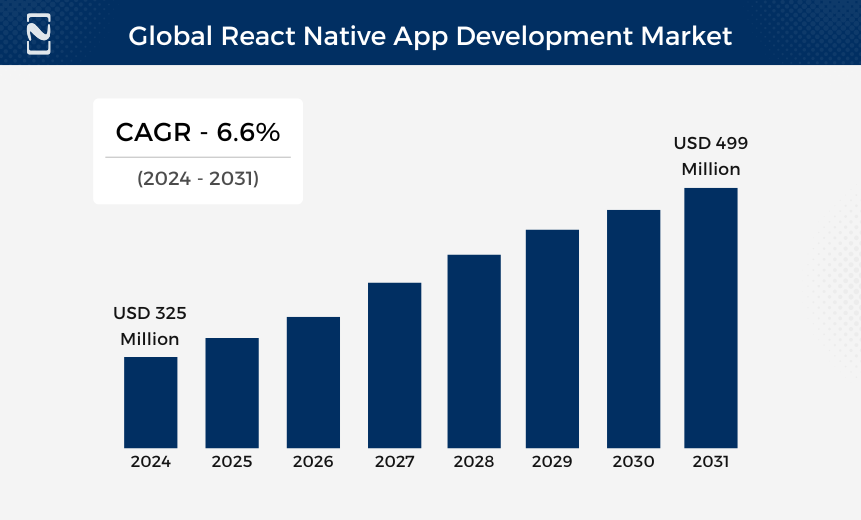
The global market for React Native was worth $325 million in 2024. It’s expected to grow to $350 million in 2025 and reach $499 million by 2031. This means it will grow at an average rate of about 6.6% each year during this time.
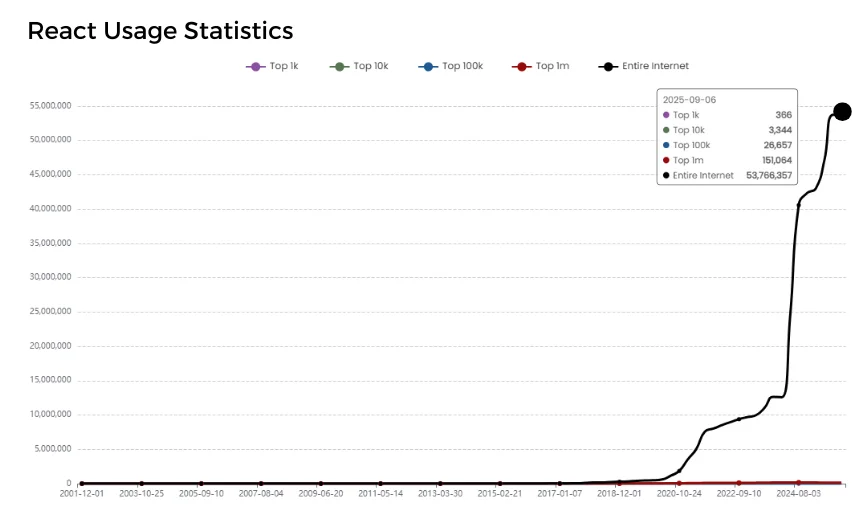
More and more businesses are using React Native to create a mobile app. This helps them save 40-50% on development costs compared to older methods. In the United States, about 2,979,341 websites are using React.
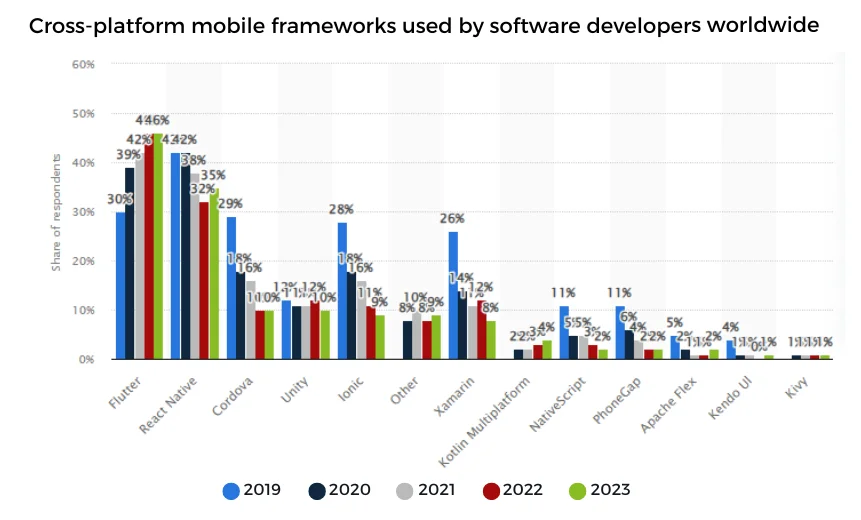
According to research by Statista, 38% of software engineers use React Native. Out of the top 500 apps in the United States, approximately 14.85% are developed using React Native.
Benefits of React Native for Mobile App Development
React Native is one of the most popular frameworks for building iOS and Android apps from a single codebase. Here’s what makes it worth considering.
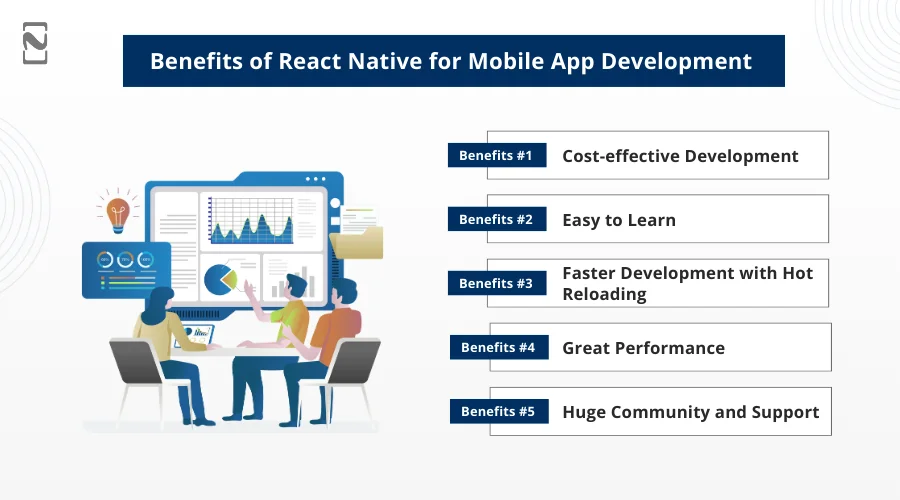
1. Cost-Effective Development
React Native cuts mobile app development costs by roughly 30-50% because one codebase replaces two. Traditionally, an app for both iOS and Android meant writing separate code for each platform, doubling the work and doubling the cost.
With React Native, you write the code once, and it runs on both platforms. This majorly lowers your project budget and timeline, making it a strong fit for startups and businesses working with limited funding.
2. Easy to Learn
Developers who already know JavaScript can become productive in React Native within days, not months. They lean on their existing web development knowledge to get up to speed quickly.
The component-based approach also makes code easier to manage and reuse, smoothing the learning curve compared to other mobile app development frameworks.
3. Faster Development with Hot Reloading
Hot reloading allows developers to see code changes in the running app instantly, without rebuilding from scratch. This speeds up the testing and tweaking process considerably. If you need to launch quickly or ship frequent updates, this is a real advantage.
4. Great Performance
React Native apps run close to native speed because they render with real native UI components, not a web view. It is not quite as fast as fully native code, but it can access device features like the camera, GPS, and built-in sensors directly.
With well-optimized code and, increasingly, the new architecture covered below, the resulting app’s performance matches native apps closely in most everyday use cases.
5. Huge Community and Support
React Native is maintained by Meta and backed by one of the largest open-source communities in mobile development. That means tutorials, forums, and pre-built libraries are widely available, so you run into an issue.
Since major brands like Instagram also build on it, the framework is continuously updated with new features and fixes.
React Native’s New Architecture: What Changed in 2026
If the last thing you read about this framework mentioned laggy scrolling or a slow bridge, that’s out of date. Starting with React Native 0.76, the new architecture became the default, and by 2026, it will be the standard on which most development apps are built.
The new architecture is built on three pieces working together.
► JSI (JavaScript Interface)
It replaces the old JSON-based bridge, allowing JavaScript to call native code directly and synchronously instead of serializing every call.
► Fabric
The new rendering engine was developed for smoother animations and better support for React’s concurrent rendering features.
► YurboModules
The native modules now load only when the app actually needs them, instead of all loading at startup, which shortens cold-start time.
In practice, teams migrating production apps to the new architecture have reported faster cold-start times, smoother list rendering, and lower memory usage compared to the legacy bridge.
Although the exact gains vary by app and depend on how many native modules it relies on. Simpler apps with few native calls see a smaller difference than apps doing heavy camera, animation, or Bluetooth work.
What this means if you are evaluating this framework in 2026: Its biggest historical weakness, the performance gap versus fully native apps, has narrowed considerably.
It is also why the core ecosystem now supports the new architecture by default, so new projects get these benefits automatically without extra configuration.
Real-World Examples of Apps Built With React Native
Here’s a handpicked list of the most popular mobile apps built with React Native. These examples show how businesses are using it to work smarter, create better user experiences, and grow their presence online.
1. Bloomberg
Bloomberg used React Native to develop their mobile app, where people read news and check the latest market updates. It helped them make the app work smoothly on both iPhone and Android phones without developing everything twice.
2. Facebook
Facebook created React Native, so they also use it in their mobile application. One example is the ads section, where people can create and manage ads. It works well across both types of mobile phones.
3. Walmart
Walmart did not want two different teams for iPhone and Android. So they used React Native to make one app that works on both. It saved time and made updates very easy.
4. Uber Eats
Uber Eats has a part of the application just for restaurants. That section was built with React Native, so it is quicker for them to fix bugs or add new features.
5. Pinterest
Pinterest tested React Native to develop just for restaurants. That section was created with React Native, so it is faster for them to fix errors or add new features in the app.
When to Use React Native for Mobile App Development?
Let’s look at the best situations for using React Native to build mobile apps, helping businesses decide when it’s the right choice to save time and expand their reach.
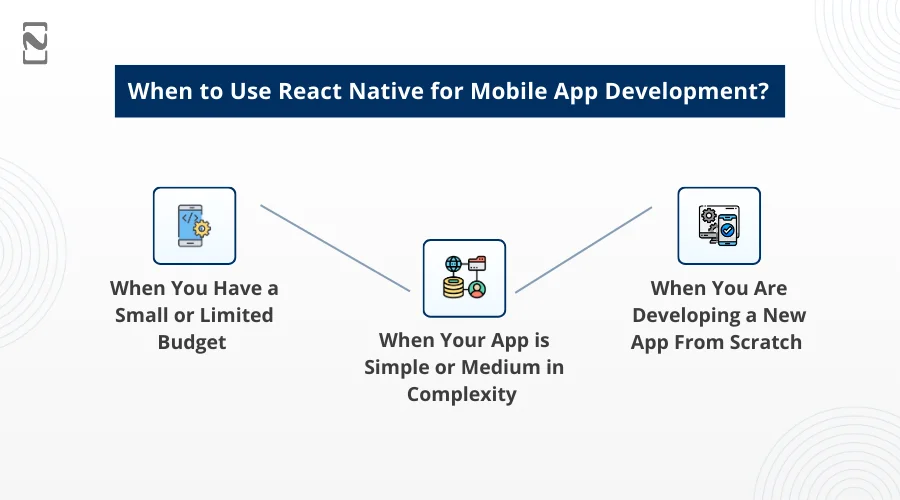
➤ When You Have a Small or Limited Budget
If you are working with a limited budget and can not afford to hire separate developers for Android and iOS, React Native is a great choice.
You only need to build your app once, and it will work on both platforms. It really saves your time and reduces mobile app development costs. It also helps you launch your app faster.
➤ When Your App is Simple or Medium in Complexity
React Native works really well if your mobile app development with React technology is not too complicated. It is perfect for react native mobile apps with basic or medium features.
You can reuse a lot of code, which saves time and effort. This makes react native for mobile app development faster and less expensive. It is best when you are not adding any advanced features.
➤ When You Are Developing a New App From Scratch
React Native is the best choice when you are starting from scratch with new React project ideas for apps. It’s flexible and easy to work with right from the beginning.
But if you’re trying to mix it into an app that already exists, it might cause issues or make the app harder to manage later.
React Native vs Flutter: A Full Comparison
Now that you know when to use react native for mobile app development, it is time to see which framework is better: Flutter vs React Native for your project.
Check out the comparison table below:
| Aspect | React Native | Flutter |
| What It Is | Framework by Facebook for mobile app development with react native with JavaScript and React | UI toolkit from Google for building apps with Dart |
| Programming Language | JavaScript (or TypeScript) | Dart |
| Performance | Slightly slower due to the JavaScript bridge | Faster due to direct compilation to native code |
| UI & Design | Uses native components, so apps look platform-specific | Uses custom widgets, offering a consistent look across platforms |
| Learning Curve | Easier for JavaScript/React developers | Steeper due to Dart and new framework |
| Ecosystem & Libraries | Larger ecosystem with more third-party libraries | Growing ecosystem, but fewer libraries than React Native |
| Community & Support | Larger community with extensive resources | Growing community, strong support from Google |
| Popularity & Job Market | Highly popular with many job opportunities (e.g., Facebook, Instagram) | Gaining popularity, especially for high-performance apps |
Is React Native Good For Your Project?
Are you still not sure if React Native is the right fit for your project?
Well, let’s take a look at how it can help you out:
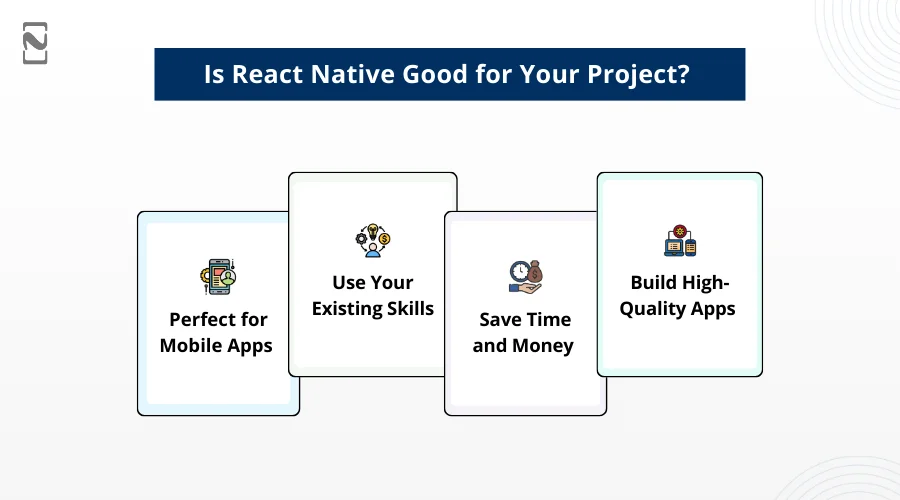
1] Perfect For Mobile Apps
React Native allows you to create smooth, interactive mobile apps that deliver a top-notch experience on both iOS and Android. While React Native focuses on mobile, React DOM is designed for web apps, with each framework tailored to its platform’s needs.
2] Use Your Existing Skills
Since React Native is based on JavaScript, your developers would not need much time to pick it up. And since it is open-source, there is a large community of mobile app developers with the required skills for support.
3] Save Time and Money
If you are creating a mobile app for both iOS and Android, React Native can reduce your code by about 95%, saving you tons of time and money. There are also plenty of open-source libraries and pre-built components to speed up your react native for mobile app development.
4] Build High-Quality Apps
React Native ensures a fast, responsive, and slick user interface. It is cheaper and faster to develop compared to native apps. Also, you do not have to sacrifice quality or functionality in react native for app development.
Why Choose Nimble AppGenie for Developing Apps in React Native?
When it comes to React Native app development services, Nimble AppGenie stands out for its strong focus on quality, delivery time, and business impact. We do not just create mobile apps. We develop real mobile solutions that solve problems and bring your ideas to life.
We understand that the cost to hire React Native app developers can be a major concern for startups and growing businesses. That’s why we offer flexible engagement models to fit your budget, without compromising on quality or performance.
From startups with limited budgets to enterprises that need scalable apps, we tailor each project to meet your objectives. No matter if you are starting from scratch or rebuilding an existing app, Nimble AppGenie delivers reliable React Native mobile development that assists you in launching faster and reducing costs.
Conclusion
React Native is the best choice for developing a fast and cost-effective app for both Android and iOS. It helps businesses launch a React Native cross-platform app quickly without requiring two separate apps.
But to get the best results, it is vital to plan carefully and know the mobile app development mistakes to avoid. With the right strategy and team, React Native can help you create a cost-effective, fully-functional app that performs well on every device.
FAQs

Niketan Sharma, CTO, Nimble AppGenie, is a tech enthusiast with more than a decade of experience in delivering high-value solutions that allow a brand to penetrate the market easily. With a strong hold on mobile app development, he is actively working to help businesses identify the potential of digital transformation by sharing insightful statistics, guides & blogs.
Table of Contents




No Comments
Comments are closed.