

 Free Consultation
 PCI-DSS Compliant
 GDPR Ready
 ISO 27001
 NDA Protected
 AI Services
 AI App Development
 Generative AI Development
 AI Chatbot Development
 AI Integration Services
 AI Consulting Services
 AI For Fintech
 AI Financial Assistant Solution
 AI Insurance Agent Development
 Tech Stack
 OpenAI / GPT-4
 Claude / Anthropic
 Gemini / Google AI
 Llama / Open Source
 LangChain / LlamaIndex
 Pinecone / Pgvector
 AWS / Azure AI


 Fintech Solution
 Core Fintech
 App Development
 Neobank Solutions
 eWallet Solutions
 Lending Software
 Banking Solutions
 BNPL Solutions
 BNPL Solutions
 Insurance App
 Wealth Management
 Crypto & DeFi
 Blockchain Development
  Payroll Software
 DeFi Solutions
 Crypto Wallet
 Crypto On/Off Ramp
 Crypto Exchange
 Trading Platform
 Payments
 Compliance
 Regulations & Compliance
 Fraud Detection
 Lending Ecosystem
 P2P Lending Platform
 Mortgage Software
 Engagement
 Fintech Outsourcing

 Mobile Development
 Mobile App Dev
 iOS App Development
 Android App Development
 React Native
 Flutter Development
 Web Solution
 Node.js Development
 React.js Development
 Angular Development
 App Services
 UI/UX Design
 App Maintenance
 By Stage
 MVP Development
 Industry Solutions
 Healthcare App Dev
 Education App Dev
 Travel App Dev
 Real Estate App Dev
 Logistics Software
 Social Media App

 Hire Mobile Developers
 Hire iPhone Developers
 Hire Android Developers
 Hire React Native Devs
 Hire Flutter Developers
 Hire Web Developers
 Hire Node.js Developers
 Hire Angular Developers
 Hire PHP Developers
 Hire Laravel Developers
 How It Works
 Pre-Vetted Developers
 Ready In 48 Hours
 NDA From Day One
 Replace Guarantee
 Company
 About Us
 Our Work Process
 Portfolio
 Case Studies
 Blog / Insights
 Careers
 Contact Us
 Awards
 Recognition


 Offices


Nimble AppGenie rolled out an African multi-currency wallet, specifically for the 14 countries and two currencies across the CEMAC and UEMOA.
It allows users to open a digital account, hold and send money in local currencies, get a free virtual Visa card, and make payments across borders, all from their phone.
Let’s uncover behind-the-scenes at how we built the Africa’s multi-currency wallet. What the product does, how we built it, what broke, and what we learned.
Fintech founders, product managers, fintech startup teams, or anyone simply interested in digital payments in Africa, get real insights here from the ground up.
What is an African Multi-Currency Wallet?
The multi-currency wallet is a platform for Central and West Africa. It is basically for users, merchants, agents, employers, and third-party partners. Apart from this, It is available in both French and English. This helps users from different regions to use it very easily.
Today, this wallet has reached a valuation of more than $1.2 million. This shows a growing popularity in the African digital market. It supports 14 countries across two monetary unions mentioned below:
- CEMAC zone (XAF): Gabon, Cameroon, Central African Republic, Chad, Republic of Congo, Equatorial Guinea.
- WAEMU zone (XOF): Benin, Burkina Faso, Côte d’Ivoire, Guinea-Bissau, Mali, Niger, Senegal, Togo.
Additionally, it supports currencies: XAF and XOF. Users can hold XAF or XOF, send money by phone number or QR code, get a free virtual Visa card, and access an IBAN for international transfers.
Besides, two features stand out from what already exists in the market.
- IBAN support: Users get a real IBAN number. This is used in international banking. For someone who has never had a bank account, this is a big deal. It means they can receive payments from anywhere in the world.
- Visa Card: Users get a free virtual Visa card immediately on signup. A physical card is also available for free, delivered within 24 hours through a partnership with ECOBANK Gabon.
| Partnership note: The Visa card is issued through ECOBANK Gabon. This partnership was non-negotiable. Without a licensed banking institution behind the card issuance, the product could not legally operate. |
What We Built Africa’s Multi-Currency Wallet: Full Feature Breakdown
The multi-currency wallet includes four core feature-type modules. The user panel manages individual accounts, KYC verification, deposits via agents or banks, etc. The business panel adds merchant QR codes, bulk supplier payments, and sub-account management.
The agent panel supports cash-in and cash-out with float management and offline mode. Let’s have a look at the different feature panels we have created.
► User Panel
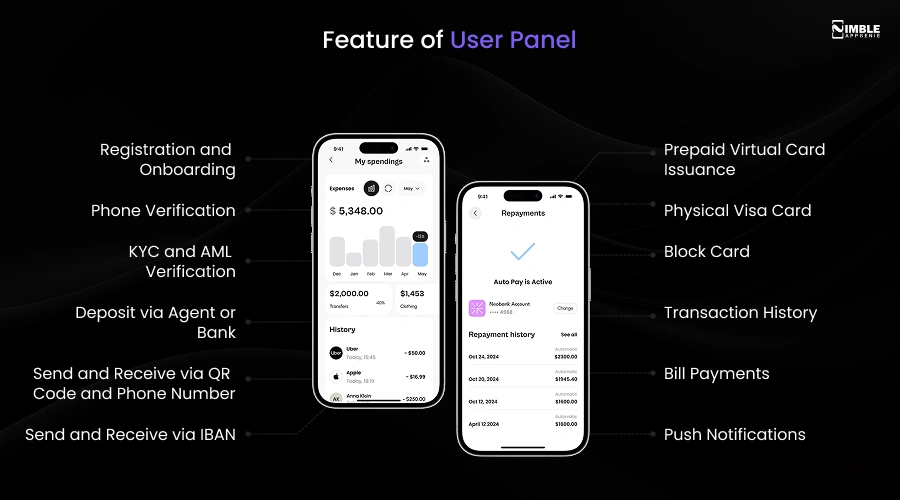
This is what most people interact with. We designed it to work on Android and iPhone devices, work on a slow connection, and take under three minutes to set up.
1. Registration and Onboarding
Users sign up with a phone number, and no bank visit is required. The entire process takes under three minutes.
2. Phone Verification
An OTP confirms the user’s phone number.
3. KYC and AML Verification
Users submit a government ID and a biometric selfie. Identity is verified automatically inside the app through KYC and AML, in real time.
4. Deposit via Agent or Bank
Users add money through a local agent or by linking a bank account. It’s the bridge between the cash economy and the digital one.
5. Send and Receive via QR Code and Phone Number
Type the number, enter the amount, and confirm. QR codes make face-to-face payments even faster.
6. Send and Receive via IBAN
International transfers in and out using the user’s real IBAN. Most people in this market have never had this before.
7. Prepaid Virtual Card Issuance
Free, issued immediately upon KYC completion. Works for online purchases right away.
8. Physical Visa Card
Users who want a physical card can request one. Delivered within 24 hours via ECOBANK Gabon’s logistics network.
9. Block Card
If a card is lost or compromised, users can block it instantly from the app. No call required, no wait.
10. Transaction History
A clear, full log of every transaction. Users see exactly where their money went.
11. Bill Payments
Utility bills, airtime top-ups, and other local services are paid directly from the wallet.
12. Push Notifications
Real-time alerts for every transaction. Users know the moment money arrives or leaves.
► Business Panel
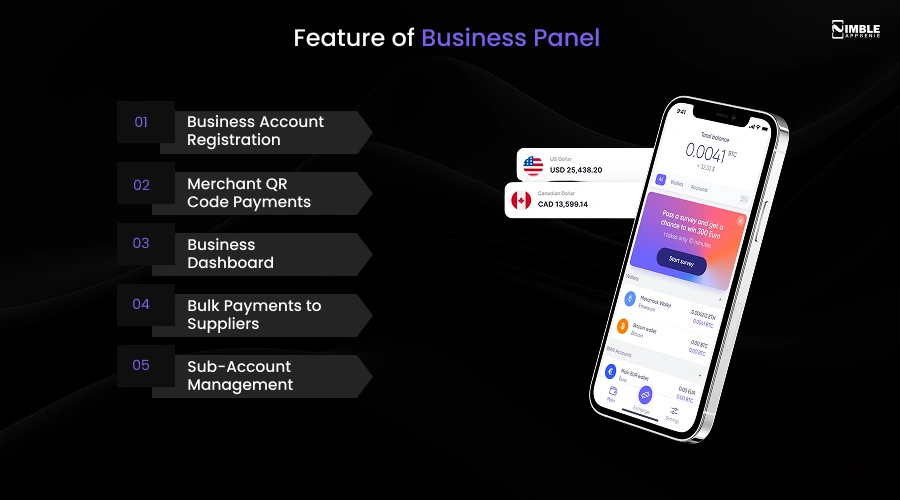
1. Business Account Registration
Company verification, not just individual KYC.
2. Merchant QR Code Payments
Customers scan and pay. No card terminal needed.
3. Business Dashboard
Real-time view of income, outgoing payments, and balances.
4. Bulk Payments to Suppliers
Pay multiple suppliers in one transaction.
5. Sub-Account Management
Separate accounts for departments, branches, or staff.
► Agent Panel
An agent is a local shop owner or individual who acts as a cash deposit and withdrawal point. Have a look at the agent panel features:
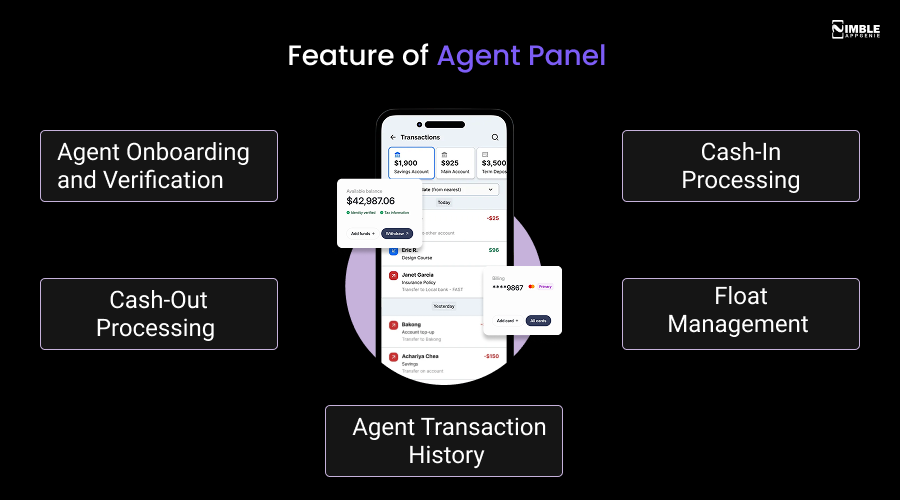
1. Agent Onboarding and Verification
Agents go through their own verification process, separate from regular users.
2. Cash-In Processing
The agent accepts cash from a user and credits the user’s wallet through the app.
3. Cash-Out Processing
The agent pays out cash to a user who wants to withdraw from their digital wallet.
4. Float Management
Agents track and top up the cash they hold to process withdrawals.
5. Agent Transaction History
A full log of every transaction the agent processes.
► Payroll System
We created it for employers who need to pay staff across multiple countries and currencies, all at once.
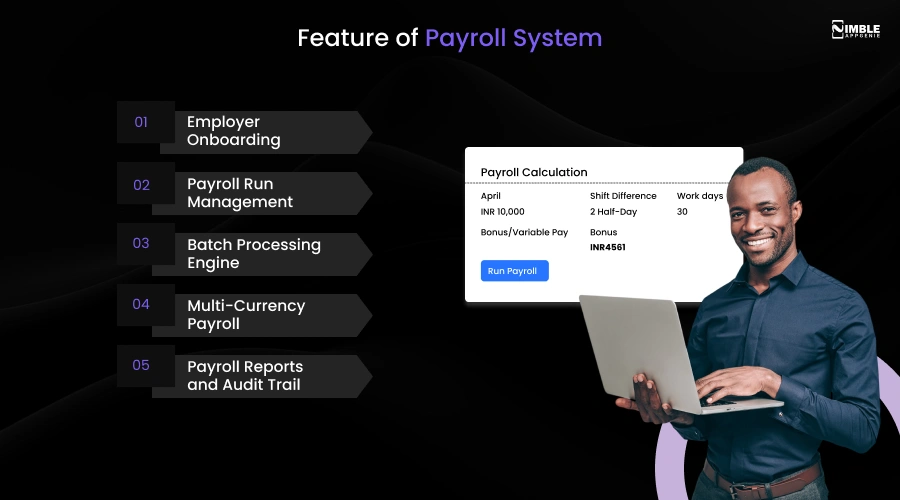
1. Employer Onboarding
Companies register separately with enhanced business verification.
2. Payroll Run Management
Employers create payroll runs, assign employees, and set amounts in one workflow.
3. Batch Processing Engine
One trigger, thousands of payments. The batch engine handles the distribution.
4. Multi-Currency Payroll
Users can pay in XAF, XOF, or both in the same payroll run. The system handles the routing.
5. Payroll Reports and Audit Trail
A full record of every payroll run, exportable for accounting and compliance purposes.
► Remittance API
The Remittance API is a B2B product. It allows licensed partners to integrate with Africa’s multi-currency wallet network to send money into user wallets from outside the platform.
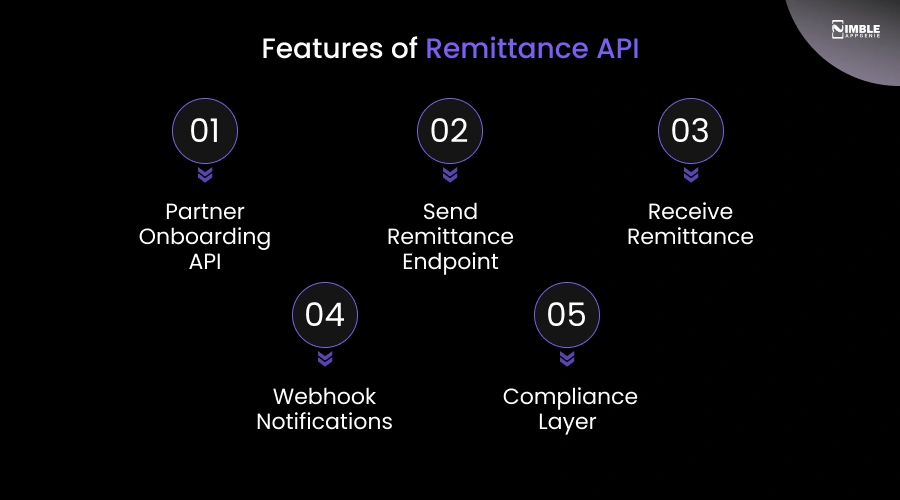
1. Partner Onboarding API
Partners integrate through a standard API with documented endpoints.
2. Send Remittance Endpoint
One API call to send money to any African wallet.
3. Receive Remittance
Users receive incoming transfers from international partners directly into their wallet.
4. Webhook Notifications
Real-time status updates for every transaction. Partners know when transfers succeed or fail.
5. Compliance Layer
It has built-in AML and sanctions screening for every partner transaction.
How We Built Africa’s Multi-Currency Wallet: Our Approach?
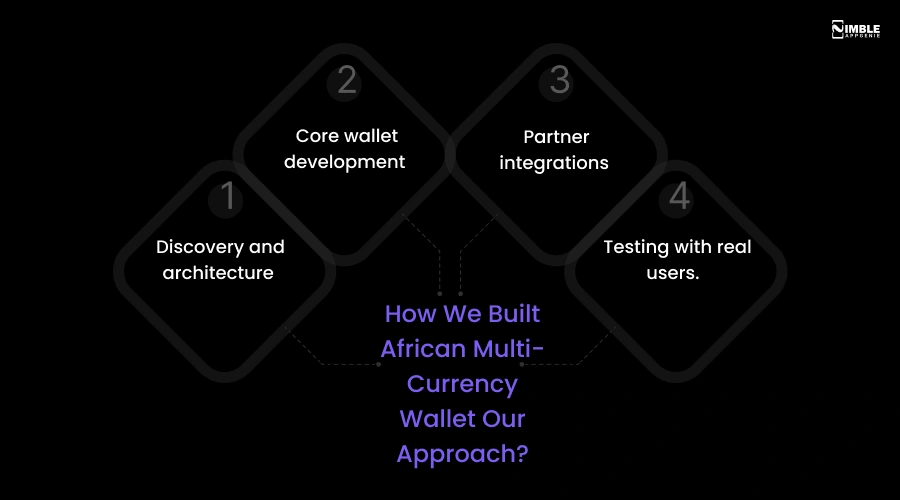
Nimble AppGenie, an eWallet app development company, built a multi-currency wallet for the African market in four phases.
Every technical decision was tested against one constraint: Does this work on an affordable Android phone? Does this work on a 3G connection? Will it work in a market where the power cuts out mid-transaction? Let’s now see how we have created Africa’s multi-currency wallet.
1. Discovery and Architecture
We started by asking three questions:
- Who is using this app?
- What is their relationship with digital money today?
- What does financial regulation look like in all 14 countries?
- What infrastructure do we need that does not already exist?
The answers were clear. Most users are first-time digital wallet users. Regulations vary by country but share a common KYC and AML baseline. Also, the infrastructure gap, like no Visa card issuance, no IBAN, no agent banking API, meant we had to create or partner for almost everything.
2. Core Wallet Development
Our dedicated development team built the core e-wallet first. Everything else depends on it. The tech stack we use is:
- React Native
- Node.js
- PostgreSQL
- Redis
Every decision ran through one filter. Does this work on a mid-range Android phone, on 3G, with an unrealistic connection? If not, we found another way.
3. Partner Integrations
Three integrations defined what the product could actually do.
- ECOBANK Gabon: Our licensed banking partner for Visa card issuance. Without a licensed bank, there is no card product. We integrated directly with their card management API for both virtual and physical issuance.
- Biometric KYC Provider: Users submit an ID photo and a selfie for two-factor authentication. The system compares them automatically. No manual reviews in the standard flow.
- IBAN Infrastructure Partner: Every user who completes full KYC gets a real, functional IBAN assigned to their account.
4. Testing and Launch
We tested in two stages. Internal QA first, every feature, every edge case, every failure scenario. Then a closed beta with real users in the target markets.
The beta phase showed us things internal tests never could. The navigation patterns we assumed were obvious turned out to be confusing. Flows we thought were fast felt slow to first-time users. We changed things, then tested again.
More than 1000 people registered on the waitlist before the public launch. That was our first confirmation that the product was solving a real problem.
| The single most important decision we made: design compliance from day one. Every feature was built around the regulatory requirement. We did not adjust to fit afterward. That is what made a 14-country rollout possible without rebuilding anything. |
Technology Stack Behind Africa’s Multi-Currency Wallet
We have used the tech stack to create a multi-currency wallet for Africa. Let’s take a look at the tech stack table.
| Category | Technologies / Services Used |
| BACKEND | PHP, Laravel 10 |
| MOBILE APPLICATION | iOS (Swift), Android(Kotlin) |
| USER VERIFICATION & SECURITY | Infobip – WhatsApp OTP Verification
Smile KYC – KYC Verification Smile KYC – AML Screening & Compliance Checks |
| PAYMENT & FINANCIAL SERVICES | GIMAC – Wallet & Payment Services
GIMAC + BDA + Onafriq – Bulk Payment Processing Onafriq – Card Services Integration |
| CLOUD & INFRASTRUCTURE | Microsoft Azure
CloudFront |
| DATABASE | MySQL |
Challenges We Faced During African Multi-Currency Wallet Development & How We Solved Them
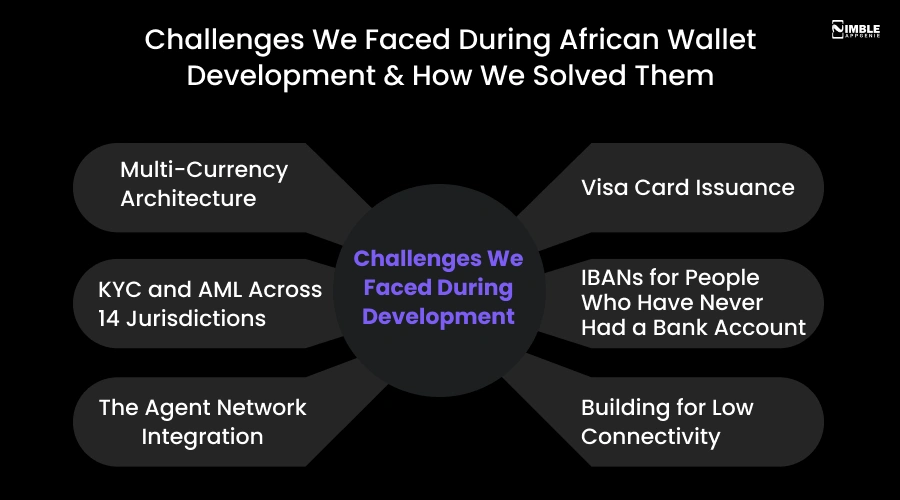
The challenges we faced while developing an African multi-currency wallet are:
- Managing two separate currencies within one system
- Running KYC compliance in 14 jurisdictions
- Integrating a physical agent cash network with real-time reconciliation
- Partnering with ECOBANK Gabon for Visa card issuance
- Issuing IBANs for users who have never had a bank account
- Building an app that performs reliably on slow connections
Challenge 1: Multi-Currency Architecture
XAF and XOF share the same value and the same euro peg. But they are separate currencies issued by separate central banks. You cannot use one in a country that runs on the other.
What we did:
We built a currency routing layer between the user interface and the transaction engine. It identifies the origin and destination zone for every transfer and routes it correctly. The user sees a simple payment screen. Behind it, two separate ledger systems are processing the transaction.
Challenge 2: KYC and AML Across 14 Jurisdictions
Compliance was not something we could bolt on at the end. It had to be built in from the start. Each country in the network has its own regulatory requirements for digital financial services. But we needed a baseline that satisfied all of them.
What we did:
We implemented biometric selfie verification combined with document scanning. The user takes a photo of their ID and a selfie. The system compares them, validates the document, and completes KYC in real time.
| Key insight: Compliance and speed are not opposites if you design the flow carefully. The trick is knowing which checks must happen before first use and which can complete in the background. |
Challenge 3: The Agent Network Integration
When an agent accepts cash from a user, three things have to happen at once: the agent’s float is debited, the user’s wallet is credited, and the transaction is logged. Any lag creates disputes and breaks trust.
What we did:
We built a real-time reconciliation layer that processes agent transactions in under two seconds. For poor-connectivity areas, the app queues transactions locally and syncs when a connection returns, with automatic conflict resolution.
Challenge 4: Visa Card Issuance
You cannot issue Visa cards without a licensed banking partner. That is not a technical problem; it is a legal one. And it has to be solved before any technical work on the cards can begin.
What we did:
We partnered with ECOBANK Gabon as the card-issuing institution. Virtual cards are generated via API the moment a user completes KYC, instantly. Physical cards connect to a logistics pipeline: request to deliver in 24 hours.
Challenge 5: IBANs for People Who Have Never Had a Bank Account
An IBAN account or International Bank Account Number is what lets any bank in the world send money directly to you. For most African users, being assigned one was the first time they became a named participant in the global financial system.
What we did:
We integrated with an infrastructure partner who could issue and manage IBANs linked to wallet accounts. Every user who completes full KYC gets one, live and functional for incoming international transfers.
Challenge 6: Building for Low Connectivity
The average smartphone in Gabon or Chad is not a high-end device. Most users are on affordable Android phones, on 3G connections, in areas where signal drops regularly. Developing for this environment meant making deliberate choices:
What we did:
We made four decisions that made the difference:
- Small app size: It is accessible on limited data plans.
- Compressed API calls: Every request is optimised to reduce data usage.
- Offline tolerance: The app queues actions and syncs when the connection returns.
- Clear failure messages: If something cannot complete without connectivity, the app tells the user plainly instead of hanging.
Every challenge here came down to the same thing: stop assuming infrastructure that does not exist. We build for what users actually have, not what you wish they had.
Lessons We Learned Building an African Multi-Currency Wallet
The biggest lessons we learned from building an African multi-currency wallet are that localization goes deeper than language, and compliance must be designed in from day one.
Agent networks are still vital because cash will not disappear overnight. Users will not trust an app they cannot understand in 90 seconds. A licensed banking partner is not optional; it is the legal foundation. Build for low-end devices first, and security and simplicity must coexist; neither can be satisfied.
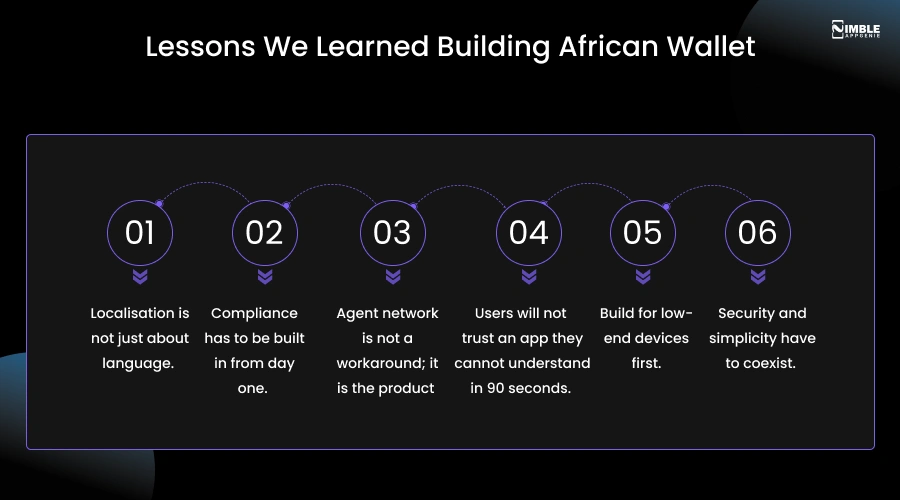
1. Localization is not just about language
We knew the app needed to be in French. That was the obvious part. What we underestimated was how much else needed to be localised.
For instance, date formats, currency displays, field ordering, and how users expect to see their account number. Every assumption we brought from other markets had to be questioned.
2. Compliance has to be built in from day one
If you treat compliance as something to manage after you have finished multi-currency wallet development, you will rebuild half the product.
We made it a core design constraint from the first day. It costs time upfront. It saved far more time later.
3. Agent network is not a workaround; it is the product
Cash is not disappearing from Central Africa soon. The agent network is what makes a digital wallet useful for people whose income arrives in physical notes.
Without it, you are building a product for the small minority who already have bank accounts.
4. Users will not trust an app they cannot understand in 90 seconds
We tested several onboarding flows. Users dropped off when the app asked for too much too early, or used unfamiliar financial language.
The final version feels almost obvious. Getting there required multiple rounds of testing with real users in the target markets.
5. Build for low-end devices first
If your app works well on a mid-range 2021 Android phone with 3G connectivity, it will work well everywhere. If you build for a high-end device first and try to scale down later, you will be doing that work twice.
6. Security and simplicity have to coexist
Security requirements pushed toward adding friction: more verification steps, more confirmation screens, more warnings. User experience pushed toward removing friction.
We had to find the minimum security footprint that still fully protected users. That balance takes real design work. There is no formula for it.
The Outcome: What African Multi-Currency Wallet Delivers Today?
The African multi-currency wallet is live and operating across its target markets. Over 1,000 people joined the waitlist before the app opened to the public. In a market where fintech adoption builds slowly and trust is hard to earn, that number was meaningful.
The ECOBANK Gabon partnership is live. Virtual Visa cards are being issued. Physical cards are being delivered. What users say most often: it is simple, it is fast, and they trust it.
Those three things do not always go together in a fintech app. Getting all three right in this market, on this kind of infrastructure, was the real fintech development challenge.
FAQs

Niketan Sharma, CTO, Nimble AppGenie, is a tech enthusiast with more than a decade of experience in delivering high-value solutions that allow a brand to penetrate the market easily. With a strong hold on mobile app development, he is actively working to help businesses identify the potential of digital transformation by sharing insightful statistics, guides & blogs.
Table of Contents




No Comments
Comments are closed.