

 Free Consultation
 PCI-DSS Compliant
 GDPR Ready
 ISO 27001
 NDA Protected
 AI Services
 AI App Development
 Generative AI Development
 AI Chatbot Development
 AI Integration Services
 AI Consulting Services
 AI For Fintech
 AI Financial Assistant Solution
 AI Insurance Agent Development
 Tech Stack
 OpenAI / GPT-4
 Claude / Anthropic
 Gemini / Google AI
 Llama / Open Source
 LangChain / LlamaIndex
 Pinecone / Pgvector
 AWS / Azure AI


 Fintech Solution
 Core Fintech
 App Development
 Neobank Solutions
 eWallet Solutions
 Lending Software
 Banking Solutions
 BNPL Solutions
 BNPL Solutions
 Insurance App
 Wealth Management
 Crypto & DeFi
 Blockchain Development
  Payroll Software
 DeFi Solutions
 Crypto Wallet
 Crypto On/Off Ramp
 Crypto Exchange
 Trading Platform
 Payments
 Compliance
 Regulations & Compliance
 Fraud Detection
 Lending Ecosystem
 P2P Lending Platform
 Mortgage Software
 Engagement
 Fintech Outsourcing

 Mobile Development
 Mobile App Dev
 iOS App Development
 Android App Development
 React Native
 Flutter Development
 Web Solution
 Node.js Development
 React.js Development
 Angular Development
 App Services
 UI/UX Design
 App Maintenance
 By Stage
 MVP Development
 Industry Solutions
 Healthcare App Dev
 Education App Dev
 Travel App Dev
 Real Estate App Dev
 Logistics Software
 Social Media App

 Hire Mobile Developers
 Hire iPhone Developers
 Hire Android Developers
 Hire React Native Devs
 Hire Flutter Developers
 Hire Web Developers
 Hire Node.js Developers
 Hire Angular Developers
 Hire PHP Developers
 Hire Laravel Developers
 How It Works
 Pre-Vetted Developers
 Ready In 48 Hours
 NDA From Day One
 Replace Guarantee
 Company
 About Us
 Our Work Process
 Portfolio
 Case Studies
 Blog / Insights
 Careers
 Contact Us
 Awards
 Recognition


 Offices


In a Nutshell:
- Fleet management software centralizes tracking, managing, and maintaining commercial fleet operations, all in one platform.
- Used by fleet managers, safety managers, training managers, and the broader transportation industry.
- It minimizes costs, boosts driver efficiency, optimizes workflows, and enhances vehicle safety.
- Once logged in, fleet operators use built-in features to optimize fuel usage and make smarter, data-driven decisions.
- Fleet management software development follows six steps — market research, feature selection, design, development, testing, and deployment.
- Development costs range from $20,000 to $80,000+, depending on app complexity, design, and developer expertise.
- Ready to build? Connect with Nimble AppGenie and launch a fleet management software built for your market.
“Time is money.”
A small delay in the delivery can impact the overall operations in the logistics and transportation industry.
Businesses in the current world rely on connected technologies, and building a fleet management software is important because whoever controls the route controls the revenue.
Are you an entrepreneur or an investor looking for fleet management software development?
Yes!
Well, it is the right time to look away from the spreadsheets and build a software that thrives and succeeds.
So, what is the right process of fleet management software development?
You can begin with the market study, selecting the right features, designing the software, choosing the right backend and frontend for your software, and then launching it to the target platforms.
In this guide to fleet management software development, we’ll walk you through the concept of fleet management, who uses such software, reasons to create one, the working process, and even the complete steps, cost, and timeline to get ahead with the same.
Then, lets get dive into it.
What is Fleet Management Software?
Fleet management software is the digital platform that centralizes the tracking, managing, and optimizing operations of commercial vehicles and assets.
This is a software that is designed to continuously monitor vehicles and equipment, just from a single application. The fleet managers use this software to monitor fuel costs and track vehicles’ fuel consumption.
It can also help in automating the refueling process to avoid any unnecessary refueling or running out of fuel. This is a software that enhances operational efficiency, minimizes costs, and enhances safety by offering real-time data on maintenance needs, driver behavior, and vehicle location.
- Tracks and manages vehicles, drivers, and fleet management in real-time.
- Helps to automate tasks and reduce fuel costs.
- Commonly used in logistics and transportation
Finding the right fleet management software for you might be difficult; however, with the right team, you can make your own software.
If you are unaware of who will use it.
Let’s consider the following section for the same.
Who Uses Fleet Management Software?
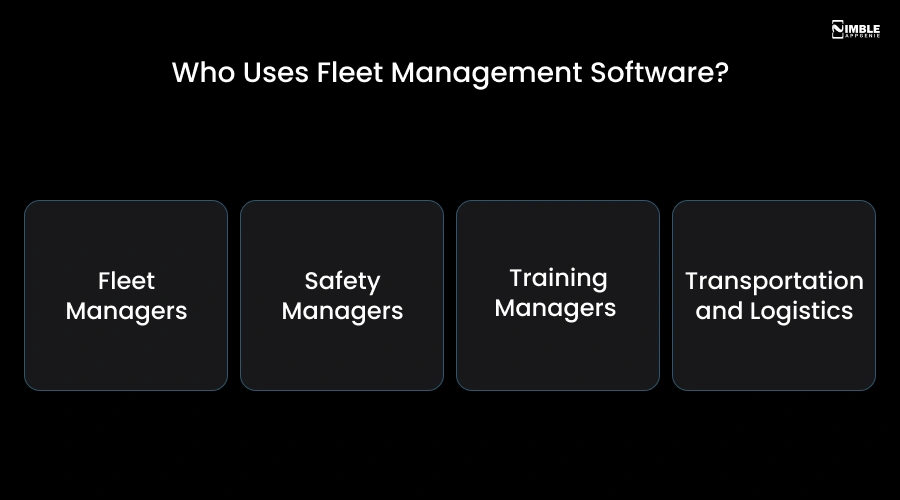
The fleet management software is used by people who are fleet managers, dispatchers, drivers, and even by safety managers.
Here is the list of the people who use fleet management software:
1. Fleet Managers
The fleet managers use the fleet management software for centralizing the operations, tracking the assets in real-time, and automating the maintenance scheduling. It helps them to optimize the complete fleet operations.
2. Safety Managers
Safety managers use the fleet management software for evaluating the complete safety parameters of the fleet, as well as of the drivers, workers associated with the fleet, along with the goods’ safety.
3. Training Managers
This software is even used by the fleet training managers who use it to train workers for the fleet. It is an important platform that helps to inform the fleet managers about how many workers or even drivers are ready for the fleet.
4. Transportation and Logistics
This software is used by the transportation and logistics companies to manage the complete operations, optimizing the routes, and even ensuring the timely deliveries.
Other than this, fleet management software is used by construction sites, in the field service for scheduling and dispatching, for inventory management, and even by the customer service executors.
Still confused on why to create a fleet management software, let’s get ahead with the reasons.
Why Create a Fleet Management Software?
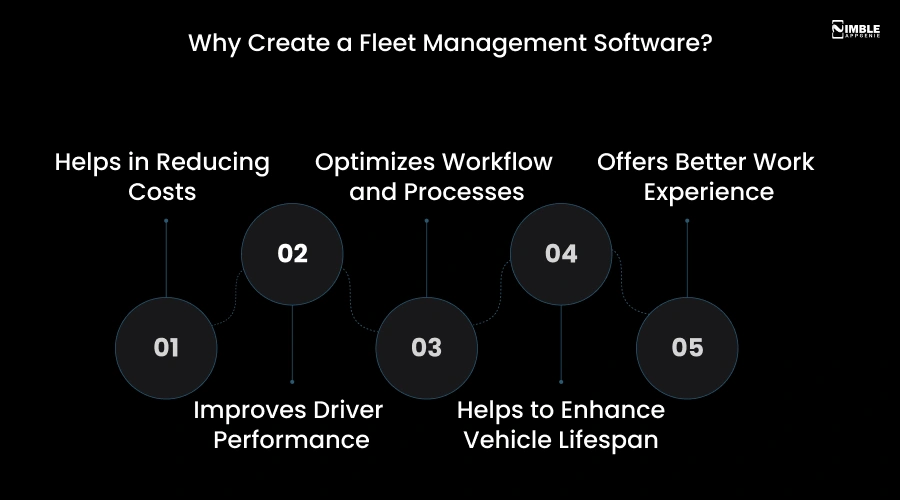
You should create a fleet management software because it helps in reducing costs, improving driver performance, optimizing workflows and processes, vehicle lifespan, and offering a better work experience.
Here is the list of reasons to create a fleet management software:
1. Helps in Reducing Costs
Creating a fleet management software helps in minimizing the total cost of creating a fleet management software.
When you build a fleet management app, it will help you in optimizing fuel consumption, reducing vehicle downtime, and enhancing routing efficiency through reducing accident rates.
2. Improves Driver Performance
The fleet management software helps to enhance the overall driver performance through analyzing their driving skills, such as speeding, harsh braking, and even excessive idle time.
This even allows the managers to provide targeted coaching and driver scorecards. These systems enhance safety via dash cams and do optimizes routes for efficiency and for ensuring compliance.
3. Optimizes Workflow and Processes
If you create a fleet management software, it will help you in optimizing the complete workflow through automating the manual tasks, centralizing the real-time data, and even streamlining communication.
The top ways through which fleet management software optimizes the workflow are real-time data and visibility, via automation of daily tasks, and route optimization.
4. Helps to Enhance Vehicle Lifespan
Building a fleet management software extends the complete vehicle lifespan by scheduling and tracking the maintenance activities, as well as ensuring that vehicles receive timely servicing.
It further helps in extending the longevity of vehicles by reducing wear and tear on parts. Regular tracking of vehicles does help in mitigating the need for costly repairs and maintenance.
5. Offers Better Work Experience
A fleet management system does offer a better work experience through replacing the manual paperwork and even spreadsheets with automation and centralization of digital workflows.
Additionally, these systems do minimizes stress for drivers and managers via streamlined communication, and even by improving routing.
Now, let’s get ahead with how fleet management software works.
How Does Fleet Management Software Work?
Fleet management software uses GPS tracking and telematics services. These are installed in an app to gather real-time information, including location, engine diagnostics, and even the driver’s behavior.
Well, before you dive into the complete process to create a fleet management software, let’s understand how a fleet management software works.
Here is the series of steps to consider:
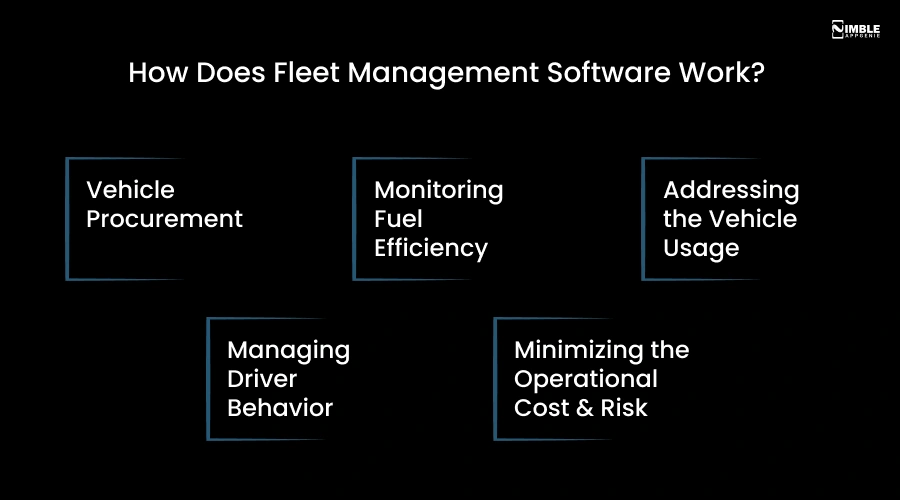
Step 1: Vehicle Procurement
Once the user has a fleet management software, they register vehicles in it and even procure the vehicles based on the current fleet requirements.
In this step, the vehicle managers create the procurement plans that align well with their current fleet operations and with the overall company’s goals.
Step 2: Monitoring Fuel Efficiency
In this step, the software is used to evaluate the current fuel status, as fuel is one of the highest costs for fleets.
It comprises integrating GPS telematics and even fuel card data to track metrics in real time. This assists the managers in identifying the wasted fuel and even optimizes the routes.
Step 3: Addressing the Vehicle Usage
Next, with the help of fleet management software, the users can understand where their fleet vehicles are, who is driving them, when they are in use, and why they are being used.
It is a software that tracks location, idle time, and the driver’s behavior via GPS and telematics. This is a software that helps the managers to balance the workloads and even prevents the misuse of vehicles.
Step 4: Managing Driver Behavior
The fleet management software assists in reducing accidents by engaging the drivers via coaching, performance metrics, incentives, and even feedback.
With the help of real-time monitoring and alerts, you can track the current behavior and feedback of the users to make the fleet more productive.
Step 5: Minimizing the Operational Cost & Risk
Later, the fleet management software is designed to comply with the compliance practices, and is helpful to track and monitor the current fleet situations. It further helps the fleet managers to make respective decisions through data analytics.
Additionally, the automated alerts are usually generated for speeding, route deviations, and even to resolve maintenance issues.
This is how fleet management software runs. Now, to create a fleet management software, you should look forward to the key features to include in such software.
Features to Include in a Fleet Management Software
The key features to include in the fleet management software are real-time GPS tracking, telematics, and automated maintenance, fuel management, and compliance tools.
Here is the list of top features to include in a fleet management software:
| Core Feature | One-Line Description |
| GPS Vehicle Tracking | Monitors real-time vehicle location, routes, and movement history. |
| Route Optimization | Suggests the most efficient routes to reduce fuel costs and travel time. |
| Fuel Management | Tracks fuel usage, expenses, and efficiency across the fleet. |
| Maintenance Scheduling | Automates service reminders and preventive maintenance planning. |
| Driver Behavior Monitoring | Analyzes speeding, braking, idling, and driving habits for safety improvement. |
| Fleet Analytics & Reporting | Provides dashboards and reports for performance, costs, and utilization. |
| Asset Management | Keeps records of vehicles, equipment, registrations, and ownership details. |
| Geofencing | Sends alerts when vehicles enter or leave predefined geographic areas. |
| Compliance Management | Helps manage licenses, inspections, ELD, and regulatory requirements. |
| Dispatch & Communication | Enables task assignment and communication between drivers and managers. |
| Accident & Incident Management | Records incidents, claims, and repair workflows for quick resolution. |
| Mobile App Integration | Allows drivers and managers to access fleet data through mobile devices. |
Are you ready with the features and user flow? Then let’s get started with the complete fleet management software development process in the following section.
How to Develop a Fleet Management Software?
You can create a fleet management software by following a complete process from market study, designing the software, selecting a tech stack, testing, then launching and supporting.
Let’s evaluate the complete set of steps below:
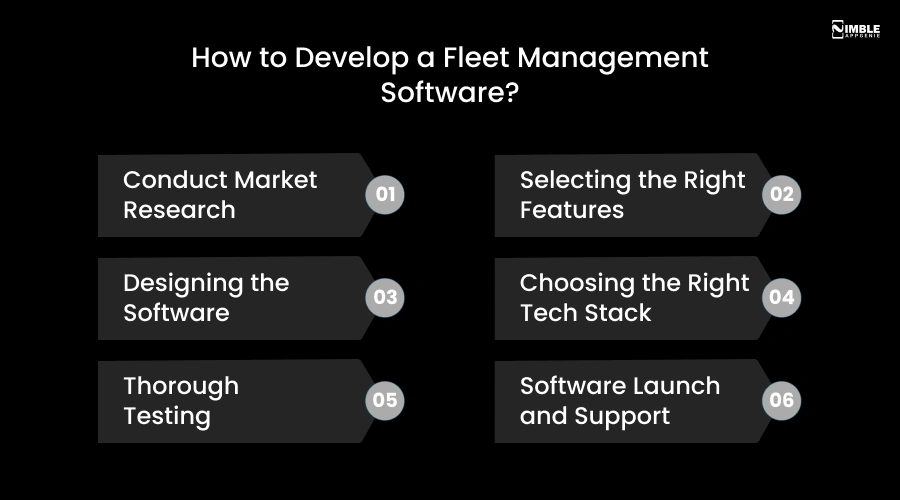
Step 1: Conduct Market Research
The first and foremost step to create a fleet management software is to conduct a complete market study by identifying the target audiences, defining complete objectives, and selecting the right methods of performing research, such as surveys, data analysis, and interviews.
Here’s what you should consider while conducting market research:
- Defining the complete set of objectives
- Gathering primary and secondary data
- Identifying the complete market gap
- Evaluating the competition
Note: connecting with a leading custom software development service provider can help you not only pursue market research, but also in creating a complete software.
Step 2: Selecting the Right Features
Now, the second step you need to take is selecting the right set of features for your fleet management software. The features should be in accordance with the goal of your project.
Here’s what you need to do:
- Evaluate the requirements of your software
- Identify what kind of features suit based on the software
- You can use the features such as geofencing, driver behavior monitoring, etc.
Step 3: Designing the Software
In this step, you should design the complete fleet management software by understanding who is going to use this software, how it will be used, and what type of typography, font, and UI/UX will be suitable for the same.
- Evaluate the functional features
- Opt for a user-friendly design
- Ensuring prioritizing the user experience
Step 4: Choosing the Right Tech Stack
For the backend process, you should select the right tech stack based on the requirements of your fleet management system. It requires a real-time technology stack that uses core technologies such as Python, Java, Apache Kafka, and even RESTful APIs.
Here is the table defining the complete tech stack:
| Software Component | Recommended Technology | Purpose |
| Fleet Management Dashboard | React.js / Next.js | Builds interactive fleet monitoring dashboards. |
| Fleet Software Interface | Tailwind CSS / Material UI | Creates responsive and user-friendly software interfaces. |
| Fleet Operations Backend | Node.js / Express.js | Handles APIs, fleet operations, and business logic. |
| Real-Time Vehicle Tracking | Socket.IO / WebSockets | Enables live tracking and instant fleet updates. |
| Fleet Database Management | PostgreSQL / MySQL | Stores vehicle, driver, and operational data securely. |
| Cloud-Based Fleet Infrastructure | AWS / Azure / Google Cloud | Hosts and scales the fleet management software. |
| GPS & Route Optimization | Google Maps API / Mapbox | Supports navigation, geo |
Opt for the top software development methodologies and align with your respective software development goals.
Step 5: Thorough Testing
You need to conduct complete testing via automated testing tools. It comprises a structured, multi-layered approach using specialized tools for the unit, functional, and performance testing.
Here’s what you need to opt:
- Covering analytical parameters
- Opting for system validation
- Sampling methods
- Testing under environmental conditions
Step 6: Software Launch and Support
This is not the last step, as even after the deployment and launch of your fleet management software, you need continuous monitoring and support. You need to conduct a thorough testing of the software, and then opt for complete support and maintenance.
Here is what you need to opt for software launch and support:
- You can begin with an MVP app development
- Evaluate different platforms to launch your software
- Opt for complete mobile app maintenance after deployment
Now, as you are ready to launch your fleet management software, let’s consider the complete cost figure to create it in the following section.
Cost to Create a Fleet Management Software
The overall cost to build a fleet management software can range from $20,000 to $80,000+.
This cost further varies due to different factors such as the complexity of the software, the design of the software, the technology stack, the security of the software, and even the skills of the developers.
Let’s evaluate the cost breakdown of fleet management software in the table below:
| Development Factor | Estimated Cost |
| UI/UX Design | $2,000 – $8,000 |
| Frontend Development | $5,000 – $15,000 |
| Backend Development | $6,000 – $20,000 |
| Software Development | $5,000 – $18,000 |
| GPS & Telematics Integration | $3,000 – $10,000 |
| Maps & Route Optimization | $2,000 – $8,000 |
| Real-Time Tracking System | $3,000 – $10,000 |
| Analytics & Reporting | $2,000 – $7,000 |
| Security & Testing | $3,000 – $12,000 |
| Cloud Hosting & DevOps | $1,500 – $5,000 |
| Third-Party Integrations | $2,000 – $8,000 |
| Maintenance & Support | $3,000 – $10,000+ annually |
| Total Estimated Cost | $20,000 – $80,000+ |
Here, the cost to hire software developers can also impact the total cost to build a fleet management software.
Other than the cost, one of the significant resources that is effective for fleet management software development is time; let’s explore it in the next section.
How Much Time Does it Take to Create a Fleet Management Software?
The overall time taken to build a fleet management software varies from 5 months to 12 months. This depends on different factors such as the skills of the developers, the complexity of the software, the technology stack, and even the purpose of fleet management software development.
Let’s evaluate the complete timeline to build a fleet management software:
| Development Phase | Timeline | Key Activities |
| Requirement Analysis & Planning | 2–4 Weeks | Define business goals, features, tech stack, and project roadmap. |
| UI/UX Design | 3–5 Weeks | Create wireframes, dashboards, software designs, and user flows. |
| Frontend Development | 4–8 Weeks | Develop web dashboards and responsive user interfaces. |
| Backend Development | 6–10 Weeks | Build APIs, database architecture, authentication, and core logic. |
| GPS & Telematics Integration | 3–6 Weeks | Integrate GPS tracking, IoT devices, and real-time data systems. |
| Route Optimization & Maps | 2–4 Weeks | Implement maps, geofencing, and route planning features. |
| Testing & Quality Assurance | 3–6 Weeks | Conduct functional, security, performance, and bug testing. |
| Deployment & Cloud Setup | 1–2 Weeks | Configure cloud hosting, DevOps pipelines, and production launch. |
| Post-Launch Support & Optimization | Ongoing | Monitor performance, fix issues, and release feature updates. |
| Total Estimated Timeline | 5–12 Months | Depends on software complexity, integrations, and team size. |
You can outsource the software development task and can concentrate on fleet management.
Why Connect with Nimble AppGenie to Create a Fleet Management Software?
With Nimble AppGenie, you will find diversified services in your fleet management software as follows:
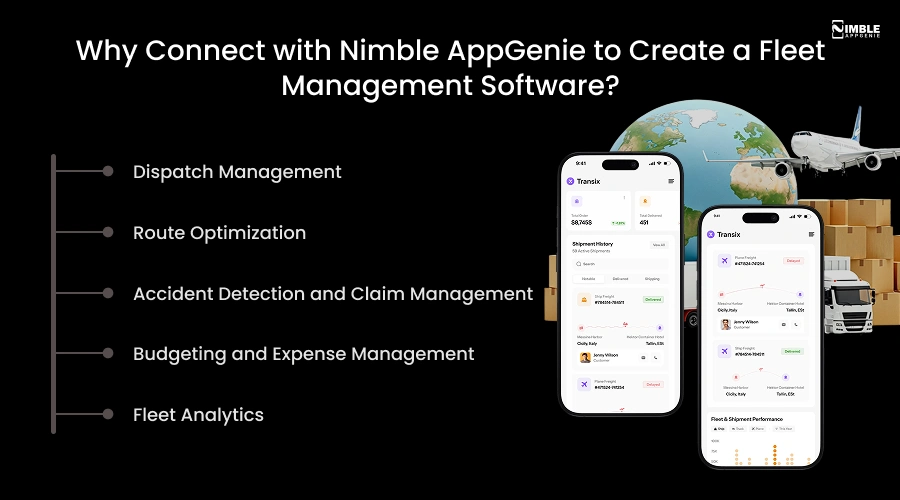
1. Dispatch Management
We will help you with the dispatch management through automating the vehicle assignment, offering real-time trip monitoring, and even managing the dispatch documents.
2. Route Optimization
With the help of fleet management software, we help you with route optimization. We add criteria-based route mapping, opting for diversified notifications to the fleet managers related to vehicle entering based on the geographical locations.
3. Accident Detection and Claim Management
We frame the accident detection and claim management in the fleet management software, providing accident detail reports, repair process management, and offering instant notifications features to the fleet managers.
4. Budgeting and Expense Management
Within the software, we do offer budgeting and expense management systems. This includes monitoring vehicle-related expenses, vehicle maintenance expense tracking, and a feature that is helpful in offering analytics support for fuel consumption.
5. Fleet Analytics
Other than this, we will help you to include the respective features impactful in engaging targeted users with our research team. We offer fleet analytics in our fleet management software that is effective in providing average time on route, engine idle time, and even load utilization.
Hence, we are the best logistics app development company, helpful in converting your dream software into reality successfully. We are the top solution provider for securing software and delivering on-demand apps.
Our team understands your demands, evaluates the current competitive landscape, and provides you with effective solutions as necessary.
Conclusion
Fleet management software has become an essential solution for businesses looking to streamline operations, reduce fuel costs, improve driver safety, and optimize vehicle performance.
From GPS tracking and route optimization to analytics and compliance management, a well-developed fleet management system helps businesses gain complete control over their fleet operations.
Whether you are a logistics company, construction business, or transportation provider, investing in fleet management software can significantly improve operational efficiency and decision-making.
By following the right development process, choosing the right tech stack, and partnering with an experienced development company like Nimble AppGenie, businesses can build scalable and future-ready fleet management solutions.
FAQs

Madan is the Backend Solutions Architect at Nimble AppGenie, specializing in the design of secure, high-concurrency systems that power complex mobile ecosystems. With deep expertise in server-side logic and database management, he ensures every platform is built with enterprise-grade security. In his free time, he is an avid researcher of emerging technologies; he spends his time deconstructing the latest backend frameworks and reading technical papers to ensure our solutions remain at the absolute forefront of industry innovation.
Table of Contents




No Comments
Comments are closed.