

 Free Consultation
 PCI-DSS Compliant
 GDPR Ready
 ISO 27001
 NDA Protected
 AI Services
 AI App Development
 Generative AI Development
 AI Chatbot Development
 AI Integration Services
 AI Consulting Services
 AI For Fintech
 AI Financial Assistant Solution
 AI Insurance Agent Development
 Tech Stack
 OpenAI / GPT-4
 Claude / Anthropic
 Gemini / Google AI
 Llama / Open Source
 LangChain / LlamaIndex
 Pinecone / Pgvector
 AWS / Azure AI


 Fintech Solution
 Core Fintech
 App Development
 Neobank Solutions
 eWallet Solutions
 Lending Software
 Banking Solutions
 BNPL Solutions
 BNPL Solutions
 Insurance App
 Wealth Management
 Crypto & DeFi
 Blockchain Development
  Payroll Software
 DeFi Solutions
 Crypto Wallet
 Crypto On/Off Ramp
 Crypto Exchange
 Trading Platform
 Payments
 Compliance
 Regulations & Compliance
 Fraud Detection
 Lending Ecosystem
 P2P Lending Platform
 Mortgage Software
 Engagement
 Fintech Outsourcing

 Mobile Development
 Mobile App Dev
 iOS App Development
 Android App Development
 React Native
 Flutter Development
 Web Solution
 Node.js Development
 React.js Development
 Angular Development
 App Services
 UI/UX Design
 App Maintenance
 By Stage
 MVP Development
 Industry Solutions
 Healthcare App Dev
 Education App Dev
 Travel App Dev
 Real Estate App Dev
 Logistics Software
 Social Media App

 Hire Mobile Developers
 Hire iPhone Developers
 Hire Android Developers
 Hire React Native Devs
 Hire Flutter Developers
 Hire Web Developers
 Hire Node.js Developers
 Hire Angular Developers
 Hire PHP Developers
 Hire Laravel Developers
 How It Works
 Pre-Vetted Developers
 Ready In 48 Hours
 NDA From Day One
 Replace Guarantee
 Company
 About Us
 Our Work Process
 Portfolio
 Case Studies
 Blog / Insights
 Careers
 Contact Us
 Awards
 Recognition


 Offices


TL;DR
- $1.4 trillion moved through African mobile wallets in 2025; 66% of all global mobile money value, yet over 70% of registered accounts sit dormant in a typical month.
- Identity fraud and SIM-swap scams hit 90% of providers in 2025; security is now the real differentiator, not onboarding speed.
- Nine major wallets now compete across telco-led, bank-led, and independent fintech models, and the ownership model shapes everything from cost to reach.
- Choosing closed, semi-closed, or open wallet architecture upfront determines your licensing path and cost.
- Nimble AppGenie has shipped compliant, multi-currency wallets across 14 African countries; this guide reflects what we have learned building for 3G networks and fragmented regulation, not just industry reports.
“Will digital wallets replace banks in Africa?” Fintech founders, investors, and bank innovation teams are asking this type of question right now, but it is the wrong one.
Digital wallets in Africa are not replacing banks; they are becoming the front door to them. According to GSMA’s State of the Industry Report on Mobile Money 2026, in 2025 alone, mobile money moved $1.432 trillion across the continent, nearly two-thirds of everything the world moved through mobile wallets that year.
That’s the headline. The real story is messier, one most articles on this topic skip: growth in registered accounts has not translated into active usage growth, fraud is surging as fast as adoption, and the winners over the upcoming five years will not be whoever launches fastest, but whoever builds the most interoperable, trusted wallet.
In this guide, Nimble AppGenie covers where the market actually stands in 2026, the ownership models and technology behind it, and what it takes to build a wallet that works well on a $50 Android phone over an unstable, fluctuating 3G connection.
Africa’s Financial Landscape in 2026
The pandemic accelerated fintech adoption across Africa, but what has sustained the growth since has been more structural: a young and rapidly urbanizing population, falling smartphone and data costs, and regulators gradually creating new opportunities for non-bank financial service providers.
- 52% of the world’s mobile money accounts are in Africa.
- 1.2 billion registered accounts, 18% YoY.
- $720 billion contributed to GDP by 2023.
- 74% of global transactions happen in Africa.
(Source: Ecofin Agency, Forbes Africa, Citing GSMA 2026)
Regionally, the picture still splits along familiar lines: South Africa stays the most mature, best-regulated banking market on the continent. East Africa rules on transaction value – $806 billion in 2025 – anchored by M-Pesa’s dominance in Kenya. West Africa leads on the number of live mobile money services (76), with Nigeria’s startup ecosystem driving fintech innovation and $498 billion in transaction value (Connecting Africa).
This is not one market – a dozen different regulatory environments, user behaviors, and currencies stitched together through mobile networks. That fragmentation is exactly why a copy-paste wallet strategy from the US or Europe fails here, and why fintech APIs built for local rails matter more than flashy UI.
The Rise of Digital Wallets In Africa: How Big Is The Market, Really?
Mobile money in Africa has moved well past P2P transfers. Wallets now bundle savings, bill payments, micro-loans, and increasingly, cross-border transfers. Merchant transactions alone rose to $155 billion in 2025, demonstrating that digital wallets are becoming the default way small businesses are paid, not only how individuals send money home (CIO Africa).
Digital Wallet vs. Mobile Money vs. Neobank: What’s The Difference?
This is one of the most searched clarifying questions in fintech right now. The terms are used interchangeably; however, they are not the same thing: mobile money is a telco-led, SIM-tied stored-value account accessed via an app (MTN MoMo, M-Pesa) or USSD; a digital wallet is a wider umbrella for any app-based store of value, telco-led, or not (SnapScan, OPay); a neobank is a fully digital bank offering cards, accounts, and usually lending – like the SWAP Africa build Nimble AppGenie delivered.
Most successful African fintechs clear up this difference – a mobile money wallet that adds savings and credit starts looking like a neobank.
Bank-Led Vs. Telco-Led Vs. Fintech-Led: Who Actually Owns Africa’s Wallets?
Before detailing names, it is worth understanding the three ownership structures competing for the same users because the model determines distribution cost, regulatory requirements, and trust from day one.
| Model | How it wins | Trade-off | Examples |
| Telco-led | Distribution via an existing SIM base and airtime agent network – near-zero customer acquisition cost | Slower to innovate; tied to one carrier’s footprint and regulatory relationship | M-Pesa, MTN MoMo, Orange Money, Airtel Money, EcoCash |
| Bank-led | Regulatory head start (already licensed), existing customer trust and formal account infrastructure | Weaker reach into the unbanked segment; wallets exist to serve | Bank-integrated wallet extensions, formal QR rails like SnapScan |
| Independent fintech-led | No captive distribution, so wins on price, UX, and speed of iteration | Must build trust and an agent network from zero – the hardest, most expensive part | Wave, Chipper Cash, OPay |
Key Digital Wallet Players Across Africa
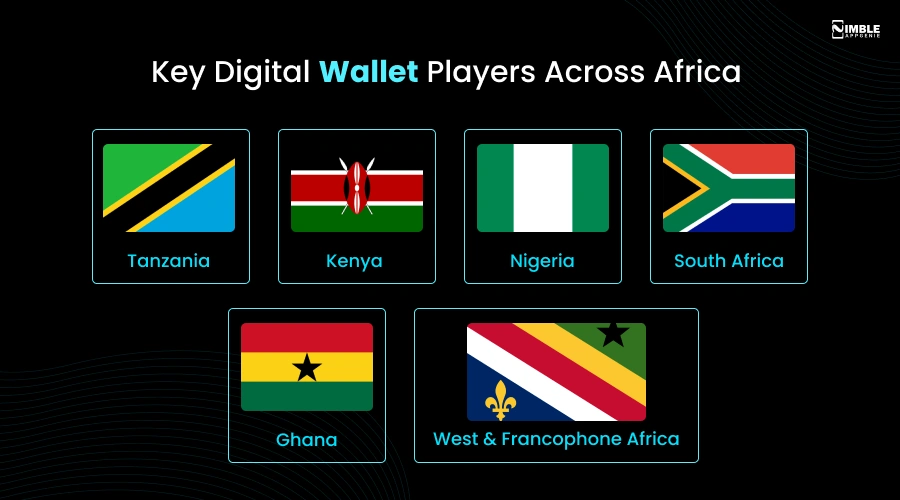
- Tanzania: Mixx (launched by Yas, formerly Tigon Pesa) allows users to transfer money across East Africa and pays quarterly interest on wallet balances.
- Kenya: M-Pesa by Safaricom remains the dominant mobile money service on the continent, still the financial inclusion reference case at scale.
- Nigeria: OPay serves roughly 35 million users via SMS and app, while Pega focuses on bill payments and contactless payments. PalmPay has also scaled rapidly here – more on its backing below.
- South Africa: SnapScan targets QR-code proximity payments, combining informal shops into the digital economy rather than competing head-on with bank apps.
- Ghana: MTN Mobile Money (MoMo) is the dominant wallet; MTN’s MoMo platform has scaled to about 70 million active accounts group-wide across its African markets, processing 900 million and more transactions a month.
- West & Francophone Africa: Orange Money stays a major telco-led player across Francophone West and Central Africa. Wave, an independent fintech founded in Senegal in 2018, has undercut incumbents on price and now operates across roughly 11 countries – Senegal, Côte d’Ivoire, Mali, Burkina Faso, Niger, The Gambia, Sierra Leone, Cameroon, Uganda, and the DRC and recently launched its own commercial bank, Wave Bank Africa, in Côte d’Ivoire, a live example of the wallet-to-bank convergence covered later in this guide.
Player Comparison at a Glance
| Wallet | Country/Region | Backer |
| MTN Mobile Money (MoMo) | Ghana, Uganda + 15 more markets | MTN (telco) |
| Orange Money | West/Central Africa (Francophone) | Orange (telco) |
| Wave | Senegal, Côte d’Ivoire + around 9 more West/Central African markets | Independent fintech |
| Airtel Money | East/West Africa | Airtel (telco) |
| EcoCash | Zimbabwe | Econet (telco) |
| Chipper Cash | Multi-country, cross-border | Independent fintech |
| Vodafone Cash | Egypt | Vodafone (telco) |
| Telecel Cash (formerly Vodafone Cash) | Ghana | Telecel Group (telco) |
| PalmPay | Nigeria | Independent fintech (backed by device-maker Transsion + NetEase) |
Note: Vodafone sold its 70% stake in Vodafone Ghana to Telecel Group in Feb 2023; the wallet fully rebranded from Vodafone Cash to Telecel Cash in Ghana by Feb 2024. Vodafone Cash still operates under that name in Egypt.
Benefits of Digital Wallets in Africa
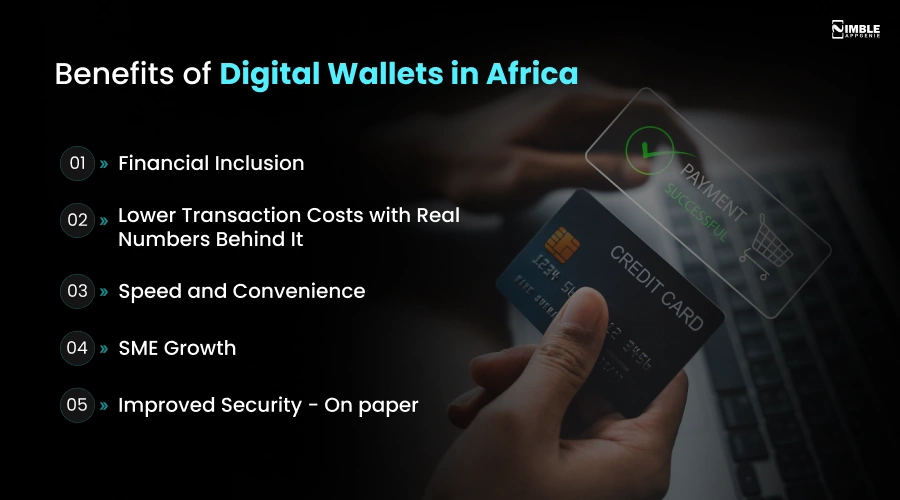
- Financial Inclusion: Millions with no bank account can send, receive, and even save using only a phone – MTN MoMo, M-Pesa, EcoCash, and Airtel Money remain the clearest proof points.
- Lower Transaction Costs with Real Numbers Behind It: Sub-Saharan Africa is the world’s most costly region to send remittances to, averaging 8.78% of the amount sent – almost triple the UN’s 3% target (World Bank Remittance Prices Worldwide, Q1 2025). Mobile-money-native players are undercutting that dramatically: Wave built its complete growth model on a flat approximately 1% transfer fee versus the approximately 10% many incumbents charged. That price gap is the real reason wallets, not banks, are winning the remittance corridor.
- Speed and Convenience: No bank hours. Bill payments, airtime, and transfers settle in seconds. About 44% of adults in Sub-Saharan Africa now hold a mobile money account.
- SME Growth: Small merchants accepting digital payments get reduced cash-handling losses and transparent records – a big part of why merchant payments reached $155 billion in 2025.
- Improved Security – On paper: PINs, encryption, and biometrics reduced theft risk versus cash. (Read more on why “on paper” matters in the challenges section below.)
Technology Behind the Boom
Three technical layers make up the actual infrastructure of an African digital wallet:
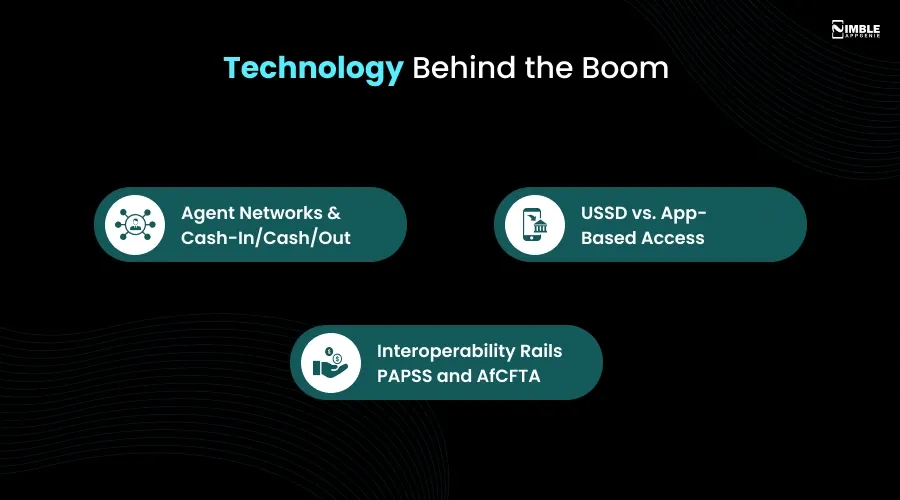
1. Agent Networks & Cash-In/Cash/Out
The understated truth: a wallet is just as useful as the nearest place to convert cash into a digital balance and back. Agent networks – airtime shops, local kiosks, and small retailers are the real last-mile infrastructure, usually hitting deeper into rural areas than bank branches ever did.
Agent density, not app design, is often the deciding factor in which wallet wins a given region
2. USSD vs. App-Based Access
USSD (the *123# style menus that work on any phone) requires no internet connection or smartphone, which is essential in markets where feature phones and patchy data still rule.
App-based access unlocks richer UX, in-app-support, and saving tools, but just works where affordable data and smartphone penetration have caught up. Most successful wallets run both in parallel rather than choosing one; we cover this trade-off in detail in our USSD wallet development guide.
3. Interoperability Rails: PAPSS and AfCFTA
Cross-border payment stays the industry’s biggest unlock. The Pan-Africa Payment and Settlement System (PAPSS) and the African Continental Free Trade Area’s (AfCFTA) digital trade protocols are the two initiatives doing the most to let a wallet in Nigeria settle directly with one in Kenya without routing through a correspondent bank in New York and London.
Any wallet developed for regional needs should plan its API integration strategy around these rails from day one, not retrofit them later.
Challenges & Regulatory Dynamics
Major challenges and what actually solves each one:
| Challenge | Problem | Solution |
| Cybersecurity & fraud | Identity fraud hit 90% of providers in 2025; SIM-swap accounts for approximately 43% of fraud, agent-assisted fraud for another 38% (Technext24). A fraudster gathers a victim’s ID and phone number, gets the number reissued on a new SIM, and every OTP routes straight to them. | Don’t rely on SIM-linked OTP as the last line of defense. Layer in real-time AI fraud detection that scores signals mobile money actually produces: SIM-swap recency, agent float anomalies, USSD session timing plus AI-powered biometric KYC (liveness detection, computer-vision ID checks) at the architecture stage, not bolted on post-launch. Nigeria’s CBN Fintech Report found 87.5% of local fintechs now use AI for fraud detection; it is the default, not a differentiator anymore. |
| Regulatory fragmentation | Licensing, taxation, and data rules differ by every country you expand into. | Build compliance as a configurable layer per market rather than hard-coding one country’s rules. See our breakdown of fintech and digital regulations, and pair it with proper KYC/AML compliance tooling from day one. |
| Interoperability | Users still struggle to move money across different wallets or networks, restricting addressable market size. | Design your API integration strategy around PAPSS and AfCFTA rails from day one rather than retrofitting cross-border support later (see the tech section above). |
| Digital literacy & trust | The real growth blocker: 70%+ of registered accounts sit inactive monthly (WeeTracker/GSMA). In Ethiopia, 60% of women and 54% of men who know about mobile money still don’t know how to use it; Egypt 21%/15%, Nigeria 22%/22%. | Treat activation as a product problem, not a marketing one. Nigerian fintechs are increasingly meeting users on WhatsApp itself, where 100M+ Nigerians already are with AI agents running in Yoruba, Hausa, Swahili, and Pidgin, handling first-transaction walkthroughs, balance checks, and support around the clock. That’s cheaper than a call center and meets the literacy gap where it actually sits inside an app people already know how to use. |
| Limited infrastructure | Patchy power and network coverage constrain agents and user reach in rural regions. | Design for the network you actually have: offline-tolerant sync, lightweight USSD access alongside the app, and agent-network tooling that works on basic Android devices over 3G. |
Regulatory Dynamics to Design around:
- E-money Licensing: Operators need an e-money license or bank partnership to hold and move customer funds legally.
- KYC/AML: Necessary for compliance, but excessively rigid identity requirements can exclude the unbanked users wallets are meant to serve.
- Central Bank Oversight: South Africa, Ghana, Kenya, and Nigeria all run comparatively mature regulatory frameworks.
- Data Protection: Countries increasingly align with the AU’s Malabo Convention, though enforcement varies broadly.
CBDC Pilots: The State-Led Version Of The Same Dormancy Problem
Central banks are running their own wallet experiments, and the outcomes echo the private-sector activation issue above.
Nigeria’s eNaira – Africa’s first CBDC, launched in October 2021 – reached about 13 million wallets by 2025, but 98.5% had never been used for a transaction, per IMF data reported by All Business Africa.
Ghana’s eCedi remains in pilot with no confirmed retail launch as of 2026.
South Africa has taken a distinct path completely: Project Dunbar and Project Khokha target wholesale, interbank settlement rather than consumer-facing digital currency. The pattern holds across both private and public digital money in Africa; issuing an account is easy, but earning a repeat transaction is the real product issue.
Building a Wallet in Africa? Start Here
If you are a bank, fintech founder, or telco deciding whether and how to build, this is the decision sequence that actually matters, more than any design or engineering work.
Choose your Wallet Architecture: Closed, Open, Semi-closed
| Model | How it works | Licensing burden | Best for |
| Closed | Funds usable only within your own ecosystem | Lowest – often no e-money license | Retailers, marketplaces, loyalty brands |
| Semi-closed | Usable across a defined merchant network, not withdrawable to cash | Moderate – e-money license typical | Vertical fintechs (transport, retail networks) |
| Open | Full send, receive, withdraw-to-bank | Highest – license + AML/KYC + often a bank partner | Neobanks, telco mobile money, cross-border remittance |
| Most African digital wallet failures come from founders defaulting to “open wallet” because it looks like M-Pesa – without budgeting for the compliance and banking-partner overhead that model actually requires. |
Compliance Checklist Before You Write A Line of Code
- E-money issuer license secured, or a signed partnership with a licensed bank / mobile money operator
- Data protection posture aligned with local law and the AU’s Malabo Convention where applicable
- KYC/AML pipeline designed around your target country’s identity infrastructure, not a generic global template
- An interoperability plan for PAPSS/AfCFTA readiness, even if cross-border is not in your v1 scope
- Real-time fraud monitoring built in at the architecture stage, with SIM-swap detection specifically addressed
Build vs Partner
Building your own licensed wallet from scratch offers full control but states owning the compliance load directly. Partnering with an already-licensed bank or mobile money operator lets you go to market faster but limits your margin and product flexibility.
The right call relies on your target country, timeline, and how much regulatory maturity you are willing to build in-house versus rent – exactly the sort of scoping conversation worth having before committing to a tech stack.
Nimble AppGenie is a fintech and digital wallet development company that has spent over a decade building exactly this kind of infrastructure for banks, telcos, and fintech founders, not just writing about it.
Most of what is written about digital wallets in Africa is analysis from the outside. We have built it inside. Nimble AppGenie’s fintech team shipped a multi-currency eWallet across 14 African countries – SWAP Africa – now supporting over 10,000 active monthly users and raised $5M+, built to work on affordable Android devices over unreliable 3G, with built-in AML and sanctions screening on each transaction.
We have also built USSD-based eWallets for markets where smartphone penetration is not there yet, and digital microfinance and credit-scoring layers for lenders entering the same ecosystem. Scoping a build? Our complete cost and feature guide covers the details.
AI in Digital Wallets: Where Africa’s Fintech is Actually Headed In 2026
“AI is coming to fintech” is not a prediction; it is already the default operating mode.
Nigeria’s CBN Fintech Report 2025 (released February 2026) found that among fintechs surveyed, 37.5% use AI for both credit scoring and KYC/onboarding, and 62.5% use AI chatbots for customer support – only 12.5% reported no AI use at all. The question for anyone building a wallet now is not whether to use AI – it is where it actually moves the needle versus where it is decoration.
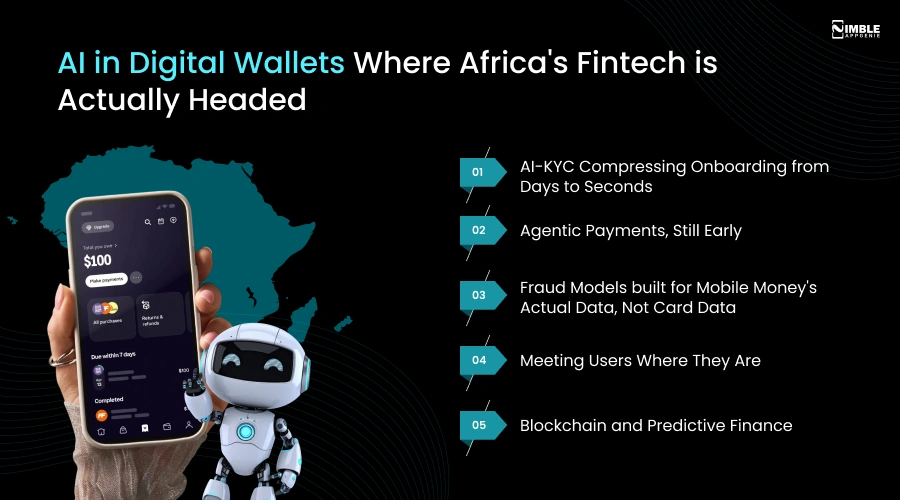
1] AI-KYC Compressing Onboarding from Days to Seconds
Computer-vision document checks, automated sanctions list, and liveness detection are replacing manual document review, essential in markets where formal ID infrastructure is inconsistent across borders.
2] Agentic Payments, Still Early
The next frontier, already in limited production globally, is AI that doesn’t only flag a transaction but initiates and completes multi-step payments within set parameters, starting with treasury and corporate use cases before consumer wallets (EICTA).
Worth watching, not still worth over-building for on a v1 African consumer wallet.
3] Fraud Models built for Mobile Money’s Actual Data, Not Card Data
Mobile money has no merchant category codes or BIN ranges; the real fraud signals are SIM-swap recency, USSD session timing, and agent float anomalies, and African engineering teams are increasingly building models around exactly those signals.
4] Meeting Users Where They Are
Rather than building a new app and hoping for adoption, various Nigerian fintech now run AI agents directly inside WhatsApp.
This is a direct answer to the digital-literacy and dormancy problems covered above – the interface barrier disappears where the “new” wallet lives inside an app people have used for years.
5] Blockchain and Predictive Finance
Smart budgeting and blockchain-based wallet rails (see our work in crypto wallet and DeFi app development) continue moving from pilots toward production roadmaps alongside these AI layers.
Our own experience building AI financial assistants for lending and wallet clients tracks with this data: the AI that actually moves usage numbers is not the flashiest model; it is the one solving the particular, boring issue (SIM-swap fraud, onboarding friction, and local-language support) that’s currently costing the business real money.
Conclusion
As a fintech app development company that has shipped compliant wallets across 14 African countries, Nimble AppGenie would argue the future of finance in Africa is not banks versus wallets; it’s the two becoming the same infrastructure.
The winners over the next five years won’t be whoever launches the flashiest app; they will be the operators who solve for activation and trust at the same time, on top of the right ownership model and architecture from day one.
Is your fintech or telco ready to build that next chapter? Talk to Nimble AppGenie’s fintech team about your fintech idea or wallet roadmap, and see our case studies from African deployments already live.
FAQs
It is a mobile-based financial service commonly known as mobile money that allows users to send, receive, and store money without any need for a traditional bank account, generally accessed via an app or USSD code.
According to Nimble AppGenie’s experts, they remove the two biggest barriers to traditional banking: physical branch access and paperwork-heavy onboarding, letting unbanked users transact using only a mobile phone and, in many markets, an agent network for cash-in/cash-out.
Rarely, at this point. Most banks now partner with mobile money providers to offer bank-to-wallet transfers, treating wallets as an acquisition channel into formal banking rather than a competitor.
Vodafone sold its 70% stake in Vodafone Ghana to Telecel Group in February 2023, and the wallet was fully rebranded to Telecel Cash by February 2024. It is the same wallet and the same underlying accounts, just a new name. Vodafone Cash still operates under that name in Egypt.
Both are major players, but they represent different models. Orange Money is telco-led, built on Orange’s existing mobile network footprint. Wave is an independent fintech that entered at a flat about 1% transfer fee and has grown to roughly 11 countries, recently launching its own commercial bank in Côte d’Ivoire.
By registered accounts and transaction value, Kenya (M-Pesa), Nigeria (OPay, Paga, PalmPay), and Ghana (MTN MoMo, Telecel Cash) lead individually, while East Africa as a region leads on total transaction value and West Africa leads on the number of live mobile money services.
Unlikely in the near term; the trend is convergence, not replacement, say Nimble AppGenie’s experts. Wallets are adding savings, credit, and investment features, while banks integrate wallet rails, so the likely outcome is a blended “bank-to-wallet” system rather than one replacing the other.
Not so far. Nigeria’s eNaira, Africa’s first central bank digital currency, has struggled with adoption; reports put usage at under 2% of issued wallets while mobile money continues to scale. Most African CBDC projects remain in pilot phase or are focused on wholesale/interbank settlement rather than consumer use.
Mainly four ways today: fraud detection tuned to mobile-money-specific signals like SIM-swap recency (used by 87.5% of Nigerian fintechs per the CBN’s 2025 report), AI chatbots for customer support increasingly inside WhatsApp in local languages, AI-powered KYC using computer vision and liveness detection, and AI-driven credit scoring from alternative transaction data. Fully autonomous “agentic payments” are still early and mostly limited to corporate/treasury use cases.
Cost depends heavily on your wallet model (closed, semi-closed, or open), compliance scope, and whether you are building on existing mobile money rails or from scratch. See Nimble AppGenie’s full cost guide, or talk to our team for a scoped estimate.
Most markets require either an e-money issuer license from the national central bank or a partnership with an already-licensed bank or mobile money operator. The right path depends on your country, wallet type, and timeline.

Niketan Sharma, CTO, Nimble AppGenie, is a tech enthusiast with more than a decade of experience in delivering high-value solutions that allow a brand to penetrate the market easily. With a strong hold on mobile app development, he is actively working to help businesses identify the potential of digital transformation by sharing insightful statistics, guides & blogs.
Table of Contents




No Comments
Comments are closed.