

 Free Consultation
 PCI-DSS Compliant
 GDPR Ready
 ISO 27001
 NDA Protected
 AI Services
 AI App Development
 Generative AI Development
 AI Chatbot Development
 AI Integration Services
 AI Consulting Services
 AI For Fintech
 AI Financial Assistant Solution
 AI Insurance Agent Development
 Tech Stack
 OpenAI / GPT-4
 Claude / Anthropic
 Gemini / Google AI
 Llama / Open Source
 LangChain / LlamaIndex
 Pinecone / Pgvector
 AWS / Azure AI


 Fintech Solution
 Core Fintech
 App Development
 Neobank Solutions
 eWallet Solutions
 Lending Software
 Banking Solutions
 BNPL Solutions
 BNPL Solutions
 Insurance App
 Wealth Management
 Crypto & DeFi
 Blockchain Development
  Payroll Software
 DeFi Solutions
 Crypto Wallet
 Crypto On/Off Ramp
 Crypto Exchange
 Trading Platform
 Payments
 Compliance
 Regulations & Compliance
 Fraud Detection
 Lending Ecosystem
 P2P Lending Platform
 Mortgage Software
 Engagement
 Fintech Outsourcing

 Mobile Development
 Mobile App Dev
 iOS App Development
 Android App Development
 React Native
 Flutter Development
 Web Solution
 Node.js Development
 React.js Development
 Angular Development
 App Services
 UI/UX Design
 App Maintenance
 By Stage
 MVP Development
 Industry Solutions
 Healthcare App Dev
 Education App Dev
 Travel App Dev
 Real Estate App Dev
 Logistics Software
 Social Media App

 Hire Mobile Developers
 Hire iPhone Developers
 Hire Android Developers
 Hire React Native Devs
 Hire Flutter Developers
 Hire Web Developers
 Hire Node.js Developers
 Hire Angular Developers
 Hire PHP Developers
 Hire Laravel Developers
 How It Works
 Pre-Vetted Developers
 Ready In 48 Hours
 NDA From Day One
 Replace Guarantee
 Company
 About Us
 Our Work Process
 Portfolio
 Case Studies
 Blog / Insights
 Careers
 Contact Us
 Awards
 Recognition


 Offices



Key Takeaways:
- Digital microfinance uses AI-driven credit scoring and mobile data to lend to Africans with no formal credit history – no branch visit, no collateral.
- Mobile money adoption in Sub-Saharan Africa jumped 13.21 % CAGR through 2031, outpacing the global microfinance market average.
- Mobile money adoption in Sub-Saharan Africa jumped from 27% to 40% of adults (2021-2024), but only about 7% have actually borrowed through a mobile account – credit is the underused layer on top of payments infrastructure that already works.
- Tala, M-Shwari, FairMoney, and Branch prove the model works, but multi-borrowing, country-by-country licensing, and pricing transparency are the real risks to design around.
- Nimble AppGenie builds digital microfinance platforms – mobile disbursement, credit scoring engines, and fraud controls for startups, NBFCs, and banks entering the African market.
Africa’s unbanked population is no longer “unbanked” in the way it used to be. It’s “under-credited”.
Millions of people across Sub-Saharan Africa now have a mobile money account, a transaction history, and a smartphone, but no formal credit score. Digital microfinance exists to close the exact gap, and it’s expanding faster than almost any other fintech category on the continent.
This guide covers what digital microfinance is, how big the Africa-specific opportunity is, who is already winning, and the regulatory realities any new entrant demands to plan around.
What is Digital Microfinance?
Digital microfinance is the delivery of small, short-term loans (and relevant services like micro-savings and micro-insurance) completely through mobile apps, agent networks, or USSD, without collateral, paperwork, or a branch visit.
It’s created on three things traditional microfinance institutions (MFIs) never had at scale:
- Instant Disbursement: Loans land in a mobile wallet in minutes, usually through the same mobile payment infrastructure used for everyday transactions.
- Alternative Credit Scoring: Using mobile money transaction history.
- Automated Underwriting: Machine learning models that approve or decline an application without a human loan officer.
It’s a close cousin to the USSD-based mobile money systems we have covered in our USSD payment solution guide for Africa. But where USSD wallets move money, digital microfinance platforms decide who gets to borrow it, how much, and on what terms.
Let’s check the numbers explaining why fintech investors and bank CTOs keep circling back to this space.
| Metric | Figure |
| Global microfinance market size, 2026 | $285.03 billion |
| Projected global market size, 2031 | $480.73 billion |
| Global CAGR (2026–2031) | 11.02% |
| Middle East & Africa CAGR (through 2031) | 13.21% (above global average) |
| Licensed digital credit providers in Kenya (April 2026) | 227 Providers |
| Digital loans issued in Kenya (as of Feb 2026) | 7.5 million loans worth KSh 133.5 billion |
| Licensed digital lending platforms in Nigeria | 457+ Apps |
Most reports skip that mobile money adoption has surged, but credit adoption is still catching up.
Mobile money account ownership in Sub-Saharan Africa jumped from 27% of adults in 2021 to 40% in 2024, according to the World Bank’s Global Findex Database, yet only about 7% of adults actually borrowed through a mobile account in 2024, accounting for nearly 60% of all formal borrowing in the region. Savings and payments went mainstream first.
Credit is the new wave, not the current one; that’s why this is still an open market rather than a saturated one.
Two takeaways for anyone evaluating this space:
- Africa is growing faster than the global average: This isn’t a mature, saturated category; it’s still in expansion mode.
- Regulation is catching up fast: Kenya’s jump to 227 licensed providers, with stricter rules in draft, signals that compliance-by-design is no longer optional; check our breakdown of fintech and digital regulations for what this means for new entrants.
What People Are Actually Asking About Digital Microfinance Apps in Africa?
Seeing improved market figures, the would-be founders and users seek answers to the questions.
Let’s clear it all up.
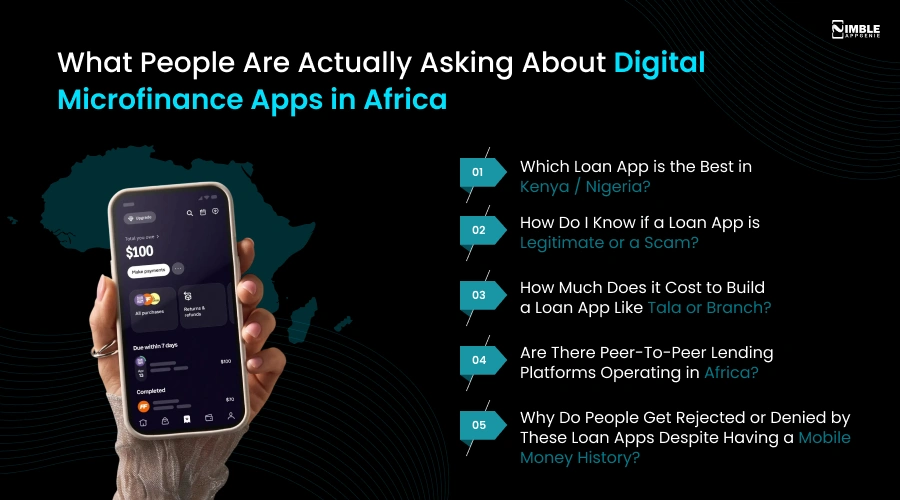
1. Which Loan App is the Best in Kenya / Nigeria?
This is one of the most frequently asked questions on Quora and forums, and the genuine answer is “it depends on licensing and transparency, not just brand.” Branch and Tala lead in Kenya; FairMoney, Carbon, and PalmCredit lead in Nigeria, but users repeatedly flag that licensed, CBN- or CBK-regulated apps are safer bets than unlicensed ones.
2. How Do I Know if a Loan App is Legitimate or a Scam?
A recurring concern across user forums: “fake loan apps” that advertise low rates (e.g., 2%) but charge effective rates well above 10%, use aggressive contact-list harassment for collections, or operate without a banking license.
This is a real trust gap in the market and a real product differentiation opportunity for compliant platforms. Google Play’s own policy now needs loan apps to disclose full APR and avoid contact-list access for collections.
3. How Much Does it Cost to Build a Loan App Like Tala or Branch?
You can find these questions asked repeatedly in founder and developer forums. Quoted answers online vary widely (from a few thousand dollars to six figures) because most don’t account for the credit-scoring engine, which is the real cost driver, not the app shell. See our detailed cost breakdown for the real number.
4. Are There Peer-To-Peer Lending Platforms Operating in Africa?
Yes, though most “digital microfinance” activity in Africa is app-to-consumer lending (Tala, Branch, and FairMoney) rather than true peer-to-peer. A small number of blockchain-based P2P platforms (e.g., Bitbond) operate across African markets including Kenya, but adoption is far smaller than app-based microlending.
5. Why Do People Get Rejected or Denied by These Loan Apps Despite Having a Mobile Money History?
A common frustration in user discussions: recent SIM swaps, irregular transaction patterns, or thin transaction history can all trigger automatic declines from scoring algorithms – this is a real UX and fairness challenge digital lenders are still working through, not a solved problem.
We break down how to design around this explainable scoring, bias testing, and reason codes regulators can review in our AI microfinance software guide.
Who is Already Winning: Digital Microfinance Players in Africa
| Platform | Market | Model |
| M-Shwari | Kenya | Bank-telco partnership (NCBA + Safaricom) built on M-Pesa; largest share of Kenya’s digital credit market |
| Tala | Kenya, and expanded to the Philippines, Mexico, and India | Standalone app using smartphone and mobile money data for AI-driven scoring |
| Branch | Kenya, Nigeria, Tanzania | Algorithm-driven credit scoring using device and social data |
| FairMoney | Nigeria | Started as an instant-loan app, now holds a microfinance bank license from the Central Bank of Nigeria |
| JUMO | Multiple Sub-Saharan markets | AI-driven lending infrastructure powering bank partnerships, including a 2024 financing deal with Standard Bank in Uganda |
| Carbon (formerly Paylater) | Nigeria | Evolved from a loan app into a full digital bank with savings and bill pay |
The pattern across all of them: none stayed a single-product loan app for long. FairMoney and Carbon became licensed banks. Tala added savings tools. JUMO became infrastructure for other banks. The lending product is the entry point – not the end state.
That’s the same trajectory we have witnessed play out in eWallet app development across the region, where a single-feature app hardly survives past year two.
Why This is a Business Opportunity For Fintech Startups?
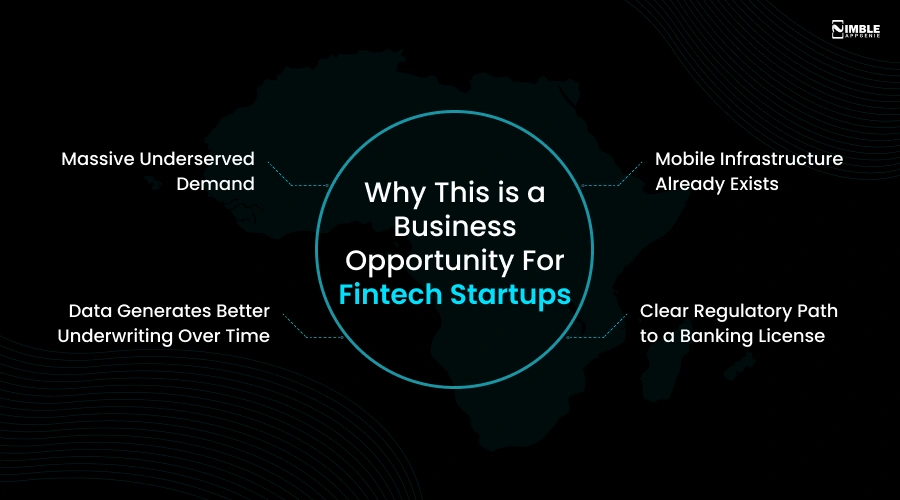
► Massive Underserved Demand
Over 2 billion people stay unbanked globally, and Sub-Saharan Africa carries a disproportionate share. Each represents a potential first-time borrower with no existing relationship with a bank or lender.
► Data Generates Better Underwriting Over Time
Every repaid loan improves the credit model. This creates a compounding advantage for early-launching platforms and ones that scale their data set more rapidly than competitors.
► Mobile Infrastructure Already Exists
You are not building on bare ground. USSD networks, mobile money rails, and smartphone penetration are already in place – the same infrastructure covered in our mobile payment technology breakdown. A lending app plugs into rails that already carry money.
► Clear Regulatory Path to a Banking License
Several players (M-Shwari, FairMoney) used a lending app as the on-ramp to a full microfinance bank license. A digital microfinance app can be step one of a much larger institution.
Already Decided to Build? Here’s Where to Go Deeper
Once you have validated the Africa opportunity, the build process itself is not unique to this region. Our P2P lending app build guide walks through the comprehensive development process step by step; our loan lending app cost breakdown covers pricing tiers in detail.
For a closer African market reference point specifically, see our FairMoney development cost guide.
Risks And Regulatory Realities to Design Around
Digital microfinance is not risk-free, and ignoring this in product design is how apps get pulled from app stores.
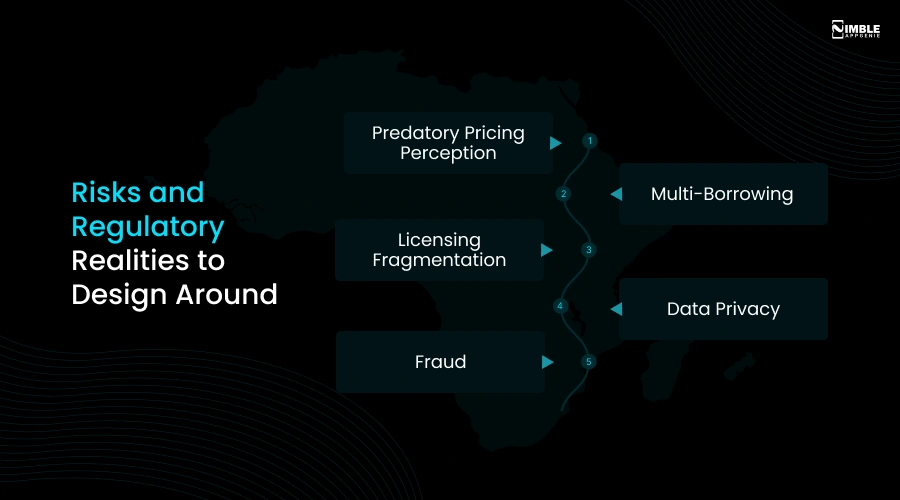
♦ Predatory Pricing Perception
Flat fees that look small can annualize into triple-digit APR (Annual Percentage Rates). Transparent, upfront total-cost disclosure is not only good practice – regulators are starting to require it.
♦ Multi-Borrowing
Many users borrow from one app to repay another. Build cross-platform default checks into your risk model from day one.
♦ Licensing Fragmentation
A model compliant in Kenya may not be compliant in Uganda or Nigeria. Multi-country expansion demands a country-by-country compliance review, not a copy-paste rollout.
♦ Data Privacy
Apps that demand full contact, phone, and SMS access without clear consent are facing increasing user pushback and regulatory action. Build minimal, consent-based data collection.
♦ Fraud
Synthetic identities and account takeover are rising issues in mobile lending. Pair this build with a dedicated fraud detection system and make sure your tech stack is built for the security and compliance load this category needs.
Why Choose Nimble AppGenie For Digital Microfinance App Development?
Nimble AppGenie has spent over seven years building fintech products for markets exactly like these – high mobile penetration, low traditional banking access, and a need for products that work on real-world connectivity, not best-case scenarios.
We have delivered 350+ projects for 250+ clients globally, including fintech platforms like SatPay and DafriBank, built specifically for the African market and operating conditions.
Our lending and credit infrastructure work covers:
- Alternative credit scoring engine design and integration.
- Mobile money and USSD disbursement integration.
- Multi-country regulatory and compliance structuring.
- Fraud detection and risk monitoring dashboards.
- End-to-end P2P and digital lending platform development.

Conclusion
Digital microfinance in Africa is not a speculative trend; it’s already a multi-million-dollar, multi-country industry with clear regulatory frameworks forming around it. The opportunity is real, but so is the operational complexity: fraud prevention, credit scoring, and compliance can’t be afterthoughts.
Validate the market, understand the regulatory landscape of your target country, and build toward a real financial institution, not just an app.
FAQs

Niketan Sharma, CTO, Nimble AppGenie, is a tech enthusiast with more than a decade of experience in delivering high-value solutions that allow a brand to penetrate the market easily. With a strong hold on mobile app development, he is actively working to help businesses identify the potential of digital transformation by sharing insightful statistics, guides & blogs.
Table of Contents




No Comments
Comments are closed.