

 Free Consultation
 PCI-DSS Compliant
 GDPR Ready
 ISO 27001
 NDA Protected
 AI Services
 AI App Development
 Generative AI Development
 AI Chatbot Development
 AI Integration Services
 AI Consulting Services
 AI For Fintech
 AI Financial Assistant Solution
 AI Insurance Agent Development
 Tech Stack
 OpenAI / GPT-4
 Claude / Anthropic
 Gemini / Google AI
 Llama / Open Source
 LangChain / LlamaIndex
 Pinecone / Pgvector
 AWS / Azure AI


 Fintech Solution
 Core Fintech
 App Development
 Neobank Solutions
 eWallet Solutions
 Lending Software
 Banking Solutions
 BNPL Solutions
 BNPL Solutions
 Insurance App
 Wealth Management
 Crypto & DeFi
 Blockchain Development
  Payroll Software
 DeFi Solutions
 Crypto Wallet
 Crypto On/Off Ramp
 Crypto Exchange
 Trading Platform
 Payments
 Compliance
 Regulations & Compliance
 Fraud Detection
 Lending Ecosystem
 P2P Lending Platform
 Mortgage Software
 Engagement
 Fintech Outsourcing

 Mobile Development
 Mobile App Dev
 iOS App Development
 Android App Development
 React Native
 Flutter Development
 Web Solution
 Node.js Development
 React.js Development
 Angular Development
 App Services
 UI/UX Design
 App Maintenance
 By Stage
 MVP Development
 Industry Solutions
 Healthcare App Dev
 Education App Dev
 Travel App Dev
 Real Estate App Dev
 Logistics Software
 Social Media App

 Hire Mobile Developers
 Hire iPhone Developers
 Hire Android Developers
 Hire React Native Devs
 Hire Flutter Developers
 Hire Web Developers
 Hire Node.js Developers
 Hire Angular Developers
 Hire PHP Developers
 Hire Laravel Developers
 How It Works
 Pre-Vetted Developers
 Ready In 48 Hours
 NDA From Day One
 Replace Guarantee
 Company
 About Us
 Our Work Process
 Portfolio
 Case Studies
 Blog / Insights
 Careers
 Contact Us
 Awards
 Recognition


 Offices



TL;DR
- An invoice financing platform for a supply chain business helps suppliers to borrow money and get early financing.
- The working process begins with application and approval, invoice submission, funding disbursement, and customer payment settlement.
- The overall cost to create an invoice financing platform varies from $30,000 to $150,000. This cost varies due to factors such as complexity, design, and core development.
- To minimize this total cost, you should opt for strategies such as beginning with an MVP, using APIs, choosing a hybrid model, automating invoice verification, and building one market and the financing product.
- Partnering with Nimble AppGenie can help you build a simplified invoice financing platform for your supply chain business.
Your suppliers wait 30, 60, sometimes 90 days, which causes delays in the completion of payment cycles. This is one of the crucial reasons that an invoice financing platform is important for your supply chain business.
The invoice financing platform market is witnessing exponential growth, projected to rise from $15.46 billion in 2025 to $18.72 billion in 2026.
To contribute to this growing market, you can invest in its development.
Therefore, as a supply chain business, you should be aware of the total cost it takes to create an invoice financing platform.
Here is the complete guide detailing the overall cost to make an invoice financing platform for your supply chain business, starting from the concept,
how it works, costs, factors, and cost minimization strategies.
What is an Invoice Financing Platform?
An invoice financing platform is a digital service that lets businesses borrow money against their unpaid customer bills. The company uses its unpaid invoices as collateral to secure cash from a financial provider, repaying the advance with interest once customers settle their accounts.
This is a financing service that lets businesses access cash by using their unpaid invoices. Companies use their unpaid invoices as collateral to secure immediate cash from a financial provider.
When it comes to supply chain businesses, an invoice financing platform is a digital system that helps the suppliers borrow money or get early cash advances using their unpaid customer invoices.
Let’s learn about how an invoice financing platform works for a supply chain business in the next section.
How Does an Invoice Financing Platform Work for a Supply Chain Business?
An invoice financing platform works for a supply chain business by beginning with application and approval, invoice submission and verification, funding disbursement, customer payment, and settlement.
In the invoice financing arrangement, three parties are involved, including the business that issues the invoice, the customer that receives the invoice, and the financial services company.
Steps to create an invoice financing platform for a supply chain business:
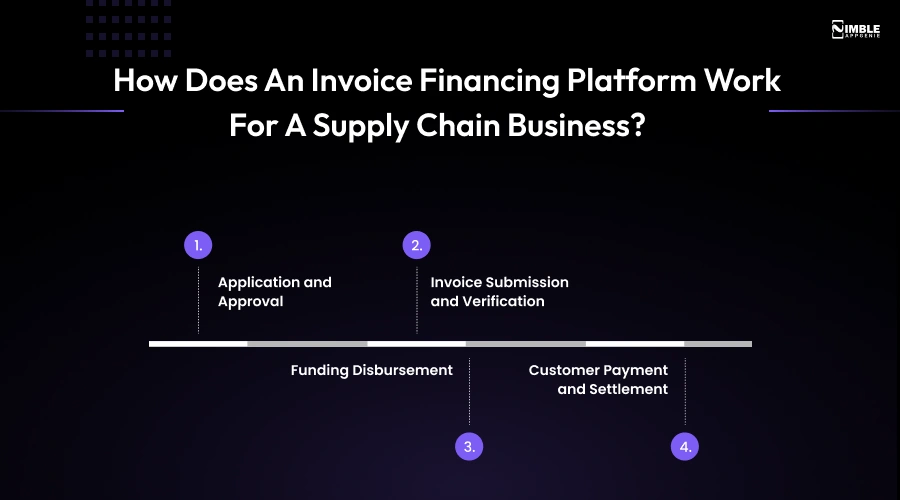
Step 1: Application and Approval
In this first step, you should submit the basic business info and details related to your customers and invoice volumes so the lender can assess the customer’s creditworthiness. Here, you should create a clear, digital application and approval workflow.
Step 2: Invoice Submission and Verification
This is the second step because it validates the financial transaction after the goods ship. Invoice verification is where the financial control meets the operational speed. It is the disciplined verification of invoices against what was ordered, received, and agreed.
Step 3: Funding Disbursement
Funding disbursement is the third step because it bridges the gap between planning and execution. It occurs after the transaction is validated and before the goods are delivered or paid for by the end buyer. It is when the platform and the lender transfer a cash advance directly to the bank account.
Step 4: Customer Payment and Settlement
In this step, once the end customer pays the invoice, the payment is routed through the platform or lender directly when the invoice becomes due. Now, the platform deducts its fees and settles the remaining balance with the business or lender, completing the financing cycle.
Here, one of the important questions asked is, “Can I add invoice financing to my existing supply chain or B2B platform instead of building from scratch?”
Yes, you can. You can go for both options as per your requirements. You need to check here what you need to add. Select embedding invoice financing platform for your supply chain business when you want speed and low upfront costs, while you need to choose building an invoice financing platform from scratch when you want custom invoice financing and total control.
Also Read: Digital Transformation in Financial Services
Let’s look at both points in the following section.
Build Invoice Financing from Scratch vs. Embed Invoice Financing in an Existing Platform
Building invoice financing from scratch can cost you more than embedding invoice financing in a supply chain business.
In simple terms-
Building invoice financing from scratch =
Initial technology investment + compliance + security + maintenance + potentially significant funding/credit risk.
Embedding into an existing platform =
Much lower upfront cost + integration API cost + provider financing
The cost of building invoice financing from scratch can be more or less, depending on whether you are creating a lending financing system or a complete software solution by yourself.
Here’s a complete view of “how to develop invoice management software vs embed invoice financing in supply chain businesses”
| Factor | Build from Scratch | Embed in Existing Platform |
| Cost | $30,000 – $150,000 | $15,000 – $50,000 |
| Timeline | 4 – 9 months | 6 – 12 weeks |
| What you’re building | A brand-new, standalone invoice financing platform | An invoice financing module added to your existing supply chain/B2B platform |
| Core Tech | Full architecture, custom UI/UX, own database & infra | Uses existing platform’s infra; adds APIs & new modules |
| Compliance Setup | Built from zero (KYC/AML, data security, licensing) | Partly reuses existing platform’s compliance layer |
| Integrations | ERP, financier, payment gateway — all built fresh | Plugs into ERP/financier via APIs, less custom work |
| Risk & Fraud Engine | Custom-built AI risk scoring | Can use lightweight/pre-integrated risk models |
| Best For | New fintech startups launching financing as their core product | Existing supply chain/procurement platforms adding financing as a feature |
| Scalability | Fully customizable, no platform limitations | Limited by existing platform’s architecture |
| Business Goal | Own the entire financing product & user base | Increase retention, add revenue stream to current users |
For the supply chain businesses, you can consider the above costs too, as both the supply chain options can help you to improve and excel in your finances.
Building from scratch will offer you more control over your supply chain businesses; however, embedding in a financing system can be helpful in lowering overall costs.
Here, most of the supply chain businesses often ask, “How much does it cost to build an invoice financing platform for your supply chain business?”
The overall cost can vary from $30,000 to $150,000. This cost can be further impacted by different factors, such as the complexity of the platform, supply chain complexity, and the skills of the developers.
Bonus Read: Fintech App Development Cost
In the next section, let’s understand the cost in detail.

How Much Does it Cost to Build an Invoice Financing Platform for Your Supply Chain Business?
The complete cost to create an invoice financing platform for your supply chain business can vary from $30,000 to $150,000. However, there are multiple factors that you should be concerned about.
Building from scratch will take more of your time and capital; it will also have a large impact on the timeline, as more investment can help you to get your invoice financing fast.
Here is the complete breakdown of an invoice financing platform for your supply chain business:
| Factor | Cost Range | Why It Impacts Cost |
| Platform Complexity & Features | $8,000 – $30,000 | Basic invoice upload/tracking vs. full workflow automation |
| UI/UX Design | $3,000 – $10,000 | Custom dashboards for buyers, suppliers & financiers |
| Core Development (Frontend + Backend) | $10,000 – $50,000 | Main engine handling invoices, users & transactions |
| AI-Based Risk & Fraud Scoring | $5,000 – $20,000 | Smart credit checks and fraud detection add complexity |
| ERP/Accounting Integrations | $3,000 – $15,000 | Connecting with SAP, Tally, QuickBooks, etc. |
| Financier/Lender Integration | $3,000 – $12,000 | APIs to connect multiple funding partners |
| Compliance & Security (KYC/AML, Data Protection) | $5,000 – $20,000 | Regulatory checks, encryption, secure data handling |
| Admin Panel & Reporting Dashboard | $2,000 – $8,000 | Tracking, analytics, and control for platform owners |
| Testing & QA | $2,000 – $10,000 | Ensures security, accuracy & smooth performance |
| Post-Launch Support & Maintenance | $1,000 – $5,000+ (recurring) | Updates, bug fixes, scaling support |
Following the above cost parameters, let’s study the factors in detail in the following section.
Factors Impacting the Overall Cost to Build an Invoice Financing Platform for Your Supply Chain Business
Different factors include platform complexity, design, core development, accounting integrations, AI-based risk scoring, and post-launch support, along with compliance and security.
Here is the complete list of different factors impacting the total cost of building an invoice financing platform for your supply chain:
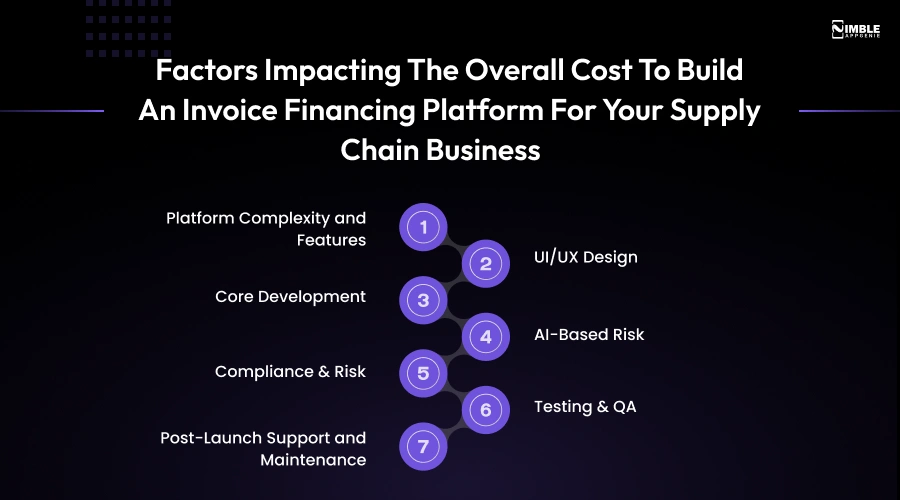
1. Platform Complexity and Features
Users have a variety of devices, and supporting them all is one of the challenges that can impact your cost to create an invoice financing platform for your supply chain business.
This all requires a high cost, as creating an invoice platform for supply chains requires you to comply with platform regulations.
2. UI/UX Design
An effective design for an invoice financing platform shapes the total cost for your supply chain by reducing the development rework, lowering the customer support expenses, and accelerating user onboarding.
Smooth functionality and engagement impact the total cost. Fintech app design choices impact the cost by dictating frontend complexity and integration depth, which improves the user experience for supply chain managers and employees working with the supply chain.
3. Core Development
Building the complete invoice financing platform has a large impact on the core development. It sets the technical foundation and takes up to 50% of the total cost to build an invoice financing platform for your supply chain business.
Core development is all about building trust, lowering operational costs, and ensuring secure, real-time data flow. It can look similar to a fintech tech stack for your supply chain business.
4. AI-Based Risk
AI-based risk management helps supply chain financing platforms by predicting financial threats and checking borrower credit safely. It impacts costs through high initial investment in machine learning models, securing data integration along with compliance systems.
It is an advanced tool that lowers long-term fraud and default expenses, but they demand continuous monitoring.
5. Compliance & Risk
The fintech regulations increasingly influence supply chain finance at the design level. This extends beyond the financial risk. Here, ESG considerations influence how programs assess supplier accessibility and suitability.
The regulations increasingly influence supply chain finance at the design level. The clearer definition around obligations and reporting does force the program to formalise once informal processes.
6. Testing & QA
Fintech app testing and QA typically consume 20% to 30% of the overall budget while creating a supply chain invoicing financing platform. Cutting corners on QA leads to massive financial and legal risks.
Quality assurance and quality control are closely related, and they serve different functions that help you to deliver progressive supply chains. It impacts cost through tools and other determinants.
7. Post-Launch Support and Maintenance
Another important factor to consider here is post-launch support and maintenance, which typically accounts for 15% to 25% of the initial development costs annually. After launching the platform, you need to maintain it according to the current sustainability requirements.
This represents the largest long-term financial variable for an invoice financing platform. This factor helps with security updates, fintech API integrations, risk management, and fraud detection.
How to Minimize the Cost to Create an Invoice Financing Platform for Your Supply Chain Businesses?
Managing the supply chain may feel like directing a play, and deciding the cost to build an invoice financing platform for your supply chain businesses can seem like solving a puzzle.
But not anymore. With the right estimation of the cost to build an invoice financing platform for your supply chain businesses, you should be aware of the right strategies to minimize the total cost.
Hence, here are the right strategies for minimizing the total cost:
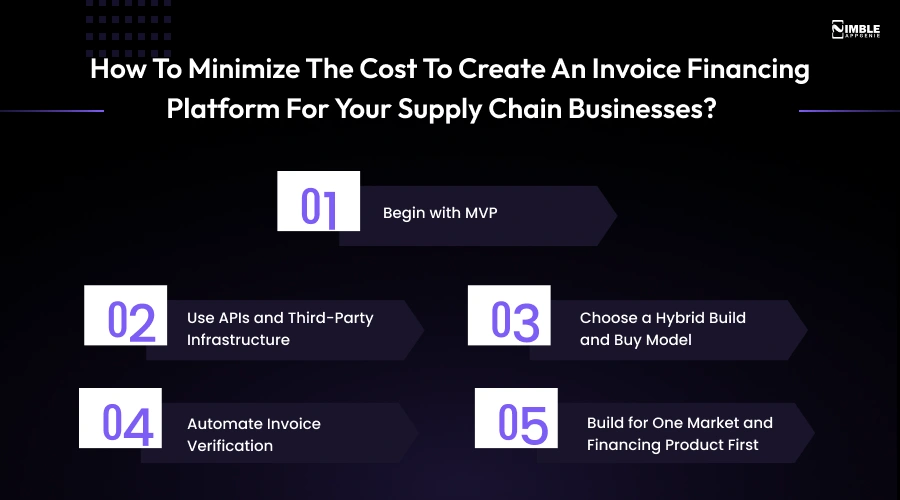
1. Begin with MVP
Starting with building an MVP can assist you in cutting down costs by creating only core features first. Here, you spend less time and money upfront. Avoid building advanced analytics and complex AI underwriting at the beginning of the project.
It will automatically save costs by primarily investing in the small project first.
2. Use APIs and Third-Party Infrastructure
To create the APIs and third-party infrastructure for the non-core functions. Here, instead of building each and every component internally, integrate the APIs for functions such as KYC/KYB verification. Select the best fintech APIs as per your requirements.
Invoicing APIs are the programmatic interfaces that will help you to embed the invoice creation, along with accounts receivable management, for your applications.
3. Choose a Hybrid Build and Buy Model
If you are confused between build and buy models, you don’t need to choose only one. Here, the cost-efficient approach is to create the overall customer-facing experience, supply chain workflows, invoice management, and business logic.
This hybrid app development framework offers you more control over the user experience by avoiding the cost of recreation.
4. Automate Invoice Verification
Automating invoice verification means using the software to create the steps that are used for handling the invoices. It reduces the need for manual data entry and processing, which can save time and reduce errors.
It even requires a three-step process capturing the invoice data with optical character recognition that uses the software for matching purchase orders, goods receipts, and invoices without human work.
5. Build for One Market and Financing Product First
You should build for one market and support only one geographical market. It is important to build with one country, one customer segment, and one funding model.
Here, you need to pick one specific buyer group and need to solve their main money problem with a simple offer.
Which is the Best Company to Create an Invoice Financing Platform for Supply Chain Businesses?
Nimble AppGenie is the best fintech app development company, offering an effective solution for creating an invoice financing platform for supply chain businesses. Here, you can create scalable B2B financial tools and multi-currency digital wallets for streamlining complex vendor transactions.
Here’s why you should connect with Nimble AppGenie:
1. AI-Powered Credit Decisioning
The engineers at Nimble AppGenie are capable of creating AI-powered credit decisioning and are highly effective because they specialize in combining AI-driven fintech architecture and secure banking-ecosystem integrations. Nimble AppGenie is the best AI app development company offering end-to-end AI solutions.
2. Offers Multi-Currency Support
Whether you want to create the app for Australia, the USA, or Europe, with the experts at Nimble AppGenie, you will get 100% support for multi-currency to be built into your invoice financing platform for your supply chain business.
3. Niche in Finance and Proven Expertise
Nimble AppGenie’s engineers offer complete support in finance, as the developers can create a scalable B2B platform with automated payment systems and multi-currency digital wallets for streamlining complex vendor transactions.
Additionally, we have delivered 350+ projects, that make us a well-experienced company.
Conclusion
The overall cost to create an invoice financing platform for your supply chain business depends on different factors such as complexity of the app, design, core development, AI-based risk, compliance and risk, testing, post-launch support, and maintenance.
Additionally, to minimize the total cost of building an invoice financing platform, you should begin with an MVP, use APIs and third-party infrastructure, choose a hybrid infrastructure, automate verification, and create one market and financing product.
You can connect with an experienced company to estimate the right cost for creating a customized invoice financing platform for your supply chain business.
FAQs
The overall cost to make an invoice financing platform varies from $30,000 to $150,000. This cost is impacted by several factors such as platform complexity, design, core development, AI-based risk, compliance, testing, and post-launch support.
MVP is a small project that is designed to know the demand in the market for your new software. However, a full-scale invoice financing platform is the complete platform that comprises the design, tech stack, testing, and then launching the complete platform.
If you plan to use your own capital to fund and discount invoices, you legally require an NBFC license because other countries use different licensing regimes, and invoice financing is regulated differently from ordinary lending.
Yes, you can add invoice financing to the existing supply chain or B2B platform by utilizing embedded finance infrastructure and specialized B2B lending APIs. You can integrate white-labeled financing directly into your software workflow. Here, third-party providers handle the regulatory compliance and capital allocation.
Building a custom financing platform typically takes 6 to 12 months from initial planning to market launch. Here, the exact duration depends on 6 to 12 months from initial scoping to a live and compliant launch.
AI-based credit scoring impacts the development cost, which often ranges from $50,000 to $200,000. Different determinants comprise the complexity of your platform, along with the skills of the developers.

Niketan Sharma, CTO, Nimble AppGenie, is a tech enthusiast with more than a decade of experience in delivering high-value solutions that allow a brand to penetrate the market easily. With a strong hold on mobile app development, he is actively working to help businesses identify the potential of digital transformation by sharing insightful statistics, guides & blogs.
Table of Contents




No Comments
Comments are closed.