

 Free Consultation
 PCI-DSS Compliant
 GDPR Ready
 ISO 27001
 NDA Protected
 AI Services
 AI App Development
 Generative AI Development
 AI Chatbot Development
 AI Integration Services
 AI Consulting Services
 AI For Fintech
 AI Financial Assistant Solution
 AI Insurance Agent Development
 Tech Stack
 OpenAI / GPT-4
 Claude / Anthropic
 Gemini / Google AI
 Llama / Open Source
 LangChain / LlamaIndex
 Pinecone / Pgvector
 AWS / Azure AI


 Fintech Solution
 Core Fintech
 App Development
 Neobank Solutions
 eWallet Solutions
 Lending Software
 Banking Solutions
 BNPL Solutions
 BNPL Solutions
 Insurance App
 Wealth Management
 Crypto & DeFi
 Blockchain Development
  Payroll Software
 DeFi Solutions
 Crypto Wallet
 Crypto On/Off Ramp
 Crypto Exchange
 Trading Platform
 Payments
 Compliance
 Regulations & Compliance
 Fraud Detection
 Lending Ecosystem
 P2P Lending Platform
 Mortgage Software
 Engagement
 Fintech Outsourcing

 Mobile Development
 Mobile App Dev
 iOS App Development
 Android App Development
 React Native
 Flutter Development
 Web Solution
 Node.js Development
 React.js Development
 Angular Development
 App Services
 UI/UX Design
 App Maintenance
 By Stage
 MVP Development
 Industry Solutions
 Healthcare App Dev
 Education App Dev
 Travel App Dev
 Real Estate App Dev
 Logistics Software
 Social Media App

 Hire Mobile Developers
 Hire iPhone Developers
 Hire Android Developers
 Hire React Native Devs
 Hire Flutter Developers
 Hire Web Developers
 Hire Node.js Developers
 Hire Angular Developers
 Hire PHP Developers
 Hire Laravel Developers
 How It Works
 Pre-Vetted Developers
 Ready In 48 Hours
 NDA From Day One
 Replace Guarantee
 Company
 About Us
 Our Work Process
 Portfolio
 Case Studies
 Blog / Insights
 Careers
 Contact Us
 Awards
 Recognition


 Offices



Key Takeaways:
- Legal billing automation is more than sending invoices faster; it needs to handle client and matter billing, IOLTA trust accounting, and escrow as three connected but legally distinct workflows.
- Generic billing software can’t separate trust funds from operating funds the way state bar rules require. That gap is where most legal-tech platforms get into trouble.
- Three-way reconciliation, client ledgers, and audit trails are not “nice to have” reporting features; they are the difference between passing a bar audit and facing discipline.
- Build vs. buy comes down to one question: is billing and trust infrastructure a feature of your platform, or is it the product? If it’s the product, buying a generic tool and bolting it on rarely survives contact with a real audit.
- The experienced fintech team at Nimble AppGenie builds compliance-first billing, trust accounting, and payment infrastructure for legal-tech and fintech platforms with the ledger, reconciliation, and audit architecture designed in from day one, not patched on afterward.
“Can billing software handle IOLTA trust accounts?” The answer is sometimes, but rarely as seamlessly as standard billing features. Legal billing automation needs to treat trust accounting, client billing, and escrow-related workflows as distinct financial processes, rather than adding a “law firm” label to a generic invoicing system.
If you are building or buying a platform for law firms, that distinction matters. The system must keep client funds properly separated, maintain accurate matter-level records, and support reconciliation and audit trails.
Most articles on this topic are written for lawyers comparing off-the-shelf tools such as Clio. This guide takes the other side of the market: legal-tech founders, product leaders, CTOs, and legal fintech startups evaluating whether to build billing and trust infrastructure into their own platforms and what that actually takes.
Here, you will learn what to build, what to buy, and how to design the financial workflows for accuracy, security, and audit readiness.
What is Legal Billing Automation?
Legal billing automation is the cluster of workflows and systems that handle a law firm’s money movement without manual entry at every step: matter-based invoicing, time capture, retainer tracking, online payments, and, critically, trust (IOLTA, Interest on Lawyers’ Trust Accounts) accounting and reconciliation. It’s not one feature, but a stack of a billing engine, a ledger, and a payment layer that keeps client funds separate from firm funds at all times.
The confusion starts because “billing automation” in most software categories means one thing: generate an invoice, collect a payment, close the loop. In legal, that loop has a second, parallel loop running beneath it – client trust funds the firm holds but doesn’t own, governed by rules that carry real professional consequences if they are handled wrong.
Why Generic Billing Software Falls Short For Law Firms
Here’s the gap most platforms fall into: they build fast, flexible invoicing using a standard payment stack – Square, Stripe, or a generic ledger and assume trust accounting can be added later as a reporting layer. It usually can’t. A trust account is not a bucket you tag “trust” inside a shared ledger. It has to be functionally separated from operating funds, tracked per client and per matter, and reconciled against the bank statement and the client ledger every month – a process called three-way reconciliation.
According to the American Bar Association’s 2024 Legal Technology Survey, 73% of law firms now use cloud-based legal tools, with document and practice management software among the most widely adopted categories. Yet digitization doesn’t eliminate the financial controls needed around client funds.
In California alone, the State Bar received 1,017 cases involving overdrafts of attorney trust accounts in fiscal year 2024, underscoring the ongoing need for robust client trust account controls and monitoring.
This makes trust accounting more than an accounting feature: for legal tech platforms, it’s a core financial-control requirement that demands precise client ledgers, transaction monitoring, reconciliation, and audit trails.
The Takeaway For Builders:
If your platform touches client money in any legal context, trust separation is not a compliance checkbox you add before launch. It’s an architecture decision you make before you write the ledger schema.
Three Layers of a Real Legal Billing Platform
Think of legal billing automation as three connected systems, not one. Each has a different owner in a law firm, a different failure mode, and different regulatory exposure.
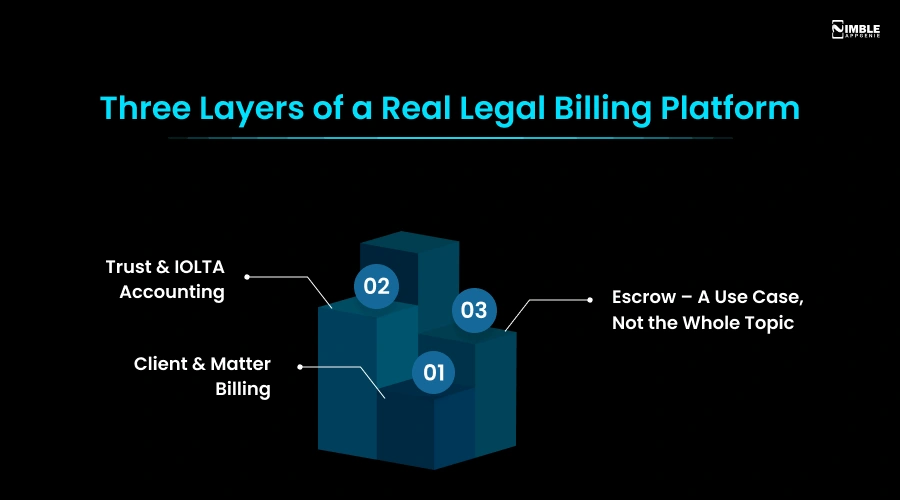
1. Client & Matter Billing
This is the layer most billing software already does reasonably well: time and expense capture tied to a specific matter, automated invoice generation (usually in LEDES format for corporate and insurance clients), flat-fee and contingency billing support, and online payment collection. Retainer management stays here too, tracking what a client has prepaid and alerting the firm before it runs low.
2. Trust & IOLTA Accounting
This is the layer that isolates a real billing platform from a generic one. It requires:
- Trust-operating Separation: Funds in an IOLTA account are never mixed with firm operating funds, enforced at the system level, not just by policy.
- Client Ledgers: A running balance per client and matter, showing deposits and disbursements of trust funds.
- Automated replenishment reminders: A replenishment-alert system you build to notify clients or staff when a trust balance drops below a set threshold, before a bill can’t be covered.
- Payment matching: A matching engine that links incoming trust deposits to the correct client and matter automatically, replacing manual journal entries.
3. Escrow – A Use Case, Not the Whole Topic
Escrow is used most often in real estate closings, settlement disbursements, and M&A transactions. It’s structurally similar to trust accounting – held funds, an audit trail, strict disbursement rules – but it is not interchangeable with IOLTA.
Escrow arrangements are generally transaction-specific and time-bound, whereas IOLTA trust accounts are an ongoing part of a firm’s operations. A platform built only around escrow will miss the ongoing client-ledger and reconciliation demands of general trust accounting, and a platform built only around routine trust accounting may not have the disbursement controls a large escrow transaction needs. Build for both, but don’t confuse them.
Reconciliation, Reporting, and Audit Trails
Three-way reconciliation – matching the bank statement, the trust ledger, and each client’s particular balance – is the single most significant recurring process in legal trust accounting, and it’s also mostly skipped or delayed when manual. Automating it means the platform pulls bank data (generally via a bank API or an aggregation service like Plaid), matches it against ledger entries, and flags discrepancies before month-end, not after.
Beyond reconciliation, a compliant platform needs:
- Automated, exportable reports formatted for state bar audits.
- Role-based reporting views, so a managing partner, a compliance reviewer, and a bookkeeper see what’s relevant to their role.
- An append-only audit trail – every deposit, ledger edit, and disbursement logged with a timestamp and user ID.
This layer turns “we have billing software” into “we can produce a clean reconciliation report the moment a state bar auditor asks for one.” That difference is what legal-tech buyers are actually paying for, even when they describe it as “billing software.” None of this exists out of the box – it has to be engineered into the ledger and reconciliation layer from the start, which is exactly the kind of infrastructure work a platform team typically brings in a development partner for.
How to Build Legal Billing Automation Into Your Platform, Step by Step
If you are scoping this out, here’s the build sequence a development team would follow:
- First, map every place money enters or leaves a matter (payments, retainers, disbursements).
- Second, build ledger-level separation between trust funds and operating funds from day one; this can’t be added later without a rebuild.
- Third, connect a banking API so your reconciliation engine can match transactions against real bank data instead of relying on manual statement review.
- Fourth, build client and matter invoicing on top of that ledger, not before it.
- Finally, layer in audit logging and reporting engineered into the architecture, not bolted on after launch.
Teams that build invoicing first and try to retrofit trust separation later almost always end up rebuilding the ledger from scratch, which costs more than doing it in the right order the first time.
How to Automate Legal Billing and Trust Accounting, Step by Step
If you are scoping this, the build sequence generally looks like this: map each place money enters, or leaves a matter (payments, disbursements, retainers), separate trust funds from operating funds at the ledger level from day one, connect a banking API so reconciliation runs against real transaction data instead of manual bank statement review, automate client and matter invoicing on top of that ledger, and layer in audit logging and reporting last, not first, but not as an afterthought either.
Skipping the ledger-separation step to ship invoicing faster is the most common reason legal billing platforms end up retrofitting trust accounting later, which is far more costly than building it from the start.
Technical Architecture, Explained For Business Teams
You don’t have to be an engineer to evaluate this, but you should know what’s under the hood before you commit a budget to it. A production legal billing platform is usually built around six components:
| Component | What it does |
| Billing engine | Turns time entries, flat fees, or contingency terms into invoices, in standard or LEDES format. |
| Payment gateway & banking APIs | Moves money in and out of client payments, trust deposits, disbursements, and connects to the firm’s bank. |
| Ledger & reconciliation engine | Maintains per-client trust balances and automates three-way reconciliation against bank data. |
| Webhooks & accounting integrations | Syncs data in real time with QuickBooks, Xero, or the firm’s general ledger, without duplicate entry. |
| Role-based permissions & audit logs | Controls who can view, edit, or disburse funds, and records every action for later review. |
| Encryption & security controls | Protects financial and client data at rest and in transit, consistent with the firm’s regulatory obligations. |
None of these are unknown. What makes legal billing automation more challenging than a typical SaaS billing build is the ordering: the ledger and reconciliation logic need to be crafted before the invoicing UI, not after, as trust separation is a structural requirement, not a feature you retrofit.
Compliance Considerations
A few ground rules worth stating plainly, because vague claims in this space cause real problems:
- PCI DSS matters, but it’s not the only security requirement: Payment card security covers card data; it says nothing about trust-fund segregation, state bar recordkeeping rules, or access controls around client ledgers. Treat it as one layer among several.
- No platform is automatically “IOLTA compliant.” IOLTA rules are set and enforced at the state bar level, and requirements vary by jurisdiction. Software can support compliance, but only once separation, reconciliation, and reporting are engineered into the platform; the firm and its attorneys remain responsible for meeting their state’s specific rules.
- Rules differ by state: Some states need specific account titling, others mandate particular reconciliation frequency or reporting formats. A platform serving firms across multiple states needs configurable compliance rules, not a single hardcoded ruleset.
Not Legal Advice:
This article explains how billing and trust infrastructure is typically built and what it needs to support. It isn’t a substitute for guidance from a licensed attorney or your state bar on your specific compliance obligations.
Build vs. Buy For Legal-Tech Platforms
If you are a law firm choosing day-to-day software, buying an established tool like Clio or MyCase makes sense – that’s a solved problem for a single firm’s internal use. The calculus changes if you are a legal-tech company, a legal fintech startup, or a platform provider building billing and trust infrastructure as part of your product for other firms to use.
In that case, billing and trust accounting are not an internal tool – they are core product infrastructure, and licensing a third-party tool underneath your own platform creates dependency, integration friction, and a ceiling on how much you can customize the compliance logic.
A reasonable decision rule: buy when billing is a back-office function you use once. Build, or build with a development partner, when billing, trust accounting, and payments are the product your customers are paying for because that’s the layer they will expect you to own, extend, and stand behind during an audit.
How Nimble AppGenie Approaches Legal Billing & Trust Infrastructure
Nimble AppGenie’s fintech app development team builds ledger, payment, and compliance infrastructure for regulated financial platforms – the same category of engineering problem as legal billing automation, even when the regulator is a state bar, not a banking authority. Our approach to any platform that touches held client funds starts with the same three questions: where the money sits, who can move it, and can we prove it every time someone asks?
Relevant Build: Compliance-First Ledger Architecture
Debtica Core – Regulated Lending Platform for the Polish Market
- While Debtica Core was built for lenders, not law firms, it’s the clearest example of the same architectural discipline legal trust accounting demands: a platform where regulatory-ready reporting, role-based access, and full audit trails were designed in from the start, not added before launch.
- Nimble AppGenie built the platform to generate compliance reports on demand in the exact format Poland’s financial regulator (KNF) reports, with every login, record change logged, data access, and role-based access separating loan officers, admins, and compliance reviewers.
- That’s the same pattern a legal billing platform needs: separation of duties, an audit trail regulators can query without a manual pull, and reporting built into the architecture rather than bolted on
- 100% actions logged – every login, access, and record change.
- 4 Build phases: discovery, core platform, integrations, audit-tested launch.
The same engineers who architected that ledger and reconciliation layer are the ones our fintech clients work with when the requirements are escrow, trust accounting, or client billing infrastructure.
If you are weighing what to build, our team can also walk you through how we have approached adjacent payment infrastructure, including ACH payment software for moving clients’ funds, and cloud-based core banking infrastructure for firms and platforms operating at scale.
One clarification worth making up front: legal billing automation is not the same as invoice management software. Invoice management handles bills a business owes; legal billing automation handles bills a firm issues and the trust funds it holds on a client’s behalf. They can integrate, but they solve different issues – worth knowing if you are scoping a platform and deciding what to build first. If your platform also needs to automate recurring or usage-based billing outside the legal vertical, our breakdown of vertical-specific payment automation (built for freight, but architecturally similar) is a useful comparison point.

Conclusion
Legal billing automation done right is not a bigger invoicing feature; it’s billing, trust accounting, and escrow built as three connected systems, each with its own rules and audit exposures.
Legal firms and platforms that treat trust accounting as an afterthought are the ones showing up in state bar discipline reports. The ones that build it as core infrastructure are the ones that can hand an auditor a clean reconciliation report without any mess.
If you are scoping a legal billing, trust accounting, or escrow platform and want an honest read on what it takes to build – compliance requirements, realistic cost and timeline, integration points – that’s a conversation worth having before you write a single spec.
FAQs

Niketan Sharma, CTO, Nimble AppGenie, is a tech enthusiast with more than a decade of experience in delivering high-value solutions that allow a brand to penetrate the market easily. With a strong hold on mobile app development, he is actively working to help businesses identify the potential of digital transformation by sharing insightful statistics, guides & blogs.
Table of Contents




No Comments
Comments are closed.