

 Free Consultation
 PCI-DSS Compliant
 GDPR Ready
 ISO 27001
 NDA Protected
 AI Services
 AI App Development
 Generative AI Development
 AI Chatbot Development
 AI Integration Services
 AI Consulting Services
 AI For Fintech
 AI Financial Assistant Solution
 AI Insurance Agent Development
 Tech Stack
 OpenAI / GPT-4
 Claude / Anthropic
 Gemini / Google AI
 Llama / Open Source
 LangChain / LlamaIndex
 Pinecone / Pgvector
 AWS / Azure AI


 Fintech Solution
 Core Fintech
 Fintech App Development
 Neobank App Development
 eWallet App Development
 Lending Software
 Banking Software Development
 BNPL Solution
 BNPL App Development
 Insurance App
 Wealth Management App
 Blockchain Development
 Payroll Software Development
 DeFi App Development
 Crypto Wallet Dev
 Crypto On Ramp Off Ramp
 Crypto Exchange Dev
 Trading Platform Dev
 Payments
 Compliance
 Fintech & Digital Regulations
 Fraud Detection
 Lending Ecosystem
 P2P Lending Platform
 Mortgage Software
 Engagement
 Outsourcing Dev

 Mobile Development
 Mobile App Dev
 iOS App Development
 Android App Development
 React Native
 Flutter Development
 Web Solution
 Node.js Development
 React.js Development
 Angular Development
 App Services
 UI/UX Design
 App Maintenance
 By Stage
 MVP Development
 Industry Solutions
 Healthcare App Dev
 Education App Dev
 Travel App Dev
 Real Estate App Dev
 Logistics Software
 Social Media App

 Hire Mobile Developers
 Hire iPhone Developers
 Hire Android Developers
 Hire React Native Devs
 Hire Flutter Developers
 Hire Web Developers
 Hire Node.js Developers
 Hire Angular Developers
 Hire PHP Developers
 Hire Laravel Developers
 How It Works
 Pre-Vetted Developers
 Ready In 48 Hours
 NDA From Day One
 Replace Guarantee
 Company
 About Us
 Our Work Process
 Portfolio
 Case Studies
 Blog / Insights
 Careers
 Contact Us
 Awards
 Recognition


 Offices



Key Takeaways:
- Cloud-based core banking runs a bank’s backend on remote servers, enabling real-time processing, lower costs, and faster innovation.
- Banks move to the cloud to fix four pain points: high infrastructure costs, slow time-to-market, poor scalability, and fragmented fintech integrations.
- The cloud-based core banking solution comprises core account management, payment processing, lending services, and core operations functioning.
- Cloud-based banking software costs $30,000–$200,000+, depending on project type, from MVP to enterprise platform.
- Backend & API development takes the largest budget share (35–40%), followed by core development and integrations (25–30%).
- GDPR, AML/CFT, and KYC compliance must be built into the architecture from day one, not added later.
- The right cloud provider (AWS, Azure, GCP) and development partner shape both security and long-term scalability.
- Partner with a trusted provider like Nimble AppGenie for expert guidance in shifting from legacy systems to cloud-based banking.
The cloud-based banking solutions are core account management, payment processing, lending services, core operational functions, security and compliance, and integration and innovation.
Do you know that the global cloud computing market sizeist USD 943.6 billion in 2025 and is further projected to grow to USD 3,349.6 billion in 2033?
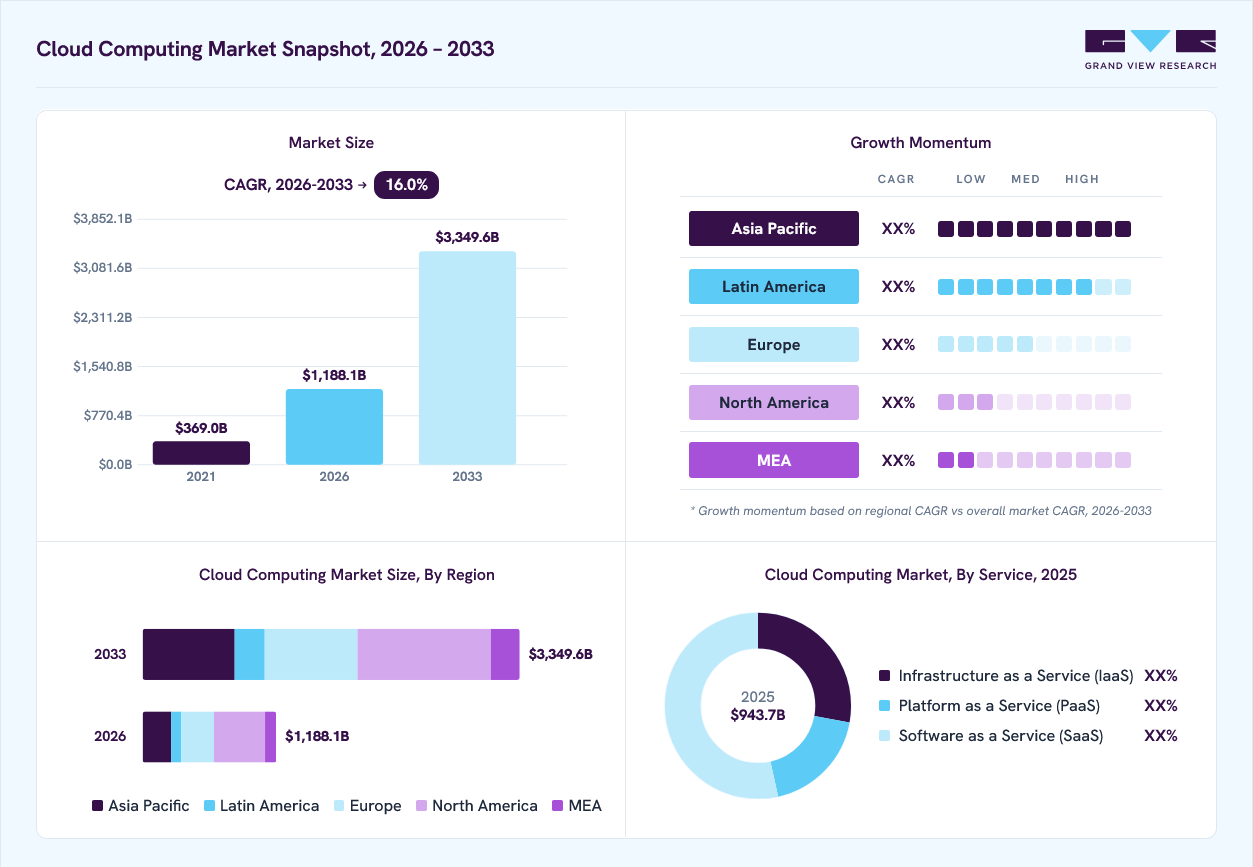
This growing market represents an opportunity, specifically for the fintech sector. Under fintech, one of the industries that is getting maximum benefits from cloud-based banking software is banking.
If you are a banking startup or a banking entrepreneur, this is the right place to be. In this guide, we will walk you through the concept, solution (functions), features, steps to build it, benefits, cost to create a banking system, and a complete list of cloud core banking software.
Without further ado, let’s get ahead.
What is Cloud-Based Core Banking?
Cloud-based core banking is the delivery of a bank’s backend processing software via the internet and remote servers, not via hardware. This banking software enables banks to manage customers’ accounts, process loans, track deposits, and update the general ledger.
This cloud-based core banking differs from legacy core banking systems by offering flexible, real-time architectures, lower operating costs, and rapid feature development.
If you are a banker with a legacy banking system, you offer stability; however, shifting to cloud-based banking provides the speed, agility, and innovation needed to stay competitive in the modern market.
Simply, cloud-based core banking is a modern software platform, hosted on remote cloud infrastructure, and handles the daily operations of banks.
But why are banks in 2026 moving Core Banking to the cloud?
Well, there are different points to consider, such as flexibility, speed, the cloud’s open API architecture, and much more. If you are creating a mobile banking app, it’s important to consider the cloud; let’s understand why!
Why Are Banks Moving Core Banking to the Cloud?
Banks are moving their core banking systems to the cloud because it offers seamless infrastructure and facilities to manage the complete banking system effectively.
Here are the top reasons why banks move core banking to the cloud:
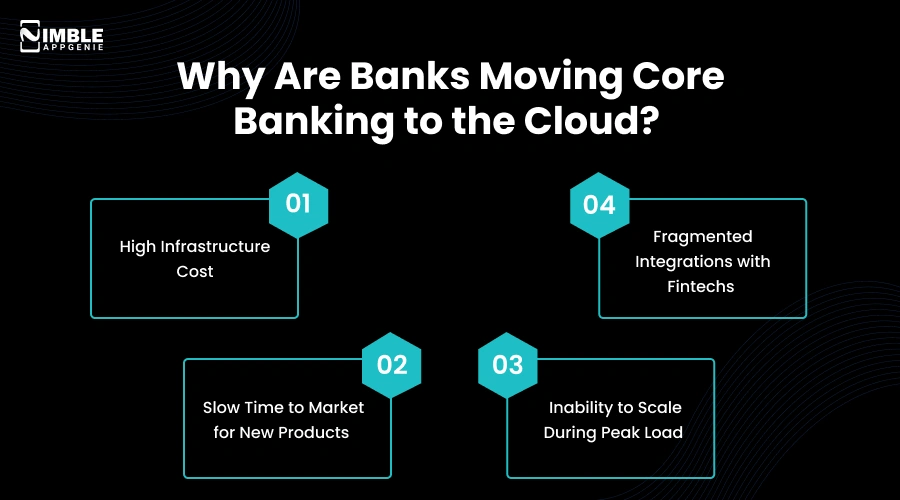
Pain Point: High Infrastructure Cost
Legacy core banking systems offer high infrastructure and maintenance costs because of scarce specialized labor, expensive custom maintenance, and inefficient scaling constraints.
Banks are switching to cloud-based core banking solutions because they enable banks to opt for a pay-as-you-go model with lower total cost of operations. Here, the pay-as-you-go model is a usage-based billing approach that includes no upfront hardware costs and metered consumption.
Pain Point: Slow Time to Market for New Products
The legacy banking structures cause slow time to market due to the monolithic core systems, rigid compliance, and siloed organizational departments.
Here, banks are switching to cloud-based core banking software solutions, where they can have API-first, faster feature releases. Banks offer API-first services by decoupling the monolithic chores into modular microservices.
Pain Point: Inability to Scale During Peak Load
Under the legacy banking structures, banks cannot scale during peak loads due to inflexible capacity limits and synchronous processing bottlenecks.
Now, banks are switching to cloud-based core banking software development, assisting them in elastic scaling. It helps banks automatically adjust the computing resources in real-time to match the fluctuating transaction volumes.
Pain Point: Fragmented Integrations with Fintechs
A traditional banking system creates a disconnected user experience, hidden integration hurdles, along with operational inefficiencies. It happens when consumers use multiple specialized apps instead of one bank.
Through core-based banking software development, you can opt for automated compliance workflows that can enable banks to adopt open API architecture. With the experts of Nimble AppGenie, you can adopt successful fintech API integration services.
Now, as you know the reasons to opt for cloud-based banking software, let’s get ahead with the key benefits of opting for cloud-based core banking in the next section.

Benefits of Using Cloud-Based Core Banking
Cloud-based core banking solutions are modern, internet-hosted back-end software systems that handle a bank’s daily tasks.
Here are the key benefits of adopting cloud-based core banking:
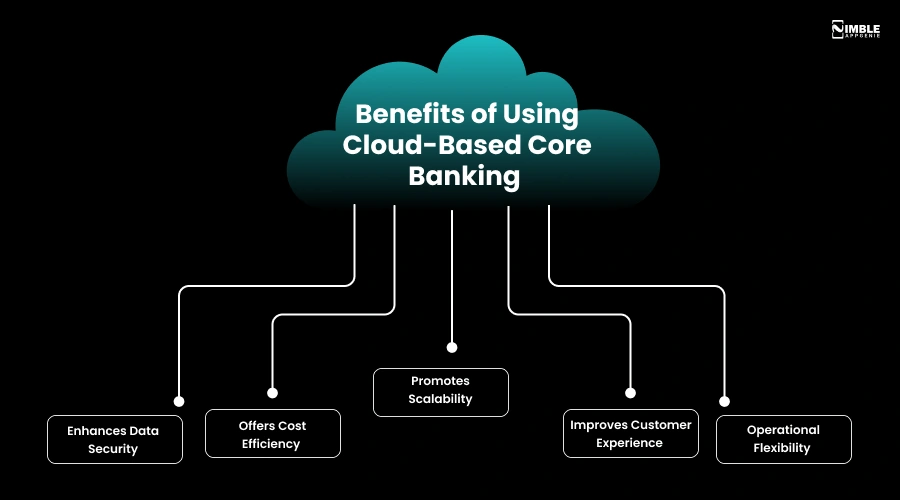
1. Enhances Data Security
With the help of cloud-based banking solutions, you can adopt advanced encryption, automated security patches, and centralized threat monitoring.
Here, with trusted providers such as Nimble AppGenie, you can implement advanced security measures that protect sensitive financial data, addressing the key concerns related to data breaches and compliance.
2. Offers Cost Efficiency
The cloud-based banking software development offers cost efficiency through eliminating heavy upfront investments.
With this model, banking startups and entrepreneurs can shift the expenses to a flexible pay-as-you-go model and reduce ongoing maintenance overhead. It optimizes spending via distinct structural changes.
3. Promotes Scalability
The cloud-based core banking offers real-time transaction processing and rapid scalability, and lower operational costs.
With the help of cloud-based core banking software promotes scalability by offering elastic resources and support for new products. This agility is important for staying competitive and responding to market demands.
4. Improves Customer Experience
The cloud-based banking software solutions deliver an exceptional customer experience. This platform offers tools and capabilities that are important for improving customer interactions and for meeting evolving customer expectations.
Through the advanced data analytics capabilities, the cloud solutions help banks to offer personalized financial products and services.
5. Operational Flexibility
Operational flexibility is important for banks to adapt to changing market conditions and customer needs. This ability allows banks to respond quickly to market changes, continuously enhancing the bank’s offerings.
It is a benefit of cloud-based banking software, where you can quickly adapt workflows, scale resources up or down, and further deploy new financial features without any physical hardware limits.
Now, let’s get ahead with the features and functions of cloud-based core banking.
What are the Features and Functions of Cloud-Based Core Banking?
The key features and functions of cloud-based core banking manage essential financial tasks, including account management, transaction processing, and even lending, by removing internet servers instead of local hardware. In the case of a cloud-based banking app, these are the must-have features for a successful mobile banking app.
Here is the list of features and functions of cloud-based core banking:
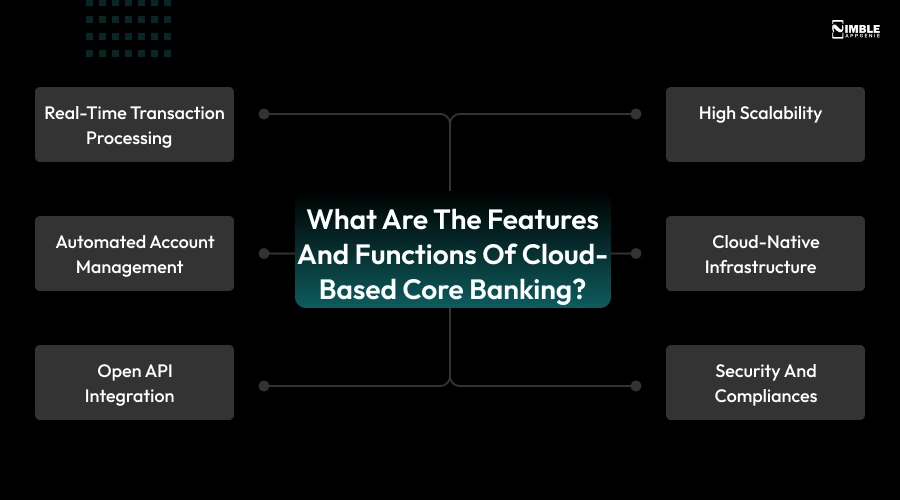
1. Real-time Transaction Processing
The real-time transaction processing in cloud-based core banking is the instant posting and updating of financial transactions as they happen, driven by cloud elasticity and 24/7 infrastructure availability.
2. Automated Account Management
The automated account management is the core feature of cloud-based banking software that streamlines tasks such as onboarding, reconciliation, and real-time balance tracking without any manual work.
3. Open API Integration
Open API integration in the cloud-based banking software acts as a secure digital bridge. This feature allows third-party financial apps to connect with the core banking systems through the cloud, enabling data sharing between mobile software and the API.
4. High Scalability
High scalability is the complete ability to grow and shrink system resources automatically based on the current user demand. This feature allows banking platforms to automatically expand computing power, storage, and transaction handling capacity in real time.
5. Cloud-Native Infrastructure
Cloud-native infrastructure is the core engine of modern cloud-based core banking, using microservices, containers, and API-first designs. This architecture replaces the rigid, old-fashioned legacy systems with flexible, fast, and scalable financial services.
6. Security and Compliances
Security and compliance in the cloud-based core banking functions are ensured through multi-layered cyber defenses, automated regulatory tracking, and the shared responsibility model. It enhances mobile banking app security and protects sensitive financial data using advanced encryption and strict access controls.
Now, let’s get ahead with the key functions of cloud-based banking software.
Functions of Cloud-Based Banking Software
The cloud-based banking software offers essential core financial operations, real-time transaction processing, along with advanced security management.
Here is the list of functions of cloud-based banking software:
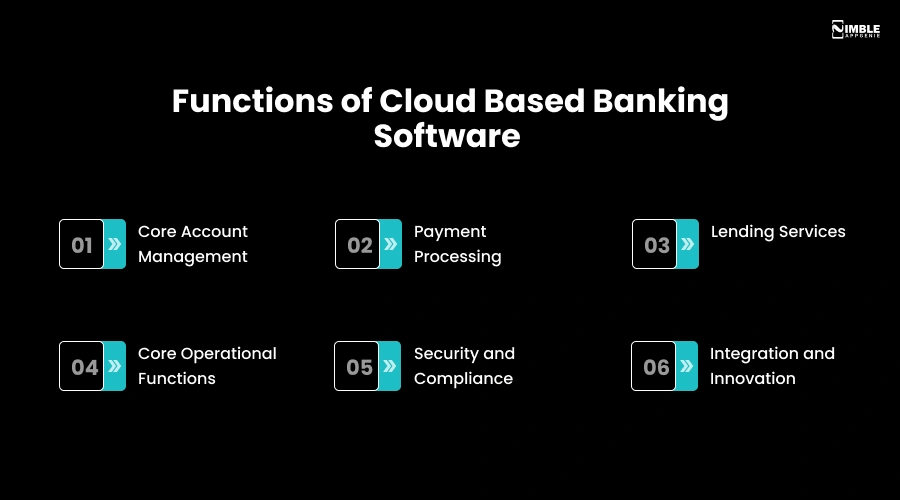
1] Core Account Management
The cloud-based banking software offers core account management through utilizing centralized online banking. The cloud-based banking software handles essential functions such as maintaining real-time customer ledgers and enabling integration with fintech solutions.
2] Payment Processing
Payment processing is a core feature of banking software because it automates the secure transfer of funds between a payer and the payee. This feature uses remote internet servers instead of local computers for handling financial transactions through mobile payment technology.
3] Lending Services
Lending services act as a core feature in cloud-based banking software that automates the complete loan lifecycle, smart underwriting, instant disbursement, servicing, and collections. These services build digital loan lifecycles, automated credit decisions, and core system integrations.
4] Core Operational Functions
Cloud-based banking software powers core operational functions through centralizing and automating a bank’s back-end tasks on remote servers. This feature handles key processes such as managing customer accounts and processing real-time transactions.
5] Security and Compliance
The security and compliance in the cloud-based banking software operate via a shared responsibility model, utilizing end-to-end encryption, automated regulatory tracking, along with granular access control.
6] Integration and Innovation
Another important function of cloud-based banking software development is integration and innovation. Integration and innovation are the key functions of cloud-based banking software because it enables seamless connections with third-party financial technology.
With these functions of cloud-based banking software development, let’s get ahead with the complete guide on “how to develop cloud-based banking software?” in the given section.
How to Develop a Cloud-Based Banking Software?
To create a cloud-based banking software, you should begin by defining the compliance requirements, designing a microservices architecture, and then choosing a secure infrastructure provider.
Let’s understand it all in detail:
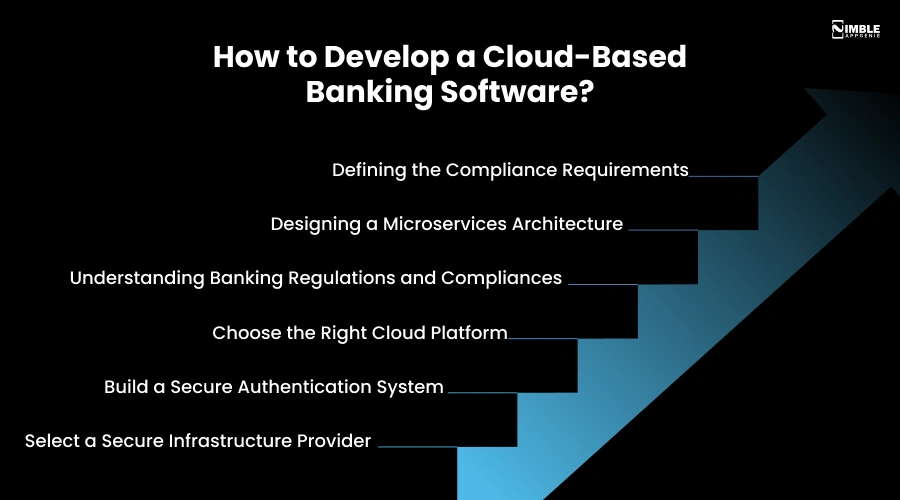
Step 1: Defining the Compliance Requirements
Defining the compliance requirements through identifying the external laws, industry standards, and internal rules that the organization must follow, breaking these compliance requirements into specific operational obligations, as well as documenting them clearly.
Here’s what you need to evolve:
- Define what you want from the cloud-based core banking solution
- Evaluate all the competitors and what they are opting for.
- Create the internal controls and identify the external rules.
Step 2: Designing a Microservices Architecture
Now, it’s time to design a microservices architecture by breaking a large application into small, independent services defined by the business domains, and using an API gateway.
Here’s what you need to consider:
- Analysing the domain by using domain-driven design to group related features.
- It comprises architecture planning, security and compliance, data strategy, API integration, and resilience.
- Breaking an app into small, independent services defined by diversified business domains. Banking app design is a core important segment to opt for.
Step 3: Understanding Banking Regulations and Compliances
Under this step, you should evaluate the complete banking regulations and compliance to strictly adhere to the data privacy laws, regional central bank directives, along with the payment security standards.
Here, many banking software companies often ask “Is Cloud Core Banking Secure and Compliant?”
You can include the key regulations, including GDPR, AML and CFT, along with KYC.
Let’s get ahead with the key regulations and compliance requirements:
- General Data Protection Regulation (GDPR): GDPR sets stringent data protection requirements for organizations handling the personal data of citizens. Whether you are launching your app in the US, UK, or any other country, you should mandate strict data privacy, empowering your customers.
- AML and CFT: You should comply with the (Anti-Money Laundering) AML and CFT (Counter-terrorism financing), assisting your customers to have complete protection of their data against any type of data theft.
- KYC (Know Your Customer): KYC is a core regulatory process that banks use for verifying identities, assessing financial risk, and blocking illegal activities. It acts as a primary defense against financial crimes such as any kind of fraud and money laundering activities.
These regulations should be complied with while developing the cloud-based banking software.
Step 4: Choose the Right Cloud Platform
Now, at this step, it’s time to choose the right cloud platform among different platforms available.
Here, many banking startups and entrepreneurs often ask, “What is the right cloud platform for my banking software?”
The right cloud platform depends on your specific needs, with the top three options including AWS, Microsoft Azure, and Google Cloud Platform.
Well, let’s look at them:
- Amazon Web Services (AWS): Best for broad tool selection, massive global reach, and advanced features, making it ideal for large enterprises as well as fast-growing startups.
- Microsoft Azure: It is a cloud computing platform that was created by Microsoft and was launched in 2010. It marked a pivotal shift from on-premises data centers, offering diversified businesses a global network of data centers.
- Google Cloud Platform: Selecting GCP matters because it delivers industry-leading data analytics with advanced artificial intelligence infrastructure and automated, highly secured global scaling.
Also Read: AWS vs Azure vs Google Cloud
Step 5: Build a Secure Authentication System
Creating a secure authentication system requires hashing passwords with diversified tools like bcrypt, using JSON web tokens (JWT) or secure sessions for the state. Here, you need multi-factor authentication, strong encryption, and zero trust policies.
Here’s what you need to opt for:
- Use of Multi-factor authentication: It makes security systems much stronger by requiring two or more different proofs of identity.
- Use token-based sessions: Token-based authentication replaces traditional server-side sessions with a self-contained digital token.
- Robust Identity Management: It provides the core framework to verify users and prevents unauthorised lifecycles.
With secure authentication, now you are required to select the right infrastructure provider.
Step 6: Select a Secure Infrastructure Provider
It’s all about identifying the right cloud provider, focusing on three core areas: verifying their compliance certification, testing their models, and incident response capabilities.
Here’s a brief;
- Compliance and Certification: Identifying the formal audits and evaluating what are the different types of compliances are followed by the provider.
- Testing Their Models: You should test the models offered by cloud-based banking software, evaluating both the underlying systems and even AI models themselves against cyber threats.
- Incident Response Capabilities: Incident response capabilities refer to an organization’s structured methods, tools, and skilled teams to detect, contain, and recover from cyberattacks.
One of the important questions to ask here is “what’s the right cost to build a cloud-based banking software?”
The overall cost to create a cloud-based core banking solution differs from $30,000 to $200,000, depending on the business model and requirements.
To get into the details, let’s look ahead in the given section.
What’s the Cost to Build Cloud-Based Banking Software Development?
The cost to create a cloud-based banking software can vary from $30,000 to $200,000. This cost varies depending on whether you are beginning with the MVP or want a complete solution; your decision will affect the cost structure.
Whether it’s about estimating the overall cost to develop a mobile banking app or about software development cost, you should consider cost based on the project type and development phase breakdown.
By Project Type:
| Project Type | Estimated Cost | What’s Included |
| MVP/Basic Cloud Banking App | $30,000 – $60,000 | Core accounts, basic transactions, onboarding |
| Digital Banking Portal (Web + Mobile) | $60,000 – $100,000 | Online + mobile banking, KYC, payments, dashboard |
| Mid-Level Core Banking Module | $100,000 – $150,000 | Ledger, multi-currency, API integrations, compliance |
| Full-Scale Cloud Core Banking Platform | $150,000 – $200,000+ | Enterprise architecture, real-time processing, full compliance |
Now, let’s get ahead with the cost breakdown for core banking solutions based on the development phase:
| Development Phase | Estimated Cost | % of Total Budget |
| Discovery & Requirement Analysis | $3,000 – $15,000 | 8–10% |
| UI/UX Design | $5,000 – $20,000 | 10–12% |
| Backend & API Development | $12,000 – $80,000 | 35–40% |
| Core Development & Integrations | $8,000 – $60,000 | 25–30% |
| Testing & QA (incl. security/compliance) | $2,000 – $20,000 | 8–10% |
| Deployment & Post-Launch Support | $2,000 – $15,000 | 5–8% |
Cloud Core Banking Providers: A List to Rely On
Here are the best core banking providers to look at; let’s have a look at them. You can select the right provider by evaluating how they are able to resolve your banking software needs.
► Nimble AppGenie
Nimble AppGenie is the best banking software development company offering effective cloud -based banking software solutions as per the requirements of startups and entrepreneurs.
Here’s why to choose us:
- Zero Downtime: While you shift from legacy banking software to cloud-based banking software development, you will have a zero-downtime, phased migration methodology with the experts of Nimble AppGenie.
- Compliance Engineering: Whether it’s about GDPR or complying with the recent regulations of the privacy act, developers of Nimble AppGenie do it all.
- Niche in Banking: Whether it’s software, including any apps or websites, our banking services cater to every need. Nimble AppGenie’s experts scale with the app’s requirements, making us the best banking app development company. Additionally, we have delivered over 350 software solutions that make us count for your next project.
► Temenos
Temenos Banking is a well-established company offering the latest cloud-based solutions for banks through its cloud-native architecture, modular designs, and AI.
This is why choose Temenos:
- Cloud-Native and Agentic: Temenos builds cloud-based banking software with the help of microservices and APIs, allowing banks and related companies to use cloud-based services and offers improved customer experience.
- Offers Flexibility and Innovation: Temenos offers flexibility and innovation by helping banks adopt cloud-based banking solutions and be future-ready with flexible, resilient, and regulatory demands.
- Provides Security and Compliance: Temenos delivers security via built-in controls, financial crime mitigation tools, along with multi-factor authentication systems.
► Infosys Finacle
The Finacle solutions are architectured on a cloud-native, cloud-neutral foundation that ensures seamless deployment and portability across the private, public, and hybrid environments.
Here’s why you need to select Infosys Finacle:
- Architecture and Design: Infosys Finacle’s architecture and design enable businesses to shift to cloud-based banking solutions seamlessly.
- Has Risk Management Practice: Infosys Finacle has a risk management practice that offers advanced analytical, real-time integrations.
- Flexible Deployment Options: Finacle offers flexible deployment options offering unparalleled flexibility with the deployment options across private, public, and hybrid cloud environments.

Conclusion
The cloud-based banking software development solutions comprise core account management, payment processing, lending services, security and compliance, along with integration and innovation.
Here, the complete cost to create a cloud-based banking software development solution varies depending on the project type and development phase. Here, you should evaluate factors such as testing, instant response capabilities, and the type of models.
Banking software businesses can shift to cloud-based banking by following the complete process from defining the requirements to selecting the right and secure infrastructure provider.
FAQs
Cloud-based core banking is a bank’s backend processing software delivered over the internet via remote servers instead of on-premise hardware. It manages account management, transaction processing, loans, and general ledger updates in real time. This model replaces rigid legacy infrastructure with flexible, scalable, API-driven architecture.
Cloud-based banking software typically costs between $30,000 and $200,000+, depending on scope. A basic MVP starts around $30,000, while a full-scale enterprise core banking platform with complete compliance and real-time processing can exceed $200,000.
Yes — cloud core banking operates on a shared responsibility model, combining end-to-end encryption, automated regulatory tracking, and granular access controls. When built to meet GDPR, AML/CFT, and KYC standards from the start, it meets or exceeds the security of legacy on-premise systems.
The right platform depends on your needs: AWS offers the broadest tool selection and global reach, ideal for enterprises and fast-growing startups. Microsoft Azure suits organizations shifting from on-premises data centers. Google Cloud Platform stands out for advanced AI infrastructure and data analytics.
Timelines vary by project type: an MVP can launch in a few months, while a full-scale enterprise platform with deep compliance and integrations can take 9–15 months or longer. Scope, regulatory requirements, and third-party integrations are the biggest timeline drivers.
Cost is driven by project type (MVP vs. enterprise), feature scope, compliance requirements (GDPR, AML/CFT, KYC), third-party integrations, and the cloud infrastructure provider chosen. Backend and API development typically account for the largest share of the total budget.
Yes — the pay-as-you-go pricing model eliminates heavy upfront hardware investment, making cloud-based core banking accessible for startups and smaller institutions. Many begin with an MVP in the $30,000–$60,000 range and scale up as their customer base and feature needs grow.

Niketan Sharma, CTO, Nimble AppGenie, is a tech enthusiast with more than a decade of experience in delivering high-value solutions that allow a brand to penetrate the market easily. With a strong hold on mobile app development, he is actively working to help businesses identify the potential of digital transformation by sharing insightful statistics, guides & blogs.
Table of Contents




No Comments
Comments are closed.