

 Free Consultation
 PCI-DSS Compliant
 GDPR Ready
 ISO 27001
 NDA Protected
 AI Services
 AI App Development
 Generative AI Development
 AI Chatbot Development
 AI Integration Services
 AI Consulting Services
 AI For Fintech
 AI Financial Assistant Solution
 AI Insurance Agent Development
 Tech Stack
 OpenAI / GPT-4
 Claude / Anthropic
 Gemini / Google AI
 Llama / Open Source
 LangChain / LlamaIndex
 Pinecone / Pgvector
 AWS / Azure AI


 Fintech Solution
 Core Fintech
 App Development
 Neobank Solutions
 eWallet Solutions
 Lending Software
 Banking Solutions
 BNPL Solutions
 BNPL Solutions
 Insurance App
 Wealth Management
 Crypto & DeFi
 Blockchain Development
  Payroll Software
 DeFi Solutions
 Crypto Wallet
 Crypto On/Off Ramp
 Crypto Exchange
 Trading Platform
 Payments
 Compliance
 Regulations & Compliance
 Fraud Detection
 Lending Ecosystem
 P2P Lending Platform
 Mortgage Software
 Engagement
 Fintech Outsourcing

 Mobile Development
 Mobile App Dev
 iOS App Development
 Android App Development
 React Native
 Flutter Development
 Web Solution
 Node.js Development
 React.js Development
 Angular Development
 App Services
 UI/UX Design
 App Maintenance
 By Stage
 MVP Development
 Industry Solutions
 Healthcare App Dev
 Education App Dev
 Travel App Dev
 Real Estate App Dev
 Logistics Software
 Social Media App

 Hire Mobile Developers
 Hire iPhone Developers
 Hire Android Developers
 Hire React Native Devs
 Hire Flutter Developers
 Hire Web Developers
 Hire Node.js Developers
 Hire Angular Developers
 Hire PHP Developers
 Hire Laravel Developers
 How It Works
 Pre-Vetted Developers
 Ready In 48 Hours
 NDA From Day One
 Replace Guarantee
 Company
 About Us
 Our Work Process
 Portfolio
 Case Studies
 Blog / Insights
 Careers
 Contact Us
 Awards
 Recognition


 Offices



Key Takeaways:
- Fragmentation arises from separate blockchains, regional rails, closed-loop payment apps, and mismatched standards.
- On Ethereum-compatible networks, ERC-4337 and EIP-7702 standardize smart-account features, but they don’t bridge distinct chains.
- In payments, instant-payment links, like UPI’s international expansion, are reducing silos one corridor at a time.
- The best defense is an architecture with modular asset support, standards-first design, and open APIs.
- Interoperability adds security and compliance work, so scope it deliberately.
Wallet interoperability decides whether your users can move money, assets, and identity across networks, apps, and borders without friction. Today, most wallets stay in separate ecosystems, creating fragmentation: extra fees, steps, and abandoned payments. This guide explains where the gaps come from, which standards close them, and how to design a wallet that connects instead of isolates.
What is Wallet Interoperability?
Wallet interoperability is the ability of wallets, networks, payment systems, and applications to exchange data and value seamlessly. A user should be able to connect, pay, transfer, or receive across these systems without switching apps or relying on manual conversations.
It applies to crypto wallets and fiat e-wallets. In crypto, it usually means working across dApps and chains. In payments, it means working across QR schemes, banks, and countries.
Key Terms to Know
| Term | Plain-English meaning |
| Fragmentation | Value, users, and features split across disconnected wallets, chains, or payment systems. |
| Closed-loop wallet | A wallet that only pays within its own network of users and merchants. |
| EOA | Externally owned account: a standard key-controlled Ethereum account. |
| Account abstraction | Letting accounts behave like programmable smart contracts, enabling batching, sponsored fees, and recovery. |
| ERC-4337 | An application-layer account abstraction standard that has run on mainnet since March 2023. |
| EIP-7702 | A protocol-level upgrade, live since May 2025, that lets an existing EOA use smart-account code. |
| Fast payment system (FPS) | A national real-time payment network, such as UPI in India. |
| Cross-chain / chain abstraction | Hiding the differences between blockchains so users don’t manage each one separately. |
Why is the Wallet Landscape So Fragmented?
Wallets fragment because each ecosystem makes independent choices: different payment rails and regulations, different blockchains and account models, and commercial incentives to keep users inside one app.
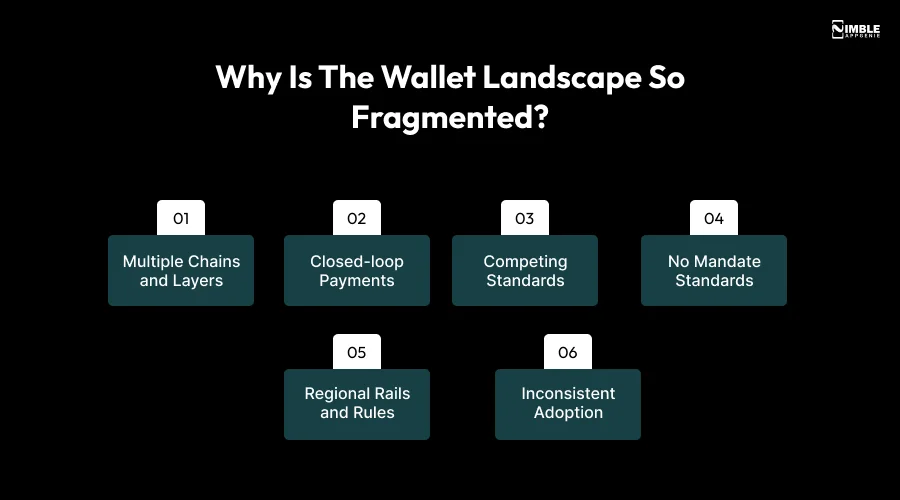
- Multiple Chains and Layers: Assets and accounts live on separate networks, and delegation or smart-account setups are configured per chain.
- Closed-loop Payments: Many e-wallets only transact within their merchant and user network.
- Competing Standards: Account abstraction alone involves EIP-7702, ERC-4337, and modular account standards such as ERC-7579 and ERC-6900.
- No Mandate Standards: Even the GENIUS Act doesn’t require stablecoin issuers to support shared technical standards across wallets and chains, so the same stablecoin can end up siloed by network. See our GENIUS Act wallet guide.
- Regional Rails and Rules: Each country runs its instant payment system, licensing, and identity checks.
- Inconsistent Adoption: Not all apps or chains support newer features equally, so users get different experiences in different places.
How Does Fragmentation Hurt Users and Businesses?
The impact gets visible in user behavior. A Reown and Nansen survey in 2025 of 1,000+ US crypto users found that 62% used at least two wallets in the past three months, up from 45% in 2024. It’s just one survey, so treat it as a directional signal rather than a definitive measure.
- For users, fragmentation means more fees, steps, and mistakes.
- For businesses, it means lower conversion, higher integration costs, and a bigger support burden.
| Problem | User impact | Business impact |
| Funds split across chains or apps | Hard to see or use total balance | Lower activity, higher drop-off |
| Separate gas tokens or fee models | Stuck without the “right” token | Failed onboarding |
| Closed payment loops | Cannot pay a merchant outside the network | Smaller addressable market |
| Different identity checks per region | Repeated verification | Duplicate KYC cost |
| Many custom integrations | Inconsistent experience | Slow releases, more maintenance |
Which Standards and Payment Rails are Reducing Fragmentation?
Progress is real but uneven. Ethereum-compatible wallets connect to shared smart-account standards, while national payment systems are linking through bilateral and multilateral connections. Neither completely removes fragmentation yet.
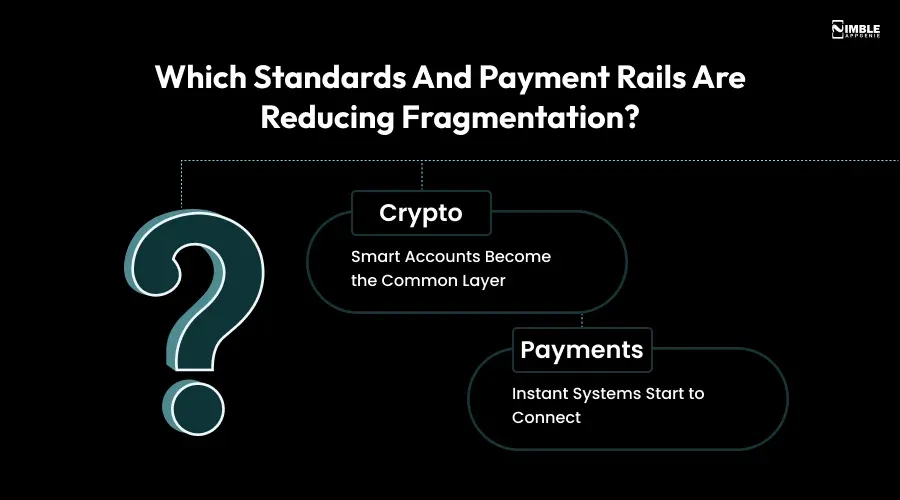
► Crypto: Smart Accounts Become the Common Layer
ERC-4337 launched on Ethereum mainnet in March 2023 and performs on EVM chains without a protocol change. EIP-7702 followed with the Pectra upgrade on May 7, 2025, enabling existing EOAs to take on smart-account behavior without a new address. Major wallets like Ledger, MetaMask, and Trust Wallet rolled out support, and industry predictions put smart wallets at 200 million; however, that figure is a projection, not an audited count.
The practical outcome is a shared feature set: sponsored or token-paid fees, batched actions, session keys, and passkey-style sign-in. Wallets and dApps can also depend on wallet-level interfaces such as ERC-5792 instead of managing delegation themselves.
What still fragments: Delegation is configured per chain, and these standards cover EVM networks. Moving value between unrelated chains still demands bridges or cross-chain orchestration layers, each with its security trade-offs.
► Payments: Instant Systems Start to Connect
India’s UPI is a useful example. In August 2026, the Government of India states that UPI is live in 11 foreign countries for remittance, merchant acceptance, or both. Individually, the BIS-led Project Nexus aims to connect instant payment systems in Malaysia, India, Singapore, the Philippines, and Thailand through one standard, with a planned rollout in 2026. Check the current go-live status before citing it as live.
The lesson for wallet builders: interoperability is coming corridor by corridor. So, design for adding new rails, not for one global switch.
How Do You Build a Wallet That Interoperates?
Treat every rail, chain, and partner as a replaceable module behind a stable internal interface. Standards-first design and open APIs lower the integration costs as the ecosystem changes.
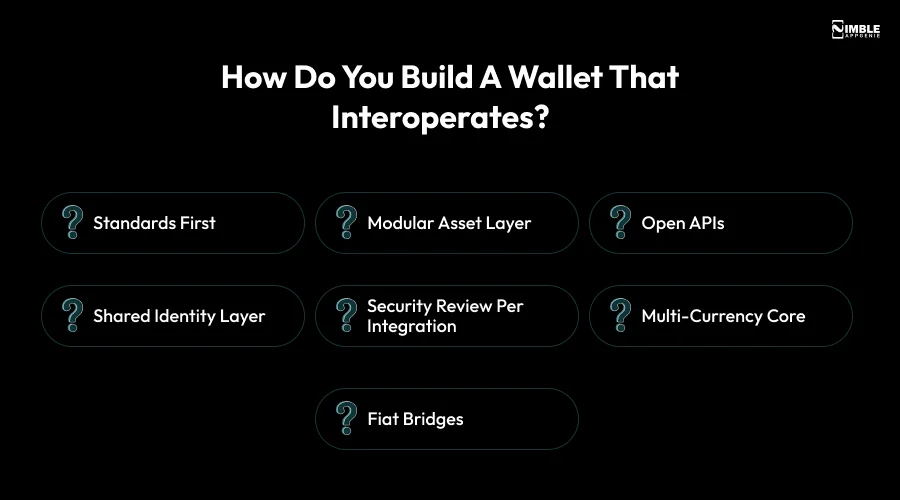
Interoperability Build Checklist
- Standards First: Support ERC-4337 and EIP-7702 flows where you serve EVM-based users, and avoid proprietary account formats.
- Modular Asset Layer: Separate wallet logic from rail-specific or chain-specific adapters.
- Open APIs: Expose and consume clean interfaces; see our work on fintech API integration.
- Shared Identity Layer: Reuse verification results where regulation allows, following our KYC and AML compliance guidance.
- Security Review Per Integration: Every new connection increases the attack surface; see our fintech security guide.
- Multi-Currency Core: Balances, P2P, and FX in one ledger, the foundation of eWallet app development.
- Fiat Bridges: Use licensed partners for conversions, as described in our crypto on-ramp and off-ramp solutions.
If you are planning a chain-native product, our crypto wallet development page explains architecture and custody choices. For regulatory impact on which assets you can list, read our guide to stablecoins and CBCDs in wallets under the GENIUS Act.
♦ Real-World Delivery Experience
Interoperability work usually begins as a multi-currency, multi-region challenge. Nimble AppGenie’s MaxPay project backs payments across 50+ countries, and Swap Africa serves 14 Francophone African countries. Both are fiat wallets, but the integration patterns apply to wider wallet ecosystems.
What are the Risks and Trade-Offs of Interoperability?
More connections mean more risk. Interoperable wallets must handle partner dependencies, bridge exposure, delegation security, and compliance across every region they touch.
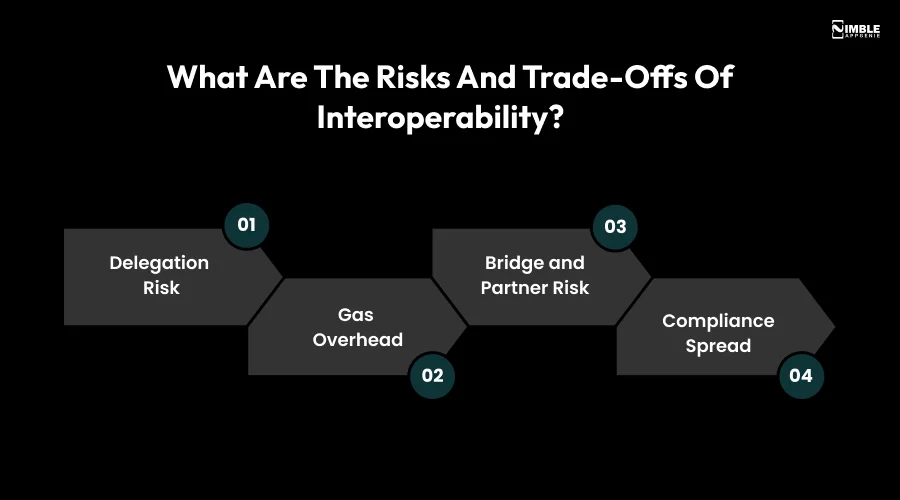
- Delegation Risk: EIP-7702 changes persist even if a relevant transaction fails, so wallets need to whitelist trusted delegation contracts and show clear approval screens.
- Gas Overhead: 7702 adds a little gas cost to authorize handling.
- Bridge and Partner Risk: Cross-chain and cross-border links depend on third parties you don’t control.
- Compliance Spread: Every new market adds KYC, licensing, and data-protection obligations.
An MVP that connects one payment rail and one chain is the safest way to test demand. Budget guidance is in our fintech app development cost guide.
Final Thoughts
Fragmentation will take time to disappear, but standards and payment links are making it manageable. Build around open APIs, modular adapters, and security reviews, and add new rails or chains only when users need them. Wallets that link well tend to win on convenience.
| Sources (accessed October 2026): Benzinga: Reown wallet survey · MIT DCI: GENIUS Act and interoperability · BlockEden: account abstraction and smart wallets · Ethereum.org: EIP-7702 overview · Arbitrum Foundation: EIP-7702 on Arbitrum · PIB (Government of India): UPI international expansion, August 2026 · PaymentsJournal: Project Nexus. This article is informational and not legal or financial advice. |
FAQs

Niketan Sharma, CTO, Nimble AppGenie, is a tech enthusiast with more than a decade of experience in delivering high-value solutions that allow a brand to penetrate the market easily. With a strong hold on mobile app development, he is actively working to help businesses identify the potential of digital transformation by sharing insightful statistics, guides & blogs.
Table of Contents




No Comments
Comments are closed.