

 Free Consultation
 PCI-DSS Compliant
 GDPR Ready
 ISO 27001
 NDA Protected
 AI Services
 AI App Development
 Generative AI Development
 AI Chatbot Development
 AI Integration Services
 AI Consulting Services
 AI For Fintech
 AI Financial Assistant Solution
 AI Insurance Agent Development
 Tech Stack
 OpenAI / GPT-4
 Claude / Anthropic
 Gemini / Google AI
 Llama / Open Source
 LangChain / LlamaIndex
 Pinecone / Pgvector
 AWS / Azure AI


 Fintech Solution
 Core Fintech
 App Development
 Neobank Solutions
 eWallet Solutions
 Lending Software
 Banking Solutions
 BNPL Solutions
 BNPL Solutions
 Insurance App
 Wealth Management
 Crypto & DeFi
 Blockchain Development
  Payroll Software
 DeFi Solutions
 Crypto Wallet
 Crypto On/Off Ramp
 Crypto Exchange
 Trading Platform
 Payments
 Compliance
 Regulations & Compliance
 Fraud Detection
 Lending Ecosystem
 P2P Lending Platform
 Mortgage Software
 Engagement
 Fintech Outsourcing

 Mobile Development
 Mobile App Dev
 iOS App Development
 Android App Development
 React Native
 Flutter Development
 Web Solution
 Node.js Development
 React.js Development
 Angular Development
 App Services
 UI/UX Design
 App Maintenance
 By Stage
 MVP Development
 Industry Solutions
 Healthcare App Dev
 Education App Dev
 Travel App Dev
 Real Estate App Dev
 Logistics Software
 Social Media App

 Hire Mobile Developers
 Hire iPhone Developers
 Hire Android Developers
 Hire React Native Devs
 Hire Flutter Developers
 Hire Web Developers
 Hire Node.js Developers
 Hire Angular Developers
 Hire PHP Developers
 Hire Laravel Developers
 How It Works
 Pre-Vetted Developers
 Ready In 48 Hours
 NDA From Day One
 Replace Guarantee
 Company
 About Us
 Our Work Process
 Portfolio
 Case Studies
 Blog / Insights
 Careers
 Contact Us
 Awards
 Recognition


 Offices



TL;DR
- Embedded finance puts financial products inside non-financial software. Payments and payouts are the most common starting point for marketplaces. You usually do not need a bank charter.
- You partner with a sponsor bank, often through a BaaS or payment facilitator provider.
- Since the Synapse collapse, regulators expect clear records of who owns customer funds and tighter oversight of third parties.
- Reported figures show sponsor banks drew a large share of recent enforcement actions, so partner choice matters.
- Start with one product, one partner and a contract that spells out who owns compliance, fraud and customer support.
- Nimble AppGenie builds the product layer and integration around the partners and licenses you choose. The company has worked on projects covering payments across 50+ countries and even serves 14 Francophone African countries.
Embedded finance for platforms and marketplaces means building payments, accounts, payouts, lending, or cards directly into your product, so users never leave your app to move money.
It adds revenue and increases retention, but it also brings responsibilities for partner banks, compliance, and fraud. This guide covers what you can embed, how the setup works, the risks regulators watch, and how to choose a build model.
What Is Embedded Finance?
Embedded finance integrates financial services, such as accounts, payments, lending, insurance, and cards, into a non-financial platform via APIs. The platform owns the customer experience, while licensed partners manage regulated activity behind the scenes.
Key Terms to Know
| Term | Plain-English meaning |
| Embedded finance | Financial products delivered inside a non-financial app or marketplace. |
| BaaS (banking as a service) | The infrastructure and bank partnerships that enable embedded banking, delivered through APIs. |
| Sponsor bank | The chartered bank that holds deposits, moves money, and carries regulatory responsibility. |
| FBO account | For benefit of pooled account at a bank, with a ledger tracking each customer’s share. |
| Payfac / PayFac-as-a-service | A payment facilitator that onboards sub-merchants under one master account. As-a-service versions let platforms offer this without building it all. |
| KYB | Know Your Business verification of sellers, vendors, or merchants. |
| Open banking | Consumers sharing existing bank data with third parties through consented APIs. |
| Middleware | The BaaS layer that handles API connectivity, ledgering, and routing between the platform and the bank. |
Embedded Finance vs BaaS vs Open Banking
| Embedded finance | BaaS | Open banking | |
| What it is | The product users see inside your platform | The infrastructure behind it | Consent-based access to existing bank data |
| Who it serves | Your end users | Platforms and fintechs | Apps that need account data or pay-by-bank |
| Example | A gig app paying workers into an in-app account | Account and card APIs from a sponsor bank | A budgeting app reading transactions with permission |
Which Financial Products Can Platforms and Marketplaces Embed?
Commonly, there are five categories: payments, accounts, payouts, cards, and insurance or credit. Marketplaces generally begin with payments and split payouts because they connect directly to how money already flows through the platform.
| Product | What users get | Typical platform fit |
| Embedded payments | Checkout, split payments, subscriptions | Marketplaces, SaaS, booking platforms |
| Payouts | Fast, scheduled or instant payments to sellers and workers | Gig, freelance and seller marketplaces |
| Embedded accounts | Wallet or business account inside the app | Vertical SaaS, creator and gig platforms |
| Cards | Virtual or physical cards for spend and expenses | Expense tools, fleet and vendor platforms |
| Lending and insurance | Working capital, buy-now-pay-later, coverage | Platforms with strong sales or transaction data |
Revenue usually comes from payment processing fees, account-related income, and card interchange, shared with partners. Margins vary widely by model, so model your unit economics before committing. Market-size estimates also differ widely by source, so treat headline figures with caution.
How Does the Embedded Finance Stack Work?
Three layers share responsibility:
- The platform owns the customer,
- The BaaS or middleware provider connects systems and keeps ledgers, and
- The sponsor bank holds the charter and ultimate regulatory obligations.
Let’s get deeper:
- Platform: Distributes the product, owns support and onboarding, and often handles KYB data collection.
- BaaS or Payments Provider: Offers ledgering, APIs, card issuing, routing, and compliance tooling.
- Sponsor Bank: Holds the funds, usually in FBO accounts, and answers to regulators for the program.
Many compliance disputes begin where these layers meet. So data flows, and contracts should state who is responsible for what. For a broader view of payment apps and super-app architecture, see our guide to fintech super apps.
What Are the Main Risks in Embedded Finance?
The major risk is partner failure: a weak sponsor bank, unclear fund records, and a middleware outage can freeze customer money and shut down your program. Compliance, fraud, and customer-support duties also stay with you, practically.
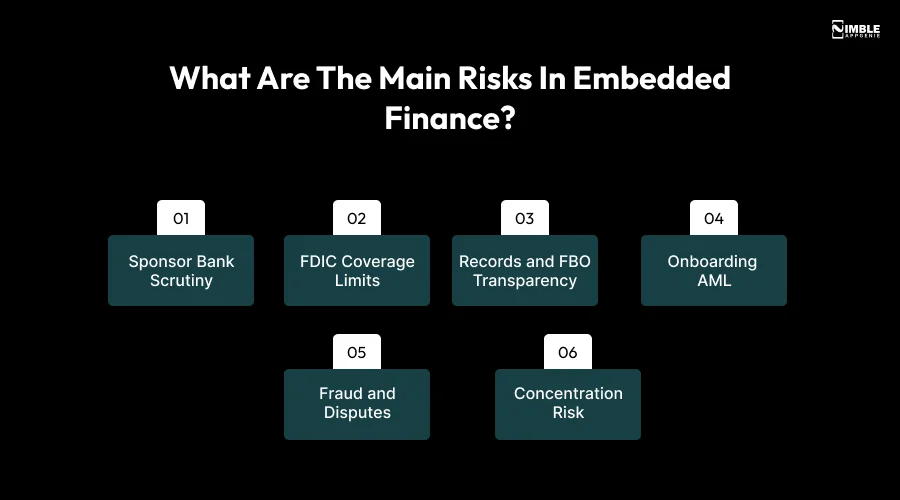
- Sponsor Bank Scrutiny: Per figures from identity firm Alloy cited by Fintech Global, since early 2024, more than a quarter of the FDIC’s formal enforcement actions, and over one in five at the OCC, have reportedly targeted sponsor banks in embedded finance partnerships.
- FDIC Coverage Limits: Deposit insurance safeguards against bank failure, not essentially against failure of a middleware provider.
- Records and FBO Transparency: After the Synapse collapse in 2024, the FDIC proposed a rule requiring banks to maintain records of beneficial owners in custodial accounts and reconcile balances routinely. Industry commentary treats robust recordkeeping as a baseline expectation whether or not the rule is finalized, so check its current status.
- Onboarding AML: Workers, sellers, and merchants need identity and business verification. See KYC and AML compliance for fintech.
- Fraud and Disputes: Customers blame the app they used. Our article on CFPB oversight rollback and fraud liability explains where fraud responsibility stands today.
- Concentration Risk: Depending on a bank or provider can end your program if they pull back. Some providers use multi-bank models to diminish this.
Regulation changes are common; see our fintech regulations guide for wider context.
Which Embedded Finance Model Should You Choose?
Most platforms should begin with a payment facilitator service or a BaaS partner, then add products as volume grows. Building your own PacFac or looking for a charter only makes sense at significant scale and with robust compliance capability.
| Model | Speed to launch | Control | Compliance load on you | Best when |
| Referral or partner link | Fastest | Low | Low | Testing demand |
| PayFac-as-a-service | Fast | Medium | Medium | Marketplace payments and payouts |
| BaaS (sponsor bank via provider) | Medium | Medium to high | Medium to high | Accounts, cards, wallets |
| Own payfac or direct bank partnership | Slow | High | High | High volume, in-house risk team |
| Multi-provider orchestration | Medium | High | Medium to high | Multi-region or redundancy needs |
Market roundups name the vendors across these categories, including Unit, Stripe, Moov, Finix, and Treasury Prime. These names are examples, not endorsements, and offerings change frequently, so evaluate current terms, enforcement history, and bank partners yourself.
Partner Due Diligence Questions
- How do you reconcile pooled FBO balances, and how often?
- Which sponsor banks do you use, and have any faced enforcement actions?
- Who handles fraud losses, chargebacks, and disputes?
- What happens to customer funds if you or the bank fail?
- Can you provide audit reports, uptime history, and a migration plan?
How Do You Launch Embedded Finance on Your Platform?
Choose one product and one partner, design onboarding and fraud controls first, and run a small pilot before expanding. A focused launch makes issues easier to identify and cheaper to fix.
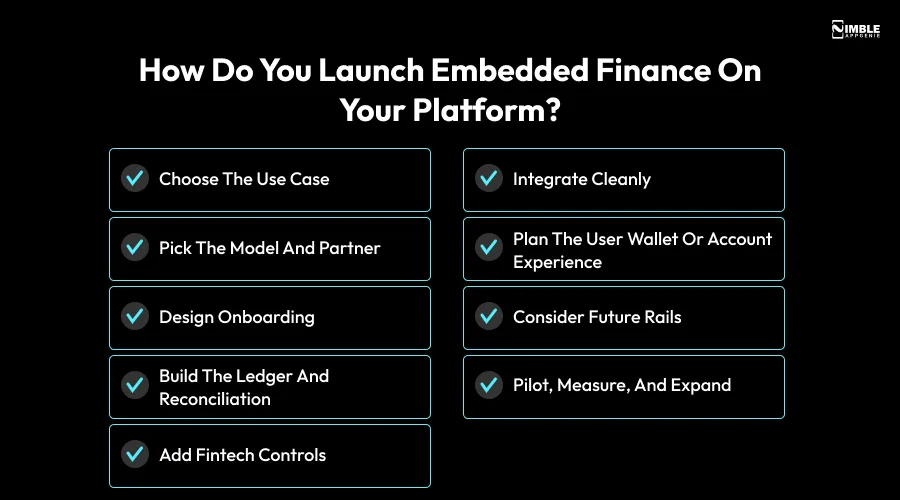
Embedded Finance Launch Checklist
- Choose the Use Case: Split payments, payouts, wallets, or cards, based on real user pain.
- Pick the Model and Partner: Use the due diligence list above and negotiate responsibilities in writing.
- Design Onboarding: KYC for individuals and KYB for businesses, with clear failure and review paths.
- Build the Ledger and Reconciliation: Keep your records aligned with the partner’s and test them regularly.
- Add Fintech Controls: Payout holds, risk scoring, and scam warnings, following our fintech security guidance, plus robust sign-in such as biometric authentication in wallets.
- Integrate Cleanly: Use well-crafted fintech API integration so you can swap providers later.
- Plan the User Wallet or Account Experience: See our eWallet app development services.
- Consider Future Rails: Stablecoin payments and cross-border flows raise new rules, covered in our GENIUS Act wallet guide and wallet interoperability.
- Pilot, Measure, and Expand: Start with a smaller seller group and track activation, support load, and failure rates.
A scoped MVP is the safest way to test demand, and our fintech app development cost guide helps with budgeting.
How Nimble AppGenie Helps Platforms Add Embedded Finance
Nimble AppGenie helps platforms and marketplaces scope, build, and integrate embedded payments, payouts, and wallet features, while keeping the architecture flexible enough to change partners later.
Our team can support you with:
- Choosing a model and planning partner integrations, including payment facilitators and BaaS providers.
- Building the user-facing wallet, payout, and account experience through eWallet app development.
- Connecting platforms, processors, and banks with clean fintech API integration.
- Launching a focused MVP to test one product before expanding.
Our work on MaxPay covers payments across 50+ countries, while Swap Africa serves 14 Francophone African countries. We don’t act as a sponsor bank or provide legal advice. We build the product layer and integrations around the licenses and partners you choose. Talk to Nimble AppGenie about your platform’s embedded finance roadmap.
Final Thoughts
Embedded finance can turn a platform into a financial hub, but the partner you choose and the controls you build matter more than the feature list. Start small, document responsibilities, keep your records, and revisit your setup as rules and bank partners change.
FAQs
It is building financial services such as payments, payouts, accounts, cards, and lending into a platform’s product using APIs and licensed partners.
Usually no. Most platforms partner with a sponsor bank, often through a BaaS or payment provider that holds the licenses. You still carry compliance, fraud, and support responsibilities.
Embedded finance is the product users see. BaaS is the infrastructure and bank partnership underneath.
A chartered bank that holds deposits, moves money, and carries regulatory responsibility for the program.
Partner failure. Regulators now expect clear fund records and tight oversight of banks and middleware, and your program depends on those partners staying healthy.

Niketan Sharma, CTO, Nimble AppGenie, is a tech enthusiast with more than a decade of experience in delivering high-value solutions that allow a brand to penetrate the market easily. With a strong hold on mobile app development, he is actively working to help businesses identify the potential of digital transformation by sharing insightful statistics, guides & blogs.
Table of Contents




No Comments
Comments are closed.